This article has been peer reviewed.
Cet article a fait l’objet d’une révision par des pairs.
Can Fam Physician 2011;57:1148-52
New spirometry interpretation algorithm
Primary Care Respiratory Alliance of Canada approach
Anthony D. D’Urzo
MD MSc CCFP FCFPItamar Tamari
MD CCFP FCFPJacques Bouchard
MDReuven Jhirad
MD CCFP FCFPPieter Jugovic
MD MSc CCFPClinical question
Is there a need for a new spirometry interpretation algorithm that contains decision-making criteria consistent with
current guidelines on asthma1 and chronic obstructive pulmonary disease (COPD)2 diagnosis?
Using spirometry to distinguish between COPD and asthma
Office spirometry provides valuable information about the relationship between flow and volume in relation to lung function and can be useful for diagnosing common conditions such as asthma and COPD.1,2 Mechanical
abnor-malities of the respiratory system can be classified as either obstructive (flow-related) or restrictive (volume-related) ventilatory defects; obstructive defects are much more common in clinical
practice. The relationship between flow and volume is described well by the ratio of the forced expiratory volume in 1 second (FEV1) to the forced
vital capacity (FVC). These measurements can be easily obtained with a simple office spirometer during a forced expiratory maneuver. The ratio of FEV1 to FVC can be useful to identify obstructive, restrictive, and
com-bined (obstructive-restrictive) defects, but it is important to recognize that total lung capacity, a more sophisticated measurement (and not the FVC),
is the best measurement to confirm a diagnosis of pulmonary restriction.3
Traditionally an FEV1-FVC ratio below 0.70 has been used to define a pure
obstructive defect if the FVC is within normal limits. Measurement of post-bronchodilator FEV1-FVC ratio is necessary to differentiate between an
acute or persistent obstructive defect and to evaluate whether reductions in the FVC are the result of hyperinflation (air trapping, where the FVC improves after bronchodilator challenge) or are related to problems in
pul-monary compliance; in the latter case, the FEV1-FVC ratio is often normal
or elevated and spirometric indices often change very little after broncho-dilator challenge.3
Current guidelines2 indicate that a spirometric diagnosis of COPD must
include an FEV1-FVC ratio that is reduced consistently below 0.70 after
bronchodilation. An interpretation algorithm currently endorsed by the Ontario Thoracic Society4 lacks these diagnostic criteria in its decision
tree; consequently, a spirometric diagnosis of COPD cannot be confirmed. Criteria for a spirometric diagnosis of asthma include an improvement in FEV1 of 12% (preferably 15%) and 200 mL after bronchodilator
chal-lenge.1 Although the FEV
1-FVC ratio might be normal in many patients
with asthma (on the basis of a normal FVC value), this does not exclude the possibility that FEV1 will improve substantially with
bronchodila-tor challenge (see case 1 below). In a currently available algorithm,4 the
finding of a normal FEV1-FVC result does not prompt further testing after
bronchodilator challenge. Differences between asthma and COPD and how the FEV1-FVC ratio can change after bronchodilator challenge are
heavily influenced by different pathophysiologic mechanisms; in asthma the FEV1-FVC ratio results can be normal or can return to normal after
bronchodilator challenge at any given time. In COPD, FEV1 is influenced
BOTTOM LINE
• An algorithm commonly promoted in
primary care is limited by its focus on using changes in forced expiratory volume in 1 second (FEV1) to distinguish asthma from
chronic obstructive pulmonary disease (COPD). The new algorithm consolidates current spirometric concepts that are consistent with both asthma and COPD guidelines.
• The new algorithm facilitates spirometric
diagnosis of COPD by focusing on postbronchodilator FEV1–forced vital
capacity ratios, and does not use changes in FEV1 after bronchodilation to separate
asthma from COPD.
pOINTs saILLaNTs
• Un algorithme communément
recommandé en soins de première ligne est limité parce qu’il est axé sur l’utilisation des changements dans le volume expiratoire maximal en 1 seconde (VEMS) pour distinguer l’asthme de la maladie pulmonaire obstructive chronique (MPOC). Le nouvel algorithme intègre les concepts spirométriques actuels qui concordent avec les guides de pratique concernant l’asthme ainsi que les MPOC.
• Le nouvel algorithme facilite le diagnostic
by permanent architectural changes, such as loss of alveolar attachments, that predispose airways to col-lapse more readily.2 Further, reductions in lung elastic
recoil often reduce FEV1 in COPD.2 These latter changes
in COPD result in a persistent reduction in FEV1. By
con-trast, asthmatic airway obstruction is determined to a great extent by factors related to bronchospasm, airway inflammation, and mucous plugs; these changes can
improve either spontaneously or in response to therapy.1
It is common for the FEV1 value to be normal in many
patients with asthma, particularly when the disease is well controlled.
Spirometric overlap between asthma and COPD
can cause confusion
Traditionally, COPD has been described as a disease characterized by fixed airflow obstruction because in many patients FEV1 values improve little after
bron-chodilator challenge. Current guidelines2 on diagnosis
and management describe COPD as a condition that is
partially reversible because some patients exhibit sub-stantial improvements in FEV1 (despite an FEV1-FVC
ratio that remains below 0.70) that compare in mag-nitude to what is observed in some asthma patients. In fact, Tashkin et al5 have shown that about 54% of
a large COPD cohort (N = 5756) exhibited an improve-ment in FEV1 values > 12% and 200 mL, while about
65% of patients had FEV1 increases > 15%. This
substan-tial overlap in FEV1 reversibility between asthma and
COPD underscores an important limitation of using this measurement to distinguish between asthma and COPD; instead we need to formulate a clinical diagnosis based on physical examination, history, and spirometric data.
An algorithm currently promoted in primary care4 is
lim-ited by its focus on using changes in FEV1 to distinguish
asthma from COPD.
New spirometry interpretation algorithm
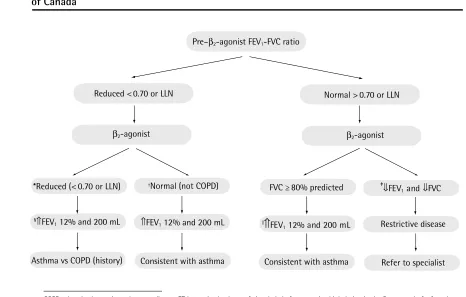
Given the limitations of the currently available algorithm,4 members of the Primary Care Respiratory
Figure 1.
Spirometry interpretation algorithm from the Primary Care Respiratory Alliance
of Canada
Pre–β2-agonist FEV1-FVC ratio
Reduced < 0.70 or LLN
β2-agonist
*Reduced (< 0.70 or LLN)
§⇑FEV
1 12% and 200 mL
Asthma vs COPD (history)
†Normal (not COPD) FVC ≥ 80% predicted ‡
⇓FEV1 and ⇓FVC
||
⇑
FEV1 12% and 200 mL Restrictive disease
Refer to specialist Consistent with asthma
⇑FEV1 12% and 200 mL
Consistent with asthma
Normal > 0.70 or LLN
β2-agonist
COPD—chronic obstructive pulmonary disease, FEV1—maximal volume of air exhaled after a maximal inhalation in the first second of a forced exhalation, FVC—maximal volume of air exhaled after inhalation during forced exhalation, LLN—lower limit of normal.
*FVC <80% predicted—perform full pulmonary function tests to rule out hyperinflation vs combined obstructive and restrictive defect. †FVC ≥80% predicted.
‡FEV
1 and FVC < 80% predicted. §The % change is calculated as (FEV
1 postbronchodilator-FEV1 prebronchodilator); FEV1 might not improve after β2-agonist challenge. FEV1 prebronchodilator
Alliance of Canada have proposed a new algorithm
(Figure 1) where spirometric diagnostic criteria for
both asthma and COPD are included and consistent with current guidelines.1,2 The new algorithm focuses
on the FEV1-FVC ratio before and after bronchodilator
challenge as a means of identifying acute or persistent airflow obstruction. This approach helps to exclude a
diagnosis of COPD quickly if the FEV1-FVC ratio returns
to normal after bronchodilator challenge. The new algorithm also includes bronchodilator challenge in
patients with a normal baseline FEV1-FVC ratio,
recog-nizing the variable nature of asthma and the possibil-ity that a normal FEV1 result could improve greatly in
response to bronchodilator challenge. The new algo-rithm also addresses the subject of reversibility as it is described in both asthma and COPD guidelines.1,2
Current COPD guidelines underscore that airflow lim-itation is only partially reversible because the FEV1-FVC
ratio does not return to normal despite improvements
in airway calibre (airflow) in many COPD patients after
bronchodilator challenge; improvements in FEV1 can
also be observed in asthma patients. The new
algo-rithm does not focus on changes in FEV1 after
broncho-dilator challenge as a means of separating asthma from COPD because of the substantial spirometric overlap between these 2 conditions. Because a clinical diagno-sis of asthma and COPD cannot be confirmed with spi-rometric data alone, Table 16 highlights historical and
physical examination data that can help differentiate asthma from COPD. This table is included because one of the decision nodes in the new algorithm leads the reader to consider asthma versus COPD. It is import-ant to consider conditions other than asthma and COPD in patients who present with respiratory com-plaints, including wheezing. It should be noted that this algorithm can be used for both adults and children, although some school-aged children might not meet international criteria for spirometry.7
Table 1. Differences between asthma and COPD
FACTORS ASThMA COPD
Influence of smoking on disease process
• no direct relationship but can adversely influence
disease control
• some asthma cases can develop into COPD after many
years of smoking
• direct relationship
Inflammation (airways) • eosinophilic • neutrophilic Reversibility of airway
obstruction
• hallmark of asthma
• airway obstruction is episodic and completely reversible in mild disease
• in chronic severe disease, only partial reversibility seen with either bronchodilator or anti-inflammatory therapy
• airway obstruction is persistent with little
or no response to bronchodilator or anti-inflammatory therapy in most patients
Age • onset often in early life: asthma is the most common
chronic disease in children
• onset in later life; often in sixth decade
Course with time • episodic • slow, insidious decline in lung function
leading to disability Role of atopy • most asthma patients are allergic to airborne allergens
such as dust mite, animal dander, pollens, molds
• uncommon
Symptoms • episodic • slowly progressive
Signs (other) • cor pulmonale never seen • cor pulmonale when disease is severe
Diffusing capacity • normal in pure asthma • often decreased; more so with
emphysema
Hypoxemia • not common but can be present in severe exacerbations • often present and chronic in advanced
disease Bronchodilator response • often marked improvements in FEV1 into the normal
range
• can be present, but FEV1 typically remains
chronically reduced Response to
corticosteroids
• often dramatic • most patients do not respond in a
clinically meaningful way Chest x-ray scan • often normal or findings of hyperinflation, which are
episodic
• can be normal
• increased bronchial markings • chronic hyperinflation (emphysema)
• useful to rule out other conditions
FEV1—maximal volume of air exhaled after a maximal inhalation in the first second of a forced exhalation, FVC—maximal volume of air exhaled after inhalation during forced exhalation, % Pred—percent of predicted normal value, Pre—prebronchodilator value, Post—postbronchodilator value. *Percent change = (FEV1 Post-FEV1 Pre).
FEV1 Pre
Figure 2.
Spirometric data for case examples
MEASUREMENT
PRE POST
% Change*
Best % Pred Best % Pred
FVC, L 3.68 88 3.99 95 8
FEV1, L 2.92 86 3.29 97 13
FEV1/FVC 79.2 82.4
MEASUREMENT
PRE POST
% Change*
Best % Pred Best % Pred
FVC, L 3.18 69 3.74 82 18
FEV1, L 1.52 44 1.88 54 24
FEV1/FVC 47.8 50.3
MEASUREMENT
PRE POST %
Change*
Best % Pred Best % Pred
FVC, L 3.54 89 3.86 97 9
FEV1, L 1.65 50 1.94 59 18
FEV1/FVC 46.7 50.3
MEASUREMENT
PRE POST
% Change*
Best % Pred Best % Pred
FVC, L 3.39 98 3.52 101 4
FEV1, L 2.17 73 2.74 92 26
FEV1/FVC 63.9 77.8
CASE 1
CASE 3
CASE 2
CASE 4
VOLUME, L VOLUME, L
VOLUME, L VOLUME, L
FLOW
, L/s
FLOW
, L/s
FLOW
, L/s
FLOW
Application to clinical practice
Four brief spirometry cases, all meeting American Thoracic Society8 criteria for acceptability and
reprodu-cibility, highlight how the new algorithm could be used as a stand-alone document to interpret spirometric data.
Case 1. The prebronchodilator and postbronchodilator FEV1-FVC ratios are 0.79 and 0.82, respectively (Figure 2),
while the FEV1 improves from 2.92 to 3.29 L after
bron-chodilation (increase of 370 mL and 13%). The new algo-rithm indicates that these data are consistent with asthma given the normal FEV1-FVC ratio and improvements in
FEV1 after bronchodilation. The patient in this case was a
45-year-old man who had never been a smoker. He had intermittent bouts of shortness of breath and chest tight-ness and normal results from cardiovascular workup. His response to asthma therapy was favourable.
Case 2. The prebronchodilator and
postbron-chodilator FEV1-FVC ratios are 0.48 and 0.50,
respectively (Figure 2). The prebronchodilator and post-bronchodilator FEV1 results are 1.52 and 1.88 L,
respec-tively (increase of 360 mL and 24%). The new algorithm recognizes the reduction in FEV1-FVC ratio before
bron-chodilator use, but the postbronbron-chodilator FEV1-FVC ratio
is evaluated to determine whether there is a combined defect of obstruction and restriction or hyperinflation. Given that the FVC increased to more than 80% of the predicted value with bronchodilation, it becomes clear that hyperinflation contributed to the reduced prebroncho-dilator FVC measurement. Because the postbronchoprebroncho-dilator FEV1-FVC ratio remains below 0.70 and the FEV1
revers-ibility criterion is met,1 the clinician is led to differentiate
asthma from COPD using historical data (Table 1).6 The
patient in this case is a 73-year-old man with a 40-pack-year smoking history, no allergies to environmental fac-tors, and a history of progressive shortness of breath over the past 10 years. The medical history and family history were otherwise unremarkable for asthma risk factors. The historical and spirometric data in this case are con-sistent with a clinical diagnosis of COPD.
Case 3. The prebronchodilator and postbronchodilator FEV1-FVC ratios are 0.47 and 0.50, respectively (Figure
2). The prebronchodilator and postbronchodilator FEV1
values are 1.65 and 1.94 L, respectively (increase of 290 mL and 18%). The new algorithm recognizes the reduced FEV1-FVC ratio and the reversibility in FEV1
after bronchodilation and guides the clinician to dif-ferentiate asthma from COPD on the basis of historical factors as well (Table 1).6 The patient in this case is a
36-year-old woman who has never been a smoker. She has numerous environmental allergies and has severe asthma that is well controlled on maintenance therapy. Cases 2 and 3 highlight the spirometric overlap between
asthma and COPD and the limitations of using FEV1
reversibility to help distinguish asthma from COPD.
Case 4. The prebronchodilator and postbronchodilator FEV1-FVC ratios are 0.64 and 0.78, respectively (Figure
2). The prebronchodilator and postbronchodilator FEV1 values are 2.17 and 2.74 L, respectively (increase of 570 mL and 26%). The new algorithm quickly excludes a spirometric diagnosis of COPD on the basis of the
normal postbronchodilator FEV1-FVC value, and the
increase in FEV1 would be consistent with a spirometric
diagnosis of asthma. This case underscores the
impor-tance of using the postbronchodilator FEV1-FVC ratio to
exclude COPD. The patient in this case is a 19-year-old boy with a history of childhood asthma and β2-agonist
use increasing over several months. In the new algo-rithm, the central focus on postbronchodilator FEV1 -FVC ratio will allow the person interpreting spirometric data to quickly exclude a spirometric diagnosis of COPD in many patients if the ratio returns to normal. In such patients, improvement in FEV1 (increase of 12% and
200 mL)1 is used to establish a spirometric diagnosis of
asthma. This approach minimizes the risk of disease misclassification. Because spirometry can be used only to identify and differentiate between obstructive and restrictive ventilatory defects, historical and physical examination data are essential for establishing a clinical diagnosis (Table 1).6 This process can be quite
reward-ing for clinicians who are comfortable with interpreta-tion of spirometry data.
Dr D’Urzo is Associate Professor, and Drs Jhirad and Tamari are Lecturers, all in the Department of Family and Community Medicine at the University of Toronto in Ontario. DrBouchard is Associate Professor of Clinical Medicine at Laval University, Head of the Department of Medicine at Centre hospitalier de la Malbaie, and a family physician in La Malbaie, Que. Dr Jugovic is Lead Hospitalist in the Department of Family Practice at Toronto East General Hospital. All authors are members of the Primary Care Working Group of the Primary Care Respiratory Alliance of Canada.
Acknowledgment
We thank Deborah D’Urzo, Devra D’Urzo, and Vasant Solanki for their valu-able assistance in preparing this manuscript.
competing interests
None declared
References
1. National Heart, Lung, and Blood Institute National Asthma Education and Prevention Program. Expert panel report 3: guidelines for the diagnosis and management of asthma. NIH Publications No. 07-4051. Washington, DC: US Department of Health and Human Services; 2007.
2. O’Donnell DE, Aaron S, Bourbeau J, Hernandez P, Marciniuk D, Hodder R, et al. Canadian Thoracic Society recommendations for management of chronic obstructive pulmonary disease-2007 update. Can Respir J 2007;14(Suppl B):5B-32B. 3. Wanger J, Clausen JL, Coates A, Pedersen OF, Brusasco V, Burgos F, et
al. Standardization of the measurement of lung volumes. Eur Respir J 2005;26(3):511-22.
4. Spirometry in primary care [CD-ROM]. Toronto, ON: The Lung Association; 2007. 5. Tashkin DP, Celli B, Decramer M, Liu D, Burkhart D, Cassino C, et
al. Bronchodilator responsiveness in patients with COPD. Eur Respir J 2008;31(4):742-50. Epub 2008 Feb 6.
6. D’Urzo AD. Differentiating asthma from COPD in primary care. Ont Thorac Rev 2001;13(1):1-7.
7. Arets HG, Brackel HJ, van der Ent CK. Forced expiratory manoeuvres in children: do they meet ATS and ERS criteria for spirometry? Eur Respir J 2001;18(4):655-60.