Geppetto: Versatile Verifiable Computation
Craig Costello
[email protected]
Microsoft Research
C´edric Fournet
[email protected]
Microsoft Research
Jon Howell
[email protected]
Microsoft Research
Markulf Kohlweiss
[email protected]
Microsoft Research
Benjamin Kreuter
[email protected]
University of Virginia
∗Michael Naehrig
[email protected]
Microsoft Research
Bryan Parno
[email protected]
Microsoft Research
Samee Zahur
[email protected]
University of Virginia
∗November 2014
Abstract
Cloud computing sparked interest in Verifiable Computation protocols, which allow a weak client to securely outsource com-putations to remote parties. Recent work has dramatically re-duced the client’s cost to verify the correctness of results, but the overhead toproduceproofs largely remains impractical.
Geppetto introduces complementary techniques for reducing prover overhead and increasing prover flexibility. With Multi-QAPs, Geppetto reduces the cost of sharing state between com-putations (e.g., for MapReduce) or within a single computa-tion by up to two orders of magnitude. Via a careful instantia-tion of cryptographic primitives, Geppetto also brings down the cost of verifying outsourced cryptographic computations (e.g., verifiably computing on signed data); together with Geppetto’s notion of bounded proof bootstrapping, Geppetto improves on prior bootstrapped systems by five orders of magnitude, albeit at some cost in universality. Geppetto also supports qualitatively new properties like verifying the correct execution of propri-etary (i.e., secret) algorithms. Finally, Geppetto’s use of energy-saving circuits brings the prover’s costs more in line with the program’s actual (rather than worst-case) execution time.
Geppetto is implemented in a full-fledged, scalable compiler that consumes LLVM code generated from a variety of apps, as well as a large cryptographic library.
1
Introduction
The recent growth of mobile and cloud computing makes out-sourcing computations from one party to another increasingly attractive economically. Verifying the correctness of such out-sourced computations, however, remains challenging, as does maintaining the privacy of sensitive data used in such compu-tations, or even the privacy of the computation itself. Prior
∗Microsoft Research Intern
work on verifying computation focused on narrow classes of computation [36,57], relied on physical-security assump-tions [45,52,54], assumed uncorrelated failures [21,22,40], or achieved good asymptotics [3,32,32,34,35,37,42,48] but impractical concrete performance [51,56].
Recently, several lines of work [10, 51, 55, 58] on veri-fiable computation [32] have combined theoretical and engi-neering innovations to build systems that can verify the re-sults of general-purpose outsourced computations while mak-ing at most cryptographic assumptions. Currently, the best performing, fully general-purpose verifiable computation pro-tocols [51, 55] are based on Quadratic Arithmetic Programs (QAPs) [33]. To provide non-interactive, publicly verifiable computation, as well as zero-knowledge proofs (i.e., compu-tations in which some or all of the worker’s inputs are private) recent systems [4,8,10,11,18,27,43,61] have converged on the Pinocchio protocol [51] as a cryptographic back end. Pinoc-chio, in turn, depends on QAPs.
While these protocols have made proof verification nearly practical, the cost togeneratea proof remains a significant bar-rier to practicality. Indeed, most applications are constrained to small instances, since proof generation costs 3-6orders of magnitudemore than the original computation.
With Geppetto1, we introduce a series of interlocked tech-niques that support more flexible, and hence more efficient, provers. These techniques include MultiQAPs for sharing state between or within computations, efficient embeddings for ver-ifying cryptographic computations, bounded bootstrapping for succinct proof aggregation, and energy-saving circuits to ensure that the prover’s costs grow with actual execution time, rather than worst-case execution time.
In more detail, we first generalize QAPs to createMultiQAPs, which allow the verifier (or prover) to commit to data once and then use that data in many related proofs. For example, the
prover can commit to a data set and then use it in many differ-ent MapReduce jobs. At a finer granularity, we show how to use MultiQAPs to break an arithmetic circuit up into many smaller, simpler circuits that can verifiably and efficiently share state. Today, compiling code from C to a QAP typically requires un-rolling all of the loops and inlining all of the functions, leading to a huge circuit full of replicated subcircuit structures. Since key size, and key and proof generation time all depend linearly (or quasilinearly) on the circuit size, this blowup severely de-grades performance. With MultiQAPs, instead of unrolling a loop a hundred times, we can create a single circuit for the loop body and then use MultiQAPs to efficiently connect the state at the end of each iteration of the loop to the input of the next itera-tion. This allows us to shrink key size and key generation time, and, more importantly, to save the prover time and memory. Prior work suggested achieving similar properties via Merkle hash trees [9, 14, 30,33,47], but implementations show that this approach increases the degree of the QAP by tens or hun-dreds per state element [10,18,61], whereas with MultiQAPs, the degree increases only by 1.
Second, we show how a careful choice of cryptographic primitives significantly improves the efficiency of generating proofs ofcryptographiccomputations. Such computations arise in many outsourcing applications. For instance, a MapReduce job may need to compute over signed data, or a customer with a smart meter may wish to privately compute a bill over signed readings [53]. As another example, recent work [8,27] shows how to anonymize Bitcoin transactions using Pinocchio [51] and would benefit from the ability to verify signatures within Bitcoin transactions. In existing QAP systems, computations take place over a small (e.g., 254-bit) field, so computing cryp-tographic operations requires an awkward and inefficient em-bedding of the cryptographic machinery via either a BigInte-ger library built out of field elements or via large extension fields [27]. With our techniques, all of these examples can be naturally and efficiently embedded into a proof of an outsourced computation.
With MultiQAPs, the prover generates multiple proofs about related data. This improves flexibility and performance for the prover, but it degrades an attractive feature of Pinocchio, in which the proof consisted of a (tiny) constant-sized proof, and the verifier’s work scaled only with the IO.
As a third contribution, we combine our MultiQAPs and cryptographic embeddings to obtain MultiQAPs with constant-sized proofs viabounded proof bootstrapping. In theory, with proof bootstrapping [12,59], the prover can combine any series of proofs into one constant-sized proof by verifiably computing the verification of all of those proofs. Very recent work ele-gantly achieves unbounded proof bootstrapping [10], but this generality comes at a cost (§5). Our bounded proof bootstrap-ping shows that, as with semi-homomorphic vs. fully homomor-phic encryption, if we pragmatically set a bound on the number of proofs we intend to bootstrap, we can achieve more prac-tical performance. Moreover, by considering (bounded or un-bounded) bootstrapping in the context of our cryptographic em-bedding techniques, we show how to efficiently outsource com-putations where the computation itself is hidden from the
veri-fier. For example, a patient might verify that a trusted authority (say the US FDA) signed the code for a medical-data analysis, and that the analysis was correctly applied to the patient’s data, without the patient ever learning anything about the proprietary analysis algorithm.
Lastly, just as MultiQAPs eliminate the prover redundancy that comes from code repetition (e.g., in the form of loops or function invocations), we introduce the notion of energy-saving circuitsto eliminate the redundant work that arises from code branching. In the standard approach to compiling code to QAPs, the prover devotes considerable effort to proving the cor-rectness of unused portions of the circuit. For example, in an if-else statement, the prover must perform computations for both the if and the else block. With energy-saving circuits, the prover only exerts cryptographic effort for the actual path taken (e.g., only the if block when the condition is true). While energy-saving circuits are generally useful, they are particularly benefi-cial when using bounded proof bootstrapping to condense many proofs from a MultiQAP. Such proof compaction requires the key generator to commit, in advance, to the number of proofs to be combined. With energy saving circuits, the key generator can choose a large number, and if a particular computation re-quires fewer proofs, the prover only performs cryptographic op-erations proportional to the number of proofs used, rather than the maximum chosen by the key generator.
We have implemented Geppetto as a complete toolchain for verifying the execution of C programs and plan to make the code available. Geppetto includes a compiler in F#, a crypto-graphic runtime in C++, and QAP-friendly libraries in C. Our compiler takes as input LLVM code produced by clang, a main-stream state-of-the-art optimizing C compiler; this enables us to focus on QAP-specific compilation. The compiler provides ex-plicit, low-level control for programming MultiQAPs, allowing the C programmer to dictate how state flows from one QAP to another and hence control the resulting cryptographic costs. It also provides higher-level C libraries for common programming patterns, such as MapReduce or loops.
2
Geppetto Overview
In this section, we give a formal but abstract description of Gep-petto’s main constructions, deferring cryptographic definitions to§3and our protocol to§4.
We first explain how we share state between computations via MultiQAPs, beginning with an intuitive overview (§2.1). We then formalize related computations using a schedule of related proofs (§2.2) where the intermediate state can be represented compactly via acommit-and-prove(CP) scheme (§2.3). Next, we design an efficient MultiQAP-based CP system (§2.4). Fi-nally, we turn to proofs for cryptographic operations and boot-strapping (§2.5), and to energy-saving circuits (§2.6).
2.1
MultiQAP Intuition
X
Y
Z
Z Y
X
Y
...
buses YX
Z
(a) (b) (c)
Figure 1: MultiQAPs(a) Most existing verifiable computation sys-tems compile programs to a single large circuit representation, lead-ing to internal redundancy. (b) By extractlead-ing common substructures, we can represent the program as a smaller collection of circuits, but the verifier must now laboriously check all of the internal IO between these circuits. (c) MultiQAPs connect circuits with abusstructure that supports a succinct and efficient commitment to the bus values.
a tuple of parameters for P. Cryptographers refer to P as a language, and u an instance. Programmers may seeP(u)as a trace-property, e.g., interpretinguas a valid input-output se-quence obtained by running a program whose specification is captured byP. AsPgrows to encompass larger and more com-plex functionality, the CPU and memory costs for the prover (as well as key size) increase linearly or worse. As§7.2shows, this limits prior systems to modest application parameters.
To scale to larger problems, we can decompose the proof ofP into a conjunction of proofs ofmsimpler propertiesP0,...,Pm−1. Figure1illustrates this decomposition in the context of circuits. The decomposition may follow the structure of the source pro-gram; for instance, onePimay prove the correct execution of a single function call, or a single loop iteration in the program. The whole proof then consists ofnproof instances, since it may include multiple instances of each propertyPi, with the various instances potentially sharing some of their parameters; e.g., the result of one loop iteration may be passed as the input for the next iteration. §2.2defines the notations used in the rest of the paper for scheduling proofs and sharing parameters.
While proof decomposition aids prover scalability, used naively, it destroys the verifier’s performance. In other words, if the prover simply uses Pinocchio to prove the correctness of eachPiinstance, then he must send all of the computation’s in-termediate values back to the verifier, so that she could check, e.g., that the prover correctly transferred the output of onePi to the input of the next. Handling so much intermediate state would make it difficult or impossible for the verifier to “win” from outsourcing.
To avoid placing this burden on the verifier, we will build a non-interactive commit-and-prove scheme [20,28,41], i.e., a scheme in which the prover can supply a short commitment to intermediate values and prove multiple statements about the
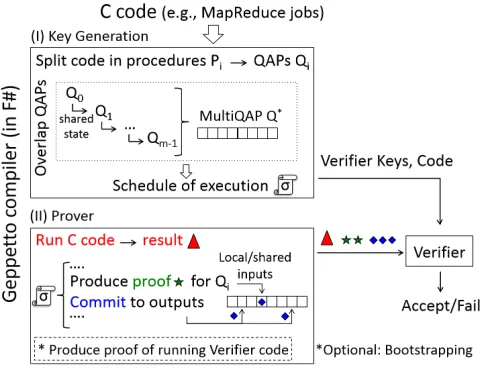
Figure 2:Overview for§2. Geppetto’s compiler runs in two phases: (I) Key generation phase splits the code into properties (procedures) that are later expressed as Quadratic Arithmetic Programs (QAPs). A MultiQAPQ? is then produced by overlapping the QAPs to cre-ate buses for sharing stcre-ate. The compiler also produces a scheduleσ
specifying which bank, including locals, inputs and outputs, should be included at each step. Finally, key generation also produces keys for the prover and verifier as well as the verifier code. (II) The prover exe-cutes the program to create variable assignments for the MultiQAPQ?
and its buses according to the schedule. In each step, the prover gener-ates a proof for the sub-QAPQi, whereiis specified in the schedule,
and commits to any outputs produced byQi. The verifier verifies the
proofs as well as the commitments. ∗In addition, for bootstrapping compile the verifier’s code and prove correct verification such that the top-level verifier is left to verify only the latter.
committed values. §2.3gives a more formal definition. Our commitments optionally offer privacy, meaning that the com-mitted values are hidden from the verifier.
Instead of building expensive commitments atop existing pro-tocols as in prior work [18], in §2.4, we show how to build shared stateinto a generalization of the underlying QAP rep-resentation, which we callMultiQAPs, hence making commit-ments nearly free.
In more detail, we use Pinocchio’s techniques to express each Pias a Quadratic Arithmetic Program (QAP)Qi, a format suit-able for succinct cryptographic proofs. To share state between individualQi, a single MultiQAPQ?combines theQiwith one or morebuses, each carrying some number of values. Each of its sub-QAPs can “tap into” a bus to write or read the bus value. In our cryptographic instantiation, writing to the bus corresponds to generating a commitment for the corresponding portion of the MultiQAP, while reading the bus corresponds to including the commitment in the proof for the sub-QAP. Connecting the QAPs via buses lets us use asingleinstance of our commit-and-prove scheme forQ?forallproof schedules over(Qi)i∈[m], with the capability to share compact, potentially private com-mitments between their proofs (rather than large collections of parameters in plaintext) without significantly increasing the prover’s costs.
2.2
Scheduling Proofs With Shared State
Multi-Proof Systems To scale prover performance, we de-compose instances of single, complex properties P into con-junctions of related instances of simpler properties(Pi)i∈[m]of the form
P(u0)
4
=∃u1.
^
(i,t)∈σ
Pi(ut)
whereσis a ‘schedule’, that is, a set of pairs(i,t)withithe in-dex of the simpler property to use, andta vector selecting vari-ables fromu0,u1. Crucially, the properties Pi may thus share intermediate worker variables.
For instance, we may decompose the Boolean function P(u,r)=4 r= f(g(f(u)))into
P0(u,r)
4
=r=f(u) P1(u,r)
4
=u=g(r)
and the 3-proof schedule σ = (0,(u1,r1));(1,(u2,r1));
(0,(u2,r2)), since we have P(u1,r2) ⇔ ∃r1u2.P0(u1,r1)∧
P1(u2,r1)∧P0(u2,r2).
Banks In the following, we group the variables of a property into pairwise disjoint sets that we callbanks. We letIindicate a bank, and letIrange over tuples of banks. Hence,P(I)specifies a property and a partition of its variables.
For instance, assuming P is compiled from the function int f(int u[ρu]) we may use banksI
4
=Iu,Ir whereIr
4
={r} andIu
4
={u0, . . . ,uρu−1}.
We consider compound proofs that share multiple instances of each bank. Formally, we define these instances by variable renaming: given a bank I=4 {u0, . . .uρI−1}, we define a
se-quence of pairwise-disjoint instancesIt =4 {ut0, . . . ,utρ
I−1} for
t≥1. (We reserve the use oft=0 for the instance that assigns the constant 0 to every variableukofI.)
We define proof schedules as follows.
Definition 1 (Multi-proof schedule) Aschedule σis a series of steps (i,t)where i∈[m]indicates a property Pi and tis a
tuple of integers, one for each bank of Pi. We define n
4
=|σ|as the length of the schedule.
Aproofforσconsists of (1) a proofπfor each step, and (2) for each bank, the values for the variables for every non-zero index t that appears inσ.
Intuitively, in each step (i,t) of a schedule,iindicates which Pithe prover must prove (or the verifier must verify), and each
t∈tindicates which values the verifier should use for each bank I∈Iithat parameterizePi, witht=0 indicating that all its vari-ables are set to zero.
2.3
Commit-and-Prove (CP) Systems
Rather than transmit intermediate state to the verifier, a commit-and-prove scheme [20, 28,41] allows the prover to generate short commitments to the state and then prove multiple state-ments about the committed values.
We give formal cryptographic definitions and proofs in §3, but abstractly, a CP scheme introduces a (keyed)CommitI(u)
algorithm for committing to the valuesuin bankI, and aVerify algorithm that takes a list of commitments to variable values, and a proof, and outputs a Boolean indicating whether the val-ues represented by the commitments are consistent with the proof. As we prove in§3, we can use a CP scheme to verify an execution following a proof schedule as defined in Defini-tion1.
To make this more concrete, we return to our earlier example (§2.2) of provingP(u,r)=4 r= f(g(f(u)))via decomposition into scheduleσ. The schedule breaksPinto three steps:
P(u1,r2) =∃r1,u2 : r1=f(u1)∧u2=g(r1)∧r2=f(u2)
To generate a proof for this schedule the prover could compute commitments to the intermediate valuesr1andu2:
Cr,1←Commitr(r1) Cu,2←Commitu(u2)
along with proofsπi proving that f and g are computed cor-rectly, and the verifier would check:
Vσ(u1,r2,Cr,1,Cu,2,π0,π1,π2) = letCu,1=Commitu(u1) letCr,2=Commitr(r2)
Verify0(Cu,1,Cr,1,π0)∧
Verify1(Cu,2,Cr,1,π1)∧
Verify0(Cu,2,Cr,2,π2)
whereVerifyiis a specialization of the verification function that checks proofs relating to propertyPi.
Pinocchio as a CP Scheme We note that Pinocchio can be viewed as a very restricted commit-and-prove system for a single QAP Q, in the sense that Pinocchio proves: P(u)=4
∃ω.Q(u,ω)whereuare function inputs and outputs,2andωare intermediate local variables for the prover. Instead of sendingω to the verifier, the Pinocchio prover computes and sends a sin-gle, digestCωof their values, and a proofπthatu,ωis a solution
forQ. As evidence ofP(u), the verifier receives(Cω,π)whose
size is independent ofQ. IfV(u,Cω,π)is true, then the verifier
has the (computational) guarantee that∃ω:Q(u,ω), and hence P(u). As a bonus feature, bothCωandπare perfectly hiding,
meaning that they do not convey any information aboutω.
2.4
An Efficient CP System from MultiQAPs
To build an efficient, general-purpose commit-and-prove scheme, we generalize Pinocchio’s QAPs into MultiQAPs.
Quadratic Programs Abstractly, Pinocchio compiles proper-ties of interest to equations of the form
Q(u)=4 ^
r∈[d]
(vr·u)(wr·u) = (yr·u)
whereuis a vector of variables that range over some large, fixed prime fieldFp, and where the vectors vr, wr, yr each define
linear combinations over the variablesu. We say thatQhas size ρ=4 |u|and degreed. Equivalently, Qmay be seen as three d×ρ matrices in Fp, i.e., V
4
= (vr)r∈[d], W= (4 wr)r∈[d], and Y= (4 yr)r∈[d].
Geppetto One of our main contributions is an extension of Pinocchio that lets us prove any property P scheduled from
(Pi)i∈[m]using a matching sequence of proofs for their quadratic specifications(Qi)i∈[m].
To this end, we provide a new, generic reduction from sched-ules usingmquadratic programs of degreed to schedules us-ing a sus-ingle quadratic programQ? of degreed+|s|, wheres includes all intermediate variables shared between those speci-fications. By choosing a decomposition fromPto(Pi)i∈[m]that exploits the structure ofP, most intermediate variables are local to onePi, so we typically achieve|s|<<d.
Overlapping Quadratic Programs To share state between individualQi, the MultiQAPQ? supports one or morebuses, each carrying some number of field values. Each sub-QAP can “tap into” a bus to write or read the bus value. In our crypto-graphic instantiation, writing to the bus corresponds to generat-ing a commitment for the correspondgenerat-ing portion of the Multi-QAP, while reading the bus corresponds to including the com-mitment in the proof for the sub-QAPs as detailed in our adap-tation of the Pinocchio protocol in§4.2.
LetIbe a series of pairwise-disjoint banks, including some distinguished shared banks we callbusesS⊆I.
Let Qi(Ii) for i=0..m−1 a series of quadratic programs, each of degree at mostd, such that we haveIi⊆Ifor alliand Ii∩Ij⊆Sfor all i6= j. (The first condition guarantees thatI collects all the banks; the second thatScollects the buses.)
Let I0i be the tuple of banks obtained from Ii by replacing eachI∈S∩IiwithIi0
4
={ci|c∈I}(using variablescithat do not occur inI). LetI0be their concatenationI00, . . . ,I0m−1, and let I?=4 I0,S, still a concatenation of pairwise-disjoint banks. Intu-itively,I?contains one additional local copyIi0of each shared busI∈Sfor eachQithat uses it.
Recall that each program is of the form
Qi(Ii) =
^
r∈[d]
(vi,r·Ii)(wi,r·Ii) = (yi,r·Ii).
whereρi
4
=∑I∈Ii|I|is the size ofQi. For eachr, we letv 0
rbe the vector concatenation v0,r, . . . ,vm−1,r, and similarly forw0r andy0r.
We define one quadratic programQ?that ‘overlaps’ theQis,
Q?(I?)=4 ^
r=0..d−1
(v0r·I0)(w0r·I0) = (y0r·I0)∧ ^
I∈S,c∈I
∑i|I∈Iici=c
of degreed+∑I∈S|I|and size∑I∈I|I|+∑I∈S,i|I∈Ii|I|.
RepresentingQ?as matricesV,W,Y, we can assemble them from those of theQis, diagonal matrices1?i with a 1 for every variable ofQi shared inS and 0s elsewhere, and the identity matrix1of size∑I∈S|I|.
V=4
V0 . . . Vm−1 0
0 . . . 0 0
Y=4
Y0 . . . Ym−1 0 1?0 . . . 1?m−1 −1
withd+∑I∈S|I| rows and∑i∈[m]ρi+∑I∈S|I|columns. (We omitW, built asV.)
Pragmatically, our compiler representsQ?implicitly from the Qis. The degree ofQ?is not (much) higher that those of theQis. Next, we translate proof schedules σ over (Qi)i=0..m−1 to proof schedulesσ?overQ?. We replace each instance(i,t)∈σ with an instance(0,t?)for Q? wheret?is defined as follows: for banksI∈Ii, we use the corresponding index fromt; for lo-cal copies of buses inI0i, we use a fresh index (that is, the bank instance is used only once in the whole schedule); for all other banks, we use the special index 0, indicating a constant, all-zero instance.
Definition 2 (Valid schedule) A schedule is valid if all re-peated non-zero indexes belong to buses, i.e. all other indexes are fresh.
Note thatσ∗is valid by construction, but we will give theorems for arbitraryvalidschedules.
Our next lemma states that every property proved byσover
(Qi)i=0..m−1can also be proved byσ?overQ?.
Lemma 1 (Overlapping Quadratic Programs) For every scheduleσover quadratic programs(Qi(Ii))i=0..m−1, we have
^
(i,t)∈σ
Qi(Iti) ⇔
^
(i,t?)∈σ?
∃I?t?\Iti.Q?(I?t?)
where, on the right-hand-side,t?is the translation oftandI?t?\ It
iprovides a local copy of each shared bus used inQi.
Proof. By induction on the length of the schedule. For each
(i,t)∈σ, we verify thatQi(Iti)⇔ ∃I?t ?
\It.Q?(I?t?). Following the definition ofQ?,
• Each of the shared-variable equations is justci=csince
cj=0 for any j6=i.
• Each of the inner products(v0r,0)·I?t? is justv
i,r·Iti since every coefficient for j6=iis multiplied by 0 andci=cfor every shared variable inIi0. (And similarly forv0randy0r.)
2.5
Verifiable Crypto and Bootstrapping Proofs
In theory, we should be able to verify cryptographic tions (e.g., a signature verification) just like any other computa-tion. In practice, as discussed in§1, a naive embedding of cryp-tographic computations into the fieldFp that our MultiQAPs operate over leads to significant overhead. In§5we show how a careful choice of cryptographic primitives and parameters al-lows us to build a large class of crypto operations (e.g., signing, verification, encryption) using elliptic curves built “natively” on
Fp. This makes it cheap to, for example, verify computations on signed data, since the data and the signature both “live” inFp.
else circuit
inputs
×
outputs
+
+
+
+
if circuit
1-cond cond
×
elsecircuit
inputs
×
outputs
+
+
+
+
if circuit
1-cond cond
×
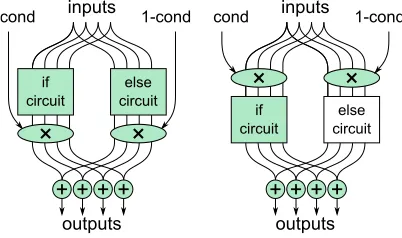
Figure 3: Energy-Saving Circuits. Moving the multiplex step can nullify expensive crypto operations, since at runtime, in one of the two circuit blocks, every wire inside takes on the value zero.
evidence—and the verifier costs—grow linearly with the num-ber of commitments and proofs. While often acceptable in prac-tice, these costs can be reduced to a constant by using another instance of our CP scheme to outsource the verification of all of the cryptographic evidence according to a target proof schedule. More formally, letVσ?(u0,C,Π)be the property that a sched-uled CP proof cryptographically verifies, where CandΠ are the vectors of commitments and proofs used in the schedule σ?. We recursively apply Geppetto to generate a quadratic pro-gramQσ? forVσ?. This yields another, more efficient verifier
Vσ◦?(u0,C◦,π◦)with a single, constant-sized commitmentC◦to C,Π, and all intermediate variables used to verify them accord-ing toσ?, and with a single constant-sized proofπ◦ to verify, now in constant time.
We further observe thatVσ◦? need not be limited to just veri-fying the execution ofVσ?, as in traditional bootstrapped
proto-cols [12,59]. For example, suppose an authority the client trusts (e.g., the US FDA) cryptographically signs the verification keys forVσ?, and we defineVσ◦? to first verify the signature on the
keys before using them to runVσ?. If we use Geppetto’s option
to make commitments and proofs perfectly hiding, then the ver-ifier checks a constant-sized proof and learns that a trusted algo-rithm (for example, a medical diagnosis) ran correctly over her data, but she learns nothing about the algorithm. Thus, we can verifiably outsource computations with proprietary algorithms.
Although the general idea of bootstrapping is well-known in principle [12,59], its practicality relies on careful cryptographic choices to support an efficient embedding. Recent work sug-gested an embedding that supports bootstrapping an unbounded number of proofs but this generality comes at a significant cost (§5). In§5, we propose a more pragmatic embedding that sup-ports only a bounded number of proofs but achieves signifi-cantly better performance.
2.6
Energy-Saving Circuits
A limitation of existing verifiable computation systems is that representing a computation as a quadratic program (informally, a circuit) results in a program whose size reflects the worst-case computational resources necessary over all possible inputs. For instance, when branching on a runtime-value, the prover needs to interpret and prove both branches then join their results. Con-cretely, the commandif(b) {x = y} else {x=2*z} is
ef-fectively compiled asx = 2z + b*(y-2z), as shown generi-cally in the left side of Figure3. Similarly, if a loop has a static bound ofNiterations, the prover must perform work for allN, even if the loop typically exits early. With many branches, the resulting verifiable-computation tree may be much larger than any path in the tree, representing a verified program execution.
Ideally, we would like to “turn off” parts of the circuit that are not needed for a given input, much the same way hardware circuits can power down parts not currently in use. Geppetto achieves this by observing that in our cryptographic protocol, there is no cryptographic cost for QAP variables that evaluate to zero. Thus, if at compile-time we ensure thatall intermedi-ate variables for the branch evaluintermedi-ate to 0 in branches that are not taken, then at run-time there is no need to evaluate those branches at all. The right side of Figure 3 shows an exam-ple of how we achieve this for branches by applying the con-dition variable to the inputsof each subcircuit, rather than to the outputs. Thus, in contrast with prior system, the prover only does cryptographic work proportional to the path actually taken through the program.§6.4explains how our compiler produces energy-saving circuits, while§7.4quantifies the significant sav-ings we recoup via this technique.
3
Defining Proof Composition
We now give formal cryptographic definitions for the concepts introduced in§2, deferring our concrete protocol to§4.
3.1
Commit-and-Prove Schemes
Since we are interested in succinct proofs, we modify earlier definitions of commit-and-prove schemes [20,28,41] to only consider computationally bounded adversaries. As a succinct commitment implies that more than one plaintext maps to a given commitment value, an unbounded adversary can always “escape” the commitment’s binding property.
In the following, we refer to representations of variable val-ues asdigests. Each digestCj, may hide the values it represents via randomness oj. Without hiding, we use a trivial opening
oj=0 (and may omit it). We require that all digests of bus values be binding, and hence specifically refer to them as com-mitments. In contrast, digests used only in a single proof need not be binding.
As a side note, while Geppetto uses commit-and-prove schemes to prove properties, such schemes also enable interac-tive protocols where values are committed before being opened and/or used to prove statements about them. For instance, they easily integrate with existing Σ-protocols as employed by pro-tocols such as anonymous credential systems [6,19].
Definition 3 (Succinct Commit-and-Prove)
Consider a family of polynomial-time verifiable relations
{
R
λ}λ∈Non tuplesuof a fixed length`.A succinct commit-and-prove scheme
P
= (KeyGen =(KeyGen1,KeyGen2),Commit,Prove,Verify) for {
R
λ}λ∈N• Key generation is split into two probabilistic algorithms:
τ←KeyGen0(1λ)takes the security parameterλas input
and produces a trapdoor τ= (τS,τE)(independent of R and consisting of a simulation and extraction component).
(EK,VK)←KeyGen1(τ,R)takes the trapdoor and a rela-tion R∈
R
λas input and produces a public evaluation keyEK and a public verification key VK. To simplify notation, we assume that EK includes a copy of VK, and that EK and VK include digest keys EKjand VKjfor j∈[`]. • Cj←Commit(EKj,uj,oj): Given an evaluation key for j,
message uj, and randomness oj, the deterministic
commit-ment algorithm produces a digest Cjto uj.
• π←Prove(EK,u,o): Given an evaluation key, messages u∈R, and openingso, the deterministic prove algorithm returns a succinct proofπ; i.e.,|π|ispoly(λ).
• {0,1} ←Verify(VKj,Cj): Given a verification key for j,
the deterministic digest-verification algorithm either re-jects (0) or accepts (1) the digest Cj.
• {0,1} ←Verify(VK,C,π): Given a verification key and` digests, the deterministic verification algorithm either re-jects (0) or accepts (1) the proofπ.
Proof-verification guarantees apply only when all digests have been either honestly generated or verified.
Besides correctness, we define the security requirements of CP schemes.
Definition 4 (Correctness) The commit-and-prove scheme
P
is perfectly correct for the`-ary relation family{
R
λ}λ∈Nif forall R∈
R
λ, allu∈R and allofrom the randomness space:Pr[ (EK,VK)←KeyGen(1λ,R):
Verify(VKj,Commit(EKj,uj,oj)) ] =1. Pr[ (EK,VK)←KeyGen(1λ,R);
Cj←Commit(EKj,uj,oj)for each j∈[`]:
Verify(VK,C,Prove(EK,u,o)) ] =1. We require that digests shared across multiple proofs (i.e., those representing bus values) be binding, meaning the prover cannot claim the digest represents one set of values in the first proof and a different set of values in the second proof. We col-lect the indexes of their keys in what we call thebinding digest subset S⊂[`].
Definition 5 (Binding) The commit-and-prove scheme
P
is binding for relation family {R
λ}λ∈N and binding digestsub-set S⊂[`], if for all efficient
A
and any R∈R
λ,Pr[ τ←KeyGen1(1λ);τ= (τS,τE);
(EK,VK)←KeyGen2(τ,R); j,u,o,u0,o0←
A
(EK,R,τE): u6=u0∧j∈S∧Commit(EKj,u,o) =Commit(EKj,u0,o0) ] =negl(λ).
Second, we require that if an adversary creates a set of digests and a proof thatVerifyaccepts, then the adversary must “know” a valid witness, in the sense that this witness can be successfully extracted by “watching” the adversary’s execution. Note that the trapdoor the extractor receives fromKeyGen1is generated independently of relationRand hence cannot make it easier for the extractor to produce its own witnesses.
Definition 6 (Knowledge Soundness) The commit-and-prove scheme
P
is knowledge sound for the `-ary relation family{
R
λ}λ∈N, if for all efficientA
there is an efficient extractorE
taking the random tape ofA
such that, for any R∈R
λ,Pr[ τ←KeyGen1(1λ);
τ= (τS,τE);
(EK,VK)←KeyGen2(τ,R);
(C,π;u,o)←(
A
(EK,R)kE
(EK,R,τE)):∃j∈[`].Verify(VKj,Cj)∧Cj6=Commit(EKj,uj,oj))∨
Verify(VK,C,π)∧u∈/R ] =negl(λ).
For the case where we do not have commitments, i.e. `=2, andu=u0is trivial andω=u1is non-binding, we also define ordinary soundness.
Definition 7 (Classical Soundness) The proof scheme
P
is sound for the`-ary relation family{R
λ}λ∈N, if for all efficientA
and any R∈R
λ,Pr[ (EK,VK)←KeyGen(1λ,R);
u,π←(
A
(EK,R) :Verify(VK,u,π)∧ ¬(∃ω:(u,ω)∈R) ] =negl(λ).
A commit-and-proof scheme is zero-knowledge if it does not leak any information besides the truth of the statement.
Definition 8 (Perfect zero-knowledge) A commit-and-prove scheme
P
is perfect zero-knowledge if there exists an efficient simulatorS
such that for allλ∈N,R∈R
λ,u∈R, all{oj}j∈Sand random {oj}j∈/S from the randomness space, and all
adversaries
A
, we havePrh(τ←KeyGen1(1λ);(EK,VK)←KeyGen
2(τ,R);
Cj←Commit(EKj,uj,oj)for each j∈[`];
π←Prove(σ,u,o,w):
A
(EK,τ,C,π) =1 i=Prh(τS,τE) =τ←KeyGen1(1λ);(EK,VK)←KeyGen2(τ,R);
Cj←Commit(EKj,uj,oj)for each j∈S:
π,{Cj}j∈/S←
S
(τS,{Cj}j∈S):A
(EK,τ,C,π) =1i
.
3.2
Composition by Scheduling
As discussed in§2, intuitively, we can prove a complex state-ment by proving simple statestate-ments about related language stances using shared commitments. We now formalize this in-tuition by extending knowledge soundness to multiple related proofs that share digests according to a valid schedule. This guarantees that the index of shared digests is inS.
Definition 9 (Scheduled Knowledge Soundness) The
commit-and-prove scheme
P
is scheduled knowledge soundfor the`-relation family {
R
λ}λ∈N and binding digest subsetS⊂[`], if for all efficient
A
there is an efficient extractorE
taking the random tape of
A
such that, for any R∈R
λ,Pr[τ←KeyGen1(1λ);
(EK,VK)←KeyGen2(τ,R);
(σ,C,Π;u,o)←(
A
(EK,R)kE
(EK,R,τ)):∀Cj t∈C.(Verify(VKj,Cj t)⇒Cj t=Commit(EKj,uj t,oj t))∧ ∀i∈0..|σ| −1.σis valid∧(Verify(VK,Cσ(i),
πi))⇒uσ(i)∈R
] =1−negl(λ).
Theorem 1 (Scheduled Knowledge Soundness) If a CP
P
is knowledge sound and binding for some relation family and binding digest subset, then it is scheduled knowledge sound for the same family and subset.Proof of Theorem1 (Scheduled soundness): Consider an adversary
A
against the scheduled knowledge soundness of the proof system.A
takesEK as input. We definen adversariesA
1, . . . ,A
nsuch thatA
i takesEK as input and behaves likeA
except that it discards all sub-proofs except πi. We construct our proof as a sequence of games.Game 1 is the scheduled knowledge soundness game.
Game 2 is the same as Game 1, except that we run all of the ex-tractorsE1, . . . ,Enfor
A
1, . . . ,A
n, whose existence is guaranteed by knowledge soundness, in parallel withA
and on the same in-put and random tape. Game 2 aborts withoutA
winning if for someπi, Verify(VK,Cσ(i),πi)and allVerify(VKj,Cj t)accept, but theEioutput witnessesuand randomnessosuch that either uσ(i)∈/RorCj t6=Commit(EKj,uj t,oj t)for someCj t ∈C.
LemmaThe difference in the success probabilities of
A
between Game 1 and Game 2 is negligible, based on the knowledge soundness ofP
.Game 3 is the same as Game 2, except that it aborts without
A
winning if for somei,i0, and j∈S, we haveuj t6=u0j t. (Recall that all digests that appear twice inσhave to be commitments and thus inSaccording to scheduled knowledge soundness.)
LemmaThe difference in the success probabilities of
A
between Game 2 and Game 3 is negligible by the binding property of the commitment scheme.The reduction runs the extractors and returns the collision to break the binding property. It relies on the adversary, and thus the reduction, receivingτEas input in the binding game.
In Game 3,
A
’s probability of success is 0, since for every proofA
returns, we can recover a witness such thatuσ(i)∈R.Instead of applying different schedules to a given CP scheme
P
, we may fix a scheduleσto produce another CP schemeP
σwith fixed, compound proofs. Letσbe a schedule of lengthn. Each proof schedule defines a relation u∈Rσ defined by the
conjunction ofuσ(i)∈R,i∈[n]. We construct the knowledge-sound commit-and-proof scheme for relation Rσ based on a
scheduled knowledge-sound commit-and-prove scheme for R, as follows, with digest indexes now ranging over j,t instead of
j, and with essentially the same keys.
• KeyGenσ(1λ,R
σ): the schedule inRσmust correspond to
the fixed scheduleσ; then simply callKeyGen(1λ,R)and returnEKjandVKjfor allEKj t andVKj t.
• Commitσ(EKj t,uj t,oj t): returnCj t ←Commit(EKj,uj t,
oj t), and similarly forVerifyσ(VKj t,Cj t).
• Proveσ(EK,u,o): For eacht∈σ, computeπ←Prove(EK,
ut,ot). Let(πi)i∈[n] collect the resulting proofs. Return
(πi)i∈[n].
• Verifyσ(VK,C,(πi)i∈[n])wheren=|σ|. For eachi∈[n], assertVerify(VK,Cσ(i),π
i). Return 1 if all assertions suc-ceed, 0 otherwise.
Theorem 2 (Scheduled CPs) If
P
is a scheduled knowledge-sound commit-and-prove scheme for {R
λ}λ∈N, thenP
σ is aknowledge-sound proof system for{{Rσ}R∈Rλ}λ∈N.
The reduction from breaking soundness of
P
σ to breakingscheduled soundness of
P
simply appends the fixed schedule to the output of the adversary.Moreover, if
P
is binding for some commitments, thenP
σis also binding for them, hence scheduled knowledge-sound. Finally, if
P
is perfectly zero-knowledge thenP
σ is perfectlyzero-knowledge.
3.3
Combining Digests and Bootstrapping
As discussed in§2.5, the goal of proof bootstrapping [12,59] is to compute a succinct proof whose length does not depend on the schedule length.
As a scheduled CPs may have many more commitments than proofs it is important for bootstrapping to also reduce the size of commitments. We achieve this by partitioning commitments into a smaller number of virtual banks. This is again a commit-and-proof scheme in which commitments are represented by tuples of commitments. In the bootstrapped CP each of these partitions will be represented by a single compact commitment. For instance we may consider two virtual banks and writeu0 for the subset of messages tagged as public, andu1for the oth-ers, minimizing the number of commitments in the final proof. (Intuitively,u0includes messages passed in the clear and used to recompute commitments.)
Protocol 1 (CP bootstrapping)
• KeyGen◦(1λ,R):
EK,VK←KeyGen(1λ,R); EK0,VK0←KeyGen(1λ,R
EK)
where
(C,π)∈REK⇔ `−1
^
j=0
Verify(VKj,Cj)∧Verify(VK,C,π).
Let EK◦j = (EK0j,EKj)and VK◦j =VK0j and output keys
EK◦= (EK,EK0)and VK◦=VK0.
• Commit◦(EK◦j,uj,oj):
Return C0j←Commit(EK0j,Commit(EKj,uj,oj),0).
• Prove◦((EK,EK0),u,o): Let Cj←Commit(EKj,uj,oj),
and Cπ←Commit(EK0`,π,0).
Letπ←Prove(EK,u,o);π0←Prove(EK0,(C,π),(0,0)). Returnπ◦= (π0,Cπ).
• Verify◦(VK0j,C0):Verify0(VK0j,C0).
• Verify◦(VK0,C0,(π0,Cπ)):
ReturnVerify(VK0`,Cπ)∧Verify(VK 0,(C0,C
π),π0).
Theorem 3 (Bootstrapped CPs) If the CP schemes
P
andP
0 are knowledge-sound for {Rλ}λ∈N and {R
0
λ}λ∈N,
respec-tively, then
P
◦as described in Protocol1is knowledge soundfor{Rλ}λ∈N.
Moreover, if
P
andP
0 are binding for some commitments,then
P
◦is also binding for them, hence scheduledknowledge-sound. Finally, if
P
andP
0 are perfectly zero-knowledge thenP
◦is perfectly zero-knowledge.This describes a single level of bootstrapping, but as the result is again a commit-and-prove scheme, unbounded boot-strapping is covered as well.
Proof of Theorem3(CP bootstrapping soundness): Con-sider an adversary
A
◦against the knowledge soundness of theconstructed proof system.
A
◦takesEK◦as input. We definean adversary
A
0 that takesEK0 andREK as its input.
A
0 ob-tainsEKfromREKand behaves likeA
◦except that it movesCπfrom the proof to the commitments. We construct our proof as a sequence of games.
Game 1 is the original knowledge soundness game.
Game 2 is the same as Game 1, except that we run the ex-tractors E0 for
A
0, whose existence is guaranteed by knowl-edge soundness, in parallel withA
◦ and on the same input and random tape as A0. Game 2 aborts withoutA
◦ winning ifVerify(VK0,(C0,Cπ),π0)accepts, butE0does not output awit-nessC,πsuch that(C,π)∈/REK.
Lemma. The difference in the success probabilities of
A
◦be-tween Game 1 and Game 2 is negligible, based on the knowl-edge soundness of
P
0.Let
E
◦be the extractor built from bothE
0andE
forP
andP
0respectively. In Game 2 the success probability of
A
◦isnegli-gible, asREK guarantees thatVerify(VK,C,π)accepts, and be-cause
P
is a knowledge sound proof system for the relationRλ.In the bootstrapping theorem we avoid controversial auxil-iary input [13], contrary to [23]. The missing information for running
A
0is be obtained from the relationREKbeing proven.
4
Geppetto’s CP Protocol
We now construct an efficient commit-and-prove protocol for a relationRfor the MultiQAPQ?derived from multiple QAPs Qi, as described in§2.4.
4.1
MultiQAPs as Polynomials
We use Pinocchio’s technique (which originated with Gennaro et al. [33]) to lift quadratic programs to polynomials.
For ad×ρmatrixV, we define polynomialsvk(x)by polyno-mial interpolation overdroots, such that fork∈[ρ]:vk(r) =Vrk for all r∈[d], and similarly for polynomialswk(x)andyk(x). Finally, we define the polynomiald(x)which has allr∈[d]as roots. We say that the polynomial MultiQAP is satisfied byuif d(x)dividesp(x), where:
p(x) = ∑ρk=0uk·vk(x)
· ∑ρk=0uk·wk(x)
− ∑ρk=0uk·yk(x)
.
We use MultiQAPs to prove statements about shared state. To achieve this, the polynomials corresponding to shared values (i.e., bus values inS) need to fulfill an additional condition.
Definition 10 (Commitment Compatible MultiQAP) Consider a polynomial MultiQAP Q and a partitioning
J
={I0, . . . ,I`−1}of[ρ]. Q iscommitment compatiblefor bind-ing subset S if the polynomials in each set {yk(x)}k∈Ij, j∈S,are linearly independent, meaning that no linear combination of them cancels all coefficients, and all polynomials in the set
{vk(x),wk(x)}j∈S,k∈Ij are0.
By inspection, our MultiQAP construction in§2.4is commit-ment compatible.
4.2
Commit-and-Prove Scheme for MultiQAPs
Geppetto’s protocol inherits techniques from Pinocchio [51], the key differences are starting with MultiQAPs instead of QAPs, and splitting the prover’s efforts into separate commit-and-prove steps.
Protocol 2 (Geppetto)
• τ ← KeyGen1(1λ): Choose s,{αv,j,αw,j,αy,j}j∈[`],rv,
rw R
←F. Constructτas(τS,τE) = (s,{αv,j,αw,j,αy,j}j∈[`], rv,rw),(rv,rw).
• (EK,VK)←KeyGen2(τ,RQ): Choose{γj,βj}j∈[`] R ←F. Set ry=rv·rw. To simplify notation, define Ev(x) =E(rvx)
(and similarly for Ew and Ey). For the
commitment-compatible MultiQAP Q= (ρ,d, `,
J
,V
,W
,Y
,d(x))with binding subset S corresponding to RQ, construct the publicevaluation key EK as:
(EKj)j∈[`], (E(si))i∈[d],
where the commitment keys EKjare
( Ev(vk(s)), Ew(wk(s)), Ey(yk(s))
Ev(αv,jvk(s)), Ew(αw,jwk(s)), Ey(αy,jyk(s)),
E(βj(rvvk(s) +rwwk(s) +ryyk(s))) )k∈Ij
Ev(d(s)), Ew(d(s)) Ey(d(s)),
Ev(αv,jd(s)), Ew(αw,jd(s)) Ey(αy,jd(s)),
Ev(βjd(s)),Ew(βjd(s)),Ey(βjd(s)) .
Construct the public verification key VK as:
(VKj)i∈[`], E(1), Ey(d(s)),
where
VKj=E(αv,j),E(αw,j),E(αy,j),E(γj),E(βjγj).
Additionally VK includes commitment keys EKjfor
com-mitments that are recomputed at the verifier. Since EK and VK are public, the split into prover and verifier keys is primarily designed to minimize the verifier’s storage over-head.
• C←Commit(EKj,uj,oj):
The values in EKj allow us to define an extractable and
perfectly hiding but not in all cases binding digest.
Let(ck)k∈Ij=uj.
For buses j∈S, compute a commitment as:
Ey(y(j)(s)),Ev(αy,jy(j)(s)),E(βj(ryy(j)(s)));
and for j∈/S, compute a non-binding digest as:
Ev(v(j)(s)), Ew(w(j)(s)), Ey(y(j)(s)),
Ev(αv,jv(j)(s)), Ew(αw,jw(j)(s)), Ey(αy,jy(j)(s)),
E(βj(rvv(j)(s) +rww(j)(s) +ryy(j)(s))) .
where oj = (ov,ow,oy), and v(j)(s) = ∑k∈Ijckvk(s) +
ovd(s)(and similarly for w(j)(s)and y(j)(s)). For
commit-ments v(j)(s),v(j)(s),ov,oware all 0. Note that all of these
terms can be computed using the values in EKj, thanks to
the linear homomorphism of the encoding E.
• π←Prove(EK,u,o): Let c=u0, . . . ,u`−1. Parse oj as
(oj,v,oj,w,oj,y) and use the coefficients c to calculate:
v(x) =∑k∈[ρ]ckvk(x) +∑j∈[`]oj,vd(x), and similarly for
w(x), and y(x).
Just as in a standard QAP proof, calculate h(x) such that h(x)d(x) =v(x)w(x)−y(x), i.e., the polynomial that proves that d(x) divides v(x)w(x)−y(x). Calculate the proof asπ←E(h(s))using the E(si)terms in EK. • {0,1} ←Verify(VKj,Cj): Verify the digest Cjby checking
Ev(v(j)(s))∗E(αv,j) =Ev(αv,jv(j)(s))∗E(1)
Ew(w(j)(s))∗E(αw,j) =Ew(αw,jw(j)(s))∗E(1)
Ey(y(j)(s))∗E(αy,j) =Ey(αy,jy(j)(s))∗E(1)
and
Eβj(rvv(j)(s) +rww(j)(s) +ryy(j)(s))
∗E(γj) =
Ev(v(j)(s))+Ey(y(j)(s))
∗E(βjγj)+E(βjγj)∗Ew(w(j)(s)).
(Note that we do not requireαv,jandαw,jchecks for
com-mitments and can simplify theβjchecks.)
• {0,1} ←Verify(VK,C0, . . . ,C`−1,π): The verifier then
combines the terms from the commitments to perform the divisibility check on the proof term E(h(s))inπ:
∑j∈[`]Ev(v(j)(s))
∗∑j∈[`]Ew(w(j)(s))
−∑j∈[`]Ey(y(j)(s))
∗E(1) =E(h(s))∗Ey(d(s)).
As described, the protocol supports non-interactive zero-knowledge proofs, in addition to verifiable computation. For applications that only desire VC, the multiples of d(s)in the EK may be omitted, as can the use of commitment randomiza-tionsoin the digest steps.
Theorem 4 Protocol2has binding commitments, as defined by Definition5under the d-SDH assumption.
Theorem 5 Protocol 2 is a knowledge-sound commit-and-prove scheme, as defined by Definition6.
Theorem 6 Protocol2is a perfectly zero-knowledge commit-and-prove scheme, as defined by Definition8.
Like the protocol, the proofs inherit techniques from Pinoc-chio’s proof. Before presenting the proofs, we recall its crypto-graphic assumptions.
4.3
Asymptotic Cryptographic Assumptions
To prove the security of Geppetto’s protocol (§4), we make the same hardness assumptions as Pinocchio [51], summarized be-low.
λ, let
G
(1λ)output a descriptionG
λ= (p,G1,G2,GT,e,Fp˜)of a cyclic bilinear group [16] of increasing order pdefined over a base field of characteristic ˜p, wheree:G1×G2→GT is the usual pairing (bilinear map) function. For(g1,g2) =g∈G1×
G2we writegxto denote(gx1,gx2). We writeG∗forG\{1}.
Assumption 1 (q-PKE [37]) The q-power knowledge of expo-nent assumption holds for
G
if for allA
there exists a proba-bilistic polynomial time extractorχA such that for all benign state generatorsS
3Pr[
G
λ←G
(1λ);g← G∗1×G∗
2;α,s←Z
∗
p;
σ←(
G
λ,g,gs, . . . ,gs q,gα,gαs, . . . ,gαsq
)
z←
S
(G
λ,g,gs, . . . ,gsq);(c,cˆ;a0, . . . ,aq)←(
A
kχA)(σ,z) : ˆc=cα∧c6=
∏qi=0g aisi
1 ] =negl(λ)
Note that(y;z)←(
A
kχA)(x)signifies that on input x,A
out-puts y, and thatχA, given the same input x andA
’s randomness, produces z.Assumption 2 (q-PDH [37]) The q-power Diffie-Hellman (q-PDH) assumption holds for
G
if for allA
we havePr[
G
λ←G
(1λ);g← G∗1×G∗
2;s←Z
∗
p;
σ←(
G
λ,g,gs, . . . ,gsq
,gsq+2, . . . ,gs2q); y←
A
(σ) : y=g1sq+1] =negl(λ).Assumption 3 (q-SDH [15,31]) The q-strong Diffie-Hellman (q-SDH) assumption holds for
G
if for allA
:Pr[ (
G
λ←G
(1λ);g← G∗1×G∗
2;s←Z
∗
p;σ←(
G
λ,g,gs, . . . ,gsq
); y←
A
(σ) : y=e(g1,g2)1
s+c,c∈Z∗
p] =negl(λ).
4.4
Proofs of Security
Proof of Theorem 4 (Binding): We use the E(si) values given as input to the d-SDH assumption to generate EK and VK. An adversary that breaks the binding property produces u = (ck)k∈Ij, o, u
0= (c0
k)k∈Ij, o
0, u 6=u0, such that
ϕ(s) = ∑k∈Ijckyk(s) +od(s)−∑k∈Ijc
0
kyk(s)−o0d(s) =0, i.e.sis a root ofϕ(s), and by factoringϕ(x), a reduction can easily findsand thus breakd-SDH.
Proof of Theorem 5 (Knowledge Soundness): Consider an efficient adversary
A
who succeeds in the knowledge-soundness game in Definition 6. GivenA
, we need to show that there exists an algorithmE
that, given the same random-ness, input, and auxiliary information asA
, and the additional trapdoorτE, produces the witnesses and openingsA
uses in its commitments and proof.We will show that
E
exists if extractorsχv,j,χw,j,χy,j,j∈[`] exist. We do this by constructingE
from these constituent ex-tractors. They in turn exist under thed-PKE assumption, when-everA
exists, as we can construct the corresponding adversariesA
v,j,A
w,j, andA
y,jfromA
.3The use of a state generator was suggested by Jens Groth.
To give more detail, we show how to construct
A
v,j, j∈[`] fromA
. SupposeA
outputs commitmentsC0, . . . ,C`−1 and proofπ=H, where eachCj= (Vj,Vj0,Wj,Wj0,Yj,Yj0,Zj),j∈[`]. Each adversaryA
v,jtakes{E(si)}i∈[0..d],{E(αv,jsi)}i∈[0..d]as its main input and(EK\({Ev(vk(s))∪Ev(αv,jvk(s))}k∈Ij),rv,VK\(E(αv,j)))as itszinput. Note that for the assumptionα=αv,j, and that z is independent of α and thus computable by the state generator
S
.A
v,j runsA
after extending z to the fullEK and VK by using its main input and rv to recomputing
({Ev(vk(s))∪Ev(αv,jvk(s))}k∈Ij), but outputs only(Vj,V 0
j). We construct adversaries
A
w,jandA
y,jin a similar fashion.Since verification succeeds, we know thatVj∗Ev(αv,j) =Vj0∗
Ev(1). Under the d-PKE assumption, we thus know that for every
A
v,jthere exists an extractorχv,j(taking the same inputs) that produces the coefficients of a polynomialVj(x), such thatEv(Vj(s)) =Vj. And similarly with respect toWj(x)for
A
w,j andYj(x)forA
y,j.Given the constituent extractorsχv,j,χw,j,χy,j,
E
computes {E(αv,jsi)}i∈[0..d],{E(αw,jsi)}i∈[0..d], and{E(αy,jsi)}i∈[0..d] us-ingrv andrw and splitsEK intoσandzto call them on their correct inputs.We now consider several games to bound the success proba-bility of the main extractor
E
.• Game 1is the same as the original knowledge soundness game, except that we abort without
A
winning if for veri-fying commitmentsχv,j,χw,j,χy,j, j∈[`]do not succeed in producing polynomialsVj(x)such thatVj6=Ev(Vj(s)) (and similarly forWj(x)andYj(x)).Lemma 2 The difference in the success probability of
A
between the original knowledge soundness game andGame 1 is bounded (via a union bound) by the sum of the failure probabilities ofχv,j,χw,j,χy,j, j∈[`].
• Game 2 is like Game 1, except that it sets H(x) = (V(x)W(x)−Y(x))/d(x), where V(x) = ∑j∈[`]Vj(x), whereVj(x)is the polynomial extracted byχv,j (and sim-ilarly forW(x)andY(x)). Game 2 aborts without
A
win-ning ifH(x)has a non-trivial denominator.Lemma 3 The difference in the success probability of
A
between Game 1 and Game 2 is bounded by the success probability of an attacker
B
1 breaking the 2q-SDHas-sumption, and is thus negligible.
• Game 3 is like Game 2, except that it aborts without
A
winning, if one of the commitment polynomial triples Rj(x) = (Vj0(x),W0
j(x),Y
0
j(x)), whereV
0
j(x) =Vj(x)mod
d(x) (and similarly for Wj0 and Yj0), is not in the lin-ear subspace Sj, generated by the polynomial triples {(vk(x),wk(x),yk(x))}k∈Ij, where the linear operations are
done element-wise.
Lemma 4 The difference in the success probability of
A
between Game 2 and Game 3 is bounded by the success probability of an attacker
B
2breaking the q-PDHIn Game 3,
A
has zero success probability.For this, we show that the aborts in Game 2 and 3 are the only two cases in which the proof verifies but the extracted witness is invalid. We assume that neither case 1 nor case 2 holds; i.e., H(x) has no non-trivial denominator, and each of the Rj(x)is in the linear subspace Sj. We will show that
V(x)0=V(x)modd(x),W0(x) =W(x)modd(x), andY0(x) =
Y(x)modd(x)are a MultiQAP solution; i.e., they can be writ-ten as linear combinations of{vk(x)k∈[0..ρ]},{wk(x)k∈[0..ρ]}and {yk(x)k∈[0..ρ]}using the same coefficientscas required by the commit-and-prove relationR?, andV0(x)W0(x)−Y0(x)is divis-ible byd(x).
Since for each j, (Vj0(x),Wj0(x),Yj0(x)), is in the linear sub-space, generated by the tuples {(vk(x),wk(x),yk(x))}k∈Ij, we
can writeVj0(x) =∑k∈Iickvk(x),Wj0(x) =∑k∈Iickwk(x),Yj0(x) = ∑k∈Iickyk(x). We thus have that V0(x),W0(x), andY0(x) in-deed can be written as the same linear combination{ck}k∈[0..ρ] of their polynomial sets, as required in a MultiQAP.
As Vj0(x) = Vj(x)modd(x), we also have that
Vj(x) =Vj0(x) +oj,vd(x)for someoj,v, and similarly forWj(x) andYj(x). Therefore,V(x) =∑j∈[`],k∈Ijckvk(x) +∑joj,vd(x),
W(x) = ∑j∈[`],k∈Ijckwk(x) + ∑joj,wd(x), and Y(x) =
∑j∈[`],k∈Ijckyk(x) +∑joj,yd(x). Since H(x) has no
non-trivial denominator, it follows that d(x) evenly divides V(x)W(x)−Y(x)and thus alsoV0(x)W0(x)−Y0(x).
The commitment opening values are defined as oj =
(ov,j,ow,j,oy,j), for j ∈ [`]. Hence V0(x), W0(x), and
Y0(x) constitute a MultiQAP solution c for the commit-and-prove relation R, and hence valid witness and openings u0, . . . ,u`−1,o0, . . . ,o`−1.
Lemma 3 follows directly from the definitions of extractors χ·,j. The proofs of Lemmas3and4 follow the security proof of PGHR [51] and are omitted for lack of space. The main difference is that we range over multiple uniform banks, instead of the special purpose banks of Pinocchio.
Proof of Lemmas3and4: Given
A
andE
such that Game 2 or Game 3 aborts for a verifying proof, we construct two al-gorithmsB
1andB
2that break the 2q-SDH orq-PDH assump-tion respectively whereq=4d+4. The proof is adapted from PGHR [51]. Like them, we describeB
1 andB
2 interleaved, sharing large parts of the exposition.B
2is givenq-PDH chal-lenge instanceE(1),E(s), . . . ,E(sq),E(sq+2), . . . ,E(s2q).B
1is given the same challenge, except for an extra E(sq+1)which will remain unused.
Both
B
1 andB
2generate a MultiQAP evaluation key and a verification key for the relationRand provide them toA
, using the same structure as in Protocol2. The only difference is that they chooserv0 andr0wat random and implicitly setrv=rv0sd+1,rw=r0ws2(d+1), lettingr0y=rv0r0w.
Regarding theβj terms, write the final term in the commit-ment for index jas:
E(βj(rvv(j)(s) +rww(j)(s) +ryy(j)(s)))
=E(βj(r0vsd+1v(j)(s) +rw0s2(d+1)w(j)(s) +r0ys3(d+1)y(j)(s))) (1)
That is, inside the encoding, βj is multiplied with a certain polynomial that is evaluated at s.
B
1 andB
2 also generate βj as a polynomial evaluated at s. In particular, they setsβj =sq−(4d+3)βpolyj (s), where β poly
j (x)is a polynomial of de-gree at most 3d+3 sampled uniformly at random such that βpolyj (x)·(rvvk(x) +rwxd+1wk(x) +ryx2(d+1)yk(x)) has a zero coefficient in front of x3d+3 for all k. We know that such a polynomial βpolyj (x)exists by Lemma 10 of GGPR [33]. By inspection, when we now write out βj in terms ofs, we see that the exponent in Equation1has a zero in front ofsq+1, and also that the powers ofsonly go up to degreeq+3d+3≤2q. Therefore,
B
1andB
2can efficiently generate the terms in the evaluation key that containβjusing the elements given in their respective challenges.B
1andB
2can clearly perform the same steps for all j∈[`]and hence compute all of theβjterms.Regarding γj,
B
1 andB
2 generate ¯γj uniformly at random from F and sets γj =γ¯jsq+2.B
1 andB
2 can generate E(γj) efficiently from their challenges, sinceE(sq+2)is given. Also, βjγj=sq−(4d+3)·βpolyj (s)γ¯jsq+2does not have a termsq+1and has degree at mostq−(4d+3) + (3d+3) + (q+2)≤2q, and soB
1 andB
2 can generate E(βjγj) from the elements in its challenge.Similarly none of the other elements in the keys contain a term sq+1in the exponent, since all of the polynomialsvk(x),
wk(x)andyk(x)are of degreedandq≥4d+4. Hence,
B
1andB
2can generate them using the terms from their challenges. Thus, the evaluation and verification keys generated byB
1 andB
2 have a distribution statistically identical to the real scheme.Given EK andVK,
A
can run theCommit, Compute, and Verifyalgorithms on its own.Since the proof verifies correctly, we have thatVj0∗Ev(1) =
Vj∗Ev(αv,j). As a result, for each commitment,
B
1andB
2can run thed-PKE extractorsχv,j,χw,j,χy,jused byE
to recover a polynomialVj(x)of degree at mostdsuch thatVj=Ev(Vj(s)). Similarly, they recover Wj(x) and Yj(x) such that Wj =Ew(Wj(s)) and Yj = Ey(Yj(s)). Then, they set H(x) =
V(x)W(x)−Y(x)/d(x), whereV(x) =∑j∈[`]Vj(x)(and simi-larly forW(x)andY(x)).
Since the proof verifies, but either Game 2 or Game 3 aborts there are two possible cases depending on which game aborted: (1)H(x)has a non-trivial denominator, or(2)One of the com-mitment polynomials triples(Vj0(x),Wj0(x),Yj0(x)), is not in the linear subspace, generated by{(vk(x),wk(x),yk(x))}k∈Ij.
In Case 1, d(x) does not divide p(x):=V(x)W(x)−Y(x). Let(x−r)be a polynomial that dividesd(x)but notp(x), and let T(x) =d(x)/(x−r). Let d(x) =gcd(d(x),p(x)). Since d(x) and p(x) have degrees at most d and 2d respectively,
com-puteE(A(s)) +E(B(s))·E(H) =E(1/(s−r)), and thus solve 2q-SDH.
In Case 2, for at least one of the digests j∈[`], there does not exist {ck}k∈Ij such that V
0
j(x) =∑k∈Ijckvk(x), W 0
j(x) = ∑k∈Ijckwk(x), andY
0
j(x) =∑k∈Ijckyk(x).
SinceVj0(x),Wj0(x)andYj0(x)have degreed, and since the linear subspaces{r0vxd+1+i|i∈[0,d]},{r0
wx2(d+1)+i|i∈[0,d]}, and{r0wx3(d+1)+i|i∈[0,d]} are disjoint (except at the origin), this also means that Rj(x) =rv0xd+1Vj0(x) +r0wx2(d+1)Wj0(x) +
ry0x3(d+1)Yj0(x) is not in the linear subspace, Sj, generated by the polynomials {rk(x) =r0vxd+1vk(x) +r0wx2(d+1)wk(x) +
ry0x3(d+1)yk(x)}k∈Ij.
By Lemma 10 [33], we have that with high prob-ability xq−(4d+3)·βpolyj (x)·(r0vxd+1Vj0(x) +rw0x2(d+1)Wj0(x) + ry0x3(d+1)Yj0(x)) has a non-zero coefficient for the term xq+1. Thus,
B
2 can subtract off all elements of the form E(si) wherei6=q+1 fromZj=E(sq−(4d+3)βpolyj (s)(r0vsd+1Vj(s) +rw0s2(d+1)Wj(s) +r0ys3(d+1)Yj(s))) to obtain E(sq+1). This breaks theq-PDH assumption.
Lemma 5 (Restating of Lemma 10 [33]) Let F[x]d denote polynomials over field F of degree at most d. Let F[x]¬ddenote polynomials over F that have a zero coefficient for xd. For some q, let U⊂F[x]q, and let span(U)denote the polynomials that can be generated as linear combinations of the polynomials in U . Let a(x)∈F[x]q+1be generated uniformly at random sub-ject to the constraint that{a(x)·u(x):u(x)∈U} ⊂F[x]¬q+1.
Let s∈F\ {0}. Then, for all algorithms
A
,Pr[u∗(x)←
A
(U,s,a(s)):u∗(x)∈/span(U)∧a(x)·u∗(x)∈F[x]¬q+1]≤1/|F|.
Proof of Theorem6(Zero Knowledge): We first define the simulator ({Cj}j∈/S,π)←
S
(τS,{Cj}j∈S): We have that eachCj= (0,0,0,0,Yj,Yj0,Zj),j∈S. Sampleδj,v,δj,w,δj,yfor j∈/S. ComputeCj= (Ev(δj,v),Ev(αv,jδj,v),Ew(δj,w),Ew(αw,jδj,w),
Ey(δj,y),Ey(αy,jδj,y),E(βj(rvδv,j+rwδw,j+ryδy,j))), for j∈/S. Let
h=(∑j∈/Sδv,j)∗(∑j∈/Sδw,j)−∑j∈/Sδy,j
d(s) .
Return({Cj}j∈/S,π=E(h)−d(s)−1∑j∈SYj).
Perfect ZK follows from both the real and the simulated com-mitments{Cj}j∈/Sbeing uniformly at random subject to the con-straints of commitment verification. Once they are fixed, the verification equation of the proof uniquely determinesπ.
5
Verifiable Crypto Computations
Background Pinocchio, along with the systems built atop it, instantiates its cryptographic protocol using pairing-friendly el-liptic curves. Such curves ensure good performance and com-pact keys and proofs. An elliptic curveE defines a group of prime order p0 where each element in the group is an (x,y)
point, withxandydrawn from a second fieldFpof large prime
characteristic p. When Pinocchio is instantiated with such a curve, the QAPs (and hence all computations) are defined over
Fp0, and hence code that compiles naturally to operations onFp0 is cheap.
Approach At a high-level, we choose the curveE we use to instantiate Geppetto such that the group order “naturally sup-ports” operations on a second curve ˜E, which we can use for any crypto scheme built on ˜E, e.g., anything from signing with ECDSA to the latest attribute-based encryption scheme.
In more detail, suppose we want to verify ECDSA signatures over an elliptic curve ˜E built from points chosen fromFq. If we instantiate Geppetto using a pairing-friendly elliptic curve Ewith a group of prime orderp0=q, then operations on points from ˜Eembed naturally into our QAPs, meaning that basic op-erations like adding two points cost only a handful of crypto-graphic operations, rather than hundreds or thousands required ifp0did not align withq.
Bootstrapping As described in§2.5, proof bootstrapping is a particularly compelling example of verifying cryptographic operations, since it allows us to condense a long series of proofs and commitments into a single proof and commitment.
Remarkably, Ben-Sasson et al. [10] recently discovered a pair of MNT curves [49]Eand ˜Ethat are pairing friendly and, more importantly, not only can ˜E be embedded inE, but E can be embedded in ˜E. While Ben-Sasson et al. use these curves to bootstrap the verification of individual CPU instructions, Gep-petto can use them to achieve unbounded bootstrapping of entire QAPs. Specifically, we could instantiate two versions of Gep-petto, one built onEthat condenses proofs consisting of points from ˜Eand another built on ˜Ethat condenses proofs consisting of points fromE.
Unfortunately, there are several drawbacks to using the curves Ben-Sasson et al. found. First, they were only able to find a pair of curves that provide 80 bits of security. Find-ing cycles of curves for the more standard 128-bit settFind-ing ap-pears non-trivial, since just finding 80-bit curves required over 610,000 core-hours of computation. Second, the MNT curve family is not the most efficient family at higher security levels, and achieving a cycle requires larger-than-usual fields, creating additional inefficiency [10].