Non-Malleable Coding Against Bit-wise and Split-State Tampering
MAHDICHERAGHCHI∗ CSAIL
MIT
Cambridge, MA 02139
VENKATESANGURUSWAMI† Computer Science Department Carnegie Mellon University
Pittsburgh, PA 15213
Abstract
Non-malleable coding, introduced by Dziembowski, Pietrzak and Wichs (ICS 2010), aims for pro-tecting the integrity of information against tampering attacks in situations where error-detection is impos-sible. Intuitively, information encoded by a non-malleable code either decodes to the original message or, in presence of any tampering, to an unrelated message. Non-malleable coding is possible against any class of adversaries of bounded size. In particular, Dziembowski et al. show that such codes exist and may achieve positive rates for any class of tampering functions of size at most22αn, for any constant α∈[0,1). However, this result is existential and has thus attracted a great deal of subsequent research on explicit constructions of non-malleable codes against natural classes of adversaries.
In this work, we consider constructions of coding schemes against two well-studied classes of tam-pering functions; namely, bit-wise tamtam-pering functions (where the adversary tampers each bit of the encoding independently) and the much more general class of split-state adversaries (where two indepen-dent adversaries arbitrarily tamper each half of the encoded sequence). We obtain the following results for these models.
1. For bit-tampering adversaries, we obtain explicit and efficiently encodable and decodable non-malleable codes of lengthnachieving rate1−o(1)and error (also known as “exact security”) exp(−Ω(n˜ 1/7)). Alternatively, it is possible to improve the error toexp(−Ω(n))˜ at the cost of making the construction Monte Carlo with success probability1−exp(−Ω(n))(while still allow-ing a compact description of the code). Previously, the best known construction of bit-tamperallow-ing coding schemes was due to Dziembowski et al. (ICS 2010), which is a Monte Carlo construction achieving rate close to.1887.
2. We initiate the study ofseedless non-malleable extractorsas a natural variation of the notion of non-malleable extractors introduced by Dodis and Wichs (STOC 2009). We show that construction of non-malleable codes for the split-state model reduces to construction of non-malleable two-source extractors. We prove a general result on existence of seedless non-malleable extractors, which implies that codes obtained from our reduction can achieve rates arbitrarily close to1/5and exponentially small error. In a separate recent work, the authors show that the optimal rate in this model is1/2. Currently, the best known explicit construction of split-state coding schemes is due to Aggarwal, Dodis and Lovett (ECCC TR13-081) which only achieves vanishing (polynomially small) rate.
∗
Email: [email protected]. Research supported in part by V. Guruswami’s Packard Fellowship, MSR-CMU Center for Computational Thinking, and the Swiss National Science Foundation research grant PA00P2-141980.
†
Contents
1 Introduction 3
1.1 Our results . . . 4
1.1.1 Bit-tampering functions . . . 4
1.1.2 Split-state adversaries . . . 5
2 Preliminaries 6 2.1 Notation . . . 6
2.2 Definitions . . . 6
3 Existence of optimal bit-tampering coding schemes 8 4 Explicit construction of optimal bit-tampering coding schemes 13 4.1 The construction . . . 13
4.1.1 The building blocks . . . 14
4.1.2 The encoder . . . 15
4.1.3 The decoder . . . 16
4.2 Analysis . . . 16
4.3 Instantiations . . . 24
5 Construction of non-malleable codes using non-malleable extractors 25 5.1 Seedless non-malleable extractors . . . 25
5.2 From non-malleable extractors to non-malleable codes . . . 29
5.3 Existence bounds on non-malleable extractors . . . 31
A Construction of LECSS codes 37
1
Introduction
Non-malleable codes were introduced by Dziembowski, Pietrzak, and Wichs [12] as a relaxation of the clas-sical notions of error-detection and error-correction. Informally, a code is non-malleable if the decoding a corrupted codeword either recovers the original message, or a completely unrelated message. Non-malleable coding is a natural concept that addresses the basic question of storing messages securely on devices that may be subject to tampering, and they provide an elegant solution to the problem of protecting the integrity of data and the functionalities implemented on them against “tampering attacks” [12]. This is part of a general recent trend in theoretical cryptography to design cryptographic schemes that guarantee security even if implemented on devices that may be subject to physical tampering. The notion of non-malleable coding is inspired by the influential theme of non-malleable encryption in cryptography which guarantees the intractability of tampering the ciphertext of a message into the ciphertext encoding a related message.
The definition of non-malleable codes captures the requirement that if some adversary (with full knowl-edge of the code) tampers the codewordEnc(s)encoding a messages, corrupting it tof(Enc(s)), he cannot control the relationship between sand the message the corrupted codewordf(Enc(s))encodes. For this definition to be feasible, we have to restrict the allowed tampering functionsf (otherwise, the tampering function can decode the codeword to compute the original messages, flip the last bit ofsto obtain a related messages˜, and then re-encodes˜), and in most interesting cases also allow the encoding to be randomized. Formally, a (binary) non-malleable code against a family of tampering functionsFeach mapping{0,1}nto {0,1}n, consists of a randomized encoding functionEnc:{0,1}k→ {0,1}nand a deterministic decoding functionDec:{0,1}n→ {0,1}k∪ {⊥}(where⊥denotes error-detection) which satisfyDec(Enc(s)) =s always, and the following non-malleability property with error: For every messages∈ {0,1}kand every functionf ∈ F, the distribution ofDec(f(Enc(s))is-close to a distribution Df that depends only onf and is independent ofs(ignoring the issue thatf may have too many fixed points).
If some code enables error-detection against some familyF, for example ifFis the family of functions that flips between1andtbits and the code has minimum distance more thant, then the code is also non-malleable (by takingDf to be supported entirely on⊥for allf). Error-detection is also possible against the family of “additive errors,” namelyFadd ={f∆| ∆∈ {0,1}n}wheref
∆(x) := x+ ∆(the addition being bit-wise XOR). Cramer et al. [8] constructed “Algebraic Manipulation Detection” (AMD) codes of rate approaching1such that offset by an arbitrary∆6= 0will be detected with high probability, thus giving a construction of non-malleable codes againstFadd.
The notion of non-malleable coding becomes more interesting for families against which error-detection is not possible. A simple example of such a class consists of all constant functions fc(x) := c for c ∈ {0,1}n. Since the adversary can map all inputs to a valid codeword c∗, one cannot in general de-tect tampering in this situation. However, non-malleability is trivial to achieve in this case as the output distribution of a constant function is trivially independent of the message (so the rate1code with identity encoding function is itself non-malleable).
1.1 Our results
This work is focused on two natural families of tampering functions that have been studied in the literature.
1.1.1 Bit-tampering functions
The first class consists ofbit-tampering functionsfin which the different bits of the codewords are tampered independently (i.e., each bit is either flipped, set to 0/1, or left unchanged, independent of other bits); formally f(x) = (f1(x1), f2(x2), . . . , fn(xn)), where f1, . . . , fn: {0,1} → {0,1}. As this family is “small” (of size4n), by the above general results, it admits non-malleable codes with positive rate, in fact rate approaching1by our recent result [5].
Dziembowski et al. [12] gave a Monte Carlo construction of a non-malleable code against this family; i.e., they gave an efficient randomized algorithm to produce the code along with efficient encoding and de-coding functions such that w.h.p the encoder/decoder pair ensures non-malleability against all bit-tampering functions. The rate of their construction is, however, close to.1887and thus falls short of the “capacity” (best possible rate) for this family of tampering functions, which we now know equals1.
Our main result in this work is the following:
Theorem 1.1. For all integersn > 1, there is an explicit (deterministic) construction, with efficient en-coding/decoding procedures, of a non-malleable code against bit-tampering functions that achieves rate
1−o(1)and error at mostexp(−nΩ(1)).
If we seek error that isexp(−Ω(˜ n)), we can guarantee that with an efficient Monte Carlo construction
of the code that succeeds with probability1−exp(−Ω(n)).
The basic idea in the above construction (described in detail in Section 4.1) is to use a concatenation scheme with an outer code of rate close to1that has large relative distance and large dual relative distance, and as (constant-sized) inner codes the non-malleable codes guaranteed by the existential result (which may be deterministically found by brute-force if desired). This is inspired by the classical constructions of concatenated codes [13, 16]. The outer code provides resilience against tampering functions that globally fix too many bits or alter too few. For other tampering functions, in order to prevent the tampering function from locally freezing many entire inner blocks (to possibly wrong inner codewords), the symbols of the concatenated codeword are permuted by apseudorandom permutation.
The seed for the permutation is itself included as the initial portion of the final codeword, after encoding by a non-malleable code (of possibly low rate). This protects the seed and ensures that any tampering of the seed portion results in the decoded permutation being essentially independent of the actual permutation, which then results in many inner blocks being error-detected (decoded to ⊥) with noticeable probability each. The final decoder outputs⊥ if any inner block is decoded to⊥, an event which happens with es-sentially exponentially small probability innwith a careful choice of the parameters. The above scheme uses non-malleable codes in two places to construct the final non-malleable code, but there is no circularity because the codes for the inner blocks are of constant size, and the code protecting the seed can have very low rate (even sub-constant) as the seed can be made much smaller than the message length.
1.1.2 Split-state adversaries
Bit-tampering functions act on different bits independently. A much more general class of tampering functions considered in the literature [12, 11, 1] is the so-called split-state model. Here the function f :{0,1}n → {0,1}nmust act on each half of the codeword independently (assumingnis even), but can act arbitrarily within each half. Formally,f(x) = (f1(x1), f2(x2))for some functionsf1, f2 :{0,1}n/2 → {0,1}n/2 wherex
1, x2 consist of the first n/2and lastn/2bits ofx. This represents a fairly general and useful class of adversaries which are relevant for example when the codeword is stored on two physically separate devices, and while each device may be tampered arbitrarily, the attacker of each device does not have access to contents stored on the other device.
The capacity of non-malleable coding in the split-state model equals 1/2, as established in our recent work [5]. A natural question therefore is to constructefficientnon-malleable codes of rate approaching1/2
in the split-state model (the results in [12] and [5] are existential, and the codes do not admit polynomial size representation or polynomial time encoding/decoding). This remains a challenging open question, and in fact constructing a code of positive rate itself seems rather difficult. A code that encodes one-bit messages is already non-trivial, and such a code was constructed in [11] by making a connection to two-source extractors with sufficiently strong parameters and then instantiating the extractor with a construction based on the inner product function over a finite field. We stress that this connection to two-source extractor only applies to encoding one-bit messages, and does not appear to generalize to longer messages.
Recently, Aggarwal, Dodis, and Lovett [1] solved the central open problem left in [11] — they construct a non-malleable code in the split-state model that works for arbitrary message length, by bringing to bear elegant techniques from additive combinatorics on the problem. The rate of their code is polynomially small: k-bit messages are encoded into codewords withn≈k7bits.
In the second part of this paper (Section 5), we study the problem of non-malleable coding in the split-state model. We do not offer any explicit constructions, and the polynomially small rate achieved in [1] remains the best known. Our contribution here is more conceptual. We define the notion of non-malleable two-source extractors, generalizing the influential concept of non-malleable extractors introduced by Dodis and Wichs [10]. A non-malleable extractor is a regular seeded extractor Ext whose output Ext(X, S)
on a weak-random source X and uniform random seed S remains uniform even if one knows the value
Ext(X, f(S))for a related seedf(S)wheref is a tampering function with no fixed points. In a two-source non-malleable extractor we allow both sources to be weak and independently tampered, and we further ex-tend the definition to allow the functions to have fixed points in view of our application to non-malleable codes. We prove, however, that for construction of two-source non-malleable extractors, it suffices to only consider tampering functions that have no fixed points, at cost of a minor loss in the parameters.
We show that given a two-source non-malleable extractorNMExtwith exponentially small error in the output length, one can build a non-malleable code in the split-state model by setting the extractor function
NMExtto be the decoding function (the encoding ofsthen picks a pre-image inNMExt−1(s)).
Explicit construction of (ordinary) two-source extractors and closely-related objects is a well-studied problem in the literature and an abundance of explicit constructions for this problem is known1 (see, e.g., [2, 3, 6, 17, 20, 21]). The problem becomes increasingly challenging, however, (and remains open to date) when the entropy rate of the two sources may be noticeably below 1/2. Fortunately, we show that for construction of constant-rate non-malleable codes in the split-state model, it suffices to have two-source non-malleable extractors for source entropy rate.99and with some output lengthΩ(n)(against tampering functions with no fixed points). Thus the infamous “1/2entropy rate barrier” on two-source extractors does not concern our particular application.
Furthermore, we note that for seeded non-malleable extractors (which is a relatively recent notion) there are already a few exciting explicit constructions [9, 14, 19]2. The closest construction to our application is [9] which is in fact a two-source non-malleable extractor when the adversary may tamper with either of the two sources (but not simultaneously both). Moreover, the coding scheme defined by this extractor (which is the character-sum extractor of Chor and Goldreich [6]) naturally allows for an efficient encoder and decoder. Nevertheless, it appears challenging to extend known constructions of seeded non-malleable extractors to the case when both inputs can be tampered. We leave explicit constructions of non-malleable two-source extractors, even with sub-optimal parameters, as an interesting open problem for future work.
2
Preliminaries
2.1 Notation
We useUn for the uniform distribution on{0,1}n andU
n for the random variable sampled fromUnand independently of any existing randomness. For a random variableX, we denote byD(X)the probability distribution thatXis sampled from. Generally, we will use calligraphic symbols (such asX) for probability distributions and the corresponding capital letters (such asX) for related random variables. We useX ∼ X to denote that the random variableXis drawn from the distributionX. Two distributionsX andY being -close in statistical distance is denoted byX ≈ Y. We will use(X,Y)for the product distribution with the two coordinates independently sampled fromX andY. All unsubscripted logarithms are taken to the base2. Support of a discrete random variableXis denoted bysupp(X). A distribution is said to beflatif it is uniform on its support. We useO˜(·)andΩ(˜ ·)to denote asymptotic estimates that hide poly-logarithmic factors in the involved parameter.
2.2 Definitions
In this section, we review the formal definition of non-malleable codes as introduced in [12]. First, we recall the notion ofcoding schemes.
Definition 2.1 (Coding schemes). A pair of functions Enc: {0,1}k → {0,1}n and Dec: {0,1}n → {0,1}k∪ {⊥}where k 6 nis said to be a coding scheme with block lengthnand message length kif the following conditions hold.
1. The encoderEncis a randomized function; i.e., at each call it receives a uniformly random sequence of coin flips that the output may depend on. This random input is usually omitted from the notation
1
Several of these constructions are structured enough to easily allow for efficient sampling of a uniform pre-image from
Ext−1(s).
2
and taken to be implicit. Thus for anys ∈ {0,1}k,Enc(s)is a random variable over {0,1}n. The decoderDecis; however, deterministic.
2. For everys∈ {0,1}k, we haveDec(Enc(s)) =swith probability1.
Therateof the coding scheme is the ratiok/n. A coding scheme is said to have relative distanceδ(or minimum distanceδn), for someδ ∈[0,1), if for everys∈ {0,1}kthe following holds. LetX :=Enc(s). Then, for any∆∈ {0,1}nof Hamming weight at mostδn,Dec(X+ ∆) =⊥with probability1.
Before defining non-malleable coding schemes, we find it convenient to define the following notation.
Definition 2.2. For a finite setΓ, the functioncopy: (Γ∪ {same})×Γ→Γis defined as follows:
copy(x, y) :=
(
x x6=same, y x=same.
The notion of non-malleable coding schemes from [12] can now be rephrased as follows.
Definition 2.3(Non-malleability). A coding scheme(Enc,Dec)with message lengthkand block lengthn is said to be non-malleable with error(also calledexact security) with respect to a familyF of tampering functions acting on {0,1}n (i.e., each f ∈ F maps {0,1}n to {0,1}n) if for every f ∈ F there is a distribution Df over{0,1}k∪ {⊥,same}such that the following holds. Let s ∈ {0,1}k and define the random variable S := Dec(f(Enc(s))). Let S0 be independently sampled from Df. Then, D(S) ≈ D(copy(S0, s)).
Dziembowski et al. [12] also consider the following stronger variation of non-malleable codes, and show that strong non-malleable codes imply regular non-malleable codes as in Definition 2.3.
Definition 2.4(Strong non-malleability). A pair of functions as in Definition 2.3 is said to be astrong non-malleable coding scheme with errorwith respect to a familyF of tampering functions acting on{0,1}n if the conditions(1) and(2)of Definition 2.3 is satisfied, and additionally, the following holds. For any messages∈ {0,1}k, letE
s:=Enc(s), consider the random variable
Ds:=
(
same iff(Es) =Es,
Dec(f(Es)) otherwise,
and let Df,s := D(Ds). It must be the case that for every pair of distinct messages s1, s2 ∈ {0,1}k, Df,s1 ≈Df,s2.
Remark 2.5(Efficiency of samplingDf). The original definition of non-malleable codes in [12] also re-quires the distributionDf to be efficiently samplable given oracle access to the tampering functionf. It should be noted; however, that for any non-malleable coding scheme equipped with an efficient encoder and decoder, the following is a valid and efficiently samplable choice for the distributionDf (possibly incurring a constant factor increase in the error parameter):
1. LetS∼ Uk, andX :=Enc(S).
Definition 2.6(Sub-cube). A sub-cube over{0,1}nis a setS⊆ {0,1}nsuch that for someT ={t
1, . . . , t`} ⊆
[n]andw= (w1, . . . , w`)∈ {0,1}`,
S={(x1, . . . , xn)∈ {0,1}n:xt1 =w1, . . . , xt` =w`};
the`coordinates inT are said to befrozenand the remainingn−`are said to be random.
Throughout the paper, we use the following notions of limited independence.
Definition 2.7 (Limited independence of bit strings). A distribution D over{0,1}n is said to be `-wise
δ-dependentfor an integer` >0and parameterδ∈[0,1)if the marginal distribution ofDrestricted to any
subsetT ⊆[n]of the coordinate positions where|T|6`isδ-close toU|T|. Whenδ = 0, the distribution is `-wise independent.
Definition 2.8(Limited independence of permutations). The distribution of a random permutationΠ : [n]→
[n]is said to be`-wiseδ-dependentfor an integer` >0and parameterδ ∈[0,1)if for everyT ⊆[n]such that|T|6 `, the marginal distribution of the sequence(Π(t) :t ∈ T)isδ-close to that of( ¯Π(t) : t ∈ T), whereΠ : [¯ n]→[n]is a uniformly random permutation.
We will use the following notion ofLinear Error-Correcting Secret Sharing Schemes(LECSS) as for-malized by Dziembowski et al. [12] for their construction of non-malleable coding schemes against bit-tampering adversaries.
Definition 2.9 (LECSS). [12] A coding scheme(Enc,Dec) of block lengthnand message length kis a
(d, t)-Linear Error-Correcting Secret Sharing Scheme(LECSS), for integer parametersd, t∈[n]if
1. The minimum distance of the coding scheme is at leastd,
2. For every message s ∈ {0,1}k, the distribution of Enc(s) ∈ {0,1}n is t-wise independent (as in Definition 2.7).
3. For every w, w0 ∈ {0,1}n such that Dec(w) 6=⊥ and3 Dec(w0) 6=⊥, we have Dec(w +w0) =
Dec(w) +Dec(w0), where we use bit-wise addition overF2.
3
Existence of optimal bit-tampering coding schemes
In this section, we recall the probabilistic construction of non-malleable codes introduced in [5]. This construction, depicted as Construction 1, is defined with respect to an integer parametert >0and adistance
parameterδ ∈[0,1).
The following, proved in [5], shows non-malleability of the construction.
Theorem 3.1([5]). LetF:{0,1}n→ {0,1}nbe any family of tampering functions. For any, η >0, with
probability at least1−η, the coding scheme(Enc,Dec)of Construction 1 is a strong non-malleable code
with respect toFand with errorand relative distanceδ, provided that both of the following conditions are
satisfied.
3
• Given: Integer parameters0< k6nand integert >0such thatt2k62n, and a distance parameter δ>0.
• Output: A pair of functionsEnc: {0,1}k× {0,1}nandDec:{0,1}n → {0,1}k, whereEnc may
also use a uniformly random seed which is hidden from that notation, butDecis deterministic.
• Construction:
1. LetN :={0,1}n.
2. For eachs∈ {0,1}k, in an arbitrary order, – LetE(s) :=∅.
– Fori∈ {1, . . . , t}:
(a) Pick a uniformly random vectorw∈ N. (b) AddwtoE(s).
(c) LetΓ(w)be the Hamming ball of radiusδncentered atw. RemoveΓ(w)fromN (note that whenδ = 0, we haveΓ(w) ={w}).
3. Givens∈ {0,1}k,Enc(s)outputs an element ofE(s)uniformly at random.
4. Givenw∈ {0,1}n,Dec(s)outputs the uniquessuch thatw∈E(s), or⊥if no suchsexists.
Construction 1:Probabilistic construction of non-malleable codes in [5].
1. t>t0, for some
t0 =O
1
6
log|F |2
n η
. (1)
2. k6k0, for some
k0 >n(1−h(δ))−logt−3 log(1/)−O(1), (2)
whereh(·)denotes the binary entropy function.
Remark 3.2. The proof of Theorem 3.1 explicitly defines the choice of Df of Definition 2.3 to be the distribution of the following random variable:
D:=
same iff(Un) =Un,
Dec(f(Un)) iff(Un)6=Unandf(Un)∈H, ⊥ otherwise,
(3)
whereH ⊆ {0,1}nis the set
H:={x∈ {0,1}n: Pr[f(Un) =x]>1/r}, (4)
for an appropriately chosenr= Θ(2t).
Lemma 3.3. (Cube Property) Consider the coding scheme(Enc,Dec)of Construction 1 with parameters
tandδ, and assume thatt2k−n(1−h(δ)) 6 1/8, whereh(·)is the binary entropy function. Then, there is a
δ0 =O(logn/n) such that ifδ > δ0, the following holds with probability at least1−exp(−n)over the
randomness of the code construction. For any sub-cubeS ⊆ {0,1}n of size at least2, andU
S ∈ {0,1}n
taken uniformly at random fromS,
Pr
US
[Dec(US=⊥)]>1/2.
Proof. LetS ⊆ {0,1}nbe any sub-cube, and let γ := tK/2n, whereK := 2k. The assumption implies
thatγV 61/8, whereV 62nh(δ)is the volume of a Hamming ball of radiusδn. LetE1, . . . , EtK be the codewords chosen by the code construction in the order they are picked.
If|S|>2tK, the claim obviously holds (since the total number of codewords insupp(Enc(Uk))istK, thus we can assume otherwise.
Arbitrarily order the elements of S as s1, . . . , s|S|, and for each i ∈ [|S|], let the indicator random variableXibe so thatXi = 1iffDec(si)6=⊥. DefineX0 = 0. Our goal is to upper bound
E[Xi|X0, . . . , Xi−1]
for eachi ∈ [|S|]. Instead of conditioning onX1, . . . , Xi−1, we condition on a more restricted event and show that regardless of the more restricted conditioning, the expectation ofXican still be upper bounded as desired. Namely, we condition on the knowledge of not onlyDec(sj)for allj < ibut also the smallestj0 ∈
[tK]such thatDec(Ej0) = sj, if such aj0exists. Obviously the knowledge of this information determines
the values ofX1, . . . , Xi−1, and thus Proposition B.1 applies. Under the more restricted conditioning, some of the codewords inE1, . . . , EtK (maybe all) will be revealed. Obviously, the revealed codewords have no chance of being decoded tosi. By a union bound, the chance that any of the up totKremaining codewords is assigned tosiby the decoder is thus at most
tK
2n− |S|V 6
tK
2n(1−2γV) 6(4/3)tK/2
n= (4/3)γ
61/6.
Since the above holds for any realization of the information that we condition on, we conclude that
E[Xi|X0, . . . , Xi−1]61/6.
LetX :=X1+· · ·+X|S|, which determines the number of vectors inSthat are hit by the code. We can apply Proposition B.6 to deduce that
Pr[X >|S|/2]6exp(−|S|/18).
Therefore, if|S|> S0for someS0 =O(n), the upper bound can be made less thanexp(−n)3−n. In this case, a union bound on all possible sub-cubes satisfying the size lower bound ensures that the desired cube property holds for all such sub-cubes with probability at least1−exp(−n).
The proof is now reduced to sub-cubes with at most δ0n = O(logn) random bits, where we choose δ0 := (logS0)/n. In this case, since the relative distance of the coding scheme of Construction 1 is always at leastδ>δ0, we deduce that
where the first inequality is due to the minimum distance of the code and the second is due to the assumption that|S|>2. Thus, whenever26|S|6S0, we always have the property that
Pr
US
[Dec(US=⊥)]>1/2.
Lemma 3.4. (Bounded Independence) Let`∈ [n], >0and suppose the parameters are as in
Construc-tion 1. Letγ :=t2k−n(1−h(δ)), whereh(·)denotes the binary entropy function. There is a choice of
t0 =O
2`+n 2
such that, provided thatt>t0, with probability1−exp(−n)over the randomness of the code construction
the coding scheme (Enc,Dec) satisfies the following: For anys ∈ {0,1}k, the random vector Enc(s) is
`-wise0-dependent, where
0:= maxn, 2γ
1−γ o
.
Proof. Consider any messages ∈ {0,1}k and suppose the tcodewords insupp(Enc(s))are denoted by
E1, . . . , Etin the order they are picked by the construction.
LetT ⊆ [n]be any set of size at most`. LetE10, . . . , Et0 ∈ {0,1}|T|be the restriction ofE1, . . . , Et to the coordinate positions picked byT. Observe that the distribution ofEnc(s)restricted to the coordinate positions inT is exactly the empirical distribution of the vectorsE01, . . . , Et0, and the support size of this distribution is bounded by2`.
LetK := 2k,N := 2n, andV 6 2nh(δ)be the volume of a Hamming ball of radiusδn. By the code construction, fori ∈ [t], conditioned on the knowledge ofE1, . . . , Ei−1, the distribution ofEiis uniform on {0,1}n\ (Γ(E
1)∪ . . .∪Γ(Ei−1)) which is a set of size at least N(1−tKV) > N(1−γ). By Proposition B.2, it follows that the conditional distribution of eachEi remains (γ/(1−γ))-close to Un. Since theEi0 are simply restrictions of theEi to some subset of the coordinates, the same holds for theEi0; i.e., the distribution ofEi0 conditioned on the knowledge ofE10, . . . , Ei−10 is(γ/(1−γ))-close toU|T|.
Observe that0−γ/(1−γ)>0/2. By applying Lemma B.8 to the sample outcomesE10, . . . , Et0, we can see that with probability at leastexp(−3n)over the code construction, the empirical distribution of the Ei0is0-close to uniform provided thatt>t0for some
t0 =O
2`+n 02
=O
2`+n 2
.
Now, we can take a union bound on all choices of the message s and the set T and obtain the desired conclusion.
We now put together the above results to conclude our main existential result about the codes that we will use at the “inner” level to encode blocks in our construction of non-malleable codes against bit tampering functions. Among the properties guaranteed below, we in fact do not need the precise non-malleability property (item 2 in the statement of Lemma 3.5 below) in our eventual proof, although we use non-malleability to prove the last property (item 5) which is needed in the proof.
Lemma 3.5. Let α > 0 be any parameter. Then, there is an n0 = O(log2(1/α)/α) such that for any
n > n0, Construction 1 can be set up so that with probability 1−3 exp(−n)over the randomness of the
1. (Rate) Rate of the code is at least1−α.
2. (Non-malleability) The code is non-malleable against bit-tampering adversaries with errorexp(−Ω(αn)).
3. (Cube property) The code satisfies thecube propertyof Lemma 3.3.
4. (Bounded independence) For any messages ∈ {0,1}k, the distribution ofEnc(s) isexp(−Ω(αn
))-close to anΩ(αn)-wise independent distribution with uniform entries.
5. (Error detection) Letf:{0,1}n→ {0,1}nbe any bit-tampering adversary that is neither the identity
function nor a constant function. Then, for every messages∈ {0,1}k,
Pr[Dec(f(Enc(s))) =⊥]>1/3,
where the probability is taken over the randomness of the encoder.
Proof. Consider the family F of bit-tampering functions, and observe that |F | = 4n. First, we apply
Theorem 3.1 with error parameter:= 2−αn/27, distance parameterδ:=h−1(α/3), and success parameter η := exp(−n). LetN := 2n and observe thatlog(N|F |/η) = O(n). We chooset = Θ(n/6) so as to ensure that the coding scheme(Enc,Dec)is non-malleable for bit-tampering adversaries with error at most , relative distance at leastδ, and message length
k>n(1−h(δ))−9 log(1/)−logn−O(1)>(1−2α/3)n−logn−O(1),
which can be made at leastn(1−α)ifn>n1for somen1 =O(log(1/α)/α). This ensures that properties 1 and 2 are satisfied.
In order to ensure the cube property (property 3), we can apply Lemma 3.3. LetK := 2kand note that our choices of the parameters implytK/N1−h(δ) = O(3) 1/8. Furthermore, consider the parameter δ0 = O((logn)/n) of Lemma 3.3 and observe thatα/3 = h(δ) = O(δlog(1/δ)). We thus see that as long asn > n2 for some n2 = O(log2(1/α)/α), we may ensure that δn > δ0n. By choosing n0 :=
max{n1, n2}, we see that the requirements of Lemma 3.3 is satisfied, implying that with probability at least
1−exp(−n), the cube property is satisfied.
As for the bounded independence property (Property 4), consider the parameter γ of Lemma 3.4 and recall that we have shownγ = O(3). Thus by Lemma 3.4, with probability at least 1−exp(−n), every encodingEnc(s)is`-wise√-dependent for some
`>logt−2 log(1/√)−logn−O(1)>5 log(1/)−O(1) = Ω(αn). (5)
Finally, we show that property 5 is implied by properties 2, 3, and 4 that we have so far shown to simul-taneously hold with probability at least1−3 exp(−n). In order to do so, we first recall that Theorem 3.1 explicitly defines the choice ofDf in Definition 2.3 according to (3). LetH ⊆ {0,1}nbe the set of heavy elements as in (4) and r = Θ(2t) be the corresponding threshold parameter in the same equation. Let f:{0,1}n→ {0,1}nbe any non-identity bit-tampering function and let`0∈[n]be the number of bits that are either flipped or left unchanged byf. We consider two cases.
Case 1:`0 >logr. In this case, for everyx∈ {0,1}n, we have
Pr[f(Un) =x]62−`
and thusH=∅. Also observe that, forU ∼ Un,
Pr[f(U) =U]61/2,
the maximum being achieved whenf freezes only one bit and leaves the remaining bits unchanged (in fact, iff flips any of the bits, the above probability becomes zero).
We conclude that in this case, the entire probability mass ofDf is supported on{same,⊥}and the mass assigned to same is at most 1/2. Thus, by definition of non-malleability, for every message s∈ {0,1}k,
Pr[Dec(f(Enc(s))) =⊥]>1/2−>1/3.
Case 2:`0 <logr. Sincer = Θ(2t), by plugging in the value oftwe see thatr =O(n/4), and thus we know that`0 <logn+ 4 log(1/) +O(1).
Consider anys ∈ {0,1}k, and recall that, by the bounded independence property, we already know thatEnc(s)is`-wise√-dependent. Furthermore, by (5),
`>5 log(1/)−O(1)>`0,
where the second inequality follows by the assumed lower boundn>n0 onn. We thus can use the `-wise independence property ofEnc(s)and deduce that the distribution off(Enc(s))is(√)-close to the uniform distribution on a sub-cubeS ⊆ {0,1}n of size at least2. Combined with the cube property (property 3), we see that
Pr[Dec(f(Enc(s))) =⊥]>1/2−√>1/3.
Finally, by applying a union bound on all the failure probabilities, we conclude that with probability at least1−3 exp(−n), the code resulting from Construction 1 satisfies all the desired properties.
4
Explicit construction of optimal bit-tampering coding schemes
In this section, we describe an explicit construction of codes achieving rate close to1that are non-malleable against bit-tampering adversaries. Throughout this section, we useN to denote the block length of the final code.
4.1 The construction
At a high level, we combine the following tools in our construction: 1) an inner code C0 (with encoder
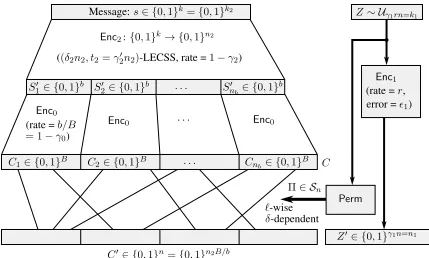
Enc0) of constant length satisfying the properties of Lemma 3.5; 2) an existing non-malleable code con-structionC1 (with encoderEnc1) against bit-tampering achieving a possibly low (even sub-constant) rate; 3) a linear error-correcting secret sharing scheme (LECSS)C2(with encoderEnc2); 4) an explicit function
Π∈ Sn C C1∈ {0,1}B C2 ∈ {0,1}B · · · Cnb ∈ {0,1}
B
C0 ∈ {0,1}n={0,1}n2B/b
Z0 ∈ {0,1}γ1n=n1 S10 ∈ {0,1}b S0
2 ∈ {0,1}b · · · Sn0b ∈ {0,1} b
Enc0
Enc0 · · · Enc0
Enc2:{0,1}k→ {0,1}n2 Message:s∈ {0,1}k={0,1}k2
((δ2n2, t2 =γ20n2)-LECSS, rate =1−γ2)
(rate =b/B
= 1−γ0)
Z ∼ Uγ1rn=k1
Perm
Enc1 (rate =r,
`-wise δ-dependent
error =1)
Figure 1: Schematic description of the encoderEncfrom our explicit construction.
At the outer layer, LECSS is used to pre-code the message. The resulting string is then divided into blocks, where each block is subsequently encoded by the inner encoderEnc0. For a “typical” adversary that flips or freezes a prescribed fraction of the bits, we expect many of the inner blocks to be sufficiently tampered so that many of the inner blocks detect an error when the corresponding inner decoder is called. However, this ideal situation cannot necessarily be achieved if the fraction of global errors is too small, or if too many bits are frozen by the adversary (in particular, the adversary may freeze all but few of the blocks to valid inner codewords). In this case, we rely on distance and bounded independence properties of LECSS to ensure that the outer decoder, given the tampered information, either detects an error or produces a distribution that is independent of the source message.
A problem with the above approach is that the adversary knows the location of various blocks, and may carefully design a tampering scheme that, for example, freezes a large fraction of the blocks to valid inner codewords and leaves the rest of the blocks intact. To handle adversarial strategies of this type, we permute the final codeword using the pseudorandom permutation generated byPerm, and include the seed in the final codeword. Doing this has the effect of randomizing the action of the adversary, but on the other hand creates the problem of protecting the seed against tampering. In order to solve this problem, we use the sub-optimal codeC1to encode the seed and prove in the analysis that non-malleability of the codeC1can be used to make the above intuitions work.
4.1.1 The building blocks
1. An inner coding scheme C0 = (Enc0,Dec0) with rate 1 −γ0 (for an arbitrarily small parameter γ0 > 0), some block length B, and message length b = (1−γ0)B. We assume that C0 is an instantiation of Construction 1 and satisfies the properties promised by Lemma 3.5.
2. A coding schemeC1= (Enc1,Dec1)with rater >0(wherercan in general be sub-constant), block lengthn1 := γ1n(where nis defined later), and message length k1 := γ1rn, that is non-malleable against bit-tampering adversaries with error 1. Without loss of generality, assume that Dec1 never outputs⊥(otherwise, identify⊥with an arbitrary fixed message; e.g.,0k). The non-malleable code C1need not be strong.
3. A linear error-correcting secret sharing (LECSS) scheme C2 = (Enc2,Dec2)(as in Definition 2.9) with message lengthk2:=k, rate1−γ2(for an arbitrarily small parameterγ2>0) and block length n2. We assume thatC2 is a(δ2n2, t2 := γ20n2)-linear error-correcting secret sharing scheme (where δ2 >0andγ20 >0are constants defined by the choice ofγ2). Sincebis a constant, without loss of generality assume thatbdividesn2, and letnb:=n2/bandn:=n2B/b.
4. A polynomial-time computable mappingPerm:k1 → Sn, whereSndenotes the set of permutations on [n]. We assume thatPerm(Uk1)is an`-wise δ-dependent permutation (as in Definition 2.8, for
parameters`andδ. In fact, it is possible to achieveδ 6exp(−`) and` = dγ1rn/lognefor some constantγ >0. Namely, we may use the following result due to Kaplan, Naor and Reingold [18]:
Theorem 4.1. [18] For every integers n, k1 > 0, there is a function Perm:{0,1}k1 → Sn
com-putable in worst-case polynomial-time (ink1 andn) such thatPerm(Uk1) is an`-wiseδ-dependent
permutation, where`=dk1/logneandδ6exp(−`).
4.1.2 The encoder
Lets∈ {0,1}kbe the message that we wish to encode. The encoder generates the encoded messageEnc(s) according to the following procedure.
1. Let Z ∼ Uk1 and sample a random permutation Π : [n] → [n] by letting Π := Perm(Z). Let Z0 :=Enc1(Z)∈ {0,1}γ1n.
2. LetS0 =Enc2(s)∈ {0,1}n2 be the encoding ofsusing the LECSS codeC2.
3. PartitionS0 into blocksS10, . . . , Sn0
b, each of lengthb, and encode each block independently usingC0 so as to obtain a stringC= (C1, . . . , Cnb)∈ {0,1}
n.
4. LetC0:= Π(C)be the stringCafter itsncoordinates are permuted byΠ.
5. OutputEnc(s) := (Z0, C0)∈ {0,1}N, whereN := (1 +γ
1)n, as the encoding ofs.
4.1.3 The decoder
We define the decoderDec( ¯Z0,C¯0)as follows:
1. ComputeZ¯ :=Dec1( ¯Z0).
2. Compute the permutationΠ : [¯ n]→[n]defined byΠ :=¯ Perm( ¯Z).
3. LetC¯∈ {0,1}nbe the permuted version ofC¯0 according toΠ¯−1.
4. PartitionC¯inton1/bblocksC¯1, . . . ,C¯nbof sizeBeach (consistent to the way that the encoder does the partitioning ofC¯).
5. Call the inner code decoder on each block, namely, for eachi ∈ [nb]compute S¯0i := Dec0( ¯Ci). If
¯
S0i =⊥for anyi, output⊥and return.
6. LetS¯0 = ( ¯S0
1, . . . ,S¯0nb)∈ {0,1}
n2. ComputeS¯ :=Dec
2( ¯S0), whereS¯=⊥ifS¯0is not a codeword ofC2. OutputS¯.
Remark 4.2. As in the classical variation of concatenated codes of Forney [13] due to Justesen [16], the encoder described above can enumerate afamilyof inner codes instead of one fixed code in order to eliminate the exhaustive search for a good inner codeC0. In particular, one can consider all possible realizations of Construction 1 for the chosen parameters and use each obtained inner code to encode one of thenb inner blocks. If the fraction of good inner codes (i.e., those satisfying the properties listed in Lemma 3.5) is small enough (e.g.,1/nΩ(1)), our analysis still applies. It is possible to ensure that the size of the inner code family is not larger thannbby appropriately choosing the parameterηin Theorem 3.1 (e.g.,η >1/
√ n).
4.2 Analysis
In this section, we prove that Construction 2 is indeed a coding scheme that is non-malleable against bit-tampering adversaries with rate arbitrarily close to1. More precisely, we prove the following theorem.
Theorem 4.3. For everyγ0 >0, there is aγ00 =γ O(1)
0 andN0 =O(1/γ O(1)
0 )such that for every integer
N >N0, the following holds4. The pair(Enc,Dec)defined in Sections 4.1.2 and 4.1.3 can be set up to be
a strong non-malleable coding scheme against bit-tampering adversaries, achieving block lengthN, rate at
least1−γ0and error
61+ 3 exp
−Ωγ
0 0rN
log3N
,
whererand1are respectively the rate and the error of the assumed non-malleable coding schemeC1.
Proof of Theorem 4.3
It is clear that, given(Z0, C0), the decoder can unambiguously reconstruct the messages; that is,Dec(Enc(s)) =
swith probability1. Thus, it remains to demonstrate non-malleability ofEnc(s)against bit-tampering ad-versaries.
Fix any such adversaryf:{0,1}N → {0,1}N. The adversaryf defines the following partition of[N]:
4
• Fr⊆[N]; the set of positions frozen to either zero or one byf.
• Fl⊆[N]\Fr; the set of positions flipped byf.
• Id= [N]\(Fr∪Fl); the set of positions left unchanged byf.
Sincef is not the identity function (otherwise, there is nothing to prove), we know thatFr∪Fl6=∅. We use the notation used in the description of the encoderEncand decoderDecfor various random vari-ables involved in the encoding and decoding of the messages. In particular, let( ¯Z0,C¯0) =f(Z0, C0)denote the perturbation ofEnc(s)by the adversary, and letΠ :=¯ Perm(Dec1( ¯Z0))be the induced perturbation ofΠ as viewed by the decoderDec. In generalΠandΠ¯ are correlated random variables, but independent of the remaining randomness used by the encoder.
We first distinguish three cases and subsequently show that, in light of Lemma B.4, the analysis of these cases suffices to guarantee non-malleability in general. The first case considers the situation where the adversary freezes too many bits of the encoding. The remaining two cases can thus assume that a sizeable fraction of the bits are not frozen to fixed values.
Case 1: Too many bits are frozen by the adversary.
First, assume thatf freezes at leastn−t2/bof thenbits ofC0. In this case, show that the distribution of
Dec(f(Z0, C0))is always independent of the messagesand thus the non-malleability condition of Defini-tion 2.4 is satisfied for the chosenf. In order to achieve this goal, we rely on bounded independence property of the LECSS codeC2. We remark that a similar technique has been used in [12] for their construction of non-malleable codes (and for the case where the adversary freezes too many bits).
Observe that the joint distribution of(Π,Π)¯ is independent of the messages. Thus it suffices to show that conditioned on any realizationΠ =π andΠ = ¯¯ π, for any fixed permutationsπandπ¯, the conditional distribution ofDec(f(Z0, C0))is independent of the messages.
We wish to understand how, with respect to the particular permutations defined byπandπ¯, the adversary acts on the bits of the inner code blocksC = (C1, . . . , Cnb).
Consider the setT ⊆[nb]of the blocks ofC = (C1, . . . , Cnb)(as defined in the algorithm forEnc) that are not completely frozen byf (after permuting the action off with respect to the fixed choice ofπ). We know that|T|6t2/b.
LetST0 be the stringS0 = (S10, . . . , Sn0
b)(as defined in the algorithm forEnc) restricted to the blocks defined byT; that is,ST0 := (Si0)i∈T. Observe that the length ofST0 is at mostb|T|6t2. From thet2-wise independence property of the LECSS codeC2, and the fact that the randomness ofEnc2 is independent of
(Π,Π)¯ , we know thatST0 is a uniform string, and in particular, independent of the original messages. Let CT be the restriction ofC to the blocks defined byT; that is,CT := (Ci)i∈T. SinceCT is generated from ST (by applying the encoderEnc0 on each block, whose randomness is independent of(Π,Π)¯ ), we know that the distribution ofCT is independent of the original messagesas well.
Claim 4.4. Supposet2 6n2/2. Then, regardless of the choice of the messages,Pr[f(Z0, C0) = (Z0, C0)] =
exp(−Ω(γ0n)) =:01.
Proof. We upper bound the probability that the adversary leavesC0 unchanged. Consider the action off
onC = (C1, . . . , Cnb)(which is a permutation of howf acts on each bit according to the realization ofΠ). Recall that all but at mostt2/bof the bits ofC (and hence, all but at mostt2/bof thenb blocks ofC) are frozen to0or1byf. LetI ⊆ [nb]denote the set of blocks ofCthat are completely frozen byf. We can see that|I|>nb/2by the assumption thatt2 6n2/2 =nbb/2.
In the sequel, we fix the realization ofS0to any fixed string. Regardless of this conditioning, the blocks ofCpicked byIare independent, and each block isΩ(γ0B)-wise,exp(−Ω(γ0B))-dependent by property 4 of Lemma 3.5. It follows that for each blocki∈I, the probability thatCi coincides with the frozen value of the ith block as defined by f is bounded by exp(−Ω(γ0B)). Since the blocks of C picked by I are independent, we can amplify this probability and conclude that the probability thatf leaves(Ci)i∈I (and consequently,(Z0, C0)) unchanged is at most
exp(−Ω(γ0B|I|)) = exp(−Ω(γ0Bnb/2)) = exp(−Ω(γ0n)).
Consider the distributionDf,s in Definition 2.4. From Claim 4.4, it follows that the probability mass assigned tosamefor this distribution is at most01 = exp(−Ω(γ0n))for everys, which implies
Df,s ≈0
1 D(Dec(f(Enc(s)))),
since the right hand side distribution is simply obtained fromDf,sby moving the probability mass assigned tosametos. Since we have shown that the distribution ofDec(f(Enc(s)))is the same for every messages, it follows that for everys, s0 ∈ {0,1}k,
Df,s≈201 Df,s0,
which proves strong non-malleability in this case.
Case 2: The adversary does not alterΠ.
In this case, we assume that Π = ¯Π, both distributed according to Perm(Uk1) and independently of the remaining randomness used by the encoder. This situation in particular occurs if the adversary leaves the part of the encoding corresponding toZ0completely unchanged. Our goal is to upper bound the probability thatDec does not output ⊥ under the above assumptions. We furthermore assume that Case 1 does not occur; i.e., more thant2/b=γ20n2/bbits ofC0 are not frozen by the adversary.
To analyze this case, we rely on bounded independence of the permutationΠ. The effect of the random-ness ofΠis to prevent the adversary from gaining any advantage of the fact that the inner code independently acts on the individual blocks.
Let Id0 ⊆ Id be the positions of C0 that are left unchanged by f. We know that |Id0 ∪Fl| > t2/b. Moreover, the adversary freezes the bits ofC corresponding to the positions inΠ−1(Fr)and either flips or leaves the rest of the bits ofCunchanged.
Thus in the sequel we can assume that|Fr∪Fl|>δ2n2/b. Moreover, we fix randomness of the LECSSC2 so thatS0 becomes a fixed string. Recall thatC1, . . . , Cnb are independent random variables, since every call of the inner encoderEnc0uses fresh randomness.
SinceΠ = ¯Π, the decoder is able to correctly identify positions of all the inner code blocks determined byC. In other words, we have
¯
C=f0(C),
wheref0denotes the adversary obtained fromf by permuting its action on the bits as defined byΠ−1; that is,
f0(x) := Π−1(f(Π(x))).
Leti∈[nb]. We consider the dependence betweenCiand its tamperingC¯i, conditioned on the knowl-edge of Π on the first i−1 blocks of C. Let C(j) denote thejth bit of C, so that the ith block of C becomes(C(1 + (i−1)B), . . . , C(iB)). For the moment, assume thatδ = 0; that is,Πis exactly a`-wise independent permutation.
SupposeiB6`, meaning that the restriction ofΠon theith block (i.e.,(Π(1 + (i−1)B), . . . ,Π(iB))
conditioned on any fixing of(Π(1), . . . ,Π((i−1)B))exhibits the same distribution as that of a uniformly random permutation.
We define eventsE1andE2as follows.E1is the event thatΠ(1 + (i−1)B)∈/Id0, andE2is the event that
Π(2 + (i−1)B)∈/ Fr. That is,E1 occurs when the adversary does not leave the first bit of theith block of Cintact, andE2occurs when the adversary does not freeze the second bit of theith block. We are interested in lower bounding the probability that bothE1 andE2 occur, conditioned on any particular realization of
(Π(1), . . . ,Π((i−1)B)).
Suppose the parameters are set up so that
`6 1
2min{δ2n2/b, γ
0
2n2/b}. (6)
Under this assumption, even conditioned on any fixing of(Π(1), . . . ,Π((i−1)B)), we can ensure that
Pr[E1]>δ2n2/(2bn),
and
Pr[E2|E1]>γ20n2/(2bn),
which together imply
Pr[E1∧ E2]>δ2γ20
n2
2bn 2
=:γ200. (7)
We letγ200to be the right hand side of the above inequality.
In general, when the random permutation is`-wiseδ-dependent forδ >0, the above lower bound can only be affected byδ. Thus, under the assumption that
δ 6γ200/2, (8)
we may still ensure that
LetXi∈ {0,1}indicate the event thatDec0( ¯Ci) =⊥. We can write
Pr[Xi= 1]>Pr[Xi= 1|E1∧ E2] Pr[E1∧ E2]>(γ200/2) Pr[Xi= 1|E1∧ E2],
where the last inequality follows from (9). However, by property 5 of Lemma 3.5 that is attained by the inner codeC0, we also know that
Pr[Xi = 1|E1∧ E2]>1/3,
and therefore it follows that
Pr[Xi= 1]>γ200/6. (10)
Observe that by the argument above, (10) holds even conditioned on the realization of the permutationΠ
on the firsti−1blocks ofC. By recalling that we have fixed the randomness ofEnc2, and that each inner block is independently encoded byEnc0, we can deduce that, lettingX0:= 0,
Pr[Xi = 1|X0, . . . , Xi−1]>γ200/6. (11)
Using the above result for alli∈ {1, . . . ,b`/Bc}, we conclude that
Pr[Dec( ¯Z0,C¯0)6=⊥]6Pr[X1 =X2 =· · ·=Xb`/Bc= 0] (12)
6
1−γ200/6
b`/Bc
, (13)
where (12) holds since the left hand side event is a subset of the right hand side event, and (13) follows from (11) and the chain rule.
Case 3: The decoder estimates an independent permutation.
In this case, we consider the event whereΠ¯attains a particular valueπ¯. Suppose it so happens that under this conditioning, the distribution ofΠremains unaffected; that is,Π =¯ π andΠ ∼Perm(Uk1). This situation may occur if the adversary completely freezes the part of the encoding corresponding toZ0to a fixed valid codeword of C1. Recall that the random variable Π is determined by the random string Z and that it is independent of the remaining randomness used by the encoderEnc. Similar to the previous case, our goal is to upper bound the probability thatDecdoes not output⊥. Furthermore, we can again assume that Case 1 does not occur; i.e., more thant2/bbits ofC0are not frozen by the adversary. For the analysis of this case, we can fix the randomness ofEnc2and thus assume thatS0is fixed to a particular value.
As before, our goal is to determine how each blockCi of the inner code is related to its perturbationC¯i induced by the adversary. Recall that
¯
C = ¯π−1(f(Π(C))).
Sincef is fixed to an arbitrary choice only with restrictions on the number of frozen bits, without loss of generality we can assume thatπ¯ is the identity permutation (if not, permute the action off accordingly), and therefore,C¯0 = ¯C(sinceC¯0 = ¯π( ¯C)), and
¯
C =f(Π(C)).
Assuming that`6t2(which is implied by (6)), letT ⊆[n]be any set of sizeb`/Bc6bt2/Bc6t2/b of the coordinate positions of C0 that are either left unchanged or flipped by f. Let T0 ⊆ [nb] (where |T0|6|T|) be the set of blocks ofC¯ that contain the positions picked byT. With slight abuse of notation, for anyτ ∈ T0, denote byΠ−1(τ) ⊆ [n]the set of indices of the positions belonging to the blockτ after applying the permutationΠ−1 to each one of them. In other words,C¯τ (theτth block ofC¯) is determined by taking the restriction ofCto the bits inΠ−1(τ)(in their respective order), and applyingfτ on those bits (recall that forτ ∈T0we are guaranteed thatfτdoes not freeze all the bits).
In the sequel, our goal is to show that with high probability,Dec( ¯Z,C¯0) =⊥. In order to do so, we first assume thatδ= 0; i.e., thatΠis exactly an`-wise independent permutation. SupposeT0={τ1, . . . , τ|T0|},
and consider anyi∈ |T0|.
We wish to lower bound the probability thatDec0( ¯Cτi) =⊥, conditioned on the knowledge ofΠon the firsti−1blocks inT0. Subject to the conditioning, the values ofΠbecomes known on up to(i−1)B 6
(|T0| −1)B 6 `−B points. SinceΠis`-wise independent,Π on theB bits belonging to theith block remainsB-wise independent. Now, assuming
`6n/2, (14)
we know that even subject to the knowledge ofΠon any`positions ofC, the probability that a uniformly random element within the remaining positions falls in a particular block ofCis at mostB/(n−`)62B/n. Now, forj ∈ {2, . . . , B}, consider thejth position of the blockτi inT0. By the above argument, the probability thatΠ−1maps this element to a block ofC chosen by any of the previousj−1elements is at most2B/n. By a union bound on the choices ofj, with probability at least
1−2B2/n,
the elements of the block τi all land in distinct blocks of C by the permutation Π−1. Now we observe that if δ > 0, the above probability is only affected by at most δ. Moreover, if the above distinctness property occurs, the values ofC at the positions in Π−1(τ) become independent random bits; since Enc
uses fresh randomness upon each call ofEnc0for encoding different blocks of the inner code (recall that the randomness of the first layer usingEnc2 is fixed).
Recall that by the bounded independence property ofC0(i.e., property 4 of Lemma 3.5), each individual bit ofC is exp(−Ω(γ0B))-close to uniform. Therefore, using Proposition B.5, with probability at least
1−2B2/n−δ(in particular, at least7/8when
n>32B2 (15)
and assumingδ 61/16) we can ensure that the distribution ofC restricted to positions picked byΠ−1(τ)
isO(Bexp(−Ω(γ0B)))-close to uniform, or in particular(1/4)-close to uniform whenB is larger than a suitable constant. If this happens, we can conclude that distribution of the blockτi ofC¯ is(1/4)-close to a sub-cube with at least one random bit (since we have assumed thatτ ∈T0and thusf does not fix all the bit of theτth block). Now, the cube property ofC0(i.e., property 3 of Lemma 3.5) implies that
Pr Enc0
[Dec0( ¯Cτi)6=⊥ |Π(τ1), . . . ,Π(τi−1)]61/2 + 1/4 = 3/4,
Finally, using the above probability bound, and running iover all the blocks in T0, and recalling the assumption thatC¯ = ¯C0, we deduce that
Pr[Dec( ¯Z0,C¯0)6=⊥]6(7/8)|T0|
6exp(−Ω(`/B2)), (16)
where the last inequality follows from the fact that|T0|>b`/bc/B.
The general case.
Recall that Case 1 eliminates the situation in which the adversary freezes too many of the bits. For the remaining cases, Cases 2 and 3 consider the special situations where the two permutationsΠandΠ¯ used by the encoder and the decoder either completely match or are completely independent. However, in general we may not reach any of the two cases. Fortunately, the fact that the codeC1 encoding the permutationΠ is non-malleable ensure that we always end up with a combinationof the Case 2 and 3. In other words, in order to analyze any event depending on the joint distribution of(Π,Π)¯ , it suffices to consider the two special cases whereΠis always the same asΠ¯, or whenΠandΠ¯ are fully independent.
We have formalized the above intuition in Lemma B.4. As in Cases 2 and 3, let us assume that the randomness of the codeC2 is fixed so that S0 attains a fixed value. Moreover, let the bit-string Rdenote the random coin flips used by all invocations of the inner encoderEnc0 by Enc. Consider the event that the final decoder, given( ¯Z0,C¯0), outputs⊥. The indicator for this event can be written as a functiongthat maps(Π,Π¯, R)to{0,1}. The exact choice ofgwill depend on the fixed information; namely the particular realization ofS0and the choice of the adversaryf. From Case 2, we know that
Pr[g(Π,Π, R)6= 1]61−γ200/6b`/Bc,
and from Case 3, we know that for everyπ¯∈ Sn,
Pr[g(Π,¯π, R)= 1]6 6exp(−Ω(`/B2)).
Since Π¯ depends on Π via a non-malleable code C1, we can ensure that for some independent random variableΠ0∈ Sn∪ {same},
D(Π,Π)¯ ≈D(Π,copy(Π0,Π)). Therefore, we can apply Lemma B.4 to conclude that
Pr[Dec( ¯Z0,C¯0)6=⊥] = Pr[g(Π,Π¯, R)6= 1]6
1−γ200/6
b`/Bc
+ exp(−Ω(`/B2)) +1=:02, (17)
where we recall that1is the error of non-malleable codeC1.
Therefore, for the general case (except when the adversary freezes too many bits, which is taken care of by Case 1), non-malleability is ensured by letting the distribution Df be fully supported on the fixed outcome ⊥. This, in fact, proves strong non-malleability as well. In order to see this, observe we have shown that, for everys,
D(Dec(f(Enc(s))))≈0
2 D(⊥) (18)
which implies that each Df,s as defined in Definition 2.4 is (202)-close to D(⊥). This is because the distribution D(Dec(f(Enc(s)))) may be obtained fromDf,s by moving the probability mass assigned to
same by Df,s tos, and (18) implies that this probability cannot be more than 02. Therefore, for every s, s0∈ {0,1}k,
Df,s≈40 2 Df,s0,
Setting up the parameters
The final encoderEncmapskbits into
k
1−γ2
· 1
1−γ0
(1 +γ1)
bits. Thus the raterof the final code is
r= (1−γ0)(1−γ2) 1 +γ1
.
We set upγ1, γ2∈[γ0/2, γ0]so as to ensure that
r >1−O(γ0).
Thus, the rate of the final code can be made arbitrarily close to1ifγ0 is chosen to be a sufficiently small constant.
Before proceeding with the choice of other parameters, we recap the constraints that we have assumed on the parameters; namely, (19), (20), 14, (8) (where we recall thatγ200 = δ2γ20(2bnn2 )2), and the assumption of Claim 4.4 which are again listed below to assist the reader.
n>32B2, (19)
`6 1
2min{δ2n2/b, γ
0
2n2/b}, (20)
`6n/2, (21)
δ 6γ200/2, (22)
t26n2/2. (23)
For the particular choice ofγ0, there is a constant
B =O((log2γ0)/γ0) (24)
for which Lemma 3.5 holds.
Note that the choice of B only depends on the constant γ0. If desired, a brute-force search5 can thus find an explicit choice for the inner codeC0 in time only depending onγ0. Moreover, (19) can be satisfied as long asN >N0for someN0=poly(1/γ0).
Now, for the assumed value for the constantγ2 ≈γ0, one can use Corollary A.2 and set upC2 to be an
(Ω(γ0n2/logn2),Ω(γ0n2/logn2))-linear error-correcting secret sharing code (note that this satisfies the assumption (23)). Thus, we may assume thatδ2 =γ20 = Ω(γ0/logN)(since, trivially,n2 6N).
Finally, using Theorem 4.1 we can set up Permso that ` = Ω(γ1rn/logn) = Ω(γ0rn/logn) and δ 6 1/n`. We can lower the value of ` if necessary (since an `-wise δ-dependent permutation is also an `0-wise δ-dependent permutation for any `0 6 `) so as to ensure that ` = Ω(γ0rn/(Blogn))and the
5
Alternatively, it is possible to sample a random choice forC0and then verify that it satisfies properties of Lemma 3.5, thereby
assumptions (20) and (21) are satisfied (recall thatn2/b=nb=n/Bandr 61). Observe that our choices of the parameters implies that the quantityγ200defined in (7) satisfiesγ200 = Ω(γ2
0/(BlogN)2). We see that the choice ofδis small enough to satisfy the assumption (22).
By our choice of the parameters, the upper bound on the failure probability in (13) is
1−γ200/6b`/Bc= exp−Ω γ
3 0rN B3log3N
, (25)
which can be seen by recalling the lower bound onγ200and the fact thatN =n(1 +γ1)∈[n,2n]. On the other hand, the upper bound on the failure probability in (16) can be written as
exp(−Ω(`/B2)) = exp−Ω γ0rN
B3logN
, (26)
which is dominated by the estimate in (25).
We also recall that the bound 01 obtained in Claim 4.4 for the error of the coding scheme when the adversary freezes too many bits isexp(−Ω(γ0n)), which is again dominated by the estimate in (25).
Now we can substitute the upper bound (24) onBto conclude that (25) is at most
exp−Ω γ
6 0rN
log6(1/γ0) log3N
= exp−Ωγ
0 0rN
log3N
,
where
γ00 := (γ0/log(1/γ0))6.
We conclude that the error of the final coding scheme(Enc,Dec)which is upper bounded by01+02, where01and02are from Claim 4.4 and (17), respectively, is at most
1+ 3 exp
−Ω
γ0
0rN
log3N
.
4.3 Instantiations
We present two possible choices for the non-malleable codeC1 based on existing constructions. The first construction, due to Dziembowski et al. [12], is a Monte Carlo result that is summarized below.
Theorem 4.5. [12, Theorem 4.2] For every integern > 0, there is an efficient coding schemeC1 of block
length n, rate at least.18, that is non-malleable against bit-tampering adversaries achieving error =
exp(−Ω(n)). Moreover, there is an efficient randomized algorithm that, givenn, outputs a description of
such a code with probability at least1−exp(−Ω(n)).
Theorem 4.6. [1, implied by Theorem 5] For every integer k > 0 and > 0, there is an efficient and
explicit6 coding scheme C1 of message length k that is non-malleable against bit-tampering adversaries
achieving error at most. Moreover, the block lengthnof the coding scheme satisfies
n= ˜O((k+ log(1/))7).
By choosing := exp(−k), we see that we can have = exp(−Ω(˜ n1/7))while the rate r of the code
satisfies
r= ˜Ω(n−6/7).
By instantiating Theorem 4.3 with the Monte Carlo construction of Theorem 4.5, we arrive at the fol-lowing corollary.
Corollary 4.7. For every integern > 0and every positive parameterγ0 = Ω(1/(logn)O(1)), there is an
efficient coding scheme(Enc,Dec)of block lengthnand rate at least1−γ0 such that the following hold.
1. The coding scheme is strongly non-malleable against bit-tampering adversaries, achieving error at
mostexp(−Ω(˜ n)),
2. There is an efficient randomized algorithm that, given n, outputs a description of such a code with
probability at least1−exp(−Ω(n)).
If, instead, we instantiate Theorem 4.3 with the construction of Theorem 4.6, we obtain the following strong non-malleable extractor (even though the construction of [1] is not strong).
Corollary 4.8. For every integer n > 0 and every positive parameter γ0 = Ω(1/(logn)O(1)), there is
an explicit and efficient coding scheme (Enc,Dec) of block length n and rate at least 1−γ0 such that
the coding scheme is strongly non-malleable against bit-tampering adversaries and achieves error at most exp(−Ω(˜ n1/7)).
5
Construction of non-malleable codes using non-malleable extractors
In this section, we introduce the notion of seedless non-malleable extractors that extends the existing defi-nition of seeded non-malleable extractors (as defined in [10]) to sources that exhibit structures of interest. This is similar to how classical seedless extractors are defined as an extension of seeded extractors to sources with different kinds of structure7.
5.1 Seedless non-malleable extractors
Before defining seedless non-malleable extractors, it is convenient to introduce a related notion of
non-malleable functionsthat is defined with respect to a function and a distribution over its inputs. As it turns
out, non-malleable “extractor” functions with respect to the uniform distribution and limited families of adversaries are of particular interest for construction of non-malleable codes.
6To be precise, explicitness is guaranteed assuming that a large primep= exp( ˜Ω(k+ log(1/)))is available. 7