Review Paper on Technologies used for Interactive
Image Segmentation
Vrushali Mendhule, Gaurav Soni, Rajesh Nigam
Department of Computer Science & Engineering , RGPV University, Bhopal.
Abstract— Image segmentation is the process that partitions
an image into region. Although many literatures studied automated image segmentation, it is still difficult to segment region-of-interest in any kind of images. Thus, manual delineation is important yet. [2] In order to shorten the processing time and to decrease the effort of users, this paper introduces the approaches of interactive image segmentation method based on various technologies. Interactive segmentation aims to separate an object of interest from the rest of an image. This problem in computer vision is known to be hard, and very few fully automatic vision systems exist which have been shown to be accurate and robust under all sorts of challenging inputs. Most of the previous works require users to trace the whole boundary of the object. When the object has a complicated boundary, or the object is in a highly textured region, users have to put great effort into iteratively correcting the selection. [1] This paper presents the study of different interactive image segmentation technologies for image foreground background separation. Various technologies used for interactive image segmentation are Adaptive GMMRF model, Maximal similarity based region merging, Probabilistic hypergraphs, Intelligent scissors, Adaptive weighted distances, Interactive graph cut method based on improved Gabor features, Constrained laplacian optimization, Dirichlet process multiple view learning (DPMVL) etc. Dirichlet Process Multiple-View Learning (DPMVL) for image segmentation technique produces very effective segmentation results as compare to previously existing techniques. DPMVL use MRF model for smoothing the segmentation. This can be further improved by using another effective technology by adding some new features which will work effectively and provide an alternative computational algorithm for building interactive image editing tools. We have the chances to improve the DPMVL image segmentation technique by using modified technology which will have more interactivity, user control of segmentation process, and reach a satisfied result among the noise restraint, edge preservation and computation complexity.
Keywords— Image Processing, Image segmentation,
Interactive image segmentation, DPMVL.
I. INTRODUCTION
Image processing is a method to convert an image into digi-tal form and perform some operations on it, in order to get an enhanced image or to extract some useful information from it. It is a type of signal dispensation in which input is image, like video frame or photograph and output may be image or characteristics associated with that image. Usually Image Processing system includes treating images as two dimensional signals while applying already set signal pro-cessing methods to them.
Image Enhancement : The principal objective of image en-hancement is to process a given image so that the result
is more suitable than the original image for a specific applica-tion.
Image Restoration : The purpose of image restoration is to "compensate for" or "undo" defects which degrade an image. Degradation comes in many forms such as motion blur, noise, and camera misfocus.
Image Compression : Image compression is an application of data compression that encodes the original image with few bits. The objective of image compression is to reduce the redundancy of the image and to store or transmit data in an efficient form.
Image Segmentation : The purpose of image segmentation is to partition an image into meaningful regions with respect to a particular application.
A. Image segmentation
The purpose of image segmentation is to partition an image into meaningful regions with respect to a particular application. Image segmentation is a low level image processing task that aims at partitioning an image into regions in order that each region groups contiguous pixels sharing similar attributes (intensity, color etc.). It is very important process because it is the first step of the image understanding process, and all other steps such as feature extraction, classification and recognition, depend heavily on its results. Image segmentation is a low level image processing task in image applications such as machine vision and robot navigation. Recently automated image segmentation techniques with computer are adopted for improving throughput, reducing cost, diminishing human bias and increasing the intelligence level of robot. However, today computer-assisted IR image segmentation techniques have not been successfully operated for many reasons. Especially the limited resolution and electronic noise of sensors reduce qualities of images, and the interactive heat environments increase the complexities of identification [3].
The Segmentation of an image entails the division or separation of the image into regions of similar attribute. The ultimate aim in a large number of image processing applications is to extract important features from the image data, from which a description, interpretation, or under-standing of the scene can be provided by the machine. [4] Numerous methods have been proposed for image segmentation such as histogram-based method, boundary-based method, region-boundary-based method and graph-boundary-based techniques. [5]
B. Interactive Image Segmentation
some user input, which typically takes the form of marking some pixels that belong to the figure or background, the system is required to find the set of pixels that belong to the figure. Like many other image labeling problems, interactive segmentation is commonly modeled using pair wise Markov Random fields that incorporate priors on labels of pairs of neighboring pixels.The problem of image segmentation has received a lot of attention since the early days of computer vision research. Automatic image segmentation is a hard problem which requires modeling the problem based on do-main knowledge. And even after that, some form of human intervention is required to correct anomalies in the segmen-tation. Moreover, automatic segmentation methods are not generic. A slightly easier and more approachable problem interactive image segmentation has also received a lot of attention over the years.
Interactive image segmentation is the process of extracting an object in an image with additional hints from the user. This problem in computer vision is known to be hard, and very few fully automatic vision systems exist which have been shown to be an ill-posed problem due to the fact that there is (i) no clear definition of a correct segmentation; and (ii) no agreed-upon objective measure that defines the goodness of a segment. For this reason a number of interactive systems have been developed which allowed users to help the vision algorithm to achieve the correct solution by giving hints [1]. Interactive segmentation aims to separate an object of interest from the rest of an image. It is a classification problem where each pixel is assigned one of two labels: foreground (F) or background (B). The interaction comes in the form of sets of pixels marked by the user by help of brushes to belong either to foreground (F) or background (B). [1]
Image segmentation is one of the fundamental but challenging problems in image processing and computer vision. The approaches of unsupervised image segmentation automatically partition an image into coherent regions with-out any prior knowledge, such as the stochastic clustering, mean shift, mixture model, level sets, and graph theoretic methods. Unsupervised image segmentation is widely used as a crucial function of high-level image understanding, which is designed to simulate functionalities of human visual perception, such as object recognition and scene parsing. However, the state-of-the-art automatic segmentation methods are still far from the human segmentation performance, which have several problems such as finding the faint object boundaries and separating objects from the complicated background in natural images. In order to solve these problems, an interactive segmentation method is often preferred when the interest objects need to be accurately selected and extracted from the background. The general task of interactive segmentation is to produce a binary segmentation mask of the input image by separating the interest objects from its background. There are a plenty of literature on the work of interactive image segmentation techniques that have been explored during the last decade, of which popular graph-based approaches include interactive graph cut , random walk , geodesic distance , and level sets. [6]
C. Dirichlet Process
The Dirichlet Process Provides a Random Distribution over Infinite Sample Spaces Recall that the Dirichlet distribution is a probability distribution over pmfs, and we can say a random pmf has a Dirichlet distribution with parameter α. A random pmf is like a bag full of dice, and a realization from the Dirichlet gives us a specific die. The Dirichlet distribution is limited in that it assumes a finite set of events. In the dice analogy, this means that the dice must have a finite number of faces. The Dirichlet process enables us work with an infinite set of events, and hence to model probability distributions over infinite sample spaces.
As another analogy, imagine that we stop someone on the street and ask them for their favorite color. We might limit their choices to black, pink, blue, green, orange, white. An individual might provide a different answer depending on his mood, and you could model the probability that he chooses each of these colors as a pmf. Thus, we are model-ing each person as a pmf over the six colors, and we can think of each person’s pmf over colors as a realization of a draw from a Dirichlet distribution over the set of six colors. But what if we didn’t force people to choose one of those six colors? What if they could name any color they wanted? There are an infinite number of colors they could name. To model the individuals’ pmfs (of infinite length), we need a distribution over distributions over an infinite sample space. One solution is the Dirichlet process, which is a random distribution whose realizations are distributions over an arbitrary (possibly infinite) sample space
II. RELATED WORK
Several methods have been proposed for Interactive image segmentation. Interactive image segmentation techniques are semiautomatic image processing approaches. They are used to track object boundaries and/or propogate labels to other regions by following user guidance so that heterogeneous regions in one image can be separated. User interactions provide the high level information indicating the “object” and “background” regions. Then, various features such as locations, color intensities, local gradients can be extracted and used to provide the information to separate desired ob-jects from the background. [11] A variety of approaches have been developed for solving image segmentation problems. In these approaches, different techniques have defined various cost functions for the task of image segmentation. There are many techniques used for interactive image segmentation.
A. Adaptive GMMRF model
generative, probabilistic formulation of the model is set out in terms of a “Gaussian Mixture Markov Random Field” (GMMRF). Secondly, a pseudolikelihood algorithm is derived which jointly learns the colour mixture and coherence parameters for foreground and background respectively. The graph cut algorithm, using the learned parameters, generates good object segmentations with little interaction. However , pseudolikelihood learning proves to be frail, which limits the complexity of usable models and hence also the achievable error rate. [8]
B. Maximal similarity based region merging
This represents a new region merging based interactive im-age segmentation method. This is because the initially seg-mented small regions of the desired object often vary a lot in size and shape. In the interactive image segmentation, the users will mark some regions as object and background re-gions. The users only need to roughly indicate the location and region of the object and background by using strokes, which are called markers. A novel maximal-similarity based region merging mechanism is proposed to guide the merging process with the help of markers. A region R is merged with its adjacent region Q if Q has the highest similarity with Q among all Q’s adjacent regions. The region merging process is adaptive to the image content and it does not need to set the similarity threshold in advance. [9]
C. Probabilistic hypergraphs
This introduces a novel interactive framework for segment-ing images using probabilistic hypergraphs which model the spatial and appearance relations among image pixels. The probabilistic hypergraphs provides us a means to pose image segmentation as a machine learning problem. In particular, this assume that a small set of pixels, are labeled as the object and background. The seed pixels are used to estimate the labels of the unlabeled pixels by learning on a hypergraph via minimizing a quadratic smoothness term formed by a hypergraph Laplacian matrix subject to the known label constraints. This derive a natural probabilistic interpretation of this smoothness term. [10]
D. Intelligent Scissors
This is an interactive tool use for image segmentation. Intelligent scissors allow objects within digital images to be extracted quickly and accurately using simple gesture motions with a mouse. When the gestured mouse position comes in proximity to an object edge, a live-wire boundary “snaps” to, and wraps around the object of interest. Live-wire boundary detection formulates boundary detection as an optimal path search in a weighted graph. Optimal graph searching pro-vides mathematically piecewise optimal boundaries while greatly reducing sensitivity to local noise or other intervening structures. Robustness is further enhanced with on-the-fly training which causes the boundary to adhere to the specific type of edge currently being followed, rather than simply the strongest edge in the neighborhood. Boundary cooling au-tomatically freezes unchanging segments and automates input of additional seed points. Cooling also allows the user to be much more
free with the gesture path, thereby increasing the efficiency and finesse with which boundaries can be extracted. [12] [14]
E. Adaptive weighted distances
This present an interactive algorithm for soft segmentation of natural images. The user first roughly scribbles different regions of interest, and from them, the whole image is au-tomatically segmented. This soft segmentation is obtained via fast, linear complexity computation of weighted distances to the user-provided scribbles. The adaptive weights are obtained from a series of Gabor filters, and are automatically computed according to the ability of each single filter to discriminate between the selected regions of interest. [13]
F. Hybrid Parallel Ant Colony Optimization (HPACO) Hybrid Parallel Ant Colony Optimization (HPACO) is introduced in the field of Medical Image Processing. The suspicious region is segmented using algorithm HPACO. New CAD System is developed for verification and comparison of brain tumor detection algorithm. HPACO automatically determine the optimal threshold value of given image to select the initial cluster point then the clustering algorithm Fuzzy C Means automatically calculates the adaptive threshold for the brain tumor segmentation. [4]
G. Interactive Graph cut method based on improved Gabor features
In this, an interactive color image segmentation approach is proposed. The method integrates color features with reduced Gabor features and then employs graph cuts method to obtain the segmentations. The reduced Gabor features are extracted by principal component analysis (PCA) from Gabor features. This way can overcome the problem that high-dimension Gabor feature vectors may contain some features irrelevant to the discrimination of texture. Graph cuts methods manage to find optimal segmentation boundaries and regions by taking image segmentation as a minimum cut problem in a weighed graph. A globally optimal solution to the minimum cut problem can be computed with min-cut/max-flow algorithms. The original work was performed by Bolkov and Jolly [5], by means of optimizing an energy function based on Markov Random Field. Both region and boundary information were combined into a weighted graph. GrabCut is an iterated method to segmentation based on graph cuts. The combination of color information in the graph cuts method and an iterative learning approach increases its robustness. [15]
H. Interactive Segmentation Using Con-strained Laplacian Optimization
first to incorporate the normalized cuts and graph cuts algorithms into a unified energy optimization framework. [6]
I. Livewire
One of the representative methods is Livewire proposed by Flalcao et al. Livewire is a method, which determines the region contour by minimizing an objective function of the path connecting user-given points. With increasing, decreas-ing or modifying user-given points, the path is redetermined online. The objective function uses a similar-ity index between neighboring points, and the minimization can be done by means of a short path problem in graph theory. The method has been applied to various medical image analysis, for example, artery extraction from MRA images. The principal advantage of the meth-od is that it can ensure the segmentation accuracy and can be applied to any kind of images because the user evaluates the producing results based on their knowledge and the experience. However, because it evaluates only similarity index between neighboring points, it cannot evaluate the intensity distribution of the ROI. [2]
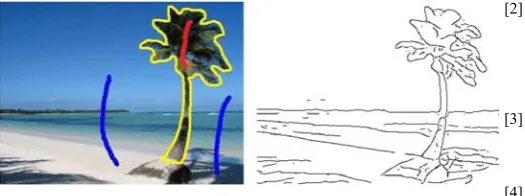
Fig. 1. (Left) Interactive image segmentation task with red and blue denoting seeds for the object and background. With the proposed framework, the whole palm tree can be cut out even when there is no seed
at the trunk. (Right) Boundary map contains strong cues for segment labeling.We show how to fuse appearance and boundary information in
segmentation. [7]
Fig. 2. Superpixels overlaid on the penguin image using the normalized-cut method as adopted by [16]. A small number of superpixels
are shown for visualization purpose. [7]
III.CONCLUSION
In this paper, we have studied about Interactive image segmentation and various technologies used for it. From these technologies, in DPMVL, their approach draws strength from Dirichlet process-based nonlinear
classification and the multiple views that include both color appearance and salient boundary information. As we have studied about Interactive image segmentation and its approaches, we got to know that the study of this topic is in depth and range of application areas will continue to increase. There are more possibilities of improvement in the effectiveness of segmentation process which can be fulfill in the proposed method. Proposed method can combines the advantages of different mentioned techniques, more algorithm extensibility, more interactivity and user control of segmentation process. Further research can be focused on the simplification of the algorithm, which attempt to decrease the computation complexities within acceptable calculation time and misclassifications. Compared with the typical existing methods, the improved algorithm can achieve superior performance.
REFERENCES
[1] “Stastical Approach to Interactive Image segmentation” Ahmed A. Hussein, School of Information Science and Engineering, Northeastern University, Liaoning 110819, China .& Xiaochun Yang ,School of Information Science and Engineering, Northeastern University, Liaoning 110819, China.
[2] 2013 IEEE International Conference on Systems, Man, and Cybernetics “Interactive fuzzy connectedness image segmentation for neonatal brain MR image segmentation”, Syoji Kobashi, Kei Kuramoto, Yutaka Hata Himeji Initiative in Computational Medical and Health Technology, Graduate school of engineering,
University of Hyogo, Himeji, Japan.
[3] Proceedings of the 2007 IEEE International Conference on Robotics and Biomimetics ,December 15 -18, 2007, Sanya, China “Image Segmentation Based on Markov Random Field with Ant Colony System” , Xiaodong Lu , Jun Zhou.
[4] “Hybrid Markov Random Field with Parallel Ant Colony Optimization and Fuzzy C Means for MRI Brain Image segmentation” , Dr. M. Karnan1, N. Nandha Gopal2, 1 Professor, Department of Computer Science and Engineering, Tamilnadu College of Engineering, Coimbatore, India & 2 Reserarch Scholar, Department of Computer Science and Engineering, Manonmaniam Sundaranar University,
Thirunelveli, India
[5] WCCI 2012 IEEE World Congress on Computational Intelligence June, 10-15, 2012 - Brisbane, Australia, “Image segmentation via ant colony algorithm and loopy belief propagation algorithm”,Xu Shengjun , Liu Guanghui & Liu Xin.
[6] IEEE TRANSACTIONS ON CIRCUITS AND SYSTEMS FOR VIDEO TECHNOLOGY, VOL. 24, NO. 7, JULY 2014, “Interactive Segmentation Using Constrained Laplacian Optimization”Jianbing Shen, Senior Member, IEEE, Yunfan Du, and Xuelong Li, Fellow, IEEE.
[7] Lei Ding, Alper Yilmaz, and Rong Yan, “Interactive Image Segmentation Using Dirichlet Process Multiple-View Learning”, IEEE TRANSACTIONS ON IMAGE PROCESSING, VOL. 21, NO. 4, PP. 2119-2129, APRIL 2012
[8] TAndrew Blake, Carsten Rother, M. Brown, Patrick Perez, Philip Torr, “Interactive Image Segmentation Using an Adaptive GMMRF Model”, Computer Vi-sion – ECCV 2004, Lecture Notes in Computer Sci-ence Volume 3021, 2004, pp 428-441.
[9] J Ning, L Zhanq, D Zhanq, C Wu – Pattern Recognition, 2010 – ElseVier , “ Interactive image segmentation by maximal similarity based region merging “ .
[10] “ Interactive image segmentation using probabilistic hypergraphs” , Pattern Recognition May 2010, Vol.43(5): 1863-1873, doi:10.101.., Lei Ding, Alper Yilmaz.
[11] Jia He, Chang-Su Kim, C.-C. Jay Kuo, “Interactive Image Segmentation Techniques” SpringerBriefs in Electrical and Computer Engineering 2014 , pp 17-62.
[13] “Interactive image segmentation via Adaptive Weighted Distances “, Image processing, IEEE Transactions on (Volume 16, Issue 4) [14] “Interactive segmentation with Intelligent scissors”, Eric N.
Mortensen, William A. Barrett, Graphical Models and Image Processing , September 1998, Vol.60(5):349-384
[15] “ Interactive Graph Cut Method based on Improved Gabor Features for Image Segmentation”, Dongliang Yang, Tingquan Deng, Chengdong Yang and Jilong Bian