Constant-Round Concurrent Zero Knowledge
From Falsifiable Assumptions
Kai-Min Chung∗ Huijia Lin† Rafael Pass‡
Abstract
We present a constant-round concurrent zero-knowledge protocol for NP. Our protocol is sound against uniform polynomial-time attackers, and relies on the existence of families of collision-resistant hash functions, and a new (but in our eyes, natural) falsifiable intractability assumption: Roughly speaking, that Micali’s non-interactive CS-proofs are sound for languages inP.
∗
Cornell University, Email: [email protected] †
MIT and Boston University, Email: [email protected].
‡
1
Introduction
Zero-knowledge (ZK) interactive proofs [GMR89] are paradoxical constructs that allow one player (called the Prover) to convince another player (called the Verifier) of the validity of a mathematical statement x ∈ L, while providing zero additional knowledge to the Verifier. Beyond being fasci-nating in their own right,ZKproofs have numerous cryptographic applications and are one of the most fundamental cryptographic building blocks.
The notion of concurrent zero knowledge, first introduced and achieved in the paper by Dwork, Naor and Sahai [DNS04], considers the execution of zero-knowledge proofs in an asynchronous and concurrent setting. More precisely, we consider a single adversary mounting a coordinated attack by acting as a verifier in many concurrent executions (called sessions). ConcurrentZK proofs are significantly harder to construct and analyze. Since the original protocol by Dwork, Naor and Sahai (which relied on so called “timing assumptions”), various other concurrentZKprotocols have been obtained based on different set-up assumptions (e.g., [DS98, Dam00, CGGM00, Gol02, PTV12, GJO+12]), or in alternative models (e.g., super-polynomial-time simulation [Pas03b, PV10]).
In the standard model, without set-up assumptions (the focus of our work,) Canetti, Kilian, Petrank and Rosen [CKPR01] (building on earlier works by [KPR98, Ros00]) show that concurrent
ZKproofs for non-trivial languages, with “black-box” simulators, require at least ˜Ω(logn) number of communication rounds. Richardson and Kilian [RK99] constructed the first concurrent ZK
argument in the standard model without any extra set-up assumptions. Their protocol, which uses a black-box simulator, requiresO(n) number of rounds. The round-complexity was later improved in the work of Kilian and Petrank (KP) [KP01] to ˜O(log2n) round. Somewhat surprisingly, the simulator strategy of KP is “oblivious”—the “rewinding schedule” of the simulator ignores how the malicious verifier schedules its messages. The key insight behind this oblivious simulation technique is that a single “rewinding” may be helpful for simulating multiple sessions; in essence, KP performs an amortized analysis, which improves the round-complexity. (As we shall see shortly, such an amortized analysis will play an important role also in this work.) More recent work by Prabhakaran, Rosen and Sahai [PRS02] improves the analysis of the KP simulator, achieving an essentially optimal, w.r.t. black-box simulation, round-complexity of ˜O(logn); see also [PTV12] for an (arguably) simplified and generalized analysis.
The central open problem in the area is whether a constant-round concurrentZKprotocol (for a non-trivial language) can be obtained. A major breakthrough towards resolving this question came with the work of Barak [Bar01], demonstrating a new non-black-box simulation technique that seemed amenable for constructing constant-round protocols that are resilient to concurrent attacks. Indeed, Barak demonstrated a constant-roundbounded-concurrent argument forNPbased on the existence of collision-resistant hash-functions; bounded-concurrency here means that for every a-priori polynomial boundmon the number of concurrent executions, there exists a protocol (which depends on m) that remains zero-knowledge as long as the number of concurrent execution does not exceed m. (In particular, in the protocol of Barak, the message length of the protocol grows linearly with thea-prioribound m on the number of concurrent executions.)
But a decade later, the question of whether “full” (i.e., unbounded) concurrent zero-knowledge is achievable in a constant number of rounds is still wide open.
1.1 Our Results
P-certificates We consider an analogue of Micali’s non-interactive CS-proofs [Mic00] for lan-guages in P. Roughly speaking, we say that (P, V) is a P-certificate system if (P, V) is a non-interactive proof system (i.e., the prover send a single message to the verifier, who either accepts or rejects) allowing an efficient prover to convince the verifier of the validity of any deterministic polynomial-time computation M(x) = y using a “certificate” of some fixed polynomial length (in-dependent of the size and the running-time of M) whose validity the verifier can check in some fixed polynomial time (independent of the running-time ofM). That is, aP-certificate allows every deterministic polynomial-time computation to be certified using a “short” certificate (of a-priori
bounded polynomial length) that can be “quickly” verified (ina-priori bounded polynomial-time). The soundness condition of a P-certificate system states that no uniform polynomial-time algorithm can output an accepting certificate for any false statement. For our application we will require a slightly stronger soundness condition: soundness needs to hold even againstT(·)-time attackers attempting to prove the validity also ofT(·)-time computations, whereT(·) is some “nice” (slightly) super-polynomial function (e.g., T(n) =nlog log logn). We refer to such proof systems as
strong P-certificates. Since we consider only languages in P, we may also consider statistically-sound (resp statistically-sound strong) P-certificates, where soundness holds also with respect to unbounded attackers restricted to selecting statements of polynomial (resp. T(·)) length. (Note that considering soundness against non-uniform efficient-time attackers is equivalent to statistical soundness, since if an accepting proof of a false statement exists, a non-uniform efficient attacker can simply get it as non-uniform advice.
On the Existence of P-certificates A candidate construction of a (computationally-sound) P-certificate system comes from Micali’s CS-proofs [Mic00]. These constructs provide short cer-tificates even for all of NEXP. However, since we here restrict to certificates only for P, the assumption that these constructions are sound (resp. strongly sound) P-certificates is falsifiable
[Pop63, Nao03]: Roughly speaking, we can efficiently test if an attacker outputs a valid proof of an incorrect statement, since whether a statement is correct or not can be checked in deterministic polynomial time. Formalizing this intuition turns out to be somewhat subtle: in general, whether an attacker breaks soundness of a strong P-certificate system, or even just aP-certificate system, may not be efficiently testable since there is no a-priori polynomial upper-bound on the running-time of the machineM selected by the attacker. At first one may think that this issue can be easily resolved by asking the prover to provide an upper-bound on the running-time of M in unary; this certainly makes the soundness condition falsifiable, but such certificates are no longer “short”. We overcome this issue by relying on the fact that Micali’s construction satisfies an additional (and very natural) property, which we refer to astime-representation invariance—namely, that whether the verifier accepts a proof of a statementxdoes not depend on how the time-bound (i.e., the upper bound on the running time ofM) is represented. For a time-representation invariantP-certificate, it suffices to define soundness for the the case that the attacker specifies the time-bound in unary; by the time-representation invariance condition, this implies soundness also for other (more efficient) representations. Thus, assuming that the soundness condition of a time-representation invariant P-certificate holds is a falsifiable assumption, yet “short” certificates can still be generated by using more efficient representations of the running-time bound.1
In our eyes, on a qualitatively level, the assumption that Micali’s CS-proofs yield strong P-certificates is not very different from the assumption that e.g., the Full Domain Hash [BR93] or Schnorr [Sch91] signature schemes are existentially unforgeable: 1) whether an attacker succeeds can
1In contrast, as shown by Gentry and Wichs [GW11], (under reasonable complexity theoretic assumptions)
be efficiently checked, 2) no attacks are currently known, and 3) the “design-principles” underlying the construction rely on similar intuitions.
Finally, note that the assumption that statistically-sound strong P-certificates exists is implied by the assumption that 1)DTIME(nω(1))⊆NPand 2) NPproofs for statements inDTIME(t) can be found in time polynomial int[BLV06]. In essence, the assumption says that non-determinism can slightly speed-up computation, and that the non-deterministic choices can be found efficiently, where efficiency is measured in terms of the original deterministic computation. Although we have no real intuition for whether this assumption is true or false2, it seems beyond current techniques to contradict it. (As far as we know, at this point, there is no substantial evidence that even SUBEXP6⊆NP.)
From P-certificates to O(1)-round Concurrent ZK Our main theorem is the following.
Theorem. Assume the existence of families of collision-resistant hash-functions secure against polynomial-size cirucuits, and the existence of a strong P-certificate system (resp. a statistically-sound strong P-certificate system). Then there exists a constant-round concurrent zero-knowledge argument for NP with uniform soundness (resp. non-uniform soundness). Furthermore, the pro-tocol is public-coin and its communication complexity depends only on the security parameter (but not on the length of the statement proved).
Our protocol is a variant of Barak’s [Bar01] non-black-box zero-knowledge argument for NP. As mentioned above, Barak’s original protocol already handles bounded-concurrent composition; that is, it remains secure under an a priori bounded number of concurrent executions. In con-trast, our protocol handles an unbounded number of executions, but relies on (seemingly) stronger assumptions.
Let us briefly remark that from a theoretical point of view, we find the notion of uniform soundness of interactive arguments as well-motivated as the one of non-uniform soundness; see e.g., [Gol93] for further discussion. From a practical point of view (and as is often the case), an asymptotic treatment of soundness is not needed for our results, even in the uniform setting: our soundness proof is a constructive black-box reduction that (assuming the existence of families of collision-resistant hash-functions), transforms any attacker that breaks soundness of our concurrent
ZKprotocol on asingle security parameter 1ninto an attacker that breaks the the soundness of the P-certificate systems with comparable probability on thesame security parameter 1n, with only a “small” polynomial overhead. In particular, if some attacker manages to break the soundness of a particular instantiation of our protocol using e.g., Micali’s CS-proof for languages inPimplemented using some specific hash function (e.g., SHA-256), then this attacker can be used to break this
particular implementation of CS-proofs.
1.2 Outline of Our Techniques
We provide a detailed outline of our techniques. We warn the reader that this outline is quite technical and assumes the reader is relatively familiar with Barak’s non-black-box simulation tech-nique.
Let us start by very briefly recalling the idea behind Barak’s protocol (following a slight variant of this protocol due to [PR03b]). Roughly speaking, on common input 1n andx∈ {0,1}poly(n), the
2As far as we know, the only evidence against it is that it contradicts very strong forms of derandomization
ProverP and VerifierV, proceed in two stages. In Stage 1,P starts by sending a computationally-binding commitmentc∈ {0,1}nto 0n;V next sends a “challenge”r∈ {0,1}2n. In Stage 2,P shows (using a witness indistinguishable argument of knowledge) that either x is true, or there exists a “short” string σ∈ {0,1}n such thatc is a commitment to a programM such thatM(σ) =r.3
Soundness follows from the fact that even if a malicious prover P∗ tries to commit to some program M (instead of committing to 0n), with high probability, the string r sent by V will be different from M(σ) for every string σ ∈ {0,1}n. To prove ZK, consider the non-black-box simulator S that commits to the code of the malicious verifierV∗; note that by definition it thus holds that M(c) = r, and the simulator can use σ = c as a “fake” witness in the final proof. To formalize this approach, the witness indistinguishable argument in Stage 2 must actually be a witness indistinguishable universal argument (WIUA) [Mic00, BG08] since the statement that c
is a commitment to a program M of arbitrary polynomial-size, and that M(c) = r within some
arbitrary polynomial time, is not in NP.
Now, let us consider concurrent composition. That is, we need to simulate the view of a verifier that starts m = poly(n) concurrent executions of the protocol. The above simulator no longer works in this setting: the problem is that the verifier’s code is now a function of all the prover messages sent in different executions. (Note that if we increase the length of r we can handle a bounded number of concurrent executions, by simply letting σ include all these messages).
So, if the simulator could commit not only to the code of V∗, but also to a program M that generates all other prover messages, then we would seemingly be done. And at first sight, this doesn’t seem impossible: since the simulatorSis actually the one generating all the prover messages, why don’t we just let M be an appropriate combination of S and V∗? This idea can indeed be implemented [PR03b, PRT11], but there is a serious issue: if the verifier “nests” its concurrent executions, the running-time of the simulation quickly blows up exponentially—for instance, if we have three nested sessions, to simulate session 3 the simulator needs to generate aWIUA regarding the computation needed to generate aWIUAfor session 2 which in turn is regarding the generation of theWIUAof session 1 (so even if there is just a constant overhead in generating aWIUA, we can handle at most lognnested sessions).
P-certificates to The Rescue Our principal idea is to useP-certificates to overcome the above-mentioned blow-up in the running time. On a very high-level, the idea is that once the simulatorS
has generated aP-certificate π to certify some partial computation performed byS in a particular session i, then the same certificate may be reused (without any additional “cost”) to certify the same computation also in other sessions i0 6= i. In essence, by reusing the same P-certificates, we can amortize the cost of generating them and may then generate WIUA’s about WIUA’s etc., without blowing-up the running time of the simulator. Let us briefly mention how the two salient features of P-certificates, namely “interactivity” and “succinctness”, are used: Without non-interactivity, the same certificate cannot be reused in multiple sessions, and without succinctness, we do not gain anything by reusing a proof, since just reading the proof may be more expensive than verifying the statement from “scratch”.
Implementing the above high-level idea, however, is quite non-trivial. Below, we outline our actual implementation. We proceed in three steps:
1. We first present a protocol that only achieves bounded-concurrent ZK, using P-certificates,
3
We require that C is a commitment scheme allowing the committer to commit to an arbitrarily long string
m ∈ {0,1}∗
2. We next show how this bounded-concurrent protocol can be slightly modified to become a (fully) concurrentZKprotocol assuming the existence of so-calledunique P-certificates —P-certificates having the property that for every true statement, there exists asingle accepting certificate.
3. In the final step, we show how to eliminate the need for uniqueness, by generating P-certificates about the generation of P-certificates etc., in a tree-like fashion.
Step 1: Bounded Concurrency Using P-certificates In this first step, we present a (some-what convoluted) protocol using strongP-certificates that achieves m(·)-bounded concurrency (us-ing an even more convoluted simulation). As mentioned, Barak’s original protocol could already be modified to handle bounded concurrency, without the use of P-certificates; but as we shall see shortly, our protocol can later be modified to handle full concurrency.
The protocol proceeds just as Barak’s protocol in Stage 1 except that the verifier now sends a string r∈ {0,1}2m(n)n2
(instead of length 2n). Stage 2 is modified as follows: instead of havingP
prove (using a WIUA) that either x is true, or there exists a “short” string σ ∈ {0,1}m(n)n2
such that c is a commitment to a program M such that M(σ) = r, we now ask P to use a WIUA to prove that eitherx is true, or
• commitment consistency: cis a commitment to a program M1, and
• input certification: there exists a “short” string σ∈ {0,1}m(n)n, and
• prediction correctness: there exists a P-certificate π of length n demonstrating that
M1(σ) =r.
(Note that the only reason we still need to use a universal argument is that there is no a-priori
upper-bound on the length of the program M1; the use of the P-certificate takes care of the fact that there is noa-prioriupper-bound on the running-time ofM1, though.) Soundness follows using essentially the same approach as above, except that we now also rely on the strong soundness of theP-certificate; since there is no a-priori upper-bound on neither the length nor the running-time of M1, we need to put a cap on both using a (slightly) super-polynomial function, and thus to guarantee soundness of the concurrent zero-knowledge protocol, we need theP-certificate to satisfy
strong soundness.
Let us turn to (bounded-concurrent) zero-knowledge. Roughly speaking, our simulator will attempt to commit to its own code in a way that prevents a blow-up in the running-time. Recall that the main reason that we had a blow-up in the running-time of the simulator was that the generation of theWIUA is expensive. Observe that in the new protocol, the only expensive part of the generation of the WIUA is the generation of the P-certificates π; the rest of the computation has a-priori bounded complexity (depending only on the size and running-time of V∗). To take advantage of this observation, we thus have the simulator only commit to a program that generates prover messages (in identically the same way as the actual simulator), but getting certificates~π as input.
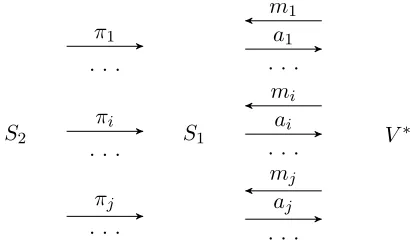
In more detail, to describe the actual simulatorS, let us first describe two “helper” simulators
S2 S1 V∗
πj
πi
π1
mj
aj
mi
ai
m1 a1
· · ·
· · ·
· · ·
· · ·
· · ·
· · ·
Figure 1: Simulation using P-certificates.
S1 proceeds as follows in the right interaction. In Stage 1 of every session i,S1 first commits to a machine ˜S1(j0, τ) that emulates an interaction betweenS1andV∗, feedingS1 inputτ as messages on the left, and finally ˜S1 outputs the verifier message in the j0’th communication round in the right interaction withV∗. (Formalizing what it means forS1 to commit to ˜S1 is not entirely trivial since the definition of ˜S1 depends onS1; we refer the reader to the formal proof for a description of how this circularity is broken.4 S1 next simulates Stage 2 by checking if it has received a message (j, πj) in the left interaction, where j is the communication round (in the right interaction with
V∗) where the verifier sends its random challenge and expects to receive the first message of Stage 2; if so, it uses M1 = ˜S1 (and the randomness it used to commit to it), j and σ being the list of messages received by S1 in the left interaction, as a ”fake” witness to complete Stage 2.
The job of S2 is to provide P-certificatesπj for S1 allowingS1 to complete its simulation. S2 emulates the interaction between S1 and V∗, and additionally, at each communication roundj,S2 feedsS1 a message (j, πj) whereπj is aP-certificate showing that ˜S1(j, σ<j) =rj, whereσ<j is the list of message already generated by S2, and rj is the verifier message in the j’th communication round. Finally, S2 outputs its view of the full interaction.
The actual simulatorSjust runsS2and recovers from the view ofS2the view ofV∗ and outputs it. Note that since S1 has polynomial running-time, generating each certificate about ˜S1 (which is just about an interaction between S1 and V∗) also takes polynomial time. As suchS2 can also be implemented in polynomial time and thus alsoS. Additionally, note that if there arem(n) sessions, the length ofσ is at mostO(m(n)n)m(n)n2—for each of them(n) sessions, and for each round of the constant number of rounds in each session, we need to store a pair (j, π) whereπ is of length
n; therefore, the simulation always succeeds without getting “stuck”.
Finally, indistinguishability of this simulation, roughly speaking, should follow from the hiding property of the commitment in Stage 1, and the WI property of theWIUA in Stage 2. Or does it? Note that since S1 is committing to its own code (including its randomness), it is committing to a message that depends on the randomness used for the commitment. (In the language of [BCPT12], this constitutes a randomness-dependent message (RDM) attack on the commitment scheme.) This circularity can be easily overcome (as in [PRT11]) by simply not committing to the randomness of
˜
S1, and instead providing it as an additional input to ˜S1 that may be incorporated inσ; without loss of generality, we may assume that the randomness is “short” sinceS1 can always use a PRG to expand it. But the same circularity arises also in theWIUA, and hereσ, which contains the seed used to generate the randomness of S1, needs to be an input. To overcome it, we here require S1 to use aforward-secure PRG [BY03] to expand its randomness; roughly speaking, a forward-secure
PRG ensures that ”earlier” chunks of the output of the PRG are indistinguishable from random, even if a seed generating the ”later” ones is revealed. We next have S1 use a new chunk of the output of the PRG to generate each new message in the interaction, but uses these chunk inreverse order (i.e., in step 1, the last chunk of the output of the PRG is used, etc.); this means that we can give proofs about ”earlier” computations of S1 (which requires knowing a seeds expanding the randomness used in the computation) while still guaranteeing indistinguishability of ”later” messages.5
Step 2: Full Concurrency using Unique P-certificates The reason that the above approach only yields a bounded concurrent zero-knowledge protocol is that for each new sessioni, we require
S2 to provideS1with new certificates, which thus grows the length ofσ. If we could somehow guar-antee that these certificates aredetermined by the statement proved in the WIUA, then soundness would hold even ifσis long. Let’s first sketch how to do this when assuming the existence ofunique
strong P-certificates—that is, P-certificates having the property that for each true statement x, there exists a single proof π that is accepted. (We are not aware of any candidates for unique P-certificates, but using them serves as a simpler warm-up for our actual protocol.) We simply modify the input certification and prediction correction conditions in theWIUAto be the following:
• input certification: there exists a vectorλ= ((1, π1),(2, π2), . . .) and a vector of messages ~
m such that πi certifies that M1(λ<j) output mj in its j’th communication round, where
λ<j = ((1, π1), . . . ,(j−1, πj−1)), and
• prediction correctness: there exists a P-certificate π of length n demonstrating that
M1(λ) =r.
Soundness of the modified protocol, roughly speaking, follows since by the unique certificate prop-erty, for every programM1 it inductively follows that for everyj,mj is uniquely defined, and thus also the unique (accepting) certificateπj certifying M1(λ<j) =mj; it follows thatM1 determines a unique vectorλthat passes the input certification conditions, and thus there exists a singler that make M1 also pass the prediction correctness conditions. Zero-knowledge, on the other hand, can be shown in exactly the same way as above (usingS1, S2), but we can now handle also unbounded concurrency (since there is no longer a restriction on the length of the inputλ).
Step 3: Full Concurrency Using (Plain) P-certificates Let us finally see how to implement the above idea while using “plain” (i.e., non-unique)P-certificates. The above protocol is no longer sounds since we cannot guarantee that the proofsπj are unique, and thus the messagesmj may not be unique either, which may make it possible for an attacker to pass the “prediction correctness” condition (without knowing the code of V∗) and thus break soundness. A natural idea would thus be to ask the prover to commit to a machine M2 (which in the simulation will be a variant of S2) that produces the certificates πj, and then require the prover to provide a ”second-level” certificate that the ”first-level” certificates were generated (deterministically) by runningM2. But have we really gained anything? Now, to perform the simulation, we need to provide the second-level certificates as input to both M1 and M2; however, for these second-level certificates, we have no guarantees that they were deterministically generates and again there is noa-priorupper bound on the number of such certificates, so it seems we haven’t really gained anything.
5
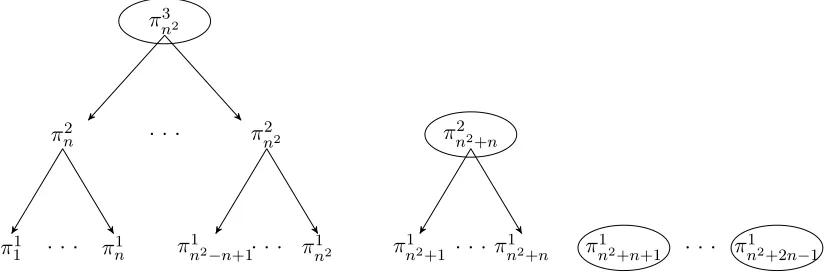
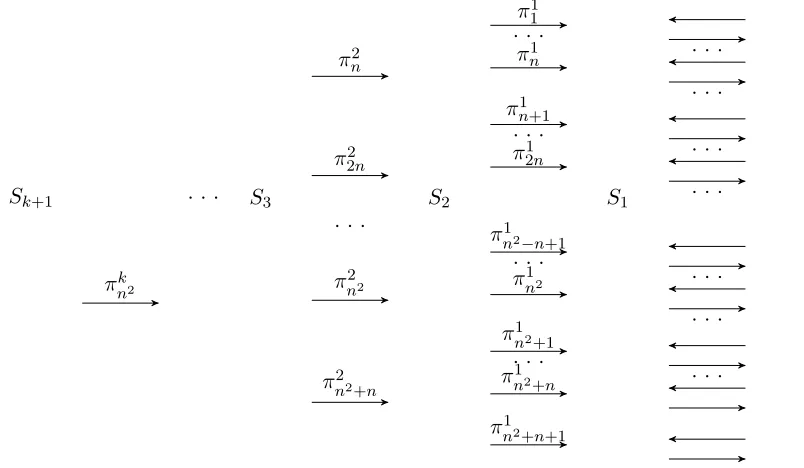
Our main observation is that a single ”second-level” certificate can be used to to certify the (deterministic generation) of n ”first-level”certificates. And a sequence of n “second-level” cer-tificates can be certified by a single “third-level” certificate, etc. At each level, there will be less than n certificates that are not certified by a higher-level certificate; we refer to these as “dan-gling” certificates. See Figure 2 for an illustration of the tree structure, and certified and dangling certificates.
π11 · ·· πn1 π1n2−n+1· ·· πn12 π
1
n2+1 · ·· πn12+n πn12+n+1 · ·· πn12+2n−1
π2n π2n2 π
2 n2+n
· · ·
πn32
Figure 2: An illustration of the tree structure for generating P-certificates. Nodes that are not circled are “certified” certificates; nodes that are circled are “dangling” certificates.
Note that since the number of messages in the interaction withV∗ is polynomially bounded, we only have a polynomial-number of level-1 certificates, and thus, the above higher-level certification process does not go beyond a constant number of levels (at each level we need a factor of n less certificates). Finally, note that the total number of “dangling” (uncertified) certificates is bounded by the number of levels timesn(and is thus bounded by, say,n2.) This means that all the dangling certificates may be provided as a “short” input σ to the committed program, and all the certified certificates can be provided as a “long” (but certified deterministically generated) inputλ.
Let us explain this idea more closely using only second-level certificates; this still only gives us bounded-concurrency, but we may now handle O(m(n)n) sessions (instead of just m(n)). (More generally, if we usek-levels of certification, we can handlem(n)nk sessions.) We now change Stage 2 of the protocol to require P to use a WIUAto prove that eitherx is true, or
• commitment consistency: cis a commitment to programs M1, M2, and
• input certification: there exists
– a vector of ”certified level-1 certificates”λ1 = ((1, π1),(2, π2), . . . ,(an, πan)),
– a ”small” number of ”dangling level-1 certificates” σ1 = (σ11, σ12, . . . , σj10), where j0 < n and for each j≤j0,σj1 ∈ {0,1}n,
– a≤m(n) level-2 certificatesσ2 = (σ2n, σ22n, . . . , σan2 ) where for eachj ≤a,σ2jn∈ {0,1}n,
such that,
– σan2 certifies that M2(σ<an2 ) generates the certificates λ1,
and
• prediction correctness: there exists a P-certificate π of length n demonstrating that
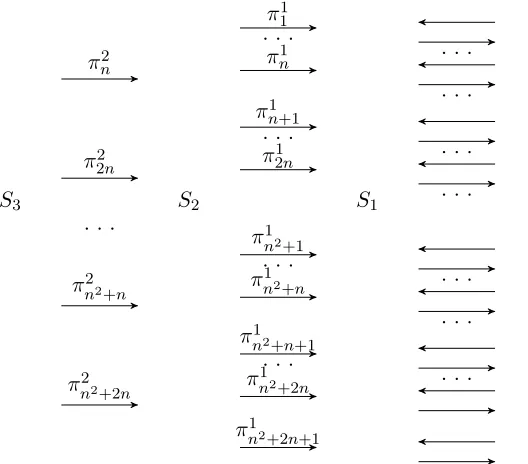
Soundness of this protocol follows since the total length of “arbitrary” (not deterministic) input is bounded by (m(n)+n)nm(n)n2. m(n)n-bounded concurrent zero-knowledge on the other hand, roughly speaking, follows by lettingM1 be as above (i.e., ˜S1) andM2 be a variant of the simulator S2 that outputs all the certificates generated by S2. We then define a simulator S3 responsible for generating second-level certificates for S2, and finally outputs its full view of the interaction. The final simulator S runs S3 and outputs the view ofV∗ in the interaction. See Figure 3 for an illustration of the communication patterns ofS1, S2, S3 and V∗.
S3 S2 S1 V∗
· · ·
· · ·
· · ·
· · ·
· · ·
· · ·
· · ·
π11
· · ·
π1 n
π1 n+1
· · ·
π12n
π1n2+1
· · ·
π1 n2+n
πn12+n+1
· · ·
πn12+2n
π1n2+2n+1
πn2
π22n
πn22+n
πn22+2n
· · ·
Figure 3: Simulation using second-level P-certificates.
Note that as long as there are less thanm(n)nmessage in the interaction withV∗, the number of first-level certificates is bounded by m(n)n, and thus we have enough “spots” for second-level certificates (inσ2) to perform the simulation.
In the final protocol, we instead have the simulator commit to a sequenceM1, M2, . . .of machine; roughly speaking,M1will be as above,M2is responsible for generating first-level certificates (while receiving level k > 1 certificates externally), M3 will be responsible for generating second-level certificates (while receiving level k >2 certificates externally), etc. Note that although there is a (potentially) exponential blow-up in the time needed to generate higher-level certificates, since we only have a constant-number of levels, simulation can be performed in polynomial-time.
1.3 Related Work
We provide a detailed discussion of some other related works:
• As mentioned in the introduction, constant-round concurrent zero-knowledge protocols with
super-polynomial-time simulators have been constructed in the plain model [Pas03a, PV08]. For the protocol of [Pas03a], the only super-polynomial-time “advantages” needed by the simulator is to find a pre-image x0 =f−1(y) to any point y output by the malicious verifier
explicitly knows, then the protocol of [Pas03a] is concurrent zero-knowledge. A problem with formalizing this is that V∗ may already get some string y =f(x) as its auxiliary input and thus may not know x. As in the literature on “knowledge-of-exponent”-type extractability
assumptions (see e.g., [Dam91, HT98, BP04b, CD09, BCCT12a, DFH12, GLR11]), this issue
can be resolved by having the prover select the one-way functionf from a familyF of one-way functions. Now the extractability assumption we need is that for every polynomial-time oracle machineM, there exists some polynomial-time machine M0 such that given any z∈ {0,1}∗, and uniformly selected functions f~ = f1, . . . fpoly(n) ∈ F, MO(
~
f)(1n, z, ~f) and M0(1n, z, ~f)
generate the same output, where O(f~) is an oracle that inverts the functions in f~. In other words, we are assuming that in the simulation, the simulator together with the verifier can —in polynomial-time—emulate the one-way function inverter used in [Pas03a]. Note that the above extractability assumption is stronger than the typical “knowledge-of-exponent”-type extractability assumptions since we require simultaneous extractability of many images y
that are chosen adaptively by the adversary.6 However, as shown in [Pas03b], any sufficiently length-expanding random oracle satisfies exactly such an extractability assumption—this was used in [Pas03a] to construct a concurrentZK protocol in the “non-programmable” random oracle model.
One important difference between the above approach and our work is that we here provide
an explicit concurrent ZK simulator. The above-mentioned approach simply assumes that
such a simulator exists; and, even if the assumption is true, it is not clear, how to find it. In particular, for the purpose of deniability (see e.g., [DNS04, Pas03b]) it is not clear whether the approach based on “extractability” assumptions provides sufficient guarantees (unless an explicit simulator strategy is found).
• Barak, Lindell and Vadhan [BLV06] show that under the assumptions that 1)DTIME(nω(1))⊆
NP and 2) NPproofs for statements in DTIME(t) can be found in time polynomial in t, 2-round proof exists that are zero-knowledge for uniform verifiers that do not receive any auxiliary input. Their zero-knowledge simulator is non-black-box. As mentioned in the introduction, the above-mentioned assumptions imply the existence of statistical strong P-certificates. We note that the protocol of [BLV06] is not known to be concurrent (or even sequential) zero-knowledge, even with respect to uniform malicious verifiers.
• Contemporary work by Canetti, Lin and Paneth [CLP12] constructs a public-coin concur-rent zero-knowledge protocol using non-black-box simulation techniques7. As shown by Pass, Tseng and Wikstrom [PTW11], public-coin concurrent (and in fact even parallel) zero-knowledge protocols require non-black-box simulation, no matter what the round-complexity is. The protocol of [CLP12] is in the “non-programmable” CRS model of [Pas03a] but as showed in [Pas03a] black-box separation of the Goldreich-Krawczyk [GK96] type (and, in particular, the [PTW11] one, falls into this category) extend also to zero-knowledge in the non-programmable CRS model; thus non-black-box simulation is necessary also for their re-sult. In contrast to our protocol, theirs, however, requires O(log1+εn) number of rounds for arbitrarily small constant ε, but instead only relies on the existence of families of collision-resistant hash functions. (Additionally, [CLP12] note that if assuming the existence of a single hash function that is collision-resistant against uniform adversaries, their protocol can
6
On the other hand, it is weaker that most other usages of extractability in it requires less structure from the function (i.e., only one-wayness).
7
be instantiated also in the plain model with uniform soundness.)
On a technical level, both our work and theirs provide methods for overcoming the exponential blow-up in the simulation time when dealing with non-black-box simulations, but the actual details of the methods are very different: [CLP12] increases the round-complexity to tackle this blow-up, and relies on ideas from the literature on concurrent zero-knowledge with black-box simulation[RK99, KP01, PRS02]; as a result, their techniques only apply in the context of super-logarithmic round protocols. In contrast, we rely onP-certificates to overcome the blow-up and obtain a constant-round protocol. (We also mention that our protocol can be modified in a straight-forward way to achieve non-uniform soundness in the non-programmable CRS model, by using 2-roundP-certificates (that are sound against non-uniform polynomial-time) and simply having the first message of the P-certificate be fixed as the CRS.)
• A recent work by Bitansky, Canetti, Chiessa, Tromer [BCCT12b] present techniques for com-posing SNARKs (succinct non-interactive arguments of knowledge) forNP; roughly speaking, [BCCT12b] shows that if forsome sufficiently largec, anynon-deterministic nccomputation can be proved using an “argument of knowledge” of length nthat can be verified in timen2, then forany d, every non-deterministic nd-time computation can be also be proved (using a SNARK of length nthat can be verified in time n2). This is achieved by having the prover first generate a SNARK for each subcomputation ofncsteps, and then for each “chunk” ofn
SNARKs, having the prover prove that itknows SNARKs that are accepted for all these sub-computations, and so on in a tree-like fashion. Finally, the prover only provides the verifier with a “top-level” SNARK that it knows lower-level SNARKs that proves that it knows even lower-level SNARKs etc. This type of proof composition was previously also used by Valiant [Val08]. To prove that this type of composition works it is crucial to work with languages inNP(since we are proving statements about theexistence of some SNARKs); additionally, it is crucial that we are dealing with arguments of knowledge—SNARKs of false statements may exists, so to guarantee soundness, the prover needs to show that not only appropriate SNARKs exists, but also that it “knows” them.
At a superficial level, our simulator strategy also uses a tree of “proofs”. However, rather than proving knowledge of lower-level “proofs” etc, in our approach, higher-levelP-certificates are only used to demonstrate that lower-levelP-certificates have been deterministically generated. As a consequence, we do not need to certify non-deterministic computations; additionally, we do not need the certificates to satisfy an argument of knowledge property. Indeed, this is what allows us to baseP-certificates on a falsifiable assumption.
• Since the work of Barak [Bar01], non-black-box simulation techniques have been used in sev-eral other contexts: For example, non-malleability [Bar02, Pas04, PR05a, PR05b], resettable-soundness [BGGL01, DGS09, BP12], concurrent secure computation [Lin03, PR03a, Pas04, BS05], covert secure computation [GJ10]. We believe our techniques will yield improved constructions also for these settings; we hope to report on this in future works.
1.4 Acknowledgements
zero-knowledge were noticed in an unpublished manuscript with Alon dating back to 2003 [PR03a]. Thanks a lot!
2
Preliminaries
LetN denote the set of positive integers, and [n] denote the set {1,2, . . . , n}. We denote by PPT probabilistic polynomial time Turing machines. We assume familiarity with interactive Turing machines, denoted ITM, interactive protocols. Given a pair of ITMs, A and B, we denote by (A(x), B(y))(z) the random variable representing the (local) output ofB, on common inputz and private input y, when interacting with A with private input x, when the random tape of each machine is uniformly and independently chosen, and ViewBhA(x), B(y)i(z) the random variable
representing B’s view in such an interaction. The term negligible is used for denoting functions that are (asymptotically) smaller than one over any polynomial. More precisely, a function ν(·) from non-negative integers to reals is callednegligibleif for every constantc >0 and all sufficiently largen, it holds that ν(n)< n−c.
2.1 Witness Relations
We recall the definition of a witness relation for aNPlanguage [Gol01].
Definition 1 (Witness relation). A witness relation for a language L ∈ NPis a binary relation
RL that is polynomially bounded, polynomial time recognizable and characterizes L by L ={x :
∃y s.t.(x, y)∈RL}
We say that y is a witness for the membership x ∈ L if (x, y) ∈ RL. We will also let RL(x) denote the set of witnesses for the membership x ∈ L, i.e., RL(x) = {y : (x, y) ∈ L}. In the following, we assume a fixed witness relation RL for each languageL∈NP.
2.2 Computational Indistinguishability
The following definition of computational indistinguishability originates in the seminal paper of Goldwasser and Micali [GM84]. LetXbe a countable set of strings. Aprobability ensemble indexed by X is a sequence of random variables indexed byX. Namely, any element ofA ={Ax}x∈X is a random variable indexed by X.
Definition 2(Indistinguishability). LetXbe a countable set. Two ensembles{An,x}n∈N,x∈X and
{Bn,x}n∈N,x∈X are said to be computationally indistinguishable over N if for every probabilistic machine D (the distinguisher) whose running time is polynomial in its first input, there exists a negligible function ν(·) so that for everyn∈N and x∈X:
|Pr [a←An,x : D(1n, x, a) = 1]−Pr [b←Bn,x :D(1n, x, b) = 1]|< ν(n)
2.3 Interactive Proofs and Arguments
commonly used (but there are exceptions, see e.g., [BP04a]). We find the uniform model of com-putation as well-motivated as the non-uniform one; see e.g., [Gol93].
Definition 3 (Interactive Proof System). A pair of interactive machines (P, V) is called an inter-active proof system for a language L if there is a negligible function ν(·) such that the following two conditions hold:
• Completeness: For everyn∈N,x∈L, and everyw∈RL(x),
Pr[(P(w), V)(1n, x) = 1] = 1
• Soundness: For every pair of machines B1, B2 and everyn∈N,
Pr[(x, z)←B1(1n) :x /∈L∧(B2(z), V)(1n, x) = 1]≤ν(n)
If the soundness condition only holds against all time (resp. non-uniform polynomial-time) machines B1, B2, the pair (P, V) is called a uniformly-sound (resp. non-uniformly sound)
interactive argument system.
2.4 Witness Indistinguishability
An interactive protocol is witness indistinguishable (WI) [FS90] if the verifier’s view is “indepen-dent” of the witness used by the prover for proving the statement.
Definition 4 (Witness-indistinguishability). An interactive protocol (P, V) forL∈NPiswitness indistinguishable for RL if for every PPT adversarial verifier V∗, and for every two sequences
{w1n,x}n∈N,x∈L∩{0,1}poly(n) and {wn,x2 }n∈N,x∈L∩{0,1}poly(n), such that w1n,x, wn,x2 ∈ RL(x) for every
n∈N andx∈L∩ {0,1}poly(n), the following ensembles are computationally indistinguishable over
N:
• {ViewV∗
P(w1n,x), V∗(z)(1n, x)}n∈N,x∈L∩{0,1}poly(n),z∈{0,1}∗
• {ViewV∗
P(w2n,x), V∗(z)
(1n, x)}n∈N,x∈L∩{0,1}poly(n),z∈{0,1}∗
2.5 Commitment Schemes
Commitment protocols allow a sender to commit itself to a value while keeping it secret from the receiver; this property is called hiding. At a later time, the commitment can only be opened to a single value as determined during the commitment protocol; this property is called binding. Commitment schemes come in two different flavors, statistically binding and statistically hiding; we only make use of statistically binding commitments in this paper. Below we sketch the properties of a statistically binding commitment; full definitions can be found in [Gol01].
In statistically binding commitments, the binding property holds against unbounded adver-saries, while the hiding property only holds against computationally bounded (non-uniform) ad-versaries. The statistical-binding property asserts that, with overwhelming probability over the randomness of the receiver, the transcript of the interaction fully determines the value committed to by the sender. The computational-hiding property guarantees that the commitments to any two different values are computationally indistinguishable.
2.6 Universal Arguments
Universal arguments (introduced in [BG08] and closely related to the notion of CS-proofs [Mic00]) are used in order to provide “efficient” proofs to statements of the universal language LU with witness relationRU defined in [BG08, Mic00]. A triplety= (M, x, t)∈LU if the non-deterministic machine M accepts input X within t < T(|x|) steps, for a slightly super-polynomial function
T(n) = nlog logn. We denote by TM(x, w) the running time of M on input x using the witness w. Notice that every language in NP is linear time reducible to LU. Thus, a proof system for LU allows us to handle allNP-statements. Below we recall the definition in [BG08].
Definition 5 (Universal argument). A pair of interactive Turing machines (P, V) is called a uni-versal argument system if it satisfies the following properties:
• Efficient verification: There exists a polynomial p such that for any y = (M, x, t), the total time spent by the (probabilistic) verifier strategy V, on common input 1n, y, is at most
p(n+|y|). In particular, all messages exchanged in the protocol have length smaller than
p(n+|y|).
• Completeness by a relatively efficient prover: For every n∈N, y= (M, x, t) ∈LU and w in RU(y),
Pr[(P(w), V)(1n,(M, x, t)) = 1] = 1
Furthermore, there exists a polynomialq such that the total time spent byP(w), on common inputs 1n and (M, x, t), is at most q(n+|y|+TM(x, w))≤q(n+|y|+t).
• Computational Soundness: For every polynomial size circuit family{Pn∗}n∈N, there is a neg-ligible functionν, such that, for everyn∈N and every triplet (M, x, t)∈ {0,1}poly(n)\L
U,
Pr[(Pn∗, V)(1n,(M, x, t)) = 1]< ν(n)
• Weak proof of knowledge: For every positive polynomial pthere exists a positive polynomial
p0 and a probabilistic polynomial-time oracle machine E such that the following holds: for every polynomial-size circuit family {Pn∗}n∈N, every sufficiently large n∈ N and every y = (M, x, t)∈ {0,1}poly(n) if Pr[(P∗
n, V)(1n, y) = 1]>1/p(n) then
Pr
r [∃w=w1, . . . wt∈RU(y) s.t. ∀i∈[t], E Pn∗
r (1n, y, i) =wi]> 1
p0(n)
whereRU(y)def= {w: (y, w)∈RU}and EP ∗
n
r (·,·,·) denotes the function defined by fixing the random-tape ofE to equalr, and providing the resultingEr with oracle access to Pn∗.
The weak proof-of-knowledge property of universal arguments only guarantees that each indi-vidual bitwi of some witness wcan be extracted in probabilistic polynomial time. Given an input 1n and y = (M, x, t) in LU ∩ {0,1}poly(n), since the witness w ∈ RU(y) is of length at most t, it follows that there exists a extractor running in time polynomial in poly(n)·t that extracts the whole witness; we refer to this as theglobal proof-of-knowledge property of a universal argument.
2.7 Concurrent Zero-Knowledge
An interactive proof is said to be zero-knowledge if it yields nothing beyond the validity of the statement being proved [GMR89].
Definition 6 (Zero-knowledge). An interactive protocol (P, V) for language L is zero-knowledge
if for every PPT adversarial verifier V∗, there exists a PPT simulator S such that the following ensembles are computationally indistinguishable overn∈N:
• {ViewV∗hP(w), V∗(z)i(1n, x)}n∈N,x∈L∩{0,1}poly(n),w∈R
L(x),z∈{0,1}poly(n)
• {S(1n, x, z)}n∈N,x∈L∩{0,1}poly(n),w∈R
L(x),z∈{0,1}poly(n)
In this work we consider the setting of concurrent composition. Given an interactive protocol (P, V) and a polynomialm, anm-sessionconcurrent adversarial verifierV∗ is a PPT machine that, on common input x and auxiliary input z, interacts with up to m(|x|) independent copies of P
concurrently. The different interactions are called sessions. There are no restrictions on how V∗
schedules the messages among the different sessions, and V∗ may choose to abort some sessions but not others. For convenience of notation, we overload the notationViewV∗hP, V∗(z)i(1n, x) to
represent the view of the cheating verifier V∗ in the above mentioned concurrent execution, where
V∗’s auxiliary input is z, both parties are given common input 1n, x ∈L, and the honest prover has a validw witness ofx.
Definition 7 (Concurrent Zero-Knowledge [DNS04]). An interactive protocol (P, V) for language
L is concurrent zero-knowledge if for every concurrent adversarial verifier V∗ (i.e., any m-session concurrent adversarial verifier for any polynomial m), there exists a PPT simulator S such that following two ensembles are computationally indistinguishable overn∈N.
• {ViewV∗hP(w), V∗(z)i(1n, x)}
n∈N,x∈L∩{0,1}poly(n),w∈R
L(x),z∈{0,1}poly(n)
• {S(1n, x, z)}
n∈N,x∈L∩{0,1}poly(n),w∈R
L(x),z∈{0,1}poly(n)
2.8 Forward Secure PRG
Roughly speaking, a forward-secure pseudorandom generator (PRG) (first formalized by [BY03], but early usages go back to [BH92]) is a pseudorandom generator where the seed is periodi-cally updated—thus we have a sequence of seeds s1, s2, . . . generating a pseudorandom sequence q1, q2, . . .—such that if the seed st is exposed (and thus the “later” sequence qt+1, qt+2, . . . is also exposed), the “earlier” sequenceq1, . . . , qt still remains pseudorandom.
We provide a simple definition of a forward secure pseudorandom generator, where the “expo-sure” timetis statically selected.8
Definition 8 (Forward-secure Pseudorandom Generator). We say that a polynomial-time com-putable function G is a forward secure Pseudo-Random Generator (fsPRG) if on input a string
s, and ` ∈ N, it outputs two sequences (s1, s2, . . . s`) and (q1, q2, . . . , q`) such that the following properties hold:
• Consistency: For everyn, `∈N,s∈ {0,1}n, the following holds
8The definition of [BY03] allows an attacker to adaptively select the exposure timet. For our purposes the simpler
– ifG(s, `) = ((s1, ~s),(q1, ~q)), thenG(s1, `−1) = (~s, ~q).
• Forward Security: For every polynomial p, the following ensembles are computationally in-distinguishable
– {s←Un,(s, ~~ q)←G(s, `) :st, ~q≤t}n∈N,`∈[p(n)],t∈[`]
– {st←Un, ~q ←(Un)` :st, ~q≤t}n∈N,`∈[p(n)],t∈[`]
whereUn is the uniform distribution over {0,1}n and~q≤t= (q1, . . . , qt).
Any (traditional) PRG implies the existence of a forward secure PRG; thus by the result of [HILL99] the existence of forward secure PRGs are implied by the existence of one-way functions. In our application of forward secure PRGs, we will use the outputs of the PRG in reverse order, and thus write G(s, `) = (s`, s`−1, . . . s1),(q`, q`−1, . . . , q1). As a consequence, we may reveal a seed st “explaining” the “earlier” sequence ((st−1, . . . s1),(qt−1, . . . , q1)) while guaranteeing that the “later” sequence (q`, . . . qt) still is indistinguishable from random.
3
P-certificates
In this section we define the notion of P-certificates. On a high-level,P-certificates can be viewed as an analogue of Micali’s CS-proofs [Mic00], but where we restrict to languages in P. As we shall see, by restricting to languages in P, we can make the soundness condition of (a restricted class of)P-certificates falsifiable.
Roughly speaking, we say that (P, V) is aP-certificate systemif (P, V) is a non-interactive proof system (i.e., the prover send a single message to the verifier, who either accepts or rejects) allowing an efficient prover to convince the verifier of the validity of any deterministic polynomial-time computation M(x) = y using a “certificate” of some fixed polynomial length (independent of the size and the running-time ofM) whose validity the verifier can check in some fixed polynomial time (independent of the running-time of M); that is, any deterministic polynomial-time computation can be certified using a “short” certificate that can be “quickly” verified.
To formalize this, we consider the following canonical languages forP: for every constantc∈N, let Lc = {(M, x, y) : M(x) =y within |x|c steps}. LetTM(x) denotes the running time of M on input x.
Definition 9. A pair of probabilistic interactive Turing machines, (Pcert, Vcert), is a P-certificate
systemif there exist polynomials gP, gV, ` such that the following holds:
• Efficient Verification: On inputc≥1, 1kand a statementq= (M, x, y)∈Lc, andπ ∈ {0,1}∗,
Vcert runs in time at most gV(k+|q|);
• Completeness by a Relatively Efficient Prover: For every c, d ∈ N, there exists a negligible functionµsuch that for every k∈N and everyq = (M, x, y)∈Lc such that|q| ≤kd,
Pr[π ←Pcert(c,1k, q) :Vcert(c,1k, q, π) = 1]≥1−µ(k)
Furthermore, Pcert on input (c,1k, q) outputs a certificate of length `(k) in time bounded by gP(k+|M|+TM(x)).
• Soundness: For every c ∈ N, and every PPT P∗, there exists a negligible function µ such that for every k∈N,
We also consider a stronger soundness condition stipulating that soundness holds even if the at-tacker selects a slightly super-polynomial-size statement and specifies some slightly super-polynomial runtime.
• Strong Soundness: There exists some “nice” super-polynomial function9 T(k) ∈ kω(1) and some “nice” super-constant function10C(·)∈ω(1) such that for every probabilistic algorithm P∗ with running-time bounded by T(·), there exists a negligible function µ, such that, for everyk∈N,c≤C(k)
Pr[(c, q, π)←P∗(1k) :Vcert(c,1k, q, π) = 1∧q6∈Lc]≤µ(k)
We say that (Pcert, Vcert) is astatistically-soundP-certificate system(resp.statistically sound strong P-certificate systemif the soundness condition holds also against (unbounded)P∗with polynomially-bounded (resp.T(·)-bounded) output.
Remark 1. The reason that we do not consider a notion of computational soundness with respect to non-uniform polynomial-time attackers is that such a notion is equivalent to statistical soundness: if an accepting proof of a false statement exists, a non-uniform efficient attacker can simply get it as non-uniform advice. Nevertheless, it still makes sense to consider a notion of a(· )-bounded-non-uniform soundness, where soundness holds for attacker that on input the security parameter
1k additionally receive a(k) bits of non-uniform advice. Our results regarding uniform soundness directly extend also to the regime of bounded non-uniform soundness.
As we shall see shortly, a candidate construction of a (computationally-sound) P-certificate systems comes from Micali’s CS-proofs [Mic00]. We also note that the assumption that statistically-sound strongP-certificates exists is implied by the assumption that 1)DT IM E(nω(1))⊆N P and 2) NP proofs for statements in DT IM E(t) can be found in time polynomial in t [BLV06]. (In essence, the assumption says that non-determinism can slightly speed-up computation, and that the non-deterministic choices can be found efficiently, where efficiency is measured in terms of the original deterministic computation.)
3.1 Time-Representation Invariant P-certificates
At first sight it may seem that since we consider only languages in P, the sound (resp., strongly soundness) condition ofP-certificates isfalsifiable [Pop63, Nao03]: we should be able to efficiently test if an attacker outputs a valid proof of an incorrect statement, since whether a statement is correct or not can be checked in deterministic polynomial time.
This intuition is somewhat misleading: recall that soundness needs to hold for all polynomial-time computations, where the polynomial-time-bound nc may be selected by the attacker trying to break soundness. Since there is noa-prioriconstant bound onc, the attacker may make the test (checking whether soundness was broken) run in super-polynomial-time (by selecting a largec.) The situation is even worse for the case of strongly soundP-certificates.
At first one may think that this issue can be easily resolved by restricting to certificate systems where the prover is asked to provide an upper-bound on the running-time of M in unary; this certainly makes the soundness condition falsifiable, but such certificates are no longer “short”. We overcome this issue by allowing for a more flexible representation of (upper-bound on) the running-time ofM, and restrict totime-representation invariantP-certificates—namely proof systems where
9For instance,T(n) =nlog log logn.
10
whether the verifier accepts a proof of a statement x does not depend on how the time-bound is represented. For a time-invariantP-certificate, it suffices to define soundness in the case that the attacker specifies the running-time bound in unary; by the time-representation invariance condition, this implies soundness also for other (more efficient) representations.
Towards this, we consider an alternative variant of canonical languages inP: for every constant
c∈N, let L0c={(M, x, y,1n) : M(x) =y within nc steps}.
Definition 10. A pair of probabilistic interactive Turing machines, (Pcert, Vcert), is atime-representation
invariant P-certificate systemif there exist polynomials gP, gV, ` such that the following holds:
• Efficient Verification: On input c ≥ 1, 1k and a statement q = (M, x, y,1n) ∈ L0c, and
π∈ {0,1}∗,Vcert runs in at most gV(k+|q|) time.
• Time-Representation Invariant Verification: There exists a negligible function µ such that every c,˜c, n,n˜, such that nc = ˜nc˜, every k ∈ N and every (M, x, y) ∈ {0,1}∗ and every certificateπ ∈ {0,1}∗,
|Pr[Vcert(c,1k,(M, x, y,1n), π) = 1]−Pr[Vcert(˜c,1k,(M, x, y,1n˜), π) = 1]| ≤µ(k)
• Completeness by a Relatively Efficient Prover: For every c, d ∈ N, there exists a negligible functionµsuch that for every k∈N and everyq = (M, x, y,1n)∈L0c such that|q| ≤kd,
Pr[π ←Pcert(c,1k, q) :Vcert(c,1k, q, π) = 1]≥1−µ(k)
Furthermore, Pcert on input (c,1k, q) outputs a certificate of length at most `(k) in time bounded bygP(k+|M|+nc).
• Soundness forL01: For every PPTP∗, there exists a negligible function µsuch that for every
k∈N,
Pr[(q, π)←P∗(1k) :Vcert(1,1k, q, π) = 1∧q6∈L01]≤µ(k)
We say that (Pcert, Vcert) is a strong time-representation invariant P-certificate system if there exists some “nice” T(k) ∈ kω(1) such that the soundness for L0
1 condition holds with respect to all probabilistic algorithms with running-time bounded by T(·). We say that (Pcert, Vcert) is a statistically-sound time-representation invariant P-certificate system (resp. statistically sound strong time-representation invariant P-certificate system) if the soundness for L01 condition holds also against (unbounded) P∗ with polynomially-bounded (resp.T(·)-bounded) output.
Note that the soundness condition of time-representation invariant P-certificates is clearly fal-sifiable since checking whether the attacker actually outputs a statement q /∈ L01 can be done in linear-time in the length of the statement, and verification of a certificateπ for a statementq can be done in polynomial-time by definition.
Let us briefly outline a candidate construction of time-representation invariant P-certificates (where bothPcert and Vcert are deterministic).
family of hash function {hk}k∈N. More precisely, CS proofs are used to prove membership of the CS language LCS with witness relation RCS as defined in [Mic00]. A quadruple (M, x, y, t) ∈LCS iff the lengths ofx and y are smaller thant and M(x) =y int steps. Roughly speaking, to prove a statement q = (M, x, y, t), the prover, on input a security parameter 1k, proceeds in two steps. In the first step, it constructs a PCP (Probabilistically Checkable Proof) [BFLS91, FGL+91] proof
π0 for q and computes a Merkle’s hash tree [Mer89] with π0 as the leaves using a hash function
hk, producing a root r. Then, in the second step, it computes a polylogarithmic number lof PCP queries, determined by the hash value hk(r); for each PCP query i, it finds the authentication path ai that reveals the corresponding PCP answer bi. Finally, the prover sends a CS proof
π =tkrkbikaik · · · kblkal. The verifier, on input a statementx and such a proof π, checks whether all the authentication paths are accepting w.r.t. r, recomputes the PCP queries using hk(r) and checks whether all the PCP answers are accepting.
In our language L0c, recall that a statement is of form q = (M, x, y,1n). The prover and the verifier on input c, 1k and q can thus recover a time bound t by computing nc and then recover the corresponding CS language instance (M, x, y, t), and next simply runs the prover and verifier algorithms of CS-proofs. By construction it follows that the above construction satisfies prover’s relative efficiency and completeness. Additionally, since the verification procedure only depends on the time bound t =nc, and not on the values of n and c, the verification procedure also has the time-representation invariance property.
Finally, in our eyes, assuming that the above construction satisfies the soundness condition of time-representation invariantP-certificates is a reasonable and “well-behaved” complexity theoretic assumption: on a qualitatively level, the assumption is not very different from the assumption that e.g., the Full Domain Hash [BR93] or Schnorr [Sch91] signature schemes are existentially unforgeable: 1) whether an attacker succeeds can be efficiently checked, 2) no attacks are currently known, and 3) the “design-principles” underlying the constructions rely on similar intuitions (e.g., that instantiating random-oracles with hash functions in “natural” schemes lead to secure protocol).
From Time-Representation Invariant P-certificates to P-certificates As we now show, time-representation invariant P-certificates implyP-certificates.
Theorem 1. Assume the existence of a time-representation invariant P-certificate system (resp. a strong time-representation invariant P-certificate system) (Pcert0 , Vcert0 ). Then, there exists a P -certificate system (resp. a strong P-certificate system) (Pcert, Vcert). Furthermore if (Pcert0 , Vcert0 ) is
statistically sound (resp. statistically strong sound), then (Pcert, Vcert) is so as well.
Proof. Let (Pcert0 , Vcert0 ) be a time-representation invariant P-certificate system. Consider a P-certificate system (Pcert, Vcert) wherePcert and Vcert simply runsPcert0 and Vcert0 respectively with n fixed to the length of the inputx. More precisely,Pcerton inputc, 1kand a statementq= (M, x, y)∈ Lc, lets q0 = (M, x, y,1|x|) ∈L0c, runs Pcert0 (c,1k, q0) and outputs whatever Pcert0 outputs.; Vcert on input (c,1k, q, π) computesq0in exactly the same way, runsVcert0 (c,1k, q0, π) and outputs the verdict of Vcert0 . It follows from the relative prover efficiency and completeness properties of (Pcert0 , Vcert0 ) that (Pcert, Vcert) also satisfies relative prover efficiency and completeness. Let us turn to soundness. We only prove the case of strong soundness (assuming that (Pcert, Vcert) is strongly sound), all the other cases follow analogously.
Assume for contradiction that for every T(k)∈kω(1) andC(k)∈ω(1), there exists aT(k)-time cheating prover A, and a polynomial p such that for infinitely many k ∈ N and ck ≤ C(k), it holds that the probability that A(1k) outputs ck, a false statement q = (M, x, y) 6∈ Lck and a
certificate π for q ∈Lck that is accepted by Vcert (that is, Vcert(ck,1
Fix some arbitrary function T0(k) ∈ kω(1). Let T(k) ∈ kω(1) and C(k) ∈ ω(1) be two functions such thatT(k)C(k)≤T0(k). By our assumption, there exists a cheating proverAthat violates the strong soundness property of (Pcert, Vcert) w.r.t. the functionsT(k) andC(k) with some polynomial probability 1/p(k). Using A, we construct another cheating prover A0 that violates the strong soundness forL01 of (Pcert0 , Vcert0 ) w.r.t. functionT0(k) with the same probability 1/p(k). MachineA0
on input 1k simply runsA(1k) to obtainck,q = (M, x, y) andπ; it then sets n=|x|ck and outputs
q0 = (M, x, y,1n) and π. Clearly, A0 runs in time T(k)C(k) ≤ T0(k). By construction of Vcert, the probability thatVcert(ck,1k, q, π) = 1 is the same as the probability thatVcert0 (ck,1k,q, π˜ ) = 1, where ˜
q= (M, x, y,1|x|). Furthermore, by the time-representation-invariance ofVcert0 , the probability that
Vcert0 (ck,1k,q, π˜ ) = 1 is negligibly close to the probability that Vcert0 (1,1k, q0, π) = 1. It follows that A0 (whose running-time is bounded by T0(k)) outputs accepting proofs of false statements with probability negligibly close to p(1k) for infinitely many k∈N. Since the above holds for any functionT0(k), we have that (Pcert0 , Vcert0 ) is not strongly sound forL01, which is a contradiction.
4
Constant-round Concurrent
ZK
In this section, we present our construction of a constant-round concurrent ZK protocol. To simplify the exposition (and following the description in the introduction), as a warm-up, we first present a protocol that only uses one level of P-certificates and thus only handles a bounded number, O(m(n)), of concurrent executions; we refer to this protocol as “Protocol 1”. We then generalize Protocol 1 and describe a protocol that usesklevels of certificates and can handleO(nk) concurrent executions; we refer to this protocol as “Protocolk”. By settingkto be super-constant, say,k= logn, we obtain a (fully) concurrentZKprotocol.
4.1 Protocol 1
We proceed to describe Protocol 1, (P1, V1), which we prove ism-bounded concurrent zero-knowledge. The protocol relies on the following primitives:
• A commitment scheme com: for simplicity of presentation, we assume that com is a non-interactive commitment scheme, but the protocol can be modified in a straight-forward way to work for any two-message commitment scheme (as in [Nao91]).
• A strong P-certificate system (Pcert, Vcert) with parameter T(·) and C(·), where T(·) is a “nice” super-polynomial function andC(·) is a “nice” super-constant function: for, simplicity of exposition, we assume that both Pcert and Vcert are deterministic. We discuss in Section 4.3 how to modify the protocol to also handle randomizedP-certificate systems.
• A family of hash functions {Hn}n: to simplify the exposition, we here assume that both
com and {Hn}n are collision resistant against circuits of size T0(·), where T0(·) is “nice” super-polynomial function. As in [BG02], this assumption can be weakened to just collision resistance against polynomial-size circuits by modifying the protocol to use a “good” error-correcting code ECC (i.e., with constant distance and with polynomial-time encoding and decoding), and replace commitmentscom(h(·)) with com(h(ECC(·))).
such that D(n)≤C(n). Letm=m(n), Γ = Γ(n) and D=D(n). In the description below, when discussing P-certificates, we always consider the languageLD.
The prover P1 and the verifierV1, on common input 1nand xand private input a witnesswto P1, proceed as follow:
Phase 1: P1 andV1 exchanges the following three messages.
1. V1 chooses a randomly sampled hash functionh← Hn.
2. P1 sends a commitment to 0n usingcom.
3. V1 replies with a random “challenge” r of length 3mn.
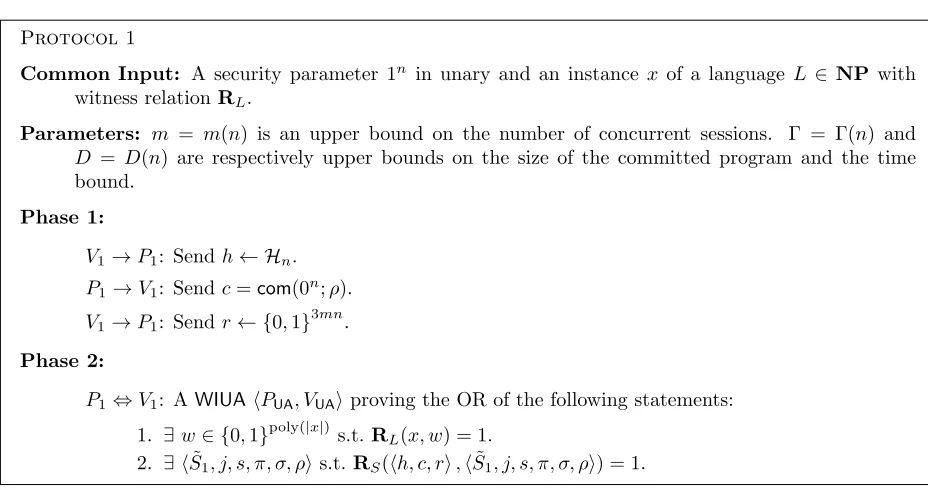
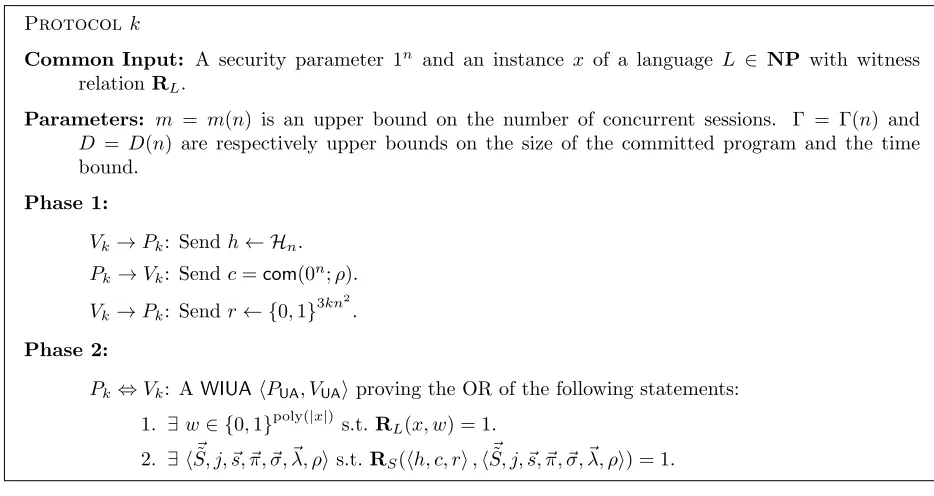
Phase 2: P1 gives a WIUA argument of the statement that either x ∈ L OR there exists ˜S1 ∈
{0,1}Γ(n),j∈[m],s∈ {0,1}n,π ∈ {0,1}n,σ∈ {0,1}Γ(n),ρ, such that
1. Commitment Consistency: c=com(h( ˜S1);ρ), 2. Input Certification: |σ| ≤2mn,
3. Prediction Correctness: π certifies that ˜S1(1n, j, s, σ) =r.
A formal description of the protocol can be found in Figure 4 and 5.
Protocol1
Common Input: A security parameter 1n in unary and an instancex of a language L ∈ NP with witness relationRL.
Parameters: m = m(n) is an upper bound on the number of concurrent sessions. Γ = Γ(n) and
D = D(n) are respectively upper bounds on the size of the committed program and the time bound.
Phase 1:
V1→P1: Sendh← Hn.
P1→V1: Sendc=com(0n;ρ).
V1→P1: Sendr← {0,1} 3mn
. Phase 2:
P1⇔V1: AWIUAhPUA, VUAiproving the OR of the following statements:
1. ∃ w∈ {0,1}poly(|x|)s.t.RL(x, w) = 1.
2. ∃ hS˜1, j, s, π, σ, ρis.t.RS(hh, c, ri,hS˜1, j, s, π, σ, ρi) = 1.
Figure 4: A public-coin non-black-box bounded concurrent zero-knowledge protocol.
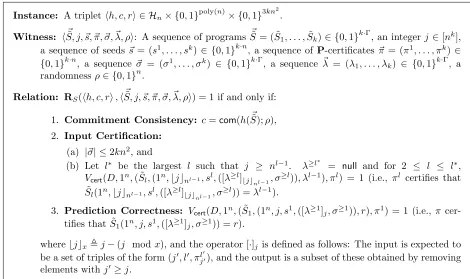
Instance: A triplethh, c, ri ∈ Hn× {0,1}poly(n)× {0,1}3mn. Witness: hS˜1, j, s, π, σ, ρi: A program ˜S∈ {0,1}
Γ
, an integerj∈[m], a seeds∈ {0,1}n, aP-certificate
π∈ {0,1}n, a stringσ∈ {0,1}Γ, a randomnessρ∈ {0,1}n. Relation: RS(hh, c, ri,hS˜1, j, s, π, σ, ρi) = 1 if and only if:
1. Commitment Consistency: c=com(h( ˜S1);ρ),
2. Input Certification: |σ| ≤2mn,
3. Prediction Correctness: Vcert(D,1n,( ˜S1,(1n, j, s, σ), r), π) = 1 (i.e., π certifies that
˜
S1(1n, j, s, σ) =r).
Figure 5: RS, a relation that Protocol 1 uses in WIUAof Phase 2.
program that generates prover messages (in identically the same way as the actual simulator), but getting certificates~π as input.
In more detail, to describe the actual simulator S, let us first describe two “helper” simula-tors S1, S2. Roughly speaking, S1 is an interactive machine that simulates prover messages in a “right” interaction withV∗. Additionally,S1 is expecting some “external” messages on the “left”; these “left” messages will be certificates provided by S2. See Figure 1 in the introduction for an illustration of the communication patterns between S1, S2 andV∗.
Let us turn to a formal description of the S1 and S2. To simplifiy the exposition, we assume w.l.o.g thatV∗ has its non-uniform advicez hard-coded, and is deterministic (as it can always get its random tape as non-uniform advice).
On a high-level, S1(1n, x, M, s, `) acts as a prover in a “right” interaction, communicating with a concurrent verifier V∗, while receiving some additional “external” messages on the “left”. (The input x is the statement to be proved, the inputM will later be instantiated with the code ofS1, and the input (s, `) is used to generate the randomness forS1;sis the seed for the forward secure pseudorandom generator g, and `is the number of n-bit long blocks to be generated using g.) A communication round in the “right” interaction with V∗ refers to a verifier message (sent byV∗) followed by a prover message (sent byS1).
Let us now specify how S1 generates prover messages in its “right” interaction with V∗. S1(1n, x, M, s, `) acts as follows:
• Upon invocation,S1 generates its “random-tape” by expanding the seeds; more specifically, let (s`, s`−1, . . . s1), (q`, q`−1, . . . , q1) be the output of g(s, `). We assume without loss of generality that S1 only needs n bits of randomness of generate any prover message (it can always expand thesenbits into a longer sequence using a PRG); in order to generate itsj’th prover message, it usesqj as randomness.
• Upon receiving a hash functionhi in session iduring thej-th communication round, S1 pro-vides a commitmentci to (the hash of) the program ˜S1(1n, j, s0, τ) =wrap(M(1n, x, M, s0, j), V∗, τ, j), wherewrap(A, B, τ, j) is the program that letsAcommunicate withB forjrounds, while allowingAto receiveτ as external messages, and finally outputtingB’s message in the