Available online: https://edupediapublications.org/journals/index.php/IJR/ P a g e | 382
Usability of Developed Multiple file Encryption using
Rijndael Algorithm
Bryan L. Guibijar, MSCS
Surigao del Sur State University – San Miguel Campus Brgy. Carromata, 8301 San Miguel, Surigao del Sur, Philippines
Abstract
This paper examined the usability of developed Multiple file Encryption using Rijndael Algorithm of College of Engineering, Computer Studies and Technology in Surigao del Sur State University – Main Campus. It is based in waterfall model (SDLC) in which descriptive research was applied to engineering and computer science students. Data from the pre-assessment survey and interview were treated by using the weighted mean to determine the level of usability of developed multiple file encryption using Rijndael algorithm. The usability of multiple file encryption to secure different file types from malicious users/hackers. Thus, the developed application is important to protect the files of the students from unauthorized use of their projects/programs submitted.
Keywords: Cipher, Rijndael, File
management, algorithm,
development
1.0 Introduction
File security dramatically raises issue especially in cloud computing which raises concern in confidentiality, data availability and data integrity (Mukhopadhyay, Sonawane, Gupta, Bhavsar, Mittal, 2013). This issue commonly happen in some industry when the employee separated. In fact, IT admin faces felony for deleting files under flawed hacking law (Greenberg, 2016). These leads to catastrophe in file management in an industry that may cause interruption in most of the transaction and affect the growth of the industry. The creation of cryptograph
using Rijndael algorithm as key factor to solve the issues (Rouse, 2007). The study aims to provide cryptograph using Rijndael algorithm to enhance all type of file security.
Cloud computing is promising and efficient, but there are many challenges for data privacy and security (Singla, Singh, 2013). According to Rouse (2007), Rijndael algorithm is a new generation symmetric block cipher that supports key sizes of 128, 192 and 256 bits. Thereby, the encryption or decryption of a block of data is accomplished by the iteration of a specific transformation (Kaleigh, 2000). Although, Rijndael Algorithm is selected by the U.S. National Institute of Standards and technology (NIST) as candidate for the Advanced Encryption Standard (AES) (Daemen, Rijmen, 2013). However, several studies revealed the weaknesses of RIJNDAEL (Kaleigh, 2000). Where in fact, according to Hoang and Nguyen (2012) the design uses an iterative looping approach with block and key size of 128 bits.
Available online: https://edupediapublications.org/journals/index.php/IJR/ P a g e | 383 Rijndael Algorithm. With that, National
Institute of Standards and Technology (NIST) adopted the Rijndael algorithm as new Advanced Encryption Standard (AES) to replace existing Data Encryption Standard (DES) (Adib, Raissouni, 2012).
Implementation of Rijndael algorithm to enhance all type of file security provides resilient file management especially in cloud computing. Thereby, Cloud Cognitive Authenticator (CCA) proposed provided by the Advanced Encryption Standard (AES) which is the Rijndael algorithm. Thus, enhancing the security issues from unauthorized users and malwares. The study increases the security for confidentiality, data availability and data integrity. It also creates harmonious environment between the civilian users and hackers. In fact, hackers doing may be avoided using the Rijndael algorithm encryption method.
2.0Theoretical/Conceptual Framework
Figure 1. The Schema of the Study
The schema of this study explains the development of multiple file encryption using Rijndael Algorithm. The Multiple file encryption using Rijndael Algorithm is an application intended to encrypt different file types to avoid file thief, file alter and file damage by a virus. As a result student file security will be strengthen.
Cyber Security Theory, according to Kuusisto (2013) that the study on the key concepts and terms of cyber security and presents the physical world and the cyber world framework. It also refers about the society and uses of the model to analyze the results of two limited media survey about
cyber-related newspaper. It also added that the media survey indicate strong need to organize the cyber world.
3.0 Methodology
The study is a descriptive type of research in which survey questionnaire and interview was applied to the students of College of Engineering, Computer Studies and Technology (CECST) to find out the level of usability of the developed multiple file encryption using Rijndael Algorithm
after utilizing the developed apps. The survey instrument was validated by IT experts two from College of Engineering, Computer Studies and Technology and two outsource.
The data collected were tabulated and analysed. Appropriated statistical tool were employed in the data analysis. Mean was used to determine the usability of developed multiple file encryption using Rijndael Algorithm.
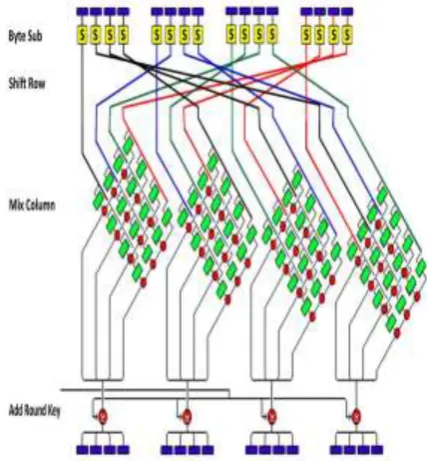
Figure 2. Rijndael Algorithm Round Transformation
Figure 2 - According to the creator of Rijndael Algorithm the round transformation is broken into layers and this Developed Multiple
file Encryption using Rijndael Algorithm
Available online: https://edupediapublications.org/journals/index.php/IJR/ P a g e | 384 layers are the linear mixing layer, which
provides high diffusion over multiple rounds. The non-linear layer which are basically application of the Rijndael S-box and the key addition layer which is simply an exclusive or of the round key and the intermediate state. Each layer is designed to have its own well-defined function which increases resistance to linear and different cryptanalysis.
Figure 3 – As illustrated in the data flow diagram of the study, the file/s (Plain Text) was process using Public Key. Under Encryption is the application of the Rijndael Algorithm in which encrypting the file/s to hide the originally contain/form by substituting special character and the like to protect from malicious users. Cipher Text label is the output of the encrypted file/s that is not readable by human language or natural language. Decryption process is the process to return the file/s into its original contain/form.
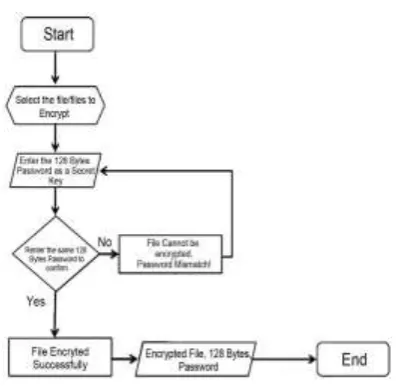
Figure 4 – Encryption Flow Chart, using the sequential process in encrypting a file. The oval (Terminal) symbol indicate that the flow chart started and ended. The Preparation/ Initialization symbol next to start, it signifies the preparation of the data it is also use to select initial conditions and it is also used to represent instructions or group of instructions that will alter or modify a program’s course of execution. The input / output symbol, data are to be read into the computer memory from an input device or data are to be passed from the memory to an output device, in this flow chart it is the input of 128 bytes password as a secret key. The diamond (Decision) symbol, it signifies any decisions that are to be done, two alternative execution paths are possible. The path to be followed is selected during the execution by testing whether or not the condition specified within the outline is fulfilled. The rectangle (Processing) symbol, perform any calculation that are to be done. In decision symbol there are two alternative execution paths the ‘Yes’ and ‘No’, if yes the remark is “File Encrypted Successfully”, but if no the remark is “File Cannot be encrypted. Password Mismatch!” in this illustration it is password mismatch, but sometimes it can
Figure 3. Application Data Flow Diagram of the Study
Figure 4. Encryption Flow Chart of the Study
Available online: https://edupediapublications.org/journals/index.php/IJR/ P a g e | 385 be the file is to large. As the flow near to the
end the output was successfully encrypted with password protect to tighten the security of the encrypted file/s.
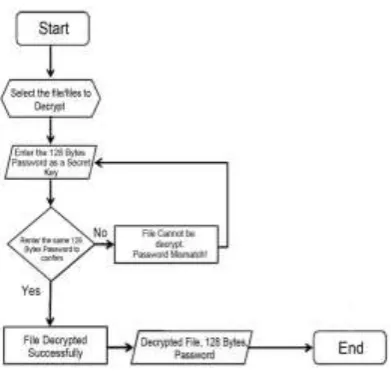
Figure 5 – The Decryption Flow Chart of the Study, is the reverse process to return the file/s into the original contain/form. As stated in figure 4, the process is the same from start to initialize the file or selecting the file to be decrypt. Then enter the password and test if the password is correct or incorrect. If not re-enter the password and if correct proceed to successfully decrypt the file/s selected, and finally the original file/s can be read by human or can be read using natural language.
4.0 Results and Discussions
Table 1 shows level of usability of the developed application. It reveals that all indicators are in the level of “Average”.
Thus, respondents give passing rate on the developed application. It implies that the program has needs some improvements to gain higher rating other than average rate application. Based in the mean shown in table 1, the graphical user interface design and operational performance is the lesser mean. As the result shows that’s the developer must improve the graphical user interface and operational performance of the developed application.
Table 2 shows factors level of concept and difficult. As it is shown in the table among the respondents 99.13% said ‘Yes’ they understand the concept of the developed application and 0.87% said ‘No’ they don’t understand the concept of the develop application. It is also shown that 2.61% said ‘Yes’ they encountered difficulty while using the application and 97.39% said ‘No’ they don’t encountered difficulty in using the develop application.
5.0 Conclusion
This study gets the usability of the Development Multiple File Encryption using Rijndael Algorithm, attempting to give free hassle from malicious users/hackers. In developing multiple file encryption using Rijndael Algorithm, developer must think about the encryption application available in the internet. As claim by Cyber Security Theory, to look into the physical world and cyber world
Figure 5. Decryption Flow Chart of the Study
Table 1. Level of Usability of the Developed Application using Rijndael Algorithm
Indicators Mean Adjectival
Rating
1. How do you rate the
functionality of the apps in terms of performance?
3.03 Average
2. How do you rate the graphical user interface design of this apps?
2.96 Average
3. How do you rate operational
performance of this apps? 2.95 Average
4. How do you rate the apps in
terms of users-friendliness? 3.00 Average 5. How do you rate the security of
the apps? 3.04 Average
Grand Mean 2.99 Average
Legend: 4.21-5.00-Excellent, 3.41-4.20-Good, 2.61-3.40-Average, 1.81-2.60-Poor, 1.00-1.80-Very Poor
Table 2. Factors level of Concept and Difficult
YES NO
1. Do you understand the concept of the
developed apps?
99.13% 0.87%
2. Did you encounter any difficulty while using the apps?
Available online: https://edupediapublications.org/journals/index.php/IJR/ P a g e | 386 framework and strongly recommend that the
media must reorganized the cyber world. 6. 0 Recommendation
Teachers may use more unique
activities to increase the reading comprehension as well as the academic performance of students. They may focus on what students need to improve performance. An intervention or plan of action shall be made to cater the students’ problem in reading.
6.0 Recommendations
It is strongly recommended by the author of this research to use the developed application as tool in securing the file/s in your computer. As the researcher recommend to use this application, it is also recommend not to use file encryption / decryption downloaded from the internet. Thus using application that is available to all might be the reason of the file/s corrupt and the file/s is not secure in some ways.
References Cited
Daemen, J., & Rijmen, V. (2013). The design of Rijndael: AES-the advanced encryption standard. Springer Science & Business Media. Retrieve October 11, 2017 from https://goo.gl/1DZm3n
El Adib, S., & Raissouni, N. (2012). AES encryption algorithm hardware implementation architecture: resource and execution time optimization. International Journal of Information and Network Security, 1(2), 110. Retrieve October 12, 2017 from https://goo.gl/4wJZ2x
Hoang, T. (2012, February). An efficient FPGA implementation of the Advanced Encryption Standard algorithm. In Computing and Communication Technologies, Research, Innovation, and Vision for the Future (RIVF), 2012 IEEE RIVF International Conference on (pp. 1-4). IEEE. Retrieve
October 11, 2017 from
https://goo.gl/eFfQUv
Kaleigh (2000, November 15). Advanced Encryption Standard. File. Retrieve October 10, 2017 from https://goo.gl/jYVZgs
Mukhopadhyay, D., Sonawane, G., Gupta, P. S., Bhavsar, S., & Mittal, V. (2013). Enhanced security for cloud storage using file encryption. arXiv preprint arXiv:1303.7075.
Retrieve October 10, 2017 from
https://arxiv.org/abs/1303.7075
Greenberg, A. (2016, June 03). ANDY GREEN SECURITY. File. Retrieve October 10, 2017 from https://goo.gl/q3Q4gy
Needham, R. M., & Schroeder, M. D. (1978). Using encryption for authentication in large networks of computers. Communications of the ACM, 21(12), 993-999. Retrieve
October 11, 2017 from
https://goo.gl/dj9SeR
Pitchaiah, M., & Daniel, P. (2012). Implementation of advanced encryption standard algorithm.
Retrieve October 12, 2017 from
https://goo.gl/7wyzjX
Rauno Kuusisto, Tuija Kuusisto (October 2013). Strategic Communication for Cyber - Security Leadership. Journal of Information Warfare, Volume 12, Issue 3. Retrieve May 22, 2018 from https://goo.gl/ga88Q8
Rouse, M. (2007, May). Rijndael. File. Retrieve
October 10, 2017 from
https://goo.gl/jYLBxU
Singla, S., & Singh, J. (2013). Survey on Enhancing Cloud Data Security using EAP with Rijndael Encryption Algorithm. Global Journal of Computer Science and Technology. Retrieve October 10, 2017 from https://goo.gl/H9ARHF
Townsend, P. (2015, December 23). Fixing Encryption key management audit failures in Microsoft Windows C# applications.
Retrieve October 12, 2017 from