Multi Response Optimization of Edm Process of OHNS Using
Fuzzy Logic Approach
1
V. Chengal Reddy,
1P. Sivaiah,
1K. Venkata Chalapathi,
1R.K.Sangha Mitra
1
Assistant Professor, Dept. of Mechanical Engineering, AITS- Rajampet, Andhra Pradesh, India. Corresponding author mail: [email protected]
Abstract— In this paper, the application of the Taguchi method with fuzzy logic for optimizing the electrical discharge
machining process with multiple performance characteristics has been reported. A multi-response performance index is used to solve the electrical discharge machining process with multiple performance characteristics. The machining parameters (discharge current (IP), pulse on time (Ton), pulse off time (Toff) and down time) are optimized with considerations of the multiple
performance characteristics (electrode wear rate and material removal rate). Experimental results are presented to demonstrate the effectiveness of this approach.
Keywords- Electrical discharge machining; Taguchi method; Fuzzy logics, OHNS, Copper
.
1. INTRODUCTION
Electrical discharge machining (EDM) is one of the most
extensively used non-conventional material removal process. Its unique feature of using thermal energy to machine electrically conductive parts regardless of hardness has been its distinctive advantage in the manufacture of mould, die, automotive, aerospace and surgical component. The selection of appropriate parameters for maximum material removal rate and minimum electrode wear rate during the EDM process traditionally carried out by the operator’s experience or conservative technological data provided by the EDM equipment manufacturers, which produced inconsistent machining performance. Some researchers carried out various investigations to improve the stock material removal rate and electrode wear rate in EDM process. Proper selection of machining parameters for the best process performance is still a challenging job.The Taguchi method can optimize performance characteristics through the settings of process parameters and reduce the sensitivity of the system performance to sources of variation. As a result, the Taguchi method has become a powerful tool in the design of experiment methods. However, most published Taguchi applications to date have been concerned with the optimization of a single performance characteristic. Handling the more demanding multiple performance characteristics is still an interesting research problem. The theory of fuzzy logics, initiated by Zadeh in 1965 has proven to be useful for dealing with uncertain and vague information. In fact, the definition of performance characteristics such as lower-the-better, higher-the-better, and nominal-the-better contains a certain degree of uncertainty and vagueness. Therefore, optimization of the performance characteristics with fuzzy logic has been considered in this study. In this study, a fuzzy reasoning of the multiple performance characteristics has been developed based on fuzzy
logic. As a result, optimization of complicated multiple performance characteristics can be transformed into the optimization of a single multi-response performance index (MRPI). In this paper, the optimization of the electrical discharge machining process with multiple performance characteristics has been investigated to illustrate this approach. In the following, optimization of multiple performance characteristics with fuzzy logic is introduced briefly and the electrical discharge machining process is then described, after which the experimental details of using the Taguchi method with fuzzy logic to optimize the electrical discharge machining process to secure low electrode wear ratio (EWR) and high material removal rate (MRR) are given. Finally, the paper concludes with a summary.
2.OPTIMIZATION OF MULTIPLE PERFORMANCE
CHARACTERISTICS WITH FUZZY LOGIC
recommendation for the optimization of a process with multiple performance characteristics is left to engineering judgment and verified by confirmation experiments. This is because several problems are encountered in the optimization of a process with multiple performance characteristics. For example: the category of each performance characteristic may not be same; the engineering unit for describing each performance characteristic may be different; and the importance of each performance characteristic may vary. As a result, the application of the Taguchi method in a process with multiple performance characteristics cannot be straightforward. In this paper, the use of fuzzy logic to deal with the optimization of a process with multiple performance characteristics is reported. First, several fuzzy rules are derived based on the performance requirement of the process. The loss function corresponding to each performance characteristic is fuzzified and then a single MRPI is obtained through fuzzy reasoning on the fuzzy rules. The MRPI can be used to optimize the process based on the Taguchi approach.
3. THE ELECTRICAL DISCHARGE MACHINING PROCESS
The electrical discharge machining removes work-piece by an electrical spark erosion process. The variations in the machining parameters, such as the pulse-on time, discharge current, pulse-off time and downtime, greatly affect the measures of the machining performance, for example, the EWR and the MRR. Therefore, proper selection of the machining parameters can result in better machining performance in the electrical discharge machining process.
3.1. Machining parameter selection
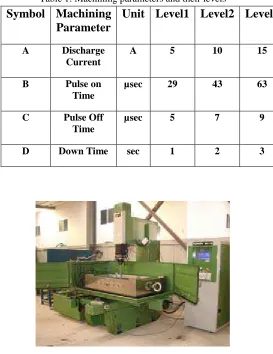
[image:2.595.296.569.88.442.2]In this study, an EDM machine (KT-200) was used as the experimental machine. Cylindrical pure copper with a diameter of 6 mm was used for an electrode to erode a work-piece with a diameter of 6 mm. The schematic diagram of the experimental set-up is shown in Fig. 1. The workpiece and electrode were separated by a moving dielectric fluid such as kerosene. Machining experiments for determining the optimal machining parameters carried out by setting: discharge current is in the range of 5 to 15 amps pulse on time in the range of 29 to 63 microsec pulse off time is in the range of 5 to 9microsec down time is in the range of 1 to 3 sec. To perform the experimental design, three levels of the machining parameters (discharge current, pulse on time, pulse off time, down time) were selected as shown in table1. The initial machining parameters were selected as follows: discharge current 5amps, pulse on time 29 microsec, pulse off time 5 microsec, down time 1 sec.
Table 1: Machining parameters and their levels
Symbol Machining
Parameter
Unit Level1 Level2 Level3
A Discharge Current
A 5 10 15
B Pulse on Time
µsec 29 43 63
C Pulse Off Time
µsec 5 7 9
D Down Time sec 1 2 3
Fig.1. EDM Machine
3.2. Machining performance evaluation
Evaluation of MRR:
The material MRR is expressed as the ratio of the difference of weight of the work-piece before and after machining to the machining time and density of the material.
MRR (gm/min) = Work-piece Removal rate
/
TimeEvaluation of electrode wear rate:
EWR is expressed as the ratio of the difference of weight of the tool wear weight to the machining time. That can be explain this equations
EWR (gm/min) = Electrode wear rate/ Time
4. DETERMINATION OF THE OPTIMAL MACHINING PARAMETERS
In this section, the use of the Taguchi method with fuzzy logic to determine the machining parameters with optimal machining performance in the EDM process is illustrated.
4.1. Orthogonal array experiment
To select an appropriate orthogonal array for the experiments, the total degrees of freedom need to be computed. The degrees of freedom are defined as the number of comparisons between process parameters that need to be made to determine which level is better and specifically how much better it is.
For example, a two-level process parameter counts for one degree of freedom. The degree of freedom associated with interaction between two process parameters are given by the product of the degrees of freedom for the two process parameters. In the present study, the interaction between the machining parameters is neglected. Therefore, there are 11 degrees of freedom owing to one two-level machining parameter and five three-level machining parameters in the EDM process. Once the degrees of freedom are known, the next step is select an appropriate orthogonal array to fit the specific task.
The degrees of freedom for the orthogonal array should be greater than or at least equal to those for the process parameters. In this study, an L9 orthogonal array was used because it has 17 degrees of freedom more than the 11degrees of freedom in the machining parameters. This array has 4 columns and 9 rows and it can handle one two-level process parameter and seven three-level process parameters, at most. Each machining parameter is assigned to a column and 9 machining parameter combinations are required. Therefore, only 9 experiments are needed to study the entire machining parameter space using the L9 orthogonal array.
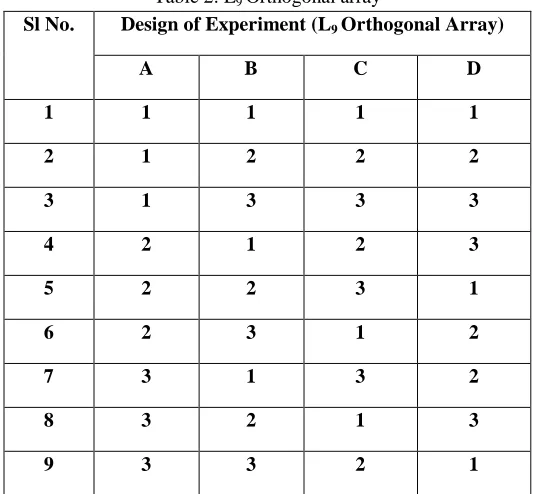
[image:3.595.295.562.128.375.2]The experimental combinations of the machining parameters using the L9 orthogonal array is presented in table 2.
Table 2: L9 Orthogonal array
Sl No. Design of Experiment (L9 Orthogonal Array)
A B C D
1 1 1 1 1
2 1 2 2 2
3 1 3 3 3
4 2 1 2 3
5 2 2 3 1
6 2 3 1 2
7 3 1 3 2
8 3 2 1 3
9 3 3 2 1
4.2. Signal-to-noise ratio
In the Taguchi method, a loss function is defined to calculate the deviation between the experimental value and the desired value. Usually, there are three categories of the performance characteristics in the analysis of the signal to-noise ratio, i.e., the lower-the-better, the higher-the-better, and the nominal-the-better. To obtain optimal machining performance, the minimum EWR and the maximum MRR are desired. Therefore, the lower-the-better EWR and the higher-the-better MRR should be selected.
The loss function Lij of the lower-the-better performance
characteristic can be expressed as
=-10 log ( )
where Lij is the loss function of the ith performance
characteristic in the jth experiment, n the number of tests, and yijk is the experimental value of the ith performance
characteristic in the jth experiment at the kth test.
The loss function of the higher-the-better performance characteristic can be expressed as
=-10 log ( )
The loss function is further transformed into an S/N ratio. In the Taguchi method, the S/N ratio is used to determine the deviation of the performance characteristic from the desired value. The S/N ratio Zij for the ith performance characteristic in
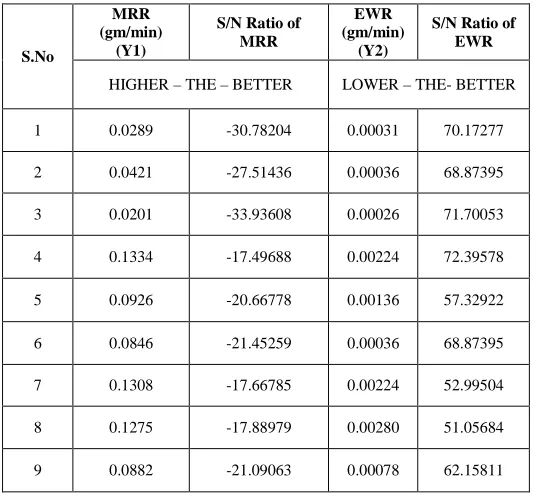
Table 3 shows the experimental results for the EWR and its S/N ratio and MRR and its S/N ratio based on the experimental parameter combinations (Table 2). As shown in Table 3, the engineering units for describing the EWR and the MRR are different. To consider the two different performance characteristics in the Taguchi method, the S/N ratios corresponding to the EWR and MRR are processed by the fuzzy logic unit.
Table 3: Experimental results for MRR, EWR and its S/N ratio
S.No
MRR (gm/min)
(Y1)
S/N Ratio of MRR
EWR (gm/min)
(Y2)
S/N Ratio of EWR
HIGHER – THE – BETTER LOWER – THE- BETTER
1 0.0289 -30.78204 0.00031 70.17277
2 0.0421 -27.51436 0.00036 68.87395
3 0.0201 -33.93608 0.00026 71.70053
4 0.1334 -17.49688 0.00224 72.39578
5 0.0926 -20.66778 0.00136 57.32922
6 0.0846 -21.45259 0.00036 68.87395
7 0.1308 -17.66785 0.00224 52.99504
8 0.1275 -17.88979 0.00280 51.05684
9 0.0882 -21.09063 0.00078 62.15811
4.3 Fuzzy Expert System :
A fuzzy rule based system consists of four parts:
Knowledge base
Fuzzifier
Inferenceengine
Defuzzifier.
[image:4.595.32.325.642.735.2]A block diagram representing these four functions is given in this continuation.
Fig.2. A block diagram of Fuzzy Logic System
Fuzzifier:
The real world input to the fuzzy system is applied to the fuzzifier. In fuzzy literature, this input is called crisp input since it contains precise information about the specific information about the parameter. The fuzzifier convert this precise quantity to the form of imprecise quantity like ‘large’, ‘medium’, ‘high’ etc. with a degree of belongingness to it. Typically the value ranges from 0 to 1.
Knowledge base:
The main part of the fuzzy system is the knowledge base in which both rule base and database are jointly referred. The database defines the membership functions of the fuzzy sets used in the fuzzy rules whereas the rule base contains a number of fuzzy IF THEN rules.
Inference engine:
The inference system or the decision making input perform the inference operations on the rules. It handles the way in which the rules are combined.
Defuzzifier:
membership functions are used to the crisp inputs because of their simplicity and high computational efficiency [Yager and Filev (1999)]. The triangular membership function as described below can be used in the model.
In the following, the concept of fuzzy reasoning is described briefly based on the two- input± one-output fuzzy logic unit. The fuzzy rule base consists of a group of if± then control rules with the two inputs, x1 and x2, and one output y, i.e.
_ Rule 1: if x1 is A1 and x2 is B1 then y is C1 else _ Rule 2: if x1 is A2 and x2 is B2 then y is C2 else
_ _ _ _ _ _ _ _ _ _ _ _ _ _ _ _ _ _ Rule n: if x1 is An and x2 is Bn then y is Cn.
Ai, Bi, and Ci are fuzzy subsets defined by the
corresponding membership functions, i.e., mAi , mBi
and mCi . In this paper, three fuzzy subsets are
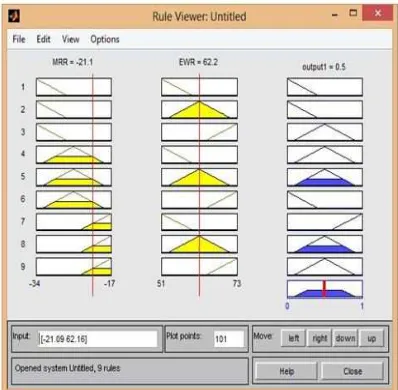
assigned in the two inputs Seven fuzzy subsets are assigned in the output Various degree of membership to the fuzzy sets is calculated based on the values of x1, x2, and y. Nine fuzzy rules (table 4) are derived
directly based on the fact that larger is the S/N ratio, the better is the performance characteristic. By taking the max± min compositional operation, the fuzzy reasoning of these rules yields a fuzzy output. Supposing that x1 and x2 are the two input values of the fuzzy logic unit, the membership function of the output of fuzzy reasoning can be expressed as
µC0(y) = [µA1 (x1)^ µB1(x2)^µC1 (y) ] v … [ µAn (xn)^
µBn (xn)^µCn (y) ]
Here ^ is the minimum operation and v is the maximum operation.
Finally, a defuzzification method, called the center-of-gravity method, is adapted here to transform the fuzzy interface output µC0 into a non-fuzzy value yo, i.e.
Y
0=
In this paper, the non-fuzzy value y0 is called an MRPI. Based on the above discussion, the larger is the MRPI, the better is the performance characteristic. Table 5 shows the experimental results for the MRPI using the experimental combinations of Table 2.
Table 4: Fuzzy rule table
MPCI
S/N Ratio of MRR
Low Medium High
S/N Ratio
of TWR
Low Low Medium High
Medium Low Medium Medium
[image:5.595.327.528.95.255.2]High Medium Low Medium
[image:5.595.330.527.305.457.2]Fig.3.Membership Function for MRR
Fig.4.Membership Function for EWR
[image:5.595.329.528.490.685.2] [image:5.595.27.292.654.783.2]
Table 5: Results for MRPI
S/N Ratio of
MRR
S/N Ratio of
EWR MPCI
-30.78204 70.17277 0.458
-27.51436 68.87395 0.337
-33.93608 71.70053 0.500
-17.49688 72.39578 0.500
-20.66778 57.32922 0.558
-21.45259 68.87395 0.399
-17.66785 52.99504 0.864
-17.88979 51.05684 0.868
-21.09063 62.15811 0.500
Confirmation test
Optimized values:
MRR (gm/min) =
EWR(gm/min)=
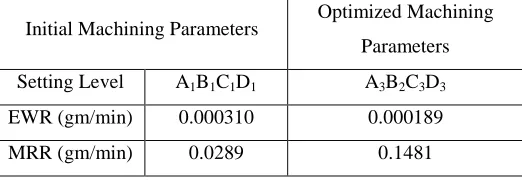
Table 6: Confirmation experiment results
Initial Machining Parameters Optimized Machining Parameters Setting Level A1B1C1D1 A3B2C3D3
EWR (gm/min) 0.000310 0.000189
MRR (gm/min) 0.0289 0.1481
5. CONCLUSION
The work has presented the use of fuzzy logic for optimization of the EDM process with multiple performance characteristics. The following factor settings have been identified as to yield the best combination of process variables: Discharge Current = 15A, Pulse-on-Time=29µs, Pulse-off-Time = 9µs, and Down Pulse-off-Time = 3 sec. The performance characteristics such as MRR and EWR can be improved through this approach.
REFERENCES
[1] C.K.Biswas and Shailesh Dewangan, “Optimization of EDM Process with Fuzzy Logic Technique”, International Journal of Machine Tools and manufacture, Vol. 40, pp. 153-164.
[2] J.L.Lin, K.S.Wang, B.H.Yan, Y.S.Tamga Department of Mechanical Engineering, National Central University, Chung-Li, Taoyuan, Taiwan, “Optimization of the electrical discharge machining process based on the Taguchi method with fuzzy logics”.
[3] Qing GAO, Qin-he ZHANG, Shu-peng SU, Jian-hua ZHANG (School of Mechanical Engineering, Shandong University, Jinan 250061, China), Journal of Zheijang University SCIENCEA, “Parameter optimization model in electrical discharge machining process”.
[4] Kamaljit Singh, M.Tech Student, SUSCET, TAngori, CS Kalra, Assistant Professor, SUSCET, Tangori, “Machining of OHNS by EDM”.
[5] S.Dhananbalan K SivaKumar C Sathiya Narayanan, Department of mechanical engineering, JJ College of engineering and Technology, Tiruchirapalli, “Optimization of machining parameters of EDM while machining Iconel 718.
[image:6.595.28.289.494.584.2]