29
Fuzzy Logic based Intelligent Vertical Handoff Algorithm
Renuka Dogra
1,Kiran Ahuja
2Department of Electronics & Communication Engineering1, 2, D.A.V Institute of Engineering & Technology, Jalandhar,Punjab, India1, 2
Email:[email protected]
1,[email protected]2Abstract
-
Seamless connectivity, continual service delivery and ubiquitous coverage are essential factors to enhance the performance of handoff procedures. So to improve the Quality of Service (QoS) of system, handoff algorithm must be performed successfully to avoid problems like ping-pong, corner effect, shadow effect, call blocking, call dropping, etc. In this paper, an Intelligent Vertical handoff algorithm (IVHA) is designed which exploits several fuzzy logic attributes after proper analysis. This algorithm tries to resolve contending requirements, and obtain high performance in a multifaceted wireless environment. It uses RSSI, SINR and data rate of traffic as inputs in initialization phase and network QoS metrics (bandwidth, coverage, velocity and load) as inputs in handoff decision making phase.Index Terms- Intelligent Vertical Handoff Algorithm (IVHA), Mobile Station (MS), Access Point (AP), Received Signal
Strength Indicator (RSSI).
1. INTRODUCTION
The advantages of heterogeneous networks are well known. These types of networks, or set of networks, are those that allow user’s mobility [1]. Handoff is the process that transfers an ongoing call from one cell to another or from one network to another during movement. This paper focuses on the design of handoff algorithm that makes use of adaptive approach to suit the dynamic environment. With the rapid development of the mobile industry, there is rapid growth of number of mobile users, due to which there is drastic requirement to integrate heterogeneous access networks and technologies for supporting ubiquitous communication and seamless mobile computing [2].
A handoff process occurs when a mobile user moves beyond the radio coverage of its access points to another. During this process, due to some latency the user is unable to send or receive traffic for few seconds; even there are many neighboring access points in a wireless environment. Therefore handoff mechanisms are to be employed in such a [image:1.595.128.476.553.661.2]
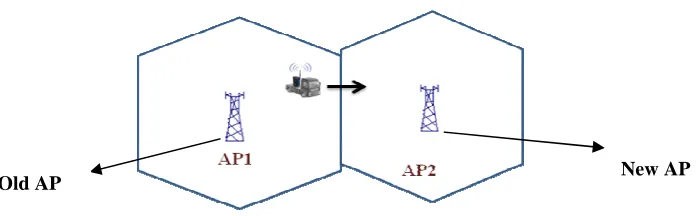
way that these can choose the best and optimal access point to enjoy continuous services. In order to maintain a continuous and reliable link between the MS and the access point in a wireless system, a new and better handoff algorithm must be needed to keep QoS as high as possible. In this paper, an improved fuzzy logic based handoff initialization and decision making algorithm IVHA to achieve the optimal handover decision in heterogeneous wireless networks is proposed. Here, fuzzy logic is applied in order to select the most appropriate network from the list of scanned networks that are available from the scanning phase, which is handled by the MS. Normally, the MS does not know which network will be a good partner to perform a handover, and it can just depend on the quality of the signal strength, available link and other related information. In Fig. 1, two access points (UMTS and WiMax) are considered which performs handoff when required according to the proposed algorithm.
Figure 1: Handoff Mechanism
30
2. RELATED WORK
Numerous works has been done to make QoS parameters adaptive. But the recent work focussed on making threshold and hysteresis adaptive as per network parameters. P. Chan et al. (2001) focused on issues related to mobility management in a future mobile communications system. A scenario consists of multi segment access network was integrated with an IP core network by exploiting the principles of Mobile IP [4]. C. F. Kwong et al. (2009) proposed an approach using adaptive network fuzzy inference system (ANFIS), where the training element was incorporated into the existing fuzzy handoff algorithm [5]. T. C. Ling et al. (2010) proposed the Selective Proactive Context Caching (SPCC) technique to proactively propagated security context of the mobile client to a selected set of neighbouring base stations before reassociating occurred [6]. V.K. Reddy et al. (2011) presented an analytical framework to evaluate VHO algorithms. This framework can be used to provide guidelines for the optimization of handoff in heterogeneous wireless networks [7]. P. Dhand et al. (2013) proposed an intelligent handoff algorithm based on fuzzy logic termed as Fuzzy Controller for Handoff Optimization (FCHO). Traditional algorithms for handoff using fixed values of parameters performed well only in specific environment but FCHO exploited attractive features of several existing algorithms, and added more capabilities to provide adaptation to the dynamic environment [8]. A. F. Christopher et al. (2013) proposed an approach to perform vertical handover using fuzzy logic and neural networks considering congestion as the primary criterion in making handover decisions [9]. The proposed approach worked with reduced handoff latency and also the network experiences increased bandwidth availability than the pure fuzzy logic and neural networks based systems. T. Thumthawatworn et al. (2013) used fuzzy logic to enhance the intelligence of the handover decision engine. An adaptive traffic dependent fuzzy based handover decision system (ATD-HDS) was presented in [10]. The results showed that, compared to a monolithic fuzzy based handover decision system, the proposed ATD-HDS significantly improved the decision quality and algorithm execution time. Suman et al. (2013) presented an intelligent adaptive and user centric network selection algorithm which used Sugeno fuzzy inference system (FIS) to decide when to perform handoff. ANFIS used to rank different wireless networks for VHO based on set of parameters along with user preferences on a mobile device [11]. P. T. Kene et al. (2013) proposed a fuzzy rule based decision mechanism considering user preferences, available bandwidth, received signal strength, network coverage area and QoS values [12]. The proposed algorithm has much more desirable performance, and is more reasonable in selecting the target network, compared with the traditional method. This algorithm will decrease number of unnecessary handoffs which effectively reduce ping-pong effect on the basis of ensuring network performance.
3. PROPOSED IVHA ALGORITHM
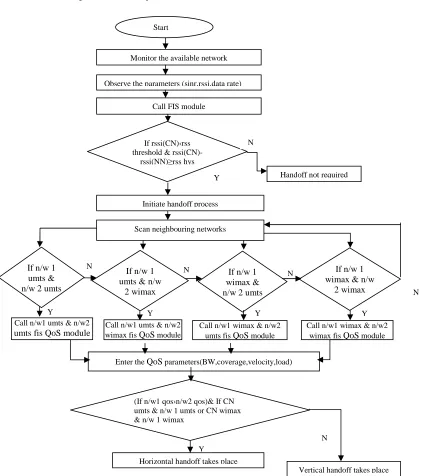
In this paper, Intelligent Vertical Handoff Algorithm (IVHA) approach to achieve the optimal handover decision in an heterogeneous environment is proposed. Fuzzy logic is employed to remove various uncertainties during the decision making process. Many soft computing techniques exist today to fight with the ever changing environment but out of that fuzzy logic is best suited to wireless networks. The algorithm is divided into two categories: Handoff initialization process and Handoff decision making process as shown in Fig. 2.
Handoff initialization phase
It is used to initiate handoff, if required. This requirement condition is checked on the basis of values of three parameters (RSSI, SINR and data rate of traffic). It is RSS based algorithm, therefore handoff condition is initiated if the RSS value becomes less than its threshold. The technique uses hysteresis value as described in pseudo code below to initiate handoff. Handoff is requested when the BS2’s RSS exceeds the BS1’s RSS by the hysteresis value if hysteresis level is too large then results in delayed handoffs i.e. lagging handoffs that can cause undesirable interference in neighbouring cells. Furthermore, delayed handoffs may increase the risk of dropped calls due to weak signal strength. Hence in this paper, a method of optimizing the value of hysteresis is proposed depending upon the RSSI, SINR and the data rate of the traffic.
IF RSSI[AP1]<RSSI[AP2] THEN
HANDOFF IS REQUIRED WHEN
RSSI[AP2]-RSSI[AP1]=HYS
The efficiency of IVHA lies in the fact that its value of the threshold is adaptively vary with the change in value of signal strength. Different scales have been set for different networks because there parameters have different ranges. The data rate, RSSI of the current AP of current network and the SINR are the inputs to the fuzzy controller. The following traits are kept in mind while designing the rules:
• If the signal strength is weak, the threshold will be increased to facilitate the handoff.
• If the signal strength is high, the threshold will be decreased to avoid unnecessary handoff.
• If the data rate of the current network is low, the threshold will be increased to facilitate the handoff. • If the data rate is high, the threshold will be decreased to
avoid unnecessary handoff.
Handoff decision making phase
31 with the current AP increases, the threshold value starts
increasing to facilitate handoff. As a handoff is triggered then only user will enter into this phase, otherwise handoff is not required. An optimal network controller is being designed which considers bandwidth availability, network load, coverage and the velocity of the mobile station as its input. This allows more efficient control of the handoff and discarding APs which do not fulfill the best expectations. Intelligent Vertical Handover Algorithm is designed to meet the requirements of vertical handoff in wireless and mobile networks. Two networks involved in handoff situation are UMTS and WiMax. Both the networks have different range for parameters, hence are measured on different scales for which different FIS editors are designed that are depicted in the Table 1.
Table 1: Network Parameters S.No Network Parameters UMTS
Range
WiMax Range
1 Data rate ( Mbps) [0 10] [0 70]
2 RSSI (dB) [-90 -3] [123
-40]
3 SINR (dB) [-100 -60] [-10 53]
4 Network Bandwidth
(MHz)
[1 6] [1 6]
5 Network Coverage
(Kms)
[0 50] [0 7]
6 Network Velocity
(Km/hour)
[0 70] [0 70]
7 Network Load (users) [1 30] [1 30]
8 QoS Factor [0 1] [0 1]
N If rssi(CN)‹rss
threshold & rssi(CN)-rssi(NN)≥rss hys Monitor the available network
Observe the parameters (sinr,rssi,data rate)
Call FIS module
Handoff not required N
Start
Horizontal handoff takes place
Vertical handoff takes place N
Y
Y
Y Initiate handoff process
Scan neighbouring networks
If n/w 1 umts & n/w 2 umts
If n/w 1 umts & n/w
2 wimax
If n/w 1 wimax & n/w 2 umts
If n/w 1 wimax & n/w
2 wimax
Call n/w1 umts & n/w2 umts fis QoS module
Call n/w1 umts & n/w2 wimax fis QoS module
Call n/w1 wimax & n/w2 umts fis QoS module
Call n/w1 wimax & n/w2 wimax fis QoS module N N N Y Y Y
Enter the QoS parameters(BW,coverage,velocity,load)
[image:3.595.110.531.265.741.2](If n/w1 qos›n/w2 qos)& If CN umts & n/w 1 umts or CN wimax & n/w 1 wimax
32 In decision making phase, the QoS controller will evaluate the
parameters available for network present in heterogeneous environment and gives a normalized value as an output. The triangular membership functions are used for different changing network’s QoS parameters (network bandwidth, coverage, velocity, and load). The design elements of basic
[image:4.595.174.424.172.269.2]fuzzy inference algorithm are the design of membership functions for fuzzy variables and rules. Eighty one rules are formulated for choosing best network among the list of scanned neighbouring networks as shown in Fig. 3. The value of optimal network is obtained on the basis of varying QoS factors.
Figure 3: Rules for QoS evaluation Factor of Network
4. RESULTS AND DISCUSSION:
Quality of service (QoS) mechanism controls the performance, reliability and usability of a telecommunications service. Mobile cellular service providers may offer mobile QoS to customers. To quantitatively measure quality of service several related aspects of the network service are often considered, such as error rates, bandwidth, throughput, transmission delay, availability, jitter, etc. Quality of service is particularly important for the transport of traffic with special
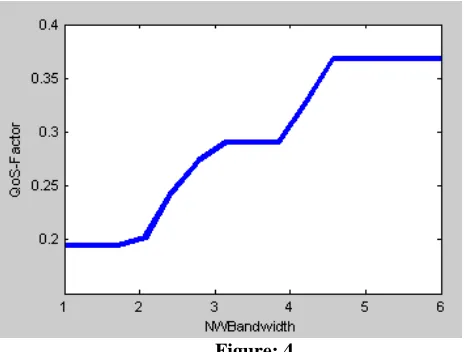
requirements. A phone call or other session may be interrupted after a handover, if the new base station is overloaded. Unpredictable handovers make it impossible to give an absolute QoS guarantee during a session initiation phase. So after the handoff initialization phase, the handoff decision making phase is executed to improve the quality. Two separate Fuzzy Inference System (FIS) for evaluating the QoS factor are created. Fig. 4 – Fig. 11 displays the graphs of relationship between QoS factor and the different network parameters for respective networks UMTS and WiMax.
Figure: 4 Figure: 5
[image:4.595.41.273.426.602.2] [image:4.595.317.552.427.598.2]33
Figure: 6 Figure: 7
Mobile Node Velocity v/s QoS Factor of UMTS Network Load v/s QoS Factor of UMTS
Figure: 8 Figure: 9
Network Bandwidth v/s QoS Factor of WiMax Network Coverage v/s QoS Factor of WiMax
Figure: 10 Figure: 11
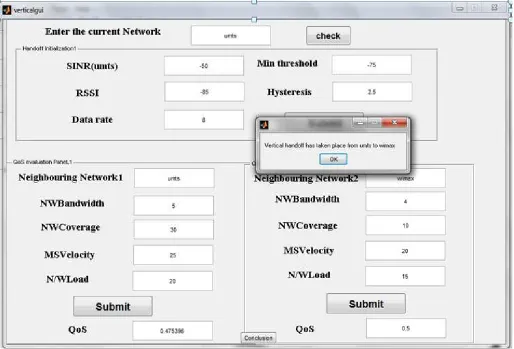
Mobile Node Velocity v/s QoS Factor of WiMax Network Load v/s QoS Factor of WiMax The GUI of the proposed intelligent vertical handover
algorithm implementation is represented in Fig. 12. First enter
34 containing WiMax parameters appears. After attaining the
values of the current network status, it is verified that whether handoff is required or not. If handoff is required then the panel corresponding to neighbouring network 1 and neighbouring network 2 appears. We can assume both UMTS and WiMax or either as neighbouring network 1 and 2. After entering the values of both the networks the quality of service of both the networks is concluded. The network parameter’s values have
[image:6.595.42.556.175.524.2]been considered from the specified range as depicted in the Table 1. The neighbouring network having better quality of service consider for handoff. In the defined case handoff takes place from UMTS network to WiMax network (i.e. vertical handover). Due to the adaptive values of metrics threshold and hysteresis solve the problem of ping-pong and corner effect using fuzzy logic.
Figure: 12 Current Network Handoff Status
5. CONCLUSIONANDFUTUREWORK
The next generation of wireless communication networks promises seamless connectivity and continuous services to the users. Future, wireless networks will be based on heterogeneous access technologies and must be able to support features such as inter carrier handoff, personal mobility, and location management for a heterogeneous network. The proposed algorithm makes threshold and
hysteresis metric adaptive to overcome ping pong problem and make it a novel approach for future. Researchers are doing much work in handoff decision phase so emphasis will be laid down in identification and authentication phase in order to obtain permissions for carrying a mobile terminal across the country. Future work includes the use of more parameters like battery power, cost, and security are in progress.
35 Management of Uncertainty in Knowledge-Based
Systems (IPMU), Paris (France) , July 2-7, 2006. [2]. H. Balakrishnan, S. Seshan, and R. H. Katz,
“Improving Reliable Transport and Handoff
Performance in Cellular Wireless Networks”, ACM Wireless Networks Journal (WINET), Vol. 1, No. 4, pp. 469-481, 1995.
[3]. K. Pahlavan et al, "Handoff in hybrid mobile data networks", IEEE Communication Magazine, Vol. 7, No. 2, pp. 34-46, 2000.
[4]. P. Chan et al, “Mobility management incorporating fuzzy logic for a heterogeneous IP environment”, IEEE Communication Magazine, Vol. 39, No. 12, pp. 42-51, 2001.
[5]. C. F. Kwong, T. C. Chuah and S. W. Lee, "Adaptive Network Fuzzy Inference System (ANFIS) Handoff Algorithm", in proceedings of international conference on Future Computer and Communication (ICFCC), Malaysia, pp. 195-198, 2009.
[6]. T. C. Ling, J. F. Lee, K. P. Hoh, “Reducing Handoff Delay In WLAN Using Selective Proactive Context Caching”, Malaysian Journal of Computer Science, Vol. 23, No. 1, pp. 49-59, 2010.
[7]. V. K. Reddy, V. Krishna, “Optimization of Handoff Method in Wireless Networks”, Global Journal of Computer Science and Technology, Vol. 11, No. 1, 2011.
[8]. P. Dhand and P. Dhillon, “Handoff Optimization for Wireless and Mobile Networks using Logic” ,International Journal of Computer Applications, Vol. 63, No. 14, pp. 31-35, 2011.
[9]. A. F. Christopher, M. K. Jeyakumar, “A Novel Congestion based Approach for Vertical Handover”, International Journal Latest Trends in Engineering and Technology, Vol. 2, No. 2, pp. 63-67, 2013. [10].T. Thumthawatworn, A. Pervez, P. Santiprabhob.
“Adaptive Traffic Dependent Fuzzy based Vertical Handover for Wireless Mobile Networks”, in the proceedings of ICN 2013 the Twelfth International Conference on Networks, pp. 112- 117, 2013.
[11].Suman, P. Singh, R. B. Patel, “User Specific Algorithm for Vertical Handoff in Heterogeneous Wireless Networks”,International Journal of Scientific & Engineering Research, Vol. 4, No. 5, pp. 676-680, 2013.