Correcting Errors in a Treebank Based on Tree Mining
Kanta Suzuki
1, Yoshihide Kato
2and
Shigeki Matsubara
11Graduate School of Information Science, Nagoya University 2Information & Communications, Nagoya University
Abstract
This paper provides a new method to correct annotation errors in a treebank. The previous error correction method constructs a pseudo parallel corpus where incorrect partial parse trees are paired with correct ones, and extracts error correction rules from the parallel corpus. By applying these rules to a treebank, the method corrects errors. However, this method does not achieve wide coverage of error correction. To achieve wide coverage, our method adopts a different approach. In our method, we consider that an infrequent pattern which can be transformed to a frequent one is an annotation error pattern. Based on a tree mining technique, our method seeks such infrequent tree patterns, and constructs error correction rules each of which consists of an infrequent pattern and a corresponding frequent pattern. We conducted an experiment using the Penn Treebank. We obtained 1,987 rules which are not constructed by the previous method, and the rules achieved good precision.
Keywords:error correction, synchronous tree substitution grammar, FREQT
1.
Introduction
It is inevitable for annotated corpora to contain errors caused by manual or semi-manual annotation process. So, detecting and correcting errors in annotated corpora are im-portant tasks. Many studies suggest methods of detecting or correcting errors in various kinds of annotated corpora (see (Dickinson, 2015) for a survey). There are several meth-ods of detecting annotation errors in a phrase structure tree-bank (Dickinson and Meurers, 2003; Ule and Simov, 2004; Dickinson and Meurers, 2005; Boyd et al., 2007; Dickin-son, 2009; Przepi´orkowski and Lenart, 2012; Kulick et al., 2013; Faria, 2014). However, there is little work on tree-bank error correction.
One exception is the work of Kato and Matsubara (2010). Their method constructs a pseudo parallel corpus where incorrect parse trees are paired with correct ones, and ex-tracts error correction rules from the parallel corpus. The rules transform incorrect tree patterns to correct ones. By applying these rules to a treebank, the method corrects er-rors. However, this method does not achieve wide coverage of error correction.
To solve this problem, we propose another approach to con-struct error correction rules. Our method does not concon-struct a pseudo parallel corpus. In our method, we consider that an infrequent tree pattern which can be transformed to a frequent one is an annotation error pattern. Based on a tree mining technique, our method seeks such infrequent pat-terns efficiently. The method constructs error correction rules by pairing the infrequent tree patterns with the fre-quent ones. We conducted an experiment using the Penn Treebank. We obtained 1,987 rules which are not con-structed by the previous method, and the rules achieved good precision.
This paper is organized as follows: Section 2 introduces the previous method of correcting errors in a treebank. Section 3 explains our method which is based on tree mining. Sec-tion 4 reports experimental results using the Penn Treebank.
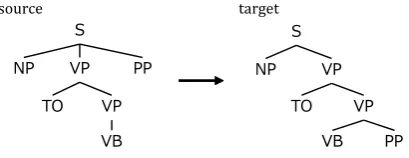
NP VP
S
VP TO NP VP
S
VP PP
TO
target source
VB VB PP
Figure 1: An example of STSG rule
2.
Previous Work
Kato and Matsubara (2010) propose a method of correct-ing annotation errors in a treebank. Their method is based onsynchronous tree substitution grammar(STSG) (Eisner, 2003). An STSG defines a tree-to-tree mapping, and con-sists of rules each of which is defined as a pair of trees called elementary trees. The one tree is called source, and the other is called target. Figure 1 shows an exam-ple of STSG rule. The rule transforms the structure which matches the source into the target’s structure. To correct an-notation errors in a treebank, the method constructs STSG rules which transform incorrect structures to correct one and applies them to the treebank.
The STSG rules are constructed as follows:
1. Make apseudo parallel corpus, which is a collection of pairs of partial parse trees which cover a same word sequence.
2. Extract STSG rules which represent a correspondence in the pseudo parallel corpus.
To select useful rules for error correction, they define a score function. Let ⟨τs, τt⟩be a rule whose source is τs and whose target isτt. The score of⟨τs, τt⟩is defined as follows:
Score(⟨τs, τt⟩) =
f(τt)
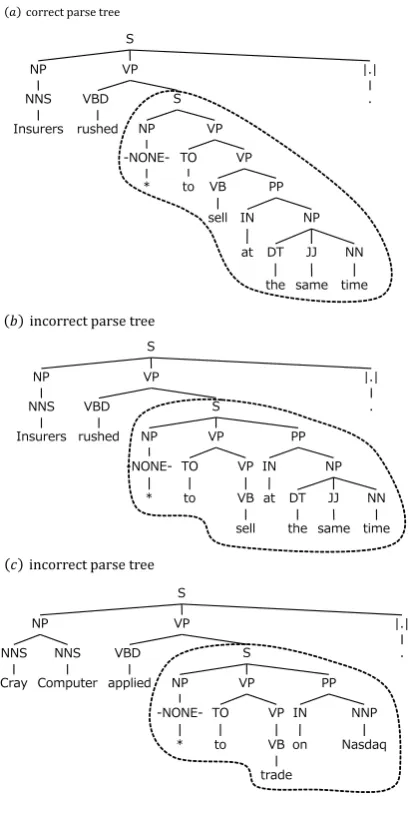
Figure 2: Examples of parse trees
wheref(τ)is the frequency of an elementary tree τ in a treebank. They assume that the frequency of an incorrect parse tree in a treebank is very low. The lowerf(τs)is, the higherScore(⟨τs, τt⟩)is. STSG rules with high scores are useful for error correction.
For example, let us consider a treebank which includes the parse trees shown in Figure 2. The parse tree (a) is correct, but (b) and (c) include a same annotation error. In (a) and (b), the word sequence “to sell at the same time” has differ-ent partial parse trees enclosed within the dotted line. The method makes a pair of these partial parse trees and extracts the STSG rule shown in Figure 1 from the pair. Applying this rule to the treebank, we can correct the error in (b). Moreover, the error in (c) can be corrected by this rule. However, this method has a problem. It can not extract any rule from a partial parse tree assigned to a word se-quence which occurs only once in a treebank. So, annota-tion errors included in only such partial parse tree can not be corrected by the method. Let us consider another case where the treebank does not include (b). In (c), the word sequence “to trade on Nasdaq” has incorrect partial parse tree. But, the method can not makes a pair of partial parse trees enclosed within the dotted lines in (a) and (c). This
S → NP VP
Figure 3: A derivation tree
is because these partial parse trees have different word se-quences. This means that it constructs no rule. As the re-sult, the method fails to correct the annotation error in (c).
3.
Correcting Errors by Tree Mining
To solve the problem described in Section 2, we adopt a different approach. Our method does not construct a pseudo parallel corpus. STSG rules are constructed based on a tree mining technique.
3.1.
Definition
In this section, we give some definitions.
3.1.1. Derivation Tree
In our method, a parse tree is represented by aderivation tree. Figure 3 shows the derivation tree corresponding to the partial parse tree enclosed within the dotted line in Fig-ure 2(a). A derivation tree for a parse tree is defined as follows: for each inner nodev of a parse tree, there exists a nodev′ which corresponds tov. v′preserves the parent-child relations onv. The label ofv′is the following gram-mar rule:
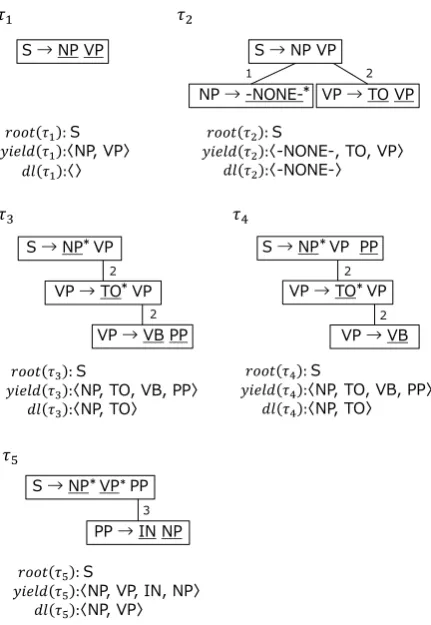
We define apatternas a connected subgraph included in a tree. Figure 4 shows examples of patterns.τ1, τ2andτ3are
included in the derivation tree shown in Figure 3. A pattern withknodes is calledk-pattern.
In a derivation tree pattern, if no grammar rule is applied to an element in the right-hand side of a grammar rule as-signed to a node, we call such elementleaf element. A leaf element corresponds to a leaf node of the original parse tree pattern. In Figure 4, leaf elements are underlined.
3.1.3. Error Correction Rule
6 ڀ13 93
Figure 4: Examples of patterns
The following formula represents whether or not two pat-ternsτandτ′can be transformed to each other:
T rans(τ, τ′)≡(root(τ) =root(τ′) ∧yield(τ) =yield(τ′))
whereroot(τ)is the left-hand side of the grammar rule of
τ’s root andyield(τ)is the list ofτ’s leaf element. τ3and τ4shown in Figure 4 can be transformed to each other since T rans(τ3, τ4)is satisfied.
We say that a patternτ is frequent iff(τ)≥σwhereσis a threshold. LetT be a treebank. Let F(T)be the set of frequent patterns inT. The following setRule(T)is the set of rules our method constructs fromT:
Rule(T) ={⟨τs, τt⟩ |τs∈/ F(T)∧τt∈F(T)
∧T rans(τs, τt)}
3.2.
Outline of Our Method
If we can enumerate all tree patterns included in a treebank and construct STSG rules from them, we can obtain any kind of rules which can be extracted from the treebank. However, such naive method is intractable, because it re-quires an exponential computational complexity. To con-struct rules efficiently, our method avoids the enumeration of patterns which do not contribute to error correction by using tree mining technique.
The procedure of our method is as follows:
1. Enumerate frequent patterns in a treebank by using a tree mining algorithm FREQT (Asai et al., 2004).
AlgorithmFREQT
Input: A thresholdσ >0, a treebankT.
Output: The setFof all frequent patterns inT.
F1:=∅
foreach 1-patternτwhich appears inT do iff(τ)≥σthen
Figure 5: The algorithm of FREQT
S → NP VP
Figure 6: Examples of expansions
2. Seek infrequent patterns which can be transformed to frequent ones.
3. Construct STSG rules which transform infrequent pat-terns to frequent ones.
3.3.
FREQT
In this section, we explain FREQT (Asai et al., 2004), which is the basis of our method. FREQT efficiently enu-merates all frequent patterns in a tree set. Figure 5 shows the algorithm of FREQT. First, FREQT creates the setF1 of all frequent 1-patterns by traversing a treebankT. Next, the algorithm generates candidate 2-patterns by expanding each frequent 1-patternτ ∈ F1 by attaching a new node (We writeτ⇒τ′whenτ′is obtained by expandingτ). For each candidate 2-patternτ′, iff(τ′)≥σ,τ′is added toF2. The algorithm iteratively expands frequent(k−1)-patterns, and adds frequentk-patterns toFk. By continuing this pro-cess until no patterns are generated, FREQT enumerates all frequent patterns.
FREQT uses the rightmost expansion technique. When FREQT expands a pattern, a new node must be attached to a node on the rightmost branch of the pattern. This en-ables FREQT to enumerate all candidate pattern without overlapping. Figure 6 shows examples of expansions.
3.4.
Constructing Error Correction Rules
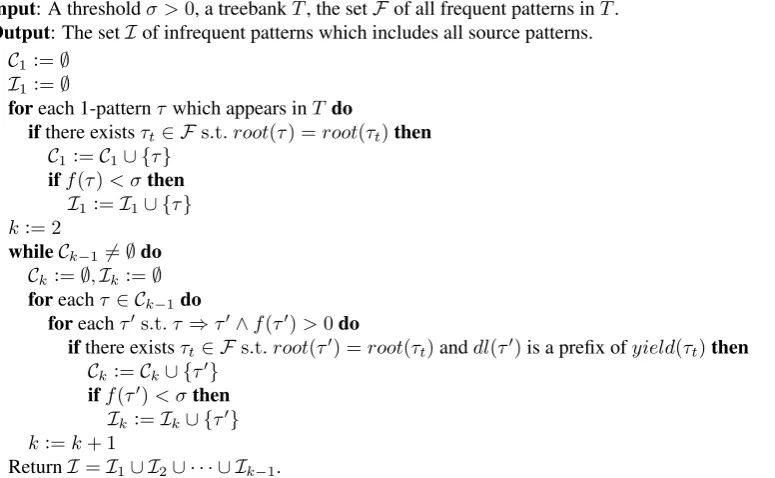
AlgorithmEnumerate infrequent patterns
Input: A thresholdσ >0, a treebankT, the setFof all frequent patterns inT.
Output: The setIof infrequent patterns which includes all source patterns.
C1:=∅ I1:=∅
foreach 1-patternτwhich appears inT do
ifthere existsτt∈ Fs.t. root(τ) =root(τt)then
C1:=C1∪ {τ} iff(τ)< σthen
I1:=I1∪ {τ} k:= 2
whileCk−1̸=∅do Ck :=∅,Ik:=∅
foreachτ∈ Ck−1do
foreachτ′s.t. τ ⇒τ′∧f(τ′)>0do
ifthere existsτt∈ Fs.t. root(τ′) =root(τt)anddl(τ′)is a prefix ofyield(τt)then
Ck:=Ck∪ {τ′}
iff(τ′)< σthen Ik :=Ik∪ {τ′}
k:=k+ 1
ReturnI=I1∪ I2∪ · · · ∪ Ik−1.
Figure 7: The algorithm of enumerating infrequent patterns
For an infrequent patternτs, if there exists someτt∈F(T) s.t.T rans(τs, τt), our method constructs the rule⟨τs, τt⟩.
3.4.1. Efficient Enumeration of Infrequent Source Patterns
To seek infrequent source patterns efficiently, we focus on leaf elements of patterns. According as pattern expansion proceeds from left to right, it is determined whether or not a grammar rule is applied to a leaf element. Once a leaf el-ement is skipped, it never has a grammar rule. We call such element determined leaf. In Figure 4 and 6, determined leaves are marked with an asterisk. Our method expands a patternτonly if there exists a frequent patternτtwhich fulfills the following conditions:
1. root(τ) =root(τt).
2. dl(τ)is a prefix ofyield(τt).
wheredl(τ)is the list of determined leaves of a patternτ. If a patternτhas no patternτtsatisfying the above conditions, the patternτdoes not contribute to constructingRule(T). This is because there is no target patternτt∈F(T)for any
τ′ s.t. τ ⇒∗ τ′. That is,T rans(τ′, τt)does not hold for anyτ′ andτt. As an example, let us consider the patterns
τ4 andτ5 shown in Figure 4. Here, dl(τ5)is ⟨NP, VP⟩
andyield(τ4)is ⟨NP, TO,VB,PP⟩. This pair does not
fulfill the condition 2. For any τ5′ s.t. τ5 ⇒∗ τ5′,dl(τ5′)
andyield(τ5′)are in the form of⟨NP,VP, . . .⟩. Therefore,
yield(τ5′)̸=yield(τ4). This also means thatT rans(τ5′, τ4)
does not hold.
Figure 7 shows our algorithm of enumerating infrequent patterns.
4.
Experiment
We performed an experiment to evaluate our method. We applied our method to 49,208 sentences in Wall Street
Jour-nal section of the Penn Treebank (Marcus et al., 1993). We implemented our method in Java. The experiment was run on a PC (Intel core i7 3.40GHz) with 8GB main memory, running Windows 7 Professional. The thresholdσwas set to 100. We obtained 2,379 rules. This took about 34 min-utes1. In these rules, 1,987 rules can not be obtained by
Kato and Matsubara’s method. To measure the precision of the rules, we applied rules to the WSJ section. Because it is time-consuming and expensive to evaluate all rules, we only evaluated the rules with the 300 highest scores. A person (not the authors) manually checks whether or not each rule corrects errors. The precisionpis measured in the same way as (Kato and Matsubara, 2010):
p= #of the positions where an error is corrected #of the positions to which some rule is applied
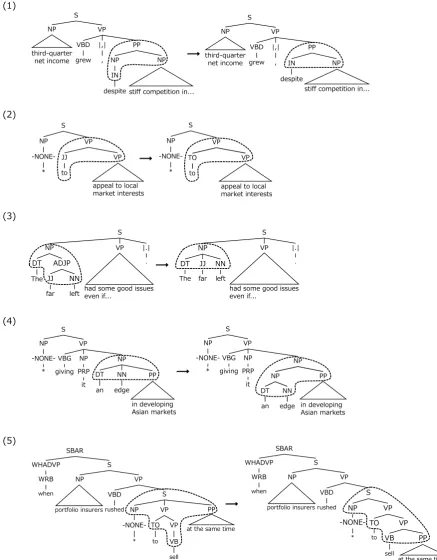
The number of the positions to which 300 rules are applied is 605. The number of the positions where an error is cor-rected is 466. Therefore, the precision of our method is 77.0%. The precision of the previous method (Kato and Matsubara, 2010) is 71.6%. We measured the precision of each rule. The precision of 196 rules achieved 100% preci-sion. 155 of the 196 rules could not be obtained by Kato and Matsubara’s method. This result shows that our method can obtain the useful error correction rules which the previous method can not obtain. Figure 8 shows some examples of correcting errors which our method correct but the previous method does not.
1
Figure 8: Examples of correcting syntactic annotation errors
5.
Conclusion
In this paper, we proposed a new method of correcting an-notation errors in a treebank. Our method is based on tree mining. An experiment showed that our method can ob-tain rules which the previous method can not obob-tain. The proposed method and the previous one are complementary. That is, by both method, we can expect to achieve wider coverage of error correction.
If a source pattern has several target patterns, our method simply transforms the source to the most frequent target. To improve the precision, we will explore how to select an appropriate target.
6.
Acknowledgements
7.
Bibliographical References
Tatsuya Asai, Kenji Abe, Shinji Kawasoe, Hiroshi Sakamoto, Hiroki Arimura, and Setsuo Arikawa. 2004. Efficient substructure discovery from large semi-structured data. IEICE Transactions on Information and Systems, E87-D(12):2754–2763.
Adriane Boyd, Markus Dickinson, and W. Detmar Meurers. 2007. Increasing the recall of corpus annotation error detection. InProceedings of the 6th Workshop on Tree-banks and Linguistic Theories, pages 19–30.
Markus Dickinson and W. Detmar Meurers. 2003. De-tecting inconsistencies in treebanks. InProceedings of the 2nd Workshop on Treebanks and Linguistic Theories, pages 45–56.
Markus Dickinson and W. Detmar Meurers. 2005. Prune diseased branches to get healthy trees! How to find er-roneous local trees in a treebank and why it matters. In
Proceedings of the 4th Workshop on Treebanks and Lin-guistic Theories, pages 41–52.
Markus Dickinson. 2009. Similarity and dissimilarity in treebank grammars. InCurrent Issues in Unity and Di-versity of Languages: Collection of the papers selected from the 18th International Congress of Linguists, pages 1597–1611.
Markus Dickinson. 2015. Detection of annotation errors in corpora. Language and Linguistics Compass, 9(3):119– 138.
Jason Eisner. 2003. Learning non-isomorphic tree map-pings for machine translation. InProceedings of the 41st Annual Meeting on Association for Computational Lin-guistics, pages 205–208.
Pablo Faria. 2014. Using dominance chains to detect anno-tation variants in parsed corpora. In10th IEEE Interna-tional Conference on e-Science, volume 2, pages 25–32. Yoshihide Kato and Shigeki Matsubara. 2010. Correcting errors in a treebank based on synchronous tree substitu-tion grammar. InProceedings of the ACL 2010 Confer-ence Short Papers, pages 74–79.
Seth Kulick, Ann Bies, Justin Mott, Mohamed Maamouri, Beatrice Santorini, and Anthony Kroch. 2013. Using derivation trees for informative treebank inter-annotator agreement evaluation. InProceedings of the 2013 Con-ference of the North American Chapter of the Associa-tion for ComputaAssocia-tional Linguistics: Human Language Technologies, pages 550–555.
Mitchell P. Marcus, Beatrice Santorini, and Mary Ann Marcinkiewicz. 1993. Building a large annotated corpus of English: the Penn Treebank. Computational Linguis-tics, 19(2):313–330.
Adam Przepi´orkowski and MichałLenart. 2012. Simulta-neous error detection at two levels of syntactic anno-tation. InProceedings of the 6th Linguistic Annotation Workshop, pages 118–123.