REACTION AND DIFFUSION IN
MICROSTRUCTURED MATERIALS
Thesis by Michael Loewenberg
In Partial Fulfillment of the Requirements for the Degree of
Doctor of Philosophy
California Institute of Technology Pasadena, California
1988
@1988
ACKNOWLEDGEMENTS
I'd like to thank some of the people who have helped me to reach this goal. First of all my advisor, George Gavalas: I have learned (am learning) a lot from you. Although its not always obvious, I have share your view that simplicity is elegant but not at the cost of clarity. I appreciate/respect your approach to research; you've been a good mentor. I would also like to thank Gary Leal and John Brady for expressing an interest in me and advising me with career plans.
thing about the experience: after a lot of hard work, learning is more enjoyable now than ever. I appreciate the students and faculty who have made this experience a good one.
I would like to thank Lark (and Nicci-nose) for taking the time to know me and for valuing this accomplishment. Thanks also for tolerating me during the trying time which accompanied my finishing. I look forward to our future together.
I'd like to thank my parents; without them, I wouldn't be here for a few rea-sons... I hope this compensates for dropping out of high school to become a cook at Sambo's. I'd like to thank Deb and Rich, my sister and brother who always accepted and supported me. Youngest, but not least, I want to acknowledge Sarah, the smartest person I know, for being an excellent niece and making me look forward to being a father very much.
I am grateful for the support provided by fellowships from the National Science Foundation and LINK Foundation.
ABSTRACT
A fundamental study of heterogeneous reaction and diffusion in random, microstruc-tured materials has been conducted. A detailed, ensemble averaging approach has been developed for the analysis of diffusion-controlled reactions. The method was used to determine the reactant flux into a bounded or semi-infinite medium contain-ing a dilute suspension of reactive, spherical particles under steady-state or transient conditions. The influence of the boundary was given explicit, detailed consideration and the results were compared with a mean-field treatment. Physical motivation is provided by the process of ash vaporization during pulverized coal combustion. The analysis was subsequently extended to study the decay of an initially uniform distri-bution of reactant which allows comparison with other theoretical approaches. The result suggests that the present method reproduces the solution to this well-known problem by a seemingly simpler, more physical approach. The configurational av-eraging technique was employed in a study of heterogeneous reaction in a porous material under diffusion-controlled conditions. The porous solid is assumed to have a bimodal pore structure with a random, isotropic distribution of cylindrical macro-pores. The results are relevant to the pulverized combustion of char from softening coals. In the diffusion-controlled limit, the results coincide with a simpler, single pore model.
TABLE OF CONTENTS
page
Acknowledgments ... 111
Abstract ... v
Table of Contents ... v1
List of Tables ... v111
List of Figures ... ix
1. Introduction ... 1
Part I:
Char Combustion
22 2 Structure and Combustion of Cenosphere Particles. . ... 233 A Simplified Description of Char Combustion ... 51
Part II: Configurational Averaging
1285 Steady-State Reactant Flux into a Medium
Containing Spherical Sinks ... 129
6 Reactant Flux into a Medium Containing Spherical Sinks: The Time-Dependent Problem ... 180
7 Time-Dependent, Diffusion-Controlled Reactions: The Influence of Boundaries ... 208
8 Reaction and Diffusion in a Random, Porous Material. ... 229
9 Summary ... 277
10 Epiiogue ... 281
LIST OF TABLES
TABLES: page
4.1 Physical properties of synthetic chars 113
LIST OF FIGURES
FIGURES:
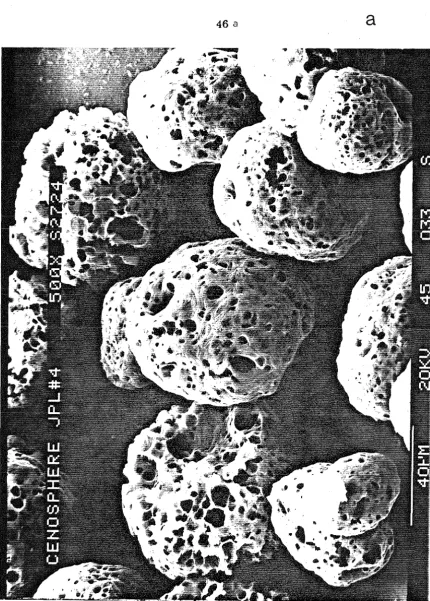
2.1 (a,b) SEM micrographs of cenospheres (c,d) optical optical micrographs of cross-sectioned cenospheres
page
46
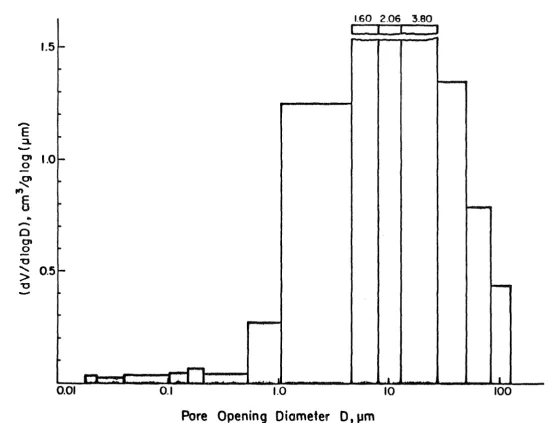
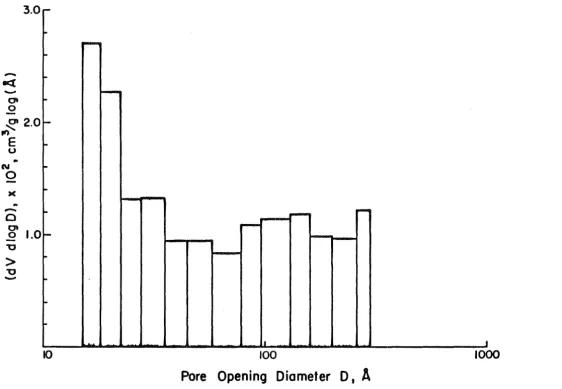
2.2 Pore size distribution of cenospheres by mercury intrusion. 4 7 2.3 Pore size distribution of cenospheres by nitrogen adsorption. 48 2.4 Particle temperature and oxygen fraction versus time.
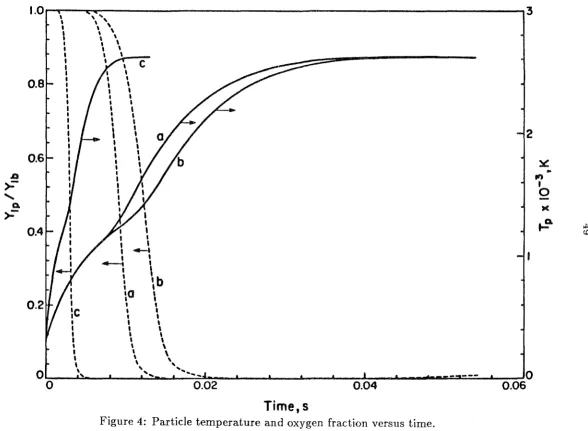
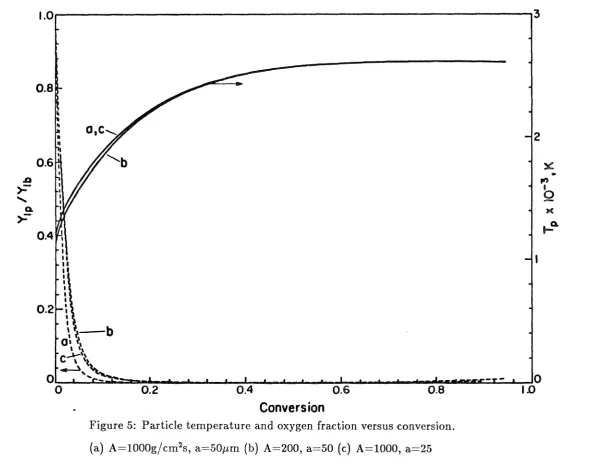
(a) A=1000g/cm2s, a=50µm (b) A=200, a=50 (c) A=lOOO, a=25. 49 2.5 Particle temperature and oxygen fraction versus conversion.
(a) A=l000g/cm2s, a=50µm (b) A=200, a=50 (c) A=lOOO, a=25. 50 3.1 Histories of particle temperature and surface oxygen concentration
during combustion in air with T 00 = 1500K
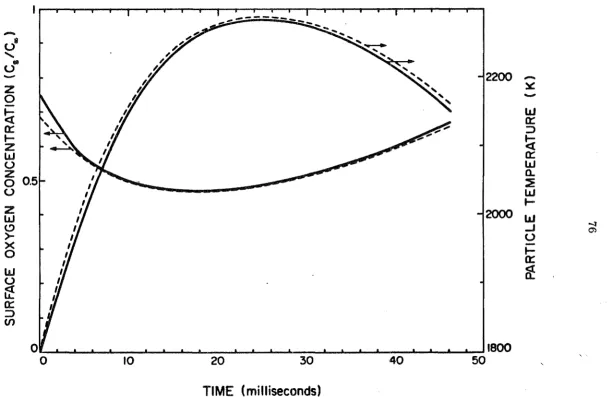
(---): complete numerical solution; (- - - -): approximate solution. 75 3.2 Histories of particle temperature and surface oxygen concentration
during combustion in air with T 00 = 1800K
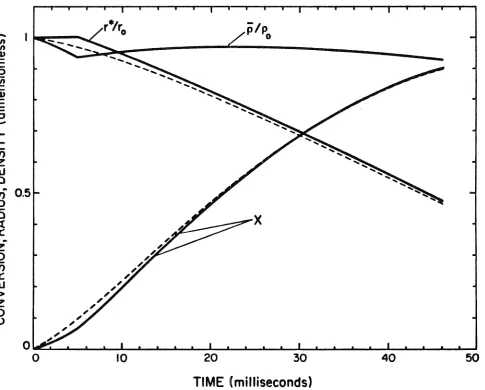
(---): complete numerical solution; (- - - -) : approximate solution. 76 3.3 Particle radius, average density, and conversion versus time
during combustion in air with T 00 1500K
( - - ) : complete numerical solution; (- - - -) : approximate solution. 77 3.4 Particle radius, average density, and conversion versus time
during combustion in air with T 00 = 1800K
4.1 SEM micrographs of solid synthetic particles:
(a) plain polymer (PFA) and (b) PFA with 25% carbon black. 114
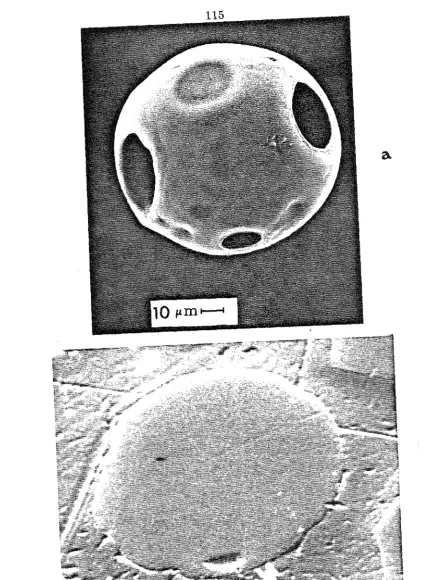
4.2 SEM micrographs of (a) a cenospheric particle
(b) a section through a partially burned PFA particle. 115
4.3 SEM micrograph of a PSOC-176 coal-char particle pyrolyzed at 1600K 116
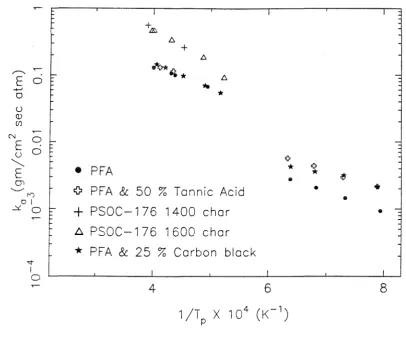
4.4 Arrhenius-type plot of the apparent reaction rate coefficient vs. the inverse of particle temperature.
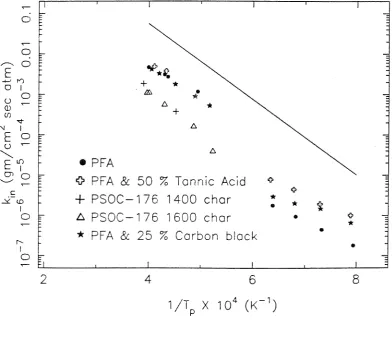
4.5 Arrhenius-type plot of the intrinsic reaction rate coefficient vs. the inverse of particle temperature.
4.6 Combustion parameters for 45 µm solid PFA particles burning in 02 at a Tw of 1500 K. (a) Temperature-time profile, model:
solid line, experiments: dotted line. (b) Burnout, relative surface oxygen concentration and relative radius vs time.
4. 7 Combustion parameters for 45 µm solid particles formed from from 50% tannic acid - 50% PFA burning in 02 at a
Tw of 1500 K. (b) Temperature-time profile, model: solid line,
experiments: dotted line. (b) Burnout, relative surface oxygen concentration and relative radius vs time.
4.8 Combustion parameters for 45 µm solid PFA particles containing 25% carbon black burning in 02 at a Tw of 1450 K
(a) Temperature-time profile, model: solid line, experiments: dotted line. (b) Burnout, relative surface oxygen concentration and relative radius vs. time.
117
118
119
120
4.9 Combustion parameters for 114 µm cenospheric particles formed from 50% tannic acid and 50% PFA burning in 02
at a Tw of 1500 K. (a) Temperature-time profile, model: case
(I)
solid line, case(II) dashed line; experiments: dotted line. (b) Burnout, relative surface oxygen concentration and relative radius vs. time.4.10 Combustion parameters for 50 µm PSOC-176 coal-char particles (1600 K pyrolysis) burning in 0 2 at a Tw of 1500 K.
(a) Temperature-time profile, model: solid line, experiments: dotted line. (b) Burnout, relative surface oxygen concentration,
122
relative particle radius and relative ash layer thickness vs. time. 123
4.11 Combustion parameters for 50 µm PSOC-176 coal-char particles (1400 K pyrolysis) burning in 02 at a Tw of 1500 K.
(a) Temperature-time profile, model: solid line, experiments: dotted line. (b) Burnout, relative surface oxygen concentration,
relative particle radius and relative ash layer thickness vs. time. 124
4.12 Combustion parameters for 45 µm solid particles formed from 50% tannic acid - 50% PFA burning in air at a Tw of 1500 K Temperature-time profile, burnout, surface oxygen concentration, relative radius and apparent density vs. time;
4.13 Combustion parameters for 45 µm solid particles formed from
50% tannic acid - 50% PFA burning in air at a Tw of 1400 K Temperature-time profile, burnout, surface oxygen concentration, relative radius and apparent density vs. time;
complete model: solid line, simplified model: dotted line. 126
4.14 Combustion parameters for 8 µm solid PFA particles burning in air at a Tw of (a) 1400 Kand (b) 1300 K. Temperature-time profile, burnout, surface oxygen concentration, relative radius
and apparent density vs. time. 127
5.1 Reactant flux versus volume fraction of spheres. 177
5.2 Approach to semi-infinite domain solution versus screening modulus. 178
5.3 Correction to mean-field solution versus radius. 179
6.1 Dimensionless reactant flux versus time. 205
6.2 Dimensionless reactant flux versus volume fraction. 206
6.3 Mean-field correction versus time. 207
7 .1 Decay of an initially uniform distribution of reactant c = 0.01.
Error relative to Felderhof's solution:
(UF - U)/UF (----);
(UF - UBz)/UF(· - · - ·-); (UF - Us)/UF(· · · ·)
2277 .2 Reactant flux into a semi-infinte medium resulting from step change on boundary, c - 0.01. Relative effect of sphere-boundary
8.1 Bimodal pore size distributions for: (a) PSOC-1451 coal derived char
Northrop (1988) and (b) Fe304-Cr03 catalyst (Bohlbro 1966). 271
8.2 Coordinate system: (a) two-dimensions (b) three-dimensions (c) cylindrical coordinates oriented with pore axis. x is an arbitrary field point, ()i is the angle between reference plane (defined by
e)
and orientation plane (defined byqi).
Azimuthal angle, 'Pi is defined in the plane6
=constant. Poreaxis intersects reference plane at Xi and orientation plane
(6
=constant) at Xi.6
is an axial coordinate (distance from the boundary) in the Qi-direction.Pi is a radial coordinate; Pi = 1 defines macropore surface.
8.3 Orientation of reference vector, e for (a) slab, (b) spherical, and (c) semi-infinite geometries.
8.4 Behavior of (1 - II)/(1 - E2) where II is defined by Eq. (42).
A.1 Distribution of calcium in CaO equivalents along the radius of calcium treated synthetic chars.
A.2 SEM-BSE micrographs of sections through low porosity calcium treated synthetic char particles (a) ion exchanged
(b) CaC03 precipitated.
A.3 SEM-BSE micrographs of sections through high porosity calcium treated synthetic char particles: (a) ion exchanged
(b) CaC03 precipitated.
272,273
274,275
276
315
316
A.4 SEM-SE micrographs of residual ash after complete combustion of low porosity synthetic char particles in air at 800 K. The particles were treated with
ion exchanged calcium: (a) outside view (b) inside view.
A.5 SEM micrographs of polished sections of ash particles resulting from combustion of high porosity chars.
A.6 XRD profiles of partially burned low porosity chars at Tw
=
1400 K, Po2=
.04, 2 ms.A.7 Temperature-time profiles of high porosity particles burning in 02 : (a) plain char, (b) ion exchanged,
( c) CaC03 precipitated.
A.8 Temperature-time profiles of high porosity particles burning in air: (a) ion exchanged,
(b) CaC03 precipitated.
A.9 Temperature-time profiles of low porosity particles burning in 02 : (a) plain char, (b) ion exchanged,
( c) calcium acetate impregnated.
A.10 Temperature-time profiles of low porosity particles burning in air: (a) ion exchanged, (b) calcium acetate impregnated. A.11 Temperature-time profiles of PSOC-680 coal particles
burning in air: (a) untreated coal, (b) CaC03 precipitated. A.12 Reaction rate Rm vs. burnoff for TGA combustion of
low porosity chars at (a) 673 Kand (b) 773 K.
318,319
320
321
322
323
324
325
326
A.13 Reaction rate Rm vs. burnoff for TGA combustion of high porosity chars at (a) 773 Kand (b) 873 K.
A.14 Reaction rate Rm vs. burnoff for TGA combustion of PSOC-176 coal-char at 773 K.
A.15 Apparent reaction rate coefficient ka at intermediate to high temperatures, both low porosity (LP) and high porosity chars (HP).
A.16 Apparent reaction rate coefficient km at low temperatures, both low porosity (LP) and high porosity chars (HP).
A.17 Intrinsic reaction rate coefficient ki at low temperatures, both low porosity (LP) and high porosity chars (HP).
328
329
330
331
CHAPTER 1
Introduction
1
Problem Statement
Relating the macroscopic properties of a material to its microstructure is a problem pervading much of modern engineering science. In most situations, the microstruc-ture refers to the molecular scale, however, under some circumstances, there exists an intermediate scale, much smaller than the system dimension, yet sufficiently large to allow appiication of the continuum hypothesis on the molecular scale. Under these circumstances, the microstructure refers to the structure of this intermediate scale. Traditionally, the continuum hypothesis has been applied to the intermediate scale as well. This approach ignores the effect of the detailed microstructure which, in some problems, is small thereby permitting such an approach. In some problems, however, the detailed microstructure has a significant, macroscopically observable, manifestation thus rendering a continuum treatment useless. Frequently, such prob-lems arise in the field of heterogeneous reaction and diffusion but only recently have serious attempts been made to gain a fundamental understanding through the proper analysis.
each problem can be effectively treated as a continuum whereas in some, practically important, situations, the detailed structure can have a significant, macroscopic impact.
The primary contribution of this work is the development of a configurational averaging approach which allows explicit consideration of the detailed microstruc-ture. Three problems are studied: (1) the flux of reactant into a bounded medium containing reactive centers, (2) reaction and diffusion in a random, porous material, and (3) the decay of an initially uniform distribution of reactant in an unbounded medium. The first two problems, relevant to ash vaporization and char combustion, have heretofore been analyzed primarily through application of the continuum
hy-,.
pothesis to the microstructure of the material. Comparison with previous results permits an assessment of the significance of the detailed microstructure. Previous theoretical results which address the detailed microstructure relevant to the third problem are available which allow a useful comparison.
2
Physical Background
Although, the majority of the work presented in this thesis is theoretical in nature and somewhat independent of specific physical phenomena, the following general discussion of the particular problems which motivated this work is useful and adds concreteness. The aforementioned processes of char combustion and ash vaporiza-tion are relevant to the industrially important problem of pulverized coal combus-tion. Pulverized coal combustion has been a subject of numerous theoretical and experimental investigations because of its obvious importance in the operation of coal combustion systems. It has been well established that the burning of pulver-ized coal particles occurs in two stages: rapid pyrolysis and evolution of volatiles followed by the comparatively slow heterogeneous oxidation of the residue (char) (Mulcahy and Smith 1969, Timothy et al. 1982). The initial pyrolysis process has been given a comprehensive treatment by Gavalas (1982) while reviews on the field of char combustion are available from several authors including Smith (1982a). The initial thermal decomposition stage profoundly affects the structure and reactivity of the residual char which consists of a porous carbon structure and small quan-tities of hydrogen, oxygen, nitrogen, sulfur depending on the rank of the parent coal. Additionally, the char contains any (inert) mineral matter contained in its coal precursor.
Walker et al. (1968).
The fate of the mineral matter in coal has received much attention because of its detrimental contribution to the particulate pollutants produced during pulverized coal combustion. Studies have shown that the distribution of mineral matter re-sulting from combustion is bimodally distributed with respect to particle size. The smaller particles result largely from the vaporization and subsequent condensation of mineral matter initially contained within the coal. A review of work in this field was recently conducted by Flagan and Seinfeld (1988).
During char oxidation, the interior of the particle is subjected to a high-temperature, carbon monoxide environment. Under these conditions, micron size inclusions of refractory metal oxides
(e.g.,
Si02 , MgO, CaO, etc.) undergo rapid reduction toa more volatile sub-oxide which diffuses through the char matrix and escapes into the oxidizing atmosphere which surrounds the particle (Quann and Sarofim 1982). In the oxidizing environment, the sub-oxide species is oxidized and subsequently condenses forming submicron size particles of the metal oxide. This chemically augmented vaporization process accounts for only a small fraction of the particu-late matter produced during combustion but it is an important problem because the submicron particles produced are very difficult to capture by particulate control devices.
3
Theoretical Background
the area of diffusion-controlled reactions which is pertinent to the ash vaporization process. The final subsection is devoted to a review of averaging techniques which are useful for a variety of problems including char combustion and ash vaporization in situations where a continuum description of the material fails.
3.1
The Continuum Description
Modern char combustion modelling typically relies on a continuum description of the char involving differential equations to treat intraparticle transport (Sotirchos and Amundson 1984a, 1984b). Such equations require local values for transport coefficients and structure properties such as void volume and pore surface area. These quantities are often obtained through the use of a random pore model in con-junction with measured physical data (Bhatia and Perlmutter 1980, 1981; Gavalas
1980). This approach yields local transport and structure properties as functions of the local burnoff with proper account given to pore overlap. However, a tacit assumption in this approach is the disparity of the characteristic length scales of the particle pore structure and oxygen concentration gradients. Often the length scale of the pore structure is orders of magnitude less than that for changes in oxygen concentration thus justifying a continuum treatment of the char structure.
particles.
3.2
Diffusion-Controlled Reactions
Diffusion-controlled reaction is a field with relevance to a variety of important engi-neering problems which typically reduce to the consideration of a diffusing chemical species in a medium with concentration sinks. Examples include spray evaporation or condensation, suspension polymerization, fluorescence quenching, and the pro-duction of metabolic products in immobilized cell systems. Smoluchowski (1916) did the pioneering work in this field by developing the mean-field approximation in the context of a study on the coagulation of colloidal sized particles. According to the mean-field approximation, a macroscopic equation describes the material as a continuum with a homogeneous reaction rate constant determined by considering an isolated sink in the ambient concentration field.
Recently, significant advances been made in this field by several workers whose general approach has been to determine a rate constant which characterizes the bulk properties of the material and accounts for the details of the microstructure. Felderhof and Deutch (1976) examined the effect of two sphere interactions and obtained results valid for a dilute volume fraction of sinks using a superposition ap-proximation. Subsequently, Muthukumar and Cukier (1981) extended their results to an arbitrary volume fraction of monopole sinks. The volume fraction dependence of the diffusion coefficient was investigated by Muthukumar (1982) and, most re-cently, Mattern and Felderhof (1986, 1987) applied a cluster expansion approach to the problem and discussed the discrepancies among previous results.
interactions under dilute conditions and non-local effects relevant to this problem were considered by Tokuyama and Cukier (1982). The techniques of multiple scat-tering were applied by Bixon and Zwanzig (1981) and later modified by Felderhof et al. (1982).
The ash vaporization problem is a diffusion controlled process in which the metal oxide inclusions behave as sinks of carbon monoxide. Thus, the foregoing results have pertinence to this problem. Quann and Sarofim (1982) have performed an experimental investigation of this problem and modelled their results using the mean-field theory of Smoluchowski.
3.3
Averaging Techniques
In the final category of the review of theoretical methods, several averaging tech-niques are discussed which address the detailed microstructure. These methods have been developed over the past few decades for use in various situations where the details of the relevant microstructure may be important. Equation averaging has proven to be a useful approach for a variety of problems in which detailed treatment of the microstructure is required.
3.3.1 Volume Averaging
In general, an ensemble average is the correct average for random, microstruc-tured materials (Hashin 1964), however, in problems with statistical homogeneity
foun-dation for this approach has been established through the work of Slattery (1967, 1970) in his investigations of viscoelastic and two-phase flows through porous media, and the independent work of Anderson and Jackson (1967) and Whitaker (1967). The essence of their work is the development of a spatial averaging theorem based on an appropriate volume average of the microstructure in the material. The recent work of Whitaker (1985) clarifies the earlier result.
Many problems exhibit the required statistical homogeneity and are amenable to a volume averaging analysis which addresses their detailed microstructure. Such problems include the determination of sedimentation velocity in a suspension of particles under gravity and the bulk stress in a suspension of force-free particles each of which was first considered in the dilute limit (no particle interactions) by Smoluchowski (1912) and Einstein (1906). Batchelor (1972a, 1972b) improved upon these early results by retaining the effects of pair-wise particle interactions in both problems through the development of a volume averaging technique which involved a renormalization procedure to eliminate divergences which commonly arise from this long-range interaction. This approach was borrowed by Jeffery (1973) to improve upon the dilute limit result obtained by Maxwell (1873} for the effective conductivity of a solid suspension of spherical particles.
3.3.2 Difficulties with Volume Averaging
of the fixed particles. His results were later supported by Childress (1972), Lund-gren (1972) and Howells (1973) who retained the effect of pair-wise interactions in the solution to this problem. Screening is also an essential feature of problems involving diffusion-controlled reactions. The screening interaction results in a much stronger influence of the microstructure than in the sedimentation and effective viscosity/ conductivity problems.
A second important situation m which a volume average is inappropriate is in the vicinity of a macroscopic boundary. In this case, statistical homogeneity is destroyed and thus the equivalence of ensemble and volumetric averages. This situation is relevant to problems including steady heat conduction in a bounded, mi-crostructured material and ash vaporization during pulverized coal combustion. In
the former problem, the boundary induces local, microscale order which is manifest as a macroscopic temperature offset far from the boundary when a bulk gradient is applied to the material (Chang and Acrivos 1987). In the latter problem, the mass flux of metal oxide on the particle surface is sought which depends on the details of the local concentration field in the neighborhood of the boundary. However, de-tailed treatment of macroscopic boundaries seems to have escaped attention in the context of diffusion-controlled reactions. A tacit assumption seems to have been that boundaries, when present, would be accommodated through application of the customary boundary conditions to the averaged equations which were obtained in the absence of macroscopic boundaries.
3.3.3 Configurational Averaging
per-formed with one particle fixed. This term is obtained from the solution to a con-ditionally averaged equation which is obtained by averaging the original equations over all configurations in which the specified particle is fixed. However, the result-ing equation relates to a doubly conditional averaged equation which is similarly obtained. According to this approach, an infinite hierarchy of coupled, configura-tionally averaged equations are produced with an additional particle fixed at each higher level. The hierarchy is truncated under the condition that the microstruc-ture is dilute or sparse. Using this approach, Hinch was able to reproduce, and therefore support, Batcheior's results for sedimentation and bulk viscosity which were obtained by volume averaging (Hinch 1977). Furthermore, he demonstrated that this approach could be successfully applied to determine the permeability of a fixed array of particles, a problem intractable by volume averaging.
3.3.4 Concentrated Systems
A rather severe restriction to the results obtained by either of the foregoing averag-ing procedures is the restriction to dilute volume fractions. Many problems of practi-cal interest arise in concentrated systems where alternate methods are required. Re-cently developed approaches include computer simulations
(e.g.,
Durlofsky, Brady and Bossis 1987), the development tight, rigorous upper and lower bounds(e.g.,
4
Outline of Thesis
In this thesis, a theoretical investigation of heterogeneous reaction and diffusion in microstructured materials is presented with emphasis on the proper treatment of the microstructure. Motivation for the study is provided by the physical processes of char oxidation and ash vaporization, under conditions relevant to pulverized coal combustion. The primary contribution of this work is contained in the second portion of the thesis which consists of Chapters 5-8 which contain the derivation and implementation of a configurational averaging approach which properly treats the detailed microstructure pertinent to the diffusion-controlled reaction problems considered therein. The first portion of the thesis, consisting of Chapters 2-4, is more specifically focused on the problem of char oxidation but serves, in part, to motivate the work contained in the latter portion.
4.1
Char Combustion
In Chapter 2, cenosphere structure and combustion behavior is studied. Particles were collected and their structure characterized. Their combustion behavior was modelled omitting pore diffusion but retaining the effects of pore growth and gas-phase heat and mass transport. The film transport equations were reduced by quadrature to a set of nonlinear algebraic equations by an approach similar to that of Libby and Blake (1979). The numerical results indicate that oxygen penetration is on the same order of magnitude as the size of the largest voids. A continuum description of the char is inappropriate.
as a traditional model which involved a tessellation of the particle were examined. Numerical solutions are presented under a variety of practical conditions in which both gas-phase and intraparticle resistances were significant.
In Chapter 4, an efficient algorithm is developed for the estimation of kinetic parameters from combustion experiments and is applied to data gathered from several well-characterized chars (Levendis and Flagan). This procedure was used in conjunction with the computer simulation developed in Chapters 2 and 3 to model the combustion behavior of these chars. The results were compared with experiment (Leven dis
et al.).
Appendix 1 describes an investigation of the catalytic effects of calcium during the char oxidation process. Three procedures are described for inducing calcium content in synthetic char particles and combustion experiments with the calcium-enriched particles were performed. The catalytic effects of this mineral were subsequently quantified by application of the algorithm for estimating kinetic parameters.4.2
Configurational Averaging Approach
semi-infinite domains. The problem has direct application to the ash vaporization process and the results are compared with the previous theoretical study of Quann and Sarofim (1982). The result of the comparison demonstrates the significance of sphere-boundary interactions in this problem.
In Chapter 6, the foregoing averaging approach developed in a steady-state con-text is extended to consider the transient problem. The time-dependent reactant flux into a bounded or semi-infinite domain is determined and numerical results pre-sented for spherical and semi-infinite domains. The results are compared with those of a mean-field analysis The decay of an initially uniform distribution of reactant in an infinite medium of spherical sinks is studied in Chapter 7. In this, statisti-cally homogeneous situation, two-sphere interactions are included in the analysis. Following the approach of previous workers, a time-dependent rate coefficient is determined which is compared with the theoretical results of Smoluchowski (1916), Felderhof (1977), and Bixon and Zwanzig (1981). It is demonstrated that such an approach cannot be applied unless the domain is unbounded; the presence of macroscopic boundaries affects the bulk equations. Numerical results are presented which demonstrate the impact of detailed interactions upon the time-dependent, bulk concentration.
The conditions of interest correspond to the regime of diffusion control in which the details of the macropore network become important. The analysis is shown to be valid in this regime and thus compliments the continuum treatment. The differential equation governing the bulk concentration field has a modified form relative to the local reaction-diffusion equation, thus a bulk rate coefficent cannot be defined. The approach may have important implication to the analysis of cenosphere combustion
5
References
1. Anderson, T.B. and Jackson, R. (1967) A fluid mechanical description of fluidized beds. Ind. Eng. Chem. Fundam. 6 (4) 527-539.
2. Batchelor, G.K. (1970) The stress system in a suspension of force-free parti-cles. J. Fluid Mech. 41, 545.
3. Batchelor, G.K. (1972a) Sedimentation in a dilute suspension of spheres. J.
Fluid Mech. 52, 245.
4. Batchelor, G .K. and Green, J. T. ( 1972b) The determination of the bulk stress in a suspension of spherical particles to order c2
• J. Fluid Mech. 56, 401.
5. Batchelor, G.K. (1974) Transport properties of two-phase materials with ran-dom structure. Ann. Rev. Fluid Mech. 227.
6. Bhatia, S.K., and Perlmutter, D.D. (1980). A random pore model for fluid solid reactions: I. Isothermal, kinetic control. A.I. Ch.E.Jl.26, 379.
7. Bhatia, S.K., and Perlmutter, D.D. (1981). A random pore model for fluid solid reactions: II. Diffusion and transport effects. A.I. Ch.E.Jl.27, 247. 8. Bixon, M. and Zwanzig, R. (1981) Diffusion in a medium with static traps.
J. Chem. Phys. 75 (5), 2354.
9. Brinkman, H. C. (1947) A calculation of the viscous force exerted by a flowing fluid on a dense swarm of particles. Appl. Sci. Res. A 1, 27.
11. Chang, E.Y. and Acrivos, A. (1987) The conduction of heat from a planar wall with uniform surface temperature to a monodisperse suspension of spheres.
J. Appl. Phys. 62, (3), 771-776.
12. Childress, S. (1972) Viscous flow past a random array of spheres. J. Chem. Phys. 56 (6), 2527-2539.
13. Darcy, H. (1856) Les Fontaines Publiques de la Ville de Dijon. Paris: Victor Dalmont.
14. Durlofsky, L., Brady, J.F. and Bossis, G. (1987) Dynamic simulation of hy-drodynamically interacting particles. J. Fluid Mech. 180, 21.
15. Einstein, A. (1906) Eine neue Bestimmung der Molekiildimension. Annin. Phys. 19, 289 (and 34, 591).
16. Felderhof, B.U. and Deutch, J.M. (1976) Concentration dependence of the rate of diffusion-controlled reactions. J. Chem. Phys. 64, (11), 4551-4558. 17. Felderhof, B.U. (1977) Frequency-dependent rate coefficient in diffusion-controlled
reactions. J. Chem. Phys. 66 (10), 4385.
18. Felderhof, B.U., Deutch, J.M. and Titulaer, U.M. (1982) Diffusion and ab-sorption in a medium with spherical sinks. J. Chem. Phys. 76 (8), 4178.
19. Flagan, R.C. and Seinfeld, J.H. (1988) Fundamentals of Afr Pollution Engi-neering. Inglewood Cliffs: Prentice Hall. p.362.
21. Gavalas, G.R. (1981) Analysis of char combustion including the effect of pore enlargement. Comb. Sci. Tech., 24,197.
22. Gavalas, G.R. (1982) Coal Pyrolysis. New York: Elsevier Scientific Co.
23. Hashin, Z. and Shtrikman, S. (1962) A variational approach to the theory of the effective magnetic permeability of multiphase materials. J. Appl. Phys.
33, 10, 3125.
24. Hashin, Z. (1964) Theory of mechanical behavior of heterogeneous media. Appl. Mech. Rev. 17, 1.
25. Hinch, E.J. (1977) An averaged-equation approach to particle interactions in a fluid suspension. J. Fluid Mech.83, 695-720.
26. Howes, F.A. and Whitaker, S. (1985) The spatial averaging theorem revisited. Chem. Eng. Sci. 40 (8), 1387-1391.
27. Howells, I.D. (1973) Drag due to the motion of a Newtonian fluid through a sparse array of small fixed rigid objects. J. Fluid Mech. 64, 449-475.
28. Jeffrey, D. J. (1973) Conduction through a random suspension of spheres. Proc. R. Lond. A 335, 355-367.
29. Libby, P.A., and Blake, T.R. (1979) Theoretical study of burning carbon particles. Comb. Flame,36,139.
31. Levendis, Y.A., Flagan, R.C. and Gavalas, G.R. Oxidation kinetics of monodis-perse spherical, carbonaceous particles of variable properties. Comb. 8 Flame In Press.
32. Lundgren, T.S. (1972) Slow flow through stationary random beds and suspen-sions of spheres. J. Fluid Mech. 51, 273-299.
33. Mattern, K. and Felderhof, B.U. (1986) Rate of diffusion-controlled reactions in a random array of monopole sinks. Physica 135A, 505-518.
34. Mattern, K. and Felderhof, B.U. (1987) Rate of diffusion-controlled reactions in a random array of spherical sinks. Physica 147 A, 1-20.
35. Maxwell, J.C. (1873) Electricity and Magnetism (1st ed.). Clarendon Press. 36. Mulcahy, M. F. R. and Smith I. W. (1969) Kinetics of combustion of
pulver-ized fuel: A review of theory and experiment. Reviews of Pure and Apphed Chemistry 19, 81.
37. Muthukumar, M. and Cukier, R.I. (1981) Concentration dependence of diffusion-controlled processes among stationary reactive sinks. J. Stat. Phys. 26, 453-469.
38. Muthukumar, M. (1982) Concentration dependence of diffusion-controlled processes among static traps. J. Chem. Phys. 76, (5), 2667-2671.
39. Northrop, P.S. (1988) A fundamental study in char combustion: changes in particle morphology during combustion. Ph.d. thesis.
40. Quann, R.J. and Sarofim, F ., 1982, Vaporization of refractory oxides during pulverized coal combustion. 1[fh Symposium {International) on Combustion,
41. Senior, C. L. (1984) Submicron aerosol formation during combustion of pul-verized coal. Ph.D. Thesis.
42. Slattery, J.C. (1967) Flow of viscoelastic fluids through porous media. A.I. Ch.E. Jl. 13 (6), 1067-1071.
43. Slattery, J.C. (1970) Two-phase flow through porous media. A.I.Ch.E. Jl. 16 (3), 345-352.
44. Smith, I.W. (1982a) The combustion rates of coal chars: A review. 1f1h Symposz"um {z"nternatz"onal} on Combustz"on, The Combustz"on Jnstz"tute, 1045. 45. Smith, I.W. (1982b) The combustion rates of coal chars: a review. Nz"neteenth
Symposz"um {Internatz"onal} on Combustz"on, The Combustion Institute, 1045. 46. Smoluchowski, M.V. (1912) On the practical applicability of Stokes' law. Proc.
sth Intern. Cong. Math. vol. 2, 192.
47. Smoluchowski, M.V. (1916) Drei Vortrage uber Diffusion Brownische Bewe-gung und Koagulation von Kolloidteilchen. Phys. Z. 17, 557-585.
48. Sotirchos, S.V., and Amundson, N.R. (1984a). Dynamic behavior of a porous char particle burning in an oxygen-containing environment. 1. Constant radius particle. A.I. Ch.E.Jl.30, 537.
49. Sotirchos, S.V., and Amundson, N.R. (1984b). Dynamic behavior of a porous char particle burning in an oxygen-containing environment. 2. Transient analysis of a shrinking particle. A.I. Ch.E.Jl.30, 549.
51. Tokuyama, M. and Cukier, R.I. (1982) J. Chem. Phys. 76 (12), 6202.
52. Torquato, S. (1985) Effective electrical conductivity of two-phase disordered composite media. J. Appl. Phys. 58 (10), 3790.
53. Walker, P.L., Shelef, M. and Anderson, R.A. (1968). Chemistry and physics of carbon (edited by P.L. Walker), Vol. 4, p. 287. Edward Arnold, London. 54. Whitaker, S. (1967) Diffusion and dispersion in porous media. A.I.Ch.E. J.
PART I.
CHAPTER 2
Structure and Combustion of Cenosphere
Particles
G.R. Gavalas* and M. Loewenberg*
J. Bellan ** and R.M. Clayton**
*
Department of Chemical Engineering 206-41
**
Jet Propulsion Laboratory
California Institute of Technology
Pasadena, California 91125
Abstract
Carbonaceous cenosphere particles from an oil furnace are characterized
by scanning electron microscopy, mercury intrusion and nitrogen porosimetry.
The porosimetry data are used to construct a random pore model describing
the evolution of surface area and pore volume distribution. The pore model
is combined with gas-phase transport to formulate the equations for transient
1
Introduction
The analysis of particle combustion is a subject of long standing largely in connec-tion with the modelling of coal combusconnec-tion. Earlier treatments of particle combus-tion assumed that the reaccombus-tion is located on the external particle surface, and is coupled with the surrounding gas by suitable heat and mass transfer coefficients. Recently analyses have included a more accurate description of external transport (Caram and Amundson 1977, Mon and Amundson 1978, Libby and Blake 1979, Sundaresan and Amundson 1980, Sotirchos and Amundson 1984a, 1984b) and have taken into account the effects of pore diffusion and pore enlargement ( Gavalas 1981, Sotirchos and Amundson 1984b). These and other recent analyses indicate that the effect of pore structure is significant except when the overall rate is determined solely by film transport.
The porous structure of cenospheres from high volatile coals or oil has a feature that sets it apart from other chars or cokes: the size of the largest voids is on the same order of magnitude as the thickness of the cenosphere shell, hence diffusion in the cenosphere cannot be described in terms of the customary effective diffusion coefficient. The description of pore diffusion and reaction in cenosphere combustion must take into account the peculiarities of cenosphere structure.
The purpose of this paper is to report some results on the characterization and modelling of cenosphere combustion. Characterization is illustrated by means of some experimental measurements obtained from oil-derived cenosphere particles. The modelling addresses the problem of film transport, and the problem of evolution of the pore structure under conditions of fast pore diffusion. The analysis of the more general case when pore diffusion is also a determinant of the rate is currently in progress.
2
Structure of
Cenosphere Particles
2.1
Experimental
8µm in size. The extent of burnout seems to vary from particle to particle. Figure lb is a 2000X micrograph of a single particle showing pores 0.5 to lOµm in size. Poremouths of 0.5 to 3µm diameter punctuate the external surface as well as the the surface of the large voids. The spheroid shape of the voids reflects their generation from the nucleation, growth, coalescence, and bursting of bubbles during the period of fuel droplet devolatilization.
A few cenosphere particles were imbedded in resin and cured under vacuum. Af-ter hardening, the resin surface was ground and polished, exposing various particles cross sections. Photomicrographs of typical cenosphere cross sections are shown in Figures lc,d at llOOX magnification. These and other photographs show that the cenospheres contain a large central bubble surrounded by a carbonaceous shell ap-pearing as light-colored material. The shell itself contains bubbles of various sizes as observed in Figures la,b. Some of the bubbles are doublets generated by coales-cence. Some bubbles have broken through the outside surface while others seem to be completely surrounded by the carbonaceous phase. The central bubble is often connected to the outside by openings known as "blowholes."
Mercury intrusion porosimetry measurements were conducted by Micromeritics, Inc. The results are displayed in Figure 2. The pressure range corresponds to pore diameters between 0.017 and 127 µm based on the conventional assumption of cylindrical pores. In reality and given size refers to the diameter of the opening and not to the maximum diameter of the void, which can be considerably larger. Void openings above llµm correspond largely to the space between particles and are irrelevant to the subsequent discussion. Void openings between 1 and llµm correspond to the central bubbles and large bubbles in the shell. Openings below lµm correspond to smaller bubbles in the shell. As shown in Figure 2, only a smal~
these voids possess the largest fraction of the surface area.
Nitrogen adsorption equilibria were also measured by Micromeritics, Inc. to determine total surface area by the BET equation and pore volume distribution in the range 15 - 300Aby the Kelvin equation, assuming cylindrical voids. The pore volume distribution presented in Figure 3 is fairly even over the size range 15 to 300A. Additional data include PHe = 2.41g/cm3, PHg
=
0.232g/cm3, SBET=
16.8m2 /g. The density PHg is the apparent density of the particles measured by
displacement in mercury at 0.097 atm.
2.2
Geometric Modelling
Analysis of particle combustion requires a geometric model of the porous structure. In view of the lack of detailed knowledge about the geometry of the pores and in the interest of simplifying the description of the intra particle diffusion and reaction, the pore structure will be represented by three groups of voids as defined below. As an illustration, we will define the three groups of voids based on the porosimetry data presented previously.
The first group of voids accessible through openings of diameter 1 to llµm. The total volume, V1 , of these voids is obtained from mercury intrusion data (Figure 2).
To estimate the surface area, we assume that the voids are spherical and that the opening diameter is 1/3 of the sphere diameter. On the basis of this assumption, we calculate the surface area, 81 . We represent these voids by uniform spheres of
diameter, D1 = 6Vi/S1 , preserving the volume to surface ratio.
The third group consists of voids with openings between 180Aand 15A. These are not accessible to mercury at the highest pressure applied in the intrusion exper-iment but are accessible to nitrogen during the adsorption measurements (Figure 3). We could assume again that these voids are spheres with diameters three times the size of their opening. However, in preliminary low-temperature (450° - 500°) thermogravimetric oxidation runs, the reaction rate was found to decline mono-tonically with conversion. This behavior suggests that the smaller voids, which possess most of the surface area (as illustrated below), have lenticular rather than spherical shape. They can be represented as flat discs, in which the relevant di-mension for Kelvin's equation is the disc thickness. The volume of these voids will be denoted by V3 • The surface area, 83 , of these voids is approximately given by, 83 =8BET-81-82 • An average void for this class can be defined as a disc with diameter, D~, and thickness{) (D~
>>
b). To define D~ and{) from V3 and 83 , it isnecessary to specify D~/ b. However, in the limit of large D~/b, b tends to V3/S3 . There is another volume, V µ, not considered yet. This is the volume penetrated
by helium but not by nitrogen during the adsorption isotherm measurement:
Vµ = ( -1- - VT,Hg)' - V3 - -1
-PHg PHe
(1)
where VT,Hg is the volume penetrated by Hg at the highest pressure of intrusion, and PHg and PHe were defined previously. The quantity in the parentheses is the total volume of the cenosphere shell not accessible to mercury but accessible to nitrogen, and 1/ PHe is the the volume of the dense carbonaceous phase, inaccessible to helium. The openings to these voids are probably smaller than lOA, although the void size could be considerably larger. It will be seen below that for the material under consideration, V µ
> >
V 3 , hence these voids could contribute substantially toIt remains to be specify the overall size of the cenosphere. For this purpose it is assumed that the cenosphere consists of a central bubble of radius b surrounded by a shell of outer radius a. The radii a and b can be estimated from microscopic observations. Mercury intrusion data (Figure 2) provide directly the quantities:
Vo,
vi
+Vi, V2,PHg and VT,Hg· Nitrogen adsorption provides V3, while heliumpycnometry provides PHe· The various volumes are related as follows:
Vo+ Vi+ VsH
1 PHg
1
-
- v
T,H g+
v
1+
V2 PHu(ff
(2)
(3)
(4)
Hence by specifying the ratio b/a on the basis of microscopic observations, we can determine the remaining quantities: Vi,V1 and VsH· As an example, the data reported in Figures 2 and 3 and Table 1 provide V0 1.98, V1 +Vi
=
1.48, V2=
1.50, VT,Hg 0.711. Assuming b/a = 0.75, we obtain:vi
0.987, V1 0.492, andV SH
=
1.35. We also have V 3 0.016, V µ = 0.28, and Ve = p}J~. All volumes aregiven in cm3 / g.
3
Combustion of Cenospheres
3.1
Random pore model for structure evolution
The description of the evolution of porous structure is an essential feature in the modelling of high temperature combustion ( Gavalas 1980, 1981; Bhatia and Perl-mutter 1980, 1981; Sotirchos and Amundson 1984b). It is also directly applicable to the interpretation of low temperature oxidation experiments designed to probe the role of the char's porous structure. The basic requirement is to describe the surface area and pore volume distribution as functions of conversion or burnoff.
Following the discussion of the previous section, we assume that the pore space of the cenosphere shell consists of three groups of voids, each group containing voids of identical shape and size. The first group consists of spheres of initial radius a10
=
Di/2 and number density ..\1 (sphere centers per unit volume). thesecond group consists of spheres of initial radius a20 = D2/2 and number density
.\ 2 . The third group consists of flat discs of initial diameter D~, initial thickness Do and number density ..\3 . It is assumed that the voids are completely randomly located. This means that the centers of each group follow a three dimensional Poisson density with parameters ..\1 , ..\ 2 and ..\3 . Furthermore, the axis of each disc has random direction. Being randomly located, the voids partially overlap.
The assumption is usually made that every element of the pore surface remains parallel to itself while it receds during reaction. For a spatial region, exposed to uniform temperature and gas composition, we have:
a· i aio
+
q(t)
Do+
q(t)
The reaction length,
q(t),
increases in proportion to the reaction rate: dqdt 1
-Rn(c,T)
Pc
(5)
(6)
where Pc is the density of the carbonaceous phase and Rin is the intrinsic rate. A number of useful relationships can be derived for the pore volume distribution and surface area at any conversion. If Vi is the volume of a single void of type i and
Wi = >.ivi, then the volume fractions (volume per unit volume of cenosphere shell)
E1 1-exp (-Wi)
(8)
E2 exp (-W1) - exp (-W1 - W2) (9)
E3 exp ( - W i W 2) - exp ( - W i - W 2 - W 3) (10)
(11)
have the following interpretation: E1 is the volume fraction of voids 1, including
their overlap with voids 2 and 3; E2 is the volume fraction of voids 2 excluding their overlap with 1 but including their overlap with voids 3; E3 is the volume fraction of voids 3 excluding their overlap with voids 1 and 2. Finally, E is the total pore
volume fraction. The conversion X and surface area S are given by:
x
s
E - Eo
1 - Eo
dE ,~ '('dv1.,dv2 ,dv3\
- = ll - EJ At
+
" - 2 -+
A3-)
dq dq dq dq
(12)
(13)
The volumes Vi are functions of ai, hence functions of q. Thus, Ei, E, S and X are
functions of the initial parameters and q.
In the previous section, we discussed the specification of the size parameters a10 , a20 , D30 and ho from porosimetry data. The specification of the density
pa-rameters ,\i is made using the same data by setting
vi
VsH
(14)
The above expressions developed for three groups of pores can be generalized m an obvious way to any number of pore groups. In the previous section, we identified a fourth group of pores inaccessible to nitrogen at -195.8°C but accessible to helium at room temperatures. These pores, of volume V µ,, could contribute
substantially to combustion either immediately or after an induction time required for the enlargement of their pore mouths. Measurement of the surface area and reaction rate at various extents of conversion during oxidation at temperatures below 500°C can be used to probe the contribution of this group of pores. For short induction times, the fourth group of pores can be treated as immediately accessible, and can be combined with group 3.
3.2
Analysis of Film Heat Transfer and Diffusion
intraparticle diffusion and reaction. The model equations were solved numerically. In this section, we follow the approach of Libby and Blake (1979) but remove the assumption of constant heat capacities and transport parameters.
The gas-phase surrounding the burning particle is composed of 02 , CO, and N2
indicated as components 1, 2, and 3. Carbon dioxide and other minor constituents are combined with nitrogen. Combustion is represented by the reaction
1
c
+
-02 ~co2
(15)
The reaction of carbon dioxide with carbon and the oxidation of CO in the gas-phase are neglected. Letting
Yi
and Fi be the mass fraction and mass flux of the ith component we can write the pseudosteady component balances as:(16)
The fluxes, F; are related by the Stefan-Maxwell equations:
(17)
where the contributions of pressure and temperature gradients have been neglected. Following the previous investigators, we assume: 012 = 013 = 023 0 which allows (17) to be written in the simpler form:
(18)
where
is the total mass flux satisfying:
The stoichiometry of reaction (15) provides the relationships:
Introducing (19) and (20) into (18) we obtain by suitable linear combination
where
Z=Yi+Y2
4
7
Equation (18) for component 3 (N2 ) reads:
Dividing (21) by (23) we obtain
with the condition at the free stream
It follows that
y: _ y: . 3 - 3b·
z _ z _
- b - - + -Ylb Y2b4 7
z
This equation is solved along with
to express Y2 and Y3 in terms of Y1 :
7A 7(4A+l)
y. -2 - y
- 7 A+ 1 4(7 A+ 1) 1
(20)
(21)
(22)
(23)
(24)
(25)
where
3 y
4(7
A+1)
1 (27){28)
The pseudosteady energy equation for a gas that does not absorb or emit radi-ation can be written as
{29)
where
~FJ[il
i r=ap
(30)
using Equations (16) and (20) we rewrite Eq. (29) as
(31)
where
(32)
along with (31) we consider the balance for component 1,
(33)
Dividing (33) by (31) we obtain
pD dY1
->.
dT(34)
where
Integrating (31) we obtain
(36)
Likewise, integrating
(34)
we obtainln (Y1b
+
!)
= [Tv>.(T) __
dT
__
Y1p
+
3 JT1> pD /p h(T) (37)In the case of uniform conditions within the particle, the mass flux is related to the reaction rate Rin ( c, T) as follows
(38)
where
S(q),
the pore surface area per unit volume is given by Eq. (13). Using the ideal gas equation of state and Eqs. (26) and (27) we write c1p as a function of Y1p:(39)
such that (38) can be expressed as follows
(40)
Equations
(36), (37)
and (40) define implicitly the quantities Fp,ep and Y1p asfunctions of particle temperature Tp and conversion, q:
(41)
(42)
(43)
3.3
The Dynamic Equations
The equations will be derived for the limiting case of fast pore diffusion, such that the overall rate is controlled by chemical reaction and film transport. Under these conditions, the particle radius ap is constant and temperature, gas composition and solid conversion are uniform throughout the particle. The particle energy balance then becomes
where
is the radiative flux. Now,
so that (44) can be written as
dmp
dt
dU
dt
47ra!FP
dHc dT
=c
-dt p dt
P ,. dTP -p~p d -
~
[ v L'p H-c(T ) -
-'-P e - eRl p Jt ap
(44)
(45)
(46)
To carry out actual calculations we need to specify the reference state for en-thalpies. By defining: fI1(n) = O,
fic(n)
=Owe havefI2(T)
= 218!:lH(n), where!:lH is the heat of reaction (15). With this convention
(47)
(48)
We also have
where the conversion
X(q)
is given as a function ofq
by Eqs. (11) and (12). The particle temperature equation then becomesdTp
dt
(50)where Fp and eP are functions of Tp and q. We finally have Eq. (7) for in the form
(51) Equations (50) and (51) with suitable initial values Tp(O) and q(O) = 0 describe the transient combustion.
Equations (50) and (51) were integrated with
Y1b
=
0.233 , Tb= 1500K, Tp(O)=
300KV1
=
0.492cm3 /g , D1=
4.3µm V2=
0.15cm3
/g , D2 0.5lµm
V 3
+
V µ=
0.296cm3 / g , D3=
270A , h=
27A
The intrinsic rate was taken as
Rin =A exp(-E / RT)Y1p
following the correlation presented by Smith (1982) with E - 42.8 kcal/gmol and A in the range 200 lOOOg/ cm2s to cover the range of reactivities of petroleum cokes lisited in the same reference.
and solid walls while reaction is negligible. The end of this period is marked by particle ignition. During the second period, reaction becomes significant, as shown by the rapidly decreasing oxygen concentration at the particle surface. The particle is initially heated by reaction and heat transfer. When the particle temperature exceeds the surrounding temperature, heat transfer becomes negative but is still smaller than the heat of reaction. The two terms eventually reach a rough balance marking the end of the second period. During this second period, the oxygen concentration at the particle surface becomes very small and the combustion rate is controlled by external diffusion. The third and last period is characterized by approximate balance of the heat of reaction with the heat transfer. During this period, the reaction rate is determined by external diffusion and the end of the period is marked by a slight drop in temperature due to the essential depletion of carbonaceous matter. Curves a and b differ only in the preexponential factor A
which is lower by a factor of 5 in curve b. The two curves are quite similar save for a modest time delay for curve b. The parameters for curve c are the same as for a except for the particle size is lower by a factor of 2. The smaller particles have earlier ignition and shorter burnout time although the pseudosteady particle temperature is the same.
4
Acknowledgement
5
Notation
Roman Symbols
A preexponential factor of intrinsic rate a external cenosphere radius
ai radius of the ith group of spherical voids
b radius of central bubble
cP heat capacity of carbon
Cp; molar heat capacity of component i
D1 , D2 diameter of spherical voids D~ diameter of disc-shaped voids
E activation energy pf intrinsic rate
ep energy flux (other than radiative) at the particle surface eR radiative energy flux
Fi mass flux of ith component Fp mass flux at the particle surface
it
enthalpy per unit mass of the ith component h enthalpy function defined by Eq. (32)kp, kb emissivities of particle and surroundings
mp mass of particle q reaction distance Rin intrinsic rate
r radial position
S pore surface area per unit volume
T
temperatureU
internal energy per unit mass of solid V volumevi
volume of the ith void Wi defined by Wi = Ai ViX conversion
Yi
mass fraction of component ithZ defined by Eq. (22)
Greek Symbols "/p defined by Equation (35)
8 thickness of disc-shaped voids
E pore volume fraction of ith group of voids E total pore volume fraction
A thermal conductivity
Ai number density of ith group of voids
Pp apparent density of particle Pc density of carbonaceous phase
a Boltzmann constant
1 oxygen
2 car hon monoxide 3 nitrogen
b conditions of free stream c carbon
p property at particle surface
SH refers to cenosphere shell
6
References
1. Bhatia, S.K., and Perlmutter, D.D. (1980). A random pore model for fl.uid-solid reactions: I. Isothermal, kinetic control. A.I. Ch.E.Jl.26, 379.
2. Bhatia, S.K., and Perlmutter, D.D. (1981). A random pore model for fl.uid-solid reactions: II. Diffusion and transport effects. A.I. Ch.E.Jl.27, 247.
3. Caram, H.S., and Amundson, N.R. (1977). Diffusion and reaction in a stag-nant boundary layer about a carbon particle. Ind. Eng. Chem. Fundamen-tals, 16, 171.
4. Gavalas, G.R. (1980). A random capillary model with application to char gasification at chemically controlled rates. A.I. Ch.E.Jl.26, 577.
5. Gavalas, G.R. (1981). Analysis of char combustion including the effect of pore enlargement. Comb. Sci. Tech., 24,197.
6. Libby, P.A., and Blake, T.R. (1979). Theoretical study of burning carbon particles. Comb. Flame,36,139.
7. Mon, E., and Amundson, N. R. (1978). Diffusion and reaction in a stagnant boundary layer about a carbon particle 2. An Extension. Ind. Eng. Chem. Fundamentals, 17,313.
8. Smith, I.W. (1982). The combustion rates of coal chars: A review. idh Symposium (international) on Combustion, The Combust£on Institute, 1045.
10. Sotirchos, S.V., and Amundson, N.R. (1984b). Dynamic behavior of a porous char particle burning in an oxygen-containing environment. 2. Transient analysis of a shrinking particle. A.I. Ch.E.Jl.30, 549.
Figure 1: (a,b) SEM micrographs of cenospheres.
[image:61.617.79.509.66.667.2]1.5 ....
~
-
E
..
:l.
-
Cl 0 I Qi-.~
..
.,,
5
...[
-
0 Cl 0 'O~OT
..
M 0.01I
I-i • l r I
0.1 1.0
I I
I I
.J... 10
I
II
IPore Opening Diameter D, µm
Figure 2: Pore size distribution of cenospheres by mercury intrusion.
r,
>llo.--1
I
.._
I
[image:65.802.113.673.76.499.2]--::c
-
0 0 ~2.0,,,
E
u..
N 0 )(..
-
0.
-..
-..
-g
1.0 ,_"'O
>
"'O-
-
.
-IOi
-I
100
Pore Opening Diameter D,
A
Figure 3: Pore size distribution of cenospheres by nitrogen adsorption.
I
1000
.i:i.
[image:66.796.127.689.73.462.2]\
II I
I
c
---~
I'
I'
o.er-
I'
I'
I'
I'
I I
I
'
I'
I'
I'
n /
/
-l2
I
'
'
I'
'
0.6 I I
'
'
D ~I
'
.
I
'
.,,
.Q I
I
>--
I [image:67.794.122.710.66.497.2]0
... I
-a. )(
>--
I~
'
...0.4 I I co
I I I
'
I
_.
I
'
--...
I'
\b
'
I'
'
0.211-/ I ~a I
\
'
.
- I'
I'
'
'
'
'
'
'
'
'
'
\'
\'
\ \'
'
'
....
io
OI
•'
I•''•
I -. ... :1. I•
I I I I----=-:1---
I0 0.02 0.04 0.06
Time, s
Figure 4: Particle temperature and oxygen fraction versus time.
.a
>--...
Q. >--0.8..
...•
II 11 I 0.6Pi I I I I..
..
0.2~\\
\l1.-b
O• l,'
'~ C_._l~2
~..
,,,
Q
)( t-Q.\ "t.
~ ...
-QI • 'c~-"-mr'n , • , I , , , d I d