Text Segmentation and Graph-based Method for Template Filling in
Information Extraction
Ludovic Jean-Louis, Romaric Besanc¸on, Olivier Ferret
CEA, LIST, Vision and Content Engineering Laboratory Fontenay-aux-Roses, F-92265 France
{ludovic.jean-louis,romaric.besancon,olivier.ferret}@cea.fr
Abstract
In event-based Information Extraction sys-tems, a major task is the automated fill-ing from unstructured texts of a template gathering information related to a partic-ular event. Such template filling may be a hard task when the information is scattered throughout the text and mixed with similar pieces of information relative to a differ-ent evdiffer-ent. We propose in this paper a two-step approach for template filling: first, an event-based segmentation is performed to select the parts of the text related to the target event; then, a graph-based method is applied to choose the most relevant entities in these parts for characterizing the event. An evaluation of this model based on an annotated corpus for earthquake events shows that we achieve a 77% F1-measure for the template-filling task.
1 Introduction
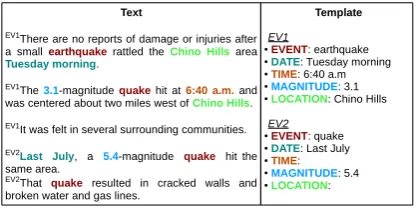
Information Extraction (IE) is a process that aims at extracting pieces of information from texts. Fol-lowing the paradigm defined in the Message Un-derstanding Conferences (MUC) (Grishman and Sundheim, 1996), IE systems focus on extract-ing structured information concernextract-ing events to fill predefined templates. These templates make it possible to highlight the information that is spe-cific to a type of events and to discard pieces of in-formation that are not relevant in this respect. Fig-ure 1 gives an example of the filling of a template by information extracted from a news article.
Common issues addressed by IE systems for filling a template include identifying named enti-ties, finding relations between these entienti-ties, re-solving entity coreference, gathering scattered in-formation, etc. (Turmo et al., 2006).
Currently, there is no standard approach for fill-ing templates. However, most IE systems have
Text
EV1There are no reports of damage or injuries after
a small earthquake rattled the Chino Hills area
Tuesday morning.
EV1The 3.1-magnitude quake hit at 6:40 a.m. and
was centered about two miles west of Chino Hills.
EV1It was felt in several surrounding communities.
EV2Last July, a 5.4-magnitude quake hit the
same area.
EV2That quake resulted in cracked walls and
broken water and gas lines.
Template
EV1
●EVENT: earthquake ●DATE: Tuesday morning ●TIME: 6:40 a.m ●MAGNITUDE: 3.1 ●LOCATION: Chino Hills
EV2
●EVENT: quake ●DATE: Last July ●TIME: ●MAGNITUDE: 5.4 ●LOCATION:
Figure 1: Example of template filling
been relying on a sentence-oriented approach: first, domain-specific patterns or classifiers are used to process sentences separately; then, ad-hoc strategies for merging these local results into tem-plates are applied. Even if such approach has been used widely, it does not take into account two im-portant problems: (i) events can be described in more than one sentence; (ii) patterns/classifiers mainly capture binary relations among entities while events are not limited to binary relations.
An illustration of the first problem is given by Figure 1, where information relative to the event EV1is expressed beyond the sentence scope. This problem raises more generally the question of defining event-related spans of text or, in other words, determining whether a sentence refers to an event, and eventually the type of this event. In this article, we tackle this issue through the means of discourse segmentation. More specifically, we propose segmenting texts according to the events they refer to. Our objective is to narrow the span of text to explore in order to link a named entity to an event mention. As time is an important feature for discriminating events, we chose to perform this segmentation by relying on temporal cues.
Concerning the second problem, we can ob-serve in Figure 1 that most of the sentences com-prise an event mention with more than 2 related entities: the first sentence involves 3 entities while
the second one involves 4 entities. Similarly to (McDonald et al., 2005), we refer to such rela-tions as complex relations, namely any n-ary re-lation amongntyped entities. In this context, each event can be seen as a complex relation where the arity of the relation n is equal to the number of entity types that should be filled in the template (n=5 in the previous example). Several meth-ods were proposed for extracting complex rela-tions such as graph-based methods (McDonald et al., 2005; Wick et al., 2006) or inference-based methods (Goertzel et al., 2006). In this article, we tackle the complex relation extraction by propos-ing a graph-based method. We start by buildpropos-ing an entity graph based on the result of text segmen-tation; then we use several domain-independent strategies for the reconstruction of the complex re-lation.
The remainder of this article is organized as follows: the next section discusses related work while Section 3 presents a general overview of our approach. Sections 4 and 5 detail the meth-ods used for the two steps: event segmentation and template filling. Finally, Section 6 gives the results of the evaluation of each step.
2 Motivation and Related Work
Template filling is a central task for IE systems and has been the object of numerous studies. For instance, in the context of the MUC (Mes-sage Understanding Conferences) and ACE (Au-tomatic Content Extraction) (Doddington et al., 2004) evaluation campaigns, one of the objectives assigned to the systems was to fill predefined tem-plates with a static/fixed structure. Although this is the most widespread approach, a work such as (Chambers and Jurafsky, 2011) adopts a different view and proposes an unsupervised approach for filling templates without prior knowledge about their structure: they rely on clustering techniques for learning the structure of templates and on syn-tactic patterns for extracting their fillers.
A wide range of IE systems, particularly those based on learning approaches, have been relying on the idea that an event is often described within a single sentence, which leads to the hypothesis that pieces of information across sentences are less im-portant. This idea is called thesingle sentence as-sumptionby Stevenson (2006), who reported that only 60% of the facts mentioned in three MUC corpora (MUC 4-6-7) could be identified
follow-ing this hypothesis. More recently, Ji et al. (2010) showed that around 40% of relations among en-tities require using cross-sentence inference tech-niques for their extraction.
Few approaches have been proposed for infor-mation extraction at a discourse level. Among them, (Gu and Cercone, 2006) and (Patwardhan and Riloff, 2007) are the closest to ours. (Gu and Cercone, 2006) is a segment-based HMM (Hidden Markov Model) approach. It relies on a first HMM model for identifying text units (sentences) that are relevant for the extraction of template fillers and on another HMM to extract the fillers from the retrieved sentences. Similarly, Patwardhan and Riloff (2007) proposed first to identify relevant sentences by using a self-trained SVM (Support Vector Machine) and then, to apply extraction pat-terns (primary and secondary patpat-terns) to find the template fillers.
One of the first successful approach for the ex-traction ofn-ary relations came from the biomedi-cal community (McDonald et al., 2005) and was later applied to the domain of corporate man-agement successions (Afzal, 2009). Other works tackled the complex relation problem in the con-text ofdatabase record extraction. They proposed to focus on the compatibility of a set of entities rather than on the compatibility of pairs of enti-ties, which led them to take into account inter-sentential relations between entities (Wick et al., 2006; Mansuri and Sarawagi, 2006; Feng et al., 2007).
3 Overview
Event extraction as presented in this article takes place in a wider context of technology watch in which users are mainly interested in the most re-cent events. In this context, our goal is to synthe-size from news articles the information about such recent events into a dashboard. However, news articles often refer to several comparable events, generally for pointing out the similarities and dif-ferences between a recent event and past events. In our specific application, we are not interested in the past events and we consider them as a source of noise for extracting information about the main event of a news article. We made the assumption, as in (Feng et al., 2007), that one document is as-sociated with one record (event in our case). We adopted a two-step strategy to tackle this problem:
be described over a single sentence. There-fore, we need to segment texts according to the events they refer to. These segments are frequently discontinuous as the struc-ture of news articles is often dominated by moves between the main event and past sim-ilar events;
• filling event templates from relations: since event segments go beyond the sentence level, they are even more likely to contain complex relations than sentences. Therefore, we have to verify which entities mentioned in these segments are eligible to be part of the com-plex relation.
4 Segmenting Texts into Events
The goal of our segmentation of texts is to delimit segment units in relation with a target event. In previous work such as (Gu and Cercone, 2006; Patwardhan and Riloff, 2007), the methods for identifying such segments relied on fully lexical-ized models that were learned using word surface forms. (Naughton, 2007) adopted a more generic approach by exploiting text structure. Our pro-posal is based on the idea that using temporal cues can help discriminate events, in particular similar events. In the example of Figure 2 for instance, two kinds of temporal cues can be used for this task: date values and verb tenses.
{MAIN}An earthquake measuring 5.6 on the Richter scale hit Jayapura, Papua, shortly after midnight onSunday. {SUB}Previously onSaturdaythe agency recorded a mag-nitude 5.6 earthquake had hit Melonguane in North Su-lawesi.
{OUT}Indonesia, sits on a vulnerable quake-hit zone called the Pacific Ring of Fire.
Figure 2: Example of text segmentation: {MAIN}=Main event, {SUB}=Secondary event, {OUT}=Background
Our segmentation approach is based on an event-oriented representation of texts: a text is viewed as a sequence of sentences in which each sentence is characterized by the presence or the absence of an event. As in previous work, we have made the hypothesis that one sentence is linked to one event1. Hence, we tackle the segmentation
1This hypothesis is not verified for all texts but can be
considered as a reasonable simplification in the context of our study.
task as a classification problem where each sen-tence of a text must be associated with an event type.
We classify sentences according to the follow-ing three categories. Main event: all sentences referring to the main event of the text;Secondary event: all sentences containing data that are re-lated to an event different from the Main Event;
Background: all sentences that belong neither to theMain Eventnor aSecondary Event. An exam-ple for each category is given in Figure 2.
Our intuition is that for segmenting texts, the most interesting criteria rely not only on the na-ture of sentences but also on their linking at a dis-course level, with the idea that categories of events don’t follow one another in an arbitrary way. For instance, in the example of Figure 2, the shift from one event to another is associated with the change of verb tensepreterit/past perfect. Our focus com-pared to previous segmentation approaches is to capture the dependencies between the shifts of temporal frames and the shifts of events.
For this purpose, we trained a linear Condi-tional Random Field (CRF) model (Lafferty et al., 2001) using the following temporal cues as fea-tures. verb tenses: a binary feature is associated with each possible verb tense (feature is 1 if at least one verb of the sentence has the considered tense);presence of dates: if a sentence contains a date, it is likely to refer to an event different from the previous sentence (except for the first occur-rence of a date);temporal expressions: this feature accounts for the presence of temporal expressions in a sentence, such as ”over the past two weeks, in recent years”, often related to generalities. The dependencies between successive event types are taken into account by the linear structure of our CRF model. More details about this segmentation model can be found in (Jean-Louis et al., 2010).
5.1 Graph Construction
The entity graph we build in this first step charac-terizes at the document level the presence/absence of semantic relations between each pair of entities. For building such a graph, we propose to rely on the most relevant text segments in relation to the target event instead of considering the entire doc-ument. In our case, these segments are those built from the sentences classified as {MAIN} by the
segmentation model presented in Section 4.
Text
{MAIN}There are no reports of damage or injuries after a small earthquake rattled the Chino Hills_1
area Tuesday morning.
{MAIN}The 3.1-magnitude quake hit at 6:40 a.m. and was centered about two miles west of Chino Hills_2.
{MAIN}It was felt in several surrounding communities.
{SUB}Last July, a 5.4-magnitude quake hit the same area.
{SUB}That quake resulted in cracked walls and broken water and gas lines.
Entity graph
Tuesday morning
6:40 a.m.
3.1
w11 w12
w13 w14
w21 w22
w23 earthquake
quake
Chino Hills_1,_2
Figure 3: Example of entity graph
The entity graph is a weighted graph whose nodes are associated with named entity mentions while edges are associated with the relations be-tween these mentions. The weight associated with each edge measures the confidence that a seman-tic relation exists between its two entities in a sen-tence. The graph is undirected as we mainly rely on relation confidence, a symmetric notion in our case, for filling templates. Figure 3 shows an ex-ample of such entity graph. Note that we assume that all entity mentions having the same value are equivalent (as the two mentions of Chino Hills) since they are located in the same event segment. Similarly, we consider all event mentions as equiv-alent (asearthquakein the first sentence andquake in the second sentence).
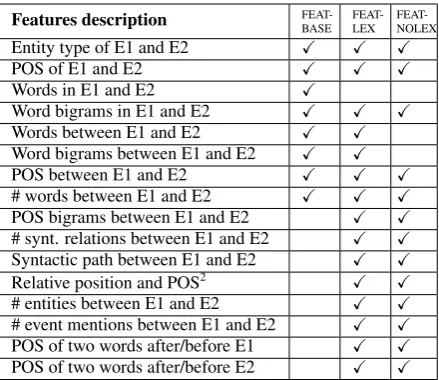
The presence of a relation between two entities in a sentence is classically determined by a statis-tical classifier. Following the standard approach of (McDonald et al., 2005) or (Liu et al., 2007), the weight of a relation is evaluated by the confi-dence score of this classifier and ranges in [0,1] in all the experiments of Section 6.3. In most previ-ous works, such classifier mainly relies on a set of lexicalized features, without any syntactic feature (Afzal, 2009; Gu and Cercone, 2006; Wick et al., 2006). In (Liu et al., 2007), syntactic features are used in addition to lexicalized features. In
con-2If either E1 or E2 is an event mention, indicate whether
the other entity is after/before its POS.
Features description
FEAT-BASE FEAT-LEX FEAT-NOLEX
Entity type of E1 and E2 X X X
POS of E1 and E2 X X X
Words in E1 and E2 X
Word bigrams in E1 and E2 X X X
Words between E1 and E2 X X
Word bigrams between E1 and E2 X X
POS between E1 and E2 X X X
# words between E1 and E2 X X X
POS bigrams between E1 and E2 X X
# synt. relations between E1 and E2 X X
Syntactic path between E1 and E2 X X
Relative position and POS2 X X
# entities between E1 and E2 X X
# event mentions between E1 and E2 X X
POS of two words after/before E1 X X
POS of two words after/before E2 X X
Table 1: Features for relation classification
trast, our aim is to build a model that only makes use of syntactic features and does not rely on lexi-cal information (such as inflected forms or lemma) in order to have a more generic model that can be easily adapted to another domain. For evaluating the contribution of lexicalized features compared to syntactic features, we trained different classi-fiers based on three distinct sets of features, de-tailed in Table 1:
• FEAT-BASE: same feature set as (Afzal, 2009), based on lexicalized features;
• FEAT-LEX: a feature set that contains lexical-ized features, and syntactic features inspired by (Liu et al., 2007)3;
• FEAT-NOLEX: same feature set as FEAT-LEX, but without the lexicalized features.
5.2 Template Filling
Template filling aims at selecting the best entities for the template slots. In our approach, this se-lection relies on the relations between entities in the entity graph. Note that we are trying to fill domain-specific templates that have a fixed num-ber of slots though it is not mandatory that every slot gets a value. As every slot is associated with an entity type, we need to select (when it is possi-ble) one entity value for each slot. This problem can be seen as the complex relation reconstruction task described in (Afzal, 2009; McDonald et al., 2005). We compared several approaches to tackle this issue:
3Some of their features are not relevant in our context
Heuristic is a simple but efficient approach that selects for each entity type the first entity mention occurring in the main event segment.
Confidence is an approach that selects, for each entity type, the entity connected to the event mention with the highest confidence weight.
PageRank is a link analysis based approach that relies on the PageRank algorithm (Brin and Page, 1998). The idea is to use the graph structure to rank entities according to their importance in the graph and to select, for each entity type, the entity mention with the highest PageRank score.
Vote is a voting-based approach exploiting the output of the Confidence, PageRank and Heuristicapproaches: a majority vote is per-formed for each entity type and the entity mention with the highest number of votes (one vote by approach) is chosen.
Hybrid is an hybrid approach that applies for each entity type the best selection approach for this type. The main idea is to increase overall performance by allowing one entity type to be selected with one approach and an-other entity type to be selected by a different approach. For instance, the best selection ap-proach for dates isConfidence whereas it is Heuristicfor geographical coordinates. Except for the first approach, the output is com-plemented by the use of the heuristic approach as back-off when no entity has been retrieved for a given entity type. Such a situation happens when a template filler is the only entity of a sentence and therefore, cannot be extracted by the binary rela-tion classifier.
6 Evaluation
This section provides details concerning the exper-imental evaluation of our template-filling process. We present the corpus in Section 6.1 and the indi-vidual results for the different steps of our process in Sections 6.2, 6.3 and 6.4. We also evaluate the impact of the segmentation step on the final results in Section 6.5 and finally propose an analysis of errors in Section 6.6.
6.1 Corpus
The work presented in this paper was developed for an application dedicated to the surveillance
of earthquake event mentions in news articles. The earthquake event template summarizes the main characteristics of a seismic event, namely its date, time, location, magnitude, geographical co-ordinates and its mention (earthquake, afterquake, etc.)4. An example of such template is provided
in Figure 1, knowing that our target application is not interested in the secondary eventEV2.
We carried out all the experiments on a cor-pus of 501 French news articles concerning earth-quakes. These articles were collected between February 2008 and early September 2008 from a Agence France Presse(AFP) newswire (1/3 of the corpus) and from Google News (2/3 of the cor-pus). The corpus was manually annotated by do-main analysts for filling the earthquake event tem-plate. The annotators identified a total of 2,775 entities divided into 6 entity types: event mention (18%), location (34%), date (17%), time (12%), magnitude (17%) and geo-coordinates (1%)5.
Each document was preprocessed by the LIMA linguistic analyzer (Besanc¸on et al., 2010), per-forming tokenization, sentence boundary detec-tion, part-of-speech tagging, verb tense analysis, named entity recognition and dependency parsing.
6.2 Segmenting Text into Events
We used a subset of 140 articles from our cor-pus as training data for the CRF-based segmen-tation model. These articles were manually an-notated into 1,659 segments according to the cat-egories defined in Section 4: Main event (70%), Secondary event (17%), Background (13%). Most of these articles contain a main event and at least one secondary event (short articles might not re-fer to a secondary event). Note that the Sec-ondary event class includes without distinction all secondary events. The implementation was achieved using the CRF++6 toolkit. We report
in Table 2 results of our CRF model (CrfSeg) compared to a baseline (ParaSeg) in terms of F1-measure using a 5-fold cross-validation. The base-line ParaSeg is a paragraph-based heuristic that assigns Main event category to all the sentences in the first two paragraphs and considers others
4Casualties were not considered here because their correct
identification would require a chunker.
5Several entities could be annotated for the same slot
when variants or different levels of granularity were present: for locations, both a city and a country name for instance.
as secondary event7. Results in Table 2 show
Event type ParaSeg (%) CrfSeg (%)
Main event 11.14 92.71
Secondary event 21.7 67.91
Background 0 79.42
Table 2: Results of text segmentation into events (F1-Measure)
that our model obtains fairly good classification performance for all categories and is particularly suited for identifying the main event section. They also show the impact of taking temporal cues into account compared to relying on text struc-ture only. Note that the poor results of our base-line partly come from its ignorance of the Back-groundcategory. TheRelevant Sentence Classifier of (Patwardhan and Riloff, 2007) has a goal simi-lar to our segmentation with Recall|Precision|
F1-Measure scores of 63%|46%|53% on terrorism documents and 72%|41%|52% on disease out-break documents. We provide these figures as in-dicative results but not for direct comparison since their approach is different: they used a SVM clas-sifier with lexicalized features and not temporal cues, classified sentences according to two classes (Irrelevant, Relevant) and performed their evalu-ation for English, on the MUC-4 terrorism and ProMed corpora.
6.3 Graph Construction
Our graph construction method relies on a binary relation classifier for assessing the existence of a semantic relation between two entities in a sen-tence. We experimented several types of statistical classifiers with the three sets of features ( FEAT-BASE, FEAT-LEX, FEAT-NOLEX) presented in Section 5.1. A set of 44 articles from our cor-pus was used to annotate binary relations. Among the 5,000 binary relations in these articles, 969 were in-sentence relations. 43 relations were dis-carded because one of their entities was actually included in the span of a larger entity not recog-nized because of its type (such as organizations), the rest was used for training the classifiers: 690 in thePOSITIVE class, in which the two entities of the candidate relation refer to the same earthquake event, and 236 in theNEGATIVEclass, where the
7We experimented other learning approaches such as
HMM and Maximum Entropy models but we only provide results for the best approach, that is to say, CRF.
two entities are associated with different earth-quake events. The following sentence contains ex-amples of both POSITIVE and NEGATIVE rela-tions:
[POSITIVE]: The firstquake, with a magnitude of 5.3, struck at about 11.05am and was followed a few minutes later by a stronger quake with a 6.5 magnitude...
[NEGATIVE]: The firstquake, with a magnitude of 5.3, struck at about 11.05am and was followed a few minutes later by a stronger quake with a6.5magnitude...
We tested three types of learning algorithms with these quite unbalanced training data by relying on the Mallet toolkit8for their implementation: Naive
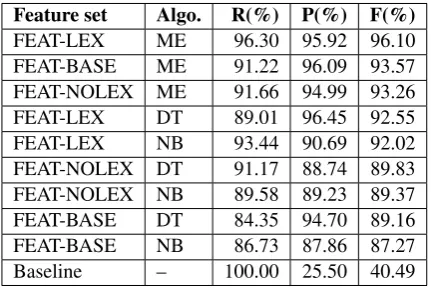
Bayes (NB), Maximum Entropy (ME), Decision Tree (DT). We report in Table 3 the results ob-tained for each feature set and algorithm in terms of recall (R), precision (P) and F1-Measure (F) us-ing a 5-fold cross-validation. The results of a sim-ple baseline that assigns the POSITIVE category to each relation are also given.
Feature set Algo. R(%) P(%) F(%)
FEAT-LEX ME 96.30 95.92 96.10
FEAT-BASE ME 91.22 96.09 93.57
FEAT-NOLEX ME 91.66 94.99 93.26
FEAT-LEX DT 89.01 96.45 92.55
FEAT-LEX NB 93.44 90.69 92.02
FEAT-NOLEX DT 91.17 88.74 89.83
FEAT-NOLEX NB 89.58 89.23 89.37
FEAT-BASE DT 84.35 94.70 89.16
FEAT-BASE NB 86.73 87.86 87.27
Baseline – 100.00 25.50 40.49
Table 3: Results for binary relation classifiers
Table 3 first shows the interest of using syn-tactic features as LEX outperforms FEAT-BASE. Moreover, the non-lexicalized feature set FEAT-NOLEX obtains results equivalent to the lexicalized feature set FEAT-BASE. Concerning the learning algorithms, we observe the follow-ing hierarchy: ME > DT > NB. (Afzal, 2009) observes a different hierarchy, DT>ME>NB,
but on a different corpus and a different language, which makes the comparison difficult. In terms of general performances, our results are in the same range as those reported in (Afzal, 2009), his best score being R=0.95%|P=0.87%|F=0.91% with a decision tree. Finally, we adopted the Maximum Entropy model trained with the FEAT-NOLEX feature set instead of FEAT-LEX. This choice is motivated by the fact that FEAT-NOLEX obtains
reasonable results without relying on strongly domain-dependent information such as lexicalized features.
6.4 Template Filling
As we mentioned in Section 5.2, our approach for template filling relies on the selection of relevant entities from the entity graph. Our idea is to com-pute for each entity a weight that quantifies its im-portance in the graph and consequently, makes it possible to rank the entities. We assume that the best ranked entities are more likely to be good fillers than others.
Before applying the entity selection strategies described in Section 5.2 to the entity graph, we ap-ply a node merging step. The goal of this step is, on the one hand, to identify all the nodes that re-fer to the same entity value and remove duplicates and, on the other hand, to establish cross-sentence relations between entities. In our case, we used the node merging step for event mentions and date and location entity types: all dates having the same normalization and all locations having the same surface form are considered equivalent.
All annotated documents in our corpus were used for evaluating the different entity selection strategies. We report in Table 4 the results of template filling in terms of recall (R), precision (P) and F1-Measure (F), aggregated for all entity types.
Approach R(%) P(%) F(%)
Hybrid 77.55 76.87 77.15 Vote 74.93 74.27 74.54 Confidence 74.89 74.16 74.47 Heuristic 73.40 73.06 73.17 PageRank 72.41 71.73 72.01
Table 4: Association of entities to events
These results confirm that the basic heuristic strategy is a powerful approach since it performs slightly better than the PageRank strategy. As the PageRank strategy only relies on the graph struc-ture without considering the weight of the edges, its highest ranked entities are those that are highly connected regardless of the weight of the edges. As a consequence, if several non fillers entities are strongly linked, they get better scores than the oth-ers. Mihalcea (2004) proposed a weighted version of the PageRank algorithm that deals with this is-sue and should be tested in this context. Table 4
also shows that the best strategy is theHybrid ap-proach, which associates each entity type with a given selection approach: this method corrects the fact that an approach can perform well on a given entity type but poorly on another type.
6.5 Impact of Event Segmentation
In this section, we propose to evaluate the impact of our text segmentation procedure on the template filling task. Our text segmentation method focuses on identifying relevant text spans for the extrac-tion. However, all documents do not mention sev-eral earthquake events and some only focus on a single event. In the latter case, our temporal seg-mentation might seem less relevant since all the sentences refer to the same event.
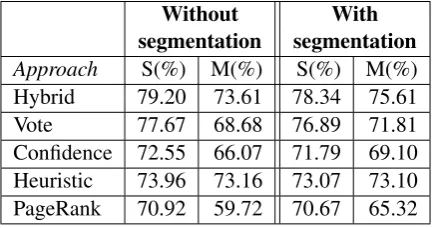
Our purpose in this section is to evaluate the im-pact of the segmentation on documents that men-tion a single event compared to those that menmen-tion multiple events. Our intuition is that the temporal segmentation should have a limited effect on sin-gle event documents and improve results on mul-tiple event documents. In order to verify this hy-pothesis, we manually split the initial corpus into two sets according to the number of earthquake events they discuss. We obtained 227 multi-event documents (M) and 274 single-event documents (S). Finally, we applied each template-filling strat-egy on both (M) and (S) document sets, including the segmentation step or not. We report the results in Table 5 in terms of F1-Measure aggregated for all entity types.
Without With
segmentation segmentation
Approach S(%) M(%) S(%) M(%) Hybrid 79.20 73.61 78.34 75.61 Vote 77.67 68.68 76.89 71.81 Confidence 72.55 66.07 71.79 69.10 Heuristic 73.96 73.16 73.07 73.10 PageRank 70.92 59.72 70.67 65.32
Table 5: Impact of segmentation on single/multi-event texts (F1-Measure)
ap-proach with segmentation) outperforms our base-line (heuristic without segmentation) on both doc-ument sets. Globally, these findings demonstrate that our temporal segmentation preserves results on single-event documents and improves results on multi-event documents.
6.6 Error Analysis
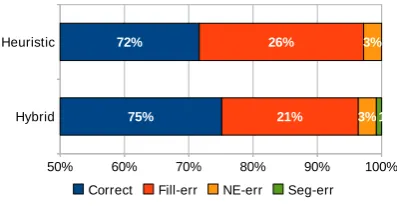
In order to have a more comprehensive view of the performance of our method for template filling, we performed an analysis of errors. The idea of this analysis is to identify the reason why a given entity filler is not found. In this context we identified three major types of errors:
• named entity recognition errors (NE-err): the entity is not identified by the linguistic pre-processing;
• event segmentation errors (Seg-err): the entity is identified by the linguistic pre-processing but its sentence is not tagged as part of a{MAIN}segment;
• template filling errors (Fill-err): the entity was identified in the correct event segment but was not selected as a template filler;
• Correct: the entity was correctly identified and selected as a template filler.
Figure 4 presents the percentage of each type of er-rors on all our evaluation corpus for two template filling strategies9: one without segmentation, the
heuristic strategy (Heuristic), and the other with segmentation, the hybrid strategy (Hybrid). The
Hybrid Heuristic
50% 60% 70% 80% 90% 100%
75% 72%
21% 26%
3% 3%
1% 0%
Correct Fill-err NE-err Seg-err
Figure 4: Classification of errors
graph shows that the baseline heuristic strategy achieves a high level of correctly identified entities (72%) but a significant level of template filling er-rors (26%). Our best strategy reduces this type of
9The percentages on the graph are rounded up, which
ex-plains why they do not sum to 100%.
errors while it increases the percentage of correct fillers. Moreover, it only induces a limited number of errors due to event segmentation (1%).
7 Conclusion
Most of IE approaches focus on sentence-based evidences for filling templates and rely on few dis-course level information. In this article, we have presented an approach for template filling based on event segmentation and graph-based entity se-lection. Our event segmentation takes place at the discourse level and relies on temporal cues. It uses a CRF model to find the sentences that are most relevant for filling the event template. These sentences are then used to build an entity graph from which template filler entities are lected. We have proposed several strategies for se-lecting the entities – heuristic, confidence-based, PageRank-based – and various ways of combining these strategies: vote and hybrid approaches.
We have presented detailed results of our IE ap-proach on a corpus of French news articles about earthquake events. Our experiments have shown that this approach improves the simple, but pow-erful heuristic in this field, that always selects the first entity found in a document for each type of fillers. These results have also shown that our ap-proach is well suited for documents that mention several comparable events. Finally, our analysis of errors have demonstrated that there is still room for improvement since 21% of remaining errors are due to incorrect entity selection.
Concerning future work, our next experiments will be dedicated to the generalization of our tem-plate filling method to different contexts and more precisely, to other languages and domains. We have already obtained promising results by testing our event segmentation module on a set of English news articles in the seismic domain with only a limited effort of adaptation. For domain general-ization, we are planning experiments in the finan-cial domain.
Acknowledgment
References
Naveed Afzal. 2009. Complex Relations Extrac-tion. In Conference on Language & Technology 2009 (CLT09), Lahore, Pakistan.
Romaric Besanc¸on, Ga¨el de Chalendar, Olivier Ferret, Faiza Gara, and Nasredine Semmar. 2010. LIMA: A Multilingual Framework for Linguistic Analysis and Linguistic Resources Development and Evalua-tion. In7thConference on Language Resources and
Evaluation (LREC 2010), Valletta, Malta.
Sergey Brin and Lawrence Page. 1998. The anatomy of a large-scale hypertextual web search engine. In
Proceedings of the seventh international conference on World Wide Web 7, WWW7, pages 107–117, Amsterdam, The Netherlands. Elsevier Science Pub-lishers B. V.
Nathanael Chambers and Dan Jurafsky. 2011. Template-Based Information Extraction without the Templates. In 49thAnnual Meeting of the
Associ-ation for ComputAssoci-ational Linguistics: Human Lan-guage Technologies, pages 976–986, Portland, Ore-gon, USA.
George Doddington, Alexis Mitchell, Mark Przybocki, Lance Ramshaw, Stephanie Strassel, and Ralph Weischedel. 2004. The Automatic Content Extrac-tion (ACE) Program – Tasks, Data, and EvaluaExtrac-tion. In4thConference on Language Resources and
Eval-uation (LREC 2004), pages 837–840, Lisbon, Portu-gal.
Donghui Feng, Gully Burns, and Eduard Hovy. 2007. Extracting Data Records from Unstructured Biomedical Full Text. InEMNLP-CoNLL’07, pages 837–846, Prague, Czech Republic.
Ben Goertzel, Hugo Pinto, Ari Heljakka, Michael Ross, Cassio Pennachin, and Izabela Goertzel. 2006. Using Dependency Parsing and Probabilistic Inference to Extract Relationships between Genes, Proteins and Malignancies Implicit Among Multi-ple Biomedical Research Abstracts. InHLT-NAACL BioNLP Workshop on Linking Natural Language and Biology, pages 104–111, New York, USA.
Ralph Grishman and Beth Sundheim. 1996. Mes-sage Understanding Conference-6: A Brief History. In16thInternational Conference on Computational
linguistics (COLING’96), pages 466–471, Copen-hagen, Denmark.
Zhenmei Gu and Nick Cercone. 2006. Segment-based hidden Markov models for information extraction. In21stInternational Conference on Computational
Linguistics and 44thAnnual Meeting of the
Associa-tion for ComputaAssocia-tional Linguistics, pages 481–488, Sydney, Australia.
Ludovic Jean-Louis, Romaric Besanc¸on, and Olivier Ferret. 2010. Using temporal cues for seg-menting texts into events. In Hrafn Loftsson,
Eir´ıkur R¨ognvaldsson, and Sigr´un Helgad´ottir, edi-tors,7thInternational Conference on Natural
Lan-guage Processing (IceTAL 2010), volume 6233 of
Lecture Notes in Computer Science, pages 150–161. Springer Berlin / Heidelberg.
Heng Ji, Ralph Grishman, and Hoa Trang Dang. 2010. Overview of the TAC 2010 Knowledge Base Popula-tion Track. InThird Text Analysis Conference (TAC 2010), Gaithersburg, Maryland, USA.
John D. Lafferty, Andrew McCallum, and Fernando C. N. Pereira. 2001. Conditional Random Fields: Probabilistic Models for Segmenting and Labeling Sequence Data. InEighteenth International Confer-ence on Machine Learning (ICML’01), pages 282– 289, San Francisco, CA, USA.
Yudong Liu, Zhongmin Shi, and Anoop Sarkar. 2007. Exploiting Rich Syntactic Information for Rela-tionship Extraction from Biomedical Articles. In
NAACL-HLT’07, short paper session, pages 97– 100, Rochester, New York.
Imran R. Mansuri and Sunita Sarawagi. 2006. Inte-grating unstructured data into relational databases. In 22nd International Conference on Data
Engi-neering (ICDE’06), pages 29–40, Washington, DC, USA.
Ryan McDonald, Fernando Pereira, Seth Kulick, Scott Winters, Yang Jin, and Pete White. 2005. Simple al-gorithms for complex relation extraction with appli-cations to biomedical IE. InACL 2005, pages 491– 498, Ann Arbor, Michigan, USA.
Rada Mihalcea. 2004. Graph-based Ranking Al-gorithms for Sentence Extraction, Applied to Text Summarization. In 42st Annual Meeting of the
Association for Computational Linguistics (ACL 2004), Barcelona, Spain.
Martina Naughton. 2007. Exploiting Structure for Event Discovery Using the MDI Algorithm. In45th
Annual Meeting of the Association for Computa-tional Linguistics (ACL 2007), pages 31–36, Prague, Czech Republic.
Siddharth Patwardhan and Ellen Riloff. 2007. Ef-fective Information Extraction with Semantic Affin-ity Patterns and Relevant Regions. In EMNLP-CoNLL’07, pages 717–727, Prague, Czech Repub-lic.
Mark Stevenson. 2006. Fact distribution in Informa-tion ExtracInforma-tion. Language Resources and Evalua-tion, 40(2):183–201.
Jordi Turmo, Alicia Ageno, and Neus Catal`a. 2006. Adaptive information extraction. ACM Computer Surveys, 38(2):1–47.
Michael Wick, Aron Culotta, and Andrew McCal-lum. 2006. Learning Field Compatibilities to Ex-tract Database Records from Unstructured Text. In