Corpus Based
S t a t i s t i c a l G e n e r a l i z a t i o n
Tree
i n
Rule
O p t i m i z a t i o n *
J o y c e Y u e C h a i A l a n W . B i e r m ~ n ~ Department of Computer Science
Box 90129, Duke University Durham, NC 27708-0129 [email protected] [email protected]
A b s t r a c t
A corpus-based statistical Generalization Tree model is described to achieve rule opthnization for the information extraction task. First, the user creates specific rules for the target informa- tion from the sample articles through a training interface. Second, WordNet is applied to gener- alize noun entities in the specific rules. The de- gree of generalization is adjusted to fit the user's needs by use of the statistical Generalization Tree model FinaUy, the optimally generalized rules are applied to scan new information. The results of experiments demonstrate the applicability of our Generalization Tree method.
I n t r o d u c t i o n
Research on corpus-based natural language learning and processing is rapidly accelerating following the in- troduction of large on-line corpora, faster computers, and cheap storage devices. Recent work involves novel ways to employ annotated corpus in part of speech tag- ging (Church 1988) (Derose 1988) and the application of mutual information statistics on the corpora to un- cover lexical information (Church 1989). The goal of the research is the construction of robust and portable natural language processing systems.
The wide range of topics available on the Internet calls for an easily adaptable information extraction sys- tem for different domains. Adapting an extraction sys- teem to a new domain is a tedious process. In the tradi- tional customization process, the given corpus must be studied carefully in order to get all the possible ways to express target information. Many research groups are implementing the efficient customization of infor- mation extraction systems, such as BBN (Weischedel 1995), NYU (Grishman 1995), SRI (Appelt, Hobbs, et al 1995), SRA (Krupka 1995), MITRE (Aberdeen, Burger, et al 1995), and UMass (Fisher, Soderland, et al
1995).
"This work has been supported by a Fellowship from IBM Corporation.
We employ a rule optimization approach and imple- ment it in our t r a d a b l e information extraction system. The system allows the user to train on a small amount of data in the domain and creates the specific rules. Then it automatically extracts a generalization from the tr~iui~g corpus and makes the rule general for the new information, depending on the user's needs. In this way, rule generali~.ation makes the customization for a new domain easier.
This paper specifically describes the automated rule optimiT.ation method and the usage of WordNet (Miller 1990). A Generalization Tree (GT) model based on the tr~inlng corpus and WordNet is presented, as well as how the GT model is used by our system to automat- ically learn and control the degree of generalization according to the user's needs.
S y s t e m O v e r v i e w
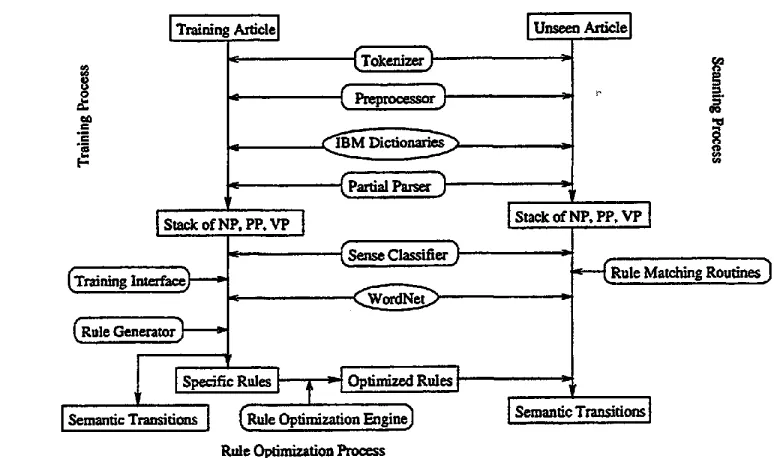
The system cont~i~.~ three major subsystems which, respectively~ address training, rule optlmi~ation, and the scanning of new information. The overall struc- ture of the system is shown in Figure 1. First, each article is partially parsed and segmented into Noun Phrases, Verb Phrases and Prepositional Phrases. An IBM LanguageWare English Dictionary and Comput- ing Term Dictionary, a Partial Parser I, a Tokenizer and a Preprocessor are used in the parsing process. The Tokenizer and the Preprocessor are designed to identify some special categories such as e-mail address, phone number, state and city etc. In the training pro- cess, the user, with the help of a graphical user in- tefface(GUI) scans a parsed sample article and indi- cates a series of semantic net nodes and transitions that he or she would like to create to represent the in- formation of interest. Specifically, the user designates those noun phrases in the article that are of interest and uses the interface commands to translate them
[ Training Article]
(
f
L
~s=~ CL~'J
(Rule Generator
~--~-
I
...
Rule Optimization Process
Unseen Article[
-t
[image:2.612.105.492.42.271.2]~Rule Matching Routines J
Figure 1: System Overview
into semantic net nodes. Furthermore, the user des- ignates verb phrases and prepositions that relate the
noun phrases and uses commands to translate them
into semantic net transitions between nodes. In the process, the user indicates the desired translation of the specific information of interest into semantic net form that can easily be processed by the machl-e. For each headword in a noun phrase, W o r d N e t is used to provide sense information. Usually 9 0 % of words in the domain are used in sense one (the most frequently used sense) as defined in WordNet. However, some words might use other sense. For example, "opening" often appears in the job advertisement domain. But instead of using the first sense as
{opening,
gap}, ituses the fourth sense as
{opportunity, chance}.
Basedon this scenario, for headwords with senses other than sense one, the user needs to identify the appropriate senses, and the Sense Classifier will keep the record of these headwords and their most frequently used senses. When the user takes the action to create the semantic transitions, a Rule Generator keeps track of the user's moves and creates the rules automatically. These rules are specific to the tralni~g articles and they need to be generalized in order to be applied on other unseen articles in the domain. According to ditferent require- ments from the user, the Rule Optimization Engine,
based on WordNet, generalizes the specific rules cre- ated in the training process and forms a set of opti- mi~.ed rules for processing new information. This rule
optimization process will be explained in the later sec- tions. During the sc~nnlng of n e w information, with
the help of a rule matching routine, the system applies the optimized rules on a large number of unseen arti- cles from the domain. For the most headwords in the phrases, if they are not in the Sense Classifier table, sense one in W o r d N e t will be assigned; otherwise, the Sense Classifier will provide the system their most fre- quently used senses in the domain. T h e output of the system is a set of semantic transitions for each article that specifically extract information of interest to the user. Those transitions can then be used by a Post- processor to frill templates, answer queries, or generate abstracts (Bagga, Chai 1997).
Rule Operations
O u r trainable information extraction system is a rule- based system, which involves three aspects of role op- erations: rule creation, rule generalization and rule ap- plication.
R i d e C r e a t i o n
In a typical information extraction task, the most in- teresting part is the events and relationships holding a m o n g the events (Appelt, Hobbs, et al 1995). These relationships are usually specified by verbs and prepo- sitions. Based on this observation, the left hand side (LHS) of our meaning extraction rules is m a d e up of three entities. T h e fn-st and the third entities are the target objects in the form of noun phrases, the second entity is the verb or prepositional phrase indicating the zelationship between the two objects. T h e right hand side (RHS) of the rule consists of the operations
Training Scntcncc:
DCR Inc.
G ~ Commands: 1
I A D D - N O D E I
Semantic Transition:
is looking for ~ C progra ~ers.
look for
Specific Rule Created by Rule Generator.
[DCR Inc., NG, I, company], [look.for, VG, I, other_type], [programmer, NG, I, other_type]
ADD_NODE(DCR Inc.), ADD_NODE(programmer), ADD_~LATION(Iook_.for, D C R Inc., programmer)
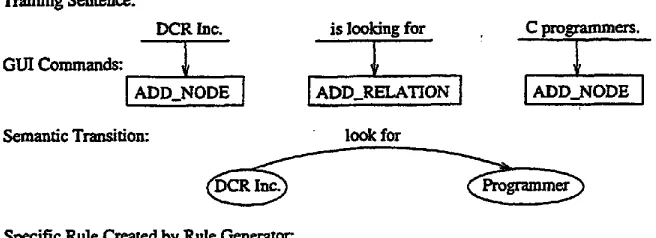
Figure 2: The Rule Creation Process
required to create a semantic transition-ADD..NODE, ADD.RELATION.
For example, during the training process, as shown in Figure 2, the user tr~in~ on the sentence "DCR Inc. is looking for C programmers...', and would like to designate the noun phrases(as found by the parser) to be semantic net nodes and the verb phrase to rep- resent a tr0n~ition between them. The training inter- face provides the user ADD.NODE, ADD.RELATION GUI commands to accomplish this. ADD.NODE is to add an object in the semantic transition. ADD.RELATION is to add a relationship between two objects. The specific rule is created automatically by the rule generator according to the user's moves.
R u l e G e n e r a l i z a t i o n
The rule created by the rule generator as shown in Fig- ure 2 is very specific, and can only be activated by the training sentence. It will not be activated by other sen- tences such as "IBM Corporation seeks job candidates in Louisville...". Semantically speaking, these two sen- tences are very much alike. Both of them express that a company is looking for professional people. However, without generalization, the second sentence will not be processed. So the use of the specific rule is very Hrn- ited. In order to make the specific rules applicable to a large number of unseen articles in the domain, a com- prehensive generalization mechauism is necessary. We use the power of WordNet to achieve generalization. I n t r o d u c t i o n t o VCbrdNet WordNet is a large- scale on-line dictionary developed by George Miller and colleagues at Princeton University (Miller, et al 1990a). The most useful feature of WordNet to the Natural Language Processing community is its attempt to or- ganize lexical information in terms of word meanings, rather than word forms. Each entry in WordNet is a
concept represented by the synset. A synset is a list of synonyms, such as {engineer, applied scientist, tech- nologist} . The information is encoded in the form of semantic networks. For instance, in the network for nouns, there are "part of", "is_a", "member of"..., re- lationships between concepts. Philip Resnik wrote that "...it is d~mcult to ground taxonomic representations such as WordNet in precise formal terms, the use of the WordNet taxonomy makes reasonably clear the na- ture of the relationships being represented..." (Remik 1993). The hierarchical organization of WordNet by word meanings (Miller 1990) provides the opportunity for automated generalization. With the large amount of information in semantic classification and taxon- omy provided in WordNet, many ways of incorporat- ing WordNet semantic features with generalization are foreseeable. At this stage, we only concentrate on the Hypernym/Hyponym feature.
A hyponym is defined in (Mitler, et al 1990a) as fol- lows: " A noun X is said to be a hyponym of a noun Y if we can say that X is a ldnd of Y. This relation gen- erates a hierarchical tree structure, i.e., a taxonomy. A hyponym anywhere in the hierarchy can be said to be "a kind of" all of its superordinateds . . . . " If X is a hyponym of Y, then Y is a hypernym of X.
G e n e r a l i z a t i o n From the training process, the spe- cific rules contain three entities on the LHS as shown in Figure 3. Each entity (sp) is a quadruple, in the form of (w,c,s,t), where w is the headword of the trained phrase; c is the part of the speech of the word; s is the sense number representing the meaning of w; t is the semantic type identified by the preprocessor for w.
[image:3.612.110.438.58.177.2]1. A n Abstract Specific Rule:
(wl, c~, s~, tl), (w2, c2, s~, t~),(~s, cs, ss, is)
> ADD..NODE(wx), ADD_NODE(to2), A D D . R E L A T I O N ( w 2 , wx,
ws)
2. A Generalized Rule:
(W1, C1, Sx , T1) • Generalize( spl , hx ), (W2, Cz , S2, T2 ) e Generalize( st~z, hz ), (Ws, C3, Ss, Ts ) ~ Generalize( sI~, hs )
, ) ADD.NODE(Wx), ADD_NODE(Ws), ADD_RELATION(W~,Wx, Ws)
Figure 3: Sample Rules
sp = (programmer. NG, I, abet_type)
various generalization degr~ Genvralize(sp, I) = {engineer, applied scientist, technologist } Gvneralize(sp, 2) = {person, individual, someone,...} Generalize(sp, 3)= {life form, organism, being, ...} Generalize(sp, 4) = {chAry)
Figure 4: Generalization for a Specific Concept
way of locating the superordinate concepts of sp. By following additional Hypernymy, we will get more and more generMi~ed concepts and eventually reach the most general concept, such as {entity). As a result, for each concept, different degrees of generalization can be achieved by adjusting the distance between this concept and the most general concept in the WordNet hierarchy (Chai, Bierm~nn 1997).The function to ac- complish this task is Generalize(sp, h), which returns
a hypernym h levels above the concept ~ in the hier-
archy. Generalize(sp, O) returns the synset of sp. For
example, in Figure 4, the concept {programmer} is gen-
eralized at various levels based on Wordnet Hierarchy. WordNet is an acyclic structure, which suggests that a synset might have more than one hypernym. How- ever, this situation doesn't happen often. In case it happens, the system selects the first hypernym path.
The process of generMi~.ing rules consists of replac-
ing each sp = (w,c,s,t) in the specific rules by a more
general superordinate synset from its hypernym hier- archy in WorclNet by performing the Generalize(sp, h)
function. The degree of generalization for rules varies with the variation of h in Generalize(sp, h).
Figure 3 shows an abstract generalized rule. The E symbol signifies the subsumption relationship. There- fore, a E b signifies that a is subsumed by b, or concept
b is a superordinate concept of concept a.
Opt~m~7.ation Rules with different degrees of gen- eralization on their different constituents will have a different behavior when processing new texts. A set of generalized rules for one domain might be sufficient; but in another domain, they might not be. Wit.hln a particular rule, the user might expect one entity to be relatively specific and the other entity to be more gen- eral. For example, if a user is interested in finding all DCR Inc. related jobs, he/she might want to hold the first entity as specific as that in Figure 2, and gener- M ~ the third entity. The rule optimization process is to automatically control the degree of generalization in the generuli~d rules to meet user's different needs. Optimi~-ation will be described in later sections.
R u l e A p p l i c a t i o n
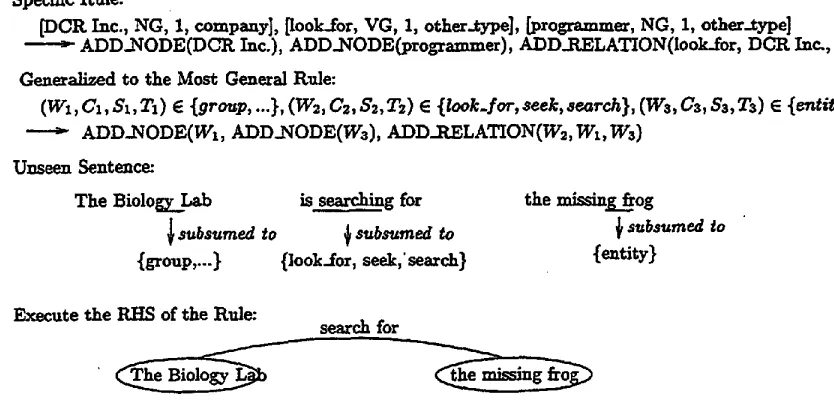
The optimally generalized rules are applied to unseen articles to achieve information extraction in the form of semantic transitions. The generaIi~.ed rule states that the RHS of the rule gets executed if a/l of the following conditions satisfy:
• A sentence contains three phrases (not necessarily contiguous) with headwords W1, W2, and Ws.
• The quadruples corresponding to these head- words
are (Wl,C1,Sx,rl), (W2,C2,S2,r2), and
(Ws, Cs,Ss, rs).
• The synsets, in WordNet, corresponding to the quadruples, are subsumed by Cenemlize(spl, hi), Gener~ize(s~, h2), and Gener~/ze(s~, hs)respec- tively.
Specific Rule:
[DCR Inc., NG, 1, company], [look.for, VG, 1, other.type], [programmer, NG, 1, other.type]
= ADD_NODE(DCR Inc.), ADD.NODE(programmer), ADD.RELATION(look.for, DCR Inc., programmer) Generalized to the Most General Rule:
(W~,C~,S~,T~) ~
{gr,~p,...}, (W2, C2, S2,T2)
¢ {look.for,~eek, se.arch}, (Ws, Cs, Ss, Ts) E{entity}
- A D D _ N O D E ( W x , A D D _ N O D E ( W 3 ) , A D D . . R E L A T I O N ( W ~ ,
Wx,Ws)
Unseen Sentence:
The BiologyLab is searching for subsumed to ~ subsumed to {group,...} {]ook./er, seek/search}
Execute the RHS of the Rule:
search for
the mis~n~._~og
subsumed to
~entity}
Figure 5: T h e Application of Gener~liT.ed Rules
the example, the most general rule is created by gen- eralizing the first and the third entities in the specific rule to their top hypernyms in the hierarchy. Since verbs usually have only one level in the hierarchy, they are generalized to the syuset at the same level.
R u l e O p t i m i z a t i o n
The specific rule can be generalized to the most gen- eral rule as in Figure 5. When we apply this most general rule again to the traLning corpus, a set of se- mantic transitions are created. Some trausitions are relevant, while the others are not. Users are expected to select the relevant transitions through a user inter- face. We need a mechanism to determine the level of generalization that can achieve best in extracting the relevant information and ignoring the irrelevant infor- mation. Therefore, Generalization Tree (GT) is de- signed to accomplish this task. While maintaining the semantic relationship of objects as in WordNet, GTs collect the relevancy information of all activating ob- jects and automatically find the optimal level of gener- alization to fit the user's needs. A database is used to maintain the relevancy information for all the objects which activate each most general concept in the most general rule. This database is transformed to the GT structure, which keeps the statistical information of relevancy for each activating object and the semantic relations between the objects from WordNet. The syso tern automatically adjusts the generalization degrees for each noun entity in the rules to match the desires of the user. The idea of this optlmi~tion process is to first keep recall as high as possible by applying the most general rules, then adjust the precision by tuning
the rules based on the user's specific inputs.
A n E x a m p l e o f G T
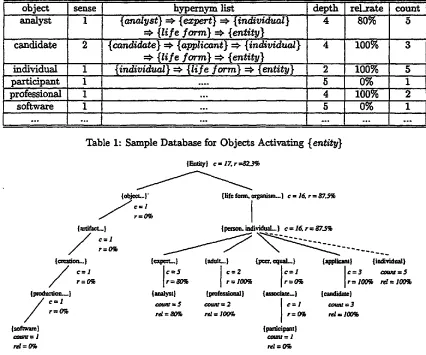
Suppose we apply the most general rule in Figure 5 to the training corpus, and the entity three in the rule is activated by a set of objects shown in Table 1. From a user interface and a statistical classifier, the rele- vancy_rate(reLrate) for each object can be calculated.
rel_rate(obj) = count o f ob] being relevant total count o f occurenoe o f
obj
As shown in Table 1,
for example, rel3ate({analyst...}) = 80%, which in- dicates that when {entity} in the most general rule is activated by analyst, 80% of time it hits relevant infor- mation and 20% of time it hits irrelevant information. On the other hand, it suggests that if {entity} is re- placed by the concept {analyst...}, a roughly 80% pre- cision could be achieved in extracting the relevant in- formation. The corresponding GT for Table 1 is shown in Figure 6.
[image:5.612.49.466.58.264.2]o1~ject sense 1
analyst
candidate
individual participant
h y p e m y m list
( anayst )
{ezpe,-t}
{individual}
{life form} =~, {entity}
{candidate} ~ {ap1~licant} ~
{individual}
{life form} m {entity}.
{ !ndividual } ~ {life form} =~ .{..entity }
depth •el_rate count 4 i 80% 5
4 100%
2 100%
5 O%
_professional 1 . ... 4 100%
software 1 ... 5 0%
= . o ! . o . . o . o . . . . .
Table 1: Sample Database for Objects Activating
{entity}
5 1 2 1
{En6ty} c = 1 7 o r . ~ . . . W b
J
c = i l ~ . . . }c : l
rffiO4b
l ~ o a , , }
¢ = 1
I ~ o n . - . I
c f f i l
~./= O~
{life from. m~mism.-} c = 16. • = 8 7 . $ ~
I
{ p e ~ . i a d i v i d m L . } c = 1 6 . r = 8 7 . 5 %
{V, lffit..} IggL.} { ~ , ai~l..} {sppli¢ffi~l { i g i ~ l a g }
r = ~Oe~ r = lOOgb r = 0 % r = l O 0 ~ r d = l O 0 %
(aa'~yu} {l~fessi~al} | ~ - . ) {~ndkim)
~ ffi $ c o u n t = 2 I ¢ = 1 ¢ o u m = $
r d = 80e~ v d = / 0 0 ~ b I r f 0 ~ b r d = 100e~
count = 1 r d = 0 ~
Figure 6: An Example of Generalization Tree
node has two other fields
counts of occurrence and rel-
evancy_rate.
For the leaf nodes, those fields can be filled from the database directly. For internal nodes, the instantiation of these fields depends on its children (hyponym) nodes. The calculation will be described later.If the relevancy_rate for the root node {entity} is 82.3%, it indicates that, with the probability 82.3%, objects which activate
{entity}
are relevant. If the user is satisfied with this rate, then it's not necessary to alter the most general concept in the rule. If the user feels the estimated precision is too low, the sys- tem will go down the tree, and check the relevancy_rate in the next level. For example, if 87.5% is good enough, then the concept {lifeform, organism...} will
substi- tute{entity} in
the most general rule. If the preci- sion is still too low, the system will go down the tree,find {adult..}, {applicant..},
and replace the concept{entity} in
the most general rule with the union of these two concepts.G e n e r a l i z a t i o n T r e e M o d e l
Let's suppose
Zn
is a noun entity in the most generalrule, and zn
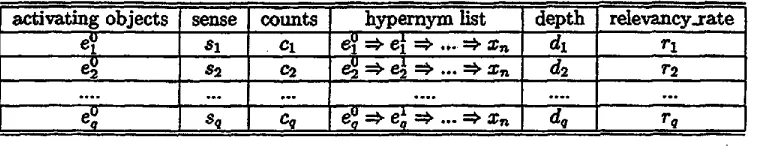
is activated by q concepts el °, e~, .... eq°; the times of activation for each ei ° are represented by c4. Since e~(i < q) activates zn, there exists a hypernym list .... z . in W o r d N e t , w h e r e is the immediate hypernym of e~ - I . The system main- tains a database of activation information as shown in Table 2, and transforms the database to a GT model automatically.GT is an n-ary branching tree structure with the foUowing properties:
• Each node represents a concept, and each edge rep- resents the hypernym relationship between the con- cepts. If ei is the immediate hypernym of ej, then there is an edge between node ei and ej. el is one level above ej in the tree.
[image:6.612.102.528.51.406.2]activating objects
e!'
. . ° .
sense I counts hypernym list s, e~ e y =r el ~ .... ~ z . s2 ! e~ ~ m d ~ . . . ~ z .
• . ° . . . . . . .
Sq ! e¢ eq , ...
depth
dl
d2
. o ° .
d~
relevancy_rate
r l r2
. . o
rq
Table 2: database of activating concepts
The leaf nodes =o oo ~I ' ~ ' """~'q .o are the concepts which
i
activate zn. The internal nodes are the concepts ej (i ~ 0 and 1 < j _~ q) from the hypernym paths for the activating concepts.
For a leaf node ei°:
~o~nt~(e~) =
releva'ricy.rate(ei °) = ri
* For an internal node e, if it has n hyponyms(ie, chil- dren) co, ...e~ then:
11
counts(e) = ~ eounts(ei)
i.~.1
n
relevancy.rate(e)
= ~ P (
eO
* relevancy_rate(w)
i ~ l
where
P(ei) = counts(ei)
counts(e)
O p t i m i z e d R u l e
For each noun entity in the most general rule, the sys- tem keeps a G T from the tra~in!ng set. Depending on user's di~Ibxent needs, a threshold 0 is pre-selected. For each GT, the system will start from the root node, go d o w ~ the tree, and find all the nodes e~ such that
reIevan~,_rate(ei) _> O. If a node relevancy_rate is
higher tl~an O, its children nodes will be ignored. In this way, the[system maintains a set of concepts whose re/e-
san~y.r~te is
higher than O, which is called Optimized-Concept~. By substituting zn in the most general rule
with O p~!mized-Conc~pts, an optimized rule is created to meet ;he user's needs.
The se ~rehlng algorithm is basically the breadth-first search a~
1. Initial~ select relevm the pr, to extl not ca
, :follows:
ze Optimal-Concep~
to be empty set. Pre-flae threshold 0. If the user wants to get the ~t information and particularly cares about ~c~ion, 0 should be set high; if the user wants act as m u c h as information possible and does :e about the precision, 0 should be set low.
2. Starting from the root node z, perform the
.Recursive-Search algorithm, which is defined as the
following:
Reenrsive-Search(concept z )
{ if (relevancy.rate(z) _> 0) {
put z into Optimal-Concepts set; ezit;
}
else {
let m denote the number of children nodes o[ z; let zi denote the child ol z (0 < i _< m); for ( i = 1; i < m; i + + )
Recursive-S earch (zi ) ;
);
}
E x p e r i m e n t a n d D i s c u s s i o n
In this section we present and discuss results from an experiment. The experimental domain is triangle.jobs
USENET newsgroup. We trained our system on 24 articles for the extraction of six facts of interests as follows:
C o m p a n y Name. Examples: IBM, Metro Informa- tion Services, D C R Inc.
Position/Title. Examples: programmer, financial analyst, software engineer.
Experience/Skill. Example: 5 years experience in Oracle.
• Location. Examples: Winston-Salem, North Car- olina.
Benefit. Examples: company matching funds~ com- prehensive health plan.
Contact Info. Examples: Fax is 919-660-6519, e-mail address.
[image:7.612.121.500.54.131.2]location benefit contact info
facts company position experience
training 62.5% 83.3% 91.7%
testing 63.1% 90.8% 90.8%
66.7% 25.0%
62.4% 23.4%
95.8%
97.9%
Table 3: Percentage of Facts in Training and Testing
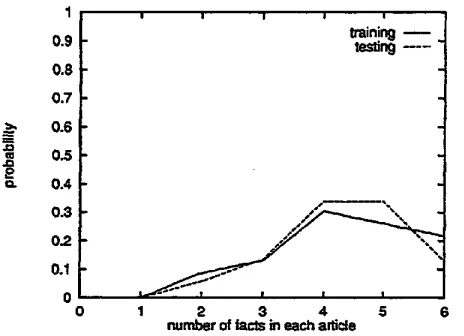
wanted, questions answered, ads to web site etc. First, we compared some of the statistics from the tr~nlng set and testing set. The percentage of representation of each fact in the articles for both training and t e - ing domain is shown in Table 3, which is the number of articles containing each fact out of the total number of articles. T h e distribution of number of facts presented in each article is shown in Figure 7.
T h e m e a n number of facts in each article from the tra;nlng set is 4.39, the standard deviation is 1.2; the m e a n number of facts in each article from the testing set is 4.35, the standard deviation is 1. Although these statistics are not strong enough to indicate the train- ing set is absolutely the good trMn;ng corpora for this information extraction task, it suggests that as far as the facts of interest are concerned, the training set is a reasonable set to be trained and learned.
J~
to
J :
~o 1
0.9
0.8
0.7
O.5
0.5
0.4
0.3
0.2
0.1
0 0
Uainin 0 tes~ng
1 2 3 4 S 6
number of facts in each a~cle
Figure 7: Distribution of Number of Facts in Each Article
T h e evaluation process consisted of the following steps: fn'st, each unseen article was studied to see if there was any fact of interest presented; second, the semantic transitions produced by the system were ex- amined to see if they correctly extracted the fact of in- terest. Precision is the number of transitions correctly extracting facts of interest out of the total number of transitions produced by the system; recall is the num- ber of facts which have been correctly extracted out of the total number of facts of interest. The overall performance of recall and precision is defined by the
Fomeasurement (Chinchor 1992), which is
(~2 + 1.0)
•P
*R
~ . P + R
where P is precision, R is recall, 13 = 1 ff precision and recall are equally important.
First, we tested on single fact extraction, which was
position~title
fact. T h e purpose of this experiment is totest whether the different 8 values will lead to the ex- pected recall, and precision statistics. F r o m the result out of 141 related testing articles, the recall, precision, F-measurement curves are shown in Figure 8. Recall is 51.6% w h e n 8 = 1.0, which is lower than 7 5 % at # = 0, however, precision is the highest at 84.7% when 0 = 1.0. The F-measurement achieves its highest value at 64.1% w h e n 0 = 1.0.
Q
C
R
Q C a
I [ [ I i [ i I l I
precision - -
0,.9 recall ~ "
0.8 F - m e ~ u ~ e n ~ ' ~
0.7
. . ."~.
2 U
0.4 0.3 0.2 0.1 0
0 0.1 0.2 0.3 0.4 0.5 0.6 0.7 0.5 0.9 I GT ~reshold
F'tgure 8: Performance vs. G T Threshold
[image:8.612.333.563.306.504.2] [image:8.612.69.301.345.513.2]and 38.1%. If we use the traditional way of keyword matching to do this information retrieval, the precision won't achieve as high as 95.7% since a few resume and job wanted postings will succeed the keyword matching and be mls-identitled as related articles.
| | | I | | ! |
1 0.9 O.8 0.7 0.6 O.5 O.4 0.3 0.2 0.1 0 0
I ! I I I I I I I
0.1 0.2 0.3 0.4 0.5 0.6 0.7 0.8 0.9
GT threshold
Figure 9: Precision of Identifying Unrelated vs. GT Threshold
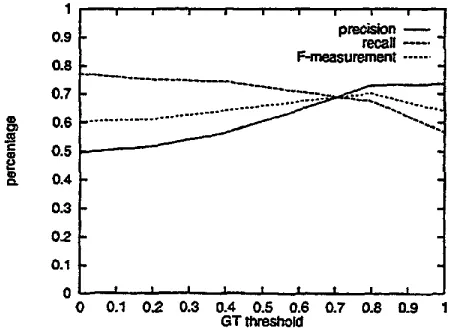
The system performance on extracting six facts is shown in Figure I0. T h e overall performance F- measurement gets to its peak at 70.2% when 0 = 0.8. W h e n 0 = 1.0, the precision does not get to what w e expected. O n e explanation is that, Im!ike the extrac- tion of
position/title fact,
for extracting the six facts from the domain, the training data is quite small. It is not sufficient enough to support the user's requirement for a strong estimate of precision. 0 = 0.8 is the best choice when the training corpus is small.o
Q .
1 O.9 O.8 0.7 0.6 0.5 0.4 0.3 0.2 0.1 0 0
t t ' | J i i J I |
precision recall ----. F-measurement ...
. . . - ~ .
t t ! s , I I I I
[image:9.612.61.289.118.289.2]0.1 0.2. 0.3 0.4 0.5 0.6 0.7 0.8 0.9 1 GT lhreshold
Figure I0: Performance of Extracting Six Facts vs. G T Threshold
S o m e problems were also detected which prevent better performance of the system. The cu~ent do-
main is a newsgroup, where anyone can post anything which he/she believes is relevant to the newsgroup. It is inevitable that some typographical errors and some
abbreviations occur in the articles. A n d the format of the article sometimes is unpredictable. If we can in- corporate into the system a spo]llng checker, and build a database for the commonly used abbreviations, the system performance is expected to be enhanced. Some problems came for the use of WordNet as well. For example, the sentence "DCR Inc. is looking for Q/A people" won't activate the most general rule in Fig- ure 5. The reason for that is
people
subsumed to con- cept{group, grouping},
but not the concept{entity}.
This problem can be fixed by adding one more rule with{group, grouping}
substituting {~nt/~} in most general rule in Figure 5. WordNet has very refined senses for each concept, including some rarely used ones, which sometimes causes problems too. This kind of problem certainly hurts the performance, but it's not easy to correct because of the nature of WordNet. However, the use of WordNet generally provides a good method to achieve generalization in this domain of job advertisement.Conclusion and Future W o r k
This paper describes a rule 0ptlmizztion approach by using Generalization Tree and WordNet. Our informa- tion extraction system learns the necessary knowledge by analyzing sample corpora through a training pro- cess. The rule optimization makes it easier for the information extraction system to be customized to a new domain. The Generalization Tree algorithm pro- rides a way to m a k e the system adaptable to the user's needs. The idea of first achieving the highest recall with low precision, then adjusting precision to sat- isfy user's needs has been successful. W e are currently studying h o w to enhance the system performance by further refining the generalization approach.
References
Aberdeen, John, John Burger, David Day, Lynette Hirschman, Patricia Robinson, and Marc Vil~n 1995 M I T R E : Description of the A L E M B I C System Used for MUC-6,
Proceedings of the Sizth Message Under-
standing Conference (MUC-6),
pp. 141-155, Novem- ber 1995. [image:9.612.61.289.464.629.2]t , . .
Bagga, Amit, and Joyce Y. Chai 1997 A Trainable Message Understanding System
Computational Natu-
ral Language Learning (CoNLL97),pp.
1-8, July 1997. Chai, Joyce Y. and Alan W. Biermann 1997 A Word- Net Based Rule Generalization Engine For Me~niug ExtractionTo appear at Tenth International Sympo-
sium On Methodologies For Intelligent Systems,
1997. Chinchor, Nancy 1992. MUC-4 Evaluation Metrics,Proceedings of the Fourth Message Understanding
Conference (MUC-4),
June 1992, San Mateo: Mor-gan Kalrfm~nn.
Church, Kenneth 1988 A Stochastic Parts Program and Noun Phrase Parser for Unrestricted Text Pro-
ceedings of the Second Conference on Applied Natural
Language Processing,
ACL, 1988.Church, Kenneth, William Gale, Patrick Hauks, and Donald Hindle. 1989 Parsing, Word Associations and typical Predicate-Argument Relations.
Proceedings of
the International Workshop on Parsing Technologies,
1989.
Derose, S., 1988 Grammatical Category Disambigua- tion by Statistical Optimization
Computational Lin-
gu/sties, 14, 1988.
Fisher, David, Stephen Soderland, Joseph McCarthy, Fangfang Feng and Wendy Lehnert. 1995. Description of the UMass System as Used for MUCC-6, Proceed-
ings of the Sizth Message Understanding Conference
(MUG-6),
pp. 127-140, November 1995.Grishmau, Ralph 1995. The NYU System for MUC-6 or Where's the Syntax?
Proceedings of the Sizth Mes-
sage Understanding Conference (MUC-6),
pp. 167- 175, November 1995.Krupka, George 1~. 1995. Description of the SRA Sys- tem as Used for MUC-6,
Proceedings of the Sixth Mes-
sage Understanding Conference (MUG-6),
pp. 221-235, November 1995.
Miller, George A. 1990. Introduction to WordNet: An On-Line Lexical Database.
WordNet Manuals,
pp. 10-32, August 1993.
Miller, George A., et al. 1990a. Five Papers on Word-
Net, Cognitive Science Laboratory, Princeton Univer-
sity, No. 43, July 1990.
Resnik, Philip 1995a Using Information Con- tent to Evaluate Seantic Similsrity in a Taxon-
omy.Proceedings
of IJCAI-g5
Resnik, Philip 1995b Disambiguating noun groupings with respect to WordNet senses,
Third Worshop on
Very Large Corpora,
1995.