Towards a Bootstrapping Framework
for Corpus Semantic Tagging
R o b e r t o Basili, Michelangelo Della Rocca, Maria Teresa Pazienza
Dipartimento di Informatica, Sistemi e Produzione,
Universita' di Roma, Tor Vergata (ITALY)
{bas ili, dellaroc, pazienza}@inf o. ut ovrm. it
Abstract
Availability of source information for se- mantic tagging (or disambignating) words in corpora is problematic. A framework to produce a semantically tagged corpus in a domain specific perspective using as source a general purpose taxonomy (i.e. Word- Net) is here proposed. The tag set is de- rived from higher level Wordnet synsets. A methodology aiming to support semantic bootstrapping in a NLP application is de- fined. Results from large scale experiments are reported 1.
1
I n t r o d u c t i o n
Lexical Acquisition (LA) processes strongly rely on basic assumptions embodied by the source informa- tion and training examples. Several approaches to LA rely on some forms of declarative descriptions of source data: bracketed or POS tagged corpora are just examples. Many authors claim that class-based methods are more robust against data sparseness problems (Dagan,1994), (Pereira, 1993), (Brown et al.,1992). Other works (Basili et al.,1993a, 1996) demonstrated that a variety of lexical acquisition methods over small size corpora are viable when- ever a domain specific semantic bias is available: using high level semantic classes (rather than sim- ple words) increase the robustness of the proba- bility driven methods, usually affected by coverage and data sparseness problems. Furthermore, domain specific semantic classes add expressivity to the un- derlying statistical acquisition model (Basili et al.,
1996):
this saves the knowledge engineer from hav- ing to deal with mysterious scores with no linguistic flavor. Semantic data possess an explanatory power that is truly required in specific knowledge domains.1 This work has been partially supported by the Esprit LRE project n. 2110 - ECRAN
Modeling semantic information is much more cor- pus and domain dependent than P O S or syntactic tagging. Bracketed corpora are core components of an underlying grammatical knowledge to which re- suits of different inductive methods equivalently re- fer. Such equivalence is no longer valid for seman- tic tagging when corpora (as well as underlying do- mains) change. In order to design tagging capabili- ties at a semantic level, it is more important to de- sign adaptation capabilities to process a given corpus in a domain driven fashion. Tagging is a dynamic process that aims to produce a core semantic infor- mation to support several induction processes over the same domain.
Availability of source information to support any tagging activity is problematic: general purpose sources (e.g. M R D s and static Lexical Knowledge Bases) m a y be too generic and worsen the induc- tion quality, while specific domain sources are usu- ally absent. Although semantic information is cru- cial to the induction of most lexical knowledge, ac- cessing it is often impossible. As gold standards are fairly questionable, it is necessary to rely on sources that are as much systematic as possible and adapt- ing their description to the underlying corpus. The widespread diffusion of WordNet, and its large scale as well, have motivated in several recent studies to start using it as a common source and adapt it for the purpose of the target LA task.
In this framework, we consider tagging as a pro- cess carried out in two phases: (1) selection of the semantic tag system specific to the domain (tnning Wordnet); (2) use of the specific classification to tag the corpus in v/vo.
2
Semantically-driven Induction of
Lexical Information
• Acquisition of word taxonomies from a cor- pus by means of syntactic (Hindle,1990) (Pereira et al.,1993) as well semantic (Basili et al.,1993a,1996) evidence
• Probability driven PP-disambignation (Hindle and Rooths,1993), (Basili et ai.,1993c), (Brill and Resnik,1994) ,(Resnik,1995), (Frank,1995), (Collins and Brooks,1995). Some of these meth- ods rely on semantic classes in order to improve robustness.
• Verb Argument Structure derivation. M a n y se- lectional constraints in argumental information have a semantic nature (e.g. ± animate), like in (Resnik and BriU,1994) (Resnik,1995) or (Basili et ai.,1996)
Semantic tagging is thus crucial to all the above activities. W e propose the following strategy:
1. Tune a predefined (general) classificatory framework using as source an untagged corpus
2. Tag the corpus within the defined model even- tually adjusting some of the tuning choices;
3. Use tagged (i.e. semantically typed) contexts to derive a variety of lexical information (e.g. verb argument structures, PP-disambignation rules,
o o o )
The design of the overall process requires a set of modeling principles:
1. to focus on the suitable tag system
2. to customize the classification to a corpus
3. to tag the corpus correspondingly.
3
T u n i n g a C l a s s i f i c a t i o n
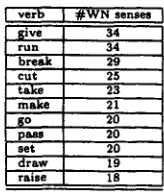
F r A m e w o r k t o a D o m a i nThe wide-spectrum classification adopted within WordNet is very useful on a purely linguistic ground, but creates unacceptable noise in NLP applications. In a corpus on Remote Sensing (RSD) 2, for example, we computed an average ambiguity of 4,76 senses (i.e. Wordnet syasets). Table 1 counts the WN synsets of some of the most ambiguous verbs found in our RSD corpus.
Several problems are tackled when a domain driven approach is used. First, ambiguity of words
2The t11.1ng phase has been evaluated over different corpora but results will be discussed over a collection -of publications on Remote Sensing, sized about 350.000
words.
Table h R S D verbs with the highest initial polysemy
] verb ] • W N senses
~ive 34 r u n 34 b r e a k 29 c u t 25 t a k e 23 m a k e 21
~o 20
p a s s 20 s e t 20 d r a w 19 r a i s e 18
is reduced in a specific domain, and enumeration of all their senses is unnecessary. Second, some words function as sense primers for others. Third, raw con- texts of words provide a significant bundle of infor- mation able to guide disambignation. Applying se- mantic disambignation as soon as possible is useful to improve later LA and other linguistic tasks. Our aim is thus to provide a systematic bootstrapping framework in order to:
• Assign sense tags to words
• Induce class-based models from the source cor- pus
• Use the class-based modesl (that have a seman- tic nature) within a NLP application.
The implemented system, called G O D o T (Gen- eral purpose Ontology Disambignation and Tuning), has two main components: a classifier C-GODoT,
that tunes WordNet to a given domain, and WSD- GODoT that locally disambignates and tags the source corpus contexts. The Lexical Knowledge base (i.e. WordNet) and the (POS tagged) source corpus axe used to select relevant words in each semantic class. The resulting classification is more specific to the sublanguage as the exhaustive enumeration of general-purpose word senses has been tackled, and potential new senses have been introduced. The tuned hierarchy is then used to guide the disam- biguation task over local contexts thus producing a final sense tagged corpus from the source data. Class-based models can be derived according to the tags appropriate in the corpus and used to derive lexical information according to generalized colloca- tions.
3.1 A s e m a n t i c t a g s y s t e m for nouns a n d verbs
[image:2.612.380.462.83.179.2](Yarowsky 1992), which inspired our tuning method, although objectives and methods of our classifier (C- G O D o T ) are slightly different.
First, the aim is to tune an e~isting word hierarchy to an application domain, rather than selecting the best category for a word occurring in a context. Second, since the training is performed on an unbal- anced corpus (and also for verbs, that notoriously exhibit more fuzzy contexts), we introduced local techniques to reduce spurious contexts and improve reliability.
Third, since we expect also domain-specific senses for a word, during the classification phase we do not make any initial hypothesis on the subset of consis- tent categories of a word.
Finally, we consider globally all the contexts in which a given word is encountered in a corpus, and compute a (domain-specific) probability distribution
over its expected senses (i.e. hierarchy nodes) A domain specific semantics is obtained through the selection of the suitable high level synsets in
the Wordnet hierarchy. A different methodological choice is required for verbs and nouns. As, Word- Net hyperonimy hierarchy is rather bushy and dis- omogeneous, we considered inappropriate, as initial classification, the WordNet lot~est level synsets. A
more efficient choice is selecting the topmost synsets, called unique beginners, thus eliminating branches of the hierarchy, rather than leaves. This is reasonable for nouns, (only 25 unique beginners), but it seems still inappropriate for verbs, that have hundreds of
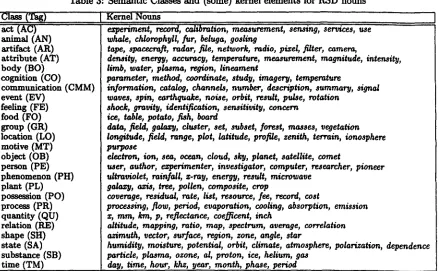
unique beginners (about 208). We hence decided to adopt as initial classification for verbs the 15 se- manticaliy distinct categories (verb semantic fields) in WordNet. The average ambiguity of verbs among these categories is 3.5 for our sample in the RSD. A similar value is the ambiguity of nouns in the set of their unique beginners. The first columns in Tables 2 and 3 report the semantic classes for nouns and verbs.
3.2 T u n i n g verbs a n d noun~
Given the above reference tag system, our method works as follows:
• Step 1. Select the most typical words in each category;
• Step 2. Acquire the collective contexts of these words and use them as a (distributional) de- scription of each category;
• Step 3. Use the distributional descriptions to evaluate the (corpus-dependent) membership of each word to the different categories.
Step 1 is carried out detecting the more significant (and less ambiguous) words in any class (semantic fields of verbs and unique beginners for nouns): any of these sets is called kernel of the corresponding class. Rather than training the classifier on all the verbs or noun in the learning corpus, we select only a subset of prototypical words for each category. We call these words w the salient words of a category C. We define the typicality Tw(C) of w in C, as:
Tw(C) = N ,c
Nw
(1)
where:
N~ is the total number of synsets of a word w, i.e. all the WordNet synonymy sets including w.
N•.c is the number of synsets of w that belong to the se- mantic category C, i.e. synsets indexed with C in Word- Net.
The typicality depends only on WordNet. A typ- ical verb for a category C is one that is either non ambiguously assigned to C in WordNet, or that has most of its senses (syneets) in C.
The synonymy Sto of w in C, i.e. the degree of syn- onymy showed by words other than w in the synsets of the class C in which w appears, is modeled by the following ratio:
S~(C) = O~,c
o ,
(2)
where:
O ~ is the number of words in the corpus that appear in at least one of the synsets of w.
Ow,c is
the number of words in the corpus appearing in at least one of the synsets of w, that belong to C.T h e
synonymy
depends both on WordNet and on the corpus. A verb with a high degree of synonymy in C is one with a high number of synonyms in the corpus, with reference to a specific sense (synset) belonging toC. Salient verbs
for C are frequent, typical, and with a high synonymy in C. Thesalient
words to, for a semantic category C, are thus identi- fied maximizing the following function, that we callSCOre:
Score.(C) = o a . x T.(C) x S.(C)
(3)
where OAw are the absolute occurrences of w in the corpus. The value of Score depends both on the corpus and on WordNet. OAw depends obviously on the corpus.
tables some highest relevance words in the classes are reported). This is exactly what is needed as a semantic domain bias of the later classification pro- cess.
Step 2 uses the kernel words to build (as in (Yarowsky,1992)) a probabilistic model of a class: distributions of class relevance of the surrounding terms in typical contexts for each class are built.
In Step 3 a words (verb or noun) is assigned to a class according to the contexts in which it ap- pears: collective contexts are used contemporarily, as what matters here is domain specific class mem- bership and not contextual sense disambiguation. Many contexts may cooperate to trigger a given class and several classifications may arise when different contexts suggest independent classes. For a given verb or noun w, and for each category C, we evaluate the following function, that we call Domain Sense (DSense(w, C)):
1
DSenseCw, C) = -~ ~ Y(k, C)
(4)
k
where
Y(k, c) =
c)
x Pr(C)
(5)
w~Ek
where k's are the contexts of w, and w I is a generic word in k.
In (5), Pr(C) is the (not uniform) probability of a class C, given by the ratio between the number of collective contexts for C 3 and the total number of collective contexts.
The t~ning phase has been evaluated over the RSD corpus, and the resulting average ambiguity of a representative sample of 826 RSD verbs is 2.2, while the corresponding initial WordNet ambiguity was 3.5. For the intrinsic difficulty of deciding the proper domain classes for verbs we designed two tests. In the first ambiguous verbs in WordNet have been evaluated: the automatic classification is com- pared with the WordNet initial description. A recall (shared classes) of 4 1 % denotes a very high com- pression (i.e. reduction in the number of senses) with a corresponding precision of 8 2 % that indicate a good agreement between WordNet and the system classifications: m a n y classes are pruned out (lower recall) but most of the remaining ones axe among the initial ones. A second test has been carried out on WordNet unambiguous verbs (e.g. fie.z, convoy,
. . . ). For such verbs a recall of 91% is obtained over their unique (and confirmed) senses. These results show that tuning a classification using word contexts
Sthose collected around the kernel verbs of C
is enough precise to be used in a semantic bootstrap- ping perspective and by its nature it can be used on a large scale.
3.3 T ~ g g i n g v e r b s a n d no~_lns in a corpus
After the tuning phase local tagging is obtained in a similar fashion: given a context k for a word w and the set of the proposed classes {C1,C2,...Cn) for w, a tag C E (C1,C2,...Cn} is assigned t o w in k itf adherence of k to the probabilistic model of C is over a given threshold and it is maximal.
The WSD algorithm (WSD-GODoT) can be sketched as follows:
I. Let k be a context of a noun/verb to in the source corpus and
{Ci,C2,
...,C,}
be the set of do- main specific classifications of w, as they have been pre-selected by C - G O D o T ;2. For each class Ci, the normalized contextual sense, N C S , is given by:
NCS(k, w, Ci) = Y(k, Ci) - Pc,
(6)
where Y(k, Ci) is defined as in (5), and #c,,
ac~ are the mean and standard deviation of the
Dsense(w, Ci) over the set of kernel words w in Ci. 3. The sense C that to assumes in the context k is expressed by:
Sense(w,k) =C
if[ NCS(k,w,C)= maxc,(NCS(k,w,C~)); (7)
Experimentation has been carried out over set of 1,000 disambiguated contexts of about 97 verbs ran- domly extracted fzom RSD. All these 97 verbs where ambiguous, with an average of 2.3 semantic classes per verb persisting ambiguity, even after the seman- tic tuning phase. Recall and Precision have been measured against a manual classification carried out by three human judges (about 70% cases received the same tag by all the judges, this suggesting a cer- tain complexity ot the task). In 98.74% of cases the tagging system selected one tag. A recall of 85.97% has been obtained. Precision is of about 62.19%.
corpus contexts). Our methodology is less demand- ing from the point of view of the required source in- formation and possibly should be compared against one only of the levels mentioned in these works. (Resnik,1995) reports a human precision of about 67% but on a noun disambiguation task carried out at the level of true WordNet ,,tenses (i.e. synsets): this task seems fairly more complex than ours as we estimated an average of 2.9 synsets per noun on a set of 100 nouns of the RSD. However one of the re- suits of our method is also to eliminate most of these senses from the hierarchy, during the tuning phase, so that precision of the two method cannot be di- rectly compared. Exhaustive experimental data on nouns are not yet available. However the significant results obtained for verbs are important, as several authors (e.g. (Yarowsky,1992)) report verb as a cat- egory that is more problematic than noun for context driven classification tasks.
4 D i s c u s s i o n
The relevance of word classes for a variety of lexi- cal acquisition tasks has been described in several works. In (Brown et al.,1993) class-based language models for text processing are described. Classes are derived by pure collocational analysis of corpora. Approaches of this type aim to improve the statis~ tical significance of probability estimations, taclde the data sparseness problems and reduce the num- ber of the model parameters. The derived clusters are very interesting but are not amenable for a direct linguistic analysis. Difficulties in interpreting data derived from numerical cluster analysis emerge also in other studies (e.g. (Pereira et al.,1993)) where ad- ditional work is required to assign a suitable me~nlug to groups of words. The essential difficulty in sep- arating word senses, when conflating data are de- rived from distinct senses, is due to the fact that simple collocations are often the surface results of independent linguistic phenomena. Collocationally derived lexical constraints (as in the strong tea vs.
powerful tea example given in (Smadja,1989)) may be very different from other types of relations, like verb-argument relations. In this case, in fact a sta- tistical significant relationship is not to be detected betwen verb and its lexical arguments, but between the verb and a whole class of words that play, in fact, the role of such arguments. For example, in the RSD corpus the verb catalogue appears 33 times. It takes as a direct object the word information only once, that is an evidence too small to support any proba- bilistic induction. Information indeed is a typical
abstraction that can be catalogued. There is no hope for any inductive method making use of simple lex-
ical collocations instead of class based collocations (e.g. abstraction) to acquire enogh evidence of most of the phenomena.
Class methods based on taxonomic information may provide more comprehensive information for a larger number of lexical acquisition tasks. In PP- disambiguation tasks several works based on bi-gram statistics collected over syntactic data (e.g. Hin- dle and Rooths,1993) show evident limitations in coverage and efficacy to deal with complex forms. In (Franz,1995) weak performances are reported for ambiguities with more that two attachment sites. These last are very frequent in a language like Ital- ian where prepositional phrases play a role similar to English compounds. Class-based approaches (e.g. (Basili et al.,1993) and (Brill and Resnik, 1994) are more promising: the implied clustering also tack- les the data sparseness difficulties, but mainly they produce selectional constraints that have a direct se- mantic interpretation. Smaller training data set can be used and also unknown collocates are deal with, if they are able to trigger the proper semantic gen- eralizations.
The method proposed in this paper suggests and provides evidences that processing a corpus, first, to tune a general purpose taxonomy to the under- lying domain and, then, sense disambiguating word occurrences according to the derived semantic clas- sification is feasible. The reference information (i.e. the Wordnet taxonomy) is a well-known sharable re- source with an explicit semantics (i.e. the hyperon- imy/hyponimy hierarchy): this has a beneficial ef- fect on the possibility to extract further lexical phe- nomenon (e.g. PP disambiguation rules) with a di- rect semantic interpretation. Let for example:
Future Earth observation satellite systems for world- udde high resolution observation purposes require satel- lites in low Earth orbits, supplemented by geostationary relay satellites to ensure intermediate data transmission from LEO to ground.
be a potential source document, taken form our RSD domain. Given a preliminary customization of the Wordnet hirerachy, according to the set of ker- nel verbs and nouns exemplified in Tables 2 and 3, the described methods allow to apply local semantic taggin to the set of verbs and nouns in the docu- ment. Some vrbs/nouns are no longer ambiguous in the domain: their unique tag is retained. For the re- maining ambiguous words the local disambiguation model is applied (by (7). The tagged version of the source document results as follows:
Earth/LO orbits/SA, supplemented/CT by geostation-
ary relay/OB satellites/OB to ensure/CG interme.
diate data/GR transmission/AC from LEO/AR
toground/LOC. 4
T h e data n o w available for any lexical acquisition techniques are not only bigrams or trigrams, or syn- tactic collocations (like those derived by a robust parser (as in (Grishman and Sterling,1994) or (Basili et al, 1994)) but also disambignated semantic tags for co-occurring words. For example, for the verb
require,
we extract the following syntactic colloca- tions from the source document:V_N (systems/CO, require/CG) N_V (require/CG, satellites/0B)
These data support several inductions. First, se- mantic tags allow to cluster togheter source syntac- tic collocations according to similar classifications. Other occurrence of the verb require, as they have been found in the RSD corpus are:
V_N (model/CO, require/CG) N_V (require/CG, satellites/OB)
V_N(process/CO, require/CG) N_V(require/CG, sensors/OB)
V_N (satellite/0B, require/CG)
N_V (requSre/CG, beam-antenna/0B) ...
When arguments are assigned with the same tags (e.g. OB for the direct objets) basic instances can be generalized into selectional rules: a typical structure induced from the reported instances is thus
(require(Subj /[+COor + OB])
(Obj/[+OBl))
(8)
where explicit semantic selectional restrictions ( + O B ) for syntactic arguments (e.g. Obj) are ex- pressed. A method for deriving a verb subcatego- rization lexicon from a corpus, according to an exam- ple based learning technique applied to robust pars- ing data is described in (Basili et al,forthcoming). Availability of explicit semantic tags (like O B ) al- lows to derive semantic selectional constraints as in (8). Further induction would allow to assign the- matic descriptions to arguments in order to extend (8) in:
(require(
Subj /Theme/[ +CO])
(Obj/r.nst,'ument/[+OB]))
(9)
Previous work on the acquisition of high level se- mantic relations is described in (Basili et al.,1993b), where the feasibility of the derivation of lexical se- mantic relations from several corpora and domains
4The reported tags are as in Tables 2 and 3.
has been studied. Interesting results on applicabil- ity of semantic filtering to synt~tic data, for the purpose of acquiring verb argument information is reported in (Dorr and Jones,1996). Semantic infor- mation greatly improve the precision of a verb syn- tactic classification.
The proposed tag system (e.g. Wordnet high level classes) has several advantages. First it puts some limit to enumeration of word senses, thus keeping limited the search space of any generalization pro- cess. Learning methods are usually search algo- rithms through concept spaces. The larger is the set of basic classes, the larger is the size of the search space. It is questionalble how expressive is the re- suiting tag system. Previous research in ARIOSTO (Basili et al,1996a) demonstrated the feasibility of complex corpus driven acquisition based on high level semantic classes for a variety of lexical phenom- ena. A naive semantic type system allows a number of lexical phenomena to be captured with a minimal h u m a n intervention. As an example acquisition of verb hierarchies according to verb thematic descrip- tion is described in (Basili et al.,1996b). Whenever an early tuning of the potetial semantic classes of a given verb in a corpus has been applied and local disambiguation has been carried out as corpus se- mantic annotation, more precise verb clustering can be applied:
* first, local ambiguities have been removed dur- ing corpus tagging,
second, clustering is applied with an intra- classes strategy and not over the whole set of verbs. First, a set of thematic verb instances from source sentences are collected for each given semantic class, so that
social
verbs are taken separate fromchange
orcognition
verbs. Then, separate hirarchies can be generated for each semantic class, in order to have a fully do- main driven taxonomic description within gen- eral classes , e.g.social,
for which a general agreement exists. Later reasoning processes could thus exploit general primitives augmented with domain specific lexico-semantic phenom- ena.5 Conclusions
methodology to customize the general purpose tag system (i.e. the high level chases of the Wordnet hierarchy) to a domain is described and a seman- tic disambiguation model to semantically tag source raw texts is defined. The result is a semantically a n n o t a t e d corpus where lexical phenomena can be studied with a reduced ambiguity. Experimental ev- idences for verb and nouns tagging in different do- mains have been outlined and extensive d a t a froma remote sensing (medium size) corpus have been re- ported. Implications of the proposed semantic tag- ging for typical lexical acquisition tasks (e.g. deriva- tion of PP-disambiguation rules or verb argument structures) have been discussed. Further research in assessing the semantic tagging evaluation, customiz- ing the lexical acquisition models to the proposed se- mantic type system and evaluating extensively the acquisition results are on going.
R E F E R E N C E S
Basili et al. 1993a. Basili R., M.T. Pazienza, P. Velardi. "What can be learned from raw text?". Vol. 8: Machine Translation.
Basili et al. 1993b. Basili It., M.T. Pazienza, P. Ve- lardi. "Acquisition of selectional patterns in sub- languages". Vol. 8: Machine Translation.
Basili et al. 1993c. Basili R., M.T. Pazienza, P. Velardi. "Semi-antomatic Extraction of Linguistic Informa- tion for Syntactic Disambiguation". Vo1.7:339-364: Applied Artificial Intelligence.
Basili et al. 1995a. Basili R., M.T. Pazienza, P. Velardi. "A context driven conceptual clustering method for verb classification", in Corpus Linguistics for Lexi- cal Acquisition, B. Boguraev & J Pustejovsky Eds., MIT press, 1996.
Basili et al. 1995b. Basili It., M. Della Rocca, M.T. Pazienza, P. Velardi. "Contexts and cate- gories: tuning a general purpose verb classification to sublanguages'. Proceeding of RANLP95, Tzigov Chark, Bulgaria, 1995.
Basili et al 1996a. Basili R., M.T. Pazienza, P. Velardi. "An Empirical Symbolic Approach to Natural Lan- guage Processing". To appear in Artificial Intelli- gence, Vol.85, August 1996.
Basili et al 1996b. Basili R., M.T. Pazienza, P. Velardi. "A Context Driven Conceptual Clustering Method for Verb Classification", in Corpus Proce-~sing for Lexical Acquisition, J. Pustejovsky and B. Bogu- raev Eds., MIT Press 1996.
Beckwith et al 1991. Beckwith I%., C. Fellbaum, D. Gross, G. Miller. "WordNet: A Lexical Database Organized on Psycholingnistic Principles, in Lexical Acquisition: Exploting On-Line Resources to Build a Lexicon". U. Zernik Ed. & Lawrenc~Erlbaum Ass.
Brill and Kesnik, 1994. E. Brill, P. Resnik, "A Itule- Based Approach to Prepositional Phrase Attach- ment Disambiguation', in Proc. of COLING 1994, Kyoto, Japan;
Brown et a!.1992. P.F. Brown, P. deSouza, R.L. Mer- cer, V.J. Della Pietra, J. C. Lai, "Class-Based n- gram Models of Natural Lauguage", in Computa- tional Linguistics, Vol. 18, n. 4, 1992.
Collins and Brooks,1995. Collins M. and Brooks J.,
Prepositional Phase Attachment trough a Backed- off Model, 3rd. Workshop on Very Large Corpora, MT, 1995
Dagan et al.1994. Dagau I., Pereira F., Lee L. "Similarly-based Estimation of Word Co- occurrences Probabilities ". Proc. of ACL, Las Cruces, New Mexico, USA, 1994.
Dorr and Jones,1996. B.J. Doff, D. Jones, "Acquisition of Semantic Lexicons: Using Word Sense Disam- biguation to Improve Precision", in Proc. of ACL SIGLEX Workshop "Breadth and Depth of Seman- tic Lexicons n, 28 June 1996, University of Califor- nia, Santa Cruz, USA.
Pranz,1995. Franz A., A statistical approach to learning prepositional phrase attachment disambiguation , in Proc. of IJCAI Workshop on New Approaches to Le aming for Natural Language Processing, Montreal 1995.
Grishman and Sterling,1994. R. Grishman, J. Sterling, Generalizing Automatically Generated Selectional Patterns, in Proc. of COLING 1994, Kyoto, Japan. Hindle and Rooth,1993. Hindle D. and Rooth M., Struc-
tural Ambiguity and Lexical Relations, Computa- tional Linguistics, 19(1): 103-120.
McRoy,1992. McRoy S., "Using Multiple Knowledge Sources for Word Sense Discrimination" Computa- tional Linguistics, vol. 18, n. 1, March 1992, 1-30. Pereira et al. 1993. Pereira F., N. Tishby, L. Lee. "Dis-
tributional Clustering of English Verbs". Proc. of ACL, Columbus, Ohio, USA, 1994.
Resnik,1995, P. Resnik "Disambiguating noun groupings with respect to WordNet senses" in Proceeding of the ACL Third Workshop on Very Large Corpora, June 30, 1995, MIT, Cambridge, MA.
Table 2: Semantic Classes and (some) kernel elements for RSD verbs
I C l ~ (Tag)
change (CH) cognition (CG). communication (CM) competition (CP) consumption (CS)
contact (CT) creation (CR) emotion (EM) motion (MO)
perception (PC) possession (PS)
social (SO)
stative (ST) weather (WE)
Kernel verbs
acquire, emit, generate, cover calibrate, reduce, increase, measure, coordinate estimate, study, select, compare, plot, identif# record, count, indicate, investigate, determine base, point, level, protect, encounter, deploy sample, provide, supply, base, host, utilize function, operate, filter, segment, line, describe design, plot, create, generate, program, simulate like, desire, heat, burst, shock, control
well, flow, track, pulse, assess, rotate, sense, monitor, display, detect, observe, show provide, account, assess, obtain, contribute, derive
e~periment, include, manage, implement, test consist, correlate, depend, include, involve, e~ist scintillate, radiate, flare
Table 3: Semantic Classes and (some) kernel elements for RSD nouns
[ Class (Tag) Kernel Nouns act (AC)
a n ~ (AN)
art~fact (AR)
attribute (AT)
body (BO)
cognition (CO) communication ( C M M ) event (EV)
feeling (FE) food (FO)
group (GR) location (LO) motive (MT)
object (OB) person (PE)
phenomenon (PH) plant (PL)
possession (PO)
process (PR) quantity (QU) relation (RE) shape (SH) state (SA) substance (SB) time (TM)
experiment, record, calibration, measurement, sensing, services, use whale, chlorophyll, fur, beluga, gosling
tape, spacecraft, radar, file, network, radio, pi=el, filter, camera,
density, energy, accuracy, temperature, measurement, magnitude, intensity, limb, water, plasma, region, lineament
parameter, method, coordinate, study, imagery, temperature
information, catalog, channels, number, description, summary, signal waves, spin, earthquake, noise, orbit, result, pulse, rotation
shock, gravity, identification, sensitivity, concern ice, table, potato, fish, board
data, field, gala=y, cluster, set, subset, forest, masses, vegetation longitude, field, range, plot, latitude, profile, zenith, terrain, ionosphere purpose
electron, ion, sea, ocean, cloud, sky, planet, satellite, comet
user, author, experimenter, investigator, computer, researcher, pioneer ultraviolet, rainfall, z-ray, energy, result, microwave
galaxy, azis, tree, pollen, composite, crop
coverage, residual, rate, list, resource, fee, record, cost
processing, flow, period, evaporation, cooling, absorption, emission z, ram, kin, p, reflectance, coe~icent, inch
altitude, mapping, ratio, map, spectrum, average, correlation azimuth, vector, surface, region, zone, angle, star
humidity, moisture, potential, orbit, climate, atmosphere, polarization, dependence particle, plasma, ozone, al, proton, ice, helium, gas
day, time, hour, khz, year, month, phase, period
[image:8.612.89.528.356.627.2]