
Studies on Caged
N itrogen
Compounds
A thesis presented to the University of London in partial fulfilment of the
requirements for the degree of Doctor o f Philosophy
Catherine Elizabeth Lipton
ProQ uest Number: U 6 4 3324
All rights reserved
INFORMATION TO ALL U SE R S
The quality of this reproduction is d ep en d en t upon the quality of the copy subm itted.
In the unlikely even t that the author did not sen d a com plete manuscript
and there are m issing p a g e s, th e se will be noted. Also, if material had to be rem oved,
a note will indicate the deletion.
uest.
ProQ uest U 643324
Published by ProQ uest LLC(2016). Copyright of the Dissertation is held by the Author.
All rights reserved.
This work is protected against unauthorized copying under Title 17, United S ta tes C ode.
Microform Edition © ProQ uest LLC.
ProQ uest LLC
789 East E isenhow er Parkway
P.O. Box 1346
Abstract
This thesis describes studies on caged nitrogen compounds, in particular
hexamethylenetetramine. Thus, Chapter One presents an introduction to the
synthesis and chemistry of hexamethylenetetramine.
Chapter Two describes efforts to synthesise new caged nitrogen compounds
using the synthesis of hexamethylenetetramine as a model. First, studies of the
reaction of formaldehyde and ammonia in the presence of a number of metal
amine complexes are described. Secondly, investigations into the use of some
macrocyclic metal amine complexes as precursors to high energy compounds are
reported.
In Chapter Three it has been shown that hexamethylenetetramine acts as a ligand
on organometallic compounds of ruthenium and rhodium. The ligand can bind
in a monodentate fashion, as in [Ru(T|^:T|^-CioHi6)Cl(hmt)] or
[Ru(ri^-^-cymene)Cl2(hmt)]; the latter has been characterised using X-ray
crystallography. Binuclear complexes have also been prepared, with
hexamethylenetetramine bound terminally, as in the chloride bridged salt
[(r|6-C6H6)ClRu(|Ll-Cl)2Ru(r|<^-C6H6)(hmt)]Cl, or bound as a bridging ligand, as in
[{Rh(Tl5-C5Me5)Cl}2(|A-hmt)].
Chapter Four presents reactions of hexamethylenetetramine with
^Âr(benzonitrile)palladium (II) dichloride to produce [Pd(hmt)2Cl2] and
[Pd(hmt)2Cl2]n. The complex [Pd(hmt)2Cl2] has been shown by X-ray
crystallography to exist as the trans isomer in the solid state. The reaction of
chloro(2-methyl-r|3-allyl)palladium(II) with hexamethylenetetramine gave
[PdCl(T|^-C4H7) (C6H12N4)] and [Pd2Cl2(T|^-C4H7)2(|Ll-C6Hi2N4)], both of which
NMR spectroscopy. Variable temperature NMR studies and computer
simulation of spectra have given an insight into the solution dynamics of these
compounds. Low temperature NMR studies have established the existence of
p d4Cl4(T|^-C4H7)4(M<'^-C6H i2N4)], whete hexamethylenetetramine acts as a
tetradentate ligand.
Chapter Five reports the synthesis of [RJi2(0 2CCH2CH3)4(hmt)2] and
[Rh2(0 2CCH2CH3)4(hmt)]n. The redox properties o f both complexes have been
investigated using cyclic voltammetry. Using these electrochemical results, the
donor ability of a number of ligands has been determined as
hmt>[PdCl(r|3-C4H7)(hmt)]>[Rh2(0 2CCH2CH3)4(hmt)]. A simple rationale for
Table o f Contents
Abstract 2
Table o f C ontents 4
Table o f F igures 9
Table o f Schem es 12
Table o f Tables 13
A bbreviations 15
A ck n ow led gem en ts 16
Chapter O ne Introduction 17
1.1 Background 18
1.2 Hexamethylenetetramine, an introduction 18
1.2.1 Synthesis and general chemistry of hexamethylenetetramine 18
1.2.2 The solid-state structure of hexamethylenetetramine 19
1.2.3 The formation of hexamethylenetetramine from formaldehyde and
ammonia 2 1
1.2.4 Selected reactions of hexamethylenetetramine 27
1.3 Interactions of hexamethylenetetramine with metals 29
1.4 Nitrogen rich cages as precursors to energetic materials 34
1.5 Present Work 37
Chapter T w o In vestigation s into the m etal-m ed iated syn th esis o f
ca g ed nitrogen com p ou n d s 38
2.1 Introduction 39
2.2 Reactions o f formaldehyde with metal amine complexes 45
2.2.1 Reactions of metal amine complexes and formaldehyde in aqueous
solution 45
2.2.2 The reaction of methylaluminium^/j(2,6-diphenylphenoxide) with
[Ni(NH3)6]Br2 50
2.2.3 Reactions of [Ni(NH3)6]Bf2 with gaseous formaldehyde. 52
2.3 Synthesis of metal encapsulating amines 53
2.3.1 Introduction 53
2.3.2 Synthesis of non-metallated diaminosarcophagine 54
2.3.3 T(?f/-butoxycarbonyl protection of diaminosarcophagine 58
2.4 Conclusions 59
2.5 Experimental 59
2.5.1 Physical Measurements 59
2.5.2 Materials 60
2.5.3 Reaction of formaldehyde with />^x^2>é/j'(amino)cobalt(III)chloride 60
2.5.4 Reaction of methylaluminium^/j(2,6-diphenylphenoxide) (MAPH) with
/>^jxr^^/j-(amino)nickel(II)bromide in inert atmosphere 61
2.5.5 Reaction of /?^x/2^/j-(amino)nickel(II)bromide with paraformaldehyde 62
2.5.6 Synthesis of [Co(sep)]Cl3 62
2.5.7 Synthesis of [Co {(N02)2sar}]Cl3 63
2.5.8 Synthesis of [Co {(NH3)2sar}]Cl5 63
2.5.9 Synthesis of (NH2)2sar.H20 64
2.5.10 Reaction of (NH2)2sar with ài-tert-huX^\ dicarbonate 64
2.5.11 Reaction o f piperazine with di-/^^-butyl dicarbonate 65
Chapter T hree R u then iu m and rhodium co m p lex es o f
hexam ethylenetetram ine 66
3.1 Introduction 67
3.1.1 The synthesis and reactions of “Ru('T|‘^-arene)”complexes 67
B/j(allyl)ruthenium(rV) complexes 77
3.2 Results and discussion 82
3.2.1 Complexes of “Ru(r|6-^-cymene)” with hexamethylenetetrarnine 82
3.2.2 Complexes of “Ru(Tj‘^-C6H6)” with hexamethylenetetramine 90
3.2.3 Complexes of “Rh(T|5-C5Me5)” with hexamethylenetetramine 93
3.2.4 Complexes of “Ru(T|^:T]^-CioHi6)” with hexamethylenetetramine 94
3.3 Conclusions 95
3.4 Experimental 96
3.4.1 Starting materials 96
3.4.2 Crystallography 96
3.4.3 Synthesis of |Ru(T|<^^-cymene) (hmt)CI2] 97
3.4.4 Synthesis of [(T|<^-C6H6)ClRu(|ul-Cl)2Ru(hmt)(T|^-C6H6)]Cl 97
3.4.5 Synthesis of [{Rh(r|5-C5Me5)Cl2}2(lt-hmt)] 98
3.4.6 Synthesis o f [Ru(r|3:r|3-CioHi6)Cl2(hmt)] 98
3.4.7 Crystallographic Data 99
Chapter Four P alladium (II) co m p lex es w ith
h exam ethylenetetram ine 103
4.1 Introduction 104
4.2 Reactions of bis(benzonitrile)paHadium(II)dichloride with
hexamethylenetetramine 104
4.2.1 Background 104
4.2.2 Reactions of ^/j"(henzonitrile)palladium(II)dichloride with
hexamethylenetetramine 105
4.3 Complexes of chloro(2-methyl-T]^-allyl)palladium(II) with
hexamethylenetetramine 110
4.3.1 Background 110
4.3.2 Synthesis of hexamethylenetetramine derivatives of
4.3.3 Variable temperature NMR studies of hexamethylenetetramine
derivatives of chloro(2-methyl-r|3-allyl)palladium(II) 124
4.3.3.1 Introduction 124
4.3.3.2 Analysis of variable temperature NMR spectra for
[Pd2Cl2(Tl3-C4H7)2(li-hmt)] 126
4.3.3.3 Analysis o f variable temperature NMR spectra for
[PdCl(Tl3-C4H7) (C6H12N4)] 131
4.3.3.4 Conclusions from analysis of variable temperature NMR spectral 33
4.4 Reactions of hexamethylenetetramine with
l,3,6,8-tetraa2atricyclo [4.4.1.1.3>8] -dodecane 134
4.5 Conclusions 137
4.6 Experimental 138
4.6.1 Crystallography 138
4.6.2 Synthesis of [Pd(hmt)2Cl2], (44) 138
4.6.3 Synthesis of [Pd(hmt)Cl2]n, 139
4.6.4 Synthesis of pPdCl(Tl3-C4H7)(hmt)], (46) 139
4.6.5 Synthesis of [Pd2Cl2(T|3-C4H7)2(ll-hmt)], (47) 139
4.6.6 Attempted synthesis of [Pd4Cl4(T|3-C4H7)4(M''^- hmt)] 140
4.6.7 Synthesis of [Pd2Cl2(Tl3-C4H7)2(ll-C8H i6N4)], (49) 140
4.6.8 Crystallographic data for [Pd(hmt)2Cl2], (44) 142
4.6.9 Crystallographic data for [PdCl(r|3-C4H7)(hmt)], (46) 145
4.6.10 Crystallographic data for [Pd2Cl2(T|3-C4H7)2(|ul-hmt)], (47) 148
Chapter Five Studies on com p lexes o f rh odiu m (II) carboxylates
w ith hexam eth ylen etetram ine 151
5.1 Introduction 152
5.1.1 Dirhodium tetracarboxylate complexes 152
5.1.2 Bonding in [Rh2(02CR)4] complexes 154
5.1.3.1 A general overview of 1:2 adducts 156
5.1.3.2 1:2 adducts with nitrogen-donor ligands 157
5.1.3.3 Polymeric complexes o f [EJi2(0 2 CR)4] with nitrogen donor ligands
159
5.1.3.4 Adducts of [Rh2(0 2CR)4] with metallo-ligands 162
5.1.4 Electrochemical studies on [Rh2(0 2CR)4L2] complexes 163
5.2 Results and discussion 164
5.2.1 Synthetic investigations 164
5.2.2 Electrochemical Investigations 166
5.3 Conclusions 171
5.4 Experimental 171
5.4.1 Reaction of [Rh2(0 2CCH2CH3)4] with two equivalents of
hexamethylenetetramine 171
5.4.2 General electrochemical procedure 172
5.4.3 Cyclic voltammetry: results 173
Table of Figures
Figure 1,1 Structures for hexamethylenetetramine as suggested by Losekann,
van’t Hoff and Dominikiewicz 20
Figure 1,2 Representation of bond length distortion in substituted
hexamethylenetetramine, the molecule now has symmetry, 21
Figure 1.3 Coordination polymer of Cul and hexamethylenetetramine 30
Figure 1,4 Three-dimensional silver-hexamethylenetetramine complex 30
Figure 1,5 A section of an infinite 2-D layer found in [Ag2(|bl^-hmt)(N02)]n 31
Figure 1,6 A representation of the polymeric structure of [Ag2(p,'*-hmt) (NOg)^^. 32
Figure 1,7 Chain polymer made up of [Cu2(02CCH3)^(hmt)]^ units 33
Figure 2,1 Tetraaza macrocycle formed via metal-template synthesis 40
Figure 2,2 Hexaaza macrocycle formed from one-pot metal template synthesis 40
Figure 2,3 Possible products from reaction of ammonia and formaldehyde 47
Figure 3,1 Geometry about ruthenium in [(T|^-C6H6)RuCl2(PMePh2)]^° 69
Figure 3,2 [Ru(T)''-arene)Cl(triazine)]Cl, (arene = benzene or^-cymene) 72
Figure 3,3 Structure of [{Ru(T]^'n^-CioHi6)Cl2}2(M'-C4H4N2)] as determined by X-ray
diffraction 82
Figure 3,4 NMR spectrum of [(T|^-^-cymene)RuCl2(hmt)] at 298 K 83
Figure 3,5 The three inequivalent sets of protons, of hexamethylenetetramine in a 1:1
adduct 84
Figure 3,6 NMR spectra of [(T|^-^-cymene)RuCl2(hmt)], 211 — 298 K 85
Figure 3,7 NMR spectrum of[(T|^-^-cymene)RuCl2(hmt)] and a second product,
253 K 8 6
Figure 3,8 Solid state structure of [(T|^-^-cymene)RuCl2(hmt)] as determined by single
crystal X-ray diffraction 8 8
Figure 3,9 NMR spectrum of "Ru(T|^-C6Hg)"-hmt adduct at 298 K 91
Figure 3,10 Chemical environments of hexamethylenetetramine protons in
[{(n'-CA)RuCl2}2(li-hmt)] 91
Figure 3,11 ’H NMR spectrum of “Ru(T|^-C6H6)”-hmt adduct at 253 K 92
Figure 4.1 Solid state structure of /ra«j--[Pd(hmt)2Cl2] as determined by single crystal
X-ray diffraction 106
Figure 4.2 Possible chain polymer [PdCl2hmt]n 109
Figure 4.3 Possible ring-type structures of [PdCl2hmt]„ 109
Figure 4.4 Temperature dependence of NMR spectra of PPh^ adduct of
chloro (aUyl) palladium (II) 114
Figure 4.5 Multinuclear species containing two aUylpaUadium units 115
Figure 4.6 NMR of [PdCl(T|^-C4Hj) (hmt)]at 298 K, CDCI3 solvent 116
Figure 4.7 NMR of [PdCl(T|^-QHy)(hmt)]at 223 K, CDCI3 solvent 116
Figure 4.8 Solid state structure of (PdCl(T|^-C4Hy)(hmt)] 118
Figure 4.9 'H NMR of [Pd2Cl2(Ti'-C4H7)2(H-hmt)]at 298 K, CDCI3 solvent 121
Figure 4.10 Expected ’H NMR signals for hexamethylenetetramine in
[Pd2C l2(Tl'-C4H 7)2(ll-hm t)] 1 2 2
Figure 4.11 NMR of [Pd2Cl2('n^-C4H7)2(M'-hmt)]at 298 K, CDCI3 solvent 122
Figure 4.12 Solid state structure of [Pd2Cl2(T|^-C4H7)2(H-hmt)] 123
Figure 4.13 NMR spectra for [Pd2Cl2(Tl^-C4H7)2(lA-hmt)], 223 — 298 K 127
Figure 4.14 Fit of experimental spectra for [Pd2Cl2(T|^-C4H7)2(H-hmt)] over a range of
temperatures 129
Figure 4.15 Arrhenius plot of In k against 1/T for [Pd2Cl2(T|^-C4H7)2(|A-hmt)] 130
Figure 4.16 Eyring plot of In (k/T) against 1/T for [Pd2Cl2(T|^-C4H7)2(|l-hmt)] 131
Figure 4.17 NMR spectra for [PdCl(T]^-C4H7)(hmt)], 223 - 298 K 132
Figure 4.18 |Pd2Cl2(Tl^-C4H7)2(|Ll-CgHi6N4)] ; hydrogen atom labelling corresponds to
NMR shown in Figure 4.19 136
Figure 4.19 'H NMR of [Pd2Cl2(Ti'-C4H7)2(ll-C8Hi6N4)] recorded at 178 K in CD2CI2
136
Figure 5.1 Examples of dirhodium tetracarboxylate complexes with bulky bridging
ligands 153
Figure 5.2 Chains formed by [Rh2(0 2CR)4], R = C3H7 or CF3 ’ 154 Figure 5.3 Effect of oxidation on the electronic configuration of [Rh2(0 2CR)4] 155 Figure 5.4 Complexes isolated from the reaction of [Rh2(0 2CCH3)4] with
2-amino-6-methylpyridine 159
Figure 5.5 Repeating unit of polymeric [Rh2(0 2CCH3)4(aamp)]„ 160
Figure 5.7 1:2 adduct of [Rii2(0 2CR)^] with a rhenium containing ligand 163
Figure 5.8 NMR spectrum at 223 K, of [Rhi2(0 2CCH2CH3)4(hmt)2] and
[{Rh2(02CCH2CH3)4}2(|l-hmt)] between 4.6 and 6.2 ppm 165
Figure 5.9 The complex [{Rh2(02CCH2CH3)4}2(M.-hmt)] 166
Figure 5.10 Cyclic voltammogram recorded in DCM (0.1 M TBABF4 supporting
electrolyte) for [RJi2(0 2CGH2CH3)] and hexamethylenetetramine 167
Figure 5.11 Cyclic voltammogram recorded in DCM (0.2 M TBABF4 supporting
Table o f Schem es
Scheme 3.1 Suggested equilibrium for [{RhCl2(îl^-C5Me5)}2(NH2NHMe)] in solution? 6
Scheme 3.2 Suggested dynamic process occurring in solution for
[(T|^-/)-cymene)RuCl2(hmt)] 87
Scheme 3.3 Proposed equilibrium in solution for
[(n'-C,HJClRu(^t-Cl)2Ru(hmt)(Tl'-C,H,)]+ 93
Scheme 4.1 Reaction of chloro(T|^-allyl)paIladium(II) in DMSO 111
Scheme 4.2 Suggested fluxional processes occurring in solution : (a) ligand exchange
(b) 71 to <7 equilibrium (c) head-over-tail equilibrium 113
Scheme 4.3 Equilibrium process rendering and equivalent and Hy and Hy,
equivalent 117
Scheme 4.4 Proposed mechanism leading to equivalence of all 12 protons on
Table o f Tables
Table 1.1 Selected properties of RDX and HMX. 34
Table 2.1 Reactions of metal amine complexes with formaldehyde at room temp. 46
Table 2.2 Reactions of metal amine complexes with formaldehyde at reflux 48
Table 3.1 Neutral, monomeric arene-ruthenium amine complexes:
[(Tl‘'-arene)RuCl2(NHRR’)] 70
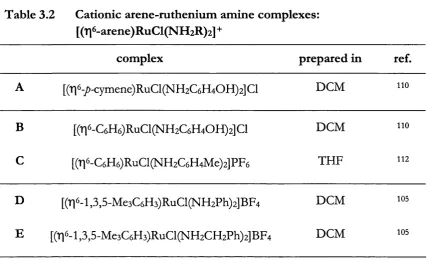
Table 3.2 Cationic arene-ruthenium amine complexes: [(T|"^-arene)RuCl(NH2R) j^ 71
Table 3.3 “RhCl(ri^-C5Me5)” complexes with aromatic amines 74
Table 3.4 Complexes of "(T|^-C5Mes)Rh" with hydrazines 75
Table 3.5 NM R data obtained on dissolution of [{Ru(Tl^:r|^-C,oHi6)Cl(|X-Cl)}2] in
CDCI3 at 298 K 78
Table 3.6 Adducts of “Ru(r|^:T|^-CioHi6)” with aromatic primary amines 81
Table 3.7 Selected bond lengths
[A]
and angles [°] for [(T|^-^-cymene)RuCl2(hmt)] 8 8 Table 3.8 Crystallographic data for [(ll^:/)-cymene)RuCl2(hmt)] .CH2CI2 99 Table 3.9 Atomic coordinates (x 10'') and equivalent isotropic displacementparameters (Ax 1 0^ for [(T|'^;/)-cymene)RuCl2(hmt)].CH2CI2 1 0 0
Table 3.10 Bond lengths
[A]
and angles [°] for [(T|'^:/)-cymene)RuCl2(hmt)] .CH2CI2 1 0 1 Table 4.1 Selected bond lengths[A]
and angles [°] for /ra«j-[Pd(hmt)2Cl2] 106 Table 4.2 Selected bond lengths[A]
for a range of dichloropalladium complexes withtertiary amine ligands 108
Table 4.3 Selected bond lengths
[A]
and angles[°] for [PdCl(r|^-C4H7)(hmt)] 118 Table 4.4 Selected bond lengths[A]
for a range of Tj^-allylpalladium complexes, Hatoms on aUyl ligand omitted for clarity. 1 2 0
Table 4.5 Selected bond lengths
[A]
and angles[°] for [Pd2Cl2(T|^-C4H7)2(ll-hmt)] 124 Table 4.6 Selected activation parameters for ligand exchange of nitrogen donorligands on aUylpaUadium complexes 134
Table 4.7 Crystal data and structure refinement for [Pd(hmt)2Cl2], (44) 142 Table 4.8 Atomic coordinates ( x 10'') and equivalent isotropic displacement
parameters (A^ x 10^ for [Pd(hmt)2Cy, (44) 143
Table 4.11 Atomic coordinates ( x lO'^) and equivalent isotropic displacement
parameters (Â^ x 10^ for [PdCl(T|^-C^Hy) (bmt)], (46) 146
Table 4.12 Bond lengths
[A]
and angles [°] for [PdCl('q^-C^H7) (hmt)], (46) 147 Table 4.13 Crystal data and structure refinement for [Pd2Cl2(T|^-C^Hy)2(|A-hmt)], (47)148
Table 4.14 Atomic coordinates ( x lO'* ) and equivalent isotropic displacement
parameters (A^ x 10^ for[Pd2Cl2(Tl^-C4H7)2(fl-hmt)], (47) 149
Table 4.15 Bond lengths
[A]
and angles [°] for [Pd2Cl2(Tl^-C4H7)2(|X-hmt)], (47) 150 Table 5.1 Overlaps of d-orbitals and their resulting molecular orbitals 154A bbreviations
BOC /^^-butoxycarbonyl
Cp* pentamethylcyclopentadienyl
Ô chemical shift/ppm
d doublet
DCM dichloromethane
DMSO dimethylsulfoxide
Epa anodic peak potential
Epc cathodic peak potential
E i/ 2 half-wave potential
E t ethyl
hmt hexamethylenetetramine
HMX l,3,5,7-tetranitro-l,3,5,7-tetraazacyclooctane
Ip a anodic current Ip c cathodic current
IR infrared
^Pr isopropyl
Me methyl
NMR nuclear magnetic resonance
y?-cymene 1 -methyl-4-isopropylbenzene
q quartet
R organic substituent
RDX cyclo-1,3,5-trimethylene-2,4,6-trinitramine
s singlet
sar sarcophagine, 3,6,10,13,16,19-hexaazabicyclo[6.6.6]eicosane
sep sepulchrate, 1,3,6,8,10,13,16,19-octaazabicyclo [6.6.6]eicosane
sept septet
TATD 1,3,6,8-tetraazatricyclo[4.4.1.1 -dodecane
TBABF4 tetrabutylammonium tetrafluoroborate
^Bu tertiary butyl
THE tetrahydrofuran
A cknow ledgem ents
appreciation recognition gratitude gratefulness thanks
During the time spent carrying out the research for this Ph.D. thesis I have made
many friends and received assistance from a number of people. First, of course
thanks goes to my supervisor, Dr. Derek Tocher, who has been a great source of
ideas, enthusiasm and encouragement. I am also very grateful to Professor Tony
Deeming for his interesting and helpful discussions and for assistance with
gNMR. Input of ideas from Dr. Rob Claridge (QinetiQ) is also greatly
appreciated. Members of the UCL chemistry department who deserve particular
mention are Dr. Abil Aliev and Professor Edgar Anderson for help with NMR
experiments and interpretation. Dr. Darren Caruana for assistance with
electrochemical experiments and Mr Phil Hayes for loans o f chemicals,
equipment and help with instrumentation. Thanks also to Dr. Jon Steed (Kings
College) who performed some of the single crystal structure determinations.
Funding from the EPSRC and QinetiQ (formerly DERA) is gratefully
acknowledged.
Special thanks goes to Abul Ali, Caroline Forth and Sarah Brown, fellow
members o f the lab that time forgot, for making 301M a good, if slightly mad,
place to work. Thanks also to all members of lab 301, past and present, for being
good friends and helpful chemists. Thank you to my organic consultant, Kason
Bala, and major thanks to Mark Field for being a great friend, as well as a
computer genius.
Warmest thanks to my parents and all of my family, for their love and
encouragement.
Chapter One
Chapter One: Introduction
1.1 B ackground
The research described in this thesis derives from interest in caged nitrogen
compounds as both precursors to energetic materials and versatile ligands in
organometallic and coordination chemistry. The caged compound
hexamethylenetetramine has been the main focus of this work. First, the
synthesis of hexamethylenetetramine has been used as a starting point for efforts
to prepare new nitrogen cage compounds using metal template synthesis as
described in Chapter Two. Secondly, the suitability o f hexamethylenetetramine as
a ligand in organometallic and coordination compounds has been investigated
and a range of adducts have been prepared. The structure, solution dynamics
and redox properties of these adducts are described in Chapters Three, Four and
Five. Thus, the remainder o f this introductory chapter presents the synthesis and
general chemistry of hexamethylenetetramine, followed by a brief survey of
metallo-hexamethylenetetramine complexes and a description of how the
compound is used as a precursor to energetic materials.
1.2 H exam ethylenetetram ine, an introduction
1.2.1 Synthesis and general chemistry o f hexamethylenetetramine
Hexamethylenetetramine, l,3,5,7-tetraazatricyclo-(3.3.1.P’^-decane (1) was first
synthesised in 1859^ and has been widely studied, as described in a number of
reviews.^' ^ Hexamethylenetetramine is also known as hexamine, aminoform,
formin, urotropine or methenamine and is abbreviated to hmt in this thesis.
Chapter One: Introduction
Hexamethylenetetramine is commonly prepared via the condensation reaction of
stoichiometric amounts of aqueous formaldehyde and ammonia, Equation 1.1/
6 C H 2 O (aq) + 4 N H 3 (aq) “ > C 6 H 1 2 N 4 (aq) + 6 H 2 O (1) E q u a t i O H 1.1
In order to precipitate the product from aqueous solution, excess ammonia may
be added, alternatively evaporation of the water on a steam bath yields the crude
product The colourless solid, which may be recrystallised from ethanol, does
not melt but sublimes at 280 °C, with slight decomposition/
Hexamethylenetetramine is readily soluble in water, with solubility decreasing
with increasing water temperature a phenomenon attributed to decreasing
association of the amine with water at higher temperatures/
The wide-ranging chemistry of hexamethylenetetramine is a consequence of its
‘dual-nature’. For instance, hexamethylenetetramine acts as a tertiary amine when
forming salts and complexes analogous to those seen for pyridine. However, the
use of hexamethylenetetramine as a source of anhydrous formaldehyde is also
reported.^ This latter property leads to the use of hexamethylenetetramine in the
manufacture of synthetic resins, for example in the final hardening of
phenol-formaldehyde resins where liberation of water would lead to bubble
formation.^
In addition to its use in the resin industry, hexamethylenetetramine is widely used
for medical purposes as a urinary antiseptic.*^ The commercial use of
hexamethylenetetramine of most relevance to this research is its application in
the synthesis of energetic materials, which is discussed in section 1.2.4.
1.2.2 The solid-state structure of hexamethylenetetramine
Hexamethylenetetramine crystallises as rhombic dodecahedrons and belongs to
the cubic spacegroup Msm, which utilises the full tetrahedral symmetry of the
Chapter One: Introduction
hexamethylenetetramine was first determined in 1923, and in fact was the first
analysis o f the structure of an organic molecule.^ This work reports the use of
spectral and Laue photographs to deduce the structure, with all carbon and all
nitrogen atoms equivalent, and confirms (1) as the solid state structure of
hexamethylenetetramine, reporting a C-N bond length o f 1.44
A.
Although thisstructure had been proposed previously,^ it was one of a number of potential
candidates, some of which are illustrated in Figure 1.1.
CH2N=CH2 I I /CHg .CH2 CH2
/ /CH2 / \ / \ / \
N ;— C H 2N = C H 2 N / N N " ... - N
C H 2 N = C H 2 I I C H 2 C H 2 C H 2
Figure 1.1 Structures for hexamethylenetetramine as suggested by
L o s e k a n n ,v a n ’t Hoffi^ and D o m i n i k i e w i c z ^ 2
Since the first structural determination there have been numerous reports of
structure determinations o f hexamethylenetetramine under various conditions.
These include investigations of hexamethylenetetramine in the gas phase,^^
neutron diffraction studies^"^»^^ and the collection o f X-ray data at
low-temperature.^' An accurate determination of atomic parameters of
hexamethylenetetramine using X-ray data collected at 120 K reported a C-N
bond length of 1.469(2)
A,
with angles for C-N-C and N-C-N of 107.88(9) °and112.58(8) °, respectively.^*^
Quaternisation of one o f the nitrogen atoms o f hexamethylenetetramine
significantly affects its tetrahedral geometry, as illustrated in Figure 1.2. The
quaternary nitrogen-carbon bonds become longer relative to the C-N length in
the unsubstituted hexamethylenetetramine. The C-N bonds making up the
six-membered ring in the basal plane of the molecule remain the same and the C-
N bonds linking this ring and the ‘cap" of the molecule are shortened. This
phenomenon has been illustrated using crystallographic studies of the
protonated,^^ methylated,^^ AT-oxide^^, borine adducts^o and metal coordinated^^
Chapter One: Introduction
decreases in the order méthylation > borine adduct formation = N — oxide
formation = protonation > metal coordination.^^
L = H, CH3, BH3, O, Mo(CO )5
Figure 1.2 Representation of bond length distortion in substituted
hexamethylenetetramine, the molecule now has Csv symmetry.
1.2.3 The formation o f hexamethylenetetramine from formaldehyde
and ammonia
The mechanism of formation o f hexamethylenetetramine from formaldehyde and
ammonia has been of interest for many years. An investigation in 1895 by
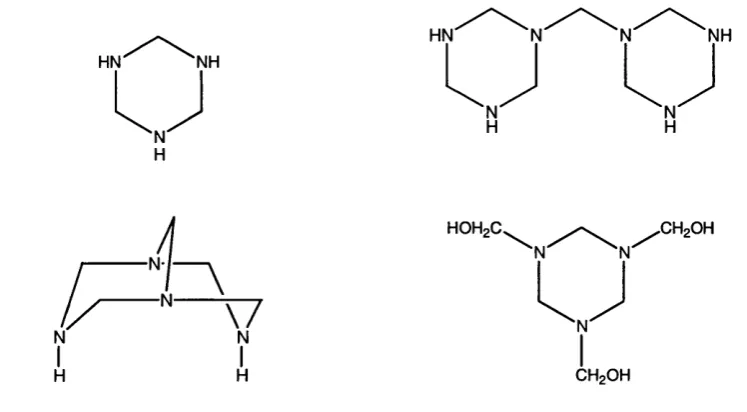
Duden and Scharff^ assigned cyclotrimethylenetriamine (1,3,5-hexahydrotriazine)
(3) as a reaction intermediate and postulated the mechanism illustrated in
Scheme 1.1. This mechanism suggests that an initial condensation of
formaldehyde and ammonia yields aminomethanol (2), which then trimerises to
cyclotrimethylenetriamine. Subsequent methylolation of
cyclotrimethylenetriamine produces trimethylolcyclotrimethylenetriamine (4),
3 CHgO + 3 NH3
Chapter One: Introduction
NHc
HO
H
(2)
Step 1
NHc
HO
H
-3 H2O
H N ‘
H
(3)
‘NH
Step 2
H N ‘ ‘NH
3 CH2O
HOH 2CN NCH2OH
N CH2OH
(4)
steps
HOH2CN NC H 2O H
‘N CH2OH
NHc
-3 H2O
Step 4
Scheme 1.1 Proposed mechanism for hexamethylenetetramine formation
In 1948, Richmond et al?'^ re-examined the formaldehyde-ammonia system
producing results in agreement with Duden and Scharff. Both groups obtained
evidence for the presence of (3) as an intermediate by comparing aqueous
hexamethylenetetramine solutions with freshly prepared formaldehyde/ammonia
solutions. In these freshly prepared solutions an aqueous solution of ammonium
chloride with an excess o f sodium hydroxide served as the ammonia source; the
resulting excess of sodium hydroxide raised the pH o f the soluiton to 12.2 where
hexamethylenetetramine formation is quite slow, thus allowing observation of
intermediates. The researchers found that when treated with benzoyl chloride
Chapter One: Introduction
(5), whereas the formaldehyde/ammonia solution gave l,3,5-tribenzoyl-l,3,5-
triazacyclohexane (6) with only a trace of (5).
O
P h ' 'NH HN'
(5)
o
Ph P h '
P h / ^ 0
(6)
Ph
In addition, Richmond et al investigated the first step of the reaction mechanism,
by studying the changing pH of a solution of ammonia and formaldehyde at 0 °C.
The pH of the initial water-ammonia solution was recorded as 12.5; the reading
of 11.0 immediately after formaldehyde addition indicates reaction o f the
majority of the ammonia present in the solution. Reaction of
dimethylolnitramide with a formaldehyde/ammonia solution may be used as a
test for the completion o f the reaction to form hexamethylenetetramine. This is
because a fresh formaldehyde-ammonia solution gives l,5-endomethylene-3,7-
dinitro-1,3,5,7-tetraazacyclooctane (DPT), (7) when reacted with benzoyl
chloride, but a solution containing only hexamethylenetetramine does not. Thus,
using the synthesis of D PT as a guide, the researchers concluded that conversion
to hexamethylenetetramine was not complete. In addition, the pH of a solution
of hexamethylenetetramine at the same concentration is ca. 7.2, a value not
reached by the test solution until 274 minutes after formaldehyde addition.
These results indicate that during mixing of formaldehyde and ammonia a fast
reaction occurs, producing cyclotrimethylenetriamine (1,3,5-triazinane) (3). It
was then proposed that the remaining formaldehyde reacts more slowly to yield
trimethylolcyclotrimethylenetriamine (1,3,5-triazinane-l ,3,5-triyltrimethanol) (4),
which reacts in a final step with the remaining ammonia to give
Chapter One: Introduction
O cN N
(7)
The theory that trimethylolcyclotrimethylenetriamine is a reaction intermediate is
not supported by more recent studies using NMR spectroscopy.^^ These
investigations by Nielsen and co-workers agree with earlier studies that
cyclotrimethylenetriamine forms rapidly upon mixing formaldehyde and
ammonia, and is ultimately the principal species present in solution other than
hexamethylenetetramine, but NMR evidence indicates the presence of other
significant reaction intermediates.^^
Both and NMR were used to investigate the species present at various
times in D2O solutions of ammonium-^ hydroxide and formaldehyde at 25°C.
Altering the molar ratio of formaldehyde;ammonia (from 3:2 to 1:4) had no
effect on the products formed, although the relative distribution of the products
at a given time had changed slightly. The NMR spectra show formation of
hexamethylenetetramine and cyclotrimethylenetriamine, and indicate the presence
of additional reaction intermediates. The resonance o f the methylene protons of
hexamethylenetetramine are observed at 4.75 ppm. The remaining methylene
signals are grouped in two principal regions: sharp signals at 3.5-4.0 ppm,
assigned as NCH2N-type methylenes, and broad signals at ca. 4.5 ppm attributed
to NCHfO-type methylenes. O f these a sharp singlet at 3.95 ppm is assigned to
cyclotrimethylenetriamine, and a collapsed AB quartet at 3.86 ppm and a singlet
at 3.81 ppm are attributed to 1,3,5,7-tetraazabicyclo[3.3.l]nonane (8). The broad
signals at 4.5 ppm, which disappear more rapidly over time than those of
cyclotrimethylenetriamine and 1,3,5,7-tetraazabicyclo [3.3. l]nonane, are attributed
to N-methylol-0-<7 derivatives.
The remaining NMR signals are attributed to intermediates present in much
Chapter One: Introduction
(8)
The NMR spectra were in agreement with the assignments made using the
NMR spectra. In addition two sets of signals were observed that decreased in
intensity with time. These signals of relative intensity 4:2:1 and 2:2:1:1, were
postulated to arise from the compounds (9) and (10).
(9)
HN \c H 2 N H 2
(10)
Using this NMR evidence a much more detailed mechanism for
hexamethylenetetramine formation from formaldehyde and ammonia, was
Chapter One: Introduction
- HgO NH3 - H2O NH3
CH2(0H)2 , CH2O HOCH2NH2 - , --- CH2=NH , CH2(NH2)2
(1)
CH2O CH2NH
HOCH2NHCH2OH HOCH2NHCH2NH2 (5) CH2NH
HOCH2NHCH2NHCH2NH2
(7)
(8) CH2NH
H2NCH2NHCH2NH2
(9) CHgNH
H2NCH2NHCH2NHCH2NH2
(10) NH3
HN' •NCH2NH2 HN'
(13)
N
CH2NH2
NH3
i A \ i
CH2NH
(1 2 )
NCH2NH2 HN' NH
CH2NH
/ I
CH2NH
(11)
- NHa
(14) N N
I I
CH2NH2 CH2NH2
(15)
Scheme 1.2 A simplified mechanism for the formation of
hexamethylenetetramine from formaldehyde and ammonia.
The kinetics of the formaldehyde — ammonia reaction have been investigated by
a number of r e s e a r c h e r s . 24-29 The reaction was found to be first order with
respect to ammonia and second order with respect to formaldehyde. Naturally,
these studies consider the various mechanisms of hexamethylenetetramine
formation, in particular the rate-determining step, which is assigned as the
reaction of formaldehyde and aminomethanol to form iminodimethanol. ^5,27,29,
This step was noted as significant in the publications of the three groups
discussed previously and is illustrated in Scheme 1.1, step two and Scheme 1.2,
step three. The kinetic studies, all published prior to the NMR studies o f Nielsen
Chapter One: Introduction
hexamethylenetetramine, via intermediates including cyclotrimethylenetriamine
and 1,3,5,7-tetraazacyclooctane.2'7
Evidently, the reaction of formaldehyde and ammonia is a complex one affected
by factors such as concentration of reactants, temperature and pH. NMR
spectroscopy has been useful in identifying reaction intermediates, but the major
product isolated from the reaction is always hexamethylenetetramine.
1.2.4 Selected reactions of hexam ethylenetetram ine
Hexamethylenetetramine has an extensive chemistry, acting both as a source of
formaldehyde and as a tertiary amine. The hydrolysis of hexamethylenetetramine
occurs via reaction with strong acids in aqueous solution. Indeed, the reaction of
hexamethylenetetramine with sulphuric acid has been used as a quantitative
analysis for hexamethylenetetramine.^® Hexamethylenetetramine is also used as a
reagent in three well-known organic preparations illustrated in Scheme 1.3.^^
The Delépine reaction involves the conversion o f alkyl halides into primary
amines under strongly acidic conditions.^^ Reaction of hexamethylenetetramine
with benzylic halides in aqueous acetic acid gives the benzylic aldehyde, this is
known as the Sommelet reaction.^^ The D uff reaction uses
hexamethylenetetramine as a reagent to introduce a formyl group onto a phenol
Chapter One: Introduction
r;
\
CH-/
C6H12N4
EtOH / CONC. HCI
\
R"
/
CH NHg D elépine
Ar
\
CH X
/
CeHi2N^
CH3COOH (aq)
)
:0 Som m elet
HX, HqC CHO
C6H12N4
CH3COOH glacial
D uff
Scheme 1.3 General exam ples of the D elépine, Som m elet and D uff reactions
O f particular relevance to the research discussed in Chapter Two of this thesis is
the fact that hexamethylenetetramine can act as a precursor to energetic
materials, Scheme 1.4. The nitrosation of hexamethylenetetramine is performed
by addition of dilute HCI and sodium nitrite to an aqueous solution of
hexamethylenetetramine, which produces trimethylenetrinitrosamine (12) or
dinitrosopentamethylenetetramine (14), depending on the pH o f the soludon.^^
Compound (12) the sole product at pH 1-2 is a powerful explosive.^^ When
hexamethylenetetramine is treated with hydrogen peroxide, in the presence of
excess acid, hexamethylenetriperoxidediamine is produced.^^ This material is a
primary explosive detonating violendy when the dry material is subject to
mechanical shock. The nitration of hexamethylenetetramine produces the
nitramines RDX, (11) (cyclo-l,3,5-trimethylene-2,4,6-trinitramine, cyclonite) and
HMX, (13) (1,3,5,7-tetranitro-l ,3,5,7-tetraazacyclooctane, octogen) depending
upon the nitration c o n d itio n s .B o th RDX and HMX have been utilised by the
Chapter One: Introduction
O2NN
N + 6 H2C = N H
'NNOo
3 H2O2 aq. (30 %)
(a) ‘N NO2 (11) HNO, (b) N HNO, .N OpNN
X
-NNOp^ \ ^ p H = 3-4
(CH3C0)20 HNO2
NH4N0 3
NNO
50%
NNOp
\
/
O2NN----^
(13)
Scheme 1.4 Reactions of hexamethylenetetramine yielding energetic materials; (a) reaction with hydrogen peroxide;^^ (b) nitration;^*^ (c) nitrosation^^
NNO 75 %
ONN
(14)
L 3 Interactions o f hexam ethylenetetram ine with m etals
In addition to the organic chemistry discussed in section 1.2.4, coordination
compounds of hexamethylenetetramine with transition metals are also known.
The majority of reports published to date involve the synthesis of coordination
polymers from solutions of hexamethylenetetramine and simple metal salts. In
these compounds hexamethylenetetramine has been observed to act in bidentate,
tridentate and tetradentate fashions. The variation in the resulting polymeric
networks {i.e. two or three dimensional with different cavity types) is a
consequence of the pH of the reaction solution, molar ratio of reactants and the
Chapter One: Introduction
Figure 1.3 depicts a coordination polymer in which hexamethylenetetramine acts
as a bidentate ligand. The polymer [(Cul)2hmt] is obtained via addition of
hexamethylenetetramine to a solution of Cul in acetonitrile.^^ As shown in the
figure there are alternating bridges o f iodide ions and hexamethylenetetramine
ligands linking pairs of copper ions, resulting in the formation of a
two-dimensional sheet structure.
, C u N
-Cu^ ^ C u NL Cü^ ^ Ç u --- n1
,N
,N C u , C u nJ n
Figure 1.3 Coordination polymer o f Cul and hexamethylenetetramine
Hexamethylenetetramine also acts as a bidentate ligand in the three-dimensional
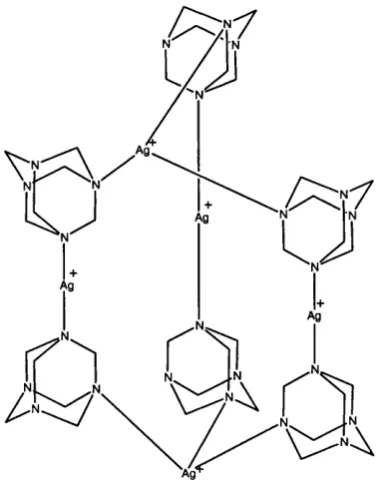
complex polymer produced upon diffusion of an ethanolic solution of AgPFô
into a chloroform solution of hexamethylenetetramine Figure 1.4.^^
A
O x
Chapter One: Introduction
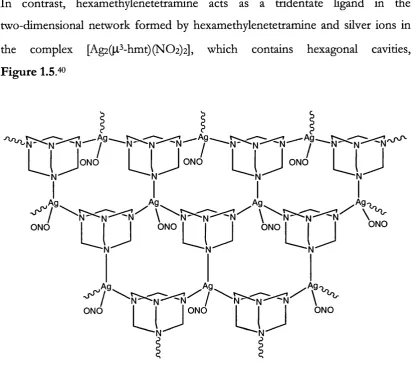
In contrast, hexamethylenetetramine acts as a tridentate ligand in the
two-dimensional network formed by hexamethylenetetramine and silver ions in
the complex [Ag2(|l^-hmt) (N 0 2)2], which contains hexagonal cavities,
Figure 1.5/^
N "N
ONO ONO
Figure 1.5 A section of an infinite 2-D layer found in [Ag2(ji^-hmt) (N O2)] n
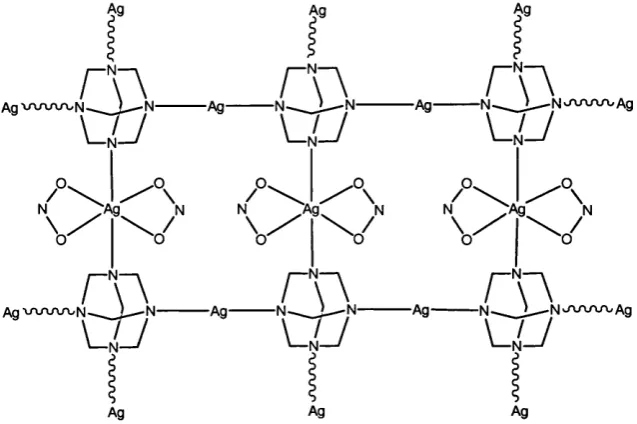
An example of the tetradentate coordination of hexamethylenetetramine is
observed in the two-dimensional coordination polymer [Ag2(|I'^-hmt)(N0 2)2]n.
This compound, synthesised by reaction of AgN02 and hexamethylenetetramine
in an acetonitrile-water mixture, exhibits a structure where the four nitrogen
atoms of each hexamethylenetetramine molecule are coordinated to a different
silver atom. Thus, a two-dimensional network with square cavities is formed.
Figure 1.6.^^ The complex contains silver atoms in two different geometries; the
geometry around one type of silver atom is linear with coordination by two
nitrogen atoms each from a hexamethylenetetramine molecule. The other silver
atom is in a triangular prism geometry coordinated by two nitrogen atoms and
Chapter One: Introduction
molecules respectively. Three-dimensional polymeric structures containing
tetradentate hexamethylenetetramine are also known, for example in the
compound [Ags(p'^-hmt)2(H2O)2](SO4)(HSO4).2
Ag Ag Ag
r a
r \\
A g v x r u v v N - ^ . Î . ^ N
---Ag---M^ \ M
r a
r\"\
\ — M— / \ — N— '
r \\
U JN^AAAA^Ag
r\A
-Ag N^)^N'AAAA,Ag
V i J
Ag Ag Ag
Figure 1.6 A representation of the polymeric structure of
[Ag2(p^-hmt) (N 02)2] n.
The compounds discussed so far involve the low coordinate metals copper and
silver. Metals with potential for tetrahedral or octahedral coordination, however,
are of particular interest due to the new structural motifs that may arise in
products formed using polydentate ligands such as hexamethylenetetramine. In
order to investigate such possibilities, reactions using N i(II), Zn(II) and Co(II)
have been performed. Each experiment involved addition o f an aqueous
solution of hexamethylenetetramine to an aqueous solution o f NaNCS and either
M(N0 3)2.6H2 0 (M = Co"^2 or NE^) or ZnS0 4 .7H2 0 .'^ A crystalline product was
obtained in each case, after leaving the solutions to stand for several days.
Interestingly, only the nickel complex is polymeric, with each
hexamethylenetetramine molecule acting as a bidentate ligand to bridge two
nickel atoms and form a one-dimensional zigzag chain structure:
[Ni(p-hmt)(NCS)2(H20)2]n. Hexamethylenetetramine also acts as a bridging
Chapter One: Introduction
hexamethylenetetramine molecules acting as counter-cations. In the cobalt
compound [Co(NCS)2(hmt)2(H2 0)2] [Co(NCS)2(H2 0)4].H2 0,
hexamethylenetetramine acts as a monodentate ligand, with the ligands around
each cobalt atom having an octahedral arrangement. An analogous compound,
[Co(hmt)2(H2 0)4][Co(H2 0)6][S0 4]2.H2 0 has been prepared by evaporation of a
mixture of water, dioxane and acetone containing hexamethylenetetramine and
CoSO4.7H2O.45
Reports of the use of hexamethylenetetramine as a ligand in organometallic
complexes are not common, examples include the monomeric compound
[Mo(CO)5(hmt)]2i and a range of adducts of hexamethylenetetramine with
trimethylgaUium and trimethylaluminium.46 The T.l, 2:1, 3:1 and 4:1 adducts of
trimethylgallium and hexamethylenetetramine and the 3:1 and 2:1 adducts of
trimethylaluminium and hexamethylenetetramine were obtained as colourless
needle crystals in near quantitative yield via addition of a stoichiometric quantity
of MesGa or MesAl to hexamethylenetetramine in toluene.46
In the complex [Cu2(02CCH3)4(hmt)]n, illustrated in Figure 1.7, the copper ions
are six coordinate and a chain polymer is formed, with hexamethylenetetramine
acting as a bridging ligand.47 The synthesis and redox properties of similar
dirhodium complexes are discussed in Chapter Five o f this thesis.
Cu ÇH
3
.Cu' .Cu'
Cu
Cu]
H3C
H3C
Chapter One: Introduction
1,4 N itrogen rich cages as precursors to energetic m aterials
Energetic materials may be classified according to their performance and uses.
This classification scheme uses the descriptions primary explosive, (detonated
easily by heat or shock), secondary explosive, (cannot be detonated by heat or
shock) and propellant, (burns only, does not explode). All military explosives are
considered secondary explosives since they cannot be detonated readily by heat
or shock. In fact the shock from the detonation of a primary explosive is
necessary in order to initiate detonation of explosives such as RDX and HMX
(Scheme 1.4: (11) and (13) respectively). After this initiation the secondary
explosive completely dissociates into its more stable components. Some
secondary explosives have such large activation energies that they can actually be
set on fire without detonating.
An explosive must contain a fuel and an oxidiser. The energy released originates
from the oxidation of the fuel, thus ideally both oxidiser and fuel will be
contained in the same molecule. The basic carbon skeleton o f the molecule acts
as the fuel portion of the explosive. The oxidising component o f the explosive is
in the form of attached functional groups that contain oxygen atoms. Explosives
may also be classified as aliphatic or aromatic by reference to their carbon
skeleton. For example, RDX is an aliphatic energetic material with nitro groups
acting as oxidisers.
Efficient explosives are required to be dense materials with high detonation
velocities. Both RDX and HMX fulfil these criteria. Table 1.1.
Table 1.1 Selected properties of RDX and HMX.^^
D ensity/ g cm-^ Detonation Velocity/ m s-^ Melting Point/
RDX 1.82 87 5 0 2 0 4
Chapter One: Introduction
RDX and HMX have similar properties, which, as well as high density and
detonation velocity, include melting points that are close to their ignition
temperatures, therefore they cannot be melted safely. Due to its slightly higher
density and detonation velocity, HMX has the better explosive performance of
the two compounds. It has been shown that the detonation velocity at the
shockwave front is proportional to the square of the density of the energetic
material.49 Thus, in order to improve upon known explosives such as HMX and
RDX materials with greater densities must be produced.
There are various approaches to optimising structures in order to increase
density. As well as having high symmetry, and thus better crystal packing, the
molecule should have an optimum number of quaternary or tertiary carbon
atoms, tertiary nitrogen atoms and condensed rings. The observed increase in
density between the monocycles cyclobutane, (0.70 g cm~^), and cyclopentane,
(0.74 g cm~^) and their corresponding caged molecules, cubane, (1.28 g cm-^) and
dodecahedrane, (1.45 g cm~3) illustrates the comparatively high density of
polycylic caged m o l e c u l e s . J n fact, the highest density polycyclic molecules
are those with condensed polycyclic cages.
Consequently, a successful improvement upon the monocyclic nitramines RDX
and H M X may be approached by the synthesis of caged nitramine compounds.
Firsdy a caged amine with the desired parent structure and the desired number of
endocyclic amino groups would be synthesised. This molecule could then be
nitrated in order to produce a polycyclic caged structure with the general formula
(C H N N 0 2 )n.49
As is evident in the synthesis of RDX and HMX from hexamethylenetetramine,
nitrating a caged nitramine does not necessarily yield a caged product. This is
because the nitrogen atoms of the cage are situated at bridgeheads and nitration
at these nitrogen atoms breaks the cage structure, producing cyclic products.
Thus, it would be preferable to synthesise a polyaza caged ring system where the
Chapter One: Introduction
then be found to introduce nitro groups onto all of the endocyclic nitrogen
atoms of the cage. Unfortunately, the reaction conditions employed in current
nitration methods facilitate ring opening reactions, destroying the cage structure.
A useful goal in this area therefore, would be the development of new nitration
procedures which circumvent this problem.
Three target molecules calculated to have higher densities, and consequently
higher detonation velocities, than RDX and HMX are
hexanitrohexaazadamantane (15), hexanitrohexaazawurtzitane (16) and
hexanitrohexaazaisowurtzitane (17). These compounds have calculated densities
o f 2.1 g cm~^ and calculated detonation velocities o f around 9500 m s~^; a
significant improvement on those found for RDX and HMX.^^>
OpNN NNOr
OpN
O g N N ^ / ^ N N O g
OgN
(15)
OgNN^ / N . _NNOg
O g N N " ' N ' NN O g
NOg
(16)
O g N N / X N N O g
O gN N \ / NNOg
^
O gN N ^ NNOg
(17)
Recent papers describe the preparation of hexanitrohexaazaisowurtzitane (17) via
a three-step r e a c t i o n . S t e p one is the condensation o f benzylamine with
glyoxal, forming hexabenzylhexaazaisowurtzitane, (HBfW). It is thought that
glyoxal reacts with the amine to yield a dümine as an intermediate, the diimines
then polymerise ultimately producing the caged c o m p o u n d . T h i s may be
considered analogous to the reaction of ammonia and formaldehyde to form
hexamethylenetetramine. Catalytic hydrogenolysis followed by débenzylation of
HBIW, and subsequent nitrolysis produces hexanitrohexaazaisowurtzitane.^^
Subsequent tests on this compound have shown it to be the most energetic
compound yet k n o w n . H o w e v e r , of its four polymorphic forms only the
Chapter One: Introduction
workable insensitivity, with the other polymorphs having significantly reduced
performance.^^
1.5 Present Work
There are two major themes to the research discussed in this thesis. First, the use
of metal-mediated synthesis to produce caged nitrogen compounds and secondly
the use of hexamethylenetetramine as a ligand in organometallic/coordination
complexes. Chapter Two describes attempts to synthesise high-energy caged
nitrogen compounds, beginning with reactions of formaldehyde and ammonia in
the presence of a metal and concluding with investigations into the suitability of
some known polycyclic caged amine complexes as precursors toward nitrated
cage species. In Chapter Three, the synthesis and structure of some 1:1 and 1:2
adducts of hexamethylenetetramine with organometallic ruthenium and rhodium
complexes are described. Chapter Four discusses investigations into the solution
dynamics of adducts of hexamethylenetetramine with [Pd(T|^-C4H7)Cl2] using
variable temperature NMR spectroscopy. In Chapter Five the synthesis and
redox properties of adducts of hexamethylenetetramine with [Rh2(0 2CR)4] are
Chapter Two
Investigations into the
m etal-m ediated synthesis
o f caged nitrogen
Chapter Two: Investigations o f the metal-mediated ^nthesis of caged nitrogen compounds
2.1 Introduction
The work discussed in this chapter is in two parts. First, section 2.2 describes
efforts to synthesise new cage nitrogen compounds using the synthesis of
hexamethylenetetramine as a model. Within this section studies of the reaction
of formaldehyde and ammonia in the presence of a number of metal amine
complexes are described. Secondly, in section 2.3 investigations into the use of
some macrocylic metal amine complexes as precursors to high energy
compounds are discussed.
2.1.1 Metal-mediated condensation reactions
Template syntheses of cyclic and polycyclic amines are ubiquitous in inorganic
coordination c h e m i s t r y . N o attempt to cover the field is made here; instead a
few particularly relevant examples are discussed. A well-known route to the
synthesis of macrocyclic amines is via a Schiff base condensation reaction.
Equation 2.1. A classic example of this is illustrated in Scheme 2.1.
RR’C=0 + HzNR" RR’C=NR” + HgO Equation 2.1
,NH. *NH,
Ni2+
H2 H2
-N
■ / V
H2 H2
CH; CH
/ \
CH
Scheme 2.1 A macrocyclic complex formed via the Schiff base route
Often, metal-mediated condensations can be templated by a number o f different
metals, for example the macrocyclic complex illustrated in Figure 2.1 is
produced via reaction of ^fiacetylacetone-ethylenediirnine with
Chapter Two: Investigations o f the metal-mediated ^nthesis o f caged nitrogen compounds
M = F e (ll), C o (ll), C u (ll): X = Y =Cr o r X = H2O , Y = S 0 / “
Figure 2.1 Tetraaza macrocycle formed via metal-template synthesis
A wide range of non-Schiff base macrocyclic amines are also prepared using
metal template synthesis. An example is the aliphatic macrocycle formed from
the reaction of formaldehyde, ethylenediamine and methylamine in the presence
of the nickel(II) ion. Figure 2.2.^^
H3CN Ni 2+ NCH3
\ N
" W "
Figure 2.2 Hexaaza macrocycle formed from one-pot metal template
synthesis
Sargeson and co-workers have made great use o f the metal templadng effect in
their synthesis of cage complexes such as [Co(sep)]Cl3, (19) (sep = sepulchrate, l,3,6,8,10,13,16,19-octaazabicyclo[6.6.6]eicosane).^4 The synthesis of
[Co(sep)]Cl3 uses the synthesis of hexamethylenetetramine as a model, and
involves the reaction of [Co(en)3]^^, formaldehyde and ammonia. The proposed
Chapter Two: Investigations o f the metal-mediated ^nthesis of caged nitrogen compounds
-:NH,
'XT)]''
y â X '
H2 H2N H2
CH2 0
S tep 1
,0H
X.T>
H2 HoN H2
H,0 -H2 0
s t e p 2
N ^ A / ^ N -H2 H2N H2
■ M
H2 H2Ns t e p 6
(i) CH2O (ii) - H2O
CH,
y i X
-H2 H2N H2
s t e p 5
S te p 7
H2
N:>
\
/ hT h
Ih^HsO*
y i X
-H2 H2N
y i X
-H2 H2N H2
(i) CH2O (ii) - H2O « ---S te p 4
S te p 3
NH,
x p f
yH2 HoN H2
R ep ea t s t e p s 1-7
on o p p o site fa c e of co m p lex
y \
hN J / NfT
N
(18) (19)
Scheme 2.2 Proposed mechanism for synthesis o f [Co(sep)]
The first step in the mechanism involves condensation of formaldehyde with a
bound deprotonated amine to yield the coordinated carbinolamine, the
elimination o f water then produces the imine.^"^ The imine is subsequently
attacked by ammonia yielding the ^gw-diamine. Intramolecular condensation of
Chapter Two: Investigations o f the metal-mediated ^nthesis of caged nitrogen compounds
rings. Formation of another imine followed by intramolecular condensation with
the secondary amine of the previously formed six-membered ring produces the
completed cap (step five). Repetition of this process on the opposite face o f the
octahedral complex affords the completely encapsulated metal ion (19).
Evidence for this route has been obtained by isolation o f reaction intermediates
such as the ‘semi-sepulchrate’ (18).^"^ In order to produce the compound in large
yields from this one-pot procedure, a continuous supply and excess o f both
formaldehyde and ammonia are required.
In addition to cobalt, other metals including rhodium, iridium and platinum have
been encapsulated in the sepulchrate cryptand using the above method.*^^»
However, the major product isolated from the reaction of ethylenediamine,
ammonia and formaldehyde in the presence of nickel (II) chloride is
[Ni(2 0)][C1 0 4]2, and the secondary product is [Ni(21)] [C1 0 4]2, where (21) is the
semi-sepulchrate ligand.<^^ Deliberate synthesis of [Ni(2 1)][C1 0 4 ] 2 has been
achieved in 70 % y i e l d . T h e synthesis o f [Ni(sep)][C1 0 4 ] 2 has been achieved,
but yields of this complex are less than 1
(20)
N N
^N H g HgN HgN
NH H N ^ N N
(21)
In order to encapsulate a larger range of metals within the sepulchrate cage
attempts have been made to decomplex the template cation and produce the free
ligand for reaction with other metal cations. However, the removal o f the
kinetically inert cobalt(III) ion from the caged complex proved unachievable,
even when reduced to Co(II), the cation could not be extracted from the
Chapter Two: Investigations o f the metal-mediated ^nthesis of caged nitrogen compounds
décomposition.^® An alternative strategy investigated for generation of a free
ligand of very similar structure was by removal of the cobalt ion from the
structurally related carbon-bridgehead sarcophagine complexes [Co(sar)]Cl3 (25)
(sar = sarcophagine, 3,6,10,13,16,19-hexaazabicyclo[6.6.6]eicosane) and
[Co{(NH3)2sar}]Cl4, (23) ({(NH3)2sar} = 1,8-diamino-sar). These complexes are
derivatives of [Co {(N02)2sar}] CI3 (22) which is prepared by reaction of
[Co(en)3]Cl3 with nitromethane and formaldehyde. Scheme 2.3.’^^
The complexes [Co{(NH3)2sar}]Cl5 and [Co(sar)]Cl3 generated in this way may be
used as sources of the free ligands, (NH2)sar and sar, by reduction to their Co(II)
forms followed by reaction in concentrated acids at elevated temperatures or
reaction in hot aqueous solutions containing an excess of cyanide ion.^^ Direct
reaction of the protonated ligands with aqueous solutions o f metal salts allowed
complexation of kinetically labile c a t i o n s . ^ ^ Using this method sarcophagine and
diaminosarcophagine complexes of numerous metal ions have been synthesised,
including chromium (III) manganese (II) and manganese (III) vanadium (TV)
and nickel(II) complexes.^®
A number of substituents can be introduced at the apical position o f the cage to
form ligands with - N O , N(CH3)3+, - O H , C O O R , N H C O C H 3, - C N , -C O N H 2
or CH2OH groups in the capping p o s i t i o n s . A s a consequence a wide range
Chapter T m : Investigations o f the metal-mediated synthesis of caged nitrogen compounds
Hg HgN Hg
NO;
3+
HN
.C6
HN
3+
+ NH,
(22)
2+
Zn / HCI
►
Ni/AI
OH'
HNO.
■^NHg
(23)
cr
Cl 3+
< lX r
H Cl
(25) (24)
Chapter T m : Investigations of the metal-mediated gpnthesis of caged nitrogen compounds
2.2 R eactions o f form aldehyde with m eta l am ine com plexes
The reaction of ammonia with formaldehyde to form hexamethylenetetramine
has been extensively studied, as described in Chapter One. However, whether
this reaction is influenced by the presence of other species is not well studied.
Indeed, the presence of metal ions in the reaction mixture might lead to the
synthesis of nitrogen cages other than hexamethylenetetramine. Hence an aim of
this research was to study the affect of metal ions on the reaction between
formaldehyde and ammonia. Section 2.2.1 describes the reactions of a number
o f metal amine complexes with formaldehyde under analogous conditions to
those used for the synthesis of hexamethylenetetramine. Although initial
investigations indicated that products other than hexamethylenetetramine were
formed, these were generally found in very small quantities and were extremely
difficult to separate or characterise reliably. Performing the reactions at elevated
temperatures served only to increase the number of products formed rather than
increase the yields of individual components. Consequently, it was proposed that
increasing reaction times while at ambient temperature might give favourable
results. However this proved not to be the case. The preparation of
hexamethylenetetramine is carried out in aqueous solution and it became
apparent that this reaction was dominating the chemistry despite the presence of
the metal ion. Therefore, it was decided to investigate reactions of metal
complexes with formaldehyde under anhydrous conditions, these studies are
described in sections 2.2.2 and 2.2.3.
2.2.1 Reactions of metal amine complexes and formaldehyde in
aqueous solution
The reaction of the metal amine complexes />^x'^?/é/j(amino)nickel(II)bromide,
^^x/2/é/j(amino)cobalt(III)chloride and tetrakis{2im[no) ^/j*(aquo) copper(II)chloride
with formaldehyde were investigated. Equation 2.2 and Equation 2.3. The

![Table 3.6 Adducts of "Ru(T]^:Tl^-CioHi6)" with aromatic primary](https://thumb-us.123doks.com/thumbv2/123dok_us/8288273.1377287/82.595.47.488.84.520/table-adducts-ru-t-tl-ciohi-aromatic-primary.webp)
![Figure 3.4 NMR spectrum of [(Tl^-/>-cymene)RuCl2(hmt)] at 298 K](https://thumb-us.123doks.com/thumbv2/123dok_us/8288273.1377287/84.595.56.500.103.348/figure-nmr-spectrum-tl-cymene-rucl-hmt-k.webp)

![Figure 3.6 NMR spectra of [(Ti^-/>cymene)RuCl2(hmt)], 211 — 298 K,](https://thumb-us.123doks.com/thumbv2/123dok_us/8288273.1377287/86.595.54.443.52.737/figure-nmr-spectra-ti-cymene-rucl-hmt-k.webp)
