Integrated Blood Pressure Control
Dovepress
R E v I E w open access to scientific and medical research
Open Access Full Text Article
Combining antihypertensive and antihyperlipidemic
agents – optimizing cardiovascular risk factor
management
José Zamorano1
Jonathan Edwards2
1Hospital Clinico San Carlos,
Madrid, Spain; 2UBC Scientific
Solutions, 5 North Street, Horsham, west Sussex, UK
Correspondence: José Zamorano Hospital Clinico San Carlos, Plaza de Cristo Rey, 28040 Madrid, Spain Tel +34 91 5448940
Fax +34 91 5448940
Email [email protected]
Abstract: Clinical guidelines now recognize the importance of a multifactorial approach to
managing cardiovascular (CV) risk. This idea was taken a step further with the concept of the Polypill™. There are, however, considerable patent, pharmacokinetic, pharmacodynamic, registration, and cost implications that will need to be overcome before the Polypill™ or other single-pill combinations of CV medications become widely available. However, a medication targeting blood pressure (BP) and lipids provides much of the proposed benefits of the Polypill™. A single-pill combination of the antihypertensive amlodipine besylate and the lipid-lowering medication atorvastatin calcium (SPAA) is currently available in many parts of the world. This review describes the rationale for this combination therapy and the clinical trials that have demonstrated that these two agents can be combined without the loss of efficacy for either agent or an increase in the incidence of adverse events. The recently completed Cluster Randomized Usual Care vs Caduet Investigation Assessing Long-term-risk (CRUCIAL trial) is discussed in detail. CRUCIAL was a 12-month, international, multicenter, prospective, open-label, parallel design, cluster-randomized trial, which demonstrated that a proactive intervention strategy based on SPAA in addition to usual care (UC) had substantial benefits on estimated CV risk, BP, and lipids over continued UC alone. Adherence with antihypertensive and lipid-lowering therapies outside of the controlled environment of clinical trials is very low (∼30%–40% at 12 months). Observational studies have demonstrated that improving adherence to lipid-lowering and anti-hypertensive medications may reduce CV events. One means of improving adherence is the use of single-pill combinations. Real-world observational studies have demonstrated that patients are more adherent to SPAA than co-administered antihypertensive and lipid-lowering therapy, and this improved adherence translated to reduced CV events. Taken together, these findings suggest that SPAA can play an important role in helping physicians improve the management of CV risk in their patients.
Keywords: Polypill™, multifactorial management, cardiovascular risk, single-pill amlodipine atorvastatin, CRUCIAL study, adherence
Introduction
Cardiovascular disease (CVD) has a multifactorial nature with CV risk factors rarely occurring in isolation.1–3 Indeed, the combination of certain risk factors such as hyper-tension (HTN) and dyslipidemia (DYS) can act multiplicatively or synergistically to increase the risk of CVD events.4–6 This synergistic relationship is recognized by most of the major clinical guidelines used currently to aid the management of patients with symptomatic CVD or at risk of CVD, as they recommend a strategy of treating CVD risk factors simultaneously rather than in isolation.7–10 There is an ever-increasing body of evidence describing the advantages of a combined/multifactorial approach to
Integrated Blood Pressure Control downloaded from https://www.dovepress.com/ by 118.70.13.36 on 22-Aug-2020
For personal use only.
Number of times this article has been viewed
This article was published in the following Dove Press journal: Integrated Blood Pressure Control
Dovepress
Zamorano and Edwards
reducing CV risk vs the older sequential approach of treating risk factors individually.11–16
This multifactorial approach to CV risk reduction was taken a stage further by Wald and Law in 200313 with the suggestion that a combination pill containing a statin, three different antihypertensives (each at half of the standard dose), folic acid, and aspirin could reduce CVD risk by more than 80%. In the 8 years since this paper was pub-lished, various pilot studies and Phase II trials of other sin-gle-pill combinations of antihypertensives, lipid-lowering medications, and aspirin (eg, the Polycap, which contains low doses of thiazide, atenolol, ramipril, simvastatin, and aspirin) have been completed and published.17–19 While the results of some of these studies have been promising, such as the Phase II study of the Polycap,17 in other studies the estimated reductions in CVD risk with single-pill combina-tions of CV medicacombina-tions have not been as large as those originally estimated by Wald and Law.13,19 Furthermore, there are significant patent, potential pharmacokinetic, pharmacodynamic, registration, and cost implications that will need to be overcome before the PolypillTM 20 or other single-pill combinations of CV medications are approved for use by regulators and become available for general use.
A large proportion of the proposed CV benefits of the PolypillTM were achieved by targeting HTN and DYS; using the information published in Table 1 of the original Wald and Law paper,13 simple calculations demonstrate that the majority (90%) of the proposed 88% benefit of the PolypillTM on ischemic heart disease and 88% of the proposed 80% stroke benefit was due to the use of multiple antihyperten-sives at low doses and the low dose of a single lipid-lowering agent.13 A single-pill combination of the antihypertensive amlodipine besylate and the lipid-lowering agent atorvastatin calcium (single-pill amlodipine/atorvastatin [SPAA]), has been available in the USA since 2004 and in other parts of the world since 2005.
The remainder of this review will discuss the rationale for combining amlodipine and atorvastatin, and discusses the results of a wide array of preclinical, clinical, and real-world observational studies assessing the efficacy, safety, and utility of the SPAA combination. The Cluster Randomized Usual Care vs Caduet Investigation Assessing Long-term-risk (CRUCIAL trial) will be discussed in detail (Figure 1). This trial is the most recent and longest clinical study of SPAA.21 Earlier SPAA studies have been discussed in detail in earlier reviews,22–24 so they will not be detailed extensively in this paper. This review will instead focus on the CRUCIAL trial
and the recent health economic and outcomes research studies that were not covered in the earlier reviews.
Rationale for the combination
of amlodipine and atorvastatin
One of the driving forces for the development of the PolypillTM was the poor level of control of CV risk factors, despite the widespread availability of efficacious antihyper-tensive and lipid-lowering mediations.25–27 For example, The European Action on Secondary and Primary Prevention by Intervention to Reduce Events III (EUROASPIRE III) survey carried out in 2006–2007 across 22 countries in Europe26 showed that 56% of patients with symptomatic CVD were not reaching their assigned 2007 European Society of Cardiology (ESC) blood pressure (BP) targets9 and over half of patients remained above the recommended ESC lipid targets. The poor level of control of HTN and DYS highlights the need for new strategies to manage these (and other) risk factors thereby reducing the impact of CVD. A single-pill combina-tion of an antihypertensive and lipid-lowering medicacombina-tion may address some of the issues thought to hinder the manage-ment of CVD, such as poor adherence to multiple treatmanage-ments due to high pill burden and the reluctance of physicians to manage more than one CV risk factor simultaneously.
The agents used in a combination medication for the treatment of HTN and DYS should have proven efficacy and excellent tolerability profiles. The antihypertensive component(s) should also be free from drug–drug inter-actions with other BP-lowering medications due to the frequent need for multiple antihypertensives to achieve BP goals in certain difficult-to-treat populations, such as patients with diabetes. The antihypertensive amlo-dipine besylate fulfills these criteria in that it has been demonstrated to reduce CV events in different patient populations28–30 and is effective when combined with other classes of antihypertensive.31 Amlodipine besylate is a dihydropyridine calcium channel antagonist (calcium channel blocker [CCB]) that primarily inhibits calcium ion influx into cardiac and smooth muscle cells, resulting in peripheral arterial vasodilation and a reduction in BP.32 The lipid-lowering agent atorvastatin calcium has also been demonstrated to reduce CV events in a variety of different patient populations (including those with HTN and $3 additional CV risk factors).12,14,33 Atorvastatin is a selective inhibitor of HMG-CoA reductase, the enzyme that converts 3-hydroxy-3-methylglutaryl-coenzyme A to mevalonate, a precursor of cholesterol and lipoproteins, and thereby reduces the formation of lipids.34
Integrated Blood Pressure Control downloaded from https://www.dovepress.com/ by 118.70.13.36 on 22-Aug-2020
Dovepress Combining antihypertensive and antihyperlipidemic agents
Table 1
Retrospective assessment of differences in adherence to different combinations of antihypertensive and lipid-lowering therapies
Reference; database; study period; follow-up Study design: inclusion criteria; primary outcome assess Patient cohorts (N/n; male %; mean age %
$
65 years)
Principal findings at follow-up
Conclusion
Chapman et al 2005;
80
Protocare Sciences Managed Care Database; (1/1/97 to 1/30/01); 1 year Patients initiating both AH or LL within 90 days and a diagnosis of HTN Outcomes:
PDC for AH
and/or LL therapy Predictors of adherence (PDC
$
0.8) with AH and LL
N
=
8406
(53.1% male; 48.2%
$
65 yr)
Adherence declined with time (3 mo: 44.7%; 6 months: 35.9%; 12 months: 35.8% of patients) Patients were more likely to be adherent if they initiated AH and LL therapy within 0–30 days (OR: 1.34 ***), had history
of CHD (OR: 1.2
**) or
CHF (OR: 1.24
**) Adherence with concomitant AH and LL therapy is poor, as only 1 in 3 patients remain adherent with both medications at 6 months
Benner et al 2009;
81
Protocare Sciences Managed Care Database; (1/1/97 to 4/30/01); 1 year Patients initiating both AH or LL within 90 days and a diagnosis of HTN Outcomes:
Median PDC
Patients remaining adherent (PDC
$
0.8) with AH
+
LL
therapies
N
=
5759
(52.3% male; 50.0%
$
65 yr)
For 0, 1, 2 other prescriptions at baseline, median PDCs (AH
+
LL
therapy) were: 72.8%, 64.3%, and 57.7%. For 8, 9, and
$
10 medications,
PDCs were lower (44.6%, 49.5%,
and 40.7%) Adherence for 0, 1, 2 prescriptions was: 41%, 35%, 30%.
For
$
10 prior prescriptions,
∼
20% were adherent (PDC
$
0.8)
Adherence to AH and LL therapies became less likely as the number of prescription medications increased
Agarwal et al 2009;
82
Pharmetrics Patient-Centric Database; (1/1/01 to 12/31/04); 1 year
Aged
$
20 yr
Initiating AH and LL within 180 days diagnosis for HTN Outcomes:
MPR adherence
for AH and/or LL therapy Predictors of adherence (MPR
$
0.8)
N
=
15,400
(60.3% male; 3.8%
$
65 yr)
1. AH before LL (n
=
7099)
2. LL before AH (n
=
3229)
3. AH/LL simultaneous (n
=
5072)
Adherence declined with time in all cohorts Patients adherent (MPR
$
0.8)
with both AH/LL therapies at 6 months was: 32.7%, 30.8%, 34.4%, and at 12 months: 31.3%, 31.0%, 34.0% (AH first, LL first, AH/LL simultaneously) Patients prescribed AH/LL simultaneously were more likely to be adherent at 12 months than
AH first (OR: 0.84
***) or LL first
(OR: 0.69
***) After adjusting for potential confounders, synchronizing initiation of treatment with AH/LL therapies increases the likelihood of adherence vs initiating one in advance of the other
(
Continued
)
Integrated Blood Pressure Control downloaded from https://www.dovepress.com/ by 118.70.13.36 on 22-Aug-2020
Dovepress
Zamorano and Edwards
Table 1
(
Continued
)
Reference; database; study period; follow-up Study design: inclusion criteria; primary outcome assess Patient cohorts (N/n; male %; mean age %
$
65 years)
Principal findings at follow-up
Conclusion
Patel et al 2008;
85
MedImpact Healthcare systems (4/1/04 to 7/30/05); 180-days before and 1-year following index
Aged
$
18 yr New SPAA,
statin or CCB starter Outcomes:
PDC adherence
(PDC
$
0.8) for SPAA or
AH/LL therapy persistence (time to first 30-day gap in therapy)
N
=
4703 (48.4% male; 63.0 yr)
1. SPAA (n
= 795) 2. Amlo + atorva (n = 735) 3. Amlo +
other statin (n
=
1163)
4. Other CCB
+ atorva (n = 652) 5. Other CCB + other statin (n = 1358)
PDC was higher in SPAA (0.81)
***
vs other cohorts (0.72–0.64) over 6 months OR for achieving PDC
$
0
.8
w
ith
SPAA vs: amlo
+
atorva: 1.95***;
amlo
+
other statin: 3.10
***; o
th
er
CCB
+
atorva: 2.06; other
CCB
+
other statin: 2.85
***
Patients taking SPAA were more likely to be adherent and persistent with therapy compared with patients taking 2-pill CCBs and statins, over both 6 months and 1 year
Hussein et al 2010;
86
PharMetrics Patient-Centric Database; (7/1/04 to 8/31/05) 180 days and 1-year follow-up
Aged
$
18 yr
SPAA, statin or CCB claim Outcomes:
PDC
$
0.8 at
180 days in SPAA vs 2-pill-regimen Adherence (PDC) at 1-year
N
=
35,430
(45.4%–65.6% male; 50.5–56.9 yr) 4-cohorts based on prior CCB/ statin experience each spilt into 3 groups (SPAA Amlo
+
atorva)
other CCB
+
statin)
1. Naïve/naïve (n
=
3593)
2. Experienced/naïve (n
=
2162)
3. Naïve/experienced (n
=
4478)
4. Experienced/experienced (n =
25,197)
Adjusted OR for achieving adherence: SPAA vs 2-pill amlo
+
atorva (OR: 2.7
***) or
other 2-pill CCB
+
statin
regimens (OR: 3.3
***) over 1 year The magnitude of the adherence benefit of the single pill is influenced by patients’ prior experience with CCB and statin therapies
Chapman et al 2009;
87
PharMetrics Patient-Centric database; (7/1/04 to 6/30/07); 6 months
Aged
$
18 yr
Taking amlo with new SPAA or new statin claim diagnosis for HTN Outcomes:
Adherence (PDC) at
180-days follow-up persistence (time to first 30-day gap in therapy)
N
=
4556 (54% male; 53.9 yr)
1. SPAA switch
a (n
=
1139)
2. Statin add-on (n
=
3417)
Patients switched to SPAA had 1.64-times*** greater odds of achieving adherence to statin therapy vs add-on statin SPAA switch cohort were persistent with therapy for 127.6 days vs 116.9*** days for statin add-on
Patients pr escribed amlodipine , sw itc hi ng to S PA A h ad higher adher
ence and longer
pe rs ist en ce w ith s ta tin thera
py vs patients who had
se pa ra te a dd -o n st at in to th ei r antih yper tensiv e r egimen
Chapman et al 2010;
74
IMS LifeLink
b Managed Care;
(10/1/03 to 8/31/06); 18 months
Aged
$
18 yr
SPAA, statin, or CCB claim diagnosis for HTN Outcomes:
Rate of C
v
events
c and relationship to
PDC, at 6-month follow-up (adherence PDC
$ 0.8) N = 19,447 (52.6%
male; 53.5–54.8 yr)
1. SPAA (n
= 1537) 2. CCB + statin (n = 17,910)
SPAA patients more likely to be adherent vs CCB
+
statin
(OR: 4.7***) Remaining adherent to either regimen lowered risk of C
v
event (HR 0.77**) Not adjusting for adherence, Cv
events were lower for SPAA
vs CCB
+
statin (HR: 0.68*)
Improved adherence to AH
and LL therapies appears to
tr an sla te in to a lo w er in g of
risk for C
v events compared
with nonadherent patients
Notes: aPatients were matched (1 SPAA vs 3 statin add on) based on propensity score weighting bformerly called the PharMetrics Patient-Centric Database; cCV events were defined as hospitalization for myocardial infarction, heart failure, angina,
other ischemic heart disease, stroke, peripheral vascular disease, or C
v revascularization procedure; *
P # 0.05; ** P # 0.01; *** P # 0.001. Abbreviations: A H , a nt ih yp er te ns iv e; a m lo , a m lo di pi ne ; a to rv a, a to rv as ta tin ; C C B, c al ci um c ha nn el b lo ck er ; C H D , c or on ar y he ar t d ise as e; C H F, c on ge st iv e he ar t f ai lu re ; C v, c ar di ov as cu la r; H R, h az ar d ra tio ; H TN , h yp er te ns io n; L L, li pi d lo w er in g th er ap y; M PR , m ed ic at io n po ss es sio n ra tio [ to ta l d ay s su pp lie d ov er a 6 0-da y pe rio d/ nu m be r of d ay s] ; O R, o dd s ra tio ; P D C , p ro po rt io n of d ay s co ve re d [n um be r of d ay s co ve re d by d isp en se d m ed ic at io n di vi de d by t he n um be r of d ay s in t he
study year]; SPAA, single-pill amlodipine/atorvastatin.
Integrated Blood Pressure Control downloaded from https://www.dovepress.com/ by 118.70.13.36 on 22-Aug-2020
Primary efficacy assessment:
Framingham 10-year risk of total CHD at week 52 Secondary efficacy assessments:
Framingham 10-year risk of total CHD at week 16 SCORE 10-year risk of CV mortality at weeks 16 and 52
Framingham 10-year risk of fatal and non-fatal CVD at weeks 16 and 52 Framingham stroke risk at weeks 16 and 52
BP/LDL-C parameters:
Change from baseline at weeks 16 and 52 Percentage of patients at treatment goals
Concurrent antihypertensive/lipid-lowering medication use Safety and tolerability
Proactive intervention arm
(73 investigator sites, 779 patients)
Study drug dispensed
week 0
Inclusion
Cluster randomization (140 investigator sites)
Intervention
Outcomes
Moderate CV risk patient population:
- 35 to 79 years old
- Hypertensiona with ≥ 3 CV risk factors
- TC ≤ 6.5 mmol/L - No CHD
UC control arm
(67 investigator sites, 682 patients)
Study drug dispensed
week 4
Study drug dispensed
week 16
Study drug dispensed
week 32
Study drug dispensed
week 52
Continued UC
week 0 to 52
Figure 1 Design of the CRUCIAL trial.
Notes: aHypertension,untreated: SBP $ 160 and/or DBP $ 100 mmHg; treated: SBP $ 140 and/or DBP $ 90 mmHg or diabetes: SBP . 130 and/or DBP . 80 mmHg. Abbreviations: BP,blood pressure; CHD, congestive heart failure; Cv, cardiovascular; CvD, cardiovascular disease; DBP, diastolic blood pressure; LDL-C, low-density lipoprotein cholesterol; SCORE, Systematic COronary Risk Evaluation; SBP, systolic blood pressure; TC, total cholesterol; UC, usual care.
Dovepress Combining antihypertensive and antihyperlipidemic agents
There are a number of important requirements for therapies used in a combination medication, regardless of the condition being treated. Firstly, the medications must have a similar dosing regimen (eg, once- or twice-daily). Secondly, there should be no negative pharmacokinetic or pharmacodynamic interactions between the proposed components (eg, exacerba-tion of adverse events [AEs] or other drug–drug interacexacerba-tions).
Thirdly, from a patient’s perspective, the tablet should be of a reasonable size and the formulations should allow flexible dosing. The following section of this paper will review the evidence for whether or not the combination of amlodipine besylate and atorvastatin calcium fulfills these criteria.
Both amlodipine and atorvastatin can be administered once daily (they are effective for 24 hours) and food causes
Integrated Blood Pressure Control downloaded from https://www.dovepress.com/ by 118.70.13.36 on 22-Aug-2020
Dovepress
Zamorano and Edwards
no clinically meaningful variation in the bioavailability of either agent.35–37 The details of the pharmacokinetic proper-ties of amlodipine and atorvastatin as individual agents have been described in detail in earlier reviews22,23,32,34,38 and will therefore not be discussed in detail in this paper. Two studies examining the pharmacokinetic properties of co-administered amlodipine and atorvastatin have been published. The first of these studies demonstrated that amlodipine does not affect the pharmacokinetic properties of atorvastatin, and vice versa, under fasting conditions.39 The second of these studies dem-onstrated that the bioavailability of both agents is unchanged when they are administered with food.40 Therefore, the phar-macokinetic properties of amlodipine and atorvastatin are well suited and are not a barrier to combining these agents into a single pill.
Two randomized, placebo-controlled clinical trials were undertaken to assess whether amlodipine affects the lipid-lowering capacity of atorvastatin, and conversely to evaluate whether atorvastatin affects the BP-lowering efficacy of amlodipine, or if co-administration adversely affects the tolerability of either agent. The first of these studies, the Atorvastatin and Amlodipine in Patients with Elevated Lipids and Hypertension (AVALON) trial,41 conducted in 848 patients from the USA and Canada, demonstrated that amlodipine co-administration with atorvastatin did not affect the BP-lowering efficacy of amlodipine. Co-administration of amlodipine 5 mg and atorvastatin 10 mg, however, led to a significantly greater effect on low-density lipoprotein cholesterol (LDL-C), total cholesterol (TC), and apolipopro-tein B levels at week 8, compared with atorvastatin 10 mg alone. The AVALON study investigators mentioned that these observations were unexpected, and additional studies were needed to explore this further. The second of these two randomized, placebo-controlled clinical trials, Respond,42 was a larger trial than AVALON. Respond was conducted across a greater dose range for both amlodipine (placebo; amlodipine 5 mg and 10 mg) and atorvastatin (placebo; atorvastatin 10 mg, 20 mg, 40 mg, and 80 mg) than AVALON. In total, 1660 patients from 15 countries were enrolled. This study demonstrated that atorvastatin did not affect the BP-lowering efficacy of amlodipine and similarly amlodipine did not affect the LDL-C lowering capacity of atorvastatin. There was also no evidence of a higher incidence or exacerbation of AEs in patients receiving both medications vs either agent alone in these two studies.41,42 Therefore, these studies demonstrated that there were no pharmacodynamic or pharmacokinetic barriers to combining amlodipine and atorvastatin into a single pill.
Indeed, there is some evidence that there might be some pharmacodynamic benefits associated with combining these agents. A wide variety of both preclinical and clinical studies has assessed the separate and combined effects of amlodipine and atorvastatin on cell systems, arterial wall compliance, and CV endpoints.43–45 Studies conducted using human umbilical vein endothelial cells to evaluate the effects of amlodipine and atorvastatin alone and in combination on nitric oxide (NO) release demonstrated that co-administered amlodipine and atorvastatin had a synergistic effect on increasing NO concentrations. This in turn reduced nitroxidative stress. Furthermore, co-administered amlodipine and atorvastatin partially restored NO levels following LDL-C–induced endothelial dysfunction.44 An AVALON substudy demon-strated a 19% improvement in small artery compliance (C2) with co-administered amlodipine 5 mg and atorvastatin 10 mg in patients with HTN and DYS from baseline to week 8, which was significantly greater than with either amlodipine 5 mg or atorvastatin alone or placebo.45 Moreover, a potential beneficial interaction between atorvastatin and amlodipine was suggested by the results of a pre-specified 2 × 2 facto-rial analysis of data from the Anglo-Scandinavian Cardiac Outcomes Trial (ASCOT). Compared with placebo, the risk reduction of non-fatal myocardial infarction (MI) and fatal coronary heart disease (CHD) was greater in patients receiving an atorvastatin- plus amlodipine-based regimen than in those receiving an atorvastatin- plus atenolol-based regimen.43
SPAA tablets are available in a range of amlodipine/ atorvastatin doses from 2.5/10 mg to 10/80 mg. However, the doses approved vary from country to country with just 5/10 mg and 10/10 mg available in some parts of Europe. SPAA pills are not particularly large and there have been no reports of the size of the SPAA being an issue for patients. Indeed, a small pilot study indicated that patients were satis-fied with SPAA treatment in relation to their previous treat-ment of HTN and DYS.46 This therefore suggests that the pill size is not a barrier to use and the dose strengths available enable flexible dosing.
Safety considerations
and contraindications
Amlodipine and atorvastatin have been used in routine clini-cal practice both alone and in combination for many years. Initial safety concerns surrounding the use of CCBs, which were based on the results of observational studies were not substantiated in a series of large randomized trials, which pro-vided evidence on both the efficacy and safety of amlodipine
Integrated Blood Pressure Control downloaded from https://www.dovepress.com/ by 118.70.13.36 on 22-Aug-2020
Dovepress Combining antihypertensive and antihyperlipidemic agents
in a broad range of patients.11,12,28,47 Furthermore, clinical trials and meta-analyses have demonstrated that atorvastatin is an effective and well-tolerated medication.12,14,48,49 A ret-rospective analysis of 49 clinical trials of atorvastatin dem-onstrated that the overall incidence of treatment-associated AEs in patients receiving atorvastatin was similar to that in patients receiving placebo.49 Furthermore, many of the side effects associated with statins such as atorvastatin, tend to be dose related and often resolve when treatment is stopped or if the dose is reduced.22 Nevertheless, the safety consid-erations for, and contraindications of, both amlodipine and atorvastatin need to be considered before prescribing these medications as SPAA.
In terms of contraindications, SPAA should not be used in patients with a known sensitivity to either amlo-dipine or atorvastatin, or in women who are, or may become, pregnant or women who are breast feeding.37 SPAA is also contraindicated in patients with active liver disease or unexplained persistent elevations in hepatic transaminases. Rare cases of rhabdomyolysis have been reported in patients treated with atorvastatin and other statins. Therefore, patients should be advised to report promptly muscle pain, tenderness, or weakness to their physician. Patients with a history of renal failure, which can exacerbate the risk of muscle damage, should be closely monitored for rhabdomyolysis.37 Other factors that may predispose patients to myopathy are advancing age ($ 65 years) and hypothyroidism. Treatment with SPAA should be temporarily withheld or discontinued if a patient develops myopathy or rhabdomyolysis. Furthermore, dos-ing instructions should be followed carefully when SPAA is co-administered with fibric acid derivatives, niacin, cyclosporine, clarithromycin, itraconazole, or HIV protease inhibitors – medications that can increase the risk of myo-pathy or rhabdomyolysis. Statins have also been associated with abnormalities in liver function.37 Therefore, it is rec-ommended that liver function tests are undertaken before and 12 weeks after initiating therapy with, or increasing the atorvastatin component of, SPAA. If persistent elevations in liver enzymes occur, reduction in the dose of SPAA or withdrawal of SPAA is recommended.37
Caution is required when treating certain patient popu-lations with SPAA. For example, elderly patients should initiate treatment at the low end of the dose range for amlodipine, and patients with hepatic impairment should have their dose titrated slowly.36 Furthermore, a potential worsening of angina and acute MI (particularly in patients with severe obstructive coronary artery disease) can develop
on initiating amlodipine or increasing the dose of this medication.37 Caution is also advised when prescribing high doses of atorvastatin in patients with a recent stroke.35,37 This advisory is based on a post hoc analysis of the Stroke Prevention by Aggressive Reduction in Cholesterol Levels (SPARCL) study.50 Patients in this study had no history of CHD but had a stroke or transient ischemic attack within the preceding 6 months. A higher incidence of hemorrhagic stroke was seen in the atorvastatin 80-mg group compared with placebo (2.3% vs 1.4%). Some baseline characteristics, including hemorrhagic and lacunar stroke on study entry, were associated with a higher incidence of hemorrhagic stroke in the atorvastatin group.
See the SPAA package insert for full details on the contraindications, precautions, and dosing requirements for SPAA.37
Treatment objectives:
efficacy studies
Single-pill amlodipine/atorvastatin studies
The AVALON41 and Respond42 studies outlined above both used co-administered amlodipine and atorvastatin rather than SPAA. A variety of both open-label and randomized controlled studies has now been conducted to evaluate the efficacy and tolerability of SPAA. The first of these was the GEMINI trial, which was a 14-week, open-label trial con-ducted in 1220 patients from the USA, which demonstrated that SPAA was well tolerated and could help patients with HTN and DYS achieve their BP and LDL-C goals.51 The subsequent GEMINI-Australia, Asia, Latin America, Africa/ Middle East (AALA) study, which was a very similar study design, confirmed the findings of GEMINI among 1649 patients residing across Asia Pacific, the Middle East, Africa, and Latin America.52 The findings of these two studies were confirmed in the JEWEL study program, with JEWEL 1 conducted among 1138 patients from the UK and Canada and JEWEL 2 conducted in 1107 patients from Europe.53 A further study on the use of SPAA in the USA, the Clinical Utility of Caduet in Simultaneously Achieving Blood Pres-sure and Lipid End Points (CAPABLE54), was conducted in 499 African American patients. CAPABLE examined the efficacy and safety of SPAA in a population that is rarely studied and has a high prevalence of HTN and mortality rates from CVD compared with other ethnic groups in the USA. In the CAPABLE trial, dual goal attainment was improved after 20 weeks of SPAA (48.3% patients achieved their BP and LDL-C goals vs 0.8% at baseline).Integrated Blood Pressure Control downloaded from https://www.dovepress.com/ by 118.70.13.36 on 22-Aug-2020
Dovepress
Zamorano and Edwards
Taken as a whole, these studies demonstrate the clini-cal utility and good tolerability profile of SPAA across patients with HTN and DYS alone as well as those with additional CV risk factors, diabetes/metabolic syndrome,55 and symptomatic CVD.51,52,54,56 The data from GEMINI, GEMINI–AALA, JEWEL 1/2, and CAPABLE have been pooled and used to compare changes in BP when SPAA was used as first-line vs add-on antihypertensive treatment, and to investigate changes in LDL-C when SPAA was used as first-line vs replacement lipid-lowering treatment. Similar BP reductions were observed when SPAA was used as first-line or add-on antihypertensive treatment. Although LDL-C reductions were greater when SPAA was used as first-line vs replacement lipid-lowering treatment, both groups were observed to have clinically beneficial lowering of LDL-C.57 Data from this pooled analysis were also used to compare BP lowering and LDL-C reduction after treatment with SPAA in patients aged $ 75 years and , 75 years,58 and in men and women aged $ 65 years and , 65 years with HTN and DYS.59 The first of these analyses demonstrated that SPAA was similarly effective at lowering BP and LDL-C in patients aged $ 75 years and , 75 years,58 The second analysis indi-cated that systolic BP reductions were similar but diastolic BP reductions tended to be greater in the older ($ 65 years) vs the younger (, 65 years) group in both men and women. In both age groups women tended to have higher baseline LDL-C and greater LDL-C reduction than men.59
In addition to the non-comparative open-label ‘real-world’ GEMINI, GEMINI-AALA, JEWEL, and CAPABLE studies, two randomized, double-blind, placebo-controlled trials have also been conducted to evaluate the efficacy of SPAA. The first of these studies, CUSP (The Caduet® in an Untreated Subject Population trial),60 compared SPAA plus therapeutic lifestyle changes (TLC) with placebo plus TLC in 130 US patients with HTN and DYS but without CHD, who were not being treated with either antihypertensives or lipid-lowering agents. Significantly more patients receiv-ing SPAA and TLC reached both BP and LDL-C goals at study end compared with TLC and placebo (55.6% vs 5.0%). The second of these studies, the TOGETHER trial, evaluated whether targeting multiple CV risk factors with SPAA (5/20–10/20 mg) and TLC resulted in greater BP/lipid control and additional reduction in CVD risk in comparison with amlodipine (5–10 mg) plus TLC in patients with HTN and additional CV risk factors (but not CVD or diabetes).61 At the end of this 6-week study, significantly more patients receiving SPAA reached both BP and LDL-C goals compared with patients receiving only amlodipine (67.8% vs 9.6; odds
ratio [OR]: 19.0; 95% confidence interval [CI]: 9.1–39.6;
P , 0.001).61
The CRUCIAL study
The CRUCIAL study is the only long-term randomized comparative trial of SPAA.21 CRUCIAL was a 12-month, international, multicenter, prospective, open-label, parallel design, cluster-randomized trial conducted in 19 countries in four geographical regions, including Asia, the Middle East, Europe, and Latin America, between March 2007 and October 2009 (Figure 1). CRUCIAL was the first study designed to investigate whether a proactive multifactorial risk factor intervention strategy using SPAA (based on SPAA [5/10, 10/10 mg] plus continuing usual care [UC]) resulted in greater reduction in calculated Framingham 10-year CHD risk compared with UC alone.
A total of 1461 patients aged 35–79 years with HTN (untreated or treated), TC # 6.5 mmol/L (untreated), and three or more additional CV risk factors, with or without diabetes but without CHD, were enrolled and received treat-ment. Investigators randomized to the proactive intervention strategy arm initiated their patients on SPAA at 5/10 mg to 10/10 mg and, if approved in the participating country, this was increased to 5/20 mg and 10/20 mg. In the UC arm, the investigator had the full choice of any locally approved (and not contraindicated) antihypertensive and/or lipid-lowering drugs based solely on the investigators’ clinical judgment, including, but not limited to, amlodipine, atorvastatin, or SPAA.
The primary efficacy endpoint was the calculated 10-year risk of developing CHD at 52 weeks using a Framingham CHD model.62 Secondary efficacy endpoints included post-baseline changes in BP and lipids, BP and LDL-C goal attainment, and additional measures of CHD or CVD risk such as the European SCORE 10-year risk of CV mortality,63 the 10-year Framingham risk for fatal and non-fatal CVD,64 and the Framingham stroke risk.65
The proactive intervention strategies with SPAA and UC treatment arms were well matched for gender (53.4% vs 50.5% male), age (60.0 vs 60.3 years), and race (white 45.8% vs 47.6%; Asian 34.9% vs 36.2%). At baseline, LDL-C levels were similar (119.4 vs 118.0 mg/dL) in the two treat-ment arms. BP, however, was higher at baseline in the proac-tive intervention strategy than in the UC arm (systolic BP 150.3 vs 144.3 mmHg and diastolic BP 89.7 vs 86.5 mmHg, respectively). This led to a higher calculated baseline absolute Framingham 10-year CHD risk in the proactive interven-tion strategy compared with the UC arm (20.0% vs 18.1%).
Integrated Blood Pressure Control downloaded from https://www.dovepress.com/ by 118.70.13.36 on 22-Aug-2020
Screening Week 16 Week 52 0
20 40 60 80 100
Proactive intervention arm (n = 760) UC control arm (n = 657)
Antihypertensive
drugsa
Lipid-lowering
drugsa
95.0% 97.0%
91.8%
85.1%
5.3%
30.8% 31.7%
3.3% 5.9% 6.1%
Proportion of patients (%)
86.1% 97.1%
Figure 2 Concurrent antihypertensive and lipid-lowering medication use at screening and at weeks 16 and 52 in the CRUCIAL trial.
Notes: aIn the proactive intervention arm these are antihypertensive and lipid-lowering medications in addition to SPAA; in the UC arm these are the total number of
antihypertensive and lipid-lowering medications.
Abbreviations: SPAA,single-pill amlodipine/atorvastatin; UC, usual care.
Dovepress Combining antihypertensive and antihyperlipidemic agents
The reasons for the difference in BP between the treatment arms at baseline are uncertain. However, it is possible that they are related to the cluster randomization used in this study in which the investigators rather than the patients were ran-domized. The following precautions were taken to balance the treatment arms for potentially confounding factors. Firstly, patients were enrolled into the study before the investigators were randomized to avoid patient selection bias. Secondly, study investigators were randomized in a 1:1 ratio within each country. Post-baseline evaluations of CHD, CVD or stroke risk, and BP were adjusted to account for these differences in BP and Framingham CHD risk at baseline.
The majority of patients in the proactive intervention strat-egy arm were taking antihypertensives in addition to SPAA (85% at week 16 and 86% at week 52), but few patients were taking additional lipid-lowering agents (5.9% at week 16 and 6.1% at week 52; Figure 2). The mean dose of SPAA at study endpoint was amlodipine 6.5 mg/atorvastatin 11.0 mg. In the UC arm nearly all patients received antihypertensives (97% at week 16 and 97% at week 52) with a mean (SD) of 2.5 (1.3) and 2.6 (1.4) antihypertensive medications per patient at weeks 16 and 52. Less than one third of patients in the UC arm received lipid-lowering therapy (31% at week 16 and 32% at week 52). This was despite the benefits of lipid-lowering therapy previ-ously observed in this patient population in ASCOT-LLA.12
At study endpoint (week 52), mean absolute Framingham CHD risk was 12.5% in the proactive intervention strategy
arm and 16.3% in the UC arm (P , 0.001), which repre-sented a relative risk reduction of –33.0% vs –4.0%. Other measures of CVD and stroke risk were similarly reduced to a much greater extent in the proactive intervention strategy vs the UC arm (Figure 3). It should be recognized that estimated CHD, CVD, or stroke risk are all surrogates for hard CV endpoints that have not been validated for assess-ing the impact of BP or lipid-lowerassess-ing medications on CV endpoints.21 However, both amlodipine and atorvastatin have been demonstrated to reduce hard CV endpoints in a clinical trial with similar patient inclusion and exclusion requirements to CRUCIAL.12,29,43
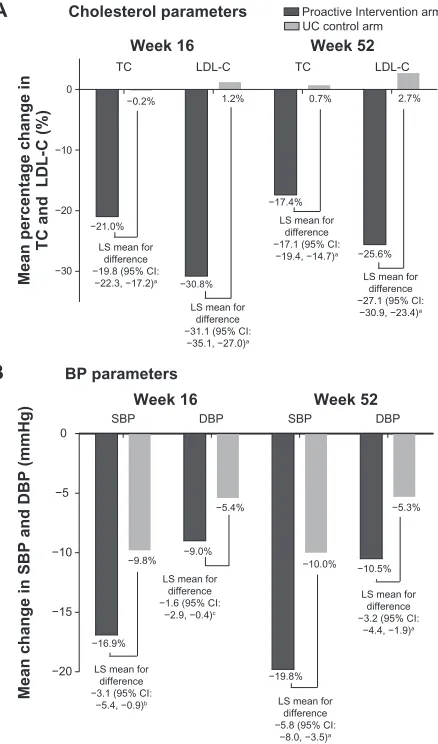
The mean absolute BP reductions from baseline at week 52 in the proactive intervention arm and the UC arm were –19.8 vs –10.0 mmHg (systolic) and –10.5 vs –5.3 mmHg (diastolic), respectively (Figure 4). The mean relative LDL-C reduction from baseline at week 52 in the proactive interven-tion arm was 25.6%, whereas LDL-C increased by 2.7% in the UC arm (Figure 4). These substantial reductions in both BP and LDL-C in the proactive intervention arm using SPAA were driving the fall in estimated CHD, CVD, and stroke risk (Figure 3).
Attainment of Joint National Committee on the pre-vention, detection, evaluation, and treatment of high blood pressure 7: (JNC 7) BP goals8 was slightly higher in the proactive intervention vs the UC arm at week 16 (49% vs 46%; OR: 1.08; 95% CI: 0.79–1.48; P= 0.618)
Integrated Blood Pressure Control downloaded from https://www.dovepress.com/ by 118.70.13.36 on 22-Aug-2020
−21.0%
LS mean for difference −19.8 (95% CI: −22.3, −17.2)a
−30 −20 −10 0
Proactive Intervention arm UC control arm
TC
−17.4%
0.7% 2.7%
−25.6% −0.2%
−30.8% 1.2%
LDL-C TC LDL-C
LS mean for difference −31.1 (95% CI: −35.1, −27.0)a
LS mean for difference −17.1 (95% CI:
−19.4, −14.7)a
LS mean for difference −27.1 (95% CI:
−30.9, −23.4)a Cholesterol parameters
Mean percentage change in
TC and LDL-C (%)
−16.9%
LS mean for difference −3.1 (95% CI:
−5.4, −0.9)b −20
−15 −10 −5
0 DBP
−19.8% −10.0%
−5.3%
−10.5%
−9.8% −9.0%
−5.4%
SBP SBP DBP
LS mean for difference −1.6 (95% CI:
−2.9, −0.4)c
LS mean for difference −5.8 (95% CI:
−8.0, −3.5)a
LS mean for difference −3.2 (95% CI:
−4.4, −1.9)a BP parameters
A
B
Week 16 Week 52
Week 16 Week 52
Mean change in SBP and DBP (mmHg)
Figure 4 Mean change from baseline in (A) cholesterol and (B) BP parameters at weeks 16 and 52 in the CRUCIAL trial.
Notes: aP,0.001; bP, 0.01; cP, 0.05.
Abbreviations: BP, blood pressure; CI, confidence interval; CRUCIAL, Cluster
Randomized Usual Care vs Caduet Investigation Assessing Long-term-risk; DBP, diastolic blood pressure; LDL-C, low-density lipoprotein cholesterol; LS, least squares; SBP, systolic blood pressure; TC, total cholesterol; UC, usual care.
−40 −30 −20 −10 0 10 20
−33.4% −5.1%
Proactive intervention arm UC control arm
−33.0% −4.0%
LS mean for difference −25.8 (95% CI: −30.6, −21.0)a
LS mean for difference −27.1 (95% CI: −31.7, −22.5)a
Week 16 Week 52
Framingham CHD risk
Percent change in 10-year CHD risk
−40 −30 −20 −10 0 10 20
−34.8% −12.9%
−36.4% −12.5%
LS mean for difference −20.8 (95% CI: −25.2, −16.4)a
LS mean for difference −23.0 (95% CI: −27.2, −18.9)a
Week 16 Week 52
European SCORE fatal CV risk
A
B
Percent change in 10-year fatal CVD ris
k
−40 −30 −20 −10 0 10 20
−35.9% −9.6%
−35.4% −9.0%
LS mean for difference −25.4 (95% CI: −29.3, −21.4)a
LS mean for difference −25.8 (95% CI: −29.8, −21.9)a
Week 16 Week 52
Framingham fatal/non-fatal CVD risk
Percent change in 10-year fatal/
non-fatal CVD ris
k
−40 −30 −20 −10 0 10 20
−35.9% −9.6%
−35.4% −9.0%
LS mean for difference −25.2 (95% CI: −29.2, −21.3)a
LS mean for difference −25.7 (95% CI: −29.6, −21.7)a
Week 16 Week 52
Framingham stroke risk
C
D
Percent change in 10-year stroke risk
Figure 3 Percentage change in calculated 10-year (A) Framingham CHD risk, (B) European SCORE fatal Cv risk, (C) Framingham fatal and non-fatal CvD risk, (D) Framingham stroke risk from baseline to week 16 and 52, by treatment arm in the CRUCIAL trial.
Note: aP, 0.001.
Abbreviations: CHD,coronary heart disease; CI, confidence interval; CRUCIAL,
Cluster Randomized Usual Care vs Caduet Investigation Assessing Long-term-risk; Cv, cardiovascular; CvD, cardiovascular disease; LS, least squares; SCORE, Systematic COronary Risk Evaluation model; UC, usual care.
Dovepress
Zamorano and Edwards
and this increased to 58% vs 48% (OR: 1.59; 95% CI: 1.15–2.2; P , 0.001) at week 52. Attainment of the National Cholesterol Education Program (NCEP) expert panel on detection, evaluation, and treatment of high blood cholesterol in adults (Adult Treatment Panel III) (NCEP ATP III)7 LDL-C goals was markedly higher in the proactive intervention vs the UC arm at both week 16 (88% vs 53%; OR: 7.1; 95% CI: 5.17–9.73; P , 0.001) and week 52 (83% vs 53%; OR: 4.39; 95% CI: 3.31–5.82;
P , 0.001). Dual BP/LDL-C goal attainment was also achieved in a significantly higher proportion of patients in the proactive intervention using SPAA vs the UC arm at both week 16 (43% vs 26%; OR: 2.1; 95% CI: 1.56–2.90;
P , 0.001) and week 52. (50% vs 27%; OR: 2.83; 95% CI: 2.11–3.90; P , 0.001).
Integrated Blood Pressure Control downloaded from https://www.dovepress.com/ by 118.70.13.36 on 22-Aug-2020
Dovepress Combining antihypertensive and antihyperlipidemic agents
The evaluation of AEs in CRUCIAL was complicated by the fact that only patients in the proactive intervention arm received study medication (SPAA). Patients in the UC arm continued their existing antihypertensive and lipid-lowering medications, which were presumably well tolerated in that they had not been discontinued due to AEs or other safety concerns before entering the study. Most AEs in both treatment arms were mild to moderate in intensity. However, more patients discontinued their treatment due to AEs in the proactive intervention (6.7%) than in the UC arm (0.6%). The most commonly reported AEs in the proactive intervention arm were peripheral edema (6.8%), headache (3.0%), and nasopharyngitis (2.8%) in comparison with headache (2.2%), bronchitis (2.2%), and upper respiratory tract infection (2.1%) in the UC arm. There were no treatment-related deaths in either treatment group. The incidence of AEs in the proactive intervention arm was similar to that previously observed for SPAA52 and co-administered amlodipine and atorvastatin.42
A number of sub-analyses of the CRUCIAL study have been undertaken, with more planned in the future. In the first of these sub-analyses, the efficacy and tolerability of the proactive intervention strategy vs UC was assessed in patients with (n = 600) and without (n = 817) diabetes.66 The reductions in Framingham CHD risk and BP in patients in the proactive intervention arm vs UC were similar in those with and without diabetes. The SPAA-based treatment in the proactive intervention arm was well tolerated in patient groups, in line with previous studies.51,52 A similar evaluation assessing the proactive intervention arm resulted in a greater reduction in calculated Framingham 10-year CHD risk, BP, or LDL-C compared with continuing UC in younger (, 65 years) and older ($ 65 years) patients. This sub-analysis demonstrated that reductions in Framingham 10-year CHD risk, systolic BP, and lipids in the patients in the proactive intervention arm vs UC were similar in both older and younger patients, and SPAA-based treatment was well tolerated.67 However, in patients treated with the proactive intervention vs UC, the reductions in diastolic BP were higher for younger than older patients.
Additional sub-analyses evaluating the efficacy and safety of the proactive intervention in comparison with UC in Pacific-Asian vs non-Pacific-Asian patients have been undertaken.68 A separate evaluation of the Pacific-Asian patients from the CRUCIAL population has compared baseline and endpoint CV risk estimations, made using the Japanese NIPPON DATA8069 risk assessment chart (which is based on Japanese longitudinal CV data), with
the Framingham and SCORE risk assessments.70 A further analysis evaluating efficacy and safety of the proactive intervention in comparison with UC in Latin American vs non-Latin American patients is also underway.
In conclusion, the CRUCIAL study demonstrated that a proactive intervention strategy based on SPAA had substantial benefits on estimated CHD/CVD risk, BP, and lipids over continued UC in patients with HTN, TC # 6.5 mmol/L (untreated), and three or more additional CV risk factors, with or without diabetes but without CHD.
Health outcome
and pharmacoeconomic studies
The results of the CRUCIAL trial clearly demonstrate the benefits of SPAA-based treatment vs UC within the controlled environment of a clinical trial. A broad range of observational studies has evaluated the effectiveness of SPAA in the real-world setting and the potential benefits of the use of SPAA in comparison with co-administered amlodipine and atorvastatin. Furthermore, a pharmacoeconomic evaluation using transition probabilities and costs from the ASCOT study indicated that the combination of amlodipine-based therapy and atorvastatin was cost-effective in patients with similar characteristics to those enrolled in CRUCIAL (HTN and three or more additional risk factors but no CHD).71 However, additional studies evaluating the costs of SPAA vs potential cost savings related to the benefits of this medication on CV endpoints in the real-world setting are required to confirm these findings.One of the key reasons for combining two or more agents into a single pill is that it reduces pill burden and thus simplifies a patient’s treatment regimen, which can in turn improve patient adherence.72 This has important implications because improvement in patient adherence may increase therapeutic goal attainment, and in the long term improve health outcomes and reduce CV events.73,74 Conversely, poor adherence to antihypertensive and lipid-lowering therapies can substantially reduce the effectiveness of these medications.75–79 For example, hypertensive patients taking antihypertensive and statin therapy at real-world adherence levels can be expected to receive only approximately 50% of the potential benefit demonstrated in clinical trials.78
Given the importance of adherence to medications that lower CV risk and the potential adherence benefits of single-pill combination medications over co-administered therapies,72 several studies have assessed predictors of adherence and nonadherence to antihypertensive and
Integrated Blood Pressure Control downloaded from https://www.dovepress.com/ by 118.70.13.36 on 22-Aug-2020
Dovepress
Zamorano and Edwards
lipid-lowering medications (Table 1). These studies have provided information on the factors that may play a role in driving the improved adherence to single-pill combination medications. The first of these studies evaluated adherence to antihypertensive and lipid-lowering medications in 8406 patients with HTN newly initiated on these medications.80 Adherence to antihypertensive and lipid-lowering medications was very low, just 36% of patients remaining adherent to both classes of medication at 12 months (Table 1). This study also suggested that increasing pill burden could decrease adherence80 and that patients were more likely to be adherent to their antihypertensive and lipid-lowering therapy if they initiated antihypertensive and lipid-lowering medications together, or had symptomatic CVD (Table 1).80 The relationship between pill burden and adherence was assessed in more detail in a later study, which confirmed that adherence decreases as the number of medications a patient was taking increased (Table 1).81 The effect of the timing of antihypertensive and lipid-lowering medication initiation was studied in more detail in a subsequent study, which confirmed that synchronized initiation of these two classes of therapy improves adherence compared with initiating them separately (Table 1).82
All of the above retrospective database studies dem-onstrated that overall adherence to antihypertensive and lipid-lowering medications is low, falling to just ∼30%–40% at 12 months after initiating therapy (Table 1).80,82 This there-fore suggests that interventions to maintain and improve adherence to these medications over time are required. The effectiveness of interventions designed to improve adherence has been evaluated, and was identified in two systematic literature reviews.83,84 The first of these reviews identified a range of interventions that had successfully improved adherence to antihypertensive or lipid-lowering medications, such as fixed-dose combinations, unit-dose packaging, educational telephone calls, case management by pharmacists or nurses, and mailed refill reminders.83 The second evaluation extended and updated the first review, by additionally comparing the effectiveness and costs of interventions to improve adherence to antihypertensive and lipid-lowering therapies.84 Effectiveness was measured as relative improvement (RI) in adherence, which was defined as the ratio of adherence in the intervention group to the control group. The control group comprised patients taking antihypertensive and lipid-lowering therapies alone without any intervention program. Costs were calculated based on those reported in the analysis, if available, or estimated
based on resource use described in each publication and using standard costs derived from the literature. Across five eligible studies, RI in adherence ranged from 1.11 for mailed refill reminders to 4.65 for case management by a commu-nity pharmacist. The costs of interventions over 6 months ranged from US$10 per patient for monthly mailed remind-ers to US$142 per patient for a combination of increased pharmacy care, and the use of patient diaries and educational material. In general, the more costly and time-consuming interventions were the most effective. However, across most healthcare systems it is unlikely that there will be sufficient resources available to provide intensive case management for all patients nonadherent to their antihypertensive and lipid-lowering medications.
Adherence benefits of single-pill
amlodipine/atorvastatin
The use of fixed-dose combination medications has been shown to be an effective approach to improving patient adherence to therapies across a diverse range of disease areas, such as HTN, tuberculosis, HIV, and diabetes.72 The Caduet Adherence Research Program and Education (CARPE) retrospective cohort studies were designed to evaluate potential adherence benefits of SPAA vs co-administered antihypertensive and lipid-lowering therapy in real-world settings (Table 1).
The first of these studies, CARPE-Patient Benefits Management (CARPE-PBM), was a retrospective database study of pharmacy claims data that identified patients who were newly initiated on SPAA, or a CCB or statin (either simultaneously or within 30 days of each other). At 6-month follow-up, and after adjustments for differences between the cohorts, patients prescribed SPAA were significantly more likely to achieve adherence vs two-pill regimen amlodipine plus atorvastatin (OR: 1.95; 95% CI: 1.80–2.13).85
The CARPE-M study provided further insight into the potential adherence benefits of SPAA, by investigating the impact of prior CCB and statin use on adherence to SPAA. Although this study supported the finding of CARPE-PBM (higher adherence in patients receiving SPAA vs those receiving a two-pill regimen), CARPE-M also suggested that patients with prior experience of either CCB or statin use (but not both) were more likely to adhere to their SPAA treatment compared with treatment-naïve patients or those who had previous experience with both of these therapies (Table 1).86
A similar study was undertaken to see if adherence to antihypertensive therapy can be used to promote adherence
Integrated Blood Pressure Control downloaded from https://www.dovepress.com/ by 118.70.13.36 on 22-Aug-2020
0.85 0.90
Survival probability
0.95 1.00
0 200 400 600
Days to CV event
800 1000
SPAA
0.93 0.95
CCB + statin
1200
Figure 5 Kaplan–Meier analysis of days to Cv event in patients receiving SPAA and co-administered CCB and statin. Abbreviations: CCB,calcium channel blocker; Cv, cardiovascular; SPAA, single-pill amlodipine/atorvastatin.
Dovepress Combining antihypertensive and antihyperlipidemic agents
to statin therapy.87 This study question was addressed by evaluating adherence to statin therapy in hypertensive patients taking amlodipine switching to SPAA in comparison with patients adding a separate statin to their amlodipine regimen. At 6-month follow-up, patients who switched to SPAA were more likely to be adherent and to persist with their therapy than those adding a statin (Table 1).
The last study in this series, CARPE-M events examined whether improving adherence to SPAA was associated with a lower risk of CV events in patients with HTN but no prior history of CV events.74 The primary measure in this study was the rate of CV events from 6 to 18 months following the initiation of antihypertensive therapy. The CV event rate was compared in three ways: (1) all adherent vs nonadherent patients; (2) SPAA vs two-pill therapy (CCB/statin patients regardless of adherence level); and (3) adherent SPAA, adher-ent two-pill, and nonadheradher-ent SPAA patiadher-ents vs nonadheradher-ent two-pill patients. After 6 months of treatment, 56.5% of the 1537 SPAA patients were adherent vs 21.4% of the 17,910 two-pill therapy patients (OR: 4.7; P, 0.001). For compari-son (1), of all adherent vs nonadherent patients, remaining adherent to therapy was associated with significantly lower risk of CV event (hazard ratio [HR]: 0.77; P= 0.003). SPAA was also associated with fewer CV events when differences in adherence were not factored in (HR: 0.68; P= 0.02). As a result of improved adherence, patients prescribed SPAA vs
two-pill CCB plus statin therapy had significantly longer time to CV event (Figure 5). For comparison (3), when adherence was included as a covariate, the strength of association was reduced. The risk of CV events was significantly lower for adherent CCB/statin patients (HR: 0.79; P= 0.01) and adherent SPAA patients (HR: 0.61; P = 0.03) compared with patients nonadherent to two-pill therapy (CCB/statin patients), suggesting differences in adherence may play a role in SPAA’s observed benefit.
Some limitations to these real-world evaluations should be taken into account. All of these studies were conducted in the USA and the results may not be directly applicable to other geographical regions due to differences in clinical practice between healthcare systems or the prevalence of CV comorbidities in other parts of the world. Further studies are therefore warranted in other patient populations to determine the beneficial effect of SPAA on adherence and CV outcomes, reported in these retrospective US studies.
Patient satisfaction/patient acceptability
There is increasing evidence that patient satisfaction with therapy improves adherence88,89 and, conversely, that patient dissatisfaction leads to poor adherence.90 Therefore, medications that improve patient satisfaction may contribute towards improving health status, lowering healthcare use, shortening hospital stays, and improving continuity of care.Integrated Blood Pressure Control downloaded from https://www.dovepress.com/ by 118.70.13.36 on 22-Aug-2020
Dovepress
Zamorano and Edwards
Patient satisfaction is therefore an important aspect of a patient’s treatment regimen. Patient satisfaction with SPAA vs a multiple-pill regimen was investigated in some pilot studies. The Expectations and Satisfaction with Treatment Questionnaire (ESTQ) was developed through patient focus groups and clinician interviews as a tool to determine patients’ expectations for, satisfaction with, and adherence to treatment for HTN and DYS. This questionnaire was originally tested during the AVALON study41 and later modified to the ESTQ short form (ESTQ-SF).46 Using data from the JEWEL program,46,56 SPAA treatment was shown to increase patient satisfaction vs a multiple-pill regimen.46 Due to the preliminary nature of these data, further study is needed before firm conclusions can be drawn on whether an increase in patient satisfaction with SPAA contributes to the improved adherence observed with SPAA vs multiple-pill regimens.
Conclusion
Much of the proposed benefits of the PolypillTM can be achieved
through reducing BP and LDL-C. There is now a wealth of preclinical, clinical, and outcomes research data supporting the use of a combination of amlodipine and atorvastatin into a single-pill therapy. The recently completed CRUCIAL trial conducted in patients with HTN and three or more additional CV risk factors but no CHD demonstrated that a SPAA-based proactive intervention strategy can improve BP and LDL-C goal attainment and reduce calculated CV risk in comparison with UC alone. Taken together, these findings suggest that SPAA can play an important role in helping physicians improve the management of CV risk in their patients.
Acknowledgments/Disclosure
Editorial support was provided by Karen Burrows and Penny Gorringe of UBC Scientific Solutions and funded by Pfizer Inc. Professor Zamorano has served as a consultant or has received travel expenses, or payment for speaking at meetings, or funding for research from one or more pharmaceutical companies (including Pfizer, who manufacture single-pill amlodipine/atorvastatin) that market blood pressure-lowering or lipid-lowering drugs. Dr Edwards of UBC Scientific Solutions was a paid consultant to Pfizer Inc in connection with development of this paper.
References
1. Zanchetti A. The hypertensive patient with multiple risk factors: is treatment really so difficult? Am J Hypertens. 1997;10:223S–229S. 2. Gu D, Gupta A, Muntner P, et al. Prevalence of cardiovascular disease
risk factor clustering among the adult population of China: results from the International Collaborative Study of Cardiovascular Disease in Asia (InterAsia). Circulation. 2005;112:658–665.
3. Asmar R, Vol S, Pannier B, Brisac AM, Tichet J, El Hasnaoui A. High blood pressure and associated cardiovascular risk factors in France. J Hypertens. 2001;19:1727–1732.
4. Kannel WB. Fifty years of Framingham Study contributions to under-standing hypertension. J Hum Hypertens. 2000;14:83–90.
5. Neaton JD, Wentworth D. Serum cholesterol, blood pressure, cigarette smoking, and death from coronary heart disease. Overall findings and differences by age for 316,099 white men. Multiple Risk Factor Intervention Trial Research Group. Arch Intern Med. 1992;152: 56–64.
6. Thomas F, Bean K, Guize L, Quentzel S, Argyriadis P, Benetos A. Combined effects of systolic blood pressure and serum cholesterol on
cardiovascular mortality in young (,55 years) men and women. Eur
Heart J. 2002;23:528–535.
7. Executive Summary of The Third Report of the National Cholesterol Education Program (NCEP) Expert Panel on Detection, Evaluation, and Treatment of High Blood Cholesterol in Adults (Adult Treatment Panel III). JAMA. 2001;285:2486–2497.
8. Chobanian AV, Bakris GL, Black HR, et al. The Seventh Report of the Joint National Committee on Prevention, Detection, Evaluation,
and Treatment of High Blood Pressure: the JNC 7 report. JAMA.
2003;289:2560–2572.
9. Graham I, Atar D, Borch-Johnsen K, et al. European guidelines on cardiovascular disease prevention in clinical practice: executive summary: Fourth Joint Task Force of the European Society of Cardiology and Other Societies on Cardiovascular Disease Prevention in Clinical Practice (Constituted by representatives of nine societies and by invited experts). Eur Heart J. 2007;28:2375–2414.
10. Mancia G, De Backer G, Dominiczak A, et al. 2007 Guidelines for the Management of Arterial Hypertension: The Task Force for the Management of Arterial Hypertension of the European Society of Hypertension (ESH) and of the European Society of Cardiology (ESC). J Hypertens. 2007;25:1105–1187.
11. ALLHAT Officers and Coordinators for the ALLHAT Collaborative Research Group. Major outcomes in high-risk hypertensive patients randomized to angiotensin-converting enzyme inhibitor or calcium channel blocker vs diuretic: The Antihypertensive and Lipid-Lowering Treatment to Prevent Heart Attack Trial (ALLHAT). JAMA. 2002;288: 2981–2997.
12. Sever PS, Dahlöf B, Poulter NR, et al. Prevention of coronary and stroke events with atorvastatin in hypertensive patients who have average or lower-than-average cholesterol concentrations, in the Anglo-Scandinavian Cardiac Outcomes Trial-Lipid Lowering Arm (ASCOT-LLA): a multicentre randomised controlled trial. Lancet. 2003;361:1149–1158.
13. Wald NJ, Law MR. A strategy to reduce cardiovascular disease by more than 80%. BMJ. 2003;326:1419.
14. Colhoun HM, Betteridge DJ, Durrington PN, et al. Primary prevention of cardiovascular disease with atorvastatin in type 2 diabetes in the Collaborative Atorvastatin Diabetes Study (CARDS): multi -
centre randomised placebo-controlled trial. Lancet. 2004;364:
685–696.
15. Gæde P, Vedel P, Larsen N, Jensen GV, Parving HH, Pedersen O. Multifactorial intervention and cardiovascular disease in patients with type 2 diabetes. N Engl J Med. 2003;348:383–393.
16. Gæde P, Lund-Andersen H, Parving HH, Pedersen O. Effect of a multifactorial intervention on mortality in type 2 diabetes. N Engl J Med. 2008;358:580–591.
17. Yusuf S, Pais P, Afzal R, et al. Effects of a polypill (Polycap) on risk factors in middle-aged individuals without cardiovascular disease (TIPS): a phase II, double-blind, randomised trial. Lancet. 2009;373: 1341–1351.
18. Patel A, Shah T, Shah G, et al. Preservation of bioavailability of ingredients and lack of drug-drug interactions in a novel five- ingredient polypill (polycap): a five-arm phase I crossover trial in healthy volunteers. Am J Cardiovasc Drugs. 2010;10:95–103.
Integrated Blood Pressure Control downloaded from https://www.dovepress.com/ by 118.70.13.36 on 22-Aug-2020