IMPACT FACTOR: 0.485 (GIF)
To Facebook or Not to Facebook:
A Comparative Study
JENNY WANG Department of Applied Foreign Languages
National Formosa University Yunlin, Taiwan
Abstract:
The aim of this study was to compare the effectiveness of different learning environments between interactive Facebook instructional method and non-Facebook instructional method for undergraduate students. Study design used a pretest-posttest control group experimental design. Sample of this study was college students who enrolled in the Department of Applied Foreign Languages at the National Formosa University between September 2011-June 2012. The experimental group (n=134) received the interactive Facebook instructional method, and the control group students (n=57) received the non-Facebook instructional method. Independent samples t-tests, Pearson’s correlation coefficient, and a linear regression were performed. Content analyses of samples of Facebook communication exchanges were also conducted. The statistical results showed that the participants in the experimental group increased their grades and engagement. The results were encouraging as the students perceived higher engagement in interactive Facebook instructional method than did participants who received non-Facebook instructional method. It concludes that the usage of Facebook acts as an important tool to assist students in achieving better grades, higher engagement, and greater satisfaction with the university learning experience.
Key words: engagement learning, Facebook, social network, Web 2.0
1. Introduction
has been interest in implementing these technologies in the learning process. Although e-learning platforms have been implemented in university teaching and learning settings throughout the world, instructional methods, techniques, and educational software tools do not always keep pace with developments in ICT. Social media activity, such as social networking, has become an integral part of college students‟ lives (Cotten 2008). The communication features of such social networking sites (SNSs) as Facebook (FB), Twitter, and Myspace have great potential for use in education. Social media far from being a fad are becoming ubiquitous.
The artifacts of Web 2.0 penetrate one‟s life in current society more thoroughly with the availability of broadband services. Web 2.0 enables users to influence the functions and features of the Internet in the process of navigating and exploring this Web of knowledge. In particular, there is a focus on collaboration and communication among Internet users, people, and organizations of similar interests (Wang et al., 2010). Web 2.0 artifacts, new social networking tools have been developed to enhance user involvement and engagement in the Web environment. Based on Downes (2005), the Web has become a platform in which users can create and share content in a virtual community. In other words, Web 2.0 characteristics have clearly afforded new possibilities for user involvement in the Internet. Web 2.0 artifacts, such as SNSs, can be used in education to enhance both formal and informal teaching and learning environments and encourage students to network and share resources with one another (Ajjan and Hartshorne 2008; Alexander 2006; Boulos and Wheeler 2007; Chen et al. 2009; Ellison et al. 2007; Evans et al. 2010). However others (Zoghbi-Manrique-de-Lara 2012; Pychyl 2008) debate that these Internet behaviors are negatively associated with student organization‟s effectiveness and reached a new level of time wasting.
1.1Purpose of the study
tool to enhance student learning engagement and learning outcomes. This study was designed to provide insight into how students‟ perceived effectiveness of FB learning environment impacted their learning engagement and how having had to use FB impacted their academic achievement. The objective is to investigate if FB is a useful and interactive learning environment that (1) could enhance student learning engagement and/or strengthen relationship among students themselves and between student and faculty, and student and institution, (2) could improve student learning outcomes. This research would enable educators and researchers to identify and comprehend how SNSs such as FB could merge students‟ social and academic lives and accordingly contribute to academic learning.
1.2 Social Network Sites and Facebook
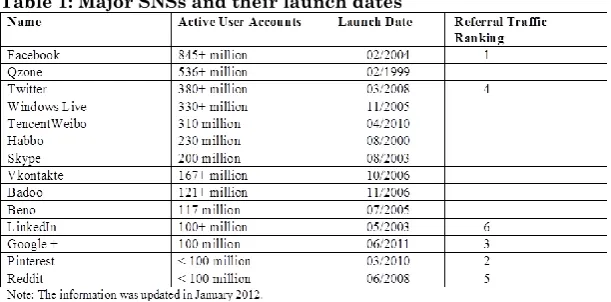
Socializing via the Internet has been widely used, and it has become an increasingly important part of college students‟ daily lives (Boyd & Ellison 2008; Cotten 2008; Gemmill & Peterson 2006). To date, the existence of hundreds of SNSs (Table 1) is consistent with the modern views of the deeply social nature of human mentality and the importance of support communication between users (Alexander 2006; Franklin & van Harmelen 2007).
Table 1: Major SNSs and their launch dates
With social networking activities becoming the predominant Web 2.0 application, FB created by Mark Zuckerberg in 2004 is the most popular SNS and the largest proportion of overall Internet traffic. Similar to other virtual communities on SNSs, FB enables users to either interact with people whom they already know offline or meet new people online. FB is described as “… an online directory that connects people through social networks at colleges and universities” (Zuckerberg 2005, 1). In addition, FB provides opportunities for sharing social and emotional support, information resources and bonds with other people who work, study, and live around them (Cheung et al, 2011; Eyadat & Eyadat 2010). More importantly, in April 2012, Microsoft Corp. and FB announced a definitive patent agreement (Microsoft 2012). This agreement opened the door for FB to allow users to attach/upload various types of files, such as Microsoft-Word, Excel, and PowerPoint files to their FB private pages which represented another significant step in expanding FB‟s features, for learning and knowledge sharing in the classroom context. Kirkpatrick (2010) describes FB as “a technological powerhouse with unprecedented influence across modern life, both public and private” (15).
and 125 billion friend connection. Currently, facebook.com is one of the most popular SNSs in Asia, an estimated 212 million Asian users (McCarra 2012). Despite the worldwide spread of FB users, it has been banned in several countries including China, Iran, and Pakistan. In addition, a fair amount of FB daily activity worldwide is comprised of application use. The current statistics include:
over 3.2 billion likes and comments generated,
over 300 million photos uploaded,
over 70 languages available (Facebook, 2012), indicating that FB is tightly integrated into the daily lives of its users.
1.3 SNSs and Student Engagement
In the context of student learning, Astin (1984) defined engagement as “the amount of physical and psychological energy that the students devote to the academic experience” (297). Today, engagement refers to the amount of time and effort that students spend on educational activities that are related to college academic work (Kuh 2009). Chickering and Gamson (1987) offer 7 principles for improving undergraduate education based on research on exemplary teaching and learning in colleges and universities. All of these principles are related to student engagement as follows.
Seven principles of improving engagement:
Encourages contact between students and faculty.
Develops reciprocity and cooperation among students.
Encourages active learning.
Provides prompt feedback.
Emphasizes time on task.
Communicates high expectations.
Respects diverse talents and ways of learning.
al. (2010) found a significant relationship between the use of educational technology and student engagement. Studies that focused on specific relationships between social media and engagement (Astin 1984; Heiberger and Harper 2008) also found a positive correlation between the use of SNSs and the engagement of college students. Surely, such powerful media can prove useful in education as well as life in general (Dyrud 2011).
1.4 Facebook and Interaction
Interaction is an essential element in any learning environment that is a necessary and fundamental process for knowledge acquisition and cognitive and physical development (Barker 1994). Furthermore, interaction directly influences learners‟ learning (Hirumi 2002; Woo & Reeves 2007). Interaction is defined as “a dialogue or discourse...between two or more participants and objects which occurs synchronously and/or asynchronously mediated by response or feedback and interfaced by technology” (Muirhead & Juwah 2004, 13). Scholarly studies of FB (Hewitt & Forte 2006; Mazer et al. 2007; Tuncay & Uzunboylu 2010) reveal a significant relationship between the use of FB among college-age respondents and higher motivation to learn, more effective learning and classroom climate, and improved faculty-student relationships. FB serves as a means for instructors to connect, befriend, and communicate with students to extend the communicative activities of the traditional physical classroom to a virtual form. Godwin-Jones (2008) claimed that FB is a tool and platform “that enhances communication and human interaction and can potentially be harnessed for language learning” (7).
2. Material and methods
2.1 Sample
shown in Table 2. Students from both groups were asked to complete a pre- and post-test. Of the 193 questionnaires that were distributed, 190 took the pre-test survey and 189 were valid, yielding a response rate of 97.92%. There was no significant difference between the groups in terms of participation rates. At the end of the study, the total 130 out of 134 (97.01%) in the experimental group and 57 (96.61%) in the control group completed the post-test survey. Again, there was no significant difference between the groups in participation rate, yielding an overall response rate of 96.89%. Therefore, participants from two classes in the experimental group were then combined for further data analysis. All of the participants (100%) were full-time undergraduates in the age range 20-24. None of participants reported that he/she did not have a FB account prior to the start of the course.
Table 2: Basic information of the participants
2.2 Research Design
2.3 Instructional Methods
Both groups received instruction according to the 7 principles for improving engagement in higher education (Chickering & Gamson 1987) hoping to foster learning engagement, including the following characteristics. The only differences between groups were the last 3 characteristics, including grouping, coaching and monitoring, and immediate feedback.
Class presentation: Based on the course objectives, the teacher lectured to the entire class and aroused their interest in a discussion to help all the students understand the importance of the course content and context.
In-class quizzes: All students were asked to take 12 in-class offline quizzes during the 10-month treatment. The quizzes were conducted individually, with no notes, textbooks, or peer help allowed. Each student was responsible for his/her own learning.
Individual improvement scores: Each student‟s average score for the previous exams/quizzes served as the basic score. The score for the current quiz minus the basic score was the index of learning progress. All teams added all team members‟ index numbers and calculated the average score as their cumulative group score. A higher cumulative group score indicated better academic performance for that group.
Classroom demonstration: All teams were asked to orally present their group projects in class along with an MS-PowerPoint slideshow. The class voted for 2 outstanding projects out of all the group presentations.
Team recognition: Members with a higher team score and those with outstanding projects received rewards and public praise. In addition, members who had made significant progress were rewarded and praised individually. Award titles and award certificates were presented in class.
Grouping:
relevant content information. Furthermore, on each FB course site, students were divided into heterogeneous groups. According to their previous academic average grades, the team members were included in high-, mid-, or low-competence groups. hrough the private page, students collaborated with other students on a shared project. During the process of group learning on the FB sites, every team tried to compete with one another to get a higher score. All team members helped each other to achieve their common goal.
b. In the control group, the teacher grouped the entire class into heterogeneous groups in class. According to the previous academic average grades, the team members were mixed with high-, mid-high-, and low-competence groups. Throughout the academic year, the students were required to work in groups. During the class hours, the instructors initiated class activities and encouraged students to work in groups. All team members were encouraged to help each other in class discussion.
Coaching and monitoring:
In the experimental group, teachers served as a coach on FB sites and monitored each individual‟s learning progress between classes.
In the control group, teacher served as a coach monitoring each individual‟s learning progress in class.
Immediate feedback:
In the experimental group, students received instant feedback on FB sites and received prompt responses from the teachers after regular classes.
In the control group, the instructors attempted to reply to the students‟ emails within 24 hours.
2.4 Instrument Reliability and Validity
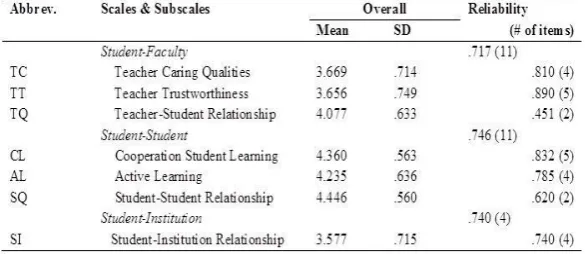
information regarding participant demographics and the frequency of engagement in FB activities. The items in the second section were adapted from the questionnaire of the NSSE investigating engagement. The NSSE is the most well-known and widely used college student engagement questionnaire for educational contexts (Chen et al. 2010). For use in this study, the scale was modified and left 40 items suitable. Additionally, through principle component analysis of factor analysis, factors with an eigenvalue larger than 1 and items with a factor loading larger than .5 were selected. Factor analysis was conducted 5 times and 14 items were deleted. Finally, three factors including “student-faculty interactions”, “student-student interactions”, and “student-institution interactions” were extracted, and the accumulated variance explained was 43.27%. Therefore, the validity of the scale was conducted. The analysis result presented the Cronbach‟s α reliability of each subscale ranged from .45 to .89. Seven subscales include:
teacher caring qualities (TC),
teacher trustworthiness qualities (TT),
teacher-student relationship (TQ),
cooperative student learning (CL),
active learning (AL),
student-student relationship (SQ), and
student-institution relationship (SI).
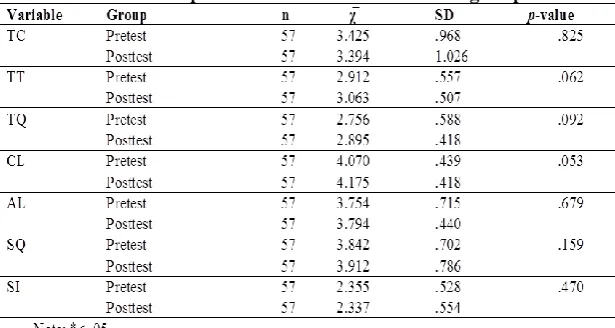
Table 3: Descriptive statistics of student-faculty, student-student, and student-institution relationships and items reliability
Table 4: List of sample items
The qualitative data were used to support and giving meaning to the quantitative data analysis. For the presentation of each student‟s excerpts, each student was coded S1, S2, S2… S130. The FB wall posts, comments from the respondents were cited as they were expressed or stated by the students and identified by their respective codes. Some excerpts may contain more than one theme/principle.
2.5 Analyses
The research analysis focused on the following research questions.
teacher trustworthiness qualities, teacher-student relationship, cooperative student learning, active learning, student-student relationship, and student-institution relationship.
What effects do interactive FB instructional methods and traditional interaction instructional methods have on the academic grades of students?
Is there a relationship between grades and the frequency of engaging in FB activities? How does the frequency of FB use affect the academic grades of students?
Both quantitative and qualitative research techniques were used together. Regarding the quantitative aspect of the study, survey model was applied. Independent-samples t-tests were used to determine whether significant differences existed between groups in terms of grades and learning engagements. Pearson‟s correlation coefficient was used to measure the relationships between interactive FB instructional methods and grades and between traditional interaction instructional methods and grades. A linear regression was also performed to analyze the predictors of student grades. Regarding the qualitative aspect of the study, analyses of FB communication exchanges and email exchanges from the both groups were conducted.
2.6 Procedure
reply, like one‟s comment, and send a private message. The control group received the in-class interaction instructions, including in-class discussion, group demonstration, after-class counseling (6 office hours per week), and email communication exchange. The experimental group received interactive FB instructional methods through the FB course sites. The FB activities in the experimental group were as follows.
The instructors created a private group particularly for the class. All members could only join with the approval of the instructors. This was to ensure that only the members see posts. Only within the private group, students can be able to upload or attach academic files, such as Microsoft-Word, -Excel, -PowerPoint, and PDF files. Each student was instructed to access FB at their convenience between classes. The instructor announced that the class-related content will be uploaded to this space constantly. The students were encouraged to follow each other and reply to other students‟ posts. The students were instructed to work in groups together to share ideas, initiate and develop a project, and participate in a discussion on FB. Students were informed of the option of creating a private page for their project team which was only accessible to group members. Private pages were organized by the students with little interaction with the instructors.
Two FB course sites were administered and managed independently by two of the authors. Each week, the teachers attached a discussion question to the FB course regarding the following week‟s subject. The students were asked to answer to the discussion questions using various sources and respond other students‟ comments. The students used the like feature when they agreed or liked others‟ comments. The purpose of this process was to encourage students to come to class prepared. Both the interactions on FB and in the classroom settings synchronized with one another. The instructor asked some particular students who had interesting thoughts on FB to lead the discussion in the classroom.
and video links on the course FB sites. Students commented on what they liked and disliked about each submission. The purpose of this feature was to encourage students to exchange information and share accomplishments with other group members. The instructors provided online office hours and respond to questions using FB‟s communication features.
The instructors responded to any questions posted on the comment wall, in online chats, or in private messages. To receive private messages, the instructors kept their personal account active.
The purpose of this process was to enhance students‟ understanding of course concepts and lecture content and provide shy students with an opportunity to ask their questions online. Students understood that via FB course, they communicated for classroom assignments or through instructors‟ personal account, they could communicate with the instructor on a personal level. This procedure was to ensure that both active and passive students were given equal importance to participate their learning. The instructors regularly posted information about academic enrichment opportunities on campus and links to off-campus academic contest opportunities. The instructors provided encouragement and assistance via online communication. The instructors also constantly posted current IT news and other relevant real world activities. The purpose of this process was to maintain students‟ interest and subsequently gain a better understanding of the subject matter. The instructors and other students periodically provided emotional support when students posted about like being upset, sad, worried or frustrated. In addition to commenting, the instructors also indicated their support using the like feature. FB was used for the online communication of class reminders, including assignment due dates, exam dates, or location changes.
regular class hours. All the students were supervised by the teachers for each quiz and given the same amount of time to complete their quizzes. At the end of the study, the students in both the experimental (n=130) and control (n=57) groups were post-tested during the final week of the second semester.
3. RESULTS
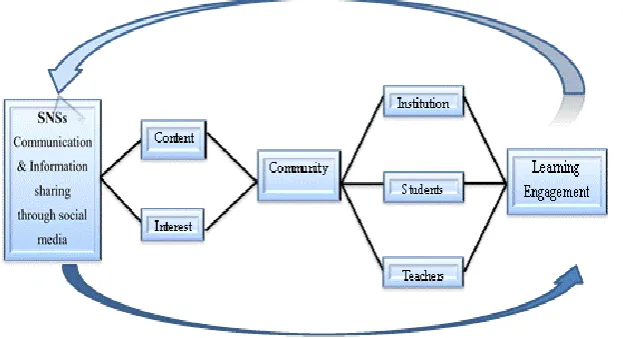
SNSs features in this study enhanced the quality of learning environment (Figure 1). The findings were then discussed in the order of the research questions.
Figure 1: Learning engagement versus SNSs
3.1 Interactive FB Instructional Methods vs. Traditional Interaction Instructional Methods
3.1.1 t-Test 1: Pretest Results Between Two Groups
The independent sample t-test was conducted on the pretest results to ascertain whether there were significant differences in student learning engagement between the two groups. For the 7 variables of interactions and relationships with teachers, other students, and the institution, no significant difference was observed between the two groups before the treatment. Thus, it could be interpreted that before the experiment, there were no pre-existing differences in the aspect of student learning engagement by group with F(1, 185.62)= 2.331, p= .129.
3.1.2 t-test 2: Posttest Results Between Two Groups
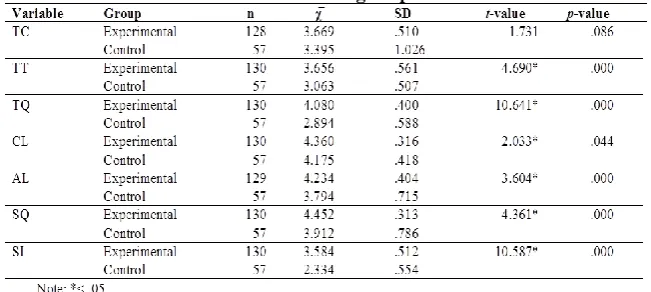
The independent sample t-test was conducted on the posttest results to understand whether there were significant differences in student learning engagement between the groups. As shown in Table 5, significant differences existed between the two groups in the constructs of TT, TQ, CL, AL, SQ, and SI.
Table 5: Posttest results between two groups
3.1.3 t-test 3: Pretest And Posttest Results Of The Experimental Group
Table 6: Pretest and posttest results of the experimental group
As shown above, after the experimental treatment, the experimental group presented significant growth in student learning engagement in terms of fostering interactions and relationships with teachers, other students, and the institution, containing all 7 variables.
3.1.4 t-test 4: Pretest And Posttest Results Of The Control Group
The paired sample t-test was conducted on the pretest and posttest results of the control group to verify the growth of the group in student learning engagement (Table 7).
As shown above, the control group treated with the traditional lecturing instruction presented no significant growth in all the variables of student learning engagement, including TC, TT, TQ, CL, AL, SQ, and SI. It can be interpreted if teachers‟ instructional methods are similar and there is no significant difference in student‟s quality, the traditional teaching method without integrating technology is unable to effectively strengthen student‟s learning engagement in today‟s society.
3.2 Interaction Instructional Methods vs. Grades
Research question 2: What effects do interactive FB instructional methods and traditional interaction instructional methods have on the academic grades of students? For these analyses, a mixed effects ANOVA model was conducted in the experimental group. The dependent variable was semester grades of students. The semester grades of the experimental group were significantly higher than those of the control group with F(1, 128)=6.641, p=.001. A statistically significant difference (t=1.914, p=.05) was found for grades between students in the experimental group who had a mean of 71.25 (SD= 7.265) and students in the control group who had a mean of 68.54 (SD=9.909).
To detect if there is a relationship between particular variables of the interactive FB instructional methods and student grades in the experimental group, a correlation matrix test was conducted. The results show that student grades were moderately correlated with cooperative student learning. aring teacher qualities were substantially correlated with teacher trustworthiness. Active learning was weakly correlated with all of the variables related to teacher interactions and relationships but substantially correlated with cooperative student learning and the quality of student-student relationships. The linear regression in the experimental group showed that the amount of time spent on FB (F (7, 125)=5.848, p<
.01) and the amount of time spent on co-curricular activities (F
(7, 126)=.6558, p< .001) were significant predictors of student
grades, and teacher caring was a significant predictor of the amount of time spent on co-curricular on campus (F (6, 124)=3.478, p= .05). Together, grades and the amount of time
21.9% of the variance in the amount of time spent on FB, the amount of time spent on co-curricular activities on campus, and interactive FB instructional methods, respectively.
Both amount of time spent on FB and the amount of time spent on co-curricular on campus significantly explained the variance in grades. inally, interactive FB instructional methods and teacher caring significantly explained the variance in the amount of time spent on co-curricular activities on campus.
3.3 Frequency of Activities vs. Grades
Research Question 3: Is there a relationship between grades and the frequency of engaging in FB activities? How does the frequency of FB use affect the academic grades of students? The previous research question concluded that encouraging the use of FB for educationally relevant purpose has a positive effect on grades, then, how the frequency of FB use affect the academic grades was examined. To examine this relationship, the authors calculated Pearson‟s r in the experimental group. The results indicate a moderate association between initiating projects and grades (Pearson‟s r=.348, p< .001). In contrast, playing games (Pearson‟s r=-.228, p= .01) and spending time using non-game applications (Pearson r=-.207, p= .01) are negatively associated with grades. In other words, students who play games or use non-game applications on FB are more likely to have lower grades.
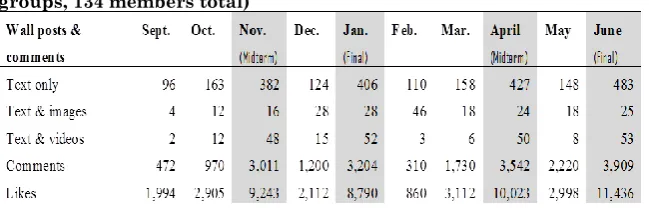
and 75,492 likes. Examination periods were associated with higher use. In addition to the text-only postings, there were a total of 468 image and video tags. Once a member posted his or her group project presentation video to other students, the students began to have lengthy conversations by commenting on each other‟s responses. This interaction led to many lively conversations and active engagement among the group members.
Table 8: Total number of FB postings every month (2 FB course groups, 134 members total)
Linear regression was also used to test the causal relationship between grades and FB activities. Among 20 FB activities in the experimental group, initiating a project (β = .758, p< .001), uploading videos (β = .613, p= .05), and tagging videos (β = .623, p= .05) were positive predictors of grade, whereas playing games (β = -.242, p< .001) and using non-game applications (β = -.025, p< .001) were negative predictors of grades. Initiating projects was the strongest predictor of overall grades with a β of .758 (p< .001). Playing games was the strongest negative predictor of overall grades with a β of -.242 (p< .001).
3.4 Analysis of Communication Exchanges
3.4.1 Experimental Group: FB Communication Exchanges
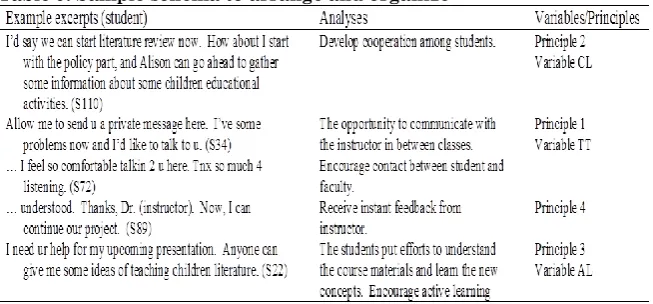
engagement, 7 principles for improving engagement proposed by Chickering and Gamson (1987) were used for the qualitative data analysis (see Table: 9 for examples of excerpts). The 7 subscales of learning engagement and the 7 principles may be combined in the excerpts.
Table 9: Sample schema to arrange and organize
The Quality of Interaction and Relationships between Students and Faculty
The majority of the students had positive responses to the FB interactions. Most users felt satisfied with FB as a supplemental communication tool to connect them with the instructors in a worry-free virtual learning community. The teachers provided caring (TC) to the students. In addition, the teachers offered intrinsic rewards to the students for their achievements.
“Do the group work to get every vocabulary’s synonyms. Collect the work and combine them into one page note or two. Then, print it out for everyone. Once you know how to effectively do the team work in your study group, you will save a plenty of time. Study hard! You can do it!” (30 likes) (Principle 6)
FB allowed both the students and the teachers to expand conversations in ways that would not have been practical during the limited class time. S72 stated, “I can also ask the teacher some stupid questions here. I‟d feel super embarrassed to ask these kinds of silly questions if I go to the teacher‟s office” (42 likes). Similarly, S13, S34, S44, and S69 delivered their thanks to the teacher for solving their problems immediately (Principle 4). The instructor called on a teammate to complete an answer when the students were stuck. S35 commented, “Our teacher is here? My! We‟d better come up with something smart!” In this respect, it can be said that the instructor‟s participation in the students‟ group discussion influenced the students‟ learning motivation. In other words, when the students knew their discussion was monitored by the instructor, they were more motivated to contribute. Enhancing their learning motivation was a byproduct of this study.
Instructors also gained trust (TT) from students. Through FB‟s private message feature, students had the opportunity to send a private message to the instructor to talk about personal issues. S13 said, “Thanks, Dr. (name of instructor). I am so glad I can talk about it out loud. Thanks for spending your time listening to my long story” (Principle 1). S69 said, “very helpful chatting with you” (Principle 1). Similarly, when S96 expressed his new discovery from talking to the instructor, he received 45 likes on this comment, suggesting that many of his peers had similar opinions or agreed with him. In addition, the students were surprisingly comfortable with expressing their thoughts on FB. Photo tagging was a fun experience in this study. Students (S21, S45, S76, S88, S101, S120) tagged their pictures on the site and suggested that their instructor try. They showed a very close relationship (TQ). S88 said, “… just never thought that I can be chatting to a teacher over FB ” .
instructors, which rarely occurs in the real world. A sample conversation is below.
“Faculty: … Being frustrated…
S10: You are the best teacher ever. Students nowadays really have a hard time understanding the meaning of “Appreciation”. @Faculty, we love you. (8 likes)
Faculty: @S10 Being touched. Thanks for your encouragement. (32 likes)
S24: @Student10 Who did this to our (faculty‟s name)? Let‟s go beat her up. (childish, haha, kidding)
S33: Let‟s give (faculty‟s name) a big Love hug.
S10: @Student33 Right, let‟s give her a big Love hug. (22 likes)
S42: Pretty, don‟t be sad. You still have us. We are here for you. (36 likes)
S5: Ignore those nonsense kids. (2 likes)
S69: Dear Pretty, cheer up. Don‟t take it so hard. She just did not cherish the time for being with you. It‟s ok cuz you have our backs. (24 likes)
Faculty: @S33, @S42, @S5, @S69 Thanks a lot. You are just always there.
S72: No doubt, you are a GREAT TEACHER! :D (36 likes)
S18: Dear (faculty‟s name), I am here for you. Don‟t be sad!! You know, because of you, I found my value. Cheer up
S9: I totally understand what you feel. Believe me, that student will find out your true meaning one day. And she will eventually feel thankful. Do remember you are the best!! (32 likes)
(… more than 20 comments posted after here)
Faculty: Thank you for all the support. Because of you, my world is warm. You are so grown up! You are actually the best. (45 likes)”
in their learning discussion. Most of the students had good experiences of cooperative learning (CL) with their peers. They wrote on FB that it was “highly efficiency working together” (S110), “we are a nice team” (S109), “easy to follow the project progress” (S84), and “thanks for giving me lots of tips” (S90). CL was a good way to promote student-student interactions (Slavin 1995). S70 reported, “FB is an excellent tool. I was able to get lots of helpful information instantly from you”. S21 said “I‟ve answered the questions”. The students said that this cooperative learning was excellent because it allowed them to perform the following activities:
gather information from all members (S79) (Principle 2 & 3);
share their answers and contribute to their own learning with other members (S82);
explain what their group has done (S21) (Principle 7);
upload .doc and .pdf files to FB (S15) (Principle 2);
meet deadlines and learn time management skills (S19) (Principle 5);
work with peers from different backgrounds (S72) (Principle 7);
form study groups and work together.
Because the students discussed and shared information online, their active learning (AL) level may have increased toward the group‟s common goal. S6, for instance, said that providing individual input to complete the group project has now made him actively pursue learning the course materials. When answering peer questions, R24 attempted to understand the posted question, whereas S72 posted questions to FB to clarify her understanding of what she learned in the class (Principles 2 & 3). Students took the initiative to find answers. This process reinforces students‟ overall active learning. S62 and S73 claimed that they learned “a lot from reading the posts” (Principle 2) and “from reading the answer”, respectively.
her peers. Many of the students felt that they benefitted from working together on FB in the following ways:
discovering new learning (S2, S24, S45, S89, S92, S101, S121);
learning new knowledge through friends‟ discussions on FB (S2, S92, S114);
trying the new study approach learned from FB (S2, S45);
having a better understanding of how to prepare for the class (S67, S72).
These benefits involve a cycle of quality interactions and relationships among the students (SQ). When posting a comment or a reply to a comment, S23, S56, and S18 felt that they were connected and supportive. Students sometimes posted personal comments and uploaded their own photos that were not relevant to the course materials. They felt a “sense of belonging” through their engagement in this FB group. Through FB, the students felt free to express themselves and to receive emotional support from others. For example, S14 said that FB guides her to interact with her friends; S90 uses FB every day to connect with peers; and S81 searches for support on FB. S9 and S118 claim that as a result of their communication on FB, they now feel that they are in the same family. These findings suggest that FB is a “powerful learning tool that is not only built [on] synchronous and asynchronous technologies that has transformed learning but also extend[s] the reach of those communicative tools” (Blattner & Fiori 2009, 19).
Negative Findings
Consequently, these students were distracted from school work, indicating that they had poor management skills. This finding is consistent with Kirschner and Karpinski‟s (2010) finding that FB users reported a lower mean GPA than non-users. In addition, S3 complained that he did not have Internet access at home; therefore, it was difficult to discuss the group project online. S27 added, “I actually prefer to meet in person. I cannot express in words. I‟m just so poor at writing. Face2Face would be better.” In this respect, it could be stated that the use of FB as a supplemental communication tool was not effective.
3.4.2 Control Group: Email Communication Exchanges
In the control group, students were given an option to send emails to communicate with the instructors outside of class. This study found that students did not communicate frequently with their instructors. The instructors received only 7 email messages from the students. Of these 7 messages, 3 were regarding arrangements for make-up exams, 2 were regarding assignment requirements and rubrics, and 2 were regarding problem-solving skills. All of these email messages were in a formal writing format. The instructors replied to all emails within 24 hours. Although the students received feedback from the instructors within 24 hours, they did not frequently contact the instructors outside of class.
Conclusions and Discussion
Harper 2008) but in contrast with other findings (Astin 1984; Kirschner and Karpinski 2010), the amount of time spent on FB was found to be a positive predictor of grades. Based on the students in this sample, the amount of time spent on co-curricular activities on campus was positively correlated with engagement and was a strong positive predictor of grades.
More importantly, specific FB activities were found to be stronger predictors of student engagement, grades, and time spent engaging in co-curricular activities on campus compared with the overall amount of time spent on FB. This finding is consistent with prior research on educational technology, which has shown that the manner in which technology is used tends to be a stronger predictor of outcomes than the amount of time that is spent using the technology (Cotten 2008; Ellison et al. 2007; Heiberger & Harper 2008; Pempek et al. 2009).
Furthermore, the amount of time spent on FB explained 27.7% of the variance in grades, and FB-based instruction explained 21.9% of the variance in time spent engaging in co-curricular activities.
communication and interaction tool to enhance faculty to assume a more active and participatory role. Thus, this study provides support for the 7 principles of improving engagement (Chickering and Gamson 1987) in FB learning environment.
The results of this controlled experimental study offer three significant contributions. First, this research provides evident that the use of FB contributes to the level of learning engagement in the real world. Specifically, FB assists students in merging their social and academic lives. Second, the use of the popular Web 2.0 artifact sustained learning engagement both inside and outside of the classroom. Third, this study found that the use of FB as a new learning tool led to better academic outcomes in certain ways (Ellison et al. 2011). FB can indeed empower the e-learning environment and is certainly not merely a time waster. Therefore, it is crucial to ensure that the current thinking regarding the implementation of new learning social network sites in classroom curricula is compatible with opportunities related to Web 2.0 activities. To summarize, SNSs such as FB can greatly increase the value of a class for both students and instructors.
For the students, the benefits can be summarized as follows.
Extends the learning continuity beyond the classroom setting
Develops collaborative learning among students
Provides motivation and award constantly
Promote active learning through a rich discussion
Allows students to process learning information and reflect deeply on a topic
Provides learning with no boundaries
Maximizes time on a task
For the instructors, the benefits can be summarized as follows.
Provides prompt feedback
Promotes high-quality learning and knowledge sharing
Maintains learning interest in the cycle
Enables instructions to communicate with students
Produce an effective pedagogy that accommodates diverse talents and methods of learning
Limitations
This study has a number of important limitations that should be considered when interpreting the results. The first limitation is possible sampling bias. All students who volunteered to participate in the study took the same classes, so the students represent a distinct population within the university. As such, the sample was very homogeneous and may not be representative of all the university students. Furthermore, a narrow selection of the overall student population at one institution is not sufficiently adequate to be representative of all university students.
Another limitation is the variables used in the present study. The results of this study were drawn from the standard quantitative approach. Like all self-reports, the survey used to measure the variables of student engagement has reliability and validity limitations. Further research should include alternative techniques for assessing the actual process of student learning engagement, such as in-class observation and interview with students and faculty.
Therefore, the findings of this study are limited by students‟ computer background and their access to the computer technology.
Furthermore, whether the school policy can allow any system that is not hosted by the school should also be considered.
Recommendations
The findings have several implications for educators. First, the instructor should demonstrate a positive perspective toward FB communication tool when they decide to include it as a class activity. Clear instructions and course requirements including guidelines of FB participation should be addressed in the class. Second, the instructor should create a collaborating learning environment to promote students‟ participation in the FB discussion activity. The instructor should also value the postings of all FB discussion and help students recognize the value of their participation. Third, the instructor should actively engage in the FB discussion, leading students‟ learning direction and guiding their interests for further interaction among students themselves.
Finally, the authors recommend further studies of the use of FB or other Web 2.0 artifacts in educational settings, particularly controlled experiments to confirm and verify the cause-effect relationships that were inferred in this study. Analysis of student interviews is recommended to explain the results from the standard quantitative approach. In addition, researchers must continue to explore the relationships and factors that are associated with student FB use in relation to academic learning outcomes. Another direction of further research might include the development of students‟ experience in the use of mobile Web 2.0 tools within the process of teaching and learning. Hence, mobile Web 2.0 learning studies implementing telephone devices and other mobile devices to the shaping of new concepts of teaching and learning are suggested.
BIBLIOGRAPHY
Ajjan, H. & Hartshorne, R. 2008. “Investigating faculty decisions to adopt Web 2.0 technologies: Theory and empirical tests.” Internet and Higher Education 11: 71-80.
Alexander, B. 2006. “A new wave of innovation for teaching and learning.” Educause 33-34.
Astin, A. 1984. “ Student involvement: A developmental theory for higher education.” Journal of College Student Personnel 25: 297-308.
Barker, P. 1994. “Designing interactive learning.” In Design and Production of Multimedia and Simulation-based Learning Material, edited by T. de Jong & L. Sarti, 1-30. Dordrech: Kluwer Academic.
Blattner, G. & Fiori, M. 2009. “Facebook in the language classroom: Promises and possibilities.” Instructional Technology and Distance Learning 6(1): 17-28.
Boulos, M. N. & Wheeler, S. 2007. “The emerging Web 2.0 social software: An enabling suite of sociable technologies in health and health care education.” Health Information and Libraries Journal 24: 2-23.
Boyd, D. M. & Ellison, N. B. 2008. “Social network sites: Definition, history, and scholarship.” Journal of Computer-Mediated Communication 13: 210-230.
Chen, P. D., Guidry, K. R., & Lambert, A. D. 2009. “Engaging online learners: A quantitative study of postsecondary student engagement in the online learning environment.” Paper presented at the 2009 American Educational Research Association Annual Conference. San Diego, CA.
Chen, P. S. D., Lambert, A. D., & Guidry, K. R. 2010. “Engaging online learners: The impacts of Web-based learning technology on college student engagement.” Computers & Education 54: 1222-1232.
Cheung, C. M. K., Chiu, P. Y., & Lee, M. K. O. 2011. “Online social networks: Why do students use Facebook?” Computers in Human Behavior 27: 1337-1343.
Chickering, A. W. & Gamson, Z. F. 1987. Seven Principles for Good Practice in Undergraduate Education. Washington Center News.
Cotten, S. R. 2008. “Students‟ technology use and the impacts on well-being.” In Using Emerging Technologies to Enhance Student Engagement. New Directions for Student ServicesIssue#124R, edited by Junco & D. M. Timm, 55-70. San Francisco, CA: Jossey-Bass.
Downes, S. 2005. E-Learning 2.0. e-Learn Magazine (Online).http://elearnmag.org/subpage.cfm?section=articles&art icle=29-1. Accessed June 2, 2012.
Dyrud, M. A. 2011. “Social networking and business communication pedagogy: Plugging into the Facebook generation.” Business Communication Quarterly 74(4): 475-478.
Ellison, N. B., Steinfield, C., & Lampe, C. 2007. “The benefits of Facebook “friends:” Social capital and college students‟ use of online social network sites.” Journal of Computer-Mediated Communication 12(4), article 1 (Online).
Available:
http://jcmc.indiana.edu/vol12/issue4/ellison.html
Ellison, N. B., Steinfield, C., & Lampe, C. 2011. “Connection strategies: Social capital implications of Facebook-enabled communication practices.” New Media & Society.
Evans, B. M., Kairam, S., & Pirolloi, P. 2010. “Do your friends make you smarter?: An analysis of social strategies in online information seeking.” Information Processing and Management 46(6): 679-692.
Eyadat, W. & Eyadat, Y. 2010. “Instructional technology and creativity among university students: The missing link.” World Journal on Educational Technology 2(2): 87-99.
Facebook (March, 2012). Statistics (Online). http://newsroom.fb.com/Key-Facts/Statistics-8b.aspx Access May 28, 2012.
Franklin, T. & van Harmelen, M. 2007. Web 2.0 Content for Learning and Teaching in Higher Education. Bristol, UK: JISC.
Godwin-Jones, R. 2008. “Mobile computing technologies: Lighter, faster, smarter.” Language Learning & Technology 12(3): 3-9.
Heiberger, G. & Harper, R. 2008. “Have you Facebooked Astin lately? Using technology to increase student involvement. In Using Emerging Technologies to Enhance Student Engagement. New Directions for Student Services Issue #124R. edited by Junco & D. M. Timm, 19-35. San Francisco, CA: Jossey-Bass.
Hewitt, A. & Forte, A. 2006, November. “Crossing Boundaries: Identity management and student/faculty relationships on the Facebook.” Paper presented at CSCW. Banff, Alberta, Canada.
Hirumi, A. 2002. “The design and sequencing of E-learning interactions: A grounded approach.” International Journal on E-learning 1(1): 19-27.
Kirkpatrick, D. 2010. The Facebook effect: The inside story of the company that is connecting the world. New York, NY: Simon & Schuster.
Kirschner, P. A., & Karpinski, A. C. 2010. “Facebook and academic performance.” Computers in Human Behavior 26: 1237-1245.
Kuh, G. D. 2009. “What student affairs professional need to know about student engagement.” Journal of College Student Development 50: 683-706.
McCarra, D. 2012, February. Facebook by the numbers: 845 million users sharing 100 billion friendships. Sociable. Retrieved from http://sociable.co/social-media/facebook-by-the-numbers-845-million-users-sharing-100-billion-friendships
Mazer, J. P., Murphy, R. E., & Simonds, C. J. 2007. “I‟ll see you on “Facebook”: The effects of computer-mediated teacher self-disclosure on student motivation, affective learning and classroom climate.” Communication Education 56(1): 1-17. Microsoft News Center (2012, April, 23). Microsoft, Facebook announce patent agreement (Online). http://www.microsoft.com/en-us/news/Press/2012/Apr12/04-23AprilAnnouncementPR.aspx Access May 28, 2012.
Neporent, L. 2011, January 19. Social „Networkout‟: How social media motivates you to exercise. ABC News/Technology (Online).
Available: http://abcnews.go.com/Health/Exercise/social-
networkouts-surprising-ways-social-media-motivates-exercise/story?id=12637803
Pempek, T., Yermolayeva, Y., & Calvert, S. L. 2009. “College students social networking experiences on Facebook.” Journal of Applied Developmental Psychology 30(3): 227-238.
Pychyl, T. A. 2008, April 3. “Facebook- a whole new world of wasting time.” Psychology Today.
Ractham, P., Kaewkitipong, L., & Firpo, D. 2012. “The use of Facebook in an introductory MIS course: Social constructivist learning environment. Decision Science.” Journal of Innovative Education 10(2): 165-188.
Slavin, R. E. 1995. Cooperative learning: Theory, research and practice (2nd ed.). Englewood Cliffs, NJ: Prentice-Hall.
Tuncay, N. & Uzunboylu, H. 2010. “Walking in two worlds: From e-learning paradise to technologically locked-in.” Cypriot Journal of Educational Sciences 5(4): 271-281.
Wang, J. et al. 2010. “Benefits of Web 2.0 in the college writing classroom.” The International Journal of Learning 17(2): 439-450.
Wikipedia (2012). List of Virtual Communities with more than 100 Million Users
http://en.wikipedia.org/wiki/List_of_virtual_communities _with_more_100_million_users Access 14 March, 2012.
Woo, Y. & Reeves, T. C. 2007. “Meaningful interaction in web-based learning: A social constructivist interpretation.” Internet and Higher Education 10: 15-25.
Zuckerberg, M. 2005. Thefacebook.com
http://thefacebook.com/about.php. Access February 9, 2012. Zoghbi-Manrique-de-Lara, P. 2012. “Reconsidering the boundaries of the cyberloafing activity: The case of a university.” Behaviour & Information Technology 31(5): 469-479.