Access Control in Publicly Verifiable Outsourced Computation
James Alderman, Christian Janson, Carlos Cid, and Jason Crampton
Information Security Group, Royal Holloway, University of London Egham, Surrey, TW20 0EX, United Kingdom
{James.Alderman.2011, Christian.Janson.2012}@live.rhul.ac.uk {Carlos.Cid, Jason.Crampton}@rhul.ac.uk
Abstract
Publicly Verifiable Outsourced Computation (PVC) allows devices with restricted re-sources to delegate expensive computations to more powerful external servers, and to verify the correctness of results. Whilst highlybeneficial in many situations, this increases the visi-bility and availavisi-bility of potentially sensitive data, so we may wish to limit the sets of entities that can view input data and results. Additionally, it is highly unlikely that all users have identical and uncontrolled access to all functionality within an organization. Thus there is a need for access control mechanisms in PVC environments.
In this work, we define a new framework for Publicly Verifiable Outsourced Computation with Access Control (PVC-AC). We formally define algorithms to provide different PVC functionality for each entity within a large outsourced computation environment, and discuss the forms of access control policies that are applicable, and necessary, in such environments, as well as formally modelling the resulting security properties. Finally, we give an example instantiation that (in a black-box and generic fashion) combines existing PVC schemes with symmetric Key Assignment Schemes to cryptographically enforce the policies of interest.
1
Introduction
The increasing use of mobile devices as general computing devices, “big data” and cloud com-puting results in a growing discrepancy between the resources of end-users and those required for computational tasks. As a result, client devices need to be able to efficiently delegate computations to a server and verify the correctness of results. Consider, for example, a com-pany operating a “bring your own device” policy for smartphones and tablets that may be unable to perform complex computations locally. Instead, the company subscribes to an ex-ternal (untrusted) company providing software-as-a-service (SaaS), but needs to ensure that results remain correct. Alternatively, in the context of battlefield communications, a squadron of soldiers may be deployed with light-weight devices to gather data from their surroundings and send it to regional servers for analysis before receiving tactical commands. Those servers may not be fully trusted, e.g. if part of a coalition network, so soldiers must be assured that the command has been computed correctly. This setting is known as Verifiable Outsourced Computation (VC) [16, 20, 10].
computations that may be outsourced by delegators; and (ii) restrict the computations a server may perform. The first need stems from separation of duties and the observation that, within an organization, it is extremely unlikely that all users have equal, uncontrolled access to all functionality. We may restrict the set of delegators that may outsource a computation to those that are authorized internally to compute it (if given sufficient resources). The second requirement arises, for example, from servers being selected from the pool for a particular job without the delegator necessarily having prior knowledge. Thus delegators may not authenticate the server beforehand (in contrast with prior schemes where a single server was chosen with which to set up a VC system) and have less control over which servers may operate on their data. The sensitivity of the data or other requirements, such as the physical location or resources of the server, may limit the servers that should be permitted to perform the computation.
Some VC settings distinguish between delegators and verifiers [2]. Delegators (or distin-guished verifiers) may learn the result of the computation, whereas standard verifiers may only confirm that the result was computed correctly. Again, in a multi-user VC setting, we may wish to restrict the users that: (i) verify the result; and (ii) learn the result. When operating on sensitive data, this second restriction ensures that read access to the generated results is limited to those that satisfy the access control policy e.g. only entities that may read the input data may read the output.
A third motivation for access control in the VC setting is that computational services may be charged for (e.g. in subscription-based utility computing [17, 21]) and that service providers may offer different levels of service to different clients (e.g. different levels may provide access to different functions or computational resources). We must ensure that only valid subscribers may access each tier of service.
In many multi-user settings for access control to stored data [7, 22], servers enforce access control policies by authenticating users and granting or denying access based onaccess control lists or capability lists. This reference monitor is not appropriate in the multi-user VC setting since the servers are assumed to be untrusted and may have a vested interest in violating the policies. We instead use a cryptographic enforcement mechanism for access control policies where cryptographic keys are used to protect objects and restrict access — the access control mechanism reduces to the appropriate distribution of keys to authorized entities. We use the trusted Key Distribution Center (KDC) introduced in the Revocable Publicly Verifiable Out-sourced Computation model (RPVC) [2] and extend its duties to instantiate the access control mechanism. In RPVC, the KDC issued keys that enable the delegation and evaluation of par-ticular functions; we additionally require it to issue keys appropriate to the access control policy that enables read and write access to certain components of the PVC system. For example, input data for particular functions may be protected such that only authorized servers may read the data and hence perform the computation.
Note that in an RPVC scheme, the KDC implicitly provides some access control in that servers are certified to perform specific functions through the generation of evaluation keys. However, no access control is applied to delegators –any entity can outsource an evaluation of anyfunction for which the KDC has published delegation information (essentially due to the use of asymmetric cryptographic primitives). In particular, a delegator may request a computation that the delegator itself is not authorized to perform.
primarily be specified in terms of these computations. Thus multi-user VC is a very natural setting in which to use cryptographic access control. However, VC leads to a somewhat novel application of these mechanisms as we will see in Section 3.
Related work Clear et al. [11] considered policies over delegators only and in a non-verifiable, multi-input outsourced computation setting using homomorphic Ciphertext-Policy ABE and fully homomorphic encryption. In independent and concurrent work, Xu et al.[23] also addressed the necessity for access control in the setting of verifiable computation, but limited their scope to non-public verifiable computation (i.e. not the full multi-user setting) enforcing access control on delegators only. We believe that the PVC setting also necessitates that delegators may specify access control requirements on thoseservers that may be selected for a given computation and, especially, limits must be placed on verifiers that may learn the output. Xu et al. discuss their notion purely in terms of using CP-ABE as the enforcement mechanism and did not discuss the form of the policies; in contrast, we discuss in detail the types of policies that may be of interest in these settings and present these in terms of generic graph-based access control policies. These may be enforced by a variety of enforcement mechanisms, including symmetric KASs as used here (which may well be more efficient that the pairing-based CP-ABE approach). We believe that we present a more generic treatment which, importantly, extends to the multi-user PVC setting and incorporates a more natural view of hierarchical access control, as well as additional security notions.
Structure of the paper We begin with some preliminary background material before, in Sec-tion 3, discussing example access control policies that are relevant to the setting of multi-user VC. We formulate policies in a generic fashion (irrespective of the cryptographic enforcement mechanism employed) in terms of authorization labels and graph-based policies over entities and computations. Then, in Section 4, we extend prior literature [16, 20, 2] to formally define a framework for PVC-AC. This results in novel security notions that we introduce in Section 5. Finally, in Section 6, we provide an example construction that provably meets the stated security goals. Our construction generically extends any RPVC scheme to use a symmetric Key Assignment Scheme (KAS). When instantiated with a PVC scheme built from Key-policy Attribute-based Encryption [2, 20], this provides a pragmatic blend of symmetric and asym-metric primitives – the symasym-metric KAS enables the efficient derivation of keys, each associated to a security label, while policies are specified in terms of these labels. A trusted authority on entities, the KDC, issues keys to each entity corresponding to the highest security label for which they are authorized, and they may derive “lower” keys as required. These keys may cryptographically protect input values and verification keys such that only entities satisfying the associated policies may operate on them. Unauthorised servers or eavesdroppers may not even learn the input values, thus exposure of data is limited to explicitly authorised (trusted) entities. Moreover, this restriction enforces access control policies on the part of the delegator device. To encrypt the inputs with a symmetric key associated with the policy, the delegator must be able to derive this key in the first place. Thus, the delegator’s security clearance must be at least the classification of the function in order to derive this keyfrom that issued by the KDC.
We use the following notation.We writey←A(·) to denote running a probabilistic algorithm
KDC
S1 S2 S3
Public
C1 C2
EKF,S1 EKF,S2 EKG,S3
σo1 θo1
σo2 θo2 σo3
θo3 V Ko1
V Ko2
V Ko3
Revoke P KF, P KG
Verify
Verify
(a) The operation of RPVC
KDC S
Public
C1 C2
EKF,S
PP
σo
θo
V Ko
Revoke SKC2 SKS
SKC1
V Ko
P KF
Retrieve BVerify
τθo
(b) The operation of PVC-AC
Figure 1: The operation of RPVC and PVC-AC
2
Background
2.1 Revocable PVC
Non-interactive verifiable computation (VC), introduced by Gennaro et al. [16],is a protocol between two PPT parties: aclient C and a server S. A successful protocol run results in the provably correct computation of F(x) by the server for an input x given by the client. More specifically [16]:
1. C computes evaluation information EKF given to S to enable the computation of F (pre-processing)
2. C sends the encoded input σo toS (input preparation)
3. S computes y = F(x) using EKF and σo and returns an encoded output θo (output computation)
4. C checks whether θo encodesF(x) (verification)
KeyGenmay be computationally expensive but the remaining operations should be efficient for the client. The cost of setup is amortized over multiple computations of F.
Parno et al. [20] introduced Publicly Verifiable Outsourced Computation (PVC) to allow multiple clients to delegate computations. Alderman et al. [2] extended PVC to consider a wider framework, Revocable PVC (RPVC). Here large pools of clients and servers exist and jobs may be submitted to the pool; an appropriate server is selected by a system-dependent mechanism. This model introduces a trusted entity known as a Key Distribution Center (KDC) that performs costly set-up operations and issues appropriate keys. RPVC comprises the algorithms Setup,
FnInit,Register,Certify,ProbGen,Compute,BVerif,Retrieve andRevoke illustrated in Figure 1a and corresponding to the following:
1. The KDC generates public parameters, issues personalised secret keys, and evaluation keys to servers and publishes function delegation information.
2. To outsource the evaluation ofF(x), a delegator C, sends an encoded input σo to a server
S, and publishes a verification token and output retrieval key for the computation.
3. Susesσoand an evaluation key forF to produce an encoded output (sent toC, a manager, or published depending on the system architecture).
5. If blind verification was successful, a party possessing the output retrieval key can recover
F(x).
6. The KDC may revoke a cheating server to prevent it from performing computations (and hence from receiving any reward for future work).
2.2 Cryptographic Enforcement of Access Control Policies
2.2.1 Graph-based Access Control
Apartially ordered set (poset) is a setLequipped with a reflexive, anti-symmetric and transitive binary relation 6. We may write x < y ifx6y and x=6 y, and write y >x ifx6y. We say that x covers y, written ylx, if y < x and noz exists in L such that y < z < x. The Hasse Diagram of a poset (L,6) is the directed acyclic graph H = (L,l) where vertices are labelled
by the elements of L and an edge connects vertex v to w if and only ifwlv. Let U be a set
of entities, O be a set of resources to be protected, and (L,6) be a poset of security labels. Letλ:U ∪O→ Lbe a labelling function assigning a security label to each entity and object. The tuple (L,6, U, O, λ) then denotes aninformation flow policy which can be represented by the H. Henceforth we refer to such policies as graph-based access control policies. The policy requires that information flow from objects to entities preserves the partial ordering relation — an entityu∈U may read an object o∈O if and only ifλ(u)>λ(o) i.e. there exists a directed path from λ(u) to λ(o) in H. Note that this statement is thesimple security property of the Bell-LaPadula security model [4]. Thus an entity assigned clearance labelx is prevented from accessing objects classified with labely ify > x.
2.2.2 Key Assignment Schemes
AKey Assignment Scheme(KAS) [1] provides a generic, cryptographic enforcement mechanism for such policies where a unique cryptographic key is associated to each node (representing a security label) inH. A KAS eases the problem of key distribution by allowing a trusted center to distribute a single key to each entity, who may combine this key with public information to derive any additional keys for which the user is authorized. More formally, for an information flow policy (L,6) [13]:
• MakeKeys(1κ,(L,6)) → κL : returns a labelled set of encryption keys {κx : x ∈ L}, denoted κL.
• MakeSecrets(1κ,(L,6)) → ωL : returns a labelled set of secret values {ωx : x ∈ L}, denoted ωL.
• MakePublicData(1κ,(L,6))→P ub(L,6) : returns a set of dataP ub(L,6) published by the
trusted authority
• GetKey(x, y, ωx, P ub(L,6)) →κy: takes two nodes, x, y∈L, the secret information for x,
ωx, and the public information,P ub(L,6) and returnsκy ify 6x.
A well-known KAS construction (known as an iterative key encrypting (IKE) KAS [13]) publishes encrypted keys. In particular, for each y < x, such that no z exists with y < z < x,
Encryptκx(κy) is published. Then for anyx > y, the key for each node on a path fromxtoycan be derived (in an iterative fashion) ifκx is known. Key indistinguishability (KI) [3] is a crucial security property if derived keys are used in other protocols: given a set of keys κx1, . . . , κxn,
Game 1 ExpSA-KI[1κ,(L,6)]:
1: b← {$ 0,1}
2: κL←MakeKeys(1κ,(L,6)) 3: ωL←MakeSecrets(1κ,(L,6))
4: P ub(L,6) ←MakePublicData(1κ,(L,6))
5: Q=
6: v? ← AOCorrupt(·,⊥)(P ub (L,6))
7: forall vi∈Qdo
8: if v? 6vi then return0 9: if b= 0 then k? =kv?
10: else k?← K$ 11: b0 ← AOCorrupt(·,v?)
(k?)
12: if b0 =b then return1
13: else return0
Oracle Query 1 OCorrupt(v
i, v?): 1: if v?6≤vi then
2: Q=Q∪vi 3: return (κvi, ωvi)
4: else if vi > v? then
5: return κvi
6: else
7: return ⊥
KI security definition for hierarchial KASs calledStrong Key Indistinguishability (S-KI) which strengthens the definition in [3] to capture a wider range of realistic attacks. S-KI requires that the adversaryAis not able to gain any information about a key which it should not have access to even if A has access to keys associated to all other classes which are predecessors of the target class in the hierachy. In Game 1 we formally capture the notion of S-KI for an adaptive adversary.
Definition 1. Theadvantageof an adversaryArunning in probabilistic polynomial time (PPT) is defined as:
AdvS-KI
A,KAS(1κ,(L,6)) = Pr[S-KIKASA (1κ,(L,6))]−12.
A KAS is secure in the sense of strong key indistinguishability against adaptive adversaries (S-KI) if for all PPT adversaries A, AdvS-KI
A,KAS(1κ,(L,6))≤negl(κ).
2.3 Authenticated Encryption
Game 2 ExpIND-CPA
A [1κ]:
1: b← {$ 0,1}
2: SK? ←KeyGen(1κ)
3: b0 ← AOLoR(·,·,SK?)
(1κ)
4: return b0 =b
Oracle Query 2 OLoR(m
0, m1, SK?):
1: return Encrypt(mb, SK?)
Game 3 ExpIND-CCA
A [1κ]:
1: b← {$ 0,1} 2: L=
3: SK? ←KeyGen(1κ)
4: b0 ← AOLoR(·,·,SK?),Decrypt(·,SK?)
(1κ)
5: return b0 =b
Oracle Query 3 OLoR(m
0, m1, SK?):
1: CT ←Encrypt(mb, SK?) 2: L=L∪CT
3: return CT
2.3.1 Symmetric Encryption
A symmetric encryption scheme [5] SE comprises three algorithms: KeyGen, Encrypt and
Decrypt. KeyGen is a randomized algorithm that takes a security parameter κ and returns a secret key SK; Encrypt is a randomized1 algorithm taking as input a message m and the secret key, and returning a ciphertext CT; finally, the Decrypt algorithm is deterministic and takes a ciphertext and the secret key and returns the corresponding plaintext m or a failure symbol ⊥. For correctness, we require that, for all SK ← KeyGen(1κ) and messages m in the messagespace,m←Decrypt(Encrypt(m, SK), SK). A symmetric authenticated encryption scheme is syntactically identical but considers integrity as well as privacy of messages, and ⊥
is returned if the ciphertext is deemed ‘inauthentic’.
Two standard notions of privacy for symmetric encryption schemes are Indistinguishability under Chosen Plaintext Attack (IND-CPA) andIndistinguishability under Chosen Ciphertext Attack (IND-CCA). These are given in Games 2 and 3 respectively. In each, the challenger
chooses a random bitband generates a keySK?. The adversary is given the security parameter (so can generate other keys itself) and oracle access to LoR which takes two messages of equal length and returns the encryption of message mb. The adversary must guess the value of b. In theIND-CCAnotion, the adversary is also given a decryption oracle for the challenge key but
may not query a ciphertext that was output from the LoR oracle to avoid a trivial win.
Definition 2. Theadvantageof an adversaryArunning in probabilistic polynomial time (PPT) for X∈ {IND-CPA, IND-CCA} is defined as:
AdvAX,SE(1κ) = Pr[XASE(1κ)]−12.
A symmetric encryption scheme is secure in the sense of X if for all PPT adversaries A,
AdvXA,SE(1κ)≤negl(κ).
Bellare and Namprempre [5] considered two notions of integrity for symmetric encryption schemes: Integrity of Plaintexts (INT-PTXT) and Integrity of Ciphertexts (INT-CTXT)
un-der chosen message attacks. INT-PTXT requires it to be hard to create a ciphertext which
1
Oracle Query 4 ODecrypt(CT,SK?)
:
1: if CT ∈Lthen return⊥ 2: return Decrypt(CT, SK?)
Game 4 ExpINT-PTXT
A [1κ]:
1: L=
2: SK? ←KeyGen(1κ)
3: CT?← AOEncrypt(·,SK?),Ver(·)(1κ)
4: return ((Ver(CT?) = 1)∧(Decrypt(CT?, SK?)∈/ L))
Oracle Query 5 OEncrypt(m, SK?):
1: CT ←Encrypt(m, SK?)
2: L=L∪m 3: return CT
Oracle Query 6 OVer(CT):
1: if ⊥6←Decrypt(CT, SK?) then return1
2: else return0
decrypts to a message never encrypted by a legitimate sender, while INT-CTXT requires it
to be hard to create a ciphertext that was not previously generated by a legitimate sender (regardless of the underlying plaintext). We will only require the first notion here, which is given in Game 4. The adversary is given both an encryption oracle and a verification oracle which returns 1 if the queried ciphertext is not deemed inauthentic. The adversary wins if it can produce a ciphertext that is deemed authentic and that decrypts to a message not previously queried to the encryption oracle.
Definition 3. Theadvantageof an adversaryArunning in probabilistic polynomial time (PPT) is defined as:
AdvINT-PTXT
A,SE (1κ) = Pr[INT-PTXT A SE(1κ)].
A symmetric encryption scheme is secure in the sense of integrity of plaintexts if for all PPT adversaries A, AdvINT-PTXT
A,SE (1κ)≤negl(κ).
In this work, we will require an authenticated symmetric encryption scheme that is secure in the sense of IND-CPA∧INT-PTXT. As noted by Bellare and Namprempre [5], such a
scheme can be constructed from an IND-CPAsymmetric encryption scheme and a weakly or
strongly unforgeable MAC using the generic composition techniques of MAC-then-Encrypt or Encrypt-then-MAC. As this latter composition is shown to be secure for all security choices of the encryption and MAC schemes and is more standard, we will adopt this notion in this paper. Thus, let SE = (KeyGen,Encrypt,Decrypt) be a symmetric authenticated encryption scheme constructed from a symmetric encryption scheme SE0 = (KeyGen0,Encrypt0,Decrypt0) and a MACMAC= (KeyGen00,Tag,Verify). KeyGenoutputs two keys: SKE corresponding toKeyGen0 and SKM relating to KeyGen002. The encryption operation is defined as Encrypt(m, SK) =
CkTag(C, SKM) for C←Encrypt0(m, SKE).
3
Policies
We now discuss the type of access control policies that are relevant in a multi-user verifiable outsourced computation environment. We consider graph-based policies where “objects” to be
2Note that in our setting where keys are derived from a KAS, the KAS could simply output strings that can
protected are not data files, as in traditional access control policies, but outsourced computations and their results. The “user” population comprises the sets of delegators C, computational servers S, and verifiersV. We are interested in specifying and enforcing policies that restrict: (i) which functions a delegator may delegate; (ii) which functions a server may evaluate; (iii) which outputs a verifier may read. As noted in the introduction, we distinguish between entities that may learn a computational result and those that may only verify correctness (blind verify). In this work, we assume that any entity may perform the blind verification step but that only a restricted subset of verifiers should be able to retrieve the actual output value3.
There has been considerable research in recent years on the cryptographic enforcement of access control policies [13, 14, 1]. Informally, access is regulated in a distributed fashion by issuing appropriate cryptographic keys to authorized subjects, rather than a centralized reference monitor mediating all attempts to access protected resources. Cryptographic access control generally focuses on read access and is regarded as being particularly appropriate when the protected content is read often but written rarely (since this would require re-encryption). In the context of VC, we will use cryptographic access control in somewhat unusual ways. Rather than storing static encrypted data and ensuring that only authorized users hold the relevant decryption key, we will encrypt dynamic messages within a protocol execution. In particular, to enforce policies restricting the computations that may be outsourced, a delegator must use an appropriate key to encrypt input data. Without the appropriate encryption, the input will be discarded by the server. The enforcement of policies for performing computations is achieved by distributing keys to servers that can be used to decrypt encrypted inputs. Without decryption, the server will be unable to read the input data and evaluate the function. The enforcement of (read) policies on outputs uses cryptographic access control in a more conventional fashion; results are published and protected via encryption with an appropriate key.
Cryptographic access control has been particularly widely studied in the context of infor-mation flow and graph-based access control policies (see Section 2.2). We restrict our focus to graph-based policies as these have been shown to encompass many notions of access trol that are desirable in practice including information flow policies, role-based access con-trol and attribute-based access concon-trol [12]. Recall that we define “user” population as the sets of delegators C, computational servers S, and verifiers V. We define a security function
λ:C ∪ S ∪ V ∪ O →LwhereOis the family of computations that may be outsourced and (L,6) is a poset of security labels. This function assigns a label from L, representing the security classification, to each delegator, server and computation in the PVC-AC system.
We first consider, in Section 3.1, the form of polices that restrict the computations a delegator may outsource and that a server may compute. We begin by examining simple policies over the choice of functions, before considering more fine-grained policies over sets of input values and other security posets. Then, in Section 3.2, we discuss policies that restrict the computation results a verifier may learn. Although we consider a variety of policies capturing a range of conditions on entities and other contextual information, this amounts to altering the policy poset and the labels assigned to each entity and computation; the definition in Section 4 and the instantiation in Section 6 is generic and encompasses any of the following forms of policy. We differentiate between computation policies over delegators and servers, denoted λC(·), and verification policies over delegators and verifiers, denotedλV(·). For ease of notation, we useλ
to denote λC in Section 3.1, and to denote λV in Section 3.2.
3
{F,G}
{F,H}
{G,H}
{F,G,H}
{G} {F}
{H}
(a)L=2{F,G,H}
({F,G},11)
({F},11) ({G},11) ({F,G},01)
({F},01) ({G},01)
({F,G},10)
({F},10) ({G},10) ({F,G},00)
({F},00) ({G},00)
(b)L= 2{F,G}
× {0,1}2
(1GB,1core) (1GB,2core) (2GB,1core) (2GB,2core)
(1GB,32core) (16GB,16core)
(32GB,32core) (32GB,1core)
Gold Silver
Bronze
(c) Subscription based computation: L = ({1GB, . . . ,32GB} × {1core, . . . ,32core}) ∪ {Gold,Silver,Bronze}
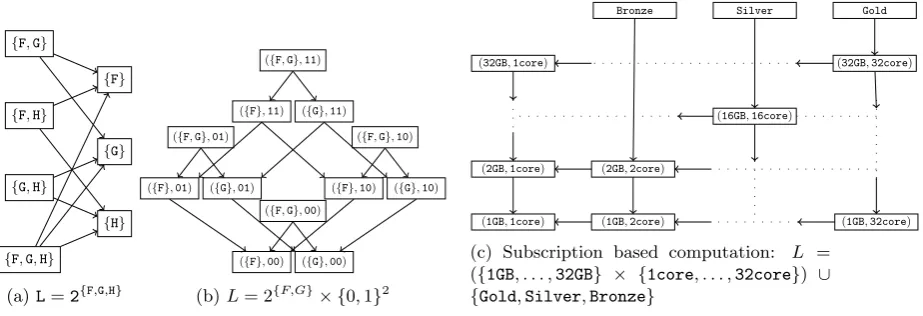
Figure 2: Example Posets of Security Labels
3.1 Delegation and Computation Policies
3.1.1 Policies over Functions
We begin by considering a simple case where policies are formulated purely in terms of the functions being computed. In simple terms, we associate each delegatorC and serverS with a set of functions λ(C) ⊆ F and λ(S) ⊆ F respectively. We define acorrectness criterion that states thatC should be able to prepare inputs for all functionsF ∈λ(C) (and similarly for S) i.e. entities should be able to perform all operations that they are authorized for. The security criterion requires λ(C), λ(S) > λ(F) in order to delegate or compute for F respectively, and that a set of unauthorized entities cannot collude to perform an operation that any of them couldn’t perform alone.
More formally, we define the set of security labelsLto be 2F (the power set of all considered functions). Then, λ(C) ⊆ F defines the set of functions that a delegator C may outsource an evaluation of, λ(S)⊆ F denotes the functions a serverS may compute, and λ(o) ={F}labels the computation ofF ∈ F. Then, for anyx, y∈Lwe define an order relation<such thatx < y
if and only if x∈ F, y ⊆ F and x ∈y. The corresponding Hasse diagram with F ={F, G, H}
is shown in Figure 2a.4 Any entity E authorized for λ(E) is, by the correctness criterion, authorized to operate on all computations such that λ(o) < λ(E). For example, in Figure 2a, an entity authorised for the set λ(E) = {F, G} is authorized for the functions F and G as expected. Each label l∈L will be associated with a key κl. To outsource a computation o of
F(x),C prepares the encoding of xusing the key κo={F}which, by the security criterion,C knows if and only ifλ(C) >λ(o) i.e. if and only if {F} ∈λ(C). To compute F(x),S uses the corresponding key κo. As before, S may do this if and only if {F} ∈λ(S).
3.1.2 Policies over Function Inputs
As well as limiting the functions that may be outsourced, we may wish to implement a more fine-grained access control policy determined by input values to functions. For ease of exposition let us assume that all functions have the same domain – for allF ∈ F,Dom(F) ={0,1}n for a positive, non-zero integern.5 We then redefine the security function such that “objects” are now considered to be pairs (F, x) whereF ∈ Fandx∈Dom(F) – that is,λ:C∪S∪(F ×{0,1}n)→L. We could, for example, let L be 2F × {0,1}n. To define the order relation on L we must first define an ordering on the input data. One choice is to define a co-ordinatewise ordering
4Nodes for empty sets are excluded from these figures. 5
If this is not the case then we can define n = maxF∈F|Dom(F)| and then redefine all functions F with
on {0,1}n: that is (x
1, . . . , xn) 6 (y1, . . . , yn) if and only if xi 6 yi for all i. Then for two labels (G, x) and (G0, x0) in L, (G, x) 6(G0, x0) if and only if G ={F} for some F ∈ F,F ∈ G0 and x 6 x0. This poset could be used to ensure delegators and servers operate over a limited range of data values. Specifically, for an entity E, we define λ(E) = (G, x), where G ⊆ F and
x∈ {0,1}n, and λ(o) = ({F},0n). ThenE is authorized to operate on G(y) for allG∈ G and all y6x. The Hasse diagram for this poset with F ={F, G}and n= 2 is shown in Figure 2b. Different choice of orderings over inputs lead to different restrictions e.g. one could consider bit strings as integers and use the natural ordering over integers for x≤y.
An alternative would be to letLbe the power set 2F ×{0,1}n. Then each function may be asso-ciated with a different range of permissible inputs. An entityE, is labelled by a set of pairs, each comprising a function label and an associated input label –λ(E) ={(F1, x1), . . . ,(Fm, xm)}. A computation ofF(x) is labelledλ(o) = ({F}, x). Then, for any two labels,
{(F1, x1), . . . ,(Fm, xm)}6{(F10, x
0
1), . . . ,(F
0
m0, x0m0)}
if and only if m = 1 (the first label is a single pair), F1 = Fi0 for some i ∈ {1, . . . , m0} and
x1 6x0i.
We remark that the first choice of poset presented in this section corresponds to the idea of assigning a possible data range to each delegator and then authorizing them to outsource a set of functions on that data. For example, a chinese wall policy may result in employees being provided with separate portions of a database. Then, depending on the employee’s role, they are permitted to evaluate a specific set of functions on that data partition. The second choice of poset is more akin to authorizing delegators to outsource a single, specified computation – that is, permitting the entity to evaluate F(x) for only this choice of function and input data. For example, one could imagine an employee being given restricted access to some sensitive data to perform only a particular task, and they should not be able to use the data for other purposes. Finally, we observe that the choice of L= 2F ×2{0,1}n extends this second case to a situation where each function can be associated with an arbitrary sets of input values.
3.1.3 Enforcing General Graph-based Policies
We have seen how sets of functions and inputs can be mapped to a graph-based access control policy to restrict the functions a delegator may outsource and a server may compute. However, in practical applications, outsourced computation functionality will be required to integrate with existing workflows and existing access control policies. As an example, a company that operates Role-based Access Control (RBAC) on their local network and wishes to provide access to an external VC system must ensure that the same access control requirements are adhered to within this new environment. Additionally, it may not always be the case that a computation my be considered purely in terms of the function and input data. Indeed, although the evaluation will be uniquely determined by such factors, the level of protection required may depend on other contextual information. As a motivating example, consider a summation function over the integers. The semantic meaning of the integers in question may determine the overall classification of this computation – if the integers are city populations then this may not be classified at all, but troop deployments in different regions may be much more sensitive. We now briefly discuss how to formulate access control policies for multi-user VC settings that incorporate additional security labels relying on the environment or external access control policies.
Then we can enforce the security functionλ:C ∪ S ∪ O →L=M×2K whereK specifies the nature, andM specifies the sensitivity, of the computationo∈ O. To delegate or computeF(x), we require that the entity E’s clearance level is at least the classification of the computation:
λ(E)>λ(o).
Similarly, it has been shown [12] that the set of roles for a Role-based Access Control Policy can be encoded as a poset. Thus, we could define L to be this role poset to integrate with existing RBAC policies within an organization.
We could also add additional criteria in the mapping to security labels. For example, we could formulate policies dependent on time by setting λ : C ∪ S ∪ (F × T) → L, where T
is a set of time periods. We could then set L = 2F ×T as in the previous section to allow entities to operate on specific functions only during specified time periods. On the other hand, by defining L = M as above, certain functions can be more highly protected during certain times of the day. In place of a temporal poset T we could also apply a geo-spatial poset to classify function evaluations differently depending on location data e.g. a function may be more sensitive if being outsourced from a battlefield as opposed to within a secured building. Finally, policies over function inputs can be extended to include characteristics of the input data (as in the averaging example above, contextual information often changes the level of protection required). LetZ be a set of labels describing data types that functions may be computed over, and defineL= 2F ×({0,1}n×Z) for example. This enables the same input to the same function to be classified differently and hence to require different authorization from the delegator and the server.
As mentioned in the introduction, one interesting setting for multi-user VC is when users pay for computation-as-a-service [17, 21]. Users may pay a price per computation, in which case they could be issued a relevant key such as those discussed in Section 3.1.2, perhaps with a short time window in which they may perform the computation. Then, when outsourcing the compu-tation, it is protected by this key to prove that the user has paid for this particular computation. An alternative model [17] would be for a server to allow subscriptions to different tiers of service. A user may pay more to subscribe to a higher tier, and then may submit multiple computations relating to this tier or lower. For example, consider a set T = {Gold,Silver,Bronze} com-prising tiers that users may subscribe to;Gold service may allow access to more computational resources, or access during busier periods, thanSilver, and so on. For simplicity, suppose the resources to be considered are just RAM capacity and the number of processor cores available, and let R and C be sets comprising the available quantities of each. Then, the set of security labelsLis set to beL= (R×C)∪T — that is, the cartesian product of the available resources, with the addition of labels for each service tier. A user that pays for Gold membership can be assigned the label λ(C) = {Gold}. Each computation is labelled by the resources that it requires. The poset ordering overLallows each tier to access different subsets of resources (e.g. if a computation is particularly memory intensive then it may require a higher subscription fee to compute), as illustrated in Figure 2c.
3.2 Verification Policies
are able to blind verify a result, but the set of entities that may learn the actual output should be restricted6. Thus, the set of verifiers we refer to in the following are just those distinguished
verifiers that are able to retrieve computation results, and we wish to restrict the results that each may read.
The notion of “no write down” is an important property in many traditional access control policies. In the VC setting, this amounts to ensuring that any verifier should at least have the access rights of the delegating or computing entity, that is λ(C), λ(S) 6 λ(V) e.g. a verifier may not read a result arising from input data that he is not also authorized to read. In some cases, however, the KDC may decide that the results of some computations are not as highly classified as the input data, or indeed the act of computing it. For example, statistics of company spending across all departments may be less sensitive than the spending of the research department alone. Alternatively, the results of a computation over classified data may be included in a public document, despite the input data remaining classified The encoded output from the computation may be published with the verification key such that recipients can verify the legitimacy of the published values. It may also be reasonable to expect that only authorised and trusted reviewers of the document should be able to verify, or that some (lower) form of clearance is still required to access the result.
3.2.1 Published Verification Token
In this second case, where verification tokens are published according to some policy, we can use similar posets and security functions to those in Section 3.1. The user population is the set of delegators C and verifiers V, and objects are encoded outputs. The security function is defined to be λV :V ∪ C ∪ O →L, where O is the set of outsourced computations and (L,6) is a poset of security labels. As part of the VC functionality, when encoding an input, C also generates an output retrieval keyRKo that enables the result of a computation to be retrieved given the encoded output and the verification key. We will protect this retrieval key and require the verifier to satisfy the verification policy in order to use it – that is λ(V)>λ(o) foro∈ O. Since the delegator generates the retrieval key, and hence may also use it to retrieve the output, we also assume λ(C) > λ(o). This is reasonable given that the delegator must have the right to compute any function that he outsources and hence (resources permitting) could certainly learn the result. As before we can extend the definition of λ and of L to accommodate more fine-grained policies over outputs.
3.2.2 Enforcement of No Write Down Policies
As mentioned, “No Write Down” is an important requirement of many access control policies. It ensures that an entity C may not write (encrypt) an object to a lower classification level
λ(o) < λ(C) as this could constitute a leak of classified data. It is, of course, possible for a delegator to write the result at his (maximal) clearance level and then any verifiers with higher access rights, by the correctness criterion of the poset, will be able to read the result. However, we may want to protect a result at a higher classification level (write up) e.g. when preparing a report that should only be read by management.
To do so, we define two posets: a computation poset PC = (L,6) (as per Section 3.1) and a verification poset PV. PV is constructed by inverting the order relation on PC where
PV = (L,>) i.e. x 6 y in PV if and only if y 6x in PC. Then, delegation and computation of o ∈ O are performed using a key associated to λC(o) ∈ PC. Retrieving the result of a
computation requires a key related to λV(o)∈ PV. A verifier V may then retrieve the output if and only if λV(V)>λV(o).
4
PVC with Access Control
We now formally define the notion of PVC-AC to enforce graph-based access control policies over delegators, servers and verifiers. Generally, as discussed above, we wish to impose restrictions on three activities: first, we wish to specify a (write) policy determining the computations a client is authorized to delegate – this means restricting the inputs a client may correctly prepare; second, we specify a (read) policy that determines the computations a server may compute – that is, encoded inputs he may access; lastly, we specify a (read) policy dictating the outputs a verifier may read. We differentiate between computation policies over delegators and servers, denotedλC(·), and verification policies over delegators and verifiers, denotedλV(·). We may also use λ(·) to denote both labels where appropriate. Finally,PC and PV denote posets encoding the computation and verification policies respectively. Recall that the set of outsourced computations is denoted byO. A specific elemento∈ O consists of the function F, some input
x as well as some auxiliary input (such as a label or additional contextual information). We extend the functionality of the KDC from [2] to grant access control credentials to delega-tors, servers and verifiers. We may split the responsibilities between two KDCs: a computation KDC (CKDC) that generates function keys for the VC functionality, and anauthorization KDC (AKDC) that manages access control policies. The AKDC could be a trusted authority on en-tities to grant relevant permissions, and may be used by multiple systems. For clarity, here we use only one KDC that performs both duties.
Definition 4. A Publicly Verifiable Outsourced Computation Scheme with Access Control (PVC-AC)comprises the following algorithms:
• (PP,MK)← Setup(1κ,PC,PV): Run by the KDC to generate public parameters for the PVC-AC system as well as secret information used to generate keys.
• P KF ← FnInit(F,MK,PP): Run by the KDC to generate a delegation key, P KF, for a functionF.
• SKID←Register(ID, λ(ID),MK,PP): Run by the KDC to create a personalised keySKID
for an entity with identifier ID,7 which grants rights for the labelλ(ID) according to the
computation or verification policy.
• EKF,S←Certify(S, F,MK,PP): The KDC creates an evaluation keyEKF,Sfor a function
F and serverS.
• (σo, V Ko, RKo)←ProbGen(x, SKC, P KF, λ(C), λ(o),PP): Run by a delegatorC to out-source the computation of F(x). C may do so only if it satisfies the computation policy – that is λC(C) > λC(o). It outputs an encoded input σo, a public verification key
V Ko to verify correctness, and an output retrieval key RKo which verifiers satisfying
λV(V)>λV(o) may use to readF(x).
• θo←Compute(σo, EKF,S, SKS, λC(S), λC(o), P P): Run by a serverS holding an evalua-tion keyEKF,S,SKS and an encoded input σo to evaluateF(x) and output an encoding,
θo, of the result. This succeeds if and only if λC(S) > λC(o), that is S satisfies the computation policy for this evaluation.
• (˜y, τθo)←Verify(θo, SKV, V Ko, λ
V(V), λV(o),PP):
Verification comprises two steps:
– (RTo, τθo)← BVerif(PP, θo, V Ko): Run by any verifier to produce a retrieval token RTo
and a token τθo = (accept, S) for a correct result, orτθo = (reject, S) to signify a cheating
serverS.
– ˜y ← Retrieve(SKV, RTo, τθo, V Ko, RKo, λ
V(V), λV(o),PP): Run by verifiers V in
pos-session of the output retrieval key RKo and the retrieval token RTo from BVerif. If
λV(V)>λV(o) thenV should be able to read the actual result ˜y=F(x) or⊥.
• {EKF,S0} or ⊥←Revoke(τθ
o, F,MK,PP): If a verifier reports a misbehaving server (i.e. Verify returned τθo = (reject, S)), the KDC issues updated evaluation keysEKF,S0 to all
servers, preventingS from performing further computations. Ifτθo = (accept, S) then this
algorithm should output⊥.
We say that a PVC-AC scheme is correct if for all functions F ∈ F, inputs x, honestly generated parameters, and honestly registered entities C, S and V (delegator, certified server and verifier respectively)such that λC(C), λC(S) > λC(o) and λV(C), λV(V) > λV(o), if S
honestly runsComputeforF on an encoding ofx generated byC, thenV runningVerifyon the output from S will almost certainly output acceptand F(x). That is, if all algorithms are run honestly by authorised parties then the verifier should almost certainly accept. More formally we can write
Definition 5(Correctness). A Publicly Verifiable Outsourced Computation Scheme with Access Control (PVC-AC) is correct for a family of functionsF if for all functions F ∈ F and inputs
x, where negl(·) is a negligible function of its input:
Pr[(PP,MK)←Setup(1λ), P KF ←FnInit(F,MK,PP),
SKC ←Register(C, λ(C),MK,PP), SKS ←Register(S, λ(S),MK,PP),
SKV ←Register(V, λ(V),MK,PP), EKF,S ←Certify(S, F,MK,PP),
(σo, V Ko, RKo)←ProbGen(x, SKC, P KF, λ(C), λ(o),PP),
(F(x),(accept, S))←Verify(Compute(σo, EKF,S, SKS, λC(S), λC(o), P P), SKV,
V Ko, λV(V), λV(o),PP)] = 1−negl(λ),
where λC(C)>λC(o), λV(C)>λV(o), λC(S)>λC(o) and λV(V)>λV(o) holds.
5
Security Definitions
function, input and environmental factors) such that λ(o) encompasses the required clearance to operate on this computation. AO denotes A having oracle access to the following func-tions: FnInit(·,MK,PP),Register(·,·,MK,PP),Certify(·,·,MK,PP),ProbGen(·, SK(·),·,·,·,PP), Compute(·,·, SK(·),·,·, P P) and Revoke(·,·, ,MK,PP). Each oracle, aside fromRegister, simply runs the relevant algorithm, with any restrictions on permissible queries stated below. The
Register oracle specified in Oracle Query 7 is used in all games except Authorized Verification which instead uses Oracle Query 8 which uses the verification policy instead of the computation policy. We define the advantage and security of Ain each of the following gamesas:
Definition 6. The advantage of a PPT adversary A making a polynomial number of queries
q is defined as follows:
• For X∈ {AO, AC}:
AdvAX(PVCAC, F,1κ, q) = Pr[ExpXA[PVCAC, F,1κ] = 1]
• For X∈ {AV, wIP}:
AdvXA(PVCAC, F,1κ, q) =|Pr[ExpXA[PVCAC, F,1κ] = 1]− 1
2|
A PVC-AC is secureagainst GameXfor a functionF, if for all PPT adversariesA, AdvXA(PVCAC,
F, 1κ,q) 6 negl(κ).
5.1 Authorized Outsourcing
In Game 5 we formalize the notion that a delegator may not outsource any computation for which he is not authorized – that is, any computation o where λC(o) 66 λC(C). Clearly, within our framework we cannot make any guarantees about what an entity may do externally. For instance, we cannot enforce that a client does not circumvent the access control policies using an external server not subject to these controls, however we do enforce that to use the provided functionality (i.e. to contract an available server registered in this system) they must prove authorization. This assumption seems reasonable, taking into consideration organizational boundaries – external control should perhaps be enforced by limiting external communication channels (e.g. using a strict firewall). Similarly, we cannot enforce that an entity does not share key content, but we do ensure that such collusion does not enable access that either entity alone could not access. Additionally, due to the revocation functionality, it may be undesirable for a server to share key material as he must trust the additional server not to cheat.
The game proceeds as follows. First the challenger runs the setup procedures for the scheme and registers the adversary for the adversary’s choice of security label. The adversary is given the public information, his secret key and oracle access, and outputs a choice of outsourced computation o to attack, including the function and input, F and x. We require that no security label that A has queried to the Register oracle may allow the derivation of a key for
λC(o) as this would be a trivial win, and we return 0 since the adversary has not found a valid attack target. We also require that any ID that A queries to its oracle must previously have been queried to theRegister oracle (which is in keeping with realistic operation). The ProbGen
oracle may not be queried on the challenge computationo. Note thatAmay register entities of his choice for any security label that is not an ancestor of the challenge label, and hence does not need oracle access for these labels. BVerif relies only on public information andA mayRegister
any verifier he likes to learn κλV(·) to runRetrieve, so these oracles are not required. C sets up
Game 5 ExpAOA [PVCAC, F,1κ]:
1: L=, o=⊥
2: (PP,MK)←Setup(1κ,PC,PV);
3: λC(A)← AO(PP);
4: SKA←Register(A, λC(A),MK,PP); 5: L=L∪λC(A);
6: o= (F, x,aux)← AO(λC(A), SK
A,PP); 7: forallλC(v
i)∈Ldo
8: ifλC(o)6λC(v i)then
9: return 0
10: SKS←Register(S, λC(S),MK,PP)s.t.λC(S)>λC(o);
11: SKV ←Register(V, λV(V),MK,PP)s.t.λV(V)>λV(o);
12: P KF ←FnInit(F,MK,PP);
13: EKF,S←Certify(S, F,MK,PP);
14: (σo, V Ko, RKo)← AO(o, λ(o), λ(A), P KF,PP);
15: θo←Compute(σo, EKF,S, SKS, λC(S), λC(o),PP);
16: (˜y, τθo)←Verify(θo, SKV, V Ko, λV(V), λV(o),PP);
17: if ((˜y, τθo)6= (⊥,(reject,A)))then return1
18: else return0
Oracle Query 7 ORegister(ID, λ(ID),MK,PP):
1: if (o6=⊥)∧λ(ID)>λC(o) then
2: return ⊥ 3: L=L∪λ(ID);
4: return SKID←Register(ID, λ(ID),MK,PP)
and verification fororespectively. The adversary is then challenged, given all information that a real attacker may learn and oracle access, to output an encoded input that theCompute and
Verify algorithms will accept – that is, an unauthorized adversary must produce an input that is accepted and computed on by honest entities.
5.2 Authorized Computation
Authorized Computation, in Game 6, proceeds similarly to Game 5 and captures the notion that a computational result should only be considered valid if generated by an authorized party. The challenger sets up the system and registers the adversary for its choice of security label. A
then chooses a target computation that it is not authorized to compute by any of the keys it holds. The challenger simulates two entities: a delegator and a verifier that are authorized for this computation and certifiesA as a server forF. The challenger creates an encoded input by runningProbGen on the adversary’s target computation and gives this to A who must output an encoded output that is accepted by the verifier. Note that although the adversary chooses the input to the computation, and therefore can certainly compute F(x), it still should not be able to convince the verifier to accept. The oracle queries are the same as in the previous section except that ProbGen may be queried for any input (even the challenge computation) and the
Computeoracle cannot be run on the challenge input.
5.3 Authorized Verification
Game 6 ExpACA [PVCAC, F,1κ]:
1: L=, o=⊥
2: (PP,MK)←Setup(1κ,PC,PV);
3: λC(A)← AO(PP);
4: SKA←Register(A, λC(A),MK,PP); 5: L=L∪λC(A);
6: o= (F, x,aux)← AO(λC(A), SK
A,PP); 7: forallλC(v
i)∈Ldo
8: ifλC(o)6λC(v i)then
9: return 0
10: SKC←Register(C, λC(C),MK,PP)s.t.λC(C)>λC(o);
11: SKV ←Register(V, λV(V),MK,PP)s.t.λV(V)>λV(o);
12: P KF ←FnInit(F,MK,PP);
13: EKF,A←Certify(A, F,MK,PP);
14: (σo, V Ko, RKo)←ProbGen(x, SKC, P KF, λ(C), λ(o),PP);
15: θo← AO(σo, V Ko, o, λC(o), EKF,A, P KF, RKo,PP);
16: (˜y, τθo)←Verify(θo, SKV, V Ko, λV(V), λV(o), RKo,PP);
17: if ((˜y, τθo)6= (⊥,(reject,A)))then return1
18: else return0
Game 7 ExpAVA [PVCAC, F,1κ]:
1: L=, o0=o1=⊥ 2: (PP,MK)←Setup(1κ,P
C,PV);
3: λV(A)← AO(PP);
4: SKA←Register(A, λV(A),MK,PP); 5: L=L∪λV(A);
6: (o0, o1) $
← AO(SK
A,PP) s.t. λV(o0), λV(o1)> λV(vi)∀λV(vi)∈L;
7: b← {$ 0,1};
8: SKC←Register(C, λC(C),MK,PP)s.t.λC(C)>λC(ob);
9: SKS←Register(V, λC(S),MK,PP)s.t.λC(S)>λC(ob);
10: P KF ←FnInit(F,MK,PP);
11: EKF,S←Certify(S, F,MK,PP);
12: (σob, V Kob, RKob)←ProbGen(x, SKC, P KF, λ(C), λ(ob),PP);
13: θob←Compute(σob, EKF,S, SKS, λ
C(S), λC(o b),PP);
14: b0← AO(θ
ob, V Kob, RKob, λ(o0), λ(o1), SKA, P KF,PP);
15: if b0=bthen return1 16: else return0
Oracle Query 8 ORegister(ID, λ(ID),MK,PP):
1: if (ob 6=⊥)∧λ(ID)>λV(ob)then 2: return ⊥
3: L=L∪λ(ID);
4: return SKID←Register(ID, λ(ID),MK,PP)
output from this computation, along with the verification keys and other public information, and must guess which computation was chosen. As the adversary chose the computations, it can work out the results; however, no information about the result should leak from the encoded output unless the verifier is authorized, and hence the adversary should be unable to tell which result the output corresponds to. The oracle queries are the same as in the previous section except that ProbGen and Compute may be queried for any input. The adversary is also given access to a Retrieveoracle (which cannot be queried for the challenge computation) in order to observe outputs for the challenge label.
5.4 Weak Input Privacy
they are working on. Instead, we are interested in ensuring that servers (or other entities) that are not authorized to access (compute on) the input data may not learnx. If full input privacy is required then the underlying PVC scheme, such as the KP-ABE based one used as a black box in the construction, could be replaced by one built from a predicate encryption scheme for the same class of functions.
The game begins like the Authorized Verification game with the adversary selecting two computations that he is not authorized for byanykey that he has queried to theRegisteroracle. The Compute oracle can be queried for any input except the challenge inputs. The challenger then simulates the outsourcing of one of these computations and gives the adversary the resulting encoded input. The adversary must guess which computation the input corresponds to i.e. which input data is encoded in the input.
Game 8 ExpwIPA [PVCAC, F,1κ]:
1: L=, o=⊥
2: (PP,MK)←Setup(1κ,P C,PV);
3: λC(A)← AO(PP);
4: SKA←Register(A, λC(A),MK,PP); 5: L=L∪λC(A);
6: (o0, o1) $
← AO(SK
A,PP) s.t. λC(o0), λC(o1)> λC(vi)∀λC(vi)∈L;
7: b← {$ 0,1};
8: o=ob;
9: SKC←Register(C, λC(C),MK,PP)s.t.λC(C)>λC(ob);
10: P KF ←FnInit(F,MK,PP);
11: EKF,A←Certify(A, F,MK,PP);
12: (σob, V Kob, RKob)←ProbGen(x, SKC, P KF, λ(C), λ(ob),PP);
13: b0← AO(σ
ob, V Kob, λ(o0), λ(o1), EKF,A, SKA, P KF,PP);
14: if b0=bthen return1
15: else return0
6
Instantiation
We now provide an example provably secure instantiation of PVC-AC. The approach we take makes generic, black-box use of existing RPVC schemes such as the Key-policy Attribute-based Encryption approaches [2, 20], and introduces the use of a symmetric Key Assignment Scheme (KAS) to restrict the behaviour of entities.
6.1 Informal Overview
The graph-based policies discussed in Section 3 assign labels to each entity and outsourced computation. The ordering relation and the correctness criterion ensures that entities are au-thorized for all appropriate computations (those that are descendants of their label in the Hasse diagram of the poset). A KAS is designed to enforce such policies, and assigns a key to each label. Each entity is provided with a key corresponding to their label, and they may derive keys for all descendants. As per the security criterion, users may not collude to derive keys for which they are not authorized.
the key, κλC(o), associated to the computation within the computation poset. To do so, the
delegator must be able to derive κλC(o) and hence must hold a key at that level or higher
i.e. λ(C) > λ(o) – delegators must be authorized by the KDC to outsource the computation. Similarly, only authorized servers can derive the decryption key to access the encoded input and perform the computation. By the IND-CPAsecurity of the symmetric encryption scheme
used, no information about the encoded input is learnt by an unauthorized entity. To enforce verification policies, delegators generate a retrieval key during delegation, and encrypt this using an appropriate key from the verification KAS. Then, only verifiers that can derive this key may decrypt the ciphertext to recover the retrieval key and learn the output.
6.2 Formal Details
LetRPVC= (RPVC.Setup,RPVC.FnInit,RPVC.Register,RPVC.Certify,RPVC.ProbGen,
RPVC.Compute,RPVC.BVerif,RPVC.Retrieve,RPVC.Revoke) be an RPVC scheme, as defined by Alderman et al. [2], for a class of functionsF. LetSE= (SE.KeyGen,SE.Encrypt,SE.Decrypt) be an authenticated symmetric encryption scheme secure in the sense ofIND-CPA∧INT-PTXT,
and let KAS = (KAS.MakeKeys, KAS.MakeSecrets, KAS.MakePublicData, KAS.GetKey) be a Key Assignment Scheme secure against Strong-Key Indistinguishability8 whose keys are compatible with SE. Finally, let PC denote the poset encoding computation policies (e.g. (L,6)), and similarly let PV denote the poset encoding verification policies (e.g. (L,>))9. Then, for the same class of functions F, there is a PVC-AC schemePVCAC = (PVCAC.Setup,
PVCAC.FnInit, PVCAC.Register,PVCAC.Certify, PVCAC.ProbGen,PVCAC.Compute,PVCAC.Verify,
PVCAC.Revoke) defined in Algorithms 1-9.
Alg. 1Setup(1κ,PC,PV)→(PP,MK)
1: (PP0,MK0)←RPVC.Setup(1κ)
2: κPC ←KAS.MakeKeys(1κ,PC)
3: ωPC ←KAS.MakeSecrets(1κ,PC)
4: P ubPC ←KAS.MakePublicData(1
κ,P C)
5: κPV ←KAS.MakeKeys(1κ,PV)
6: ωPV ←KAS.MakeSecrets(1
κ,P V)
7: P ubPV ←KAS.MakePublicData(1κ,PV)
8: Set PP = (PP0, P ubPC, P ubPV)
9: Set MK = (MK0, κ
PC, ωPC, κPV, ωPV)
Alg. 2FnInit(F,MK,PP)→P KF
1: P KF ←RPVC.FnInit(F,MK0,PP0)
Alg. 3Register(ID, λ(ID),MK,PP)→SKID
1: ifID is a serverthen
2: SKID0 ←RPVC.Register(ID,MK0,PP0)
3: SKID= (SKID0 , κλC(ID), ωλC(ID))
4: else ifID is a delegatorthen
5: SKID= (κλC(ID), ωλC(ID), κλV(ID), ωλV(ID))
6: else
7: SKID= (κλV(ID), ωλV(ID))
Alg. 4Certify(S, F,MK,PP)→EKF,S
1: EKF,S←RPVC.Certify(S, F,MK0,PP0)
8It has been shown that S-KI is equivalent to KI [9]. We make use of the additional queries in the S-KI game,
but due to the equivalence this is not a strengthening of the assumptions. It in interesting to note that the form of the S-KI game is useful as a proof technique besides the original motivation to reflect realistic attacks.
9
We useκPC to denote the set of all keys generated by the KAS for the computation poset PC and, for a
Alg. 5ProbGen(x, SKC, P KF, λ(C), λ(o),PP)→(σo, V Ko, RKo)
1: (σ0
o, V Ko, RKo0)←RPVC.ProbGen(x, P KF,PP0)
2: κλC(o)←KAS.GetKey(λC(C), λC(o), ωλC(C),PP) 3: κλV(o)←KAS.GetKey(λV(C), λV(o), ωλV(C),PP)
4: if(κλC(o)6=⊥) and (κλV(o)6=⊥)then 5: σo= (λC(o),SE.Encrypt(σ0o, κλC(o)))
6: RKo= (λV(o),SE.Encrypt(RKo0, κλV(o)))
Alg. 6Compute(σo, EKF,S, SKS, λC(S), λC(o),PP)→θo
1: Parseσo as (λC(o), c)
2: κλC(o)←KAS.GetKey(λC(S), λC(o), ωλC(S),PP) 3: ifκλC(o)=⊥then
4: return ⊥
5: else
6: σ0
o←SE.Decrypt(c, κλC(o))
7: if σ0o=⊥then return⊥
8: else θo←RPVC.Compute(σo0, EKF,S, SKS, P P0)
Alg. 7BVerif(θo, V Ko,PP)→(RTo, τθo):
1: (RTo, τθo)←RPVC.BVerif(θo, V Ko,PP
0)
Alg. 8Retrieve(RTo, τθo, V Ko, RKo, λ
V
(V), λV(o),PP)→y˜: 1: ParseRKo as (λV(o), e)
2: κλV(o)←KAS.GetKey(λV(V), λV(o), ωλV(V),PP)
3: ifκλV(o)=⊥then
4: return ⊥
5: else
6: RKo0←SE.Decrypt(e, κλV(o))
7: y˜←RPVC.Retrieve(RTo, τθo, V Ko, RK
0
o,PP0)
Alg. 9Revoke(τθo, F,MK,PP)→ {EKF,S0}or ⊥
1: return RPVC.Revoke(τθo, F,MK,PP
0)
We now give a theorem and proof that the construction presented above is secure against the games presented in Section 5.
Theorem 1. Given any Strong-Key-Indistinguishability secure KAS, any RPVC scheme secure in the sense of Public Verifiability, Revocation, and Blind Verification, and an authenticated symmetric encryption scheme secure in the sense of IND-CPA∧INT-PTXT, let PVCAC be the PVC-AC scheme defined in Algorithms 1-9. Then PVCAC is secure in the sense of Public Verifiability, Revocation, Blind Verification, Authorized Outsourcing, Authorized Computation, Weak Input Privacy, and Authorized Verification.
Informally, the security proofs follow from the security of the underlying RPVC scheme and the S-KI andIND-CPAsecurity properties. The proofs for Public Verifiability, Revocation and
Blind Verification are similar to the proofs given by Alderman et al. [2] up to some syntactical changes. We now present a formal proof for Theorem 1.
6.3 Security Proofs
Lemma 1. Given a secure RPVC scheme, a symmetric authenticated encryption scheme secure in the sense ofIND-CPA∧INT-PTXT and a KAS secure against Strong-Key Indistinguisha-bility, let PVCAC be the PVC-AC scheme defined in Algorithms 1–9. Then PVCAC is secure in the sense of Authorized Outsourcing (Game 5).
Proof. LetAV C be an adversary with non-negligible advantageδin the Authorized Outsourcing game and letASEbe an adversary playing theIND-CPAgame with a challengerC againstSE.
a negligible difference between the two. We can then use an adversary against this modified game to break theIND-CPAsecurity of the symmetric encryption scheme.
• Game 0. This is the Authorized Outsourcing game as defined in Section 5.1.
• Game 1. This is identical to Game 0, except that we replace the key κλC(o) for the
challenge computation owith a random key κ? drawn uniformly from the keyspace.
Game 0 to Game 1 This game hop relies on the Strong Key Indistinguishability (S-KI) of
the KAS. Suppose an adversary AV C exists that can distinguish Game 0 from Game 1with non-negligible advantage δ. Then there exists an adversary ASE that breaks the S-KI of the
KAS also with advantageδ. AV C will play eitherGame 0 orGame 1 withASE acting as the challenger, and must guess correctly which game he is playing. ASE in turn will play theS-KI
game with a challengerC. This reduction is important to ensure that no additional information about the encryption key is leaked through the construction.
1. C begins by selecting a bit b ← {$ 0,1} which will determine whether the challenge key is real or random, and hence whether AV C plays Game 0 or Game 1. C continues by instantiating the KAS in lines 1 to 5 and giving the public information to ASE.
2. ASEruns lines 1 and 2 of the Authorized Outsourcing game, and sendsAV C the generated public parameters. During theSetup algorithm in line 2, ASE will not run lines 2 to 4 of Algorithm 1. Instead, it will set P ubPC to be the challenge public information from the
S-KI challengerC and will make use of oracle queries to C for the remaining parameters.
3. AV C is then given oracle access. Queries to the FnInit, Certify and Revoke functions can be answered simply by running the corresponding algorithm. Queries to the remaining algorithms may need to make use of KAS derived keys. ASE can use its knowledge of the verification poset and the corresponding KAS which it owns where appropriate but it does not know anything other than the public information for the computational poset, because this is the challenge poset for theS-KI game. Thus,ASE will issueCorruptoracle queries to retrieve the necessary keys and secret information for the queried identity label. Since AV C has not yet chosen a challenge computation o, andASE has not yet chosen a challenge nodev?, theCorruptoracle will always return a valid key and secret pair, which
ASE can use to form a full, valid response forAV C.
4. AV C will select a challenge security labelλC(A) for itself, whichASE will register it for using anotherCorrupt oracle query to C – that is, it will query OCorrupt(λC(A),⊥) in the S-KI game. C will add λC(A) to the list Q and return (κλC(A), ωλC(A)). Additionally,
ASE may run RPVC.Register(A,MK0,PP0) to create SKA0 . Finally, ASE sets SKA = (SKA0 , κλC(A), ωλC(A)) as well as updating the list toL=L∪λC(A).
5. AV C is again given oracle access which ASE can respond to as above. Eventually, AV C will output a challenge computation o. ASE will sendλC(o) to C as the challenge node
v? for the S-KI game. Note that this is a valid challenge in the S-KI game since, in the
Authorized Outsourcing game,AV C may not choose a challenge computationofor which he is authorized – that is, any o such that λC(o)6λC(vi) for any λC(vi) queried to the
Registeroracle. This corresponds precisely to the condition on the choice ofv?in theS-KI
game. C will return a keyκ? which corresponds either to the real keyκλC(o) or a random
6. ASE must now simulate a server and a verifier. It does this by first registering two such entities, S and V respectively, that are authorized to compute and verify o respectively. It setsλC(S) =λC(o) and henceκλC(S)=κ?. Note that this is the only part ofSKS that
is required, and in particular ωλC(S) is not required (as this is only needed for deriving
keys, and S will only need to useκ?). To register S,ASE runs Register and setsSKS = (SKS0, κ?,⊥). Furthermore, to registerV,ASE setsSKV = (κλV(V), ωλV(V)).
7. ASE then runs lines 12 and 13 as written in the Authorized Outsourcing game. It can also run theComputealgorithm as it knows κλC(o) fromκλC(C), and Verifyas it owns the
verification KAS. ASE can therefore return the result of the game toAV C as expected.
Now, AV C has been provided all information that an adversary against the Authorized Outsourcing game would be given and will guess which game he is playing with advantage δ. Notice that the distribution of the game generated byASEis precisely that ofGame 0 ifb= 0 (i.e. the real KAS key is used), and is precisely that ofGame 1otherwise, if a random key was chosen. Thus, ASE can simply forwardAV C’s guess to C as its guess in theS-KI game. Thus
we conclude that ifAV C guesses correctly with non-negligible advantageδ, thenASE can break the Strong-Key Indistinguishability of the KAS also with non-negligible advantageδ. Since we assumed the KAS was S-KI secure, such an adversary may not exist and hence Game 0 is
indistinguishable fromGame 1 except with at most a negligible advantage61−δ.
Reduction to INT-PTXT We have shown that, from the adversary’s point of view,Game 1 is almost (with negligible distinguishing advantage) identical toGame 0. Thus, we may run the adversary againstGame 1instead with at most anloss in the tightness of the reduction. In essence, we have now removed any information leakage from the KAS. Suppose AV C is an adversary with non-negligible advantageδ inGame 1. We now show that we can construct an adversaryASE that breaks theINT-PTXTsecurity of the authenticated symmetric encryption
scheme SE using AV C as a subroutine. LetC be the INT-PTXT challenger for ASE who in turn acts as the challenger inGame 1 forAV C.
1. C begins by initializing the list L and running SE.KeyGen(1κ) to generate a key κ?. It sends the security parameter 1κ toASE.
2. ASE must now initialize Game 1 forAV C. Informally, it will set the KAS key for the label
λC(o) to be the random key κ? chosen by C. However, the challenge label is unknown until AV C chooses it, whilst the public parameters and oracle access must be provided before this choice. Thus, we require ASE to guess the challenge label during Setup so that the correct key can be implicitly set to be the INT-PTXT challenge key (and all
encryptions under that key can be formed using oracle access to C). If the number of labels in the poset isN, whereN is polynomial in the security parameter (as the scheme must be efficiently instantiable), then ASE may guessλC(o) with probability at least N1. Assuming that the guess is correct, we proceed as follows.
3. ASE runsPVCAC.Setupas given in Algorithm 1 with the modification that the key for the
guessed label in the computation poset, κλC(o) is implicitly set to be the key generated
by C in the IND-CPA game and the KAS is made to be consistent with this choice. Of