Article
1
Radar Detection of Fluctuating Target in
Heavy-2
tailed Clutter Using TBD
3
Jie Gao 1, 2,*,Jinsong Du 1 and Wei Wang 1, 2
4
1 Shenyang Institute of Automation, Chinese Academy of Sciences, Shenyang 110016, China; [email protected]
5
2 University of Chinese Academy of Sciences, Beijing 100049, China; [email protected]
6
* Correspondence: [email protected]; Tel.: +86-24-8360-1084
7
8
Abstract: This paper considers the detection of fluctuating target in heavy-tailed clutter through the
9
use of dynamic programming based on track-before-detect (DP-TBD) in radar systems. The clutter
10
is modeled in terms of K-distribution, which can be widely used to describe non-Gaussian clutter
11
received from high-resolution radars and radars working at small grazing angle. Swerling type 1 is
12
considered to describe the target fluctuation between scans. Conventional TBD techniques suffer
13
from significant performance loss in heavy-tailed environments due to the more frequent
14
occurrences of target-like outliers. In this paper, we resort to DP-TBD algorithm based on prior
15
information, which can enhance the detection performance by using the environment and target
16
fluctuating information during the integration process of TBD. Under non-Gaussian background,
17
the expressions of the likelihood ratio merit function for Swerling type 1 target are derived first.
18
However, the closed analytical form of the merit function is difficult to be obtained. In order to
19
reduce the complexity of evaluating the merit function and the computational load, an efficient
20
approximation method as well as a two-stage detection approach is proposed and used in the
21
integration process. Finally, several numerical simulations of the new strategy and the comparisons
22
are presented to verify that the proposed algorithm can improve the detection performance,
23
especially for fluctuating target in heavy-tailed clutter.
24
Keywords: target detection; radar systems; K-distributed clutter; heavy-tailed; Swerling target;
25
track-before-detect (TBD)
26
27
1. Introduction
28
The detection of fluctuating target with low signal-to-clutter ratio (SCR) is of significant
29
importance in radar systems. Conventional detecting and tracking algorithms use thresholded
30
detection as input. Target with low signal-to-clutter ratio is often lost due to the information is
31
irreversibly discarded after thresholding. Multi-frame integration is an effective strategy used in
32
radar applications to detect dim target by integrating signal returns over multiple consecutive scans.
33
In the presence of moving target, multi-frame integration requires track-before-detect (TBD)
34
techniques to correctly correlate data over time.
35
Dynamic programming based on TBD (DP-TBD) is one of the TBD techniques [1,2], which has
36
attracted extensive attention for the advantages of simplicity and needing less information. It
37
transforms the integration into an optimal estimation of the physically admissible trajectory by
38
maximal integration value of the merit function, which is a kind of multi-frame test statistic. DP-TBD
39
can detect target of arbitrary motion form and has been widely applied to several kinds of sensors
40
[3,4]. In order to solve the problem of high-dimensional maximization under multi-target
41
environment, a novel partition method to cluster targets into well separate groups was proposed
42
in[5]. In [6,7], the track formation procedure with successive track cancellation (STC) was described
43
to overcome the performance loss when targets are closely-spaced. Meanwhile, research on the merit
44
function of DP-TBD has also been widely carried out in recent years. In [8-10], the expressions for the
45
log-likelihood ratio (LLR), which can better discriminate clutter-plus-target measurements from
46
clutter only measurements, were derived and used. In addition, a low-complexity power-efficient
47
TBD procedure, where the generalized likelihood ratio test (GLRT) was solved using a Viterbi-like
48
tracking algorithm, was proposed in [11]. To reduce the big computational burden of DP-TBD,
49
computationally efficient DP-TBD algorithms were derived in [12] and [13] respectively.
50
The above quoted papers on DP-TBD techniques always assumed that the background is
51
Gaussian distributed with known power. However, for high resolution radars and radars at small
52
grazing angle, the Gaussian assumption may or may not be adequate. In this case, more heavy-tailed
53
background models should be considered in the real world. Weibull distribution, log-normal
54
distribution and K-distribution are the commonly Compound-Gaussian background models used in
55
radar communities. This paper is mainly concerned with K-distribution, which is widely used in high
56
resolution radar detection systems. K-distribution [14,15]was derived from a paper by Eric Jakeman
57
and Peter Pusey (1978) who used it to model microwave sea echo. It has been found to be a suitable
58
model for heavy-tailed background in radar systems [16], since it provides an excellent agreement
59
between theoretical and experimental data. K-distribution also arised as the consequence of a
60
statistical or probabilistic model used in Synthetic Aperture Radar (SAR) imagery.
61
As the signal strength may change from scan to scan, these fluctuations should be taken into
62
account when building the measurement models. Swerling family of target amplitude fluctuation
63
models are commonly used to capture the RCS changes over time [17]. Swerling target of types 0 can
64
be used to model a target with constant RCS, while Swerling target of types 1 is used to model a
65
target whose RCS fluctuates according to the exponential density in radar systems.
66
Target detection in K-distributed background is more challenging than in Gaussian or Rayleigh
67
distributed background due to the higher likelihood of target-like outliers, especially for fluctuating
68
target. Besides, it is inefficient and computational costly to carry out accurate search for all the
69
discrete states, as the surveillance region is much larger than the size of a target, such as radar target
70
detection. In this paper, attention is devoted to the detection of Swerling target of type 1 in a
71
surveillance region characterized by K-distributed background through the use of DP-TBD.
72
Moreover, by employing two-stage detection approach, the proposed algorithm is able to achieve
73
further computational reduction. The main contributions of this paper are given as below:
74
75
1. In order to limit complexity while still retain the benefits of DP-TBD, we resort to two-stage
76
detection process with different resolution cells.
77
2. For typical non-Gaussian distributed clutter (K-distribution) and typical target amplitude
78
fluctuation model (Swerling 1), the DP-TBD algorithm based on prior information is proposed.
79
By using the likelihood ratio merit function in DP integration, the performance loss produced
80
by the “heavy-tailed” clutter measurements can be reduced.
81
3. An efficient but accurate approximation method is proposed to reduce the complexity of
82
evaluating the merit function.
83
84
The remainder of this paper is organized as follows: Section 2 presents the notations and system
85
models. In Section 3, two-stage detection approach is proposed at first, the expressions of the
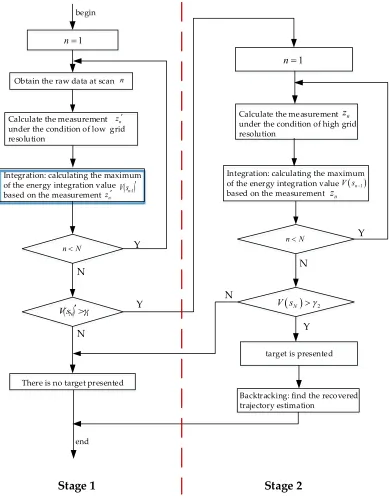
86
likelihood ratio merit function are derived in K-distributed clutter background for Swerling target of
87
types 1, the implementation issues of the merit function are also discussed. Simulation results are
88
showed by comparing different DP-TBD strategies in Section 4 and Section 5 provides some
89
conclusions.
90
2. Models and Notations
92
2.1. Kinematic Model
93
radar
target
rn,n
n n r
Figure 1. Radar surveillance region illustration.
94
As shown in Figure 1, we assume that there is only one target in the surveillance region, whose
95
kinematic state at scan n is denoted by the vector sn . The kinematic vector sn is specified by
96
2, 1
n n n
s r , n N (1)
where
'
denotes matrix transpose, rnand n denote the range and azimuth measurement97
respectively, 2
denotes the two-dimensional state space and
N
denotes the number of98
consecutive frames processed in a DP-TBD integration batch. The evolution of the target state is
99
modeled by the linear process as
100
1
n n n
s Fs w (2)
The term wn is the process noise,
F
is the transition matrix.101
Every real target must comply with some physical constrains on its kinematics, such as the
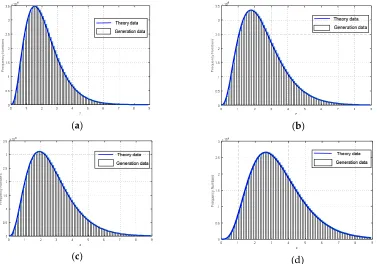
102
maximum target velocity considered in this paper. The radial and tangential velocity can be
103
calculated by two successive scans, which are given by
104
1 1
1 1
tan
[ cos ]
sin
n n n n
n radial
n n n
n gential
r r v
T r
v
T
(3)
where
T
denotes the time interval between successive scans.105
2.2. Measurement Model
106
The measurement data consists of Mr cells in the range-dimension and M cells in the
107
azimuth-dimension. If no target exists (hypothesisH0), the
i j, th recorded resolution cell, z i jn
,108
1 i Mr,1 jM, at scan n can be expressed as
109
,
,n n
z i j c i j (4)
while in the presence of a target (hypothesis H1), the recorded resolution cell z i jn
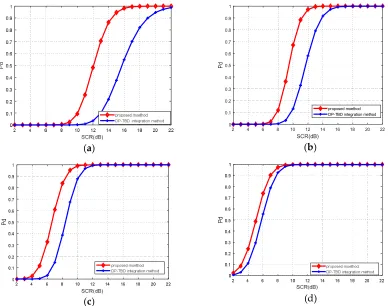
, can be110
,
,n n n
z i j A c i j (5)
where An denotes a complex fluctuated amplitude measurement from the target, and cn
i j,
112
denotes the K-distributed clutter, which is assumed in this paper.
113
Swerling 1 fluctuation model supposes that returned signal power per pulse is to be constant
114
during a single scan, but to fluctuate independently from scan to scan. The probability density
115
function (PDF) of the Swerling 1 target amplitude An is given by
116
2
2 exp
n n
n
A A
p A
(6)
with being the mean squared target amplitude.
117
2.3. K-distributed Clutter Model
118
The K-distributed model is proposed as a model for radar clutter in this paper, which has the
119
probability density function as
120
12 , ,
( ) 2
v v
z z
p z v b K
b v b b
(7)
In formula,
denotes the Gamma function and Kv1
denotes the modified Bessel function121
of the second kind, z is the clutter amplitude, b is scale parameter which describes the intensity of
122
the clutter, v is the shape parameter which determines the shape of the distribution function. For
123
v , the K-distribution turns into the Rayleigh distribution. PDFs of K- and Rayleigh-
124
distributions are shown in Figure2 (a) while the K-distributed clutter (v2,b0.5)is shown in
125
Figure2 (b).
126
(a) (b)
Figure 2. K-distribution (a).PDFs of K- and Rayleigh- distribution for various shape and scale
127
parameters; (b).K-distributed clutter including real part and imaginary part.
128
The substitution is used as an zn ,which denotes the amplitude measurement, so that (7) can
129
be rewritten as
130
1 1 21 2
4 n 2 n
n
a a
p a
(8)
where =v denotes the shape parameter, 2
4b
Meanwhile, K-distribution can also be viewed as a Rayleigh distribution modulated by a
132
Gamma distribution for convenience
133
n 0
n
p a
p a p d (9)where
134
2
2 exp
n n
n
a a
p a
(10)
1exp
p
(11)
3. Development of the Proposed Strategies
135
DP-TBD algorithm decomposes the integration among N successive scans into N sub-processes.
136
The nth sub-process contains all the measurements up to scan n. Target can be detected and tracked
137
by calculating the maximum of the energy integration value through a recursive model, which could
138
be expressed as:
139
1 1
1
max
n n
n n n
s s
V s I s V s
(12)
1
1
arg max
n n
n n
s s
s V s
(13)
where I s
n is defined as the merit function at scan n; V s
n1
is defined as the maximal140
integration value of all the admissible trajectories;
sn is a collection of states at scan n for which141
a transition to sn is possible, and it can be obtained by the location and maximum velocity of the
142
target;
is the operator of integration;
sn is the retracing function, indicating the best state of143
the previous scan, which makes the integration value reach its maximum.
144
In summary, DP-TBD implements the equivalent of an exhaustive search in an efficient manner
145
by enumerating and valuing all physical admissible state sequences, finally returning the state
146
sequences whose final maximal integration value V s
N exceeds a given detection threshold ,i.e.147
N
V s (14)
There are mainly two problems throughout the process. Firstly, the computational complexity
148
of DP-TBD is unaffordable in the presence of high-mobility target when the number of resolution
149
elements is large. The discretization of state space is always based on the sensor’s resolution so as to
150
make full use of the measurements and achieve possibly accurate estimates. In this situation,
151
strategies hardly lead to real-time implementable schemes, even resorting to dynamic programming
152
algorithm. In order to reduce the burden of computation, a two-stage detection approach is proposed
153
in this work. Secondly, most of the previous work on DP-TBD assumed that the background model
154
would be Rayleigh or Gaussian distribution with a known power. Such assumptions may or may not
155
be adequate, as in real world, more heavy-tailed background model is often encountered than
156
expected. To improve the detection performance, we propose a novel DP-TBD algorithm based on
157
the prior information to solve the aforementioned problem. In this paper, the merit function is set to
158
be likelihood ratio under both target-present hypothesis and null-target hypothesis in a surveillance
159
region which characterized by K-distributed background, and the simulated data would be tested for
160
presenting the performance.
161
3.1.Two-stage Detection Approach
163
Since the surveillance region is much larger than the part of the measurements which are related
164
to the target, it is inefficient and computational costly to carry out accurate search based on all the
165
sensor’s resolution for the discrete states. In order to reduce the computational load, while still retain
166
the benefits of TBD, here we resort to a two-stage detection approach which is illustrated in Figure 3.
167
Obtain the raw data at scan
Calculate the measurement under the condition of low grid resolution
1
n
begin
Integration: calculating the maximum of the energy integration value based on the measurement
nN
n1V s
N 1Vs
There is no target presented
end
1 n
Integration: calculating the maximum of the energy integration value based on the measurement
nN
n1
V s
N 2V s
target is presented
Backtracking: find the recovered trajectory estimation
n
n z
n
z zn
n z Calculate the measurement under the condition of high grid resolution
Y
N
Y
N
Y
N
N
Y
Stage 1
Stage 2
Figure 3. The flowchart of the two-stage detection approach.
168
At stage 1, we first obtain the raw data at scan n, and roughly calculate the measurement zn
169
under the condition of low grid resolution. The target states are estimated by searching discrete
170
grids with larger cell size based on the DP integration. After N times loop, the maximum of the
171
energy integration value V s
N at scan N could be got by the process. For single target model, the172
maximum integration value V s
N which exceeds detection threshold 1 is used to determine theexistence of target. If there is a target presented in the surveillance region, we could refine the target
174
trajectory in stage 2.
175
In order to obtain a more accurate estimate, stage 2 is employed to recalculate the
176
measurements under the high grid resolution condition. Once the maximum integration value
177
NV s exceeds the detection threshold2, the estimation of final target trajectory can be obtained
178
by backtracking. For each estimated the state sˆn, we have :
179
1
ˆn ˆ ,n ,...1
s
s for nN (15)So the recovered trajectory estimate is SˆN
sˆ1,...,sˆN
.180
The surveillance region is divided into MrM grid cells based on the resolution of the radar
181
system, i.e., rand , where Mr and Mdenote the number of cells in range and azimuth,
182
respectively. To realize the target search with larger cell size, the state space is re-discretized by
183
r
and to obtain MrM grid cells at first. As shown in figure 4, all the measurements and
184
DP integrations are processed in stage 1 based on the new state space, which may get a roughly
185
target trajectory by less computation. Then in stage 2, DP integration concentrates on the part of
186
states which are indicated by stage 1. As calculations of less meaningful states could be avoided, the
187
computational costs will become more reasonable.
188
n
s
1
n
s stage 1
stage 2
9
q
states of interest
Figure 4. Illustration of possible transition state collection during the two-stage DP integration.
189
3.2.Derivation and Implementation of the Merit Function
190
Combined (6), PDF for the Swerling 1 target in K-distributed clutter is given by
191
2
2
, = n exp n
n n
a a
p a s
(16)
and p a s
n n
can be derived by marginalizing over since is random, i.e.192
02 1
0
2 1
0
0
,
2
exp exp
2
exp exp
2
( )
n n n n
n n
n n
n
p a s p a s p d
a a
d
a a
d
a
f d
(17)
2 1
exp an
f
(18)
Substituting (8) and (17) into the expression of merit function I s
n at scan n,I s
n can be194
written as
195
1 2 1
0 1 2 1
( )
ln
ln
2
n n n
n
n
n p a s I s
p a
a f d
K a
(19)Although the integrand f
in (18) has no closed-form solution, it can be evaluated with196
reasonable accuracy by using the trapezoidal rule, i.e.
197
1
0
1 2
sa
N
i i
i i
f f
f
(20)where f
i is sample point drawn from the time interval i, i is a sampling interval which is198
short enough to cover the effective support of f
, Nsadenotes the number of sample points.199
The sample points can be obtained by either deterministic sampling with a uniform grid or
200
stochastic importance sampling. Since the integrand f
may tend quickly towards when201
0
, while tend slowly towards 0 when . A reasonable approximation obtained by
202
deterministic uniform grid sampling or stochastic importance sampling is difficult to carry out. A
203
grid with variable resolution method was proposed in[18] to approximate merit function which also
204
leads to high computational complexity.
205
(a) (b)
(c)
(d)
Figure 5. Histogram of generation data and theory PDF data with SCR=15dB (a).= and =2 1; (b).
206
2 =3 and =
In order to reduce the complexity of approximation, we could possibly circumvent these
208
problems by generating a lookup table offline with sample points using a uniform grid. The number
209
of sample points with uniform grid is large enough to approximate the integrand f
accurately.210
Based on the lookup table, this calculating method trades little cost of precision and memory space
211
to a great improve on running speed in calculation. Histogram of generation data and theory PDF
212
are shown in Figure 5 for Swerling targets types 1 with different parameters. According to Figure 5,
213
we conclude that the approximation error is negligible.
214
Note that the K-distribution shape parameter , the scale parameter are supposed to be
215
known in the derivation of merit function. In the case where the background is significantly
heavy-216
tailed and the parameters are unknown, we should estimate the parameters first, which can be
217
obtained through a numerical maximization of the likelihood function. Since the maximum
218
likelihood techniques require numerical optimization routines and evaluation of Bessel functions,
219
they are computationally intensive and therefore inappropriate for evaluation of large data sets.
220
Abraham[19] recommended a moment estimators based on the first and second moments, which can
221
be used as our estimator in this work.
222
4. Simulation
223
In this paper, the detection performances of conventional DP-TBD and proposed strategy for
224
Swerling type 1 target are assessed. We assume that the measurement noise satisfies K-distribution ,
225
each measurement frame consists of MrM= 180×90 resolution cells. The number of frames
226
processed in a DP batch is N6, while the number of possible state transition in a scan is q=9. This
227
scenario is run 1000 times for various SCR and shape parameters while the false alarm is fixed as
228
3
10
FA
P
.
229
4.1.Performance Analysis
230
We assess the performances of different strategies via the probability of track detectionPd, which
231
is a performance metric for both detection and tracking performance. Pd is defined as the probability
232
of the maximum integration value exceeding detection threshold, and its final position is within
233
certain range of the actual target position. In addition, the root-mean square error (RMSE) on the
234
estimation of the target position is also considered, which is defined as
235
21
n
RMSE E e s H (21)
where H1 is the event that target is confirmed, and
2n
e s is the Euclidean distance between the
236
true and estimated target position.
237
Performance and RMSE comparison of conventional DP method and proposed method based
238
on prior information is shown in Figure 6. For K-distributed clutter and Swerling 1 target, proposed
239
method performs better than the traditional integration method. It can also be concluded that for
240
proposed method, which processed with only one stage (blue solid line) or two-stage (red solid line)
241
could achieve almost identical performance while the latter one obtains further computational
242
reduction.
243
(a)
Figure 6. Performance and RMSE comparison of different DP-TBD integration method with
244
0.5 1
= and =
against SNRs from 2dB to 20dB (a) The detection probability Pd (b) The RMSE on
245
estimated position.
246
For different parameters of K-distributed clutter, detection performances are shown in Figure 8.
247
With the increasing of shape parameter α, both conventional DP and proposed method on prior
248
information, achieve significant performance improvement. That’s because when α is increasing, the
249
K-distributed clutter is smoother and the frequency of target-like outliers is lower. Note that when α
250
= 50, since K distribution almost degenerates to Rayleigh distribution in this case, the detection
251
performances are nearly identical.
252
(a) (b)
(c)
(d)
Figure 7. Performance comparison of DP-TBD integration method (red solid line with diamond) and
253
proposed moethod in this paper (blue solid line with cross) for K-distributed clutter and Swerling 1
254
target (a).= and =22 ; (b). =5 and = 2; (c). = and =10 2; (d). =50 and =2 ;
255
4.2.Computational Complexity Analysis
256
The complexity of the conventional DP-TBD method is
M M qNr
, where Mr and M are257
the number of range and azimuth resolution elements, q is the number of possible state transition in
258
a scan and N is the number of the integration scans. In comparison with the conventional method,
259
the two-stage detection approach schemed in Figure 3 has low computational complexity. The
260
computational cost in stage 1 is
M M qNr
, where MrM denotes grid cells re-discretized by261
r
and to realize the target search with larger cell size. Since the DP integration in stage 2 is
262
concentrated on the part of states, which are indicated by stage 1, the computational cost is small
263
enough to be neglected.
264
265
2 4 6 8 10 12 14 16 18 20 22
SCR(dB)
0 0.1 0.2 0.3 0.4 0.5 0.6 0.7 0.8 0.9 1
Table 1. Computational cost with different parameters
266
Parameters MrM 180 90 MrM90 45 MrM60 30
q=4 308ms 224ms 146ms
q=9 935ms 684ms 370ms
267
The computational cost of strategies is listed in Table 1 for different parameters. It can be seen
268
that the computational cost depends on the number of possible state transition q and the resolution
269
elements. For the same resolution cells, scenario at q=9 costs almost three times as long as the
270
scenario q=4. Meanwhile, the computational cost reduces rapidly as the number of resolution
271
elements decreases. For example, when q=4, the CPU times for MrM 180 90 ,
272
90 45
r
MM and MrM60 30 are 308ms 224ms and 146ms, respectively.
273
5. Conclusion
274
This paper has presented the systematic treatment of heavy-tailed clutter from a target detection
275
and tracking perspective. Target detection in K-distributed clutter is more challenging than in
276
Gaussian- or Rayleigh-distributed clutter due to the higher likelihood of target-like outliers,
277
especially for fluctuating target. In this work, we dealed with the fluctuating target detection and
278
tracking problem using modified DP-TBD method. The contributions are as follows: First we have
279
solved the target detection problem using two-stage detection architecture to avoid calculations of
280
less meaningful states. Secondly, for Swerling 1 target in K-distributed background, merit function
281
was derived and implemented in the integration process of DP-TBD to enhance radar detection
282
performance. In order to reduce the complexity of integral calculation, we also resorted to the
283
trapezoidal rule with a generating lookup table.
284
Numerical analysis demonstrated that performance improvement could be applied via
285
proposed DP-TBD algorithm based on prior information, especially for heavy-tailed K-distributed
286
clutter. Moreover, simulation results suggested that a tradeoff between performance and
287
computational complexity exists.
288
Acknowledgments: This work was supported by the National Key Research and Development Program of
289
China (Grant No. 2016YFB0101101), by the National Natural Science Foundation of China (Grant No. 61703393
290
and No. U1613214).
291
Author Contributions: Jie Gao contributed to the original ideas and designed the simulations; Jie Gao and Wei
292
Wang performed the simulations and analyzed the data; Jinsong Du provided the significant guidance in
293
research planning and revised the manuscript. All authors contributed to and approved the written manuscript.
294
Conflicts of Interest: The authors declare no conflict of interest.
295
References
296
1. Barniv, Y.; Kella, O., Dynamic Programming Solution for Detecting Dim Moving Targets Part II: Analysis.
297
IEEE Transactions on Aerospace & Electronic Systems 1985, 21 (1), 144-156.
298
2. Barniv, Y.; Kella, O., Dynamic Programming Solution for Detecting Dim Moving Targets Part II: Analysis.
299
IEEE Transactions on Aerospace and Electronic Systems 1987, AES-23 (6), 776-788.
300
3. Buzzi, S.; Lops, M.; Venturino, L.; Ferri, M. In Detection of an Unknown Number of Targets via
Track-Before-301
Detect Procedures, 2007 IEEE Radar Conference, 17-20 April 2007; 2007; pp 180-185.
302
4. Buzzi, S.; Lops, M.; Venturino, L.; Ferri, M., Track-before-detect procedures in a multi-target environment.
303
IEEE Transactions on Aerospace and Electronic Systems 2008, 44 (3), 1135-1150.
304
5. Yi, W.; Morelande, M. R.; Kong, L.; Yang, J., An efficient multi-frame track-before-detect algorithm for
305
6. Grossi, E.; Lops, M.; Venturino, L. In A track-before-detect procedure for sparse data, 2012 IEEE Statistical Signal
307
Processing Workshop (SSP), 5-8 Aug. 2012; 2012; pp 772-775.
308
7. Grossi, E.; Lops, M.; Venturino, L. In A novel track-before-detect procedure for multi-frame detection in radar
309
systems, 2013 IEEE Radar Conference (RadarCon13), April 29 2013-May 3 2013; 2013; pp 1-6.
310
8. Jiang, H.; Yi, W.; Cui, G.; Kong, L.; Yang, X. In Track-before-detect strategy for HRR radars, 2015 IEEE
311
International Radar Conference, RadarCon 2015, May 10, 2015 - May 15, 2015, Arlington, VA, United states,
312
Institute of Electrical and Electronics Engineers Inc.: Arlington, VA, United states, 2015; pp 362-367.
313
9. Jiang, H.; Yi, W.; Kong, L.; Yang, X.; He, B. In Radar detection of Swerling 3 target in G0-distributed clutter via
314
track-before-detect, 2016 IEEE Radar Conference, RadarConf 2016, May 2, 2016 - May 6, 2016, Philadelphia,
315
PA, United states, Institute of Electrical and Electronics Engineers Inc.: Philadelphia, PA, United states,
316
2016; p IEEE AESS; Philadelphia Section of the IEEE.
317
10. Yi, W.; Jiang, H.; Kirubarajan, T.; Kong, L.; Yang, X., Track-Before-Detect Strategies for Radar Detection in
318
G0-Distributed Clutter. IEEE Transactions on Aerospace and Electronic Systems 2017, 53 (5), 2516-2533.
319
11. Buzzi, S.; Lops, M.; Venturino, L., Track-before-detect procedures for early detection of moving target from
320
airborne radars. IEEE Transactions on Aerospace & Electronic Systems 2005, 41 (3), 937-954.
321
12. Ebenezer, S. P.; Papandreou-Suppappola, A., Generalized Recursive Track-Before-Detect With Proposal
322
Partitioning for Tracking Varying Number of Multiple Targets in Low SNR. IEEE Transactions on Signal
323
Processing 2016, 64 (11), 2819-2834.
324
13. Zheng, D.; Wang, S.; Qin, X., A Dynamic Programming Track-Before-Detect Algorithm Based on Local
325
Linearization for Non-Gaussian Clutter Background. Chinese Journal of Electronics 2016, 25 (3), 583-590.
326
14. Zhou, J.; Chen, D.; Sun, D. In K Distribution Sea Clutter Modeling and Simulation Based on ZMNL, International
327
Conference on Intelligent Computation Technology and Automation, 2016; pp 506-509.
328
15. Aprile, A.; Grossi, E.; Lops, M.; Venturino, L., Track-before-detect for sea clutter rejection: tests with real
329
data. IEEE Transactions on Aerospace and Electronic Systems 2016, 52 (3), 1035-1045.
330
16. Berry, P.; Venkataraman, K.; Rosenberg, L. In Adaptive detection of low-observable targets in correlated sea clutter
331
using Bayesian track-before-detect, Radar Conference, 2017; pp 0398-0403.
332
17. Swerling, P., Probability of detection for fluctuating targets. Information Theory Ire Transactions on 1960,
IT-333
6 (2), 269-308.
334
18. Brekke, E.; Hallingstad, O.; Glattetre, J., Tracking Small Targets in Heavy-Tailed Clutter Using Amplitude
335
Information. IEEE Journal of Oceanic Engineering 2010, 35 (2), 314-329.
336
19. Abraham, D. A.; Lyons, A. P., Novel physical interpretations of K-distributed reverberation. Oceanic
337
Engineering IEEE Journal of 2002, 27 (4), 800-813.