Miran Kim1 and Kristin Lauter2
1
Seoul National University (SNU), Republic of Korea
2 Cryptography Research Group, Microsoft Research [email protected]
Abstract. The rapid development of genome sequencing technology allows researchers to access large genome datasets. However, outsourcing the data processing to the cloud poses high risks for personal privacy. The aim of this paper is to give a practical solution for this problem using homomorphic encryption. In our approach, all the computations can be performed in an untrusted cloud without requiring the decryption key or any interaction with the data owner, which preserves the privacy of genome data.
In this paper, we present evaluation algorithms for secure computation of the minor allele frequen-cies andχ2statistic in a genome-wide association studies setting. We also describe how to privately compute the Hamming distance and approximate Edit distance between encrypted DNA sequences. Finally, we compare performance details of using two practical homomorphic encryption schemes -theBGVscheme by Gentry, Halevi and Smart and theYASHEscheme by Bos, Lauter, Loftus and Naehrig. Such an approach with theYASHEscheme analyzes data from 400 people within about 2 seconds and picks a variant associated with disease from 311 spots. For another task, using the
BGVscheme, it took about 65 seconds to securely compute the approximate Edit distance for DNA sequences of size 5K and figure out the differences between them.
Keywords:Homomorphic encryption, Genome-wide association studies, Hamming distance, Ap-proximate Edit distance.
1 Introduction
The rapid development of genome sequencing technology has led to the genome era. We ex-pect that the price of a whole genome sequence will soon be $1K in a day, which enables researchers to access large genome datasets. Moreover, many genome projects like the Personal Genome Project (PGP) [2] and the HapMap Project [1] display genotypic information in public databases, so genomic data has become publicly accessible.
Privacy Threats from Exposing Genomic Data.While genome data can be used for a wide range of applications including healthcare, biomedical research, and forensics, it can be misused, violating personal privacy via genetic disease disclosure or genetic discrimination. Even when explicit identifiers (e.g., name, date of birth or address) are removed from genomic data, one can often recover the identity information [18, 12, 26]. For these reasons, genomic data should be handled with care.
Fully homomorphic encryption (e.g.,[13, 30, 15]) permits encrypted data to be computed on without decryption, so it allows us to evaluate arbitrary arithmetic circuits over encrypted data. Thus, we can privately perform all types of genome analysis using Homomorphic Encryption (HE) cryptosystems. Moreover, we can delegate intensive computation to a public cloud and store large amounts of data in it.
Recently, many protocols to conduct privacy-preserving computation of genomic tests with fully homomorphic encryption have been introduced. Yasuda et al. [32] gave a practical solution for computation of multiple Hamming distance values using the LNV scheme [21] on encrypted data, so to find the locations where a pattern occurs in a text. Graepel et al. [16] and Bos et al. [7] applied HE to machine learning, and described how to privately conduct predictive analysis based on an encrypted learned model. Lauter et al. [20] gave a solution to privately compute the basic genomic algorithms used in genetic association studies. Cheon et al. [11] described how to calculate edit distance on homomorphically encrypted data.
Scenarios. One possible scenario could be of interest in situations involving patients, a data owner (e.g., a healthcare organization or a medical center) and a public cloud. In our solution, a data owner wants to store large amounts of data in the cloud and many users may interact with the same data over time. The cloud can handle all that interaction through computation on encrypted data, so it does not require further interaction from the data owner. The patients can upload their encrypted data directly to the cloud using the public key. The genomic tests are performed on the cloud and the encrypted results are returned to the data owner. Finally, the data owner decrypts the results using the secret key to share it with the patient. All the computations in the cloud are performed on encrypted data without requiring the decryption key, so the privacy of genomic data can be protected by the semantic security of the underlying HE schemes.
Our Contributions. In this paper, we propose efficient evaluation algorithms to compute genomic tests on encrypted data. We first consider the basic tests which are used in Genome-Wide Association Studies (GWAS). They are conducted to analyze the statistical associations between common genetic variants in different individuals. In particular, we focus on the minor allele frequencies (MAFs) and χ2 test statistic between the variants of case and control groups. Secondly, we consider DNA sequence comparison which can be used in sequence alignment and gene finding. We show how to privately compute the Hamming distance and approximate Edit distance on encrypted data. We also adapt these methods to the practical HE schemes −BGV scheme [14] by Gentry, Halevi and Smart and YASHE scheme [6] by Bos, Lauter, Loftus and Naehrig. Finally, we compare the performance of the two encryption schemes in these contexts. In practice, we take advantage of batching techniques to parallelize both space and computation time together.
2 Background on Genome Analysis
2.1 Task 1: GWAS on Genomic Data
Given the encrypted genotypes of two groups of individuals over many single nucleotide vari-ants (SNVs), the goal of this task is to privately compute the MAFs in each group and a χ2 test statistic between the two groups on each site.
Suppose thatAandBare two alleles of the gene, and letnAA, nAB, nBB denote the numbers
of observed individuals for genotypes AA, AB, BB, respectively. The allele counts of A and B are given by nA
let
= 2nAA+nAB and nB let
= 2nBB+nAB. Then the MAF of the given alleles is
defined by
min(nA, nB)
nA+nB
.
If we letN be the total number of people in a sample population, the total number of alleles in the sample is nA+nB = 2N, so we compute only one of two allele counts in encrypted form.
The minimum can then easily be computed after decryption and we obtain the MAF by one division by 2N.
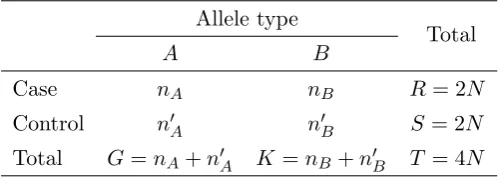
The χ2 test statistic in case-control groups is computed based on the allelic contingency table (Table 1):
T(nAn0B−nBn0A)2
R·S·G·K .
We observe that the test can be written as a function of nA and n0A. More precisely, it is
expressed as
4N(nA(2N −n0A)−n0A(2N −nA))2
2N·2N·G·K
= 4N(nA−n
0
A)
2
nA+n0A
· 4N − nA+n0A
.
Let n(Aj) and n0(Aj) denote the allele counts of A at SNV j in the case group and control group, respectively. As discussed above, it suffices to compute (n(Aj)+n0(Aj)) and (n(Aj) −n0(Aj)) over encrypted data.
Allele type
Total
A B
Case nA nB R= 2N
Control n0A n0B S= 2N
Total G=nA+n0A K=nB+n0B T = 4N
Table 1.Allelic Contingency Table
2.2 Task 2: Human Genome Comparison
Algorithm 1 Hamming Distance Algorithm 1: h←0
2: fori∈ L do
3: if (‘xi.sv’ or ‘yi.sv’) in{‘INS’,‘DEL’} then
4: hi ←0
5: else if ((xi oryi) == ‘∅’) or
6: ((xi.ref ==yi.ref) and (xi.alt ! =yi.alt))then
7: hi ←1
8: else
9: hi ←0
10: end if 11: h←h+hi
12: end for 13: return h
Algorithm 2 Approximate Edit Distance Algorithm 1: e←0
2: fori∈ L do
3: if xi == ‘∅’then
4: D(xi)←0
5: else if ‘xi.sv’ == ‘DEL’ then
6: D(xi)←len(xi.ref)
7: else
8: D(xi)←len(xi.alt)
9: end if
10: Define D(yi) with the same way asD(xi)
11: if ((xi.ref ==yi.ref) and (xi.alt ==yi.alt))then
12: ei←0
13: else
14: ei←max{D(xi), D(yi)}
15: end if 16: e←e+ei
17: end for 18: return e
If there is only one record in the VCF files at a specified location, the other one is considered to be an empty set (‘∅’). Let L be a list indexed by the positions of two participants. Then we can define the Hamming distance as described in Algorithm 1, where “xi.sv” denotes the
type of structural variant relative to the reference, “xi.ref ” the reference bases and “xi.alt” the
alternate non-reference alleles.
3 Practical Homomorphic Encryptions
Fully Homomorphic cryptosystems allow us to homomorphically evaluate any arithmetic circuit without decryption. However, the noise of the resulting ciphertext grows during homomorphic evaluations, slightly with addition but substantially with multiplication. For efficiency reasons for tasks which are known in advance, we use a more practical Somewhat Homomorphic En-cryption (SHE) scheme, which evaluates functions up to a certain complexity. In particular, two techniques are used for noise management of SHE: one is the modulus-switching technique introduced by Brakerski, Gentry and Vaikuntanathan [9], which scales down a ciphertext during every multiplication operation and reduces the noise by its scaling factor. The other is a scale-invariant technique proposed by Brakerski [8] such that the same modulus is used throughout the evaluation process.
Let us denote by [·]qthe reduction moduloq into the interval (−q/2, q/2]∩Zof the integer or
integer polynomial (coefficient-wise). For a security parameterλ, we choose an integerm=m(λ) that defines the m-th cyclotomic polynomial Φm(x). For a polynomial ringR =Z[x]/(Φm(x)),
set the plaintext space to Rt:= R/tR for some fixed t ≥2 and the ciphertext space to Rq :=
R/qR for an integer q = q(λ). Let χ = χ(λ) denote a noise distribution over the ring R. We use the standard notation a← D to denote that ais chosen from the distribution D. Now, we recall the BGVscheme [14] and the scale-invariant YASHEscheme [6].
3.1 The BGV scheme
Gentry, Halevi and Smart [14] constructed an efficient BGV-type SHE scheme. The security of this scheme is based on the (decisional) Ring Learning With Errors (RLWE) assumption, which was first introduced by Lyubashevsky, Peikert and Regev [25]. The assumption is that it is infeasible to distinguish the following two distributions. The first distribution consists of pairs (ai, ui), whereai, ui ←Rq uniformly at random. The second distribution consists of pairs
of the form (ai, bi)=(ai, ais+ei) whereai ←Rq drawn uniformly ands, ei ←χ . Note that we
can generate RLWE samples as (ai, ais+tei) where t and q are relatively prime. To improve
efficiency for HE, they use very sparse secret keys s with coefficients sampled from {−1,0,1}. Here is the SHE scheme of [14]:
– ParamsGen: Given the security parameter λ, choose an odd integer m, a chain of moduli q0 < q1 < · · · < qL−1 = q, a plaintext modulus t with 1 < t < q0, and discrete Gaussian distribution χerr. Output (m,{qi}, t, χerr).
– KeyGen: On the input parameters, choose a random s from {0,±1}φ(m) and generate an RLWE instance (a, b) = (a,[as+te]q) for e ← χerr. For an integer P, we define the key
switching matrix
W =
bs
as
wherebs= [as·s+tes+Ps2]P qL−2
for as ← Rq uniformly at random and es ← χerr. We set the key pair: (pk,sk,evk) =
((a, b),s, W). Then we define theSwitchKey(c,evk) for the extended ciphertextc= (d0, d1, d2) at level las follows: set
c0 =
c00 c01
=
"
P d0 [bs]P ql
P d1[as]P ql
1 d2
#
P ql
,
and then take an element c00 ∈ Rql such that c
00 ≡ c0(mod t) and c00 is the closet to P ·c0
– Encryption: To encryptm∈Rt, choose a small polynomialv and two Gaussian polynomials
e0, e1 overRq. Then compute the ciphertext given by
Enc(m,pk) = (c0, c1) = (m,0) + (bv+te0, av+te1)∈R2q.
– Decryption: Given a ciphertextct= (c0, c1) at levell, outputDec(ct,sk) = [c0−s·c1]ql modt
where the polynomial [c0−s·c1]ql is called thenoise in the ciphertextct.
– Homomorphic Evaluation: Given two ciphertexts ct= (c0, c1) andct0 = (c00, c01) at levell, the homomorphic addition is computed by ctadd = ([c0 +c00]ql,[c1+c
0
1]ql). The homomorphic
multiplication is computed byctmult =SwitchKey(c0∗c1,evk) wherec0∗c1 = ([c0c00]ql,[c0c
0 1+ c1c00,]ql,[c1c
0
1]ql) and the key switching function SwitchKey is used to reduce the size of
ciphertexts to two ring elements. We also apply modulus switching from qi toqi−1 in order to reduce the noise. If we reach the smallest modulus q0, we can no longer compute on ciphertexts.
Smart and Vercauteren [29] observed thatRtis isomorphic toQ`i=1Zt[x]/fi(x) ifΦm(x)
fac-tors modulotinto`irreducible factorsfi(x) of the same degree. Namely, a plaintext polynomial
mcan be considered as a vector of`small polynomials,mmodfi, calledplaintext slots. We can
also transform the plaintext vector (m1, . . . , mr)∈Q`i=1Zt[x]/fi(x) to an elementm∈Rtusing
the polynomial Chinese Remainder Theorem (i.e., m =CRT(m1, . . . , mr)). In particular, it is
possible to add and multiply on the slots: if m, m0 ∈Rtencode (m1, . . . , m`) and (m01, . . . , m0`)
respectively, then we see that m+m0 =mi+m0i modfi and m·m0 =mi·m0i modfi. This
technique was adapted to theBGVscheme.
3.2 The YASHE scheme
A practical SHE scheme, YASHE, was proposed in [6] based on combining ideas from [8,?,24]. The security of this scheme is based on the hardness of the RLWE assumption similar to the one forBGV. It also relies on the Decisional Small Polynomial Ratio (DSPR) assumption which was introduced by Lopez-Alt, Tromer, and Vaikuntanathan [24]. Let t ∈ R×q be invertible in Rq, yi ∈ Rq and zi = yi/t (mod q) for i = 1,2. For z ∈ Rq, we define χz = χ+z to be the
distribution shifted byz. The assumption is that it is hard to distinguish elements of the form h = a/b, where a ← y1 +tχz1, b ← y2+tχz2, from elements drawn uniformly from Rq. The
YASHEscheme consists of the following algorithms.
– ParamsGen: Given the security parameterλ, choosemto be a power of 2 (them-th cyclotomic polynomial isΦm(x) =xn+1 (n=φ(m) =m/2), modulusqandtwith 1< t < q, truncated
discrete Gaussian distribution χerr on R such that the coefficients of the polynomial are
selected in the range [−B(λ), B(λ)]), and an integer base ω >1. Output (m, q, t, χerr, ω).
– KeyGen: On the input parameters, samplef0, g← {0,±1}φ(m) and setf = [tf0+ 1]
q. Iff is
not invertible modulo q, choose a new f0 and compute the inversef−1 ∈ R of f modulo q and set h= [tgf−1]q. Let`ω,q=blogω(q)c+ 1 and define
Dω,q(a) = ([ai]ω)`ω,q
−1
i=0 , Pω,q(a) = ([aωi]q)`ω,q
−1
i=0 ,
where a= P`ω,q−1
i=0 aiωi, ai ∈ R with coefficients in (−ω/2, ω/2]. Sample e,s ← χ
`ω,q
err and
compute γ = [Pω,q(f) +e+hs]q ∈R `ω,q
q .Then we set the key pair: (pk,sk,evk) = (h, f, γ).
For a ciphertext ct, we define the SwitchKey(ct,evk) by computing hDω,q(ct),evki
q. Note
– Encryption: To encrypt m∈Rt, choose e, s←χerr and then compute the ciphertext
Enc(m,pk) =q
t
·[m]t+e+hs
q∈Rq.
– Decryption: Given a ciphertext ct, outputDec(ct,sk) =t
q ·[f·ct]q
modt.
– Homomorphic Evaluation: Given two ciphertextctandct0, the homomorphic addition is com-puted by ctadd = [ct+ct0]q. The homomorphic multiplication is computed by ctmult =
SwitchKey(t
qct·ct
0
q,evk) (see [6] for details).
4 Our Method for Private Genome Analysis
In this section, we describe how to encode and encrypt the genomic data for each task. Based on these methods, we propose the evaluation algorithms to compute the genomic tests on encrypted data.
4.1 Encoding Genomic Data
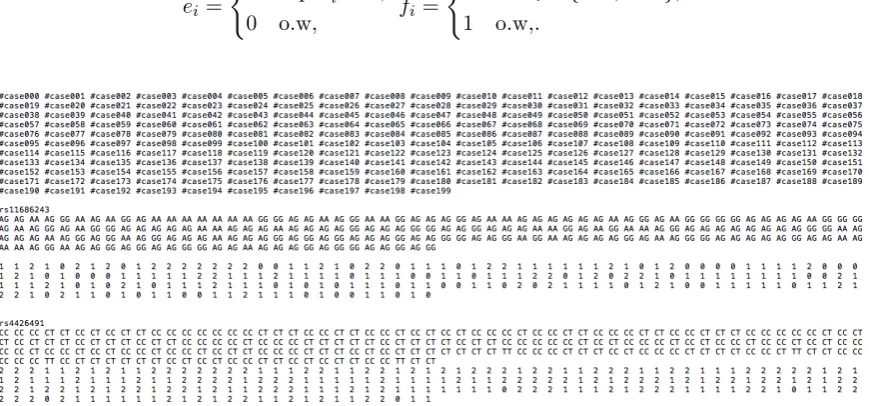
Lauter et al. [20] presented a method to encode a person’s genotype given a candidate allele associated to a specified disease. They used a binary dummy vector representation, which makes the number of ciphertexts too large. In contrast, we encode the genotypes as integers so that one can efficiently compute their sums and differences over the integers. More precisely, for a bi-allelic gene with allelesAandB, there are 3 possible Single Nucleotide Polymorphisms (SNPs) - AA,AB,BB, and they are encoded as follows:AA→2, AB→1, BB →0. Figure 1 shows the file format of the data for task 1 and its encodings.
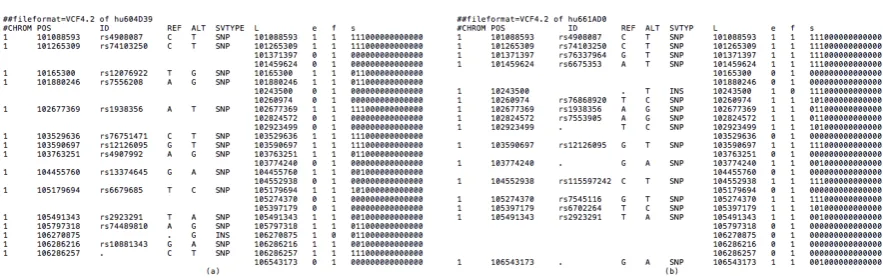
Now, we describe how genomic data can be encoded for DNA comparison. The first step is to curate the data using the positions in the VCF files of two participants. In other words, the server should arrange the information and make the merged listL so that each individual can encode their genotypic information according to the list. Let `(L) denote the length of the list L. Then, for 1≤i≤`(L), we define two values
ei =
(
1 if posi ∈ L,
0 o.w, fi =
(
0 if svi∈ {INS,DEL},
1 o.w,.
Fig. 2.A snapshot of the dataset for task 2 and its encodings: (a)hu604D39 and (b)hu661AD0
The valueei defines whether the genotype at the specified locus is missing; the valuefi specifies
the variants compared with the reference.
Since both VCF files are aligned with the same reference genome, we don’t need to compare the columns of ‘REF’. To improve performance, we assume that it suffices to compare 7 SNPs between two non-reference sequences. In the following, we describe how to encode the sequences. Each SNP is represented by two bits as
A→00, G→01, C →10, T →11,
and then concatenated with each other. Next we pad with 1 at the end of the bit string so as to distinguish the A-strings. Finally, we pad with zeros to make it a binary string of length 15, denoted by si. Let si[j] denote j-th bit of si. If a person’s SNV at the given locus is not
known (i.e., ei = 0), then it is encoded as 0-string. For example, ‘GT C’ is encoded as a bit
string 01||11||10||10. . .0, of length 15.
Finally, let us consider thei-th genotype lengthsDi, Di0of two participants defined as follows:
when it has no variants at the given locus of the sequence, set zero as the length at the locus. If it includes a deletion compared with the reference, use the length of reference. Otherwise, we take the length of the target sequence at the current locus. In Figure 2, we illustrate the file format of the data for task 2 and its encodings.
4.2 Homomorphic Computation of The BGV Scheme
We describe how to compute the genomic algorithms described above on encrypted genetic data using theBGVscheme.
4.2.1 Task 1: GWAS on Encrypted Genomic Data
Using the encodings that we propose for practical HE, we can homomorphically evaluate any function involving additions and multiplications, but it is not known how to perform homomor-phic division of integer values. We obtain the counts using a few homomorhomomor-phic additions.
Let gj be the encoded value of SNV site j based on the encoding method as described in
Section 4.1. Then each person packs gj into the j-th slot. Let s be the total number of SNVs.
Assuming that each ciphertext holds ` plaintext slots for s ≤ `, the i-th person encrypts the vector (gi(1), . . . , gi(s),0. . . ,0)∈Z`t using batching as
cti=Enc(CRT((gi(1), . . . , g
(s)
Letcteval be a ciphertext given by the homomorphic operation
cteval = N
X
i=1
cti. (1)
Note that the use of batching technique enables to perform N aggregate operations in parallel. Next, let m = Dec(cteval,sk) denote the decryption of the ciphertext cteval and decode the s
outputs from the output plaintext polynomial as follows: let mj be the constant coefficient of
mmodfj for 1≤j≤s. That is, we have
mj let
=mmodfj = N
X
i=1 gi(j).
Thus the MAF of SNV j in the group is computed as
min{mj,2N −mj}
2N .
For the homomorphic evaluation of χ2 test, each group performs aggregations over cipher-texts as shown in (1). Letctcaseand ctcontdenote the ciphertexts by the evaluations in the case
and control groups, respectively. Then one can compute two ciphertexts by the homomorphic operations
ct+let=ctcase+ctcont, ct− let
= ctcase−ctcont.
The plaintext polynomial fromct+can be decoded as the plaintext slots which have (n(j)
A +n
0(j)
A )
at thej-th slot. In other words, we have
Dec(ct+,sk) modfj = N
X
i=1
(g(ij)+g0(ij)) =n(Aj)+n0(Aj).
Similarly, the plaintext polynomial from ct− is decoded as the plaintext slots which has the value congruent to (nA−n0A) in the interval [0, t)∩Z. Thus, if the output value is larger than
t
2, then subtracttfrom it; that is, we have
[Dec(ct−,sk) modfj]t= N
X
i=1
(gi(j)−g0(ij)) =n(Aj)−n0(Aj).
Task 2: Secure DNA Sequence Comparison
We represent sequence comparison algorithms as binary circuits and then evaluate them over en-crypted data. We use the native plaintext space of binary polynomials (i.e.,R2= Z2[x]/(Φm(x))),
and denote XOR and AND as⊕and∧, respectively. For simplicity, you may consider the plain-text space Z`2 supporting batching operation with `slots.
For the homomorphic evaluation of Hamming distance, the genomic data of two participants, denoted by (ei, fi,si) and (ei0, fi0,s0i), are encrypted bit-wise. For example, the encryptions ofei’s
are in the form of
Enc(CRT(e1, . . . , e`),pk),
Enc(CRT(e`+1, . . . , e2`),pk), . . . ,
Enc CRT(eb`(L)/`c·`+1, . . . , e`(L),0, . . . ,0),pk
This allows to compute the same function on ` inputs at the price of one computation. Then one can evaluate the following binary circuit over encryption:
E(si,s0i)∧ ei⊕e0i⊕1
⊕1
∧fi∧fi0
whereE(si,s0i) =∧15j=1(si[j]⊕s0i[j]⊕1) has 1 if and only ifsi,s0i are the same. After
homomor-phic computations, the output can be decrypted with the secret key. The plaintext polynomial has the Hamming distance result of SNV siteiat thei-th slot, so we need only aggregate them. Now, we consider the comparison binary circuit (described in [11]) for the secure computation of the approximate Edit distance. We express an unsigned µ-bit integer x in its binary repre-sentation and denote thej-th coordinate of x by x[j] (i.e., x=Pµ
j=1x[j]·2j−1, x[j]∈ {0,1}). For twoµ-bit integers xand y, the comparison circuit is defined by
C(x, y) =
(
1 ifx < y, 0 o.w.,
and this is written recursively asC(x, y) :=cµ where
cj = (x[j]⊕1)∧y[j]
⊕ (x[j]⊕1⊕y[j])∧cj−1
forj≥2 with an initial valuec1 = (x[1]⊕1)∧y[1]. Then thej-th bit of maximum value between two inputs is defined as follows:
max{x, y}[j] = (1⊕C(x, y))∧x[j]
⊕ C(x, y)∧y[j]
=x[j]⊕ C(x, y)∧(x[j]⊕y[j])
.
For the bit-sliced implementation, all the lengths are also expressed in a binary representation and we denote the maximum length of SNPs by µ. It follows from the primitive circuits that we can evaluate the circuits homomorphically:
E(si,s0i)∧(fi⊕fi0⊕1)⊕1
∧ max{Di, Di0}[j].
Finally, one can decrypt the results and decode `(L) values from the output plaintext polyno-mials. More precisely, let`i,j be the value ati-th slot which corresponds to thej-th bit. We see
thatPµ
j=1`i,j·2j
−1is the approximate Edit distance of SNV sitei, hence we need only perform
aggregation operations over them.
4.3 Homomorphic Computation of The YASHE Scheme
We explain how to evaluate the genomic algorithms homomorphically using theYASHEscheme.
4.3.1 Task 1: GWAS on Encrypted Genomic Data
Lauter et al. [21] introduced a method how to pack mbits b0, . . . , bm−1 into a single ciphertext that encodes the polynomialb(x) =Pm−1
i=0 bixi. We note that polynomial addition corresponds to simple component-wise addition of the vectors. Since a case-control study requires only additions, this method can be used for our case. When using a ring polynomial xn+ 1 with
a power-of-two n, we can embed data of n0 let= bn
sc persons into a single plaintext polynomial.
Namely, one can encrypt the polynomial
pm(g1 = (g1(1), . . . , g1(s)), . . . , gn0 = (g(1)
n0 , . . . , g (s)
n0 ))
let
=
n0
X
i=1
s−1
X
j=0
The simple aggregation operations are performed over packed ciphertexts. Now, let
m=
n0s−1
X
j=0
mjxj ∈Rt
denote the decryption result of the evaluated ciphertext. Then, for 1≤j≤s, one can aggregate n0 data from the output plaintext polynomial by computing
mj ← n0−1
X
i=0
mj+is,
which is the allele counts ofA at the SNV sitej. Notice that if n0 = 1, then we don’t need to do the above operations. Hence, the MAF of the SNVj in the group is computed as
min{mj,2N −mj}
2N .
Similarly, let ct+ and ct− denote the ciphertexts computed by the homomorphic additions and subtractions after simple aggregations. As we have demonstrated, we need additional ag-gregation processes after decryptions. Let
m+=
n0s−1
X
j=0
m+jxj, m−=
n0s−1
X
j=0 m−jxj
denote the decryption polynomials of ct+ and ct−, respectively. Then, for 1≤ j ≤s, one can obtain the allele counts by computing as
n(Aj)+n0(Aj)=
n0−1
X
i=0
mj++is, nA(j)−n0(Aj)=
n0−1 X
i=0 m−j+is
t
.
4.3.2 Task 2: Secure DNA Sequence Comparison
Since polynomial multiplication does not correspond to component-wise multiplication of the vectors, we have to consider another packing method instead of [21]. Let us consider the polynomial-CRT packing method. The m-th cyclotomic polynomial Φm(x) factors modulo 2
into a product of the same irreducible factors (i.e.,Φm(x) = xn+ 1 = (x+ 1)nmod 2), so we
cannot apply batching technique with these parameters. We can instead do that if taking a prime t (not 2) such that the polynomial splits into the distinct factors modulot, but the use of a different message space leads to change our primitive circuits.
As noted in [10], we see that forx, y∈ {0,1}, the following properties hold:x⊕y= (x−y)2 andx∧y=x·ywhere−and·are arithmetic operations over integers. From these observations, we can amend the evaluation circuit for the Hamming distance as follows:
E(si,s0i)· (ei−e0i)2−1
+ 1
·fi·fi0
whereE(si,s0i) =
Q15
j=1 1−(si[j]−s0i[j])2
.
We note that forµ-bit integerxandy, the comparison circuitC(x, y) =cµcan be expressed
as
cj = (1−x[j])·y[j] + 1−(x[j]−y[j])2
forj≥2 with c1 = (1−x[1])·y[1]. Since it is available to compute on large integer inputs, the maximum value is defined by
max{x, y}= (1−C(x, y))·x+C(x, y)·y
=x+C(x, y)·(y−x).
Using these circuits, we compute the ciphertext given by the homomorphic operations
1 +E(si,s0i)· (fi−fi0)2−1
·max{Di, D0i}.
Then we get the encryptions of the approximate Edit distance result of SNVi.
5 Experimental Results & Discussion
In this section, we explain how to set the parameters for homomorphic evaluations and present our experimental results. We used BGV scheme with Shoup-Halevi’s HE library [17] (called HELib). HELib is written in C++ and based on the arithmetic library NTL [28] over GMP. Our experiments with BGVwere performed on a Linux machine with an Intel Xeon 2.67 GHz processor. We also implemented YASHE scheme with ARITH library in C. The measurements were done in an Intel Core 3.60GHz, running 64-bit Windows 7.
The dataset used for task 1 consists of 200 case group (constructed from 200 participants from PGP) and 200 control group (simulated based on the haplotypes of 174 participants from CEU population of HapMap Project). The dataset for task 2 consists of two individual genomes randomly selected from PGP.
5.1 Theoretical Comparison between BGV and YASHE
BGV scheme has a chain of ciphertext moduli by a set of primes of roughly the same size, p0,· · ·, pL−1, that is, the i-th modulus qi is defined as qi = Qik=0pk. For simplicity, assume
that p is the approximate size of the pis. Given the lattice dimensionn=φ(m), the plaintext
modulust, and the Hamming weighth of the secret key, it follows from Theorem 3 in [10] that the depth of a classical homomorphic multiplication is
dn,t≈
log2(h·n·t4) 2 log2(p)
≈
log2(h·n·t4) 36
,
so the total number of modulus switching operations during the M-levels of multiplications is about M·dn,t. Since we first should do one modulus switching to the initial ciphertext before
homomorphic computation, we see that L=M·dn,t+ 2. Thus we can approximate the size of
the ciphertext modulus qBGV in theBGV scheme (from C.3 in [14]) as follows:
log2qBGV ≈24 +
3
2log2n+ (L−2)·(11 + 1
2log2n)<(L+ 1)·(11 + 1
2log2n).
Since a fresh ciphertext inBGVconsists of a pair of polynomials overRqL−1, the size of ciphertext
from the above inequality is about
|ct|BGV ≈2n·log2qBGV ≈2n(L+ 1)·(11 +
1
2log2n).
Table 2.The theoretical sizes of ciphertext modulus and a ciphertext
BGV YASHE
log2q (M·
log2(h·n·t4)
36 + 3)·(11 + 1
2log2n) 2M·log2nt
|ct| 2n(M·log2(h·n·t4)
36 + 3)·(11 + 1
2log2n) 2nM·log2nt
coefficient bound of error polynomials. It should be less than the ratio of qYASHE to t so that
the decryption procedure works; we should select a ciphertext modulus qYASHE so as to satisfy
log2qYASHE≈2M·log2nt+ log2(12σ`ω,qωM)≥2M·(log2nt).
Since a ciphertext consists of only a single ring element, the size is about
|ct|YASHE≈n·log2qYASHE≈2nM·(log2nt).
We summarize the above results in Table 2.
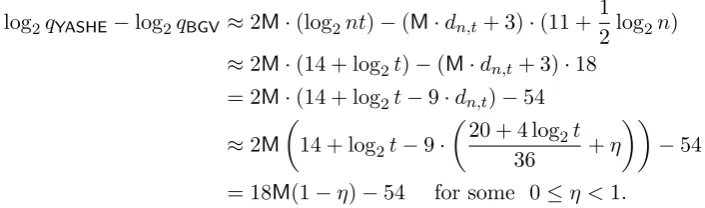
Note that it is difficult to compare these two schemes because their parameters depend on at least 4 variables: the plaintext modulus, t, the dimension, n, the Hamming weight, h, and the number of multaplicative levels to be evaluated, M. However we observe that, in the case that log2n≈14 and h= 64, we have:
log2qYASHE−log2qBGV ≈2M·(log2nt)−(M·dn,t+ 3)·(11 +
1
2log2n) ≈2M·(14 + log2t)−(M·dn,t+ 3)·18
= 2M·(14 + log2t−9·dn,t)−54
≈2M
14 + log2t−9·
20 + 4 log2t
36 +η
−54
= 18M(1−η)−54 for some 0≤η <1.
Hence, ifMis large, we can use a smaller ciphertext modulus to evaluateM-levels of multiplica-tions with BGVin comparison to YASHE; however, the YASHE scheme has smaller ciphertexts thanBGV. This follows from the fact that
|ct|BGV− |ct|YASHE≈2(M·dn,t+ 3)·(11 +
1
2log2n)−2M·(log2nt) ≈2M·(18·dn,t−14−log2t) + 108
≈2M·(log2t+ 18η−4) + 108
for some 0≤η <1; if log2t≥4, then log2t+ 18η−4≥0; otherwise, we havedn,t = 1 and so
18·dn,t−14−log2t >0.
For the polynomial multiplication in the base ringRq=Zq[x]/(xn+ 1), we implemented the
FFT algorithm by Nussbaumer [27] based on recursive negacyclic convolutions (with run-time complexity 92nlognlog logn +O(nlogn) of arithmetic operations in Zq). The homomorphic
multiplication in YASHE includes a costly key switching operation which is an inner product on R`qω,q, hence we obtain a total cost of`ω,q·(92nlognlog logn+O(nlogn)) operations for a
ciphertext multiplication. Therefore,BGVis expected to be faster thanYASHEfor a ciphertext multiplication if we take similar parameters withq andn.
5.2 How to Set Parameters
The security of BGV relies on the hardness of the RLWE assumption. Similarly, YASHE is provably secure in the sense of IND-CPA under the RLWE assumption and DSPR assumption. The main difference between the schemes is that BGV uses an odd integer m while YASHE choosesmto be a power-of-two with a prime integerqsuch that q≡1 (mod m). In [25], it was shown that the hardness of RLWE with the cyclotomic polynomialΦm(x) =xφ(m)+ 1 can be
established by a quantum reduction to shortest vector problems in ideal lattices. This means thatYASHE is believed to be secure as long as the lattice problems are hard to solve.
5.2.1 Parameters of the BGV scheme
To homomorphically evaluate the algorithms for task 1, we first choose sufficiently large t so that no reductions modulotoccurs in the plaintext slots. For example, we taketas the smallest power-of-two which satisfies the following inequalities:
n(Aj)= 200
X
i=1 g(ij)≤
200
X
i=1
2 = 400< t
since the total number of people in the same group is N = 200. So it suffices to take t= 29 for privately computing the minor allele counts. In the case ofχ2 test, we have
n(Aj)+n0(Aj)= 200
X
i=1 g(ij)+
200
X
i=1
g0(ij)≤2 200
X
i=1
2 = 800< t,
thus we set the parametert= 210. For the second task, we usedt= 2 to evaluate binary circuits. Now, we derive a lower-bound on φ(m) such that
φ(m)≥ (L(logm+ 23)−8.5)·(λ+ 110)
7.2 . (2)
from the security analysis of [14] based on Lindner and Peikert’s method [23]. For the efficiency of the implementation, we choose the smallest integermso as to satisfy Inequality (2) and pack the message into plaintext slots as many as possible. Next, we define a ladder of moduli to make the correct decryption after computation withLlevels (see [14] for details). Finally, we consider the discrete Gaussian distribution χerr = DZ,σ with mean 0 and standard deviation σ = 3.2
over the integers to sample random error polynomials.
5.2.2 Parameters of the YASHE Scheme
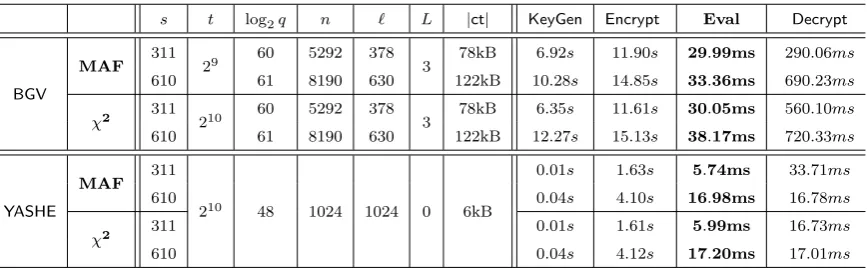
Table 3.Implementation results of task 1 usingBGVandYASHE
s t log2q n ` L |ct| KeyGen Encrypt Eval Decrypt
BGV
MAF 311 29 60 5292 378 3 78kB 6.92s 11.90s 29.99ms 290.06ms
610 61 8190 630 122kB 10.28s 14.85s 33.36ms 690.23ms
χ2 311 210 60 5292 378 3 78kB 6.35s 11.61s 30.05ms 560.10ms
610 61 8190 630 122kB 12.27s 15.13s 38.17ms 720.33ms
YASHE
MAF 311
210 48 1024 1024 0 6kB
0.01s 1.63s 5.74ms 33.71ms
610 0.04s 4.10s 16.98ms 16.78ms
χ2 311 0.01s 1.61s 5.99ms 16.73ms
610 0.04s 4.12s 17.20ms 17.01ms
one go. We fix the word ω = 2128 for the evaluation key and the standard deviation σ = 8 for the error distribution χerr.
Since we can estimate the size of noise during homomorphic operations, we get the lower bound on q to ensure the correctness. We also have maximal values of q to ensure the desired security using the results of [22], so that we can have more loose bound than that from LP’s method. Then we set m as a power-of-two to get a non-trivial interval for q and then select a smallest q in this interval.
5.3 Implementation Results
We present the parameter setting and performance results for secure genome analysis in Table 3 and 4. All the parameters provide 80-bit security level. We give the plaintext modulust, the size of the ciphertext modulusq, the lattice dimensionn=φ(m), and the number of plaintext slots `. We also give the circuit depthLso that HE scheme can correctly evaluate such a computation on encrypted data. In particular, it can be considered as the number of ciphertext moduli in the BGV scheme. We consider the ciphertext size in kBytes for a set of parameters. The last columns give the timings for the key generation, encryption, evaluation and decryption.
5.3.1 Performance results of task 1
In Table 3, the top four rows refer to the results using BGV, and the bottom four rows refer to results using YASHEfor computing the MAFs and χ2 statistic in case-control groups. Note that the number of slots means that how many messages we can pack into one single ciphertext. When usingYASHE, we can evaluate simultaneously by embedding the data into the coefficients of plaintext polynomial; the maximal degree of plaintext polynomial in this case is considered to be the number of slots.
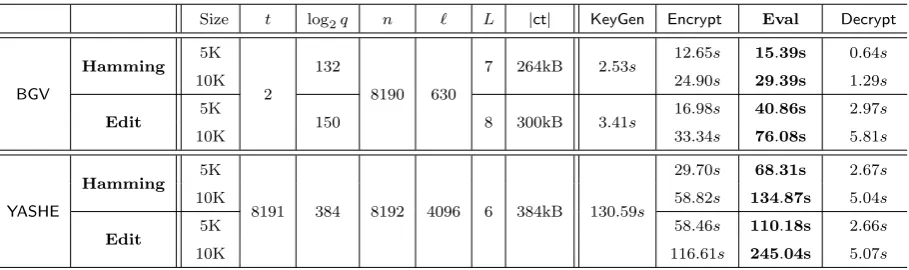
Table 4.Implementation results of task 2 usingBGVandYASHE
Size t log2q n ` L |ct| KeyGen Encrypt Eval Decrypt
BGV
Hamming 5K
2
132
8190 630
7 264kB 2.53s 12.65s 15.39s 0.64s
10K 24.90s 29.39s 1.29s
Edit 5K 150 8 300kB 3.41s 16.98s 40.86s 2.97s
10K 33.34s 76.08s 5.81s
YASHE
Hamming 5K
8191 384 8192 4096 6 384kB 130.59s
29.70s 68.31s 2.67s
10K 58.82s 134.87s 5.04s
Edit 5K 58.46s 110.18s 2.66s
10K 116.61s 245.04s 5.07s
5.3.2 Performance results of task 2
Table 4 presents the parameter setting and performance results for secure DNA sequence com-parison usingBGVand YASHE. We evaluated the performance with the input data of different sizes 5K and 10K. We implemented the comparison circuit with the same method as described in [11, Lemma 1] in order to reduce the circuit depth over encryption.
As discussed before, given the parameter L, we obtain the approximate size of ciphertext modulus as log2q≈43 + 18·(L−2) forBGVwhen usingt= 2 andR=Z[x]/(Φ8191(x)). Since it should support L = 7 or 8 to correctly evaluate genomic algorithms of task 2, we use the modulusq around 130 to 150. On the other hand, the size of the parameterq inYASHEshould be strictly larger than 2Llog2(nt) ≈52L with t= 29 and R =Z[x]/(x8192+ 1). So we used a
384-bit prime q such that q≡1 (mod 214).
In the implementation ofYASHEscheme, computing the inverse off moduloq turns out to be the most-time consuming part of the key-generation, which runs in around 128.34 seconds(s). In total, it takes about 130.59s to generate the public key, secret key and evaluation keys, while the key generation of the BGVscheme takes about 3.41s in order to support 8 levels.
There is also quite a big gap between the two schemes in timings for a multiplication of ci-phertexts:BGVtakes around 0.07s, whileYASHEtakes around 1.75s (including the key switching step) under the parameter settings used in task 2. For the efficiency of the YASHE scheme, we might avoid a costly key switching step during the homomorphic multiplication; however, it supports a limited number of homomorphic multiplications without the key switching step. This follows since the noise grows exponentially with the multiplicative depth through such consecutive operations. One alternative is to use a hybrid approach, in which we leave out key switching in certain places but do it in others using the evaluation key with a power of the secret key so that one can keep the ciphertext noise small for correct decryption. As a result, polynomial multiplication modulo xn+ 1 takes about 0.64s, but it is still slower than that in BGV. As expected, BGV is faster than YASHE to evaluate the genomic algorithms for DNA sequence comparison.
6 Conclusion
YASHEis slower than that inBGV. Therefore, the performance numbers forBGVare better than YASHE when homomorphically evaluating deep circuits (like the Hamming distance algorithm or approximate Edit distance algorithm). On the other hand, it might be more efficient to use the YASHE scheme for a low-degree computation, such as minor allele frequencies or χ2 test statistic in a case-control study.
Acknowledgements.The authors would like to thank Michael Naehrig for extensive assistance with the code for the YASHE-based implementation for the contest. The authors would also like to thank the iDASH Secure Genome Analysis Contest organizers, in particular Xiaoqian Jiang and Shuang Wang, for running the contest and providing the opportunity to submit competing implementations for these important tasks.
References
1. Hapmap project. http:// hapmap.ncbi.nlm.nih.gov/.
2. Personal genome project. http://www. personalgenomes.org/.
3. E. Ayday, J. L. Raisaro, P. J. McLaren, J. Fellay, and J.-P. Hubaux. Privacy-preserving computation of disease risk by using genomic, clinical, and environmental data. In 2013 USENIX Workshop on Health Information Technologies.
4. P. Baldi, R. Baronio, and E. D. Cristofaro. Countering gattaca: efficient and secure testing of fully-sequenced human genomes. InProceedings of the 18th ACM conference on Computer and communications security 2011, pages 691–702.
5. L. I. Bluestein. A linear filtering approach to the computation of the discrete fourier transform, volume 18. 6. J. W. Bos, K. Lauter, J. Loftus, and M. Naehrig. Improved security for a ring-based fully homomorphic
encryption scheme. InProceedings of Cryptography and Coding - 14th IMA International Conference 2013, volume 8308, pages 45–64.
7. J. W. Bos, K. Lauter, and M. Naehrig. Private predictive analysis on encrypted medical data. Journal of Biomedical Informatics, 50:234–243, 2014.
8. Z. Brakerski. Fully homomorphic encryption without modulus swithing from classical gapsvp. InProceedings of Advances in Cryptology-Crypto 2012, volume 7417, pages 868–886.
9. Z. Brakerski, C. Gentry, and V. Vaikuntanathan. (Leveled) fully homomorphic encryption without boot-strapping. InProceedings of the 3rd Innovations in Theoretical Computer Science Conference 2012, pages 309–325.
10. J. H. Cheon, M. Kim, and M. Kim. Search-and-compute on encrypted data. In M. Brenner, N. Christin, B. Johnson, and K. Rohloff, editors, Proceedings of Financial Cryptography and Data Security - FC 2015 International Workshop WAHC, volume 8976, pages 142–159.
11. J. H. Cheon, M. Kim, and K. Lauter. Homomorphic computation of edit distance. In M. Brenner, N. Christin, B. Johnson, and K. Rohloff, editors, Proceedings of Financial Cryptography and Data Security - FC 2015 International Workshop WAHC, volume 8976, pages 194–212.
12. Y. Erlich and A. Narayanan. Routes for breaching and protecting genetic privacy. Nature Reviews Genetics 2014, 15:409–421.
13. C. Gentry. Fully homomorphic encryption using ideal lattices. InProceedings of the 40th ACM symposium on Theory of computing 2009, pages 169–178.
14. C. Gentry, S. Halevi, and N. Smart. Homomorphic evaluation of the AES circuit. InProceedings of Advances in Cryptology-Crypto 2012, volume 7417, pages 850–867.
15. C. Gentry, A. Sahai, and B. Waters. Homomorphic encryption from learning with errors: Conceptually-simpler, asymptotically-faster, attribute-based. InProceedings of Advances in Cryptology-Crypto 2013, vol-ume 8042, pages 75–92.
16. T. Graepel, K. Lauter, and M. Naehrig. Ml confidential: Machine learning on encrypted data. InProceedings of Information Security and Cryptology-ICISC 2012, volume 7839, pages 1–21.
17. S. Halevi and V. Shoup. Design and implementation of a homomorphic encryption library. Technical report, IBM, 2013.
18. M. Humbert, E. Ayday, J.-P. Hubaux, and A. Telenti. Addressing the concerns of the lacks family: quantifica-tion of kin genomic privacy. InProceedings of the ACM SIGSAC conference on Computer and communications security 2013, pages 1141–1152.
20. K. Lauter, A. L´opez-Alt, and M. Naehrig. Private computation on encrypted genomic data. InProceedings of Progress in Cryptology - LATINCRYPT 2014, volume 8895, pages 3–27.
21. K. Lauter, M. Naehrig, and V. Vaikuntanathan. Can homomorphic encryption be practical? InProceedings of the 18th ACM conference on Cloud computing security 2011, pages 113–124.
22. T. Lepoint and M. Naehrig. A comparison of the homomorphic encryption schemes fv and yashe. In Proceedings of Progress in Cryptology- AFRICACRYPT 2014, volume 8469, pages 318–335.
23. R. Lindner and C. Peikert. Better key sizes (and attacks) for lwe-based encryption. InProceedings of Topics in Cryptology- CT-RSA 2011, volume 6558, pages 319–339.
24. A. L´opez-Alt, E. Tromer, and V. Vaikuntanathan. On-the-fly multiparty computation on the cloud via multikey fully homomorphic encryption. InProceedings of the 40th ACM symposium on Theory of computing 2012, pages 1219–1234.
25. V. Lyubashevsky, C. Peikert, and O. Regev. On ideal lattices and learning with errors over rings. In Proceedings of Advances in Cryptology-Eurocrypt 2010, volume 6110, pages 1–23.
26. M. Naveed, E. Ayday, E. W. Clayton, J. Fellay, C. A. Gunter, J.-P. Hubaux, B. A. Malin, and X. Wang. Privacy in the genomic era.
27. H. J. Nussbaumer. Fast polynomial transform algorithms for digital convolution. IEEE Trans on Acoustics, Speech and Signal Proceesing, 28(2):205–215, 1980.
28. V. Shoup. NTL: A library for doing number theory. http://www.shoup.net/ntl, 2009.
29. N. Smart and F. Vercauteren. Fully homomorphic SIMD operations. IACR Cryptology ePrint Archive, 2011(133).
30. M. van Dijk, C. Gentry, S. Halevi, and V. Vaikuntanathan. Fully homomorphic encryption over the integers. InProceedings of Advances in Cryptology-Eurocrypt 2010, volume 6110, pages 24–43.
31. R. A. Wagner and M. J. Fischer. The string to string correction problem.Journal of the ACM, 21(1):168–173, 1974.