Available Online atwww.ijcsmc.com
International Journal of Computer Science and Mobile Computing
A Monthly Journal of Computer Science and Information Technology
ISSN 2320–088X
IMPACT FACTOR: 6.199
IJCSMC, Vol. 8, Issue. 4, April 2019, pg.142 – 149
Node Localization Techniques for
Underwater Acoustic Networks
Manisha Kapoor
Research Scholar, Arni University, Indora, Himachal Pradesh, India
Anurag Rana
Assistant Professor, Arni University, Indora, Himachal Pradesh, India
Ankur Sharma
Associate Professor, Arni University, Indora, Himachal Pradesh, India
Abstract: The wireless sensor network is the decentralized type of network in which sensor nodes sense information and pass sensed information to base station. The underwater acoustic network is the type of sensor network which is deployed under sea oceans to sense underwater conditions. The node localization and energy consumption are the major issues of underwater acoustic networks. In this paper, various techniques of node localization are reviewed and analyzed in terms of certain parameters.
Keywords: Underwater acoustic network, node localization, energy consumption
Introduction
acoustic networks, various researches have been made over the time. Initially, underwater phones were generated for the US navy during the World War II so that the armies could access them in the oceans for communication. Over the time, the communication has been improved by introducing these networks within other scientific, military as well as the commercial applications as well. In the underwater acoustic networks, the mode of communication can be done by using the electromagnetic waves, optical waves or the acoustic waves. There are advantages as well as disadvantages for both of these approaches. For instance, the radio waves are highly affected by the high attenuation of the water which thus results in increasing the transmission power and also requires larger antennas [3]. The optical waves will be affected largely by scattering as well as absorption, even though the data rate communication used by them is higher. Therefore, highly efficient and reliable optical waves can only be provided with the help of short distance links available. B using acoustic waves for communication, one can transmit the information over long distances in comparison to other networks. However, the affects that are caused due to the absorption of wader water is less. So, reliable results are provided with the deployment of these networks. In comparison to other networks, the demand and popularity of these networks is growing day by day and thus the research within them is also expanding. Node localization is an issue that mainly arises due to the dynamic nature of WSNs [4]. The node localization approach is used to share the location of sensor nodes such that one can ensure that an efficient data communication is being performed. It is possible to resolve the data aggregation problem by introducing an efficient solution to the node localization problem. WSNs are deployed in several applications such that the larger fields can be tracked and monitored. Node localization however, plays a very important role within these networks. The problem arises here mainly since these networks are highly dynamic in nature. Node localization is known to be the process in which the unknown nodes are recognized by gathering the coordinate nodes [5]. By using the coverage area that includes the deployment of sensor nodes in it, along with the distance approaches, this mechanism can be executed. It is important to introduce queries within this approach such that sensor nodes can further create queries for certain events, forward the gathered data and perform routing on it. The node localization technique includes within it various approaches that are proposed by different researchers. This approach includes centralized as well as decentralized approaches within it. A specific algorithm is assigned to a class depending upon the type of mechanism involved [6]. A centralized type of location technique is known to be the one in which it is possible to forward the control messages and in the form of a response, the location of node is sent. Further, the decentralized type of localization technique is known to be the one in which the nodes and anchor nodes are deployed in such a way that the position is estimated by them by forwarding the control messages. This mechanism includes several approaches that have been proposed by different researchers over time.
Some of these approaches are given below:
i) Particle Swarm Optimization (PSO): A stochastic approach that is highly flexible in nature is introduced on the basis of the nature as well as mobility of swarms which is known as PSO [7]. This technique uses the concept of social interaction and was introduced in 1995 by the researchers namely James Kennedy (social-psychologist) and Russell Eberhart (electrical engineer). Depending upon the mobility in the search space along with the presence of swarm within various particles, it is possible to known the best optimization solution. Each particle that provides the best optimal solution within the solution space also keeps a track of all the coordinates.
iii) Trilateration Method: There is wide utilization of trilateration technique in order to perform localization. The most important task to be performed here is to utilize three or more anchor nodes. The distances that are calculated from the known to known objects are defined as the radiuses of circles. On the basis of the unknown entity, the three circles are intersected. There is one point that does not lie within the intersection of these circles [8]. The distances of the nodes are measured in order to determine the absolute as well as relative locations of the points through this approach.
iv) Bee Optimization algorithm: This algorithm is used to localize the sensor nodes of WSNs. With the help of conducting different tests, different topologies use within them the values achieved from Time of Arrival (TOA) measurements and received signal strength (RSS).
v) Received signal strength Indicator (RSSI): This approach can be defined as a methodology that is based on the range depending upon the RSSI circuitry that also includes the transceivers chipsets of the sensor [9]. This technique also helps in calculating the operations in which there is no processing power of sensor nodes known. When this technique is applied in WSNs, the performance achieved is better and the cost as well as localization issues are also resolved.
vi) Angle-of-Arrival (AoA): When the relation amongst the angles of trajectory is introduced along with the direction of received signals by using the angle of arrival technique, it is possible to estimate the position of sensor nodes. The accuracy level of this approach is better when comparisons are made against the RSSI approaches.
vii) Triangulation: This approach is used to estimate the direction of sensor nodes. However, it is not possible to estimate the distance of sensor nodes as well. The application of trigonometric laws is done here in order to calculate the positions of nodes [10].
viii) Time based methods (ToA, TDoA): These mechanisms include within them various time-based techniques by using with the location of sensor nodes can be estimated. The propagation of signals is done and the estimation to location of sensor nodes is done depending upon the propagated signals when the wireless channels are involved.
Literature Review
Shengming Chang, et.al (2018) presented the underwater acoustic wireless sensor network (UWSN) and their measurements on the basis of received signal strength (RSS) in order to address the issue of target localization [11]. They proposed a fast implementation algorithms in this paper using which non-convex problems has been converted into generalized trust region sub problem (GTRS) frameworks. In order to increase the estimation accuracy in the unknown target transmit power case, they provided a three-step procedure in this paper. Therefore, for both cases they derived the Cramer–rao lower bounds (CRLBs). On the basis of performed experiments, it is concluded that proposed method outperforms in the condition of underwater environment.
algorithm provides the better accuracy as compared to others in terms of reduce time error and node localization accuracy. The MATLAB tool was used for the process of simulation in specific underwater circumstance.
Xu Jiahui, et.al (2017) presented for the underwater acoustic sensor network the process of node localization was utilized in the past but it was very costly. Therefore, they proposed a Range-free localization algorithm in this paper in which information about distance and angle is not required. It used the network connectivity only for the localization [13]. They proposed an improved APIT localization algorithm in this paper using which grid scanning is converted into the point scanning. They also compared the improved APIT algorithm with the traditional APIT and the centroid algorithm. As per done experiments, it is concluded that better performance is provided by the proposed method in condition of network load while the location accuracy is affected due to the collision.
Gao Jingjie, et.al (2017) presented in the wide range of applications the currently used technology is of Mobile Underwater Acoustic Networks (MUANs). The self-localization of mobile nodes is not an easy task. They proposed a range-angle based self-localization scheme for MUANs in this paper. The original positions are estimated by the other ordinary nodes and also predicted the information of track using the mobility model [14]. The initial step, it is not required to localize periodically and second, GPS receiver is given to only anchor and self-guide system, rest of the nodes should communicate with anchor in order to attain their positions, according to the proposed method. With the help of the proposed method, both the cost and the communication traffic can be minimized easily in the underwater environment.
Yuhan Dong, et.al (2017) presented in the wireless sensor networks an essential role is played by the localization of sensor nodes mainly for underwater WSNs (UWSNs) [15]. They proposed a median RLS (MRLS) in this paper using which the median path is selected and weighted RLS (WRLS) using which path is assigned for the direct path for UWSNs. On the basis of performed experiments and obtained numerical results, it is concluded that proposed scheme has better performance as it minimizes the multipath effect as compared to others. Also, suggested that performance of WRLS is better in comparison to MRLS and traditional approaches.
Yashwanth N, et.al (2016) presented the underwater acoustic sensor network (UASN) defined as the distributed network of many wireless sensor nodes [16]. The main objective of this network is to find the locations for the nodes for the efficient data processing and transmission. They utilized the recursive procedure for 2-D localization and for both hallow and deep underwater communication they utilized the MATLAB and Aqua-sim Network Simulator 2.30 for this purpose. Therefore, with the help of this method there is increase in the lifetime of the network and it also save the energy of batteries due to which it is widely utilized in the applications of underwater.
Jing Yan, et.al (2017) designed active and passive sensor nodes which include the autonomous underwater vehicles (AUVs) in it. In this model, anchor nodes are AUVs which provides the localization information for sensor nodes [17]. They also provided an asynchronous localization algorithm for active and passive sensor nodes also having the prediction of mobility. This method is used to eliminate the effect of asynchronous clocks and to minimize the sensor nodes mobility. Convergence analysis and Cramer-Rao lower bounds (CRLB) provided in this paper helps in minimizing the localization errors. On the basis of obtained simulation results, it is concluded that there is reduction in the time localization by the proposed method as compared to previously used methods.
attitude in the network, they developed a communication protocol [18]. This is possible due to the eavesdropping on the communication of other nodes. For this purpose, they combined Bayes estimator with the acoustic USBL modems and pressure sensors. They used the multi-beam sonar for this purpose as it plays major role in measurement. They utilized the Monte-Carlo-Simulation in this paper for the evaluation of their proposed method and also using the collected real data from the sea trial in the Middle Atlantic Ocean.
Vignesh Mandalapa Bhoopathy, et.al (2016) presented the network in this paper in which distribution of the wireless sensor nodes is done randomly for the specific geographic region. This network observed this specified area and used the acoustic signals in order to communicate with each other nodes this network is known as underwater acoustic sensor network (UASN) [19]. Propagation delay, limited energy sources, high bit error rate, and limited harvesting techniques are some disadvantages of acoustic channel. This makes the process of localization of UASN a critical process. Hence, they proposed a distributed localization scheme in this paper using which issue of distance calculation and requirement of time synchronization can be avoided. This method used the two-way time of arrival estimation method to make it more effective.
Sergej Neumann, et.al (2016) presented a novel localization approach in this paper for the nodes in an acoustic underwater sensor network. Within the network, nodes are able to localize their by themselves due to the combination of pressure sensors with the functionality of modern acoustic USBL modems [20]. In this process, the transmitted messages of other network nodes are listened that helps in saving the energy. This also helps in separating the communication channel from additional traffic and performs all working in passive manner. They performed various experiments in this paper for the evaluation of the proposed method in real conditions in the middle Atlantic Ocean along with simulation.
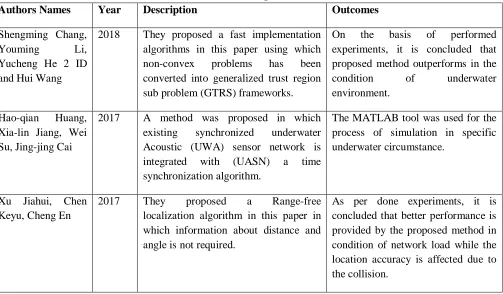
Table of Comparison
Authors Names Year Description Outcomes
Shengming Chang,
Youming Li,
Yucheng He 2 ID and Hui Wang
2018 They proposed a fast implementation algorithms in this paper using which non-convex problems has been converted into generalized trust region sub problem (GTRS) frameworks.
On the basis of performed experiments, it is concluded that proposed method outperforms in the condition of underwater environment.
Hao-qian Huang, Xia-lin Jiang, Wei Su, Jing-jing Cai
2017 A method was proposed in which existing synchronized underwater Acoustic (UWA) sensor network is integrated with (UASN) a time synchronization algorithm.
The MATLAB tool was used for the process of simulation in specific underwater circumstance.
Xu Jiahui, Chen Keyu, Cheng En
2017 They proposed a Range-free localization algorithm in this paper in which information about distance and angle is not required.
Gao Jingjie, Shen Xiaohong, Mei Haodi, Jia Tianyi, Wang Ling, Wang Haiyan
2017 They proposed a range-angle based self-localization scheme for MUANs in this paper. The original positions are estimated by the other ordinary nodes and also predicted the information of track using the mobility model
With the help of the proposed method, both the cost and the communication traffic can be minimized easily in the underwater environment.
Yuhan Dong, Rui Wang, Zheng Li, Chen Cheng, Kai Zhang
2017 They proposed a median RLS (MRLS) in this paper using which the median path is selected and weighted RLS (WRLS) using which path is assigned for the direct path for UWSNs.
Also, suggested that performance of WRLS is better in comparison to MRLS and traditional approaches.
Yashwanth N, B R Sujatha
2016 The main objective of this network is to find the locations for the nodes for the efficient data processing and transmission.
With the help of this method there is increase in the lifetime of the network and it also save the energy of batteries due to which it is widely utilized in the applications of underwater.
Jing Yan, Xiaoning Zhang, Xiaoyuan Luo, Yiyin Wang, Cailian Chen, and Xinping Guan
2017 In this model, anchor nodes are AUVs which provides the localization information for sensor nodes.
On the basis of obtained simulation results, it is concluded that there is reduction in the time localization by the proposed method as compared to previously used methods.
Sergej Neumann, David Oertel, Heinz Worn
2016 A Deep Net Localization approach was proposed in this paper in an acoustic underwater sensor network for both the stationary and mobile nodes.
They utilized the Monte-Carlo-Simulation in this paper for the evaluation of their proposed method and also using the collected real data from the sea trial in the Middle Atlantic Ocean.
Vignesh Mandalapa Bhoopathy,
Mohamed Ben Haj Frej, Steve Richard Ebenezer
Amalorpavaraj, Imran shaik
2016 A network was presented in this paper in which distribution of the wireless sensor nodes is done randomly for the specific geographic region.
This method used the two-way time of arrival estimation method to make it more effective.
Sergej Neumann, David Oertel and Heinz Woern
2016 Within the network, nodes are able to localize their by themselves due to the combination of pressure sensors with the functionality of modern acoustic USBL modems.
Conclusion
In this paper, it is concluded that underwater acoustic network is the type of sensor network which sense information and pass it to base station. The node localization is the major issue of underwater acoustic network which affect performance. In this work, the techniques of node localization are reviewed and analyzed in terms of certain parameters. In future, novel approach will be designed for node localization which localize maximum nodes in least amount of time.
References
[1] Manjula.R.B, Sunilkumar S. Manvi, “Issues in Underwater Acoustic Sensor Networks”, International Journal of Computer and Electrical Engineering, vol.3, pp.101-110, 2011.
[2] J.H. Cui, J. Kong, M. Gerla, and S. Zhou, Challenges: Building scalable mobile underwater wireless sensor networks for aquatic applications, IEEE Network, Special Issue on Wireless Sensor Networking, pp. 12-18, 2006.
[3] X. Yang, K.G. Ong, W.R. Dreschel, K. Zeng, C.S. Mungle, and C.A. Grimes, “Design of a wireless sensor network for long-term, insitu monitoring of an aqueous environment”, vol. 11, pp. 455–472, 2002.
[4] Vasilescu.K.Kotay and D.Rus, Data Collection, Storage and Retrieval with an underwater Sensor Network, ACM SenSys, vol.5 pp.154-165, 2005.
[5] I. F. Akyildiz, D. Pompili, and T. Melodia, Underwater acoustic sensor networks: Research challenges, Ad Hoc Networks, vol.7, pp. 257–279, 2005.
[6] Q. Zhang , and M. Cheng, “A node localization algorithm for wireless sensor network based on improved particle swarm optimization”, Lecture Notes in Electrical Engineering, 2014, vol. 237, pp.135-144
[7] Sharma, A., & Gaffar.H, A., “A Survey on Routing Protocols for Underwater Sensor Networks”, 2012, International Journal of Computer Science & Communication Networks , 74-82.
[8] P.K Singh, Bharat Tripathi, Narendra Pal Singh, “NODE LOCALIZATION IN WIRELESS SENSOR NETWORKS,” 2011, IJCSIT, vol.2, pp. 2568-2572.
[9] Satvir Singh, Shivangna, Etika Mittal, “Range based wireless sensor node localization using PSO and BBO and its variants”, International conference on communication systems and network technologies, 2013, vol.4, pp.9-20.
[10] Avinash Kaur, Sonu Agrawa, “Location detection in wireless sensor network using classical optimization methodology,” 2012, IJCST, vol. 3, pp.108-115.
[11] Shengming Chang , Youming Li, Yucheng He 2 ID and Hui Wang 1, “Target Localization in Underwater Acoustic Sensor Networks Using RSS Measurements”, IEEE, 2018.
[12] Hao-qian Huang, Xia-lin Jiang, Wei Su*, Jing-jing Cai, “The passive hidden mobile node time synchronization algorithm used in Underwater Acoustic Networks”, IEEE, 2017.
[14] Gao Jingjie; Shen Xiaohong; Mei Haodi; Jia Tianyi; Wang Ling; Wang Haiyan, “A range-angle based self-localization scheme for MUANs”, IEEE, 2017.
[15] Yuhan Dong, Rui Wang, Zheng Li, Chen Cheng, Kai Zhang, “Poster Abstract: Improved Reverse Localization Schemes for Underwater Wireless Sensor Networks”, IEEE, 2017.
[16] Yashwanth N, B R Sujatha, “Wireless Sensor Node Localization in Underwater Environment”, 2016 International Conference on Electrical, Electronics, Communication, Computer and Optimization Techniques.
[17] Jing Yan, Xiaoning Zhang, Xiaoyuan Luo, Yiyin Wang, Cailian Chen, and Xinping Guan, “Asynchronous Localization with Mobility Prediction for Underwater Acoustic Sensor Networks”, IEEE, 2017.
[18] Sergej Neumann, David Oertel, Heinz Worn, “Deep Net Localization - Eavesdropping in Mobile Acoustic Underwater Sensor Networks”, IEEE, 2016.
[19] Vignesh Mandalapa Bhoopathy, Mohamed Ben Haj Frej, Steve Richard Ebenezer Amalorpavaraj, Imran shaik, “Localization and Mobility of Underwater Acoustic Sensor Nodes”, IEEE, 2016.