On Tightly Secure Non-Interactive Key Exchange
Julia Hesse
∗,1, Dennis Hofheinz
†,2, and Lisa Kohl
‡,2 1Technische Universit¨
at Darmstadt, Germany
[email protected]
2
Karlsruhe Institute of Technology, Germany
{
dennis.hofheinz,lisa.kohl
}
@kit.edu
June 11, 2018
Abstract
We consider the reduction loss of security reductions for non-interactive key exchange (NIKE) schemes. Currently, no tightly secure NIKE schemes exist, and in fact Bader et al. (EUROCRYPT 2016) provide a lower bound (of Ω(n2), wherenis the number of parties an adversary interacts with) on the reduction loss for a large class of NIKE schemes.
We offer two results: the first NIKE scheme with a reduction loss ofn/2 that circumvents the lower bound of Bader et al., but is of course still far from tightly secure. Second, we provide a generalization of Bader et al.’s lower bound to a larger class of NIKE schemes (that also covers our NIKE scheme), with an adapted lower bound ofn/2 on the reduction loss. Hence, in that sense, the reduction for our NIKE scheme is optimal.
1
Introduction
Tight security reductions. A security reduction relates the security of a cryptographic construction to the difficulty to solve some assumed-to-be-hard problem. In other words, to base the security of a schemeS
on the hardness of a problemP, one has to show how to solveP given an adversary that successfully attacks
S. As one usually considers asymptotic security, both adversary and problem solver are required to have polynomial running time and non-negligible success probability.
Many security reductions now guess where inSto embed problemP. For example, in case of a signature scheme, the security reduction might guess in which generated signature (an instance of) P is embedded. Asymptotically, this is fine, as an S-attacker can only ask for a polynomial number of signatures. But when instantiating the scheme with concrete parameters, this guessing step leads to the following paradox: Considering a number of, say, 230signature queries (which is realistic when thinking of servers) and a security
parameterλ= 100, the concrete loss in success probability introduced by the reduction would actually be larger than a factor of 2λ/4. When aiming at concrete security guarantees (derived from the hardness of
P), one thus has to account for the number of expected signatures at the time of set-up, when choosing keylengths.
This makes so calledtight security reductions a desirable goal. A security reduction is regarded as tight, if (with comparable running times) the success probability of the problem solver is close to the success probability of the underlying attacker. More precisely, one usually requires the success probabilities to only differ up to a small constant factor (or, for a broader notion of tightness, up to a factor linear in the security parameter). Tight security reductions allow to choose the security parameter for concrete instantiation
∗Parts of work done while at ´Ecole Normale Sup´erieure, Paris, supported by ERC Project CryptoCloud FP7/2007-2013
Grant Agreement no. 339563
†Supported by ERC Project PREP-CRYPTO (724307), and by DFG grants HO 4534/4-1 and HO 4534/2-2.
‡Supported by ERC Project PREP-CRYPTO (724307), by DFG grant HO 4534/2-2 and by a DAAD scholarship. Parts of
Reference |pk| model sec. loss assumption uses
Diffie–Hellman [15] 1×G HKR n2 DDH
-Ours, Sec. 3 3×G HKR n/2 DDH
-CKS08 [10] 2×G DKR 2 CDH ROM
FHKP13 [18] 1×ZN DKR n2 factoring ROM
FHKP13 [18] 2×G+ 1×Zp DKR n2 DBDH asymm. pairing
Ours, Sec. 4 12×G DKR n/2 DLIN symm. pairing
Figure 1: Comparison of existing NIKE schemes. |pk| denotes the size of the public keys, measured in numbers of group elements and exponents. “DKR” or “HKR” denote the CKS-heavy security notion from [18] with dishonest, resp. honest key registrations. Regarding security loss,ndenotes the number of honest parties the adversary interacts with andq is the total number of queries made by the adversary. The losses of the two constructions from [18] stems from applying a generic transformation (from the same paper) to level the security guarantees of all compared schemes. Our construction from Section 3 is instantiated with the HPS of Cramer–Shoup based on DDH presented in Section 3.1. We omit the second scheme from [18] since we focus on non-interactive key registration procedures.
independently of the number of expected instantiations (or, say, generated signatures in case of a signature scheme).
Positive and negative results on tight security. Schemes with tight security reductions could
already be constructed for a variety of cryptographic applications (such as public-key encryption [6, 29, 2, 39, 38, 21, 27, 20], identity-based encryption [11, 7, 32, 3, 24], digital signature schemes [35, 39, 38, 28, 1], or zero-knowledge proofs [29, 21]). For public-key encryption schemes, the price to pay for an (almost) tight reduction has been reduced to essentially only one additional group element in ciphertexts [21, 20].
On the other hand, starting with the work of Coron [12], a number of works show that certain types of reductions are inherently non-tight (in the sense that a problem solver derived from a given adversary has a significantly reduced success probability). For instance, [12, 33, 30, 4] prove that any “simple” reduction for a sufficiently “structured” signature scheme must lose a factor of Ω(qsig), where qsig is the number of adversarial signature queries. (Here, the definitions of “simple” and “structured” vary across these papers.) Similar lower bounds exist also for specific schemes and other primitives [19, 43, 37, 17, 4]. Particularly interesting to our case is the work of Bader et al. [4], which proves lower bounds on the reduction loss of signature, encryption, and non-interactive key exchange schemes in the standard model.
Our focus: non-interactive key exchange. In this work, we investigate tight reductions for
non-interactive key exchange (NIKE) schemes in the two-party setting1. Intuitively, a NIKE scheme enables
any two parties Pi and Pj to compute a common shared key Kij using a public-key infrastructure only, but without any interaction. (That is, Kij should be an efficiently computable function of Pi’s public and
Pj’s private key, and we require Kij =Kji.) Already the original Diffie-Hellman key exchange [15] forms a NIKE scheme (although one that only satisfies a weak form of security). However, the formal investigation of NIKE schemes started with the work of Cash, Kiltz, and Shoup [10], with a more detailed investigation provided in [18].
While there exist highly secure and efficient NIKE schemes (e.g., [10, 18]), currently there is no NIKE scheme with a tight security reduction to a standard assumption (and in the standard model). We believe that this is no coincidence: as we will detail below, the rich interdependencies among NIKE keys prevent existing techniques to achieve tight security. Also, it might be interesting to note that the already mentioned work of Bader et al. [4] presents a particularly strong (i.e.,quadratic) lower bound of Ω(n2) on the reduction
loss of NIKE schemes, wherenis the number of parties that the adversary interacts with. While the scheme of [10] is proven only in the random oracle model (such that Bader et al.’s lower does not apply), this lower bound applies to the scheme of [18].
Our results. In this work, we provide two contributions. First, we construct an efficient and modular NIKE scheme with a reduction significantly tighter than previous reductions. Concretely, our reduction targets the`-Linear assumption in pairing-friendly groups, and has a loss of n/2, wherenis the number of users an adversary interacts with. Thus, our scheme is the first to break (or, rather, circumvent) the lower bound of Bader et al. [4]. As a technical tool, we also present a generic transformation that turns any mildly secure NIKE scheme (i.e., secure only against passive adversaries) into a strongly secure one (secure against active adversaries).
Second, we show that our security reduction is optimal, in the sense that we can generalize the result of Bader et al. [4] to our scheme, at the price of a smaller lower bound (of preciselyn/2). Our generalization follows the high-level ideas of Bader et al. (who in turn follow Coron’s work [12]). However, unlike their result, we even consider NIKE schemes and reductions that make nontrivial changes to the public-key infrastructure itself. We believe that our second result points out the inherent difference between the public-key or signature settings (in which we already have tightly secure schemes from standard assumptions), and the NIKE setting (in which a broader range of lower bounds holds, and, to our knowledge, no tight schemes exist).
We note that in line with previous works [4, 26], our negative result does not consider schemes or reductions in the random oracle model.
1.1
Technical overview
In order to describe our results, it will be helpful to first recall existing lower bounds results (and in particular the result of Bader et al. [4]). This way, we will be able to detail how we circumvent these lower bounds, and what other obstacles still block the way to a tight reduction.
A closer look on existing lower bound results. It might be interesting to see why these lower bounds do not contradict any of the constructions mentioned above. All mentioned lower bounds use a “meta-reduction” (cf. [9]) that turns any tight reduction into a successful problem solver (even without a given successful adversary). To describe how a meta-reduction works, assume a reductionR that interacts with an adversary A. Assume further that R first solves a number of problem instances for A, and then expects Ato solve a new problem instance. (For instance, in the signature setting, Rmight first generate many signatures forAon messages ofA’s choice, and then expectAto forge a signature for a fresh message.)
Rwill then try to solve its own input instance using the fresh solution provided byA.
Now a meta-reduction M runs R, and takes the place of A in an interaction with R. Intuitively, M
will try to feed R with R’s own problem solutions, and hope thatR can use one of those to solve its own input. Of course, security games generally require the adversary to generate a fresh problem solution to avoid trivial attacks. (For instance, the standard security game for signatures [23] requires the adversary to forge a signature for a message that has not been signed before.) Hence, M runs Rtwice: in the first run,
M asks R for the solutions to, say, q randomly chosen problem instances z1, . . . , zq. Then, M rewindsR,
asks for solutions todifferent problem instances ˜zi, and submits the previously obtained solution to one zi
as fresh solution.
Of course, Rmay fail to convert a zi-solution into a solution to its own input sometimes (depending on its reduction loss), and this leaves a “loophole” forRto escape the meta-reduction strategy ofM. However, a combinatorial argument of [12] shows thatR must have a reduction loss of Ω(qsig) to use this loophole.
For this strategy of M, it is essential that the reduction R will “accept” a problem solution that it has generated itself. To this end, [12, 33] require unique signatures (i.e., problem solutions), and [30, 4] require re-randomizable signatures (so that any valid signature produced byRcan be converted in a random signature byM). However, this property is violated (in a very strong sense) by many of the tightly secure signature schemes mentioned above (e.g., [39, 38, 28, 1]). Specifically, the corresponding (tight) reductions find a way to produce special valid-looking signatures for an adversary that are however useless to solving a problem instance. (Of course, these signatures are not re-randomizable or unique.)
The argument of Bader et al. for NIKE schemes. Bader et al. [4] adapt the above argument to
NIKE schemes. To describe their argument, we first recall the NIKE security experiment (according to [10]). A NIKE adversary may request an arbitrary numbern of public keys pki, and may adaptively corrupt an
arbitrary subset of them (in which case the adversary gets the corresponding secret keysski).2 Finally, the
adversary selects two public keyspki∗,pkj∗that have not been corrupted, and then must distinguish between
their shared keyKi∗,j∗, and an independently random value.3
Now assume a reduction R that turns any NIKE adversary into a successful problem solver. This reduction R has to be able to answer adversarial corruption queries, and come up with the corresponding secret keysski. Intuitively, a meta-reductionM can take the role of an adversary, and first obtain some of
these keysskifromR. Then,M can rewindR, and choose to be challenged on a shared keyKi∗,j∗that can
be computed from one previously obtainedski.
The main difference to the signature case above is that n public keys pki give rise to O(n2) shared
keys (or, problem instances/solutions) Kij. In particular, O(n) corruptions enable M to compute O(n2)
shared keys (and thus to potentially solve a quadratic number of shared key challenges). IfR turns any of those challenge solutions into a problem solution, then M succeeds. Hence, R must fail with probability 1−O(1/n2). (Another way to view this is that the reduction’s success has to vanish with the failures of the
simulation.)
How to circumvent the NIKE lower bound. However, similar to previous works, Bader et al. assume that any secret key (or, more generally, problem solution) output byR can be used to solve corresponding challenges posed byR. This assumption can in fact be violated easily, e.g., by allowing many different secret keys per public key. (That is, a secret key is not uniquely determined by a given public key and, e.g., R
may hand out different secret keys upon a corruption query.) Furthermore, different secret keys (for a given public key) may behave differently in the computation of shared keys, and thus may not necessarily be useful in solving a given challenge. Similar ideas are at the core of known techniques for improving tightness, in particular in the context of corruptions [5].
While this first thought allows to circumvent the lower bound of Bader et al., its concrete implementation is not clear at all in the context of NIKE schemes. In particular, there should be many secret keys (with different functionality) for a given public key, but the secret keys obtained through corruptions should still satisfy correctness (in the sense thatpkiandskj lead to the same shared key asski andpkj). (We note that
this obstacle is specific to NIKE schemes, and in our opinion the main reason why obtaining tightly secure NIKE schemes appears to be particularly difficult.)
Our scheme. To explain our solution, it might be easiest to first outline our scheme (which, in its basic form, is a variation of the password-authenticated key exchange scheme of [34, 22]). Let L be a language, and assume a hash proof system (HPS) for L with public keyshpkand secret keys hsk. We write Hhsk(x) for hash proof of anL-instancexunder key hsk. Then, public and secret keys of our NIKE scheme are of the following form:
pk= (hpk, x) sk= (hsk, x, w),
wherex∈Lwith witnessw, and a HPS keypair (hpk,hsk) are randomly chosen. Givenpki= (hpki, xi) and
skj = (hskj, xj, wj), the corresponding NIKE shared key is computed asKij =Hhskj(xi)·Hhski(xj), where the hash valueHhski(xj) is computed from (and uniquely determined by)hpki andwj. We have correctness
in the senseKji=Hhski(xj)·Hhskj(xi) =Hhskj(xi)·Hhski(xj) =Kij.
Recall that there are many HPS secret keys hskfor any given public key hpk. However, all these secret keys act identically on any x ∈ L. Hence, in order to benefit from the non-uniqueness of hsk, a NIKE reduction will have to switch at least onex∈Lin a NIKE public keypki to a no-instancex /∈L. Let us call such a NIKE public key (withx /∈L) “invalid”. For an invalidpki, no (full) secret key exists. This means
that our reduction must hope that no invalidpki is ever corrupted. Since a NIKE adversary may corrupt all
public keys except for the two selected challenge keyspki∗,pkj∗, this means that our reduction may instead
fail with probability 1−2/n.
In other words, already with one invalid public key, our reduction has a loss of at least n/2. On the bright side, we will present a strategy that uses precisely one invalid public key to leverage a NIKE security reduction (with lossn/2). This reduction is of course far from tight, but it has a loss still considerably better than the O(n2) lower bound by Bader et al., and thus is significantly tighter than previous constructions.
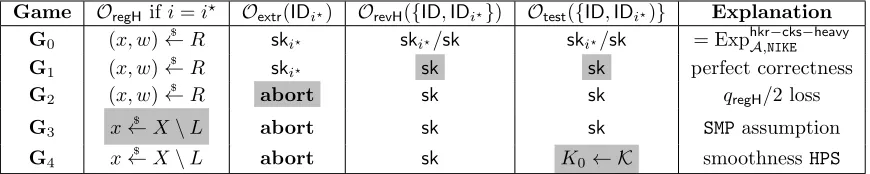
In a nutshell, our security proof proceeds in game hops:
1. We start with the NIKE security game.
2. We guess one index i∗, and hope that pki∗ is one of the challenge public keys finally selected in the
adversary’s challenge. (If this is not the case, the reduction fails.) Since there are 2 challenge public keys, this step loses a factor ofn/2.
3. We choose xi∗ ∈/ L. Since we may assume thatpki∗ is selected as challenge, this change will not be
detectable (assumingL has a hard subset membership problem).
4. Finally, we observe that now, all keysKi∗j (for arbitraryj) are randomized by the smoothness of the
underlying HPS. In fact, HPS smoothness implies that Ki∗j is close to uniform, even given pkj. In
particular, this holds for j=j∗and the final challenge Ki∗j∗.
Note that while [10] also crucially relies on HPSs, there are significant technical differences. Namely, [10] uses hash proof systems mainly as a tool to implement a “replacement decryption method” that allows to forget parts of the secret key. In other words, they use HPSs exclusively in “proof mode”. In contrast, for our basic NIKE scheme we use the HPS only in “randomization mode”, i.e. to randomize shared keys.
Instantiations and variants.. Our basic scheme only requires a HPS for a language with hard subset
membership problem, and thus can be implemented efficiently from various computational assumptions (such as the DDH [13],`-Linear [31], DCR [13], or QR [13] assumptions). However, this basic scheme satisfies only a relatively mild form of security called “honest key registration” or “HKR” security in [18]. Hence, we also present a general transformation that turnsany mildly secure NIKE scheme into one that satisfies a stronger form of security (dubbed “dishonest key registration” or “DKR” security in [18]). Our scheme requires a suitable non-interactive zero-knowledge proof system, and, very loosely speaking, adapts the Naor-Yung paradigm [41] to NIKE schemes. We finally give a concrete and optimized instance under the `-MDDH assumption [16] (for any`≥2 in pairing-friendly groups). For details we refer to Section 4.3.
We note that we view our construction as a “first” that demonstrates how to circumvent existing lower bounds for a particularly challenging application. We do not claim superior efficiency of our (fully secure) scheme over existing state-of-the-art NIKE schemes, not even when taking into account the reduction loss in the choice of group sizes. Still, Figure 1 provides an overview over existing NIKE schemes, in particular in comparison to our scheme.
Our new lower bound. Even though it breaks the existing bound of Bader et al. [4], the reduction loss
(of O(n)) of our scheme might be a bit disappointing. Our second result shows that we can extend the results from [4] to show that the reduction loss (at least for our scheme) is optimal. Specifically, we are able to give new lower bounds on the tightness of NIKE reductions even for schemes with invalid public keys.
In more detail, we show that a weak validity check (on public keys) is sufficient to prove a meaningful lower bound. Namely, we require that validity of a public key (in the sense that two valid public keys admit only one shared key) is verifiable given that public keyand one of its possible secret keys. Hence, as long as a given public key is not corrupted, its validity may not be efficiently verifiable, and a reduction can hope to substitute it with an invalid key. (Note that this is precisely what happens in the proof of our NIKE scheme.)
On the other hand, this weak validity check allows us to again apply a rewinding argument as in [4]. Namely, as soon as the reduction returns a secret key on an extraction query, we can check whether the given public key was actually valid and in this case use the obtained secret key later to compute the unique shared key. The only case where we fail to do so is if the reduction does not return a valid secret key for a certain public key in all rewinding attempts. But then we can simply abort with high probability, namely in case this public key is part of the extraction queries (which happens with probability 1−2/n). In other words, we prove that the best a reduction can do is to switch one public key to invalid and hope that this public key is not part of the extraction queries. We can thus conclude that a NIKE (such as ours) that admits a non-public validity check still suffers from a security reduction loss of at leastn/2.
NIKE into a strongly secure one, and how to tweak efficiency of this transformation when using our NIKE construction. In Section 5 we finally prove a new lower bound for a broad class of NIKE schemes including ours.
2
Preliminaries
Notation. Throughout the paper,λ denotes the security parameter. We say that a function isnegligible
in λ if its inverse vanishes asymptotically faster than any polynomial in λ. If a probabilistic algorithmA
has running time polynomial in λ, we say thatAisprobabilistic polynomial time (PPT). We usey ← A(x) to denote that y is assigned the output of A running on input x, and we writey ← A(x;r) to make the randomnessr used by a probabilistic algorithm explicit. We usey ←$ X to denote sampling from a setX
uniformly at random. Forn∈Nby [n] we denote the set{1, . . . , n}. Letε∈[0,1] andX,Y distributions. To denote thatX andY have statistical distance at mostε, we write X ≡εY and sayX andY areε-close.
To represent group elements we use the notation introduced in [16]. Namely, for a ∈ Zp, we define
[a] =aP ∈Gas theimplicit representationofainG, where the generatorPshould be clear from the context. To denote a vector we define [a, b] := (ga, gb) accordingly. More generally, for a matrix A= (a
ij)∈Znp×m
we define [A] as the implicit representation ofAinG:
[A] :=
a11P ... a1mP
an1P ... anmP
∈Gn×m
Note that from [a] ∈ G it is hard to compute the value a if the discrete logarithm assumption holds in G. Obviously, given [a],[b] ∈ G and a scalar x ∈ Zp, one can efficiently compute [a]·x= [ax] ∈ G and [a] + [b] = [a+b]∈G.
Definition 2.1 (Group generator). Let GGen be an algorithm that on input 1λ returns a description G =
(G, p, P), whereGare additive cyclic groups of order pfor a2λ-bit prime pwith group generator P. Then
GGen is called a group generator.
We recall the definitions of the Matrix Decision Diffie-Hellman (MDDH) assumption from [16]. As it is sufficient for our purposes we restrict to matrix distributions returning matrices of dimensions (`+ 1)×`.
Definition 2.2 (Matrix distribution). Let `∈N andp be a 2λ-bit prime. We call a PPT algorithm D` a
matrix distributionif it outputs matrices in Z(p`+1)×` of full rank `.
TheD`-Matrix Diffie-Hellman problem inGis to distinguish the between tuples of the form ([A],[Aw]) and ([A],[u]), for a randomly chosenA← D$ `,w
$
←Z`p andu
$ ←Z`p.
Definition 2.3 (D`-MDDH). Let D` be a matrix distribution. We say that the D`-Matrix Diffie-Hellman
(D`-MDDH) assumptionholds relative to a prime order groupG, if for all PPT adversariesA,
AdvmddhA,G,G,D
`(λ) :=|Pr[A(G,[A],[Aw]) = 1]
−Pr[A(G,[A],[u]) = 1]| ≤negl(λ),
where the probabilities are taken overG:= (G, P, p)←GGen(1λ),A $ ← D`,w
$ ←Z`p,u
$ ←Z`p+1.
Definition 2.4 (`-Linear). For`∈Nand the distributionD` returning matrices of the form
A:=
a1 0 · · · 0
0 a2 . .. ...
..
. . .. . .. 0 0 · · · 0 a`
1 · · · 1 1
fora1, . . . , a` $
For`= 1 theD1-LIN assumption equals the DDH assumption we define in the following. For`= 2 the
D2-LIN assumption is also called DLIN (Decisional Linear) assumption.
Definition 2.5 (DDH). We say that the decisional Diffie-Hellman (DDH) assumption holds relative to a prime order groupG, if for all PPT adversariesA the advantage
AdvddhG,A(λ) : =|Pr[A(G,[a],[b],[ab]) = 1]−Pr[A(G,[a],[b],[c]]|
is negligible in λ, where the probabilities are taken over G:= (G, p, P)←$ GGen(1λ),a, b, c $ ←Zp.
The Kernel-Diffie-Hellman assumption D`-KMDH [40] is a natural computational analogue of the D`
-MDDH Assumption.
Definition 2.6 (D`-Kernel Diffie-Hellman assumption D`-KMDH). Let D` be a matrix distribution. We
say that the D`-Kernel Diffie-Hellman (D`-KMDH) assumption holds relative to a prime order group G if for all PPT adversariesA,
AdvkmdhG,G,D
`,A(λ) : = Pr[c
>A=0∧c6=0|[c] $
← A(G,[A])]
is negligible in λ, where the probabilities are taken over G:= (G, p, P)←GGen(1λ), andA← D$ `.
TheD`-KMDH assumption is a relaxation of theD`-MDDH assumption, a non-zero vector in the kernel
of A can be employed to test membership in the column space of A. This observation is captured in the following lemma from [40].
Lemma 2.7. For any ` ∈ N and any matrix distribution D`, the D`-MDDH assumption implies the D`
-KMDH assumption.
Definition 2.8(Bilinear group generator). LetGGen2be an algorithm that on input1λreturns a description
G = (G,GT, p, P, gT, e), where G is an additive cyclic group of order p for a 2λ-bit prime p with group generators P and GT is a multiplicatively written cyclic group with order pand generator gT. Let further e:G×G−→GT be a non-degenerate mapping (that ise(P, P)6= 1 ) satisfying
e([a], P) =e(P,[a]) =e(P, P)a.
ThenGGen2 is called a bilinear group generator.
Fora∈Zp we use [a]T to denote denote elementsgTa.
A hash function generator is a probabilistic polynomial time algorithm Hthat, on input 1λ, outputs an
efficiently computable functionH :{0,1}∗→ {0,1}λ, unless domain and co-domain are explicitly specified.
For k ∈ N and matrices A ∈ Zp2k×k by A ∈ Zkp×k we denote the upper square matrix of A and by
A∈Zkp×k the lower one. For a vectora∈Z2pk bya∈Zkp we denote the upperk entries ofaand bya∈Zkp
the lower ones.
Definition 2.9 (Collision Resistance). We say that a hash function generatorHoutputs collision-resistant functions H, if for all PPT adversaries AandH $
← H(1λ)it holds
AdvcrH,A(λ) := Pr
x6=x0∧H(x) =H(x0)|(x, x0)← A(1λ,H)≤negl(λ).
2.1
Public key encryption
Definition 2.10 (Public key encryption). We call a tuple of PPT algorithmsPKE:= (KeyGen,Enc,Dec)a public key encryption scheme if the following holds.
• KeyGen(1λ)returns a key pair(ppk,psk).
• Enc(ppk, M)returns a ciphertext C.
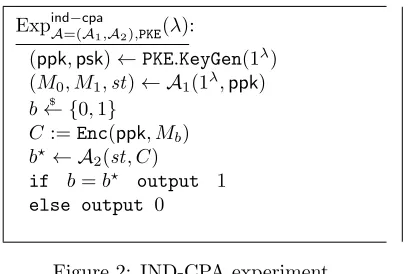
ExpindA=(−cpaA
1,A2),PKE(λ):
(ppk,psk)←PKE.KeyGen(1λ) (M0, M1,st)← A1(1λ,ppk)
b $ ← {0,1}
C:=Enc(ppk, Mb) b?← A
2(st, C)
if b=b? output 1
else output 0
Figure 2: IND-CPA experiment.
We further require Correctness, that is for all(ppk,psk)in the range ofKeyGen(1λ), for all messages M
and for allC in the range of Enc(pk, M)we require
Dec(sk, C) = 1.
Definition 2.11 (IND-CPA). LetPKEbe a public key encryption scheme. We say PKEis IND-CPA secure if for all PPT adversariesA we have that
AdvindA,PKE−cpa(λ) :=|Pr[ExpindA,PKE−cpa(λ)⇒1]−1/2|
is negligible in λ, whereExpindA,PKE−cpa(λ) is defined as in Figure 2 and we require|M0|=|M1|.
2.2
Hash proof systems
Definition 2.12 (Subset membership problem). We call SMP:= Setup a subset membership problem, if
Setup is a PPT algorithm with the following properties.
Setup(1λ) outputs a compact (i.e. with length polynomial inλ) description(X, L, R), whereL⊂X are sets
andR is an efficiently computable relation with
x∈L⇐⇒ ∃witness wwith (x, w)∈R.
(We say a relationRis efficiently computable if given a pair(x, w)it can be efficiently checked whether (x, w)∈R.)
Further we require for all(X, L, R)in the image ofSetup that it is possible to efficiently sample elementsx
uniformly at random from X\L (written x←$ X\L) and to sample elements xuniformly random from L
together with witnessw (written(x, w)←$ R).
Definition 2.13 (Subset membership assumption). Let SMPbe a subset membership problem. We say that the subset membership assumptionholds forSMP, if for all PPT algorithmsAit holds that
AdvsmpA,SMP(λ) :=|Pr[A(1λ,(X, L, R), x) = 1|(x, w)←$ R]
−Pr[A(1λ,(X, L, R), x) = 1|x←$ X\L]|
is negligible in λ, where(X, L, R) $
←SMP.Setup(1λ).
We will employ the notion of a hash proof system based on [13].
Definition 2.14 (Hash Proof Systems (HPS)). Let SMP be a subset membership problem. We callHPS:=
Setup(1λ) first samples public parameters PPSMP := (X, L, R) ← SMP.Setup(1λ) for the underlying subset membership problem. Further Setup chooses setsHSK,Π,HPK such that elements can be efficiently sampled at random fromHSK(denotedhsk $
← HSK). FurtherSetupchooses an efficiently computable map
α:HSK −→ HPK,
a family of efficiently computable functions
H:={Hhsk :X −→Π|hsk∈ HSK}
and an efficiently computable map
F :R× HPK −→Π
such that for all hsk∈ HSK,hpk∈ HPK withα(hsk) =hpkand for all(x, w)∈Rwe have
Hhsk(x) =F(x, w,hpk).
Finally,SetupoutputsPP:= (PPSMP,HSK,H, α, F), which containsPPSMP together with the compact (i.e. with length polynomial inλ) description ofHSK,H, α andF.
We need a property of a HPS called smoothness, introduced in [13].
Definition 2.15 (Smoothness). Let SMP be a subset membership problem and HPSbe a hash proof system for SMP. We call HPS ε-smoothif for all PP := ((X, L, R),HSK,H, α, F) in the image of HPS.Setup, the following distributions areε-close:
(x,hpk, Hhsk(x))
hsk← K$
hpk:=α(hsk)
x←$ X\L
≡ε
(x,hpk, π)
hsk← K$
hpk:=α(hsk)
x←X\L, π←$ Π
.
(Recall thatΠis the image set ofHhsk.) In other words, on statementsxoutside the languageL, the output of the private evaluation algorithms is ε-close to uniformly random even under knowledge of the public key. Note though that this statement only holds as long as no image ofHhsk on inputx∈X\Lis known.
2.3
Non-interactive key exchange (NIKE)
We formally define the notion of NIKE, following [10],[18] and also adopting most of their notation. A NIKE schemeNIKE consists of three algorithms (Setup,KeyGen,SharedKey), an identity spaceIDS and a shared key spaceKwhich is the output space of SharedKey.
• Setup: On input 1λ, this probabilistic algorithm outputs the system parametersPP.
• KeyGen: On input PP and an IDID, this probabilistic algorithm outputs a tuple (pk,sk)∈ PK × SK.
• SharedKey: On input of the public parametersPPand two identity, public key pairs (ID1,pk1),(ID2,sk2),
this deterministic algorithm outputs a shared keyK12∈ K. We assume thatK contains a failure
sym-bol ⊥.
We always requireNIKEto be perfectly correct, meaning that for all corresponding key pairs (ID1,pk1,sk1),
(ID2,pk2,sk2) generated byKeyGenit holds
SharedKey(ID1,pk1,ID2,sk2) =SharedKey(ID2,pk2,ID1,sk1)6=⊥
Security. We quickly recall the game-based security notion from [10], called the CKS model, with its
refinements from [18]. The model is defined via adversarial queries to oracles implemented by a challenger
Model qregH qregC qextr qrevH qrevC qtest
DKR CKS-light 2 X - - X 1
DKR CKS X X - - X X
DKR CKS-heavy X X X X X 1
DKR m-CKS-heavy X X X X X X
HKR CKS-light 2 - - - - 1
HKR CKS X - - - - X
HKR CKS-heavy X - X X - 1
HKR m-CKS-heavy X - X X - X
Table 1: Types of queries for different security models, taken from [18], where qx denotes the maximum
number of allowed queries of the adversary to oracleOx. X, - andn mean that an adversary is allowed to
make arbitrary, zero ornqueries of this type, in an arbitrary order.
• OregH for registering an honest user. C generates a key pair using NIKE.KeyGen and hands the public key to the adversary.
• OregC for registering a corrupt user. The adversary may introduce a public key without providing the corresponding secret key.
• Oextr for extracting a secret key of an honest user.
• OrevH for revealing a shared key of an honest pair of users.
• OrevC for revealing a shared key between a corrupted and an honest user.
• Otest for obtaining a challenge. Aprovides a pair of users it wishes to be challenged upon. C then flips a coin and replies either with their real shared key or a random one.
First, C runs PP ←$ NIKE.Setup(1λ) and givesPP to A. Then, the adversary may make an arbitrary
number of the above queries, in an arbitrary order. Finally, the adversary outputs a bit ˆb and wins if ˆb=b. Note that the adversary may register eachIDonly once4.
To obtain different notions of CKS security, the adversary is restricted in the number of its queries. See Table 1 for a complete list. Notions that admit OregC and OrevC queries are said to allow dishonest key registrations, dubbed DKR. Notions that do not allow such types of queries are called with honest key registration, orHKR for short.
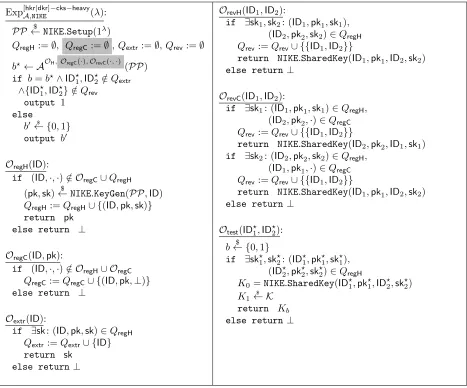
In this paper, we are interested in CKS-heavy secure NIKE schemes. We provide the corresponding security experiment in Figure 3.
Definition 2.16(HKR- and DKR-CKS-heavy security). Let NIKE be a NIKE. We sayNIKEis CKS-heavy secure with honest key registration, or HKR-CKS-heavy secure, if for any PPT adversary Athe advantage
AdvhkrA,NIKE−cks−heavy(λ) =|Pr[ExphkrA,NIKE−cks−heavy(λ)⇒1]−1/2|
is negligible in λ, where ExphkrA,NIKE−cks−heavy is provided in Figure 2.3. Similarly, we say that NIKE is CKS-heavy secure with dishonest key registration, or DKR-CKS-heavy secure, if for any PPT adversary A the advantage
AdvdkrA,NIKE−cks−heavy(λ) =|Pr[ExpdkrA,NIKE−cks−heavy(λ)⇒1]−1/2|
is negligible in λ.
2.4
Non-interactive zero knowledge proof of knowledge
The notion of a quasi-adaptive non-interactive zero-knowledge proof was introduced in [8]. The following definition of non-interactive zero-knowledge is an adaptation of [21] with some differences. Note for instance, that we consider computational zero-knowledge instead of perfect zero-knowledge. We will employ such proofs to generically transform a NIKE which is secure in the HKR-CKS-heavy security model to a NIKE which is secure in the DKR-CKS-heavy security model.
Exp[Ahkr,NIKE|dkr]−cks−heavy(λ):
PP←$ NIKE.Setup(1λ)
QregH:=∅, QregC:=∅, Qextr:=∅,Qrev:=∅
b?← AOH,OregC(·),OrevC(·,·)
(PP)
if b=b?∧ID?
1,ID
?
2∈/ Qextr
∧{ID?1,ID?2}∈/Qrev
output 1
else
b0← {$ 0,1}
output b0
OregH(ID):
if (ID,·,·)∈ O/ regC∪QregH
(pk,sk)←$ NIKE.KeyGen(PP,ID)
QregH:=QregH∪ {(ID,pk,sk)}
return pk
else return ⊥
OregC(ID,pk):
if (ID,·,·)∈ O/ regH∪ OregC
QregC:=QregC∪ {(ID,pk,⊥)}
else return ⊥
Oextr(ID):
if ∃sk: (ID,pk,sk)∈QregH
Qextr:=Qextr∪ {ID}
return sk
else return⊥
OrevH(ID1,ID2):
if ∃sk1,sk2: (ID1,pk1,sk1),
(ID2,pk2,sk2)∈QregH
Qrev:=Qrev∪ {{ID1,ID2}}
return NIKE.SharedKey(ID1,pk1,ID2,sk2)
else return⊥
OrevC(ID1,ID2):
if ∃sk1: (ID1,pk1,sk1)∈QregH, (ID2,pk2,·)∈QregC
Qrev:=Qrev∪ {{ID1,ID2}}
return NIKE.SharedKey(ID2,pk2,ID1,sk1)
if ∃sk2: (ID2,pk2,sk2)∈QregH, (ID1,pk1,·)∈QregC
Qrev:=Qrev∪ {{ID1,ID2}}
return NIKE.SharedKey(ID1,pk1,ID2,sk2)
else return⊥
Otest(ID?1,ID
?
2):
b← {$ 0,1}
if ∃sk?1,sk?2: (ID?1,pk?1,sk?1),
(ID?2,pk?2,sk?2)∈QregH
K0=NIKE.SharedKey(ID?1,pk
?
1,ID
?
2,sk
?
2)
K1 $ ← K
return Kb
else return⊥
Figure 3: Experiment for HKR and DKR CKS-heavy security of a NIKE schemeNIKEwith shared key space
ExpussA,PS(λ):
(X, L, R)←SMP.Setup(1λ)
(crs,trp)←$ PS.Setup(1λ,(X, L, R))
Qsim:=∅
(x?,Π?)← AOsim(·)(1λ,crs)
if PS.Ver(crs, x?,Π?)∧x?∈/ L∧x?∈/Qsim
output 1
else output 0
Osim(x):
Qsim:=Qsim∪ {x} Π←PS.Sim(crs,trp, x)
returnΠ
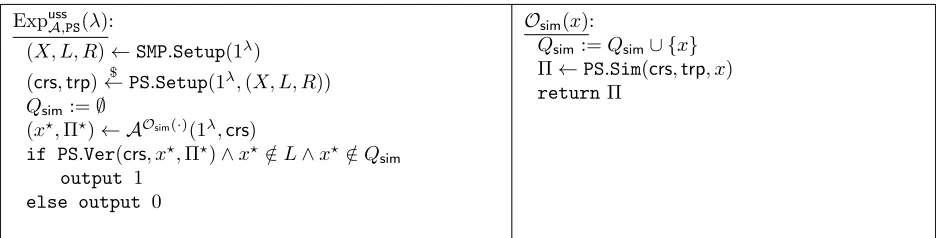
Figure 4: Experiment for unbounded simulation soundness of a QANIZK.
Definition 2.17 (QANIZK). Let SMP be a subset membership problem. Let (X, L, R) ← SMP.Setup(1λ).
A quasi adaptive non-interactive zero-knowledge proof (QANIZK) for SMP is a tuple of PPT algorithms
PS:= (Setup,Gen,Ver,Sim)of the following form.
• Setup(1λ,(X, L, R))generates a common reference stringcrsand a trapdoortrp. We assume(X, L, R)
to be part of the crs.
• Prove(crs, x, w)given a wordx∈Land a witness wwith R(x, w) = 1, outputs a proof Π.
• Ver(crs, x,Π)on input crs,x∈X andΠoutputs a verdict b∈ {0,1}.
• Sim(crs,trp, x)given acrs with corresponding trapdoor trpand a wordx∈X, outputs a proofΠ.
Further we require the following properties to hold.
Perfect completeness: For all security parameters λ, all (X, L, R) in the image of SMP.Setup(1λ), all
(crs,trp)in the range of Setup(1λ,(X, L, R)), all wordsx ∈ L, all witnesseswsuch thatR(x, w) = 1
and all Πin the range of Prove(crs, x, w)we have
Ver(crs, x,Π) = 1.
Computational zero-knowledge: For all security parametersλ, all(X, L, R)in the range ofSMP.Setup(1λ), all tuples (crs,trp)in the range ofSetup(1λ,(X, L, R)), we have for all PPT adversaries Athat
AdvzkA,PS(λ) :=|Pr[AOprv(·,·)(1λ,crs) = 1]−Pr[AOsim(·,·)(1λ,crs) = 1|
is negligible in λ, where both oracles on input (x, w)first check whether(x, w)∈R. If this is the case,
Oprv returnsProve(crs, x, w)andOsim returnsSim(crs,trp, x)(and⊥otherwise).
The definition of unbounded simulation soundness follows [42, 14].
Definition 2.18(Unbounded simulation soundness). LetPSbe a QANIZK for a subset membership problem
SMP. We sayPS satisfies unbounded simulation soundness, if for all PPT adversariesAthe advantage
AdvussA,PS(λ) :=|Pr[ExpussA,PS(λ)⇒1]|
is negligible in λ, whereExpussA,PS(λ)is provided in Figure 4.
The following definition is tailored to our purposes. We require a strong notion of proof of knowledge in the sense that we need to be able to extract a witness while simulating proofs ourselves.
Definition 2.19 (QANIZK Proof of knowledge). Let PS0 be a QANIZK for a subset membership problem
SMP, whereSMP.Setupreturns tuples(X, L, R). LetSetupdenote an algorithm that, on input(1λ,(X, L, R))
runs (crs,trp) ←$ PS0.Setup(1λ,(X, L, R)) and outputs (crs,trp,extr) with an additional trapdoor extr. Let Gen:= PS0.Gen,Prove := PS0.Prove,Ver:= PS0.Ver,Sim:= PS0.Sim. Let further Extract be an algorithm that on input (crs,extr, x,Π) returns a witness w. We say PS= (Setup,Gen,Prove,Ver,Sim,Extract) is a QANIZK Proof of Knowledge forSMP(QANIZKPoK), if for all PPT adversariesA the advantage
ExpextrA,PS(λ):
(X, L, R)←SMP.Setup(1λ)
(crs,trp,extr)←$ PS.Setup(1λ,(X, L, R))
Qsim:=∅
(x?,Π?)← AOsim(·),Oextract(·,·)(1λ,crs) w← Oextract(x?,Π?)
if PS.Ver(x?,Π?) = 1∧(x?, w)∈/R
∧x?∈/Q
sim
output 1
else output 0
Osim(x):
Qsim:=Qsim∪ {x} Π←PS.Sim(crs,trp, x)
returnΠ
Oextract(x,Π):
ifx /∈Qsim
w←PS.Extract(crs,extr, x,Π)
return w
else return ⊥
Figure 5: Experiment for a extraction in the presence of simulated proofs. The adversary tries to set up a pair (x,Π) such that a witnesswis not extractable from Π.
Remark 2.20. Note that extraction in the presence of simulated proofs implies unbounded simulation sound-ness, as an adversary outputting a tuple (x,Π)with x /∈Land PS.Ver(crs, x,Π) = 1trivially wins the proof of knowledge experiment.
3
Our construction
We now present a NIKE scheme that is secure in the HKR setting. Our reduction loses a factor ofqregH/2, whereqregHis the number of honest users. Our scheme uses a hash proof system and its security relies on the hardness of the underlying subset membership problem as well as the smoothness of the HPS. It is presented in Figure 3.
Let us first elaborate on why our NIKE scheme does not fall under the impossibility result of Bader et al. [4]. To enforce that the output of a successful NIKE attacker can always be used to solve the chal-lenge given to the reduction, Bader et al. require that the NIKE scheme allows only public keys whose corresponding secret keys are uniquely determined. This way, the shared key between two public keys is uniquely determined and will be useful to solve the challenge. Moreover, the uniqueness condition has to be efficiently checkable given only a public key. This essentially prevents a reduction from switching public keys to “invalid” public keys that violate the uniqueness condition. Formally, Bader et al. require an efficient algorithmPKCheckfor testing uniqueness.
Our scheme does not provide such an algorithm, since essentially deciding uniqueness amounts to deciding a subset membership problem that we assume to be hard. This way, our reduction will have a way to indistinguishably switch one of the public keys to “invalid” by drawing it from outside the subgroup. Note that for such an invalid public key there exist no secret key, since secret keys contain a witness for the public key belonging to the subgroup. While this non-existence of a secret key helps us in arguing security, it also introduces an inherent loss in our reduction; namely, our reduction has to abort whenever the adversary wants to see the secret key corresponding to the invalid key, which occurs with probability 2/qregH and thus results in a loss ofqregH/2. We now provide a proof of security that meets exactly this loss.
Theorem 3.1. Let SMPbe a subset membership problem, and let HPSbe a hash proof system for SMP, such that for all PP := (PPSMP,HSK,H, α, F) in the range of HPS.Setup the image Π of F and all Hhsk ∈ H is a commutative multiplicative group. If the subset membership assumption holds for SMP and if HPS is
ε-smooth with ε negligible in λ, then the NIKE scheme NIKE described in Figure 6 is a perfectly correct, HKR-CKS-heavy secure NIKE. Further, the reduction to SMP loses a factor of qregH/2, where qregH is the number of queries toOregH thatAmakes. More formally, ifAis an adversary with running timetA against the scheme in the HKR-CKS-heavy model, there exists an adversaryB with running time tB ≈tA breaking the subset membership problemSMPsuch that
NIKE.Setup(1λ)
(PPSMP,HSK,H, α, F)
$
←HPS.Setup(1λ) PP := (PPSMP,HSK,H, α, F)
returnPP
NIKE.SharedKey(PP,ID1,pk1,ID2,sk2) parsePP =: (PPSMP,HSK,H, α, F) parsepk1=: (hpk1, x1)
parsesk2=: (hsk2, x2, w2) K12:=Hhsk2(x1)·F(x2, w2,hpk1) returnK12
NIKE.KeyGen(PP,ID)
parsePP=: (PPSMP,HSK,H, α, F) parseP PSMP=: (X, L, R)
hsk← HSK$ hpk:=α(hsk) (x, w)←$ R pk:= (hpk, x) sk:= (hsk, x, w)
return(pk,sk)
Figure 6: Our NIKE scheme. Recall that H = {Hhsk: X → Π | hsk ∈ K} is a family of functions and
F:R× HPK →Π a function (where HPKis the image ofα).
Game OregH ifi=i? Oextr(IDi?) OrevH({ID,IDi?}) Otest({ID,IDi?)} Explanation G0 (x, w)
$
←R ski? ski?/sk ski?/sk = Exphkr−cks−heavy A,NIKE
G1 (x, w)←$ R ski? sk sk perfect correctness G2 (x, w)
$
←R abort sk sk qregH/2 loss
G3 x←$ X\L abort sk sk SMPassumption
G4 x $
←X\L abort sk K0← K smoothnessHPS
Figure 7: GamesG0 to G4 we employ to prove the NIKE presented in Figure 3 HKR-CKS-heavy secure.
From game G1 on the index i? ←$ qregH is chosen ahead of time. By IDi? we denote the i?-th registered honest user. The oracleOtestmay only be queried once. In Column 4 and 5, we give the secret key employed to computeNIKE.SharedKey. By denoting the input as a set{·}we want to indicate that we consider both inputspk,pki? andpki?,pk. In gameG0 there is thus two possibility secret keys to be employed, depending
on the order of the input.
Proof. Perfect correctness. Let the public parameters bePP := (PPSMP,HSK,H, α, F) $
←NIKE.Setup(1λ)
and (pk1,sk1)←NIKE.KeyGen(PP,ID1),(pk2,sk2)←NIKE.KeyGen(PP,ID2). Let furtherpk1=: (hpk1, x1),pk2=:
(hpk2, x2) and sk1 =: (hsk1, x1, w1),sk2 =: (hsk2, x2, w2). AsHPSis a hash proof system and as x1, x2 ∈L,
hpk1=α(hsk1)),hpk2=α(hsk2)) we have
Hhsk2(x1) =F(x1, w1,hpk2) andHhsk1(x2) =F(x2, w2,hpk1).
This yields
K12=Hhsk2(x1)·F(x2, w2,hpk1) =Hhsk1(x2)·F(x1, w1,hpk2) =K21
as required.
CKS-heavy security. We prove that the NIKEmeets CKS-heavy security with honest key registration in a number of hybrid games. We provide an overview of the games in Figure 7. By Pr[Gi] we denote the
probability thatAwins gameGi.
Game G0: The real experiment. GameG0 is the HKR-CKS-heavy experiment as presented in Figure
3, whereAplays with a challengerC. We have thus
AdvhkrA,NIKE−cks−heavy(λ) =|Pr[G0]−1/2|.
with input (ID,IDi?) (for an arbitrary identityID) we will compute the shared key employingsk, where (ID,pk,sk)∈QregH, instead ofski?. By perfect correctness ofNIKEwe have
Pr[G1] = Pr[G0].
Game G2: Abort upon wrong guess. We change the winning condition of the game as follows. IfIDi? is not included in the test query ofA, the experiment returns 1 with probability 1/2 and aborts. Then it holds
Pr[G2] = Pr[G1]·2/qregH+ 1/2·(1−2/qregH)
= (Pr[G1]−1/2)·2/qregH+ 1/2
and thus
Pr[G1]−1/2 =qregH/2·(Pr[G2]−1/2).
Game G3: Remove the secret key. Upon receiving thei?-th register honest user query,Cdeviates from
theNIKE.KeyGenprocedure as follows: instead of drawing (xi?, wi?)←$ R, Cdrawsxi?←$ X\L. Note that this way there is no wi? such that R(xi?, wi?) = 1 and thusC cannot compute a secret keyski?. Instead, C adds (IDi?,pki?,ski?) := (IDi?,(hpki?, xi?),(hski?,⊥)) to QregH. A distinguisher between both games can be turned directly into a SMP attackerB putting his challenge in the place ofxi?. If the challenge was inL, Game G2 was simulated, else it was GameG3. Observe that it is crucial here
that Cdoes not make use of wi?anymore due to the changes made in Game 1. This yields
|Pr[G2]−Pr[G3]| ≤Adv
smp B,SMP(λ).
Game G4: Randomize the test query. C changes the answer to the queryOtest(IDi?,ID)5 by drawing
K0 $
← K, where K= Π is the image of the hash functions of the HPS. To analyze the distinguishing advantage, note that in the former game it holds that K0 = NIKE.SharedKey(IDi?,pki?,ID,sk) =
Hhsk(xi?)·F(x, w,hpki?) with (ID,pk,sk) = (ID,(hpk, x),(hsk, w)) ∈ QregH and (IDi?,pki?,ski?) = (IDi?,(hpki?, xi?),(hski?,⊥))∈QregH. The two distributions (xi?,hpk, Hhsk(xi?)),(xi?,hpk, r ←$ Π) are
ε-close by the ε-smoothness of the HPS, and thus K0 was already statistically close to the uniform
distribution over Π in Game G3. We thus have
|Pr[G3]−Pr[G4]| ≤ε.
We now show that the advantage ofAplaying the CKS-heavy game is negligible. We repeatedly use a folklore technique - add zero, then apply the triangle inequality - to go through all the above games until Game G4, for which the winning probability of Ais 1/2 since its view does not depend on the
challenge bit.
AdvhkrA,NIKE−cks−heavy(λ) = |Pr[G0]−1/2|= |Pr[G1]−1/2|
= qregH/2· |Pr[G2]−Pr[G3] + Pr[G3]−1/2|
≤ qregH/2· |Pr[G3]−Pr[G4] + Pr[G4]−1/2|+qregH/2·Adv smp B,SMP(λ)
≤ qregH/2· |Pr[G4]−1/2|+qregH/2·(Adv smp
B,SMP(λ) +ε)
= qregH/2·(AdvsmpB,SMP(λ) +ε)
Remark 3.2. A variant of our NIKE can be obtained if there is a total ordering <on all identities. Then, the shared key of ID1,ID2 can be computed as the hash of the statement provided by the smaller identity.
More formally, we modifyNIKE.SharedKeyas follows:
NIKE.SharedKey(ID1,pk1,ID2,sk2) : =Hhsk2(x1)
=F(x1, w1, hpk2) =:NIKE.SharedKey(ID2,pk2,ID1,sk1),
where ID1 <ID2. The only change in the proof of security is that in game G2 the challenger aborts if the
guessedi? is not the smallest identity contained in the test query. This yields a reduction loss ofqregH.
3.1
Instantiating our construction
Definition 3.3 (D`-MDDH as subset membership problem). Let GGen be a group generator. We define
the following SMP based on DDH via the following algorithm Setup: on input1λ the algorithmSetup first
samples a group G := (G, p, P) ←GGen(1λ). Further, Setup draws an A← D$ ` at random. It defines the
sets as
X :=G`+1,
L:=h[A]i={[x]∈G`+1| ∃w∈
Z`p: [x] = [A]·w} and R:={([x],w)∈G`+1×
Z`p|[x] = [A]·w}.
Setupfinally returns(G, p, P)and[A] as a compact description ofX, LandR. It is easy to see that under
D`-MDDH the subset membership assumption holds for SMP. For ` = 1 the language L is the so-called
Diffie-Hellman language.
Definition 3.4 (HPS for D`-MDDH). Let SMP the subset membership problem based on D`-MDDH as
presented in Definition 3.3. Following [13] we present a HPS HPS for SMP. Given a group description
G:= (G, p, P)and a matrix[A],Setup definesHSK:=Zp`+1,Π :=G,HPK:=G. Further Setupdefines
α:Z`p+1 →G1×`,hsk 7→hsk>·[A],
Hhsk:G`+1 →G, [x] 7→hsk>·[x]
F:G`+1×Z`p×G
1×`→
G, ([x],w,[hpk])7→[hpk]·w.
This defines aHPS, as for allhsk∈Z`+1
p ,[hpk] =α(hsk),[x] = [A]·w∈Lwe have
Hhsk([x]) =hsk>·[x] =hsk>·[A]·w= [hpk]·w =F([x],w,[hpk]).
Lemma 3.5. The HPS presented in Definition 3.4 isε-smooth forε= 0.
Proof. LetA⊥∈Z(p`+1)×`such that (A⊥)>·A=0. Then for anyhsk∈G`+1,k∈Z`p we have α(hsk+k·A⊥) =α(hsk) +k·(A⊥)>·A=α(hsk).
Further, note that the distributions {hsk | hsk ← Zp`+1} and {hsk+k·a⊥ | hsk ← Z`p+1,k ← Z`p} are
equivalent. This yields
([x],[hpk], Hhsk([x]))
hsk $ ← K,
[hpk] :=α(hsk),[x] $ ←X\L
)
≡
([x],[hpk], Hhsk+k·A⊥([x]))
hsk $
← K,k $ ←Z`p,
[hpk] :=α(hsk),[x] $ ←X\L
)
=
(
([x],[hpk], Hhsk([x]) +k·(A⊥)>·[x]
| {z }
6 =0 )
hsk← K$ ,k←$ Z`p,
[hpk] :=α(hsk),[x] $ ←X\L
)
≡
([x],[hpk], π)
hsk← K$ , π←$ G, [hpk] :=α(hsk),[x]←$ X\L
)
NIKEdkr.Setup(1λ) PP ←NIKE.Setup(1λ)
PPPS←PS.Setup(1λ,(XNIKE, LNIKE, RNIKE)) parse PPPS:= (crs,trp,extr)
PPdkr:= (PP,crs)
returnPPdkr
NIKEdkr.SharedKey(PPdkr,ID1,pk1,ID2,sk2) parsePPdkr=: (PP,crs)
parsepk1=: (pk01,Π01) if PS.Ver(crs,ID1,pk01,Π
0
1) = 1
return NIKE.SharedKey(ID1,pk01,ID2,sk2) else return⊥
NIKEdkr.KeyGen(PPdkr,ID)
parsePPdkr=: (PP,crs)
r← Rrand
(pk,sk)←NIKE.KeyGen(PP,ID;r) Π←PS.Prove(crs,ID,pk,sk, r)
return((pk,Π),sk)
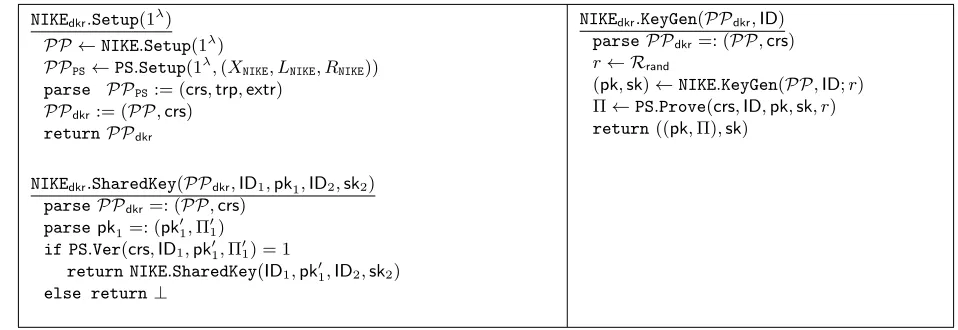
Figure 8: A generic transformation from HKR-CKS-heavy security to DKR-CKS-heavy security. (XNIKE, LNIKE, RNIKE) is defined as in Remark 4.1.
Remark 3.6. As the keyspace of the hash proof system HPSpresented in Definition 3.4 is HSK := Z`p+1,
membership in HSK is efficiently checkable provided p(which is part of the public parameters returned by
HPS.Setup).
4
Security against dishonest key generation
In this section we want to show how to achieve CKS-heavy security for our scheme allowing dishonest key registrations. That is the adversary is allowed to dishonestly register keys and ask for shared keys where one of the public keys is registered dishonestly.
4.1
A generic transformation
We begin by showing how to generically transform a HKR-CKS-heavy secure NIKE into a DKR-CKS-heavy secure NIKE. To this purpose, we first show how to obtain an SMP from a NIKE.
Remark 4.1. Every NIKE induces a SMP as follows. Let NIKE be a NIKE with public key spacePK and secret key spaceSKand randomness space Rrand. Then we define an SMPSMPNIKE as follows. On input 1λ,
SMPNIKE.Setup generatesPP ←NIKE.Setup(1λ)and sets
XNIKE:=IDS × PK,
LNIKE:={(ID,pk)∈X | ∃sk, r: (pk,sk) =NIKE.KeyGen(PP,ID;r)} and
RNIKE:={(ID,pk,sk, r)|(pk,sk) =NIKE.KeyGen(PP,ID;r)}.
Theorem 4.2. If NIKE is a perfectly correct, HKR-CKS-heavy secure NIKE and PS is an QANIZKPoK for the SMPSMPNIKE, then theNIKEdkr presented in Figure 8 with algorithmsNIKEdkr.Setup,NIKEdkr.KeyGen,
NIKEdkr.SharedKeyis perfectly correct and secure in the DKR-CKS-heavy model. More precisely, ifA is an adversary onNIKEdkr with running timetA, there exists adversariesB,B1,B2with running timestB≈tB1≈
tB2 ≈tA such that
AdvdkrA,NIKE−cks−heavy
dkr (λ)≤Adv
zk
B,PS(λ) + Adv extr
B1,PS(λ) + Adv
hkr−cks−heavy B2,NIKE (λ).
Proof. Perfect correctness directly follows from the perfect correctness of the underlyingNIKEtogether with the perfect completeness of PS. To prove security, we proceed via a series of games. By Pr[Gi] we denote
Game OregH(ID) OregC(ID,pk,Π) OrevC(·,·) Explanation
G0 PS.Prove(ID,pk,sk;r) ⊥ honest = Exp
dkr−cks−heavy A,NIKE
G1 PS.Sim(trp,ID,pk) ⊥ honest PScomp. ZK
G2 PS.Sim(trp,ID,pk) PS.Extract(extr,ID,pk,Π) honest PSPoK
G3 PS.Sim(trp,ID,pk) PS.Extract(extr,ID,pk,Π) corrupted NIKEperf. corr.
Figure 9: GamesG0toG3. Column “OregH(ID)” gives an overview which algorithm is employed for proving that a public key is computed correctly on a honest key registration query. The column “OregC(ID,pk,Π)” indicates the pair (ID,pk,·) registered on a corrupt key query. The column “OrevC(·,·)” indicates whether the secret key of the honest or the corrupted identity is used to compute the shared key. The last column finally gives an explanation on the indistinguishability of games. We assumePS.Prove,PS.Sim,PS.Extract2
to have access tocrs without stating it as an input.
Game G0: GameG0 is the DKR-CKS-heavy security experiment. We thus have
AdvdkrA,NIKEdkr−cks−heavy(λ) =|Pr[G0]−1/2|.
Game G1: We change the oracleOregH. Instead of honestly generating a proof Π←PS.Prove(crs,ID,pk,sk;r) we simulate Π ←PS.Sim(crs,trp,ID,pk). By the computational zero-knowledge of PSthere exists an adversaryBwithtB≈tAand
|Pr[G0]−Pr[G1]| ≤AdvzkB,PS(λ).
(The adversary B obtains 1λ,crs, generatesPP ←NIKE.Setup(1λ) and forwards (PP,crs) to A. To generate a proof for a public key pk obtained as (pk,sk) ← NIKE.KeyGen(PP,ID;r) it employs its proof generating oracle on input (ID,pk,sk, r). If the oracle was aPS.Prove(·,·) oracleBsimulatesG0,
otherwiseG1. For verifying proofscrs is sufficient.)
Game G2: We change the behaviour of the oracle OregC. On input (ID,pk,Π), the oracle employs the knowledge extractor PS.Extract(crs,extr,ID,pk,Π) to extract (sk, r) corresponding to (ID,pk) and to register (ID,pk,sk) inQregC. If
bad:=PS.Ver(crs,ID,pk,Π) = 1 ∧ (ID,pk,sk, r)∈/ RNIKE
occurs, we abort. If baddoes not occur, G1 is distributed exactly as G2, since none of the extracted
secret keys is used. On the other hand, an adversary A playing in G2 causing badcan be directly
turned into an adversary B1 winning the proof of knowledge experiment, with running timetB1≈tA.
Note that badmeets the winning conditions of the PoK experiment, as (ID,pk)∈/ Qsim is guaranteed byOregC rejecting already honestly registered identities. This yields
|Pr[G1]−Pr[G2]| ≤AdvextrB1,PS(λ).
Game G3: We now let OrevC compute shared keys with the extracted secret keys. Due to the perfect correctness ofNIKEdkr, we have
Pr[G2] = Pr[G3].
We can now reduce the HKR-CKS-heavy security of NIKE to the altered DKR-CKS-heavy experi-ment as described in Game G3. To this end, we assume an adversary A winning game G3 and
show how to construct an HKR-CKS-heavy adversary B2. On inputPP,B2 sets up (crs,trp,extr)←
PS.Extract(1λ,(XNIKE, LNIKE, RNIKE)) and forwards (PP,crs) toA. FurtherB2maintains a setQregH:=
∅ and a setQregC :=∅. We next consider oracle queries.
OregH(ID): On honest register queries,B2forwards theIDto its own oracle, on output pksimulates a proof Π←PS.Sim(crs,trp,ID,pk), forwards (pk,Π) toAand setsQregH :=QregH\ {(ID,·,·)} and
QregH := QregH∪ {(ID,pk,Π)}. (Note that for an identity ID with (ID,·,·) ∈ QregC, i.e., that is already registered as dishonestID,B2 forwards⊥to A.)
OregC(ID,pk,Π): On corrupt register queries,B2checks the proof Π. If it holdsPS.Ver(crs,ID,pk,Π) = 1, B2 extracts a secret sk, r corresponding to ID,pk employing its extraction oracle and sets
QregC :=QregC\ {(ID,·,·)} andQregC :=QregC∪ {(ID,pk,sk)}. (Note that for an identityIDwith (ID,·,·)∈QregH, i.e., that is already registered as honestID,B2forwards⊥toA. )
OrevC(ID1,ID2): For dishonest reveal queriesB2checks whether exactly one of the keys was registered
honestly and the other correct (employing the sets QregH and QregC). If this is the case B2 can employ the extracted secret key to compute the shared key.
Finally,B2 forwards the outputb?ofAto its own oracle. It is straightforward to see thatB2simulates
the experiment described in game G3 perfectly (refer to Figure 9 for an overview of how the game is
implemented), and thatB2 wins the HKR-CKS-heavy experiment ifAwins gameG3.
This yields
|Pr[G3]−1/2| ≤AdvBhkr2,−NIKEcks−heavy.
Altogether, we thus have
AdvdkrA,NIKEdkr−cks−heavy(λ) =|Pr[G0]−1/2| ≤ |Pr[G1]−1/2|+ AdvzkB,PS(λ)
≤ |Pr[G2]−1/2|+ AdvzkB,PS(λ) + Adv
extr B1,PS(λ)
=|Pr[G3]−1/2|+ AdvzkB,PS(λ) + Adv
extr B1,PS(λ) ≤AdvzkB,PS(λ) + AdvextrB1,PS(λ) + AdvhkrB −cks−heavy
2,NIKE (λ)
4.2
Instantiating
PS
LetNIKE be a NIKE with public key spacePK and identity spaceIDS. We can instantiatePSas follows. LetPKEbe a CPA-secure encryption scheme with message spaceSK × Rrandand ciphertext spaceCenc. Let
SMPNIKE,PKEbe the SMP that generatesPP ←NIKE.Setup(1λ) and (ppk,psk)←PKE.KeyGen(1λ) and outputs
(XNIKE,PKE, LNIKE,PKE, RNIKE,PKE) as
XNIKE,PKE:=ID× PK × Cenc
LNIKE,PKE:={(ID,pk, C)|∃r,sk, renc: (pk,sk)←NIKE.KeyGen(PP,ID;r),
C=Encppk(sk, r;renc)}
RNIKE,PKE:={(ID,pk,sk, r)|(pk,sk) =NIKE.KeyGen(PP,ID;r),
C=Encppk(sk, r;renc)}
Let further PS0 be an unbounded simulation-sound QANIZK forSMPNIKE,PKE (for an instantiation see [25],
for a tight instantiation see [29]). Then the proof system PS provided in Figure 10 is a QANIZK proof of knowledge for SMPNIKE. More precisely, for every adversary A with running time tA we have adversaries
B,B1,B2 with running times tB ≈ tB1 ≈ tB2 ≈ tA and Adv
zk
A,PS(λ) ≤ Adv
zk
B,PS0(λ) + Adv
ind−cpa
B1,PKE (λ) and
AdvextrA,PS(λ) ≤ Adv
uss
B2,PS0(λ). Note though that instantiating PS
0 in general requires a USS-QANIZK for general NP-languages and thus leads to a very inefficient NIKE. We therefore provide a more efficient transformation for our concrete scheme in the following section.
Sketch. Computational zero-knowledge. LetAbe an adversary breaking the computational zero-knowledge of PS. We proceed with the proof employing a number of hybrid games. By Pr[Gi] we denote the
PS.Setup(1λ,(X
NIKE, LNIKE, RNIKE)):
(ppk,psk)←PKE.KeyGen(1λ)
(crs0,trp0)←PS0.Setup(1λ,SMPNIKE,PKE) crs:= (crs0,ppk),trp:=trp0,extr:=psk return (crs,trp,extr)
PS.Extract(crs,extr,pk,Π):
parse crs=: (crs0,ppk)
parse Π =: (C,Π0)
if PS0.Ver(crs0,(pk, C),Π0) = 0
return⊥
sk←PKE.Dec(psk, C)
returnsk
PS.Prove(crs,pk,sk;r):
parse crs=: (crs0,ppk)
draw renc
C←Encppk(sk, r, renc)
Π0←PS0.Prove(crs0,(pk, C),sk;r, r enc) Π := (C,Π0)
returnΠ
PS.Sim(crs,trp,pk):
parse crs=: (crs0,ppk)
draw renc
C←Encppk(0;renc)
Π0 ←PS0.Sim(crs0,trp0,(pk, C)) Π := (C,Π0)
returnΠ
PS.Ver(crs,pk,Π):
parse crs=: (crs0,ppk)
parse Π =: (C,Π0)
b←PS0.Ver(crs0,(pk, C),Π0)
returnb
Figure 10: An unbounded simulation-sound QANIZK PPOK PS for SMPNIKE, where SMPNIKE,PKE :=
(XNIKE,PKE, LNIKE,PKE, RNIKE,PKE). Here0is such that|0|=|sk, r|forsk∈ SK, r∈ Rrand.
Game G0: This is the Zero-knowledge game whereAis provided either with an oracleOprv or with an oracleOsim. We have
AdvzkA,PS(λ) =|Pr[G0]−1/2|.
Game G1: We switch the proofs Π0 in Oprv(·,·) to simulated. This yields and adversary B with
tB≈tAand
|Pr[G0]−Pr[G1]| ≤AdvzkB1,PS0(λ).
Game G2: We now employ the IND-CPA security of PKE to switch the ciphertexts in Oprv(·,·) to encryptions of0. This yields and adversaryB1withtB1≈tAand
|Pr[G1]−Pr[G2]| ≤AdvBind1,−PKEcpa(λ).
As nowOprv andOsimbehave accordingly we have Pr[G2] = 1/2.
Proof of knowledge. LetAan adversary on the proof of knowledge game. We construct an adversaryB2
on the USS of PS0 as follows. On input 1λ,crs0 the adversaryB2 sets up (ppk,psk)←$ PKE.KeyGen(1λ) itself and forwards crs:= (crs0,ppk) toA. Simulation queries (ID,pk) it answers by choosingr,sk, renc and employing its own simulation oracle on (ID,pk, C) withC ←PKE.Encppk(sk, r;renc). It forwards
C together with the reply Π0 to A. On an extraction query Oextract(ID,pk,Π) the adversary parses Π =: (C,Π0) and returns (sk, r) ← PKE.Dec
psk(C) to A. Finally, if A manages to supply a fresh and valid tuple (ID?,pk?,Π?) where we are not able to extract a witness, by the correctness of
PKE
we have (ID?,pk?, C?) ∈/ L (where Π? =: (C?,Π0?) and B2 wins its own experiment by outputting
(ID?,pk?, C?,Π0?). This yields
AdvextrA,PS(λ)≤AdvussB
4.3
An optimized transformation for our construction
Definition 4.3 (D`-MDDH as SMP with pairing). Let GGen2 be a bilinear group generator. We define
the following SMP based on DDH via the following algorithm Setup: on input1λ the algorithmSetup first
samples a group G := (G,GT, p, P, gT, e)← GGen2(1λ). Further, Setup draws an A
$
← D` at random. It
defines the sets as
X:=G`+1,
L:=h[A]i={[x]∈G`+1| ∃[w]∈G`: [x]T =e([A],[w])} and
R:={([x],[w])∈G`+1×G`|[x]T =e([A],[w])}.
Setup finally returns(G,GT, p, P, gT, e)and[A]as a compact description ofX, LandR.
Definition 4.4 (HPS for D`-MDDH with pairings). Let SMPthe subset membership problem based on D`
-MDDH with pairings as presented in Definition 4.3. It is straightforward to generalize the HPS from Defini-tion 3.4. Given a group descripDefini-tionG:= (G,GT, p, P, gT, e)and a matrix[A],Setupdefines HSK:=Z`p+1,
Π :=GT,HPK:=G. FurtherSetup defines
α:Z`p+1 →G1×`,hsk 7→hsk>·[A],
Hhsk:G`+1 →GT, [x] 7→e([hsk]>,[x]) F:G`+1×G`p×G
1×`
→GT, ([x],[w],[hpk])7→e([hpk],[w]).
Correctness, smoothness and efficiently checkable membership of the key space follow straightforward from the respective properties of the HPS defined in 3.4.
Note that in order to computeHhsk it is sufficient to know [hsk]∈G`+1.
Let ` ∈ N, ` ≥ 2 and NIKE our construction given in Figure 3, where SMP is instantiated with the SMP from Definition 4.3 andHPSwith the corresponding hash proof system from Definition 4.4. Then we define SMPopt as follows. On input 1λ, SMPopt.Setup calls SMP.Setup(1λ) to obtain [A]∈G(`+1)×`. Further
SMPopt.SetupchoosesB←$ Zp2(`+1)×(`+1) (ifBis not invertible it resamples) and defines Xopt:=G`+1×G`×G2`
and
Lopt:={([x],[hpk],[c])∈Xopt |∃w,hsk,r: [x] = [A]·w∧[hpk] =hsk>[A]
∧[c] =
0
hsk
+ [B]·r}.
(We can viewC := [c] as an encryption of [hsk] with randomnessrenc:=r and employ it for extraction) . Further, we can rewriteLopt as
Lopt:={
x hpk c ∈G
4`+1 | ∃ w hsk r ∈Z
3`+2
p : x hpk c =
A 0 0 0 A> 0 0 0 B 0 1 B
| {z }
[Mopt]:=
· w hsk r },
(Ropt accordingly) where1∈Z(p`+1)×(`+1) is the identity matrix andB,B∈Z(p`+1)×(`+1) denote the upper
PS.Setup(1λ,(X
opt, Lopt, Ropt)):
V $ ← D0`
K0,K $
←Z(4p`+1)×(`+1)
crs:= ([K>0Mopt],[K>Mopt], [VK>0],[VK>],[V])
trp:= (K0,K)
return (crs,trp)
PS.Prove(crs,ID,[y],w):
parse crs=: ([K>0Mopt],[K>Mopt], [VK>
0],[VK>],[V])
τ:=H(ID)
[Π] := [K>0Mopt] +τ[K>Mopt]
w
return[Π]
PS.Sim(crs,trp,ID,[y]):
parse crs=: ([K>0Mopt],[K>Mopt], [VK>0],[VK>],[V])
parse trp:= (K0,K)
τ:=H(ID)
[Π] := (K0+τK)>[y]
return[Π]
PS.Ver(crs,ID,[y],[Π]):
parse crs=: ([K>
0Mopt],[K>Mopt], [VK>
0],[VK>],[V])
τ:=H(ID)
ife([V],[Π])
=e([VK>0] +τ[VK>],[y])
return1
else return0
Figure 11: A one-time simulation-sound QANIZKPSforSMPopt. Recall thatLopt is described via the matrix Mopt, whereH: IDS →Zp is the output of a collision-resistant hash function generatorH. (Note that the
public parameters have size 15`2+ 11`+ 1 and the proofs have size`+ 1.)
Theorem 4.5. Let NIKEdkr be the NIKE from Figure 8, where PS is instantiated with thePS from Figure 11. Then NIKEdkr is DKR-CKS-heavy secure under the D0`-KMDH assumption in G and the D`-MDDH
assumption inG. More formally, for every adversaryAwith running timetA we have adversariesB,B1,B2 with running timestB≈tB1 ≈tB2 ≈tA and
AdvdkrA,NIKE−cks−heavy(λ)≤AdvkmdhB,D0
`G(λ) + 1
p+ qregH
2 (Adv cr
B1,H(sec) + Adv
smp
B2,SMP(λ) +ε), whereε is negligible inλandqregH denotes the number of queries toOregH thatAissues.
Sketch. By Pr[Gi] we denote the probability thatAwins gameGi.
Game G0: The real experiment. GameG0is the DKR-CKS-heavy experiment as presented in Figure
3, whereAplays with a challengerC. We have thus
AdvdkrA,NIKE−cks−heavy(λ) =|Pr[G0]−1/2|.
Game G1: Guess the challenge. The modifications are exactly as in game G1 of the proof of
Theo-rem 3.1. By perfect correctness ofNIKEwe have
Pr[G1] = Pr[G0].
Game G2: Recall that ski? = ([wi?],[hski?]). Next, we want to make [wi?] redundant also for dishonest reveal queries. In order to do so, for dishonest registration queries (ID,[x,hpk,c],[Π]) we will extract [hsk] from the proof such that e([A],[hsk]) = e([hpk],[1]) and save (ID,[x,hpk,c],[Π],[hsk]) in QregC. Whenever [x,hpk,c]∈Lopt we can compute
[hsk] = [c]−B·B−1·[c],
where [c],[c]∈G`+1 denote the upper and lower part of [c].
Now, on a query (ID,IDi?) to OrevC with (ID,([x,c],[hpk]),[Π],[hsk]) ∈QregC we compute the shared key as
![Figure 1: Comparison of existing NIKE schemes.|two constructions from [18] stems from applying a generic transformation (from the same paper) to level thesecurity guarantees of all compared schemes](https://thumb-us.123doks.com/thumbv2/123dok_us/7984777.1324735/2.612.105.509.72.160/comparison-existing-constructions-applying-transformation-thesecurity-guarantees-compared.webp)
![Table 1: Types of queries for different security models, taken from [18], where qx denotes the maximumnumber of allowed queries of the adversary to oracle Ox](https://thumb-us.123doks.com/thumbv2/123dok_us/7984777.1324735/10.612.120.490.71.181/queries-dierent-security-denotes-maximumnumber-allowed-queries-adversary.webp)