CAPA:
The Spirit of Beaver against Physical Attacks
Oscar Reparaz1,2 ( ), Lauren De Meyer1, Beg¨ul Bilgin1, Victor Arribas1, Svetla Nikova1, Ventzislav Nikov3, and Nigel Smart1,4
1 KU Leuven, imec - COSIC, Leuven, Belgium
2 Square Inc., San Francisco, USA
3 NXP Semiconductors, Leuven, Belgium
4
University of Bristol, Bristol, UK
Abstract. In this paper we introduce two things: On one hand we intro-duce the Tile-Probe-and-Fault model, a model generalising the wire-probe model of Ishai et al. extending it to cover both more realistic side-channel leakage scenarios on a chip and also to cover fault and combined attacks. Secondly we introduce CAPA: a combined Countermeasure Against Phys-ical Attacks. Our countermeasure is motivated by our model, and aims to provide security against higher-order SCA, multiple-shot FA and com-bined attacks. The tile-probe-and-fault model leads one to naturally look (by analogy) at actively secure multi-party computation protocols. Indeed, CAPA draws much inspiration from the MPC protocol SPDZ. So as to demonstrate that the model, and the CAPA countermeasure, are not just theoretical constructions, but could also serve to build practical coun-termeasures, we present initial experiments of proof-of-concept designs using the CAPA methodology. Namely, a hardware implementation of the KATAN and AES block ciphers, as well as a software bitsliced AES S-box implementation. We demonstrate experimentally that the design can resist second-order DPA attacks, even when the attacker is presented with many hundreds of thousands of traces. In addition our proof-of-concept can also detect faults within our model with high probability in accordance to the methodology.
1
Introduction
Fault analysis (FA) is another relevant attack vector for embedded cryptogra-phy. The basic principle is to disturb the cryptographic computation somehow (for example, by under-powering the cryptographic device, or by careful illumination of certain areas in the silicon die). The result of a faulty computation can reveal a wealth of secret information: in the case of RSA or AES, a single faulty ciphertext pair makes key recovery possible [10, 48]. Countermeasures are essentially based on adding some redundancy to the computation (in space or time). In contrast to masking, the countermeasures for fault analysis are mostly heuristic and lack a formal background.
However, there is a tension between side-channel countermeasures and fault analysis countermeasures. On the one hand, fault analysis countermeasures require redundancy, which can give out more leakage information to an adversary. On the other hand, a device that implements first-order masking offers an adversary double the attack surface to insert a fault in the computation. A duality relation between SCA and FA was pointed out in [23]. There is clearly a need for a combined countermeasure that tackles both problems simultaneously.
In this work we introduce a new attack model to capture this combined attack surface which we call thetile-probe-and-faultmodel. This model naturally extends the wire-probe model of [34]. In the wire-probe model individual wires of a circuit may be targetted for probing. The goal is then to protect against a certain fixed set of wire-probes. In our model, inspired by modern processor designs, we allow whole areas (or tiles) to be probed, and in addition we add the possibility of the attacker inducing faults on such tiles.
Protection against attacks in the wire-probe model is usually done via masking; which is in many cases the extension of ideas frompassively securesecret sharing based Multi-Party Computation (MPC) to the side-channel domain. It is then natural to look at actively secure MPC protocols for the extension to fault attacks. The most successful modern actively secure MPC protocols are in the SPDZ family [20]. These use a pre-processing orpreparationphase to produce so called Beaver triples, named after Beaver [6]. These auxiliary data values, which will be explained later, are prepared either before a computation, or in a just-in-time manner, so as to enable an efficient protocol to be executed. This use ofpreparedBeaver triples also explains, partially, the naming of our system, CAPA (a Combined countermeasure Against Physical Attacks), since Capa is also the beaver spirit in Lakota mythology. In this mythology, Capa is the lord of domesticity, labour andpreparation.
1.1 Previous Work
When it comes to countermeasures, one distinguishes between protection of the algorithm on the one hand and protection of the device itself by using, for example, active or passive shields on the other. No countermeasure provides perfect security at a finite cost; it is the designer’s responsibility to strive for a balance between high-level (algorithmic) countermeasures and low-level ones that work at the circuit level and complement each other. In this paper, we discuss the former.
One algorithmic technique is to replicate the calculationmtimes in either time or space and only complete if all executions return the same result [54]. This countermeasure has the important caveat that there are conceptually simple attacks, such asm identical fault injections in each execution, that break the implementation with probability one. However, it should be stated that these attacks are not trivial to mount in practice when the redundancy is in space.
A second method is to use an error correcting or detecting code [8, 12, 13, 32, 35, 36, 37, 38, 39, 46]. This means one performs all calculations on both data and checksum. A drawback is that error correcting/detecting codes only work in environments in which errors are randomly generated, as opposed to maliciously generated. Thus, a skilled attacker may be able to carefully craft a fault that results in a valid codeword and is thus not detected. A detailed cost comparison between error detection codes and doubling is given in [44].
Another approach is that of infective computation [25, 43], where any fault injected will affect the ciphertext in a way that no secret information can be extracted from it. This method ensures the ciphertext can always be returned without the need for integrity checks. While infective methods are very efficient, the schemes proposed so far have all been broken [5].
Side-Channel Attack Models and Countermeasures: A side-channel adversary typically uses the noisy leakage model [55], where side-channel analysis (SCA) attacks are bounded by the statistical moment of the attack due to a limited number of traces and noisy leakages. Given enough noise and an independent leakage assumption of each wire, this model, when limited to the tth-order statistical moment, is shown to be comparable to thet-probing model introduced in [34], where an attacker is allowed to probe, receive and combine the noiseless information abouttwires within a time period [21]. Finally, it has been shown in [4] that a (semi-)parallel implementation is secure in thetth-order bounded moment model if its complete serialization is secure at thet-probing model.
presence of adversaries amongst the computing parties. The maximum number of dishonest parties which can be tolerated is called the threshold. In an embedded scenario, the basic idea is that different parts of a chip simulate the parties in an MPC protocol.
Combining Faults and Side-Channels Models and Countermeasures. The im-portance of combined countermeasures becomes more aparent as attacks such as [2] show the feasibility of combined attacks. Being a relatively new threat, combined adversarial models lack a joint description and are typically limited to the combination of a certain side-channel model and a fault model independently.
One possible countermeasure against combined attacks is found in leakage resilient schemes [45], although none of these constructions provide provable
security against FA. Typical leakage resilient schemes rely on a relatively simple and easy to protect key derivation function in order to update the key that is used by the cryptographic algorithm within short periods. That is, a leakage resilient scheme acts as a specific “mode of operation”. Thus, it cannot be a drop-in replacement for a standard primitive such as the AES block cipher. The aforementioned period can be as short as one encryption per key in order to eliminate fault attacks completely. However, the synchronization burden this countermeasure brings, makes it difficult to integrate with deployed protocols.
There are a couple of alternative countermeasures proposed for embedded systems in recent years. In private circuits II [16, 33], the authors use redundancy on top of a circuit that already resists SCA (private circuits I [34]) to add protection against FA. In ParTI [62], threshold implementations (TI) are combined with concurrent error detection techniques. ParTI naturally inherits the drawbacks of using an error correction/detection code. Moreover, the detectable faults are limited in hamming weight due to the choice of the code. Finally, in [63], infective computation is combined with error-preserving computation to obtain a side-channel and fault resistant scheme. However, combined attacks are not taken into account.
Given the above introduction, it is clear that both combined attack models and countermeasures are not mature enough to cover a significant part of the attack surface.
Actively Secure MPC. Modern MPC protocols obtain active security,i.e.security against malicious parties which can actively deviate from the protocol. By mapping such protocols to the on-chip side-channel countermeasures, we would be able to protect against an eavesdropping adversary that inserts faults into a subset of the simulated parties. An example of a practical attack that fits this model is the combined attack of Amiel et al. [2]. We place defences against faults on the same theoretical basis as defences against side-channels.
to work in a full threshold setting (i.e.all but one party can be corrupted) and attach information theoretic MACs to each data item. This approach turns out to be very efficient in the MPC setting, apart from its usage of public-key primitives. The computational efficiency of the use of information theoretic MACs and the active adversarial model of SPDZ lead us to adopt this philosophy.
1.2 Our Contributions
Our contributions are threefold. We first introduce thetile-probe-and-faultmodel, a new adversary model for physical attacks on embedded systems. We then use the analogy between masking and MPC to provide a methodology, which we call CAPA, to protect against such a tile-probe-and-fault attacker. Finally, we illustrate that the CAPA methodology can be prototyped by describing specific instantiations of the CAPA methodology, and our experimental results.
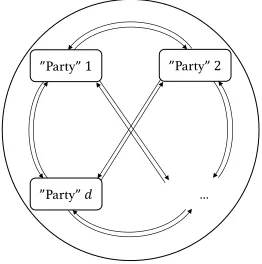
Tile-probe-and-fault model. We introduce a new adversary model that expands on the wire-probe model and brings it closer to real-world processor designs. Our model is set in an architecture that mimics the actively secure MPC setting that inspires our countermeasures (see Figure 1). Instead of individual wires at the foundation of the model, we visualize a separation of the chip (integrated circuit) into areas or tiles, consisting of not only many wires, but also complete blocks of combinational and sequential logic. Such tiled designs are inherent in many modern processor architectures, where the tiles correspond to “cores” and the wires correspond to the on-chip interconnect. This can easily be related to a standard MPC architecture where each tile behaves like a separate party. The main difference between our architecture and the MPC setting is that in the latter, parties are assumed to be connected by a complete network of authenticated channels. In our architecture, we know exactly how the wires are connected in the circuit.
”Party” 2
”Party” "
”Party” 1
…
The tile architecture satisfies the independent leakage assumption [21] amongst tiles. That is, leakage is local and thus observing the behaviour of a tile by means of probing, faulting or observing its side-channel leakage, does not give unintended information about another tile through, for example, coupling.
As the name implies, the adversary in our model exploits side-channels and introduces faults. We stress that our goal is todetect faults as opposed totolerate
or correct them. That is, if an adversary interjects a fault, we want our system to abort without revealing any of the underlying secrets.
CAPA Methodology. We introduce CAPA, a countermeasure against the tile-probe-and-fault-attacker, which is suitable for implementation in both hardware and software. CAPA inherits theoretical aspects of the MPC protocol SPDZ [20] by similarly computing on shared values, along with corresponding shared MAC tags. The former prevents the adversary from learning sensitive values, while the latter allows for detection of any faults introduced. Moreover, having originated from the MPC protocol SPDZ, CAPA is the first countermeasure withprovable
security againstcombined attacks. The methodology can be scaled to achieve an arbitrary fault detection probability and is suitable for implementation in both hardware and software.
Experimental Results. We provide examples of CAPA designs in hardware of the KATAN and AES block ciphers as well as a software bitsliced implementation of the AES S-box. Our designs show that our methodology is feasible to implement, and in addition our attack experiments confirm our theoretical claims. For example, we implemented a second-order secure hardware implementation of KATAN onto a Spartan-6 FPGA and perform a non-specific leakage detection test, which does not show evidence of first- or second-order leakage with up to 100 million traces. Furthermore, we deploy a second-order secure software based CAPA implementation of the AES S-box on an ARM Cortex-M4 and take electromagnetic measurements; for this implementation neither first-nor second-order leakage is detected with up to 200 000 traces. Using toy parameters, we verify our claimed fault detection probability for the AES S-box software implementation. It should be noted that our experimental implementations are to be considered only proof-of-concept; they are currently too expensive to be used in practice. But the designs demonstrate that the overall methodology can provide significant side-channel and fault protection, and they provide a benchmark against which future improvements can be measured.
2
The Tile-Probe-and-Fault Model
Tile Architecture. Consider a partition of the chip in a number of tiles Ti, with
wires running between each pair of tiles as shown in Figure 1. We call the set of all tiles T. Each tile Ti ∈ T possesses its own combinational logic, control
logic (or program code) and pseudo-random number generator needed for the calculations of one share. In the abstract setting, we consider each tile as the set composed of all input and intermediate values on the wires and memory elements of those blocks. A probe-and-fault attacker may obtain, for a given subset of tiles,
allthe internal information at given time intervals on this set of tiles. He may also inject faults (known or random) into each tile in this set.
In our model, each sensitive variable is split intodshares through secret sharing. Without loss of generality, we use Boolean sharing in this paper.
We define each tile such that it stores and manipulates at most one share of each intermediate variable. Any wire running from one tile to another carries only blinded versions of a sensitive variables’ share used byTi. We make minimal
assumptions on the security of these wires. Instead, we include all the information on the unidirectional wires in Figure 1 in the tile on thereceiving and not the
sending end. We thus assume only one tile is affected by an integrity failure of a wire. We assume that shared calculations are performed in parallel without loss of generalization. The redundancy of intermediate variables and logic makes the tiles completely independent apart from the communication through wires.
Probes. Throughout this work, we assume a powerfuldp-probing adversary where
we give an attacker information about all intermediate values possessed bydp
specified tiles,i.e.∪i∈i1,...,idpTi. The attacker obtainsallthe intermediate values
on the tile (such as internal wire and register values) with probability one and obtains these values from the start of the computation until the end. Note that this is stronger than both the standardt-probing adversary which gives access to only tintermediate values within a certain amount of time [34] and-probing adversary where the information about t intermediate values is gained with certain probability. In ourdp-probing model, the adversary gets information from
n intermediate values fromdp tiles where n dp. Therefore, our dp-probing
model is more generic and covers realistic scenarios including an attacker with a limited number of EM probes which enable observation of multiple intermediate values simultaneously within arbitrarily close proximity on the chip.
Faults. We also consider two types of fault models. Firstly, adf-faulting adversary
which can induce chosen-value faults in any number of intermediate bits/values withindf tiles,i.e. from the set ∪i∈i1,...,idfTi. These faults can have the nature of
eitherflipping the intermediate values with a pre-calculated (adversarially chosen) offset orsetting the intermediate values to a chosen fixed value. In particular, the faults are not limited in hamming weight. One can relate this type of faults with, for example, very accurate laser injections.
example, flip each bit with certain probability), but he cannot set all intermediates to a chosen fixed value. This adversary is different from thedf-faulting adversary.
One can relate the -faulting adversary to a certain class of non-localised EM attacks.
Time periods. We assume a notion of time periods; where the period length is at least one clock cycle. We require that a df-fault to an adversarially chosen value
cannot be preceded by a probe within the same time period. Thus adversarial faults can only depend on values from previous time periods. This time restric-tion is justified by practical experimental constraints; where the time period is naturally upper bounded by the time it takes to set up such a specific laser injection.
Adversarial Models. Given the aforementioned definitions, we consider on the one hand an active adversaryA1with bothdp-probing anddf-faulting capabilities
simultaneously. We defineP1 the set of up todptiles that can be probed and F1 the set of up to df tiles that can be faulted byA1. Since each tile potentially sees a different share of a variable and we use ad-sharing for each variable, we constrain the attack surface (the sets of adversarially probed and potentially modified tiles) as follows:
(F1∪ P1)⊆ ∪dj=1−1Tij
The constraint implies that at least one share remains unaccessed/honest and thus|F1∪ P1| ≤d−1. Within thosed−1 tiles, the adversary can probe and fault arbitrarily many wires, including the wires arrivingat each tile. The adversary’s
df-faulting capabilities are limited in time by our definition of time periods,
which implies that anydf-fault cannot be preceded by another probe within the
same time period.
We also consider an active adversaryA2 that hasdp-probing and-faulting
capabilities simultaneously. In this case, the constraint on the set of probed tiles
P2remains the same:
P2⊆ ∪dj=1−1Tij
but the set of faulted tiles is no longer constrained:
F2⊆ T
Moreover, as-faults do not require the same set-up time asdf-faults, they are
As our constructions are based on MPC protocols which arestatically secure
we make the same assumptions in our tile-probe-and-fault model,i.e.the selection of tiles attacked must be fixed beforehand and cannot depend on information gathered during computation. This model reflects realistic attackers since it is infeasible to move a probe or a laser during a computation with today’s resources. We thus assume that both adversariesA1 andA2are static.
3
The CAPA Design
The CAPA methodology consists of two stages. A preprocessing step generates auxiliary data, which is used to perform the actual cryptographic operation in the evaluation step. We first present some notation, then the building blocks for the main evaluation, and finally the preprocessing components.
Notation. Although generalization to any finite field holds, in this paper we work over a fieldFq with characteristic 2, for exampleGF(2k) for a givenk, as
this is sufficient for application to most symmetric ciphers. We use ·and + to describe multiplication and addition inFq respectively. We use upper case letters
for constants. The lower case lettersx, y, z are reserved for the variables used only in the evaluation stage (e.g. sensitive variables) whereasa, b, c, . . .represent auxiliary variables generated from randomness in the preprocessing stage. The kronecker delta function is denoted by δi,j. We useL(.) to denote an additively
homomorphic function and A(.) =C+L(.) with C some constant.
Information Theoretic MAC Tags and the MAC Key α. We represent a value
a∈Fq (similarlyx∈Fq) as a pairhai= (a,τa) of data and tag shares in the
masked domain. The data shares a= (a1, . . . , ad) satisfy Pai = a. For each
a∈Fq, there exists a corresponding MAC tagτa computed as τa=α·a, where
αis a MAC key, which is secret-shared amongst the tiles asα=P
αi.
Analogously to the data, the MAC tag is sharedτa= (τa
1, . . . , τda), such that
it satisfies P
τa i =τ
a, but the MAC key itself does not carry a tag. Depending
on a security parameterm, there can bemindependent MAC keysα[j]∈Fq for
j∈ {1, . . . , m}. In that case,αas well asτa are in
Fmq and the tag shares satisfy
P
τa i[j] =τ
a[j] =α[j]
·a, ∀j ∈ {1, . . . , m}. Further we assumem = 1 unless otherwise mentioned.
3.1 Evaluation Stage
We let each tile Ti hold the ith share of each sensitive and auxilary variable
(xi, . . .,ai, . . .) and the MAC key shareαi. We first describe operations that do
not require communication between tiles.
Addition. To compute the addition (z,τz) of (x,τx) and (y,τy), each tile
performs local addition of their data shares zi =xi+yi and their tag shares
τz
i = τix+τ y
i. When one operand is public (for example, a cipher constant
C∈Fq), the sum can be computed locally aszi =xi+C·δi,1 for value shares andτz
Multiplication by a Public Constant. Given a public constant C ∈ Fq, the
multiplication (z,τz) of (x,τx) andC is obtained locally by settingz
i=C·xi
andτz
i =C·τix.
The following operations, on the other hand, require auxiliary data generated in a preprocessing stage and also communication between the tiles.
Multiplication. Multiplication of (x,τx) and (y,τy) requires as auxiliary data a Beavertriple (hai,hbi,hci), which satisfiesc=a·b, for randomaandb. The multiplication itself is performed in four steps.
– Step A. In the blinding step, each tile Ti computes locally a randomized
version of its share of the secret:εi=xi+ai andηi=yi+bi.
– Step B. In thepartial unmasking step, each tileTi broadcasts its own shares
εiandηito other tiles, such that each tile can construct and store locally the
valuesε=P
εiandη=Pηi. The valueε(resp.η) is thepartial unmasking
of (ε,τε) (resp. (η,τη)), i.e.the valueε(resp.η) is unmasked but its tag τε (τη) remains shared. These values are blinded versions of the secretsx
andyand can therefore be made public.
– Step C. In theMAC-tag checking step, the tiles check whether the tagsτε
(τη) are consistent with the public valuesεandη, using a method which we
will explain later in this section.
– Step D. In theBeaver computation step, each tile locally computes
zi=ci+ε·bi+η·ai+ε·η·δi,1
τz i =τ
c i +ε·τ
b i +η·τ
a
i +ε·η·αi.
It can be seen easily that the sharing (z,τz) corresponds toz=x
·yunless faults occurred. Step B and C are the only steps that require communication among tiles. Step A and D are completely local. Note that to avoid leaking information on the sensitive dataxand y, the sharesεi andηi must be synchronized using
memory elements after step A, before being released to other tiles in step B. Moreover, we remark that step C does not require the result of step B and can thus be performed in parallel.
Squaring. Squaring is a linear operation in characteristic 2 fields. Hence, the output shares of a squaring operation can be computed locally using the input shares. However, obtaining the corresponding tag shares is non-trivial. To square (x,τx) into (z,τz), we therefore require an auxiliarytuple(hai,hbi) such that
b=a2. The procedure to obtain (z,τz) mimics that of multiplication with some
modifications: there is only one partially unmasked valueε=x+a, whose tag needs to be checked, and each tile calculateszi=bi+ε2·δi,1andτiz=τib+ε2·αi.
Affine Transformation. Provided that we have access to a tuple (hai,hbi) such thatb=A(a), we can compute (z,τz) satisfyingz=A(x) =C+L(x), where
L(x) is an additively homomorphic function over the finite field, by computing the output sharing aszi=bi+L(ε)·δi,1 andτiz=τib+L(ε)·αi.
Multiplication following Linear Transformations. The technique used for the above additively homomorphic operations can be generalized even further to computez=L1(x)·L2(y) in shared form, whereL1 andL2are additively homo-morphic functions. A trivial methodology would require two tuples (haii,hbii)
with bi = Li(ai) for i ∈ {1,2}, plus a standard Beaver triple (i.e. requiring
seven pre-processed data items). We see that we can do the same operation with five pre-processed items (hai,hbi,hci,hdi,hei), such thatc =L1(a), d=L2(b) and e = L1(a)·L2(b). The tiles partially unmask x+a (resp. y +b) to obtain ε (resp. η) and verify them. Each tile computes its value share and tag share of z as zi = ei +L1(ε)·di +L2(η)·ci+L1(ε)·L2(η)·δi,1 and
τz i =τ
e
i +L1(ε)·τ d
i +L2(η)·τ c
i +L1(ε)·L2(η)·αi, respectively. We refer to
(hai,hbi,hci,hdi,hei) as aquintuple.
Proof. d X i=1 zi= d X i=1
ei+L1 (ε)·di+L2 (η)·ci
+L1 (ε)·L2 (η)
=
d X
i=1
ei+L1 (ε)·
d X
i=1
di+L2 (η)·
d X
i=1
ci+L1 (ε)·L2 (η)
=L1 (a)·L2 (b) +L1 (x+a)·L2 (b) +L2 (y+b)·L1 (a) +L1 (x+a)·L2 (y+b)
=L1 (a)·L2 (b) +L1 (x)·L2 (b) +L1 (a)·L2 (b) +L1 (a)·L2 (y) +L1 (a)·L2 (b)
+L1 (x)·L2 (y) +L1 (x)·L2 (b) +L1 (a)·L2 (y) +L1 (a)·L2 (b)
=L1 (x)·L2 (y)
d X
i=1
τiz=
d X
i=1
τie+L1 (ε)·τid+L2 (η)·τic+L1 (ε)·L2 (η)·αi
=
d X
i=1
τie+L1 (ε)·
d X
i=1
τid+L2 (η)·
d X
i=1
τic+L1 (ε)·L2 (η)·
d X
i=1
αi
=α·e+L1 (ε)·α·d+L2 (η)·α·c+L1 (ε)·L2 (η)·α
=α· e+L1 (ε)·d+L2 (η·c+L1 (ε)·L2 (η)
=α·L1 (x)·L2 (y)
Checking the MAC Tag of Partially Unmasked Values. Consider a public valueε=x+a, calculated in the partial unmasking step of the Beaver multiplica-tion operamultiplica-tion. Recall that we obtain its MAC-tag shares as follows:τε
i =τia+τix.
During the MAC-tag checking step of the Beaver operation, the authenticity of τε corresponding to ε is tested. Asε is public, each tile can calculate and
broadcast the valueε·αi+τiε. For a correct tag, we expect
Pτε
i =α·ε, thus
each tile computesP(ε
·αi+τiε) and proceeds if the result is zero. Recall that
Note on Unmasked Values/Calculations. There are several components in a cipher which do not need to be protected against SCA (i.e.masked), because their specific values are not sensitive. One prominent example is the control unit which decides what operations should be performed (e.g. the round counter). Other examples are constants such as the AES affine constant 0x63or public values such asεin a Beaver calculation and the differenceε·α+τε during the
MAC-tag checking phase.
While thesepubliccomponents are not sensitive in a SCA context, theycanbe targeted in a fault attack. It is therefore important to introduce some redundancy. Each tile should have its own control logic and keep a local copy of all public values to avoid single points of attack. The sharesεiare distributed toall tiles so
thatεcan be unmasked by each tile separately and any subsequent computation performed on these public values is repeated by each tile. Finally, each tile also keeps its own copy of the abort status. This is in fact completely analogous to the MPC scenario.
3.2 Preprocessing Stage
The auxiliary data (hai,hbi, . . .) required in the Beaver evaluations, is generated in a preprocessing stage. This preparation corresponds to the offline phase in SPDZ . However, CAPA’s preprocessing stage is lighter and does not require a public key calculation due to the differences in adversary model. As in SPDZ , this stage is completely independent from the sensitive data of the main evaluation. Below, we describe the generation of a Beaver triple used in multiplication. This can trivially be generalized to tuples and quintuples.
Auxiliary Data Generation. To generate a triple (hai,hbi,hci) satisfyingc=a·b, we draw random sharesa= (a1, . . . , ad) and b= (b1, . . . , bd) and use a passively
secure shared multiplier to computecs.t. c=a·b. We then use another such multiplication with the shared MAC keyα to generate tag sharesτa, τb, τc.
We note that the sharesai, bi are randomly generated by tileTi. There are thus
dseparate PRNG’s onddistinct tiles.
Passively Secure Shared Multiplier. For a secure implementation of a shared multiplication, no subset of d−1 tiles should have access to all shares of any variable. This concept, which is used in the context of secure implementations against SCA on hardware, is precisely called d−1th-order non-completeness in [9, 52]. In the last decade, there has been significant improvement on passively secure shared multipliers that can be used in both hardware and software [9, 27, 29, 51, 56]. In principle, CAPA can use any such multiplier as long as the tile structure still holds.
A close inspection of existing multipliers show that they require the calculation of the cross productsaibj. In order to make these multipliers compatible with
the CAPA tile architecture, we define tilesTi,j which receiveai fromTi andbj
fromTj wherei6=j in order to handle the pair (ai, bj) to be used during tuple,
during auxiliary data generation in addition todtiles used for both auxiliary data generation and evaluation. The output wires fromTi,j are only connected
toTi and carry randomized information.
The multipliers used in the preprocessing phase are onlypassively secure. We also ensure resistance againstactive adversaries because on the one hand, deterministic faults are limited to d−1 tiles and on the other, because of a relation verification step, which is explained in the next section.
3.3 Relation Verification of Auxiliary Data
The information theoretic MAC tags provide security against faults induced in the evaluation stage. To detect faults in the preprocessing stage, we perform a relation verification of the auxiliary data. This relation verification step is done for each generated triple that is passed from the preprocessing to the evaluation stage and ensures that the triple is functionally correct (i.e. c = a·b) by sacrificing another triple. That is, we take as input two triples (hai,hbi,hci) and (hdi,hei,hfi), that should satisfy the same relation, in this examplec=a·band
f =d·e. The following Beaver computation holds if and only if both relations are satisfied:
– Draw a randomr1∈Fq
– Use triple (hdi,hei,hfi) to calculate the multiplication of r1· haiandhbi using a constant multiplication withr1, followed by the Beaver equation for multiplication described above. The resulthc˜iis a shared representation of ˜
c=r1·a·b.
– For each sharei, calculate the difference with the shares and tags of r1·c:
∆i=r1·ci+ ˜ci andτi∆=r1·τic+τic˜.
– Unmask the resulting differences∆andτ∆.
– If a difference is nonzero, reject (hai,hbi,hci) as a valid triple. – Pick anotherr2∈Fq such thatr26=r1 and repeat a second time.
Note that this relation verification ensures that the second triple is functionally correct too. However, it is burnt (or “sacrificed”) in this process in order to ensure that the first triple can be used securely further on. Note that this relation verification or “sacrificing” step is mandatory in each Beaver-like operation.
Why We Need Randomization. This sacrificing step involves two valuesr1andr2. We present the following attack to illustrate why this randomization is needed. Again, we elaborate on triples, but the same can be said for tuples and quintuples. As the security does not rely on the secrecy ofr1andr2, we assume for simplicity that they are known to the attacker. We only stress that they are different:
r16=r2.
Consider two triples (hai,hbi,hc0i) and (hdi,hei,hf0i) at the input of the sacrificing stage. We assume that the adversary has introduced an additive difference into one share ofc0andf0such thatc0=a
·b+∆c andf0=d·e+∆f.
valid tags for the faulted valuesc0 andf0 respectively. In particular, this means we haveτc0 =τc+α
·∆c andτf
0
=τf+α
·∆f.
The sacrificing step calculates the following four differences (forrj =r1 and
r2) and only succeeds if all are zero.
∆j= d
X
i=1
rj·c0i+f 0
i+ε·ei+η·di
+ε·η
=rj·∆c+∆f ? = 0
τ∆j =
d
X
i=1
rj·τc
0
i +τ f0 i +ε·τ
e i +η·τ
d
i +ε·η·αi
=rj·α·∆c+α·∆f ? = 0
Without randomization (i.e.r1=r2= 1), the attacker only has to match the differences ∆f =∆c to pass verification. With a random r1, the attacker can fix∆f =r1·∆c to automatically force∆1 andτ∆1 to zero. Even if he does not knowr1, he has probability as high as 2−k to guess it correctly.
Only thanks to the repetition of the relation verification withr2, the adversary is detected with a probability 1−2−km. Assuming he fixed∆
f =r1·∆c, it is
impossible to also achieve∆f =r2·∆c. Even if the attacker manages to force
∆2 to zero with an additive injection (since he knows all components r2, ∆c
and∆f), he cannot get rid of the differenceτ∆2=r2·α·∆c+α·∆f without
knowing the MAC key. Since αremains secret, the attacker only has a success probability of 2−km to succeed.
4
Discussion
4.1 Security Claims
With both described adversariesA1 andA2, our design CAPA claims provable security against the following types of attacks as well as a combined attack of the two
1. Side-Channel Analysis (i.e.againstd−1 tile probing adversary).
2. Fault Attacks (i.e.an adversary introducing either known faults intod−1 tiles or random faults everywhere).
Side-channel Analysis. One can check that no union ofd−1 tiles∪j∈j1,...,jd−1Tj
has all the shares of a sensitive value. Very briefly, we can reason to thisd−1th -order non-completeness as follows. All computations are local with the exception of the unmasking of public values such asε. However, the broadcasting of all shares ofεdoes not break non-completeness sinceε=x+ais not sensitive itself but rather a blinded version of a sensitive value x, using a random a that is shared across all tiles. Unmasking the public valueεtherefore gives each tileTi
only one shareε+ai of a new sharing of the secretx:
In this sharing, no union of d−1 shares suffices to recover the secret. Our architecture thus provides non-completeness for all sensitive values. As a result, ourd-share implementation is secure againstd−1-probing attacks. Any number of probes following the adversaries’ restrictions leak no sensitive data. Our model is related to the wire-probe model, but with wires replaced by entire tiles. We can thus at least claim security againstd−1th order SCA.
Fault Attacks. A fault is only undetected if both value and MAC tag shares are modified such that they are consistent. AdversaryA1can fault at most df < d
tiles, which means he requires knowledge of the MAC keyα∈GF(2km) to forge a
valid tag for a faulty value. Sinceαis secret, his best option is to guess the MAC key. This guess is correct with probability 2−km. Adversary
A2 has -faulting abilities only and will therefore only avoid detection if the induced faults in value and tag shareshappen to be consistent. This is the case with probability 2−km.
We can therefore claim an error detection probability (EDP) of 1− 1 2km. The
EDP does not depend on the number of faulty bits (or the hamming weight of the injected fault).
Combined Attacks. In a combined attack, an adversary withdf-faulting
capabili-ties can mount an attack where he uses the knowledge obtained from probing some tiles∈ P1 to carefully forge the faults. In SPDZ, commitments are used to avoid the so called “rushing adversary”. CAPA does not need commitments as the timing limitation onA1adversary ensures adf-fault cannot be preceded by a
probe in the same clock cycle. As a result, we inherit the security claims of SPDZ and the claimed EDP is not affected by probing or SCA. Also, the injection of a fault in CAPA does not change the side-channel security. Performing a side-channel attack on a perturbed execution does not reveal any additional infor-mation because the Beaver operations do not allow injected faults to propagate through a calculation into a difference that depends on sensitive information. We can claim this security, because of the aspects inherited from MPC. CAPA is essentially secure against a very powerful adversary that has complete control (hence combined attacks) over all but one of the tiles.
What Does Our MAC Security Mean? We stress that CAPA provides significantly higher security than existing approaches against faults. An adversary that injects errors in up to df tiles cannot succeed with more than the claimed detection
probability. This means that our design can standd0
f df shots if they affect
at mostdf tiles. This is the case even if thosedf tiles leak their entire state;
hence our resistance against combined attacks. The underlying reason for this is that to forge values, an attacker needs to know the MAC key, but since this is also shared, the attacker does not gain any information on the MAC key and their best strategy is to insert a random fault, which is detected with probability 1−2−km. Moreover, our solution is incredibly scalable compared to for example
error detection code solutions.
How Much Do Tags Leak? The tag shares τa
i form a Boolean masking of a
underlying value aand can be seen as a multiplicative share ofa. We therefore require the MAC key to change for each execution. Hence MAC tag shares are a Boolean masking of a multiplicative share and are expected to leak very little information in comparison with the value shares themselves.
Forbidding the All-0s MAC Key. If the MAC key sizemk is small, we should forbid the all-0 MAC key. This ensures that tags are injective: if an attacker changes a value share, he must change the tag share. We only pay with a slight decrease in the claimed detection probability. By excluding 1 of the 2km MAC
key possibilities, we reduce the fault detection probability to 1−2−κ, where
κ= log2(2km−1).
4.2 Attacks
The Glitch Power Supply or Clock Attack. The solution presented in this paper critically depends on the fact that there is no single point where an attacker can insert a fault that affects alldtiles deterministically. An attacker may try to glitch the chip clock line that is shared among all tiles. In this case, the attacker could try to carefully insert a glitch so that writing to the abort register is skipped or a test instruction is skipped. Since all tiles share the same clock, the attacker can bypass in this way the tag verification step. Similar comments apply, for example, to glitches in the power line. The bottom line is that one should design the hardware architecture accordingly, that is, deploy low-level circuit countermeasures that detect or avoid this attack vector.
Skipping Instructions. In software, when each tile is a separate processor (with its own program counter, program memory and RAM memory), skipping one instruction in up to d−1 shares would be detected. The unaffected tiles will detect this misbehavior when checking partially unmasked values.
Safe Error Attack. We point out a specific attack that targets any countermeasure against a probing and faulting adversary. In a safe error attack [65], the attacker perturbs the implementation in a way that the output is only affected if a sensitive variable has a certain value. The attacker learns partial secret information by merely observing whether or not the computation succeeds (i.e.does not abort). Consider for example a shared multiplication of a variablexand a secrety and call the resulting productz=xy. The adversary faults one of the inputs with an additive nonzero difference such that the multiplication is actually performed on
x0=x+∆instead ofx. Such an additive fault can be achieved by affecting only one share/tile. The multiplication results in the faulty productz0 =z+∆·y. The injected fault has propagated into a difference that depends on sensitive data (y). As a result, the success or failure of any integrity check following this multiplication depends on y. In particular, if nothing happens (all checks pass), the attacker learns thaty must be 0.
initial fault ∆. The attacker can always target the wire running from the last integrity check onxto the multiplication withy. We believe CAPA is currently unique in preventing this type of attack. One can verify that the MAC-tag checking step in a Beaver operation successfully prevents∆from propagating to the output. This integrity check only passes if all tiles have a correct copy of the public valueε. Any faults injected after this check have a limited impact as the calculation finishes locally. That is, once the correct public values are established between the tiles, the shares of the multiplication outputzare calculated without further communication among tiles. The adversary is thus unable to elicit a fault that depends on sensitive data.
PACA. We claim security against the passive and active combined attack (PACA) on masked AES described in [2] because CAPA does not output faulty ciphertexts. A second attack in this work uses another type of safe errors (or ineffective faults as they are called in this work) which are impossible to detect. The attacker fixes a specific wire to the value zero (this requires the df-faulting capability) and
collects power traces of the executions that succeed. This means the attacker only collects traces of encryptions in which that specific wire/share was already zero. The key is then extracted usingd−1th-order SCA on the remainingd
−1
shares. This safe error attack however falls outside our model since the adversary gets access (either by fault or SCA) to alldshares and thus (F1∪ P1) =T.
Advanced Physical Attacks. In our description we are assuming that during the broadcast phase there are no “races” between tiles: by design, each tile sets its share to be broadcasted at clock cycletand captures other tiles’ share in the same clock cyclet. We are implicitly assuming that tiles cannot do much work between these two events. If this assumption is violated (for example, using advanced circuit editing tools), a powerful adversary could bypass any verification. This is why in the original SPDZ protocol there are commitments prior to broadcasting operations; if this kind of attack is a concern one could adapt the same principles of commitments to CAPA. This is a very strong adversarial model that we consider out of scope for this paper.
4.3 Differences with SPDZ
Offline Phase. In SPDZ, the auxiliary data is generated using a somewhat homomorphic encryption scheme. The mapping onto a chip environment thus seems prohibitive due to the need for this expensive public-key machinery to obtain full threshold and the large storage required. We avoid this by generating the Beaver triples using passively secure shared multipliers. Furthermore, to avoid the large storage requirement, we produce the auxiliary data on the fly whenever required.
because in the MPC setting, local memory is cheaper than communication costs. In an embedded scenario the situation is opposite so we check the opened values on the fly at the cost of additional dedicated circuit. In hardware, we “simulate” the broadcast channel by wiring between all tiles. Each tile keeps a local copy of those broadcasted values.
Adversary. Although MPC considers mainly the “synchronous” communication model, the SPDZ adversary model also includes the so-called “rushing” adversary, which first collects all inputs from the other parties and only then decides what to send in reply. In our embedded setting, as already pointed out, the “rushing” adversary is impossible. Due to the nature of the implementation, the computational environment and storage is very much restricted. On the other hand, communication channels are very efficient and can be assumed to be automatically synchronous with all tiles progressing in-step in the computation.
4.4 Cost Analysis and Scalability
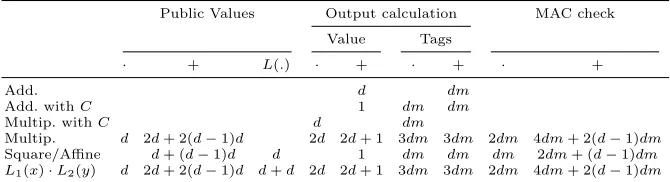
The computation as described in§3.1 scales nicely with the masking orderdand the security parameter m. For any fixed number of sharesd, the circuit area scales linearly in m(see for example Table 2). Storage increases with a factor (m+ 1)dcompared to a plain implementation. We note that our implementations run in almost the same amount of cycles as that of a plain implementation. There is almost no loss in throughput and only negligible in latency. In software as well, the timing scales linearly if tiles run in parallel.
Table 1.Overview of the number ofFq multiplications (.),Fqadditions (+) and linear operations inGF(2) (L(.)) required to calculate all building blocks withdshares and
mtags
Public Values Output calculation MAC check
Value Tags
· + L(.) · + · + · +
Add. d dm
Add. withC 1 dm dm
Multip. withC d dm
Multip. d 2d+ 2(d−1)d 2d 2d+ 1 3dm 3dm 2dm 4dm+ 2(d−1)dm
Square/Affine d+ (d−1)d d 1 dm dm dm 2dm+ (d−1)dm L1(x)·L2(y) d 2d+ 2(d−1)d d+d 2d 2d+ 1 3dm 3dm 2dm 4dm+ 2(d−1)dm
Complexity for Passive Attacker Scenario. It is remarkable that if active attackers are ruled out, and only SCA is a concern, then the complexity of the principal computation is linear in d. This may seem like a significant improvement over previous masking schemes which have quadratic complexity on the security order [18, 34, 58]. However, this complexity is again pushed into the preprocessing stage. Nevertheless, this can be interesting especially for software implementations in platforms where a large amount of RAM is available to store the auxiliary data generated in §3.2. The same comments apply to FPGAs with plenty of BlockRAM.
Optimization of Preprocessing. It may be beneficial to store the output of the preprocessing stage§3.2 in a table for later usage. One could optimize this process by recycling auxiliary data (sample elements with replacement from the table). Of course, this would void the provable security claims; but if performed with care (with appropriate table shuffling and table elements refresh), this can give rise to an implementation that is secure in practice.
5
Proof-of-Concept
In this section we detail a proof-of-concept implementation of the CAPA method-ology in both a hardware and a software environment. We emphasize specific concepts for hardware and software implementations and provide case studies of KATAN-32 [14] and AES [1], which cover operations in different fields, possibility of bitsliced implementations, specific timing and memory optimizations, and performance results.
5.1 Hardware Implementations
We now describe two case studies for applying CAPA in hardware. Our imple-mentations are somewhat optimized for latency rather than area with d tiles spatially separated and operating in parallel, each with its own combinational and control logic and auxiliary data preparation module. These preparation modules are equipped with a passively secure shared multiplication with higher-order non-completeness. Literature provides us with a broad spectrum of multipliers to choose from [9, 27, 29, 51, 56]. In order to minimize the randomness requirement, our implementation uses the one from [29], hereafter referred to as DOM.
Library. For synthesis, we use Synopsis Design Compiler Version I-2013.12 using the NanGate 45nm Open Cell library [49] for ease of future comparisons. We choose the compile option- exact mapto prevent optimization across tiles. The area results are provided in 2-input NAND-gate equivalents (GE).
Table 2.Area (GE) of 2-share KATAN-32 implementations withmMAC keysα[j]∈Fq
No tags m= 1 m= 8 Anym
- Evaluation 2 315 4 708 21 404 ≈2 315 + 2 390m
* Shift Register 888 1 823 8 419 ≈888 + 935m
* Key Schedule 1 427 2 885 12 985 ≈1 427 + 1 455m
- Preprocessing (x3) 363 679 2 727 ≈363 + 315m
* Two triple generation 237 431 1 786 ≈237 + 195m
* Relation verification 126 248 941 ≈126 + 120m
Total 3 672 7 103 30 596 ≈3 672 + 3 430m
four AND-XOR operations. Hence, its natural shared data representation is in the field Fq = GF(2), which makes the mapping into CAPA operations
relatively straightforward. However, the small finite field means that we need to utilize a vectorized MAC-tag operation (m >1) to ensure a good probability of detecting errors. Our implementation is round based, as in [14] with three AND-XOR Beaver operations and one constant AND-XOR calculated in parallel. Each Beaver AND-XOR operation requires two cycles, and is implemented in a pipelined fashion such that the latency of the whole computation increases only by one clock cycle.
Implementation Cost. Tables 2 and 3 summarize the area of our KATAN imple-mentations. Naturally, compared to a shared implementation without MAC tags, the state registers grow with a factorm+ 1 as the MAC-key size increases. In the last columns, we extrapolate the area results for anym.
Each Beaver multiplication in GF(2) requires one triple, and each triple needs 2drandom bits for generatingaandb. Ad-share DOM multiplication requires
d
2
units of randomness. The construction of one triple requires 1 + 3mmasked multiplications: one to obtain the multiplicationcofaandb; and 3mto obtain themtagsτa,τb andτc. Due to the relation verification through the sacrificing of another triple, the randomness must be doubled. Hence, the total required number of random bits per round of KATAN is 3·2·(2d+ (1 + 3m)d(d2−1))).
Experimental Validation. The goal of the prior proof-of-concept implementation is to experimentally validate the protection against side-channel attacks offered by the CAPA methodology. We deploy a first- and second-order secure KATAN
Table 3.Area (GE) of 3-share KATAN-32 implementations withmMAC keysα[j]∈Fq
No tags m= 1 m= 8 Anym
- Evaluation 3 560 7 139 32 368 ≈3 560 + 3 580m
* Shift Register 1 363 2 812 12 890 ≈1 363 + 1 450m
* Key Schedule 2 197 4 327 19 478 ≈2 197 + 2 130m
- Preprocessing (x3) 638 1 468 7 124 ≈638 + 830m
* Two triple generation 428 952 4 694 ≈428 + 524m
* Relation verification 210 516 2 430 ≈210 + 306m
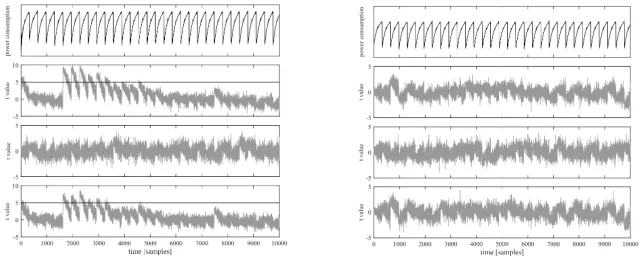
Fig. 2.Non-specific leakage detection on the first 31 rounds of first-order KATAN. Left column: PRNG off (24K traces). Right column: PRNG on (100M traces). Rows (top to bottom): exemplary power trace; first-order t-test; second-order t-test
instance onto a Xilinx Spartan-6 FPGA. Our platform is a Sakura-G board specifically designed for side-channel evaluation with two FPGA’s to minimize platform noise: a control FPGA handles I/O with the host computer and supplies masked data to the crypto FPGA, which implements both the preprocessing and evaluation. The KATAN implementations use d= 2 (resp. d= 3) shares and
m= 2 MAC keys. The parameter m= 2 is insufficient in practice, but serves for this experiment sincemhas no influence on SCA security. The designs are clocked at 3 MHz and we sample power traces of 10 000 time samples each at 1 GS/s. Exemplary traces are shown in Figure 2,top.
We perform a non-specific leakage detection test [17] following the methodology from [57, 61]. First, we test the designs without masks to verify that our setup is indeed sound and able to detect leakage. Then we switch on the PRNG and corroborate that the design does not leak with high confidence.
In Figure 2, we show the results for the first-order secure design (d= 2). In the left column, the PRNG is turned off, emulating an unmasked design. Indeed, we see clear leakage at first order, since the t-statistics cross the threshold 4.5. With the PRNG on (right column), no first-order leakage is detected with up to 100 million traces. As expected, we do see second-order leakage. Figure 3 exhibits the results for the second-order secure design (d= 3). The left column shows clear leakage at first, second and third order when the PRNG is turned off. In the right column, we repeat the procedure with PRNG on and no univariate leakage is detected with up to 100 million traces.5
Case Study: AES. There has been a great deal of work on MPC and masked implementations of the basic AES operations. We take what has now become the traditional approach and work in the field GF(28) withm= 1 for AES,i.e.the MAC key, data and tag sharesαi,ai andτia are∈GF(28). The ShiftRows and
MixColumns operations are linear in GF(28), hence are straightforward. Here, we only describe the S-box calculation.
Design choices. The AES S-box consists of an inversion in GF(28), followed by an affine transformation over bits. We distinguish two methodologies for the S-box implementation: It is well known that the combination of the two operations can be expressed by the following polynomial in GF(28) [19]:
S-box(x) =0x63+0x8F·x127+0xB5
·x191+0x01
·x223+0xF4
·x239
+0x25·x247+0xF9·x251+0x09·x253+0x05·x254 (1)
This polynomial can be implemented using 6 squares and 7 multiplications in GF(28) with a latency of 13 clock cyles. A second approach is to evaluate the inversionx−→x254 using the following multiplication chain from [30]:
x254=x4· (x5)552
Since the AES affine transformA(x) is linear over GF(2), we can then use the Beaver operation described in§3.1 to evaluate it in one cycle, using auxiliary affine tuples (hai,hbi) such thatb=A(a) . Initial estimations reveal the former method is more expensive than the latter, so we adopt the latter technique.
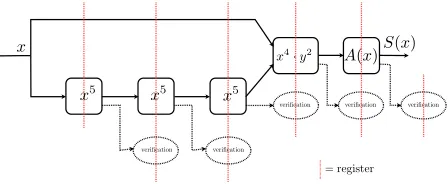
Multiplication Chain. Our implementation of the proposed multiplication chain uses two types of operations: x5 andx4·y2, which can both be computed as described in §3.1 (Multiplication following Linear Transformations). Given an inputhxiand a triple (hai,hbi,hci) such thatb=a4 andc=a5, we calculate the CAPA exponentiation to the power five. Likewise, we perform the mapx4·y2 (with y =x125) in one cycle, using quintuples (hai,hbi,hci,hdi,hei) such that
c=a4,d=b2 ande=c
·d=a4
·b2. As a result, an inversion in GF(28) costs 5
x S(x)
verification verification
verification verification
x5 x5 x5
x4
·y2 A(x)
= register https://drive.google.com/file/d/ 0B19mBnPrtz4hQllQMVNTeTBpSGM/ view?usp=sharing
verification
Fig. 4.AES S-box pipeline
only 4 cycles, using 3 exponentiation triples and 1 quintuple. Combined with the affine stage, we obtain the S-box output in 5 cycles (see Figure 4). This approach does not only optimize the number of cycles but also the amount of required randomness. The S-box is implemented as a five stage pipeline.
Implementation Cost. We use a serialized AES architecture, based on that in [28]. One round of the cipher requires 21 clock cycles, making the latency of one complete encryption 226 clock cycles. Since the unprotected serialised implementation of [47] also requires 226 cycles, the timing performance is very good.
Table 4 presents the area for the different blocks that make up our AES implementation. We can see a significant difference between the preprocessing and evaluation stages,i. e. the efficient calculation phase comes at the cost of expensive resource generation machinery.
Table 5 summarizes the required number of random bytes for the generation of the triples/tuples for the AES S-box as a function of the number of MAC keys
mand the number of sharesd. Recall that the S-box needs three exponentiation triples, one quintuple and one affine tuple per cycle (doubled for the sacrificing). Each of these uses dinitial bytes of randomness per input for the shares ofa
(andb). Furthermore, recall that each masked multiplication requires d2 bytes
Table 4.Areas for first- and second-order AES implementations withm= 1 in 2-NAND Gate Equivalents (GE)
Evaluation d= 2 d= 3 Preprocessing d= 2 d= 3
S-box 18 810 28 234 Quintuples 29 147 53 212
* Beaverx5(x3) 3 914 5 875 * Generation 15 092 32 241 * Beaverx4y2 4 944 7 427 * Sacrificing 14 055 20 971
* Beaver Affine 1 563 2 344 Triples (x3) 19 106 34 954 State array 4 962 7 466 * Generation 9 804 21 112 * MixColumns 1 056 1 584 * Sacrificing 9 302 13 842 Key array 3 225 4 835 Affine tuples 7 603 14 657
Others 1 296 1 839 * Generation 4 821 10 444
* Sacrificing 2 782 4 213
Total 28 293 42 374 Total 94 068 172 731
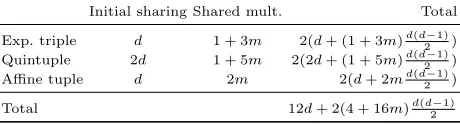
Table 5.The number of randomness in bytes for the initial sharing, shared multiplication and the sacrifice required for AES S-box
Initial sharing Shared mult. Total
Exp. triple d 1 + 3m 2(d+ (1 + 3m)d(d−1)
2 )
Quintuple 2d 1 + 5m 2(2d+ (1 + 5m)d(d2−1)) Affine tuple d 2m 2(d+ 2md(d2−1)) Total 12d+ 2(4 + 16m)d(d−1)
2
or randomness. That is, ford= 3 and m= 1, we need 156 bytes of randomness per S-box evaluation.
5.2 Software Implementation
CAPA is a suitable technique for software implementations if we map different tiles to different processors/cores. We do, however, need to place some constraints on the underlying hardware architecture; namely each processor should have an independent memory bank. Otherwise, a single affected tile (processor) could compromise the security of the whole system by for example dumping the entire memory contents (including all shares for sensitive variables).
This model therefore does not perfectly fit commercial off-the-shelf multi-core architectures, but we think isolated memory regions is a reasonable assumption for future micro-processors. While we do not have access to such architecture, as a proof of concept we emulate the proposed multi-processor architecture by time-sharing a 32-bit single-core ARM Cortex-M4 processor. This proof-of-concept does not provide resistance against attacks such as the memory dump example above.
Case Study: AES S-box. Even though it is possible to implement the AES S-box using GF(28) operations in SW also, we base our bitsliced software imple-mentation on the principles of gate-level masking and we use the depth-16 AES S-box circuit by Boyar et al. [11] in order to provide competitive throughput. Our high-level implementation processes 32 blocks simultaneously which is compatible with the word size of our processor and can naturally be reduced. As the circuit boils down to a series of XOR and AND operations over pairs of value and tag shares, we redefine these elementary operations in the same way as previous works [3,§4]. We note that this technique is independent from the concrete design, and one could apply the same principles to different ciphers.
We create a prototype implementation in C99. This is an unoptimized imple-mentation meant for functionality and security testing. We compile withgcc-arm
4.8.4. The 32 parallel SubBytes operations are performed in 2.52 million cycles
50 100 150 200 EM field -50 0 50 t value -60 -40 -20 0 t value
0.5 1 1.5 2 2.5 3 3.5 4 4.5 5 5.5 time [samples] 105 -40 -20 0 20 40 t value 50 100 150 200 EM field -5 0 5 t value -5 0 5 t value
0.5 1 1.5 2 2.5 3 3.5 4 4.5 5 5.5
time [samples] 105
-5 0 5
t value
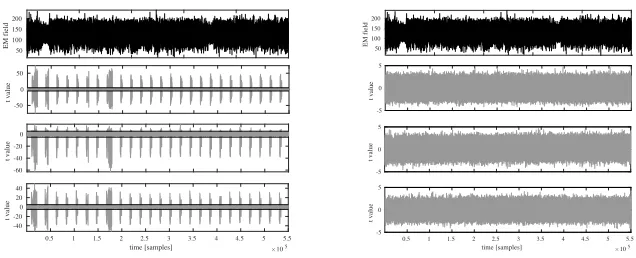
Fig. 5.Non-specific leakage detection on second-order SubBytes. Left column: masks off. Right column: masks on (200K traces). Rows (top to bottom): one exemplary EM trace, first-order t-test; second-order t-test; third-order t-test
Experimental Validation of DPA Security. We use an STM32F407 32-bit ARM Cortex-M4 processor running the C99 implementation. We take EM measure-ments with an electromagnetic probe on top of a decoupling capacitor. This platform is very low noise: a DPA attack on the unprotected byte-oriented AES implementation succeeds with only 15 traces. Each trace is slightly above 500 000 time samples long and covers the entire execution of SubBytes. An exemplary trace is depicted at the top of Figure 5.
Following the same procedure as in§5.1, we first perform a non-specific leakage detection test with the masking PRNG turned off. The results of the first-, second-and third-order leakage tests are shown on the left side of Figure 5. Severe leakage is detected, which confirms that the setup is sound. When we plug in the PRNG, no leakage is detected with up to 200 000 traces (the statistic does not surpass the thresholdC=±4.5). This serves to confirm that the implementation effectively masks all intermediates, and that first- nor second-order DPA is not possible on this implementation. SPA features within an electromagnetic trace are better visible in the cross-correlation matrix shown in Figure 6.
Experimental Validation of DFA Security. For the purposes of validating our theoretical security claims on CAPA’s protection against fault attacks, we scale down our software AES SubBytes implementation, reducing the MAC key size to
m= 2 and scaling down words to bits (k= 1). Note that this parameter choice lowers the detection probability; the point of using these toy parameters is only to verify more comfortably that the detection probability works as expected. It is easier to verify that the detection probability is 1−2−2rather than 1
−2−40. This concrete parameter choice is naturally not to be used in a practical deployment. When barring the all zeroes key, we expect the attacker to succeed with probability at most 1
2mk−1 =
1
22−1 = 33%. The instrumented implementation
100 200 300 400 500 50
100
150
200
250
300
350
400
450
500
550
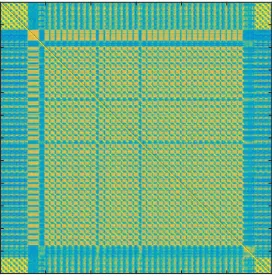
Fig. 6.Cross-correlation for second-order SubBytes. One can identify the 34 AND gates in the SubBytes circuit of Boyar et al. [11].
We verify that single faults on only values or only tags are detected uncondi-tionally when we bar the all-0s key. When a single-bit offset (fault) is inserted in a single tile in both the value and tag share, it is indeed detected in approximately 66% of the iterations. Inserting a single-bit offset in value share and a random-bit offset in tag share is a worse attack strategy and is detected in around 83% of the experiments. The same results hold when faults are inserted in up tod−1 tiles. When the value and tag shares in all dtiles are modified and fixed to a known value, the fault escapes detection with probability one, as expected.
6
Conclusion
In this paper, we introduced the first adversary model that jointly considers side-channels and faults in a unified and formal way. The tile-probe-and-fault
security model extends the more traditional wire-probe model and accounts for a more realistic and comprehensive adversarial behavior. Within this model, we developed the methodology CAPA: a new combined countermeasure against physical attacks. CAPA provides security against higher-order DPA, multiple-shot DFA and combined attacks. CAPA scales to arbitrary security orders and borrows concepts from SPDZ, an MPC protocol. We showed the feasibility of implementing CAPA in embedded hardware and software by providing proto-type implementations of established block ciphers. We hope CAPA provides an interesting addition to the embedded designer’s toolbox, and stimulates further research on combined countermeasures grounded on more formal principles.
Bilgin are postdoctoral fellows of the Fund for Scientific Research - Flanders (FWO) and Lauren De Meyer is funded by a PhD fellowship of the FWO. The work of Nigel Smart has been supported in part by ERC Advanced Grant ERC-2015-AdG-IMPaCT, by the Defense Advanced Research Projects Agency (DARPA) and Space and Naval Warfare Systems Center, Pacific (SSC Pacific) under contract No. N66001-15-C-4070, and by EPSRC via grants EP/M012824 and EP/N021940/1.
References
1. Advanced Encryption Standard (AES). National Institute of Standards and Tech-nology (NIST), FIPS PUB 197, U.S. Department of Commerce, Nov. 2001. 2. F. Amiel, K. Villegas, B. Feix, and L. Marcel. Passive and active combined attacks:
Combining fault attacks and side channel analysis. In L. Breveglieri, S. Gueron, I. Koren, D. Naccache, and J. Seifert, editors,FDTC 2007, pages 92–102. IEEE Computer Society, 2007.
3. J. Balasch, B. Gierlichs, O. Reparaz, and I. Verbauwhede. DPA, bitslicing and masking at 1 GHz. In G¨uneysu and Handschuh [31], pages 599–619.
4. G. Barthe, F. Dupressoir, S. Faust, B. Gr´egoire, F. Standaert, and P. Strub. Parallel implementations of masking schemes and the bounded moment leakage model. In J. Coron and J. B. Nielsen, editors,EUROCRYPT 2017, Part I, volume 10210 of LNCS, pages 535–566, 2017.
5. A. Battistello and C. Giraud. Fault analysis of infective AES computations. In W. Fischer and J. Schmidt, editors,FDTC 2013, pages 101–107. IEEE Computer Society, 2013.
6. D. Beaver. Precomputing oblivious transfer. In D. Coppersmith, editor, CRYPTO’95, volume 963 ofLNCS, pages 97–109. Springer, Heidelberg, Aug. 1995. 7. R. Bendlin, I. Damg˚ard, C. Orlandi, and S. Zakarias. Semi-homomorphic encryption
and multiparty computation. In Paterson [53], pages 169–188.
8. G. Bertoni, L. Breveglieri, I. Koren, P. Maistri, and V. Piuri. Error analysis and detection procedures for a hardware implementation of the advanced encryption standard. IEEE Trans. Computers, 52(4):492–505, 2003.
9. B. Bilgin, B. Gierlichs, S. Nikova, V. Nikov, and V. Rijmen. Higher-order threshold implementations. In P. Sarkar and T. Iwata, editors,ASIACRYPT 2014, Part II, volume 8874 ofLNCS, pages 326–343. Springer, Heidelberg, Dec. 2014.
10. D. Boneh, R. A. DeMillo, and R. J. Lipton. On the importance of eliminating errors in cryptographic computations. Journal of Cryptology, 14(2):101–119, 2001. 11. J. Boyar, P. Matthews, and R. Peralta. Logic minimization techniques with
applications to cryptology. Journal of Cryptology, 26(2):280–312, Apr. 2013. 12. J. Bringer, C. Carlet, H. Chabanne, S. Guilley, and H. Maghrebi. Orthogonal direct
sum masking - A smartcard friendly computation paradigm in a code, with builtin protection against side-channel and fault attacks. In D. Naccache and D. Sauveron, editors,WISTP 2014. Proceedings, volume 8501 ofLNCS, pages 40–56. Springer, 2014.
13. J. Bringer, H. Chabanne, and T. Le. Protecting AES against side-channel analysis using wire-tap codes. J. Cryptographic Engineering, 2(2):129–141, 2012.
![Table 2. Area (GE) of 2-share KATAN-32 implementations with m MAC keys α[j] ∈ Fq](https://thumb-us.123doks.com/thumbv2/123dok_us/7956146.1320076/20.612.163.451.583.664/table-area-ge-share-katan-implementations-mac-keys.webp)