© 2017, IJCSMC All Rights Reserved 64
Available Online atwww.ijcsmc.com
International Journal of Computer Science and Mobile Computing
A Monthly Journal of Computer Science and Information Technology
ISSN 2320–088X
IMPACT FACTOR: 6.017
IJCSMC, Vol. 6, Issue. 7, July 2017, pg.64 – 68
BIG DATA & HADOOP: A Survey
Rehana Hassan
1, Rifat Manzoor
2, Mir Shahnawaz Ahmad
31, 2
Student, Department of Computer Science Engineering, SSM College of Engg. & Tech., Kashmir, India
3
Assistant Professor, Department of Computer Science Engineering, SSM College of Engg. & Tech., Kashmir, India
1
[email protected], 2 [email protected], 3 [email protected]
Abstract— In today’s modern world, the availability of large number of online products like web-sites, web-portals, shopping sites, social networking sites, etc., give rise to a collection of extremely large and complex data sets known as Big Data. The analysis and processing of such an enormous volume of data in an efficient manner is a prime concern. Also, due the complex nature of Big Data it becomes very difficult to process using on-hand databases management tools. So, a specialized tool is required for processing Big Data, and one such tool is Hadoop. This paper presents a detailed overview of Big Data and finally describes an easy-to-use and highly scalable software framework, known as Map-Reduce framework, which is used to process Big Data.
Keywords— Big Data, Hadoop, Map-Reduce.
I. INTRODUCTION
Big data describes the large volume of data, it is a combination of huge datasets that can be handled using new techniques. Big data is not only containing data, it also contains various tools, techniques and frameworks. Data that has extra-large Volume, comes from Variety of sources like text, audio, video, xml files etc, Variety of formats and comes at us with a great Velocity is normally referred to as Big Data. Big data can be structured, unstructured or semi-structured. Big data that hold the data generated by various equipment and applications like Black box.
© 2017, IJCSMC All Rights Reserved 65 II. BIG DATA & ITS PARAMETERS
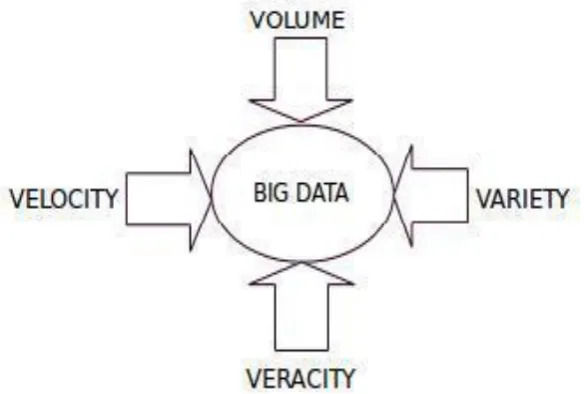
As the data is bigger from different sources in different form, it is represented by the 4 V’s [2]:
Volume: Ratio of data or huge amount of data develops in every second. Machine develop data are examples for these components. Nowadays data volume is increasing very quickly from gigabytes to peta-bytes.
Velocity: Velocity is the speed at which data is developing and processed. For example facebook, google, twitter etc Variety: Variety is important characteristic of big data. It is a type of data. Data can be in different styles such as Text,
numerical, xml files, application programs, images, audio, video data. On facebook more than 2 billion people are sharing files, photos, txt, videos, audio,
Veracity: Veracity means accuracy or anxiety of data. Data is uncertain due to the inconsistency and in completeness.
Fig. 1: Four – V’s of BIG DATA
A. The Challenges with Big Data
1.
Heterogeneity and Incompleteness: If we want to evaluate the data, it should be structured data but when we deal with the Big Data, then data may be structured or unstructured as well. Heterogeneity is the big challenge in data analysts and Analysis need to cope with it [3]. Suppose an example of patient in Hospital. We will create each record for each medical test. And we will also generate a record for hospital stay. This will be not equal for all patients. This design is not well structured. So managing with the Heterogeneous and incomplete is required. A good data analysis can be applied to this.2. Privacy: Privacy of data is another huge concern that increases in the context of big data. In some countries there are strict laws about the data privacy, for example in USA there are strict law for health records, but for others it is less forceful. For example in social media we cannot get the private posts of users for sentiment analysis.
3. Scale: Big Data is having very hu
ge size of data sets. Managing
large and rapidly increasing volumes of data has beena challenging issue for many decades. In past years, this problem has been solved by the processors getting faster but now data quantity is becoming large and processors are static. World is moving towards the Cloud technology, due to this shift data is generated in a very high rate [3]. This high rate of increasing data is becoming a challenging problem to the data analysts. Hard dis
ks are used for storage of data
. They are slower I/O performance. But now Hard Disks are replaced by the solid state drives and other technologies.© 2017, IJCSMC All Rights Reserved 66
B. Opportunities to Big Data
1. Media: Media is using big data for the boost and sale of products by focus the interest of the user on internet. For example social media posts, data analysts get the number of posts and then evaluate the interest of user. It can also be done by taking the positive or negative reviews on the social media.
2. Government: Big data can be used to handle the issues faced by the government. Obama government declared big data research and development initiative in 2012 [4]. Big data analysis played an important role of BJP winning the elections in 2014 and Indian government is implement big data analysis in Indian electorate.
3.
Technology: Almost each top organization like Facebook and yahoo has adopted Big Data and are spending on big data. Facebook holds 50 Billion photos of users. Every month Google holds 100 billion searches. From this one can say that there are a lot of opportunities on internet and social media.4. Science and Research: Big data is an up-to-the-minute topic of research. Large number of Researchers is working on big data [4]. There are so many papers being published on big data.
5.
Healthcare: According to IBM Big data for Healthcare, 80% of medical data is unstructured. Healthcare organizations areadapting big data technology to grab the complete data about a patient. To boost the healthcare and low down the cost big data analysis are needed and certain technology should be adapted.
III.TECHNIQUES AND TECHNOLOGIES FOR BIG DATA
For the purpose of processing the large amount of data, the big data requires exceptional technologies. The various techniques and technologies have been introduced for manipulating, analyzing and visualizing the big data. There are many solutions to handle the Big Data, but the Hadoop [5] is one of the most widely used technologies.
A. Hadoop
Hadoop is a programming framework user to support the processing large data sets in a disturbed computing environment. It is an open source project hosted by Apache Software Foundation. It consists of various small sub projects which belong to the category of infrastructure for distributed computing. Hadoop was the name of a yellow toy elephant owned by the son of one of its inventors. Hadoop mainly consists of:
1. File System (The Hadoop File System) .
2. Programming Paradigm (Map Reduce) [6].
© 2017, IJCSMC All Rights Reserved 67
B. Hadoop Distributed File System
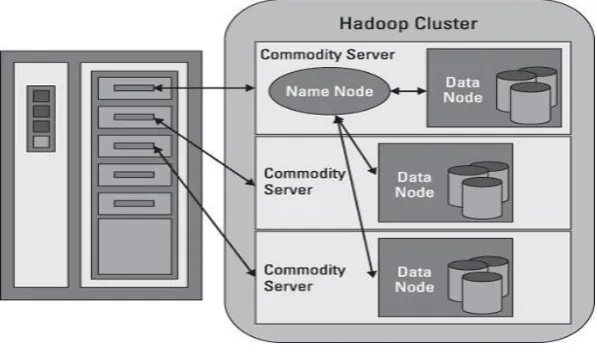
Fig. 2: HDFS Architecture
HDFS stands for Hadoop Distributed File System. The Hadoop Distributed File System is a versatile, clustered way to handling files in a big data environment. It includes a fault-tolerant system HDFS is able to store hug
e amounts of
information. HDFS, i
t is a kind of data service that offers a different set of capabilities required when data volumes and velocity are high.HDFS manages storage on the cluster by breaking incoming files into pieces called blocks. The blocks are stored on data nodes to notice what blocks on which data nodes make up the complete file.
The Name Node also performs as a “traffic cop,” handling all access to the files. The entire collection of all the files in the cluster is sometimes referred to as the file system namespace. Even though a strong relationship occurs between the Name Node and the data nodes, they run in a “loosely coupled” fashion. This allows the cluster elements to act dynamically. The data nodes communicate among themselves so that they can cooperate during normal file system operations. This is mandatory because blocks for one file are likely to be stored on multiple data nodes.
C. Map Reduce
Map-The Function takes key or value pairs as input and generates an intermediate set of key or value paris. Reduce- The Function which merges all the intermediate values associated with the same intermediate key [7]. Map-Reduce is an implementation of the algorithm developed and managed by the Apache Hadoop project. Hadoop Map Reduce consists of many stages, each with a meaningful set of operations helping to get the answers you need from big data. The development starts with a user request to run a Map Reduce program and go on until the results are written back to the HDFS.
© 2017, IJCSMC All Rights Reserved 68
a. Get the Big Data Ready
When a client requests a Map Reduce program to run, the first step is to discover and study the input file. The file pattern is totally arbitrary, but the data must be changed to something the program can process [8]. This is the activity of Input Format and Record Reader. Input Format chooses how the file is going to be broken into smaller pieces for processing using a function called Input Split. It then assigns a Record Reader to transform the raw data for processing by the map. Different types of Record Readers are supplied with Hadoop, offering a wide variety of conversion options.
b. Let the Big Data Map Begin
Your data is now in a mode tolerable to map. For all input pair, a specific instance of map is called to process the data for each input pair. Map and reduce need to perform together to process your data, the program needs to gather the output from the separate map and pass it to the reducers. This task is done by an Output Collector. A Reporter function also present information collected from map tasks [9]. This entire task is being done on multiple nodes in the Hadoop cluster simultaneously. After all the map tasks are complete, the common results are collected in the partition and a shuffling occurs, sorting the output for excellent processing by reduce.
c. Reduce and combine for big data
For each output pair, reduce is called to do its task. In similar pattern to map, reduce collect its output while all the functions are processing. Reduce can’t begin as far as all the mapping is done. The output of reduce is also a key and a value. Hadoop provides an Output Format feature, and it performs very much like Input Format. Output Format takes the key-value pair and formulates the output for writing to HDFS. The last task is to actually write the data to HDFS. This is done by Record Writer, and it performs similarly to Record Reader except in reverse. It takes the Output Fo
rmat data and writes it to HDFS [10].
IV.CONCLUSION
The paper describes the concept of Big Data along with 4 V’s, Volume, Velocity, variety veracity of big data. The paper also focuses on Big Data processing problems. These challenges must be addressed for good and fast processing of Big Data. The challenges include not just the obvious issues of scale, but also heterogeneity, lack of structure, error-handling, privacy, timeliness, , and visualization at all stages of the analysis pipeline from data acquisition to result interpretation.
The paper describes Hadoop which is an open source software used for processing of Big Da. That’s where Hadoop has become one of the enabling data processing technologies for big data analytics. Hadoop allows companies to store and manage far larger volumes of structured and unstructured data than can be managed by relational database management systems
R
EFERENCES
[1] S.Vikram phaneedra & E.Madhusudhan Reddy, “Big data-solutions for RDBMS- A survey” in 12th IEEE/IFIP Network operations & management symposium (NOMS 2010) (Osaka,Japan,Apr 19 2013 ).
[2] Kiran kumara Reddi & Dnvsl Indra “Different technique to transfer Big Data; survey” IEEE Transations on 52(8) (Aug.2013).
[3] Bernice Purcell “The emergence of “big data” technology and analytics” Journal of Technology Research 2013.
[4] Albert Bifet “Mining Big Data In Real Time” Informatica 37 (2013) 15–20 DEC 2012. [5] Jimmy Lin “Map Reduce Is Good Enough?” The control project. IEEE Computer 32 (2013).
[6] Kenn Slagter · Ching-Hsien Hsu “An improved partitioning mechanism for optimizing massive data analysis using MapReduce” Published online: 11 April 2013
[7] Ahmed Eldawy, Mohamed F. Mokbel “A Demonstration of Spatial Hadoop: An Efficient MapReduce Framework for Spatial Data”, Proceedings of the VLDB Endowment, Vol. 6, No. 12 Copyright 2013 VLDB Endowment 21508097/13/10.
[8] Jeffrey Dean and sanjay Ghemawat “Map Reduce; Simplified Data Processing on Large Clusters” OSDI 2010. [9] http://www.tutorialspoint.com/Hadoop