COMPARATIVE ANALYSIS OF THERMO-ELASTIC
PROPERTIES OF ZINC OXIDE NANOMATERIALS
AT HIGH TEMPERATURES
Krishna Chandra
1, Mahipal Singh2, Luv Kush3 and Madan Singh4
1,2,3
Department of Physics, R.H. Govt. P. G. College, Kashipur, Uttarakhand, India-244713
4Department of Physics and Electronics, National University of Lesotho, Roma 180, Lesotho
ABSTRACT
In the present work, a comparative analysis of thermo-elastic properties like volume thermal expansion, thermal
expansivity, isothermal bulk modulus of zinc oxide nanomaterials (w-ZnO and rs-ZnO) at high temperatures has
been done. For the comparative analysis of thermo-elastic properties of n-ZnO materials at high temperatures,
various expressions and equation of states established by various workers have been used and the results
obtained are comparatively analyzed.
Keywords: Analysis, Nanomaterials, Thermo-Elastic Properties, Temperature
PACS: 61.46.Fg, 62.25.+g, 64.30.+t
I INTRODUCTION
Potential of nanomaterials is immense and encompasses virtually every field of life. The technologist and
researchers all across the globe have realize this and call these materials of the future. The nanomaterials are
expected to be the turning point of the next technological revolution in solid state electronics and to have a
considerable impact practically in all domains of science. The nanomaterials are very sensitive to external
parameter like temperature. The study of nanomaterials under high temperature provides possible path to expand
the range of available solid state materials. High temperature applications have the potential for the exploration
of infinity of paths for nano assembling in a controlled way and constitute a unique root for the elaboration of
new materials. The physical properties of nanomaterials depend strongly on the structure and interatomic
distances.
The study of nanocrystalline materials with dimensions less than 100 nanometer(nm) in an active area of
research in Physics, Chemistry and Engineering as they provide vital information on their intrinsic
microstructure characteristics. Nanocrystal have large surface to volume ratio and surface effects take on a
significance that is normally inconsequential for bulk materials One of the main area of scientific interest of
nanocrystalline material is their thermodynamic properties because their stability and their atomic interactions
are related in complex ways to their mechanical properties. Recently, Zinc Oxide nanomaterial has attracted
much attention within the scientific community as ‘future material’. The behavior of thermo-elastic properties of
n-ZnO materials under the effect of temperature has attracted the attention of the theoretical as well as the
somewhat of a misnomer, as zinc oxide has been widely studied since 1935[1] with much of
our current industry and day-to–day lives critically reliant upon this compound. The renewed interest in this
material has arisen out of the development of growth technologies for the fabrication of the high quality single
crystal and epitaxial layers, allowing for the realization of ZnO-based electric and optoelectronic devices.
Zinc Oxide (ZnO) nanomaterials belong to the family of wide-band gap semiconductors with strong ionic
character of chemical bonds. At ambient conditions ZnO has wurtzite structure (P63mc, w-ZnO) that transforms
into rock-salt one (Fm3m, rs-ZnO) at high pressure above about 5GPa[2,3]. Upon pressure release rs-ZnO
reverts back to wurtzite phase [4]. Recently, it has been shown that nano-crystallline rs-ZnO synthesized at high
pressures and high temperatures can be completely recovered at normal conditions. ZnO exhibits intersesting
morphologies and structure such as nanorods[5], nanotubes[6], nanorings[7], nanowires[8], pencil-like[9],
whisker[10] tetrapots[11], nano-niddle and nanoflowers[12]. In contrast to the corresponding bulk counter parts,
nanostructured ZnO has enhanced electric and photoconducting properties. Nanometer scale sample with well-
controlled shapes have been successfully fabricated and they are potentially great candidates for nano devices
like field effect transistors and gas sensors [13, 14].
Zinc Oxide nanomaterial is one of the most important and widely used materials. Some experimental scientists
and theoreticians have studied the thermo-elastic properties of n-ZnO. In 1999, Petr et al.[15] studied the
thermal expansion of rock-salt ZnO, metastable high pressure phase experimentally in 10 to 300K temperature
range at ambient pressure using synchrotron X-ray powder diffraction. The volume thermal expansion
coefficient is found to increase from almost zero volume in 10-80K range to 4.77x10⁻⁵K-1 at 298 K and remains virtually constant at higher temperatures. In 2005, Seelaaboyina et al.[16] studied the behavior of thermo-elastic
constants under the effect of temperatuture for n-ZnO. He found that thermal expansivity and volume thermal
expansion increases with temperatuture and isothermal bulk modulus decreases with temperature. In 2011,
Solozhenko et al.[3] observed that the volume thermal expansion coefficient of ZnO increases with high rate
with increase in temperature.
There are also so many theoretical studies on thermo-elastic properties of n-ZnO materials. In 2008, Jeevan
Chandra et al. [17] studied thermal properties of n-ZnO using integral form of equation of state proposed by
Singh and Gupta[18] assuming the fact that Anderson-Gruneisen parameter is strongly dependent on
temperature. They analyzed the variation of thermal expansion coefficient, volume thermal expansion and
relative bulk modulus with temperature and found that integral form of equation of state successfully explain the
thermo-elastic properties of nanomaterials. Very recently, Mahipal Singh[19] studied the temperature
dependence of isothermal bulk modulus of Zinc Oxide nanomaterials. For this purpose he used a modified linear
relationship between isothermal bulk modulus and temperature He calculated the variation of isolated bulk
modulus for zinc oxide nanomaterials(rock-salt phase and wurtzite phase ) in the temperature range from 300K
to 1800K and found that the isothermal bulk modulus decreases with raising the temperature almost linearly for
both rs-ZnO and w-ZnO and the rate of decrease of isothermal bulk modulus almost same for both phases.
In 2013, Singh and Singh [20] has studied the thermal expansion of rock salt and wurtize phases of ZnO
nanomaterials using various relationship between volume thermal expansivity and temperature in low and high
temperature ranges. They observed that in low temperature range i.e. up to room temperature volume thermal
temperature range, thermal expansion coefficient increases with high rate with increase in temperature in the
case of rs-ZnO and with slow rate in the case of w-ZnO.
Sufficient experimental as well as theoretical studies on temperature dependence of thermo-elastic properties of
ZnO are still lacking. A lot of work is required in this direction because of numerous applications of ZnO.
Therefore, it is planned to study the thermo-elastic properties-Volume thermal expansion, thermal expansivity
and Isothermal bulk modulus of n-ZnO materials under the effect of temperature
.
II THEORETICAL FORMULATION
The expression for temperature dependence of relative volume thermal expansion (V/V0) is given by Fang [21]
as follows-
= 1- . ... (1)
where T0 is the reference temperature, α0 is volume thermal expansivity at room temperature, δT 0
is
Anderson-Guneisen parameter at room temperature, V0 is the initial volume and V is the volume at temperature T.
Kumar and Upadhyaya [22] derived the expression for V/V0 as-
= ... (2)
where α0 is volume thermal expansivity and other symbols have their usual meanings.
It has been noted that under effect of temperature, the product of thermal expansion coefficient ( and bulk
modulus (K) remains constant [23]. i.e.
K= constant ...(3)
Differentiating equation (1) with respect to volume V at constant pressure P:
(dK/dV)P =-(d /dV)PK ...(4)
which yields = ( )P
= - ( )P (using equation (4))
or ( )P =- K ...(5)
where is known as Anderson-Gruneisen parameter at temperature T which is basically a measurement of
anharmonicity in a crystal.
A linear relationship between bulk modulus (K) and temperature (T) has been reported by Fang[21] in the
following way:
KT = K0[1- 0 (T-T0)] ...(6)
where K, K0, 0 and are isothermal bulk modulus at temperature T, isothermal bulk modulus at T=T0 i.e at
room temperature (reference temperature), volume thermal expansion coefficient at room temperature and
Anderson-Gruneisen parameter at T=T0.
(dK/dT)P=-K0 0 ...(7)
From equations (5) and (7) ,we get-
=
or = dT ...(8)
Anderson –Gruneisen parameter has been expressed as[24, 25]
...(9)
Using equations (6) and (9),the equation (8) takes the form as-
= ...(10)
Integrating equation (10), we get-
= ...(11)
On rearranging the terms, we get
= dT ...(12)
where
The above equation (12) is recently established Integral form of Equation of state (IFEOS) for volume thermal
expansions for solids and nanocrystals known as Singh and Singh equation of state for volume thermal
expansion[26]. There are so many expressions for the volume thermal expansivity of nanomaterials. Singh and
Chauhan[27] have presented the following relationship for thermal expansivity as-
...( 13)
where all the symbols have their usual meanings.
Kumar and Upadhyaya[22] derived the expression for thermal expansivity for nanomaterials
as- = α0 [1- δT (T-T0)]-1 ...(14)
where all symbols have their usual meanings.
Chuanhui Nie et al.[24] expressed the expression for δT as –
δT = [1- ln{1- (T-T0)}] ...(15)
Putting for δT in equation (14), we have
= [1- {1- ln{(1- (T-T0)}}(T-T0)]-1 ...(16)
The variation of thermal expansion coefficient of nanomaterials with temperature is given by Sorot et al. [28]
as-
= ( ) [1-α0 (T-T0)]
-1 ...
(17)
This equation can be used straightforward to calculate thermal expansion properties of nanocrystals.
To calculate isothermal bulk modulus of nanomaterials, many expressions are available in the literature. A linear
relationship to show the variation of isothermal bulk modulus with respect to temperature has been reported by
KT = K0 [1- 0 (T-T0)] ...(18)
where K0 is isothermal bulk modulus at room temperature(T0), is Anderson-Gruneisen parameter at
reference temperature(T0) and α0 is thermal expansivity at room temperature(T0).
Singh and Chauhan[27] have presented relationship between isothermal bulk modulus and temperature as-
KT =K0 [1-1.06 α0 (T-T0)] ...(19)
where all the symbols have their usual meanings.
Chuanhui Nei et al.[24] established the following expression for temperature dependence of isothermal bulk
modulus –
KT=K0 exp[-α0 (T-T0){1+c1(T-T0) +c2(T-T0)2+c3(T-T0)3}] ...(20)
where , , ,
b1=1.45x10⁻⁴ K-1 and b2=5.40x10⁻⁷ K-2
Using equations (1), (2), (12); equations (13), (16), (17) and equations (18), (19) and (20), we have made the
comparative analysis of volume thermal expansion, thermal expansivity and isothermal bulk modulus of rs-ZnO
and w-ZnO nanomaterials.
III RESULTS AND DISCUSSION
Using equations (1), (2) and (12) the values of thermal expansion (V/V0) for both the phases of ZnO
nanomaterials have been calculated in the temperature range from room temperature to 2100K. The input
parameter used in the present work have been given in the table-
Table1: Input parameters used in computations
[29, 30, 31, 32, 33, 34]
Nanomaterials α0(K-1) K0(GPa)
rs-ZnO 4.7X10⁻⁵ 5.5 24
w-ZnO 1.57x10⁻⁵ 5.5 24
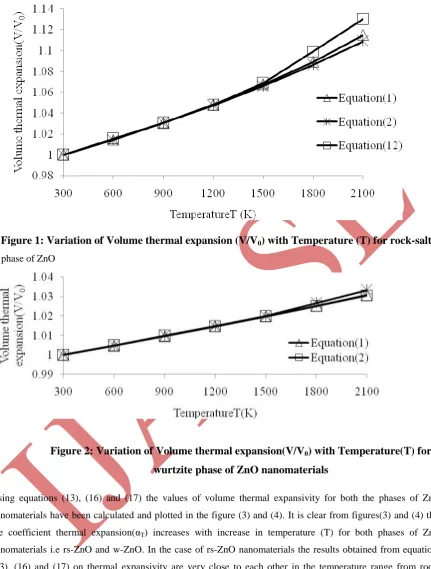
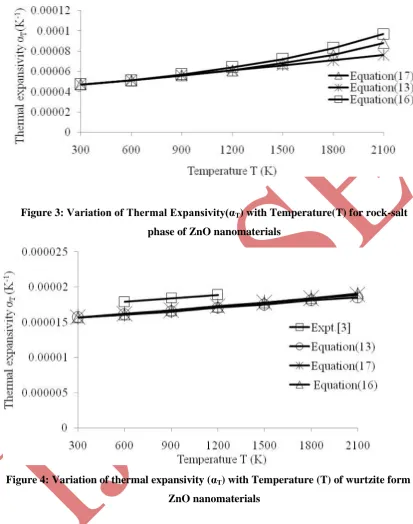
The theoretical results on volume thermal expansion (V/V0) obtained for rs-ZnO and w-ZnO are reported in
figure (1) and figure (2) respectively. It is obvious from figure (1) that for rs-ZnO nanomaterials, volume
thermal expansion increases with temperature. Obviously the results obtained from equations (1), (2) and (3) are
in good agreement with each other but at high temperature (greater than 1500K) equation (12) shows some
deviation from equations (1) and (2). Similarly from figure (2), it is clear that in the case of w-ZnO nanorods,
Figure 1: Variation of Volume thermal expansion (V/V
0) with Temperature (T) for rock-salt
phase of ZnO
Figure 2: Variation of Volume thermal expansion(V/V
0) with Temperature(T) for
wurtzite phase of ZnO nanomaterials
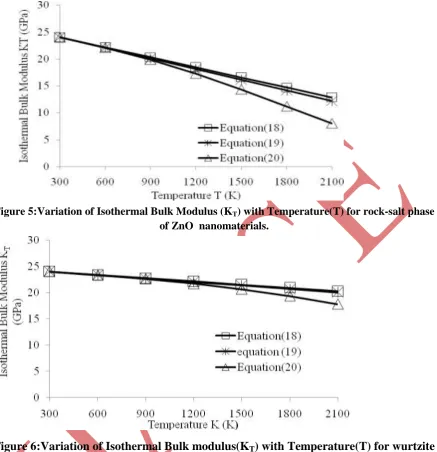
Using equations (13), (16) and (17) the values of volume thermal expansivity for both the phases of ZnO
nanomaterials have been calculated and plotted in the figure (3) and (4). It is clear from figures(3) and (4) that
the coefficient thermal expansion(αT) increases with increase in temperature (T) for both phases of ZnO
nanomaterials i.e rs-ZnO and w-ZnO. In the case of rs-ZnO nanomaterials the results obtained from equations
(13), (16) and (17) on thermal expansivity are very close to each other in the temperature range from room
temperature(300K) to 900K but at higher temperatures the variation of thermal expansivity(αT) with temperature
deviates. But in the case of w-ZnO nanomaterials, the theoratical results obtained from equations (13), (16) and
(17) on thermal expansivity(αT) are in very good agreement with each other and also with experimental results
obtained by Solozhenko et al.[3] The values of isothermal bulk modulus have been calculated as a function of
temperature using equations (18), (19) and (20) for both the phases of ZnO nanomaterials in the temperature
Figure 3: Variation of Thermal Expansivity(α
T) with Temperature(T) for rock-salt
phase of ZnO nanomaterials
Figure 4: Variation of thermal expansivity (α
T) with Temperature (T) of wurtzite form of
ZnO nanomaterials
The figures (5) and (6) demonstrate the variation of isothermal bulk modulus with temperature for rs-ZnO and
w-ZnO nanomaterials. It is obvious from figures that the isothermal bulk modulus decreases with increase in
temperature almost linearly for both rs-ZnO and w-ZnO nanomaterials. From figure (5), it is clear that the
results on isothermal bulk
modulus obtained from equations (18) and (19) are in close agreement
while the equation (20) shows the variations with different rate of decrease in the case of
Figure 5:Variation of Isothermal Bulk Modulus (K
T) with Temperature(T) for rock-salt phase
of ZnO nanomaterials.
Figure 6:Variation of Isothermal Bulk modulus(K
T) with Temperature(T) for wurtzite
phase of ZnO nanomaterials
.
Our theoretical analysis may stimulate the experimental Scientists for the measurement of
variation of thermo-elastic properties for n-ZnO materials in the future.
IV CONCLUSION
In the present work we have made the comparative analysis of thermo-elastic properties of Zinc Oxide
nanomaterials. For the comparative analysis of thermo-elastic properties- volume thermal expansion, thermal
expansivity and isothermal bulk modulus of rs- ZnO and w-ZnO, various equations established by many
researchers have been used. The theoretical results obtained from various equations are found in good
agreement with each other but at high temperature, some results on thermo-elastic properties deviate. Our
theoretical analysis may stimulate the experimental scientists for the measurement of thermo-elastic properties
REFERENCES
[1] C.W. Bunn, Proc. Phys. Soc. London 47, 835(1935)
[2] K. Kusaba, Y.Syono, T. Kikegawa, Proc. Jpn. Acad. B 75, 1(1999)
[3] V. L. Solozhenko, O. O. Kurakevych, P. S. Sokolov, A. N. Baranov, J. Phys. Chem. A 115, 4354(2011)
[4] F. Decremps, F. Datchi, A. M. Saitta, A. Polian, S.Pascarelli, A. Di Cicco, J. P.Itié, and F.Baudelet.,Phys.
Rev. B. 68, 104101(2003)
[5] B. Liu and H. C. Zeng, J. Am. Chem. Soc., 125, 4430(2003)
[6] X.Ren, C.H.Jiang, D.D. Li and L.He, Mater Lett. 62, 3114(2008)
[7] W. L. Hughes and Z. L. Wang, Appl. Phys. Lett. 86, 043106(2005)
[8] L. E. Greene, B. D. Yuhas, M. Law, D. Zitoun and P. Yang, Inorg. Chem. 45, 7535(2006)
[9] H. Hou, Y. Xiong and Y. Xie, J. Solid State Chem. 177, 176(2004)
[10] C. X. Xu, X. W. Sun and B. J. Chem, Nanotech., 16, 70(2005)
[11] C. X. Langfeng, J. Dongli, A. B. Djurisic and Y. H. Leung ,Chem. Phys. Lett., 401, 426(2005)
[12] X. H. Sun, S. Lamand, T.K.Sham, J. Phys. Chem B 109, 3120(2005)
[13] Z. L. Wang, J. Song, Science, 312, 242(2006)
[14] X. Y. Kong, Y. Ding , R. Yang , Z. L. Wang, Science, 303, 1348(2004)
[15] PetrS. Sokolov, Andrey N. Baranov, Anthony M.T.Bell and Vladimir L.Solozhenko, Proc. Jpn. Acad. B,
75, 1(1999)
[16] R.Seelaboyina, N. Phatak, R.P. Gulve, H. P. Leimann and S.K.Saxena, Thermal conductivity 27,
647(2005)
[17] Jeevan Chandra, Deepika Kandpal and B.R.K.Gupta, High temp-high press, 37, 325(2008)
[18] K. Y. Singh, and B. R. K. Gupta Physica B, 334(2003)
[19] Mahipal Singh, International Journal of Adv. Research in Science and Engg., 2(10), 109(2013)
[20] Mahipal Singh and Madan Singh, Nanoscience and Nanotechnology Research, 1(2), 27(2013).
[21] Z H Fang, Physica B, 357, 433(2005).
[22] M. Kumar and S. P. Upadhyay, Phys. Status Solidi B 181, 55(1994)
[23] O. L. Anderson and Zou K, Phys, Chem, Miner, 16, 642(1989).
[24] Chuanhui Nie, S. Huan0g and W. Huang, Applied Phys. Research, 2(1), 144(2010)
[25] Mahipal Singh, International Journal of Phys.& Research, 3(4), 55(2013).
[26] Mahipal Singh and Madan Singh, American Journal of Nanomaterials, 2(2), 26(2014)
[27] K. S. Singh and R. S. Chauhan, Physica B 315, 74(2002).
[28] Neetu Sorot, Monika Goyal and B. R. K. Gupta, Nano Vision, 3(2), 62(2013)
[29] O. L. Anderson, Equation of state for geophysics and ceramic Science, Oxford University Press, Oxford,
(1995 )
[30] X. Wu, Z. Y. Wu, L. Guo, C. Liu, J. Liu, and X. D. Li solid state comm. 135, 780(2005)
[31] R. Kumar and Munish Kumar, Indian Journal of Pure and Applied Phys. 51, 87(2013)
[32] A. Seko, F. Oba, A. Kuwabara and I. Tanaka, Phys. Rev. B 72, 02410(2005)
[33] D. Taylor, materials, Br. Ceram. Trans.83, 5(1984)