EFFECT OF AUTHENTIC CHEMISTRY PROBLEM SOLVING COMPETENCY IN SOLVtNG OPEN-ENDED PROBLEMS
SURAIYA B1NTIHAJI MUHAMAD
A thesis submitted in fulfilment o f the requirements for the award of the degree of Doctor o f Philosophy (Chemistry Education)
Facutty o f Education Universiti Teknotogi Malaysia
To my dearest supportive husband, Mohd Nor bin C. Lah &
iv
A C K N O W L E D G E M E N T S
As ! devote this moment to the Almighty Altah for His blessings through this journey. ! would like to express my gratitude and thank each and every individual who involved directly and indirectly in this research. Without them, this study could not have been carried through to a successful completion.
I would like to express my sincere heartfelt thanks and appreciation to my supervisors, Associate Professor Dr. Jamalludin Harun, Dr. Johari Surif and Dr. Noor Dayana Abd. Halim for their full support and guidance throughout this journey. My deepest thanks to all lecturers and staffs in Faculty of Education, UTM Johor Bahru, especially to our dedicated dean, Prof. Dr. Baharudin Aris, Associate Prof. Dr. Azlina Kosmin, Associate Prof. Dr.Nor Affandy Yahya, Dr. Corienna Abd. Talib, Dr. Rohaya Talib and Dr. Norhasniza Ibrahim.
My sincere thanks and appreciation to Dr. Hajah Norisah Suhaili, Mr. Syahrul Azinar bin Abdul Rahman, Miss Nurhidayatul Aliaa, Mr. Ismaili bin Morshidi, Miss Amira Nadia Hj. Bokhari, Mdm. Nur Nui Nadia bt Sadri Sham and Mdni. Nordalina binti Ismail of Sekolah Menengah Sains Kuching Utara for their assistance, cooperation , advices and views in ensuring smooth progress of this research. Bundle of thanks to my Synergy group (KPM-UTM) for the great togetherness in this adventure journey especially to Siti Salbiah Omar, Suhaimi, Hafzan Ibrahim, Rohani, Latifah, Nor Delyliana and Mohd Mokhzani.
It is also my indeed pleasure to offer my salutations to all other parties including administrators, teachers and the participants of this study who have rendered a tremendous degree of help, assistance and support in this research. ! would also like to thank Nuraqeelah Md. Shamhari, Emi Syafini Mazuki, Jasriati binti Adi, Nurul Nadzirah Yusman, Muhammad Umar Khan, Usman Ahmad and Murad Tariq for their loyal commitment during the journey.
ABSTRACT
vi
ABSTRAK
vii
TA BLE O F CO N TEN TS
C H A P T E R T IT L E PA G E
D EC LA R A TIO N ii
D ED IC A TIO N iii
A C K N O W LE D G E M E N TS iv
A B STR A C T v
A B STR A K vi
TA BLE O F C O N TEN TS vii
L IS T O F TA BLES xiv
L IS T O F FIG U R ES xix
L IS T O F A B R EV IA TIO N xxii
L IS T O F A PPEN D IC ES xxiii
1 IN T R O D U C TIO N 1
1.1 Introduction 1
1.2 Research Background 3
1.2.1 Problem Solving o f Open-Ended Problems 4 1.2.2 Problem Solving Competency in Chemistry 5 1.2.3 Students' Difficulties in Chemistry Problem
Solving 6
1.2.4 Potential o f Authentic Learning for Chemistry
Problem Solving Competency 10
1.2.5 Model o f Problem-solving Instruction 12
1.3 Problem Statement 14
1.4 Research Objectives 15
1.5 Research Question 16
viii 1.6.1 Problem Solving Instruction Model
(SSCS Model) 18
1.6.2 Authentic Learning Model 19
1.6.3 PISA 2012 Science Framework 21
1.6.4 Needham 's Five Phase Constructivist Model 22
1.7 Research Conceptual Framework 24
1.8 Research Rationale 25
1.9 Significance of the Study 27
1.9.1 Curriculum Development Centre, Malaysian
M inistry of Education 28
1.9.2 The Global Principals 28
1.9.3 The Teachers in School 29
1.9.4 The Secondary School Students 29
1.10 Research Scope and Limitation 29
1.11 Operational Definition 30
1.11.1 Problem-Solving Competency 30
1.11.2 Authentic learning practice 31
1.11.3 Open-ended Problems 31
1.11.4 Problem Solving Skills 32
1.11.5 Problem Skills Ability 32
1.11.6 Authentic Chemistry Problem Solving
Competency 33
1.12 Summary 33
2 L IT E R A T U R E R E V IE W 34
2.1 Introduction 34
2.2 Foundation of Authentic Learning 34
2.3 Chemistry Problem Solving Competency 42
2.4 Needham 's Five Phase Constructivist Model 45
2.5 Review on Open-ended Problem 47
2.6 Problem Solving Model 51
2.7 Problem Solving Instruction Model 52
Solving Instructions 53 2.8 Review o f Literature on Problem Solving in Chemistry 56 2.9 Difficulties in Learning Electrochemistry 60
2.10 Summary 61
3 R E SE A R C H M ET H O D O L O G Y 62
3.1 Introduction 62
3.2 Research Design 62
3.3 Research Procedure 64
3.3.1 Phase 1 : Analyze 66
3.3.2 Phase 2 & 3 : Design and Development of
Instructional and Learning Module (MAC-PSC) 67 3.3.3 Phase 4 : Implementation o f Module (MAC-PSC) 68
3.3.4 Phase 5 : Evaluation 71
3.4 Population 73
3.5 Research Instrument 78
3.5.1 Chemistry Problem Solving Ability Test 1
(CPSAT I) 79
3.5.2 Chemistry Problem Solving Skills Questionnaire
(CPSSQ) 83
3.5.3 Interview Session 1 86
3.5.4 Pre and post tests (CPSAT II and III) 88
3.5.5 Interview Session II 91
3.5.6 E-reflection Grid 92
3.5.7 Rubric o f Real Life Tasks 93
3.5.8 Interview Session III 95
3.6 Pilot Study 97
3.6.1 Pilot Study : Phase 1 for Test (CPSAT) and 97 Questionnaire (CPSS)
3.6.2. Pilot Study : Phase 2 for module (MAC-PSC) 98
3.7 Data Collection Procedures 98
3.7.1 Quantitative Data Collection 99
3.7.2 Qualitative Data Collection 100
x
3.8 Data Analysis Procedures 101
3.8.1 Analysis o f level o f Chemistry problem-solving
ability and skills o f school students 102 3.8.2 Analysis to determine to process and underlying
factors to solve open-ended problem in
Chemistry 103
3.8.3 Analysis o f the students' performance in Chemistry problem solving ability to solve the open-ended problems after implementation o f Module o f Authentic Chemistry Problem
Solving Competency (MAC-PSC) 107
3.8.3.1 Descriptive analysis 107
3.8.32 Inferential analysis 107
3.8.4 Analysis on how students develop their problems solving competency in authentic learning practice to solve open-ended problem in real life tasks 109
3.9 Ethical Considerations 110
3.10 Summary 110
4 PR E L IM IN A R Y STUDY 112
4.1 Introduction 112
4.2 Preliminary Study 112
4.2.1 Demography 113
4.3 Level o f Chemistry problem-solving ability and skills
among school students 114
4.3.1 Analysis o f Level o f Chemistry Problem-Solving Ability and Skills Among School Students 114 4.3.2 Chemistry Problem Solving Skill to Solve
Open-ended Problems in Learning Chemistry 117 4.4 Process and Underlying Factors to Solve Open-ended
Problems in Learning Chemistry 120
5 D ESIG N AND D EV E LO PM EN T O F TH E M O D U LE 134
5.1 Introduction 134
5.2 The ADDIE model 135
5.3 Development methodology 136
5.3.1 Analysis phase 137
5.3.1.1 Analysis of content 137
5.3.1.2 Analysis o f users 138
5.3.2 Design Phase 140
5.3.3 Development Phase 144
5.3.3.1 Development Module 145
5.3.3.2 Constructivist Learning Theory
in the module 146
5.3.33 Formative evaluation : Expert 164
5.3.4 Implementation Phase 169
5.3.5 Evaluation Phase 170
5.4 Module o f Authentic Chemistry Problem Solving
Competency (MAC-PSC) 170
5.5 Summary 171
6 RESU LTS AND FIN D IN G S 172
6.1 Introduction 172
6.2 Students' performance in chemistry problem solving ability to solve the open-ended problems after implementation o f Module o f Authentic Chemistry
Problem Solving Competency (MAC-PSC) 173
6.2.1 Introduction 173
6.2.2 Demography: Gender 173
6.2.3 Descriptive analysis 174
6.2.4 Inferential analysis 175
6.2.5 Performance in Chemistry Problem Solving
Ability (Interview Session) 185
6.3 Development o f chemistry problem solving competency in authentic learning practice to solve open-ended
problem 194 6.3.1 Development o f PSC Based On Achievement
o f Real Life Tasks 196
6.3.2 Reflection Grid : How to develop problem solving competency by solving real life task
(RLT) 209
6.3.3 Key Elements to Develop Problem Solving
Competency Analysis Interview Session 3 222
6.4 Summary 251
7 DISCUSSIONS, IM PL IC A T IO N S, R EC O M M EN D A TIO N S
AND CO N C LU SIO N 252
7.1 Introduction 252
7.2 Research Summary 252
7.3 Discussion 255
7.3.1 Current performance o f Chemistry problem
Solving ability CPSA among school students 255 7.3.2 Problem solving process to solve the
open-ended problem in learning electrolysis 260 7.3.2.1 Problem Solving Process 261 7.3.22 Underlying Factors to Solve
Open Ended Problems 262
7.4 The Effect o f "Module o f Authentic Problem Solving
Competency" on Student's Performance 267 7.4.1 Development o f Problem Solving Competency
For Open-Ended Problem 270
7.4.2 Development o f PSC based on Performance
in Real Life Tasks 270
7.4.3 Development o f Problem Solving Competency
Based on Students Practised and Experience 273
7.5 Recommendation for Future Studies 279
7.6 Conclusion 281
7.7 Summary 282
R E FE R E N C E S 284
Appendices A-N 300-340
xiv
L IS T O F TABLES
TA BLE NO. T IT L E PA G E
2.1 Development o f authentic learning studies 36
2.2 Key elements extracted from common previous studies ^ o f authentic learning themes (Rule, 2007)
2.3 The types o f problem (Johnston, 1993) 49
2.4 Issues involving type o f problem solving in learning ^
Chemistry 49
2.5 Comparison o f Three Problem Solving Instruction
Methods 53
2.6 Summary o f the outcomes o f using SSCS Model 56 2.7 Problems faced by students in Chemistry problem
58 solving
3.1 Summary o f research questions and types o f data 64
3.2 The summary o f research procedure 72
3.3 Research questions and total sample involved 76
3.4 Experts to validate the instrument 77
3.5 Summary o f instruments, based on research questions 79 3.6 Specification o f item in CPSAT I (Refer to Appendix A) 80 3.7 Determination o f level o f achievement in CPSAT based
on "Sijil Pelajaran Malaysia" Grading System (MOE,
2009) 81
3.8 Comment and suggestion from experts for test sheets for
CPSAT I 82
3.9 Constructs and domains o f items in Chemistry problem ^ solving skills questionnaire (CPSSQ)
3.10 Degree o f respondent's feedback 84
3.11 Levels o f Chemistry problem solving skills (CPSS), ^
based on range mean score 85
3.13 3.14 3.15 3.16 3.17 3.18 3.19 3.20 3.21 4.1 4.2 4.3 4.4 4.5 4.6 4.7 4.8 4.9 4.10 4.11
Specification o f items in the pre- and post-tests (CPSAT II and III)
Comment and suggestion from experts for test sheets for CPSAT II and III
The criteria o f potential interview questions (Session II) Rubric level of problem-solving competency (adapted from R eeff et al.2006)
The criteria o f potential interview questions (Session III)
Summary o f instrumentation and data analysis based on research question
Example o f data from interview and initial code generated
Example o f initial coding and example o f initial theme generated from interview
Example o f initial themes and themes o f problem solving process (Search)
Participants' gender according to different school Mean and standard deviation o f the CPSAT I Achievement Level o f CPSAT I for Electrolysis (Grading adapted from MOE,2009)
Mean score and achievement level o f each item in CPSAT I
Mean o f the item in the Chemistry Problem Solving Skill Questionnaire (CPSSQ)
Chemistry Problem Solving Skill in solving in open- ended problems
Participants' score in CPSAT
Example o f data from interview and initial code generated
Example o f initial coding and example o f initial theme generated from interview
Example o f initial themes and themes o f problem solving process (Search)
xvi 4.12 Example o f initial coding and example o f initial theme
generated
4.13 Example o f initial themes and themes o f problem solving (Solve)
4.14 Example o f data from the interview and initial coding generated
4.15 Example o f initial coding and initial themes generated from interview
4.16 Example o f initial themes and themes o f factors influence problem solving ability
5.1 Differences between the conventional and constructivist classrooms (Welch, 2016)
5.2 The four themes supporting authentic learning (Rule,2006)
5.4 Specification o f elements in Authentic Learning, Assessment and Resources in the Module (MAC-PSC) 5.5 The constructivist learning principles in the developed
module
5.6 Reflection grid for Module Authentic Chemistry Problem Solving Competency
6.5 Independent samples test statistic for pre- and post tests (CPSATS)
6.6 Individual results for overall CPSAT scores o f pre-test, post-test and gain <g> for conventional group
6.7 Individual results for overall CPSAT scores o f pre-test, post-test and gain <g> for authentic group
124 124 128 129 129 141 142
5.3 Resources for teachers and students 144
145
146
157
5.7 Real life task developed for the module 160
5.8 Detailed characteristics o f each expert 165
5.9 Amendments for each comment /suggestion by the experts
6.1 Gender distribution for the conventional and authentic groups
6.2 Mean and standard deviation o f the CPSAT's in both groups
xvii 6.9 6.10 6.11 6.12 6.13 6.14 6.15 6.16 6.17 6.18 6.19 6.20 6.21 6.22 6.23 6.24 6.25 6.26 6.27 6.28
6.8 Average normalized gain <g> for conventional and authentic group
Average normalized gain <g> for each item in CPSAT for authentic group
Participants' evaluation about the MAC-PSC Participants' understanding about problem solving competency (PSC)
Participants' effect o f using the MAC-PSC towards problem solving
Benefits o f problem solving task Role o f problem solving task
Number o f groups succeeding in each construct in problem solving competency in the group-based real life task
Levels o f problem solving competency in the real life tasks
Level o f competency in Real Life Task 1 Level o f competency in Real Life Task 2 Level o f competency in Real Life Task 3 Level o f competency in Real Life Task 5 Achievement in real life task 4 (Individual)
Level o f problem solving competency in the real life 4 (Individual)
Comparison o f achievement levels o f problem solving competency between group and individual in real life task
Constructs o f problem solving competency gained from real life task
Ways to solve problem in real life task
Collaborative problem solving
Application o f problem solving processes to develop PSC
Ways to solve problem successfully
xviii 6.29 Themes generated as the key elements in developing of 220 6.30 Gain values of 8 selected participants for interview 223 6.31 Experiences to develop problem solving competency 224 6.32 Competency to solve the open-ended problem in the test 227
6.33 Determining the answer or solution correctly 230
6.34 Factors affecting problem solving skills 233
6.35 Relevant strategy in problem solving competency 236
6.36 Role o f scientific knowledge and competencies 239
6.37 Effect o f authentic learning to develop problem solving
competency 241
6.38 The role o f reflection 243
6.39 Theme generated o f key elements in developing of
problem solving competency 246
6.40 Domains and elements to develop problem solving
xix
L IS T O F FIG U R ES
FIG U R E NO. T IT L E
1.1 Theoretical Framework o f the research
1.2 The SSCS problem solving Instruction model (Pizzini;1987,1996)
1.3 Research Conceptual Framework
3.1 The systematic procedures used in this research 3.2 Themes generated o f problem solving process 4.1 Achievement level o f CPSAT I for electrolysis 4.2 Histogram and normality curve for CPSAT III 4.3 Process practised by the participants to solve open-
ended problems (search)
4.4 Process practised by the participants to solve open- ended problems (solve)
4.5 Process practised by the participants to solve open- ended problems (create)
4.6 Process practised by the participants to solve open- ended problems (share)
4.7 First theme generated to enhance the Chemistry- problem solving ability
4.8 Second theme generated to enhance the Chemistry- problem solving ability
4.9 Third theme generated to enhance the Chemistry- problem solving ability
4.10 Fourth theme generated to enhance the Chemistry- problem solving ability
5.1 ADDIE Model (Rossett, 1987)
5.2 Integration o f model and framework to design module (MAC-PSC)
155 156 164 164 164 164 167 167 168 168 176 177 178 178 195 198 205 210 211 215 217 219 Captions from the student learning worksheet in
module
Captions o f worksheets with answers
Main page o f the Chemistry Authentic Learning : Problem Solving
Caption o f real life task
Reflection grid in e-learning system Online forum
Change o f diagram in the module Change o f Diagram 4.1 in the module
Change o f question to have open-ended question and include HOTS tag
Changes o f question to have open-ended element and includes HOTS tag
Normal curves for scores o f the pre-test for the conventional group
Normal curves for scores o f the post-test for the conventional group
Normal curves for scores o f the pre-test for the authentic group
Normal curves for scores o f the post-test for the authentic group
Real life task (RLT) in the Module (MAC-PSC) Graph o f the percentage for level of chemistry problem solving competency in four real life tasks Frequency o f different 4-scale levels o f problem solving competency in real life task 4
Example o f coding and themes, emerged for reflection grid
Theme generated on how the participants practise construct in problem solving competency
Theme generated from collaborative problem solving
Theme generated from the process applied from the participants
6.13 6.14 6.15 6.16 6.17 6.18 6.19 6.20 6.21 6.22 6.23 6.24 7.1 7.2 xxi Formulated key elements to develop problem
solving competency from reflection grid Theme generated from experience to develop problem solving competency
Theme generated how participant competent to solve open-ended problems
Theme generated how participants determine the answer or solution correctly
Theme generated from factors that affecting participants problem solving skills
Theme generated from strategy applied by
participant to develop problem solving competency
Effects o f authentic learning to develop problem solving competency
Roles o f reflection in developing problem solving competencies
Formulated elements for developing solving competency (PSC) from interview
Elements extracted from both reflection grid and interview
Elements to develop Authentic Chemistry Problem Solving Competency
xxii
L IS T O F A BBREV IA TIO N S
PISA - Programme For International Students Assessment
OECD - The Organisation for Economic Co-operation and Development HOTS - Higher Order Thinking Skills
LOTS - Lower Order Thinking Skills
CPSAT - Chemistry Problem Solving Ability Test CPSS - Chemistry Problem Solving Skills SPM - Sijil Pelajaran Malaysia
PSC - Problem Solving Competency PSS - Problem Solving Skill
SSCS - Search, Solve, Create, Share RLT - Real Life Task
ADDIE - Analyse. Design. Develop. Implement. Evaluate. MOE - Ministry o f Education
xxiii
A PPEN D IX A B C D E F G H I J K L M N
L IS T O F A PPEN D IC ES
T IT L E
Chemistry Problem Solving Ability Test (CPSAT 1) Questionnaire
Interview Question Session I
Post Chemistry Problem Solving Ability Test (Pre CPSAT)
Post Chemistry Problem Solving Ability Test (Post CPSAT)
Interview Question Session II Reflection Grid 5
Content Validation for Chemistry Problem Solving Ability Test (CPSAT I) (Preliminary Study) and Chemistry Problem Solving Ability Test (CPSAT II & III) (Pre & Post - Test)
Content Validation for Problem Solving Skills Questionnaire (PSSQ)
Content Validation for Module o f Authentic Chemistry Problem Solving Competency o f Open-Ended Problems in Learning Electrolysis
Validation for Rubric o f Problem Solving Competency (PSC)
Validation for Reflection Grid
Validation for Interview Questions III
Kebenaran Menjalankan Kajian Di Sekolah-Sekolah Berasrama Penuh
CHAPTER 1
IN T R O D U C TIO N
1.1 In tro d u ctio n
In the formal education system, intellectual achievement is one o f the main aspects, emphasized to produce global knowledgeable and competent Malaysian citizens. Intellect is an important component in the development o f human capital as it is clearly stated in the Malaysian National Education Philosophy.
"FJMc%Yo m M%/%ys/% M o^-gomg e/orY Yow%rJs /MrYAer Jeve/opmg YAe poYe^Y/%/ o / mJ/v/JM%/s m % Ao//sY/c %^J /^Yegr%YeJ w%^^er, /^ o rJe r Yo proJMce /^J/v/JM%/s wAo %re /^Ye//ecYM%//y, sp/r/YM%//y, ewoY/o^%//y %^J pAys/c%//y, ^%/%^ceJ %^J A%rwo^/oMs/y, ^%seJ o^ % //rw ^ e //e / /^ %^J JevoY/o^ Yo GoJ. ^McA %M e//orY /s Jes/g ^eJ Yo proJMce M%/%ys/%^ c/Y/ze^s wAo %re A%ow/eJge%Ne %^J co^eYe^Y, wAo possess A/gA wor%/ sY%^J%rJs %^J wAo %re respo^s/^/e %^J c%p%^/e o / %cA/evmg % A/gA /eve/ o / p e r s o n / we//-^e/^g Yo co^Yr/^MYe Yo YAe ^eYYerwe^Y o / YAe ^%Y/o^, /%w//y %^J soc/eYy."
2
National Science Education Philosophy (Ministry o f Education Malaysia, 2005) also emphasized on how science education has played an important and significant role in Malaysia to nurture the citizens to be competitive, dynamic, robust and resilient, and able to master scientific knowledge and technological competency in the future. This is due to the rapid change in the global market, which requires competent citizens, hence, demands a transformation in Malaysian national education. The role o f formal education in school is not merely to transfer knowledge but also to apply the knowledge to produce future generation with Higher Order Thinking Skills (HOTS) to solve complicated problems in the real world especially in Malaysia.
In addition, by the year 2025, Malaysia government aims that features universal access all the way through to secondary education, will produce students who perform in the top third o f international assessments, to provide equal and quality educational opportunities for all students (Malaysian Blue Print, 2012). However, till to date, the performance o f Malaysian students in Programme for International Students Assessment (PISA, 2006, 2012) in problem solving tests are below the global average score as compared to other countries due to low application o f higher order thinking skills in solving the problems (Yunus et al., 2006).
In order to compete with the best in the world, the education system must develop young Malaysians, who are knowledgeable, able to think critically, innovative and creative, have leadership qualities and problem solving skills that will enable them to communicate with the rest o f the world. In conjunction to this, problem-solving competency becomes a central objective within the educational programmes o f many countries such as Shanghai (China), Hong Kong, Singapore, Japan and Finland because the acquisition o f increased levels o f problem-solving competency provides a basis for future learning, for effective participation in society and for conducting personal activities (OECD, 2014).
3
problem solving tasks during formal education assessment and authentic practice. As a result, education in Malaysia is moving on to shift the trend from routine learning process in the classroom with text books into an active, meaningful and authentic learning in order to produce scholars that are competent to solve real-world problems (Malaysia Ministry o f Education, 2012).
Due to transformation in education, Malaysia focuses on developing human capital that can compete globally. Malaysia Education Blueprint (2012) stated that the goal and purpose o f the education system was to equip the local students holistically to allow them to succeed in the 21st century, with all o f the opportunities and challenges in this new era. To achieve the concerned goal, achievement among Malaysian students especially in Science and Mathematics must be equal or higher than their counterparts in other developing countries such as Singapore and Finland. Hence, to face these challenges, students must be equipped with sufficient and updated scientific knowledge, competency and new emerging skills in order to compete with the rest o f the world. In science education, it is crucial to foster the students' problem solving competency in order to solve real world problems. Therefore, the nation's aspiration to develop efficient citizens by enhancing problem solving competency among students is a crucial issue in science education research.
1.2 R esearch B ackground
4
Information explosion and rapidly changing technology can play an important role in addressing the issue o f problem solving competency. According to The Organization for Economic Co-operation and Development (OECD, 2013), the method on how individuals solved problems have changed in response to the current demands. Once upon a time, we needed a dictionary to find the translation o f words from one language to another. However, now the immediate search is no longer from paper dictionary but via online translator using the search engine navigation. Thus, the approach used to solve the problems in the learning process must also suit with the current realities o f life. Extensive application o f information communication technology (ICT) in problem solving should be integrated at school level by providing an appropriate learning module. This comprehensive learning module as a tool has the potential to catalyse the development o f problem solving competency to solve open-ended problems among school students.
1.2.1 Problem Solving of O pen-E nded Problem s
5
has provided a window into their capabilities to employ basic thinking and other general cognitive approaches to confront challenges in life (Lesh and Zawojewski, 2007).
1.2.2 Problem Solving C om petency in C hem istry
Problem solving is fundamental in physical science course such as Chemistry. Chemistry is a core subject in Malaysian National Curriculum (Ministry o f Education, 1983) for students in Science and Technical Stream in secondary schools. However, there have not been any remarkable improvements in the interest o f students toward Chemistry. Reportedly, Education General-Director from the Ministry o f Education stated that the performance o f SPM candidates was dropped in 2015 by 0.08 from 5.15 to 5.08 in 2014 (BERNAMA, 2016). The same scenario occurred at the international level o f Malaysian students' performance in both PISA and TIMSS that showed low level o f understanding o f basic concepts in Science.
6
Some key findings o f the survey done in 2005 on problem-solving due to inclined performance o f PISA in Science found that in most countries, more than 10% o f students were unable to solve basic problems meanwhile, half o f the students in OECD countries were unable to solve problems that were more difficult than basic problems (OECD, 2012). Successful problem solving indicates that students have applied the knowledge, skill and ability to discover solution in Chemistry with certain justification (Bozi and Tramullas, 2014). Due to the emergence, it is essential to engage the students with open-ended problem in schools in order to develop the problem-solving competency.
1.2.3 S tu d en ts' Difficulties in C hem istry Problem Solving
Students' performance in Chemistry depends on many factors and stands out to show how well a student is doing. Researchers in Science Education have noted that school and university students performed poorly in conceptual and open-ended problems in Chemistry problem solving ability (Osborne and Cosgrove, 1983; Nakhleh, 1993; Surif et al., 2014). Difficulties in solving the problems arise due to certain factors such as students familiarity with solving only the routine problems, poor conceptual understanding to solve open-ended problems, lack o f problem solving skills possessed by students (Surif et al., 2013; Yunus et al., 2006). Evidence showed that there is limited availability and application o f specific instruction module to teach Chemistry problem -solving skills to school students (Gayon, 2008; Surif et al., 2013, Bozi and Tramullas, 2014). Then, most o f researchers in education focused on the learner problem-solving ability and heuristic in the context of classroom learning environment.
7
1993). If students are able to solve the given problem immediately without any difficulties, then the problem is known as exercise, not a problem (Wood, 2006).
This trend o f problem can be found in the school based and national assessments that require students with low order thinking skills to solve the problems. This scenario has contributed to the poor achievement o f Malaysian students in PISA (Malaysian Ministry o f Education, 2012) because they have been familiarised with lower-order and intermediate cognitive skills o f problems which include the level o f knowledge, comprehension and application (revised Bloom 's Taxonomy, 1981). Therefore it is indicated that school students are essential to be exposed and guided to solve open-ended problem in Chemistry extensively.
Problem familiarity is a factor that contributes to the successful problem solving ability o f students in Chemistry. The students' performance in problem familiarity shows that the students have a lack exposure to open ended problems (Gayon, 2008; Surif et al., 2013). A small number o f Malaysian university students cannot solve open-ended problem successfully because o f inability to understand the concepts underlying the problems given (Surif et al., 2013). Open-ended problems are more contextual and experiential illustrating real-life problem situations are more relevant to the students. Reid and Yang (2002) noted that familiarity has given a great confidence which came from experience. Therefore students should learn in an environment that favours activity to experience and fosters immediate engagement (Nordstrom and Korpelainen, 2011). Criteria for success are very different in open- ended problems from the more common closed problems because students are so used in getting 'the correct answer' in academic closed problems. Hence, application o f higher order thinking will nurture the students with critical and reasoning skills to justify many answer options for open-ended problems which lack in problem solving
skills.
8
and implementation, and verification o f the solution (Yunus et al., 2006). Gayon (2008) found that school students performed poorly on applying specific problem solving strategies and still could not perform the basic steps o f the procedure.
Poor achievement o f Malaysian students in PISA 2009 is also due to the lack o f problem solving skills as students have the inability to comprehend the questions in the form o f long texts that require them to do interpretation, reflection and real life based assessment (Malaysian Ministry o f Education, 2012). If the students were not exposed with structured problem solving process in school, then how could they manage to be more competent to develop their problem solving competency in Chemistry. This problem solving competency can be developed and supported by meaningful learning process emphasised on problem solving skills.
Research evidence has not only discovered that most students are lack of problem-solving skills but also the teachers who have a limited specific or formal instruction for problem-solving teaching in Chemistry among school students. Module o f Problem Solving Instruction is essential in promoting an appropriate and effective classroom techniques and practices to foster meaningful learning (Bulte and Driel, 2009; Herrington, 2000). Unfortunately, most o f the existing instruction modules are developed for university students (Anderson, 1993; Bozy and Tramullas, 2014; Wood, 2006). One approach to identify and describe the generic steps or stages problem solvers go through in struggling with the problem is by developing the model o f problem-solving (Prins et al., 2009). Then the teacher or educator can create an instructional strategy based on the developed model to enhance students' problem-solving abilities (Evy Suryawati et al., 2010; Herrington and Herrington, 2008). It becomes tougher for the teachers to teach problem solving in Chemistry because this task involves an exposure to a problem-solving strategy and other problem-solving skills (Bozi and Tramullas, 2014).
9
the problem either in the classroom or outside the classroom. PISA 's science framework (OECD, 2006) has a clear outline on how the students need to competent with those scientific skills known as scientific competency. Science subjects in Malaysia secondary school such as Chemistry is still bonding with the practical work assessment to evaluate the students in laboratory practical work. The constructs for this type o f assessment emphasize on science process and manipulative skills rather than develop scientific competency to solve real life problems.
To reach at the global education standard assessment, this scientific competency is still missing in our national curriculum. M ost o f local school students are not competent to apply scientific knowledge and skills practically to develop scientific competency. All domains in scientific competency are closely related with application o f HOTS to create the appropriate solution. Gagne (1977) stated that problem solving can be viewed as thinking process to yield new knowledge by which the students discovered a combination o f previously learned rules that they can apply to solve novel problems especially in Chemistry.
Due to the educational research development to emphasize that higher order thinking skills are important in problem solving task, Malaysian Education Blueprint (Ministry o f Education, 2012) has stated that one o f the key attributes acquired by students to be globally competitive is thinking skills (Jensen et al., 2014). Normally open-ended problems existing in real-life often require complex solutions that can be obtained through higher thinking processes. Every student will learn how to continue acquiring knowledge throughout their lives and be able to connect different pieces of knowledge to create a new scientific knowledge. Then students will master a range o f important cognitive skills including problem-solving, reasoning, creative thinking, and innovation in Chemistry. This is an area where the system has historically fallen short, with students are being less able than they should be in applying knowledge and thinking critically outside familiar academic contexts.
10
due to many job perspectives which demanded advanced skills, required people to be able to learn, reason, think creatively, make decision and solve problems. Students should be given many opportunities to learn how science can solve the crucial open- ended problems (Herrington and Herrington, 2008; Herrington, 2000; Yunus et al., 2006). However, when learning and context are separated, knowledge itself is seen by students as the final product o f education rather than a tool to be used dynamically to solve problems (Herrington, 2000).
Problem solving competency has emerged as a powerful platform to produce future scientifically trained generation who are competent enough to think rationally, critically and creatively to solve their real-world problems successfully (Jensen et al., 2014). As a result, development o f the problem solving competency will lead to the integration o f scientific knowledge, problem solving ability, skill and experience of the students in problem-solving explanation, decision making, performances and products in their future career undertaking. However, teachers are still facing some difficulties to enhance problem solving competency o f students to solve the open- ended problems in the Chemistry learning process and real world situation. By engaging the students with authentic learning practice, problem solving competency is crucial to search solutions for the open-ended problems efficiently (Lombardi and Oblinger, 2007).
1.2.4 Potential of A uthentic L earn in g fo r C hem istry Problem -Solving C om petency
11
to teacher-centred to deliver the knowledge to the student and apply the knowledge to answer questions in the examination. However, students would be inspired and motivated to learn new concept and skill as the better preparation to succeed in college, careers, and adulthood if what they are learning mirrors real-life contexts, equips them with practical and useful skills, and addresses topics that are relevant and applicable to their lives outside o f school (Pagliaro, 2012).
An authentic learning, on the other hand, takes a constructive approach, in which learning is an active process. Teachers provide opportunities for students to construct their own knowledge through self-directed inquiry engaging, problem solving, critical thinking, and reflections in real-world contexts. This knowledge construction is heavily influenced by the students' prior knowledge and experiences, as well as by the characteristics that shape the learning environment such as values, expectations, rewards, and sanctions. Students no longer simply learn rote facts in abstract and artificial situations, but they experience and apply information in ways that are grounded in reality (Newman et al., 1995).
Due to the connectivity o f students prior knowledge, experience and real life, the authentic learning has a potential to be practiced in order to overcome our greatest short coming in education to implement multisensory activities to enhance problem-solving competency in Chemistry (Evi Suryawati, 2010; Froyd, 2003; Heller et al., 1992; Ngu et al., 2006). The authentic learning approach can improve problem-solving skills among students with moderate and high cognitive skills (Evi Suryawati, 2010)). In our interpretation o f contexts, authentic Chemistry practices are used for the design o f meaningful learning environments to enhance the problem solving skills among students (Bulte et al., 2005; Bulte et al., 2006; Lombardi, 2007; Prins et al., 2008, Westbroek, 2005).
12
that the authentic learning will help promoting a better interest and understanding in scientific knowledge and competency. Therefore, by considering the prior knowledge o f students and connectedness with real-world activities to solve open- ended problems, problem solving competency will be developed in learning Chemistry. This scientific knowledge competency and authentic learning practice can be incorporated with a model o f problem-solving instruction in order to develop an effective and meaningful ways in learning Chemistry.
1.2.5 M odel of Problem -Solving In stru ctio n
One major issue in developing problem-solving competency among school students is a lack o f problem solving skills. Researchers have already drawn attention to the issue by developed Model o f Problem-Solving Instruction (Bransford and Steins, 1984; Osborn, 1963; Pizzini, 1987). The possibility to improve the students' problem-solving competency after treatment by using authentic practice or Problem Solving Instruction depends on students' scientific knowledge, problem solving skills and ability. Teachers should rationalise when selecting and deciding an appropriate problem solving model o f instruction to equip students for real-world problem solving.
13
Chemistry in school has traditionally been taught around open-ended problems without fostering any the problem-solving competency. In the current scenario, students learn to solve the open-ended problem as the essay question in order to score well in the examination and not for the purpose to solve problem in real life context. In other words, students are unfamiliar with open-ended problems which are non-routine, ill-defined and related with real-life situation. Hence, the ability to solve open-ended problem type in school will become a great experience and a tool to generate more number o f competent problem solvers in real a world context.
Open-ended problem is commonly characterised by lacking some required information, and not necessarily having a known correct or the best solution (Nickerson, 1994; Roberts, 1995). Even when we are looking deeply into the crucial development o f problem-solving in education at present, there is a lack o f scientific knowledge competency base to integrate Authentic Learning Model with problem solving instruction model to enhance problem solving competency at school level.
14
1.3 Problem Statem ent
Despite hundreds o f studies over a quarter o f a century have investigated to understand the difficulty o f problem solving and find out the method to make it simpler, previous studies in science education have revealed that most o f school and university students performed poorly in conceptual and open-ended questions in Chemistry problem solving ability (Bodner, 1991; Bozi and Tramullas, 2014; Gabel and Bunce, 1991; Gayon, 2008; Nakhleh, 1993; Nakhleh and Mitchell, 1993; Osborne and Cosgrove, 1983; Surif et al., 2012, 2014). M ost o f studies have focused the investigation on the Chemistry problem solving ability. In addition, few studies were related to learning competency in Chemistry but not the Chemistry problem solving competency. So far, very little attention has been paid to develop problem solving competency for open-ended problems in learning Chemistry.
M ost studies on problem solving have focused on improving the problem solving skills by applying a meaningful and effective instructional strategy (Evi Suryawati, 2010; Froyd, 2003; Gayon, 2008; Howe and Warren, 1989; Heller et al., 1992; Kauchak and Eggen, 1998; Reid and Yang, 2002; Surif et al., 2012). The studies have investigated the problem solving with different pedagogical approaches such as contextual or problem based learning. However, research on construction of scientific knowledge competency and authentic learning practice to promote Chemistry problem solving competency has yet to be done.
15
To fill up the gap, this research aimed to enhance the development of problem solving competency. The assessment was conducted to measure problem solving ability in solving open-ended problems. It is important to study the process o f how students build their own Chemistry problem solving competency in authentic learning practice to solve open-ended problems. Potential factors to enhance the development o f problem solving competency were identified and integrated with authentic learning practice in designing the module. Once the students have engaged with problem solving competency, then they are competent to solve problem in school or real life as their performance in problem solving ability has been improved. Hence, this module assisted the students to construct scientific knowledge and become competent to solve problems in learning Chemistry. Outcome from this study will generate global citizens equipped with problem solving competency (OECD, 2013).
1.4 R esearch O bjectives
This research aimed to achieve the following objectives:
1. To determine the level o f Chemistry problem solving ability and skills among school students.
2. To investigate the process and underlying factors to solve open-ended problems in Chemistry.
3. To design a Module o f Authentic Chemistry Problem Solving Competency (MAC-PSC) that has potentials to enhance students' problem solving competency in solving open-ended problem in Chemistry.
16
5. To study on how students develop their chemistry problem solving competency in authentic learning practice to solve open- ended problems in real life tasks
1.5 R esearch Q uestion
The research questions addressed in this research were:
1. W hat is the level o f Chemistry problem-solving ability and skills among school students?
2. How are the process and underlying factors to solve open-ended problems in learning Chemistry?
3. W hat is the students' performance in Chemistry problem solving ability to solve the open-ended problems after implementation o f Module of Authentic Chemistry Problem Solving Competency (MAC-PSC).
4. How do students develop their chemistry problem solving competency in authentic learning practice to solve open-ended problems in real life tasks?
1.6 R esearch T heoretical F ram ew o rk
17
C onstructivist L earn in g E nvironm ent
!
Design & Develop M odule o f Authentic ChemistryProblem Solving Competency (M AC-PSC)
t
PISA Science Framework (OECD,2012)
* Explain phenomena scientifically
* Used scientific evidence * Identify scientific issue
Authentic Learning Activity (Real Life Tasks)
Performance in Chemistry Problem Solving Ability
Test
18
In Figure 1.1, Problem Solving Instruction Model was used to study the ability and skills how school students solve the open-ended problem in Chemistry. The scientific knowledge competency was blended to study how students apply the problem solving skills to solve the real life tasks, provided in the developed module. The synergy input o f scientific knowledge from students and application o f problem solving skill with authentic learning approach have potential to enhance students' problem solving competency in Chemistry.
1.6.1 Problem Solving In stru ctio n Mode! (SSCS Mode!)
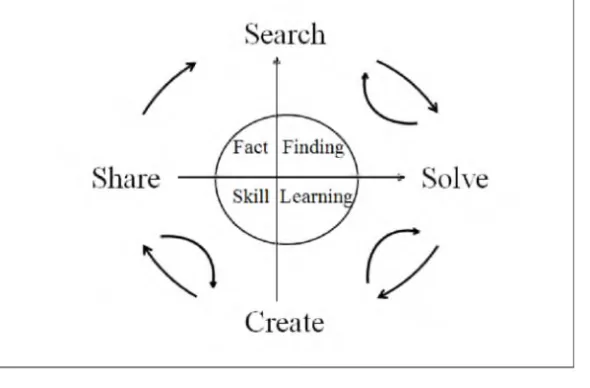
Problem Solving Instruction Model - Search, Solve, Create and Share (SSCS Model) was selected as a problem-solving approach in the theoretical framework. This model was developed by Pizzini in 1987 for science subject and further work of implementation was done to refine the model. The SSCS model consists o f four phases; search, solve, create and share. The advantage design o f SSCS Model is due to cyclical steps that allow for re-entry into the various phases of the model during problem solving process as illustrated in Figure 1.2.
19
Referring to Figure 1.2, learning activity in the model SSCS (Pizzini, 1991) began with the provision o f problems or conditions related to the problems to be solved. Then students searched information to comprehend situations or problems presented. When the students knew or understood the problems, this led them to plan how to solve the problem using the appropriate strategy and relevant concept in Chemistry. Students created the solution based on the information and plans that have been prepared. Final phase, students shared the solution with teachers, friends and experts by conducting a discussion, forum and presentation. This sharing session gave opportunity to the students to share knowledge, ideas and justify their solution o f the problem given. These problem solving skills must be mastered by students to develop the problem solving competency in learning Chemistry.
1.6.2 A uthentic L earn in g M odel
Authentic Learning Model (Herrington, 2000) emphasizes on authentic practice to engage all the senses, allowing students to experience a meaningful learning process, create a solution o f the given problems and share the outcomes as mentioned in SSCS Model. For the purpose o f this research, four core elements were selected as manipulated variables due to appropriateness and most relevant domains required to design the module and develop the model. Those four pertinent elements were real life activity or task, ill-defined problem, collaborative and reflective writing practices.
20
Moreover, this approach is appropriate to enhance students' problem solving competency because authentic instruction standards emphasize on higher order thinking, depth o f knowledge and connectedness to the world beyond the classroom (Newman and Wehlage, 1993). Reportedly, most students were motivated by solving real-world problems during the learning process since it was related with life experience and prior knowledge (Lombardi and Oblinger, 2007).
Students are able to develop a deep understanding on what they have learned when they engage with learning activities and problems, related with real life situations (Newman and Wehlage, 1993). These activities acquire students to apply their higher-order thinking especially to solve ill-defined problem (Li et al., 2013). This ill-defined problem is presented in the form o f open-ended problem with non routine challenge that normally related with the real life situations.
Solve the problem collaboratively as one o f element in authentic learning can be implemented face-to-face or with e-learning system (MOODLE). Success in learning is not achievable by an individual student working alone (Lombardi and Oblinger, 2007). Working in teams to solve the problems can promote students to communicate, interpret, relate and justify their solution. Authentic activities enable students to engage in meaningful discussions on issues presented on their learning in order to make choices, justify, make decision and reflect both individually and as a team.
21
1.6.3 PISA 2012 Science F ram ew o rk
In this framework, competency is more than just knowledge and skills. When discussing the cognitive dimensions o f the specific scientific competencies, as is pertinent to the PISA, science assessment in the current cycle, reference is made to the relevant scientific knowledge and skills demonstrated by students. Scientific knowledge in PISA is used to measure the level o f understanding and application of the advance scientific knowledge.
PISA is concerned with both the cognitive and affective aspects o f students' competencies in science. The cognitive aspects include students' knowledge and their capacity to use this knowledge effectively to solve the problems. Current thinking about the desired outcomes o f science education emphasises scientific knowledge. This outcome requires an understanding o f important key concepts, explanations o f science and application to solve real life problem.
In assessing scientific competencies, PISA is concerned with issues to which scientific knowledge can contribute and which will involve students, either now or in the future, in making decisions. PISA has highlighted three domains o f scientific competencies that consist o f (i) identifying the scientific issue (ii) explaining phenomenon scientifically and (iii) using the scientific evidence. Application of these scientific competencies is important to develop problem solving competency among school students. From the point o f view o f their scientific competencies, students respond to such issues (problem) in terms o f their understanding o f relevant scientific knowledge, ability to access and evaluate information, interpret evidence bearing on the issue and identify the scientific aspects o f the issue (Koballa et al.,
22
1.6.4 N eedham 's Five Phase C onstructivist M odel
In this research, the development o f problem solving competency was depending much on construction o f the scientific knowledge based on students' prior knowledge and experience. Educator required identifying an appropriate learning theory to suit with learning approach to enhance this problem solving competency. Needham 's Five Phase Constructivist Model is one o f the established models, has been used widely in education research to enforce the construction o f knowledge in various subjects at all levels, from primary until tertiary education. Every phase in this N eedham 's model engages students with cognitive process based on the stimulus or learning activity used to achieve the aim o f respective phase.
The first phase; orientation is important to get attention and interest of students and motivate students for their continued interest in the teaching process. Orientation aims to prepare students' state o f mind to proceed with the learning activity. Secondly, in phase o f generating ideas; teachers identify students' alternative thinking and encourage them to think the reason they are not consistent with the idea o f scientific ideas. Teacher may pose more questions to encourage thinking process among students. Third phase is dealing with restructuring ideas based on the information and activities to establish students' new concept according to their intelligence. Students will be able to make the definitions, explain concepts, question the justification and request further explanations.
23
know about problem solving. This is a practical and effective self-assessment method to assess whether the students understand and apply what they have learned.
Those five phases in N eedham 's are general and practical to design a constructive learning environment but this model needs to be blended with from other models and frameworks. N eedham 's theory is used to provide a systematic learning flow based on students' prior experience until they are able to construct a new knowledge. Therefore, learning practice can support the specific collaborative learning activities such as solving a real life task that consists o f ill-defined problems. Moreover, application o f problem solving skills in SSCS Problem Solving Instruction Model will guide the students to master to solve those ill-defined problems that are also known as open-ended problems. SSCS model will attach the students with the appropriate problem solving skills (search, solve, create and share) since all these skills are lack in school curriculum. Students should be exposed with a proper problem solving strategy and given an opportunity to share the solution obtained with others. PISA Science Framework is used to evaluate the learning outcomes such as construction o f scientific knowledge competency to solve the open-ended problems because N eedham 's model does not have a specific method or rubric for assessment. This PISA Science Framework provides three domains to measure the development o f scientific knowledge competency that leads the students to solve the real life tasks given.
24
1.7 R esearch C onceptual F ram ew o rk
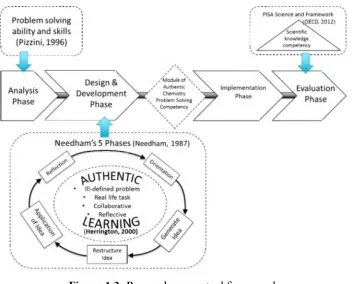
This research was conducted according to the research framework illustrated in Figure 1.3. Initially, the level o f problem solving ability and skills among school students were determined. Problem solving skills referred to the four stages (Search, Solve, Create and Share) in Problem Solving Instruction Model by Pizzini (1987, 1996). Process practiced in solving open ended problem and factors that influenced problem solving ability o f some participants were investigated. Prior analysis has explained that problem solving ability in learning Chemistry depended heavily on the conceptual understanding o f the students' scientific knowledge, problem solving skills, familiarity and work collaboratively to solve open-ended problems (Suraiya et al., 2015).
Figure 1.3: Research conceptual framework
25
designed for the purpose o f promoting the development o f problem solving competency in Chemistry using ADDIE Model (Rossett, 1987).
In the implementation phase, the developed learning module was used by students to learn the Chemistry topic in the authentic environment. This authentic learning environment has provided real life activities or tasks, for example using common substances in our daily life such as carbonated drinks to conduct experiment. From this approach, the research expected to investigate the students' performance in learning Chemistry and problem solving competency development in this topic. Instead o f that, upon the implementation o f the learning module, the students' problem solving competency development has been investigated deeply and the students' reflection grid was obtained.
Problem solving competency can be developed if students were able to apply the scientific knowledge competency to solve the open-ended problem (ill-defined and non-routine) in the authentic learning environment. Moreover, e-learning system has also been used to accomplish the problems or tasks given in the module. This approach equips the student with the problem solving competency and they apply it to confront with real-life problems outside the classroom.
Finally, the effect o f the learning module on enhancing the students' development o f the Chemistry problem solving competency to solve open-ended problem was investigated in the evaluation phase. Furthermore, the data in the students' Chemistry problem solving ability and problem solving competency have supported the contribution o f Module o f Authentic Chemistry Problem Solving Competency (MAC-PSC) as an effective learning module to enhance problem solving competency in learning Chemistry.
1.8 R esearch R ationale
26
2012). In order to produce universal citizens as future competent in problem solvers, our present education must equip students with higher order thinking skills and noble values. As citizens in the information age, "Gen Y" must have strong problem solving and thinking skills (Morgan, 1996). Hence, knowledge and experiences can encourage and improve students' problem solving competency as an essential element in 21st century education transformation. High competency in problem solving is required to enhance the students' performance in the national and international assessment o f the science subjects such as Chemistry. High performance in Chemistry will enable students to be good thinkers in problem solving in the future (Lartson, 2013).
Chemistry is one o f the elective science subjects taken by form four to form six Malaysia students in secondary schools. Since Chemistry is an abstract subject, it is a challenge for teachers to ensure the students manage to grasp the knowledge and skills in constructing a strong conceptual understanding. Students are able to solve Chemistry problem such as open-ended problem well if they have a strong conceptual understanding as a prior specific knowledge in a successful problem solving.
The attention to problem competency is explicit with extensive research in this field. An approach to learning that has students solving on realistic problems to gain new knowledge and skills in context, rather than listening to lecture and memorizing vast amounts o f information to be applied during assessment especially in test or examination. Authentic practice enables the students to create a meaningful learning when they are engaged with real-life situations including in problem solving. Hence, students need to be engaged with learning practice that provides more opportunity to relate the scientific knowledge with real life experiences and construct authentic problem solving competency.
27
components consist o f Authentic Learning Model (Herrington, 2000) as learning strategy, Problem Solving Instruction Model (Pizzini, 1987, 1996) to engage students with problem solving skills, N eedham 's Five Phase Model (Needham, 1987) to construct scientific knowledge and PISA Science Framework (OECD, 2012) to assess the development authentic Chemistry problem solving competency. This module facilitates the students to engage in solving open-ended problems in Chemistry generally.
This comprehensive study was conducted in this research to evaluate the Chemistry problem solving ability after the implementation o f Module o f Authentic Chemistry Problem Solving Competency (MAC-PSC) in enhancing problem-solving competency among school students. Besides, the researcher expected this research would contribute to learning resource development based on constructivist learning, emphasize on authentic learning practice in learning Chemistry.
1.9 Significance of th e Study
28
1.9.1 C u rricu lu m D evelopm ent C entre, M alaysian M inistry of E ducation
Curriculum Development Centre, Ministry o f Education in Malaysia is responsible to ensure all current educational needs in schools, especially those related to curriculum get urgent attention. Realistic measures should be implemented to enhance the development o f curriculum in the education system. In this respect it was hoped that the results o f this study could be used as a guide for determining the policies, curriculum, methods and approaches that improving the subject content. Most probably, it is essential to prepare more open ended problems to be solved in the text books. Findings from this study could identify the appropriate assessment to measure students' problem solving competency more efficient at the school based assessment. Outcomes o f this study could also lead the ministry to prepare more modules to assist teachers especially pre service teachers to develop problem solving competency in Chemistry when they are attached or posted to schools. Moreover, this study would increase the learning resources and kits that engage the problem solving to catalyse its implementation in school especially to the schools in rural areas.
1.9.2 The global principals
29
1.9.3 The teachers in school
There is no doubt that teachers are the most directly involved with the process o f teaching and learning in the classroom. Teachers should benefit more as a result o f this study and to make it as a guide to reach and inspire students to continue to learn effectively and master the knowledge and skills that are important before they can face the global challenge. Results from this study would help teachers to identify students' competencies o f problem solving that may affect their academic achievement. In addition, problem solving competency has become a core criteria to perform well and systematically in their career undertaking.
1.9.4 The secondary school students
Modules developed from this research were beneficial in assisting students to become competent problem solvers in Chemistry. M ost students have such difficulties in solving problems open-ended problems in Chemistry. This study identified the underlying factors that influenced the students' competency in solving Chemistry problems especially open-ended problems and authentic learning was proposed as an effective and meaningful approach to develop the problem solving competency.
1.10 R esearch Scope and L im itation
This research aimed to develop a Chemistry problem solving model and learning module that incorporated the authentic practice and scientific knowledge competencies to provide an authentic learning environment by engaging the students with problem-solving competency in solving open-ended problems.
30
students' problem solving competency in Science generally and specifically in Chemistry. This research was limited to determine the problem solving competency o f open-ended Chemistry problems. Scientific knowledge competency was investigated from the real life tasks.
However, the findings o f this research would help the relevant authorities, especially teachers, school administrators and officers from the Malaysia Ministry of Education in order to enhance Chemistry problem-solving competency. In addition, this research aimed to enhance problem solving competency at present and continuously moving towards 21st century education.
1.11 O p eratio n al D efinition
There were some terminologies frequently used in this research, which were:
1.11.1 Problem -Solving C om petency
By the definition, "competency" is a combination o f knowledge, skill and attitude. Knowledge is an awareness o f a material you get through the use of experience, books or any other media. Skill is the ability to execute a certain task. Attitude demonstrates a person's willingness. The PISA 2012 definition o f problem solving competency is grounded in these generally-accepted meanings o f "problem" and "problem solving." Problem-solving competency is defined as an individual's capacity to engage in cognitive processing to understand and resolve problem situations where a method o f solution is not immediately obvious (OECD, 2012). It includes the willingness to engage with such situations in order to achieve one' s potential as a constructive and reflective citizen.
31
1.11.2 A uthentic L earn in g Practice
According to Lombardi and Oblinger (2007), authentic learning typically focused on real life, complex problems and their solutions, using role-playing exercises, problem-based activities, case studies, and participation in virtual communities o f practice. Learning-by-doing was generally considered the most effective way to learn. The internet and a variety o f emerging communication, visualization, and stimulation technologies now make it possible to offer students authentic learning experiences ranging from experimentation to real-world problem solving.
In this study, authentic learning practice was implemented only with four core elements; real-world relevance, ill-defined problem, collaborative problem-solving and reflective assessment. The authentic learning practice was created by providing real life activities and tasks to solve the open ended problems collaboratively with a reflective assessment and supported by e-learning module (MOODLE) as a tool.
1.11.3 O pen-E nded Problem s
The new-style open-ended problem can be used to assess whether or not a student has truly grasped a Chemistry concept (Scottish Qualification Assurance, 2012). The student is required to draw deep understanding o f key Chemistry principles in order to solve an open-ended problem. The open-ended nature o f these questions is such that there is no unique correct answer. The less prescriptive marking instructions focus on rewarding students for their understanding of Chemistry.