DISTRIBUTED LEADERSHIP AND STUDENT
PERFORMANCE
SIA SUOK SUOK
A dissertation submitted in partial fulfillment of the requirements for the
award of the degree of Master of Education (Management and
Administration).
Faculty of Education
Universiti Teknologi Malaysia
DEDICATION
This dissertation is dedicated to my beloved family for their endless support and encouragement.
I would like to dedicate to almighty GOD and for the undeserved kindness of God. Due to it is acknowledged that we already belong to God, "for we were bought with a price," and he has "full claim on our lives." Everything what had been done will be dedicate to
ACKNOWLEDGEMENTS
To God, who is rich in mercy, for his great love with which he loved us, made us alive together with the Christ, I give you all the glory, honour and praise. Amen.
First of all, I would like to thanks my supervisor, Dr. Khadijah Binti Daud for her unceasing patient in guiding me from the first chapter of my thesis until the last chapter of my thesis. I had made many mistakes during the writing process for my thesis; but Dr. Khadijah still gives me a lot of help, encouragement, guidance and support. Next, I would like to thank my beloved sister Sia Lily who accompanied throughout our two years of study together. In the two years of our study, she never stop give me encouragement to finish our master study. When I am down, she always beside me to give me support until I manage to finish my thesis on time. With her support, I manage to go through this two years study smoothly. Lastly, I would like to thanks my mother for her caring and support throughout my writing thesis process. When I am tired, she will ask me to rest first and continue my writing of thesis when I am energize again.
ABSTRACT
ABSTRAK
TABLE OF CONTENTS
CHAPTER TITLE PAGE
TITLE PAGE i
DECLARATION ii
DEDICATION iii
AKNOWLEDGEMENTS iv
ABSTRACT v
ABSTRAK vii
TABLE OF CONTENTS viii
LIST OF TABLES xii
LIST OF FIGURES xv
1 INTRODUCTION
1.1 Introduction 1
1.2 Background of the study 6
1.3 Statement of problem 20
1.4 Objectives of the study 22
1.5 Research Questions 22
1.6 Hypothesis of the study 23
1.7 Significance of the study 24
1.9.2 Student Performance 28 1.9.3 Conceptual Framework 30
1.10 Definition of Terms 31
1.10.1 Distributed Leadership 31
1.10.2 Student Performance 32
1.11 Conclusion 34
2 LITERATURE REVIEW
2.1 Introduction 35
2.2 Distributed Leadership 36
2.2.1 The concept of Distributed Leadership 37 2.2.2 Model of Distributed Leadership 39 2.2.3 Past Related Study on Distributed Leadership 40
2.3 Student Performance 42
2.3.1 The model of Student Performance 43 2.3.2 Past Related Study on Student Performance 44 2.4 Past Related Study on relationship between Distributed
Leadership to Student Performance
47
2.5 Conclusion 49
3 RESEARCH METHODOLOGY
3.1 Introduction 51
3.2 Research Design and Methodology 52 3.3 Framework of the Research methodology and procedures 54 3.4 Population and Samples of Study 58
3.5 Research Instruments 59
3.5.1 Part A: Demographic (Personal Information Respondents)
59
3.5.3 Part C: Student Performance 67
3.6 Pilot Test 70
3.7 Reliability and Validity 71
3.7.1 Validity and Reliability of Distributed Leadership 71 3.7.2 Validity and Reliability of Student Performance 72 3.8 Study Procedure in Data Collection 73
3.9 Data Analysis 74
3.9.1 Descriptive Statistics 75 3.9.2 Inferential Statistics 76
3.10 Conclusion 78
4 DATA ANALYSIS
4.1 Introduction 79
4.2 Profile of respondents 80
4.3 Data analysis of section A: Demographics of Respondents 80 4.4Analysis of Research Questions (Part B : Distributed
Leadership Questionnaire)
87
4.5Analysis of Research Questions (Part C : Student Performance Questionnaire)
89
4.6Testing the hypothesis 90
4.7 Conclusion 96
5 DISCUSSIONS, CONCLUSIONS AND
RECOMMENDATIONS
5.1 Introduction 99
5.2 Summary of Findings 100
5.3 Discussion 103
5.3.1 Research question 1 103
5.3.3 Research question 3 106
5.4 Recommendations 112
5.5 Further study 114
5.6 Summary 115
REFERENCES 118
LIST OF TABLES
NO. TABLES TITLE PAGE
3.1 The selected schools for the research study. 58 3.2 The original items been translated and modified into new
items adapted from Monique Whittington Davis (2009) 61
3.3 Translation new item from English version to Malay version.
64
3.4 Likert scale of five scores 67
3.5 New items created after modification from Misnah A. Hamid (2010) questionnaire.
68
3.6 Translation of new items from English version to Malay version for student performance items.
69
3.7 Likert scale of five scores 70
3.8 Cronbach’s alpha for Distributed Leadership’s items. 72 3.9 Cronbach’s alpha for student performance’s items. 73 3.10 The use of statistics in the research questions study 75 3.11 The level analysis of the mean and scale interpretation
for the analysis of data from the questionnaires (Azizi, 2007)
76
3.12 Correlation strength classification 77 3.13 Significant level of null hypothesis 77 3.14 Level of evaluation based on percentage 77
4.2 Distribution of Respondents Based on Age 81 4.3 Distribution of Respondents Based on Race 82 4.4 Distribution of Respondents Based on Status 82 4.5 Distribution of Respondents Based on Educational level 83 4.6 Distribution of Respondents Based on Professional
Qualification
83
4.7 Distribution of Respondents Based on Experience of Teaching
84
4.8 Distribution of Respondents Based on Years of Service in the school.
85
4.9 Distribution of Respondents Based on Position held 85 4.10 Distribution of Respondents Based on Service group 86 4.11
4.12
Distribution of Respondents Based on Years of service under the recent principal.
Distribution of respondent by dimension of Distributed Leadership 86 88 4.13 4.14 4.15 4.16 4.17 4.18
Level of student performance
Value of correlation coefficient between distributed leadership and student performance in secondary school in Johor Bahru.
Value of correlation coefficient between the dimension of distributed leadership (school organization) and student performance in secondary school in Johor Bahru.
Value of correlation coefficient between the dimension of distributed leadership (school vision) on student
performance in secondary school in Johor Bahru.
Value of correlation coefficient between the dimension of distributed leadership (school culture) on student
performance in secondary school in Johor Bahru.
Value of correlation coefficient between the dimension of distributed leadership (instructional program) on student
4.19
4.20
4.21
4.22
5.1
performance in secondary school in Johor Bahru.
Value of correlation coefficient between the dimension of distributed leadership (artifacts) on student performance in secondary school in Johor Bahru.
Value of correlation coefficient between the dimension of distributed leadership (teacher leadership) on student performance in secondary school in Johor Bahru.
Value of correlation coefficient between the dimension of distributed leadership (principal leadership) on student performance in secondary school in Johor Bahru. The Summary and the conclusion of the study.
The summary of the relationship between the seven dimensions of distributed leadership on student performance in secondary school in Johor Bahru.
94
95
96
98
LIST OF FIGURES
NO. FIGURES TITLE PAGE
1.1 Seven Element of Distributed Leadership, (James P. Spillane, 2006)
28
1.2 The component of student performance 29 1.3 Conceptual framework for distributed leadership and
student performance
30
CHAPTER 1
INTRODUCTION
1.1 Introduction
The ever changing environments have forced leaders in every field to find a new leadership to manage their group members and organizations. According to Margaret Wheatley (1997), we need to find a new way in order to manage the organization nowadays. Creativity is essential in order to lead the organization effectively nowadays.
Providing education to the citizens is the main tool to develop a nation. Human resources contribute significantly to the social and economic development of a nation and not its capital or natural resources. Education can consider as an investment; because there is a correlation between economic-social productivity and education.
The improvement in education will also lead to the improvement in labour skills. With higher education and more skillful the workforce will be well-paid and poverty will be ultimately reduced.
In the secondary school, students can acquire the knowledge, skills and competencies which are needed in order to produce reasoning, analytical, and good communicative skills. This will bring to the ability to compete with others at a higher level in the economic sector. (Lewin, 2001).
Nowadays, when country become more develops, the school works for principals also become more complex. (Hallinger & Heck, 1998; Leithwood & Jantzi, 2000). Scholars and practitioners need to look beyond the principalship to identify the most suitable leadership style to be practice in school. (Yukl, 2002, p. 14).
In some cases, it has show that principals could not lead the school simple-handedly. Leader-plus aspect state that to construct leadership practice, there need to be present of interaction of team member. Leadership practice also needs to be “reciprocal interdependency between team member actions” and it is not treating principals as the expertise heroic in doing the leadership practice. (Spillane, 2006). Leadership function is a co-joint activity, so the team members need to have a role in the social interactions in the school compound. (Firestone, 1996; Firestone & Martinez, 2007).
Leaders need to adapt their behavior to the characteristics of their team member. In school, principal could have more indirect leadership if the team members are more mature and stable. If the team members are less mature and younger, then principal need to have a direct leadership style. (Dwyer et al. 1983; Cohen et al. 1977). So, the studies of the school leadership need to have a look on the aspect of the teachers.
With the increase demand in the education field, a new leadership approaches are needed to achieve the higher efficiency and to make sure the education become more effective. We need to reform the management in the school to achieve the efficiency needed in the school management field. (Lewin, 2001) So, the distributed leadership is being studied in this research.
Some schools look for a leadership team which is consists of many member of leader from the team members. The study about the distributed leadership for the school in Johor Bahru could enable us discovered the effect between the distributed leadership with student performance. There is also schools come out only with one leader and one assistant of the leader. But, principal still is the head of the school and has important roles toward the teachers’ attitude and culture of the school. (Engels, Hotton, Devos, Bouckenooghe, & Aelterman, 2008). The assistant principals or teacher leaders duty in school are to mentor their colleagues as well as provide the support more to the professional guidance (Wasley, 1991). This also means that the principal can influence teachers’ commitment while in the school.
In the school organization, changes need to be done to move to the next level of reform. To make the extraordinary effort work out to carry out the reform in the school organization, many leaders are needed to do so. (Fullan, 2003).
Broader distribution of the leadership is needed to meet the capacity for the scaling up of school development. A broad base of capacity is possible if the control is not limited to a few individuals. (Elmore, 2000).
Distributed leadership is chosen due to the type of leadership called separate leadership practices been spread over between two leaders. The task needs to be done in a sequence. So, distributed leadership needs to be selected to make sure multiple interdependent tasks to be done smoothly in the team with more than one leader. (Spillane, 2005)
Besides that, teachers need to be motivated to complete their task to the greater performance. It is hope that the teachers will perform their task at their maximum capability to develop the student performance in the school. As for our knowledge, it had been discovering that many of the school days being wasted due to the inefficiency of the school management especially the teacher management in the classroom. (Lewin, 2001). Teacher leadership is an important dimension in distributed leadership. So, it is important to study this dimension in this research.
Distributed leadership should be practiced by the whole school and not only by the principal. (Copland, 2001; Elmore, 2000; Neuman & Simmons, 2000). This means teachers should also taking part in the role of leadership in the school. The second perspective of the distributed leadership has stated that teachers need to take part in making decision concerning the leadership in school.
teachers’ commitment. Relation between the school and students’ achievement is an important indirect variable for the student performance. It is widely known that teachers’ commitment does have an effect on the school’s pedagogical quality and students’ performance in school.
According to Robinson (2008), not only does leadership promote but also affects teachers directly in their professional learning. The professional learning will on the other hand influence the students’ performance in school.
A survey carried out by the National College in 2003 on distributed leadership in schools showed that shared leadership in school is an important issue. In 2004, Leithwood and colleagues made a statement that leadership does influence students’ learning. Students’ learning attitude will also improve if a leader practises distributed leadership. To make the statement more clear, this research is being done to support it.
Questions such as performance must be clearly defined in the context of the school for the accuracy of the research. What does it mean by performance and how it is measured? Brumbach (1988) argues that behaviour is the mean of performance and results, providing his own behaviour and appropriate job in order to achieve the expected results. Behaviour is an effort of both mentally and physically to achieve certain goals. Performance in school is measured in terms of test scores, exam results, and social capabilities of students. However, other skills which students need to attain are skills in dealing with obstacles encountered in life which is full of challenges. These will to be mastered by students.
achievement, many changes and challenges are face by school in Johor Bahru. The hindrance that make the teacher couldn’t give good teaching and the students couldn’t have a good learning is the social economic pressures from the society. The hindrance need to be overcome due to high demand on the standards set by the state and federal government. (Fullan, 2001).
Numerous school search for solutions in order to produce the better-educated graduates to meet the demand of global economic realities. So, the leadership is being study to determine the influence of the dimension of distributed leadership on the changes to the student performance. (Fullan, 2001).
1.2 Background of the problem
Due to the complexity in school and the increasing demand in school organization nowadays, it is not right to make the principal as the only head to lead the school to the greatest heights (Spillane, 2005).
In the 20th century, the principal as the sole leader in the school had been perceived as outdated. In the educational landscape, the school leadership from top to bottom had become a major issue (Hart, 1995; Lambert, 2002). What has changed in the way leaders lead the schools is the students’ achievements and the instructional improvements. (Elmore, 2000). Principals need active participation by other educators to play the entire leadership role in school as the principals normally do not have time for the improvement of instruction in schools. (Olson, 2000).
Rowan, & Taylor, 2003). Distributed leadership is a process bringing together people, materials, and organizational structure (Spillane et al., 2001).
Distributed leadership not only focuses on “what” or by whom is being distributed but also “how” the leadership is distributed. It also encompasses how the leaders synchronize his or her actions through reciprocal influence. It has been discovered that an effective team is characterized by mutual trust and dependency, decision making, freedom to express feeling and dissatisfaction as well as aims and objectives sharing (Swailes, 2007). In addition, the effective teams are also characterized by coordination, cooperation and cohesion as well as the collective and synergetic effect (Luthans, 1995). Lastly, the effective teams should possess clear membership boundaries (Hackman, 2002).
In justification for the leadership practice at school, principals still play the leading role in the school for the continuations of heroic genre. Describing improvements at Adam School is quite challenging due to the principal, Brenda does not turn around the school in a single-handedly. Likewise in any good epic, what Brenda did and how she did are subject to be measurement for many others. This many others by the feature on the official or unofficial responsibilities will help in leading the school development. Brenda agreed that the essential responsibilities played by the others while she said, “I just couldn’t do it all.” Brenda clarified that a team of members with the power to make decision had been chosen to aid in the makeover process of Adam. Brenda also explained that a helper in managing the disciplinary problems would become a vital issue: “I couldn’t get involved in day-to-day discipline and I have to focus on instructional programmes too.” (Spillane, 2006)
critical point of Adam School great transformation, it was a great team of people with the William as the top leader. (Spillane, 2006)
The management staff and teachers have a vital task in the development of coaching, changing the society in the school as well as altering anticipation of the previous team members in the school organizations. Some of the members of the Adam School organization simply do what had been told by William as part of their responsibilities. While, the others do take on the leadership responsibilities assign to them. William had figured out that the leadership in school is not done solely by her alone. Leadership practice is no longer an individual issue because it had been acknowledged that leadership practice in the school organization extends beyond the school principal. (Spillane, 2006).
The biggest challenge face by the schools in Malaysia nowadays is to make sure that all the students (including all races, immigrant status and social class) will be able to receive fair and high quality of education to achieve their best potential. This could be achieved by providing the students with high quality of learning opportunities to every school and every classroom. To meet this requirement, leaders (principals) of the schools need to make sure that instructional practices are widely distributed all over the schools. (Spillane, 2006).
Nowadays, treating principals as “experts” in all matters is not realistic. In “principle of comparative advantage”, people will lead in their area of expertise according to distributed leadership. (Elmore’s, 2002). According to Burns, (1978), followers’ roles in the practice creation and understanding of leadership dynamics are equally crucial with the leader. Besides that, the leaders are relying upon the followers (Smylie & Hart, 1999).
effective school where the principal is at the center of the school organization. When the principal is at the center of the school organization, this would encourage the teacher in the decision making process in the school organization. This would also lead to encouragement of teacher leadership in the school organization as well. (Newmann & Associates, 1996).
Relationship between administrators and students performances happens through the collaboration between the structures in the school association (Hallinger& Heck, 1996). This hypothesis of the relationship between administrators and students was made through the reciprocal-effects model. Through the interaction between the principal and other people, principal actions are eventually linked to student performance. In order to find the support for this statement, the distributed leadership is being investigated in the secondary school in Johor Bahru.
Without the participation of other educators in the administration of the school, the principal could not be serving as the instructional leader for the entire school. (Elmore, 2000). Principals who succeeded in distributing tasks to committee members and get strong support from members of the committee were able to bring success to the leadership of the school. The definition of the practice of leadership in schools is related to the basis for integrating the culture of the school as well as makes a difference to the organization. Leadership practice had the promise of achieving the purpose behind the restructuring of the organizational culture in schools. Organization allows the cooperation between the members of the organization. Flexibility in school structure allows the alteration of the school development program.
mathematics, in developing the approach in giving instructions and expectations to make a difference to teacher practice.
The principal as the lone instructional leaders is ended. An administrator cannot serve as the instructional leader for the whole school organization. The participation of the other educators is needed to make sure the school organization function effectively. (Elmore, 2000).
In the old model of leadership in educational field, lone leader leaves the followers to be talented untapped. Improvement in the school with the principal as the lone leader couldn’t be sustained. When the principal is leaving the school for another school, the momentum of some promising program may deteriorate. The model for one-person leadership is called by individualistic fallacy. (Fullan, 2003).
The process of reformation of the school organization required not only a few excellent leaders. Instead the process of changing required a huge number of good leaders. (Fullan, 2003). Educational field in Malaysia is demanding a lot of changing process in order to achieve the 2020 vision of Malaysia to become a develop country.
Review for evidence that suggest a successful leadership can perform a greatly significant role in developing student learning. Two important claims being stated out from the effect about successful leadership. A first claim is about the instruction in the classroom is the main factor that contributes to students learning in the class, and leadership is the second factors that also contribute to student learning at school. Second claim is about successful leadership are needed at utmost when or where leadership is needed in an organization (Kenneth Leithwood, 2004).
underestimate the effect of the successful leadership. By the way, this evidence does support the widespread of the present research interest to effectively implement a large-scale reform in the school organization.
Leaders have greater responsibility for the development of learning in school as well as play a role in any official in the administration of the school. Although there are factors that contribute to the development of learning in school, but the school leadership is critical. As a result, efforts to bring about change in the dimensions of school leadership, especially in poor schools are important in order to create development in the school concerned.
Distributed leadership was chosen because it involves the process of leadership that involves more than one leader. Routine chores such as monitor and evaluate teaching in schools certainly need more than a leader.
The democratic, distributed and other leadership had been identified as leadership quality in improving schools, but we need more data to understand better the leadership significant influence on the student’s performance. (NCSL, 2003). Spillane, Halverson and Diamond (2001) had been survey the distributed leadership in action. But, still plenty of distributed leadership studies needed to be done in order to understand distributed leadership effects on the student performance. (National College for School Leadership, 2003).
The process of leadership in a variety of socio-economic background and culture requires two approaches. The first approach requires a plan and creativity that can lead to help the children that we worry. This includes providing education to parents, reducing the size of classes and builds a strong curriculum.
contributions from the others in the school organization. Normally, principal rely more on the key teacher as well as the local administrative colleagues in helping principal to have highly successful leadership in the school compound (Hord, 1984).
Recent study focused on the nature and effects of leadership even though the idea of leadership has occurred since 70 years (Gronn, 2002). The concept of distributed leadership is an initiative and leadership practices as an incentive for more than one individual. Leadership encouragement is exerted through activities or duty that is endorsed to accomplish tasks for the organization (Spillane et al, 2000). Gronn (2002) differentiates two elementary forms of distributed leadership, additive and holistic.
Gibb (1954) had used the term “distributed leadership” for the leading time. The dynamics of the influence Gibb is an Australian psychologist, who drew attention to the dynamics of influence processes as they impact on the work of different group. Gibb suggest leadership should be treating as a shared function between the member in an organization rather than as the domination of an individual in an organization. In the arena of education, it is trust that leadership is greatest thought as a group of quality that has gained prevalent approval. Distributed leadership is treat as “the leadership idea of the moment” (Harris, 2007). Distributed leadership also being treat as the concept “the new kid on the block” (Gronn, 2000). The concept of the distributed leadership is being state as embraced with enthusiasm by the educational researcher as the review of the educational administration.
Leadership had been determined as distributed practice by Haverson and Diamond, 2004. In cognitive psychology study, Spillane (2006) put emphasize on distributed cognition and the function of the social framework as the impact on the human behavior and learning process.
perpetual interaction of formal and informal groups for an organization. In the context of the mutual form of communication, learning and action, distributed leadership could be considered as mutual practice used by an individual looking for organizational matters and issues. In the school, action take to solve specific problems in collaboration means that the teacher was engage with the distributed leadership.
A conceptual framework in the research for school leadership and management could be considered as part of the distributed leadership. This conceptual framework involves two parts: the leaders part (who) and the practice part (how). As for the leaders part (who), it acknowledge that the process of leading the school need collaborations from numerous individuals and management of school shouldn’t be the matter for the principal or the assistant of principals. The interaction between the principal, teacher and the environment in the school is the result from the distributed leadership practice (Spillane, Hunt, & Healy, 2008). Subsequently, the distributed leadership will shift the focus on principal as the sole leader in school to the web of stakeholders and the environment (Spillane & Diamond, 2007).
Emergent of teacher leadership is by the restructuring of the school, changes in the school, and professional school culture. Six ways to make the teacher be the leader in the teacher leadership is as follow. First is the improvement of one’s teaching proficiency and skill, secondly is organize and lead the peer in the teaching practices. As a leader, teacher should also take part in the decision making process in the school as well as providing curriculum development. Fifth is about the leading in the staff development process. The last one is about the making sure the teacher partaking in the collaborative action planning, research and reflection. These show that teacher had the variety of roles in the teacher leadership.
contributed to an assortment of leadership roles, including supporting the program vision and informally observing program execution (Heller and Firestone, 1995).
Research on Australian schools (Crowther, 2002) and U.S. and Canadian schools (Hargreaves, 2004) demonstrate that teachers, in their own or togetherness, take accountability for leadership roles and schedules, at times in an power to make up for leadership fissures that cause from officially selected leaders’ lack of proficiency or oversight. In the case for rural Sunbeach Elementary and Middle School designated by Crowther and his associates is illustrative. Loretta, a learning support teacher at Sunbeach, get to have herself for literacy instruction thrilled by a professional development workspace on an incorporated approach to literacy.
Educational reform pays much attention on the relationship between the leadership and the school performance. An effective leader could have a powerful influence on the school organization as well as the student performance. (Leithwood and Jantzi, 2000).
In the school improvement process whether it is in the school or school system, the specialization is the problem face by the school in order to scale up the improvement of the school organization. If the control of the scaling up process in the school is limited to the one individual, the building up of broad base capacity in the school could be hindered. The way out is to have a wider distribution of leadership. (Elmore, 2000).
The distributed leadership theory is being studied in my research due to it had proved that distributed leadership had been work out not only in the school but also the district over the past decade. The distributed leadership had show a good result via the quality of the professional development and the achievement of the school curriculum as well as the assessment of the tools that had been produced. (Riordan, 2003).
Besides that, the distributed leadership also had been works out among the teacher in which the teacher had been successfully recruited into intensive professional development. This statement is according to research done by MISE over the past decade. (Riordan, 2003).
Next, the emergence of the teacher-led professional communities also had been created according to MISE research as well. (Riordan, 2003). The successfulness of the distributed leadership that had been achieved in the past decade had attract researcher to find more support to show that the statement is benefit to the educational development in this century.
With the clear vision and efficient communication, the leader could run the team successfully by the independent of the team member in carried out their task. This would enable the leader to bring the leadership to a higher level of leadership. (Kerri Salls, 2005).
students than principal because teacher involved straight with the students (Leithwood &Jantzi, 1998). Ogawa and Hart’s (1985) also had the finding that 12-8% of the difference in students’ performance is by the principal. If related to the additional school and environmental factors, the effect of distributed leadership by the principal is being perceived as small. But, this finding provides support for the continued practice of distributed leadership in the school.
Teacher leadership is mean by teachers work together, constructing knowledge cooperatively and collaboratively (Lamvert, 1998). If all the teachers work together to bring the improvement to the school, the improvement process would be a successful process. (Katzenmeyer and Moller, 2001). So, the leadership shouldn’t be restricted to the formal positions only, instead leadership should be assigned to all the team member of the school organization. (Harris and Lambert, 2003).
The center of the capacity for the building up of model in the school organization is the teachers. Teachers are the largest numbers of staff within the school compound. Teacher are directly involved in the teaching process thus teacher had the special position to bring the change to the school organization. (Lieberman & Miller, 2004). Therefore, teacher leadership aims at developing teacher to become the leaders as well beside the principal as the sole leaders in the school. By doing this, it is hope that the teacher leadership would lead to the improvement of educational practice in the school. (Katzenmeyer and Moller, 2001).
Some researchers found that due to the two-way street, the leader-follower distinction become problematic. While such doubts are reasonable, my anxiety is that if the distinction is overlooked completely, the role of followers in describing leadership working out will fall through the fissures. Some data propose that teachers, specialists, and administrators do make others as leaders (whether formal or informal), relying on the specific situations, so the distinction between leaders and followers looks to be actual enough in schools. (spillane, 2006).
In some investigations on the interactions of leadership practice, attention that had been pay to the follower also play an important roles. It had been discovered that, classroom teachers act as active participants in the literacy committee meeting at Adams School by cooperating regularly with the four leaders by the contribution of samples and ideas. Through the review of strategies for aiding students to create connections, for example, a teacher reacted to the African American heritage coordinator’s demonstration by noticing that it is significant to be overt with students regarding the approach one is coaching. (Spillane, 2006)
Recognizing the significance of what the teacher had said, Williams went on to retell teachers not to hurdle to hand over a strategy but to trail the school’s instructional order: modeling, guided practice, scaffolding, and application. Williams’s declaration makes sense only in the situation of the teachers’ remarks. Another teacher gave a sample of how this planning might play out when using the making networks plan in the classroom. What we can realize here is leaders and followers complementing and extending each other’s actions done thoughtful interconnecting. Therefore, leaders mutually establish collaboration with the subordinates in enabling them to have a role play in the leadership carried out in the school (Spillane, 2006).
interconnecting between the literacy coordinator, the principal, the African American heritage director, teacher leader, and the collaborations between principal and classroom teachers. There is a mutual connection between all of the above mention people in their actions, and it is by this interconnecting that the leadership training takes figure. (Spillane, 2006).
In the Smylie’s review, 1997, a research to examine the relationship among teacher leadership and a diversity of school-related outcome had been done. Smylie through his report had examined the condition of the skill in teacher leadership. About partial (Bryk, Deabster, & Tum, 1994) of the analyses, it had been discover that teacher leadership does not linked to student performance. The other half of the analyses had (Smylie & Hart, 1999) discover optimistic relationship between teacher leadership and academic achievement.
Teacher leadership states the need for teachers to be a leader in order to support the development process in the other teachers. Intellectual resource would be greatly wasted if the teachers do not interacting with each others. In the discussion session carried out between the teachers, the teacher knowledge would be greatly increased. (Harris and Mujis, 2005).
The “top down” leadership approach means the strategies and solutions which had been determine by the senior leaders would be pass down the organization (Hodgkinson, 1991). The “bottoms up” approach encourages the participation of the team member in the decision making process. The advantageous of non-hierarchical collaborative approach (Distributed leadership)is the work performance can be greatly increase (Leithwood and Riehl, 2003).
had report there is an increases in students’ accountability and eagerness toward learning as well as problem-solving abilities. The student performance is being included in this study to find the data to support the above statement.
A survey carried out on 2003 of the distributed leadership works which was showed by the National College for leadership in the school had unresolved that: “The association between shared leadership and learning is a significantly important issue, but there are no practical data at all on this” (Harvey, 2003). According to Leithwood and colleagues (2004), a study concerning the influence between encouragement of students learning through leadership. So, it had been determined that connotation do happened between provoke students learning with the leaders practicing distributed leadership.
Linking between the leadership in school and the school performance had been done by Pitner (1998). This theoretical model is name as “reciprocal-effects model”. The model shows the correlation among the interaction of leadership and student achievement. In the future, the principal leadership actions would be impact by changes in the school.
Smylie and Hart (1999) found that instructional improvement and the student academic achievement had been achieved through the distributed leadership. This finding was through the study conducted upon involvement of other team member in the decision making process in the school.
`
performance in the school.
In addition, a small number of studies had been done examining connection among the student performance with the distributed leadership. According to a survey carried out in the Secondary school in Ontario, it had been discovered that a significant relationship between planned approaches with the distributed leadership towards high level of academic achievement in the school. According to Spillane, 2004, there is a link between distributed leadership with the enhancement in the quality of teaching and learning for a certain subject in the school.
The result of the successful leaders in creating the encouraging environment in the school organization is by measure the student learning outcome that would be the student performance. (Hallinger and Heck, 1996). Student achievement in the school could be influence by school mission and goals, culture, participation of the team member in the decision making process and wider community. Measuring the outcome of the potential influence on student performance is the utmost suitable variable to determine the effectveness of the school leadership.
Most of the school leadership effect was on the student performance in the school. Until recently, the effects of the leadership on the students have been considered to be indirect and too complex to be sort out. (Murphy and Hallinger, 1998). The improvement strategies could contribute to the student learning in the school.
1.3 Statement of problem
school to prominence due to the complication of the school and the growth demands sited on principals (Spillane, 2005). Besides that, the conceptual framework for the principal leadership role is also in exchanging due to changes in the way work is accomplished in the school, and in the reaction to the increase on anticipations of students learning. Presently, there is a developing theory about the distributed leadership do have the potential in the development of teaching and learning in the school (Harris, 2005).
Due to the distributed leadership is a developing concept, not many quantitative studies being carried out to determine the way distributed leadership is related to the school performance. Due to lack of research knowledge about this theory, so the definition for the distributed leadership is always interchangeably with “shared leadership” and “teacher leadership”. Analysis and strategy approach to leadership and management perceives school leaders as the critical agents in developing the school. Nevertheless, such a methodology does not need every school to reinvent the well-known wheel one improvement at a time.
A distributed leadership could act as a frame for the leaders to assign the task to the right person to hold the right position in order to enable the school to achieve at its maximum capacity. Dimension for distributed leadership also been develop in order to aid in the leadership practice in the school in diverse kind of aspect.
1.4 Objective of the question
This research was carried out as the tool to investigate the relationship between the teachers’ perception for the distributed leadership with the student performance in the secondary school in Johor Bahru. Referring to the research problem stated above, the objectives of this study are to:
1. To identify the dominant dimension of distributed leadership (school organization, school vision, school culture, instructional program, artifacts, teacher leadership and principal leadership) practice by secondary school teachers.
2. To determine the level of student performance in secondary school in Johor Bahru.
3. To determine whether there is any relationship between distributed leadership (school organization, school vision, school culture, instructional program, artifacts, teacher leadership and principal leadership) on student performance in secondary school in Johor Bahru.
1.5 Research Questions
The research questions of this study are:
1. What is the dominant dimension of distributed leadership (school organization, school vision, school culture, instructional program, artifacts, teacher leadership and principal leadership) practice by secondary school teachers?
2. What is the level of student performance in secondary school in Johor Bahru?
organization, school vision, school culture, instructional program, artifacts, teacher leadership and principal leadership) on student performance in secondary school?
1.6 Hypothesis of the study
In this study, the research hypotheses were developed to find the findings for the research questions above-mentioned. The following research hypotheses are tested with significance level 0.05.
Ho1: There is no significant relationship between distributed leadership and
student performance in secondary school.
Ho2: There is no significant relationship between the dimension of distributed
leadership (school organization) on student performance in secondary school in Johor Bahru.
Ho3: There is no significant relationship between the dimension of distributed
leadership (school vision) on student performance in secondary school in Johor Bahru.
Ho4: There is no significant relationship between the dimension of distributed
leadership (school culture) on student performance in secondary school in Johor Bahru.
Ho5: There is no significant relationship between the dimension of distributed
leadership (instructional program) on student performance in secondary school in Johor Bahru.
Ho6: There is no significant relationship between the dimension of distributed
Johor Bahru.
Ho7: There is no significant relationship between the dimension of distributed
leadership (teacher leadership) on student performance in secondary school in Johor Bahru.
Ho8: There is no significant relationship between the dimension of distributed
leadership (principal leadership) on student performance in secondary school in Johor Bahru.
1.7 Significance of the study
The significance of this study is to develop the understanding of the distributed leadership in the student performance and school improvement process. Through the study, it is thought that this study could contribute to the principal ship program to harvest more talented principal in order to contribute to the realization of the vision 2020 in Malaysia. In the education development plan 2013-2015 focus on the 11 shift, it had mention about the principal ship issues. In the 5 shift, it mention about ensuring high performance leadership being placed in each school. The content is about introducing competency-based selection criteria and strengthens succession planning process for principals from 2013. Besides that, it also mention about implementation of new career for principals from 2013 with more support, more flexibility to improve the operation of the school, the curriculum and co-curriculum, and more accountability for improvement of student outcomes. (Anonymous)
study could lead to the contribution for students in the distributed leadership courses design for the teacher preparation toward teaching program. Through this course, it is believe that teacher would progress beyond the instruction for practices in teaching and teacher would become best practitioner in school and taking part in the decision making process in the school. (Spillane, 2005)
The distribution of leadership between the team members in the school also rely on the subject matter (Spillane, 2003). Survey carried out for the Distributed Leadership had discover that the number of persons involved for the roles of a leadership daily implementation in the school were involved with school subject. It had been discovered that approximately, two or three leaders would be needed to carry out the leadership roles for the mathematics subject.(Spillane, 2005)
1.8 Research Scope and Limitations
This study focused on the relationship between teachers’ perceptions of distributed leadership and performance of form 2 students measured by mathematic assessment. This means we utilized design with teacher self-reports on distributed leadership that had been practices in their own school. The study research was limited to a data point from 2012 to 2013 school years. Prior to the survey and after the survey, any changes in the school were not evaluated afterward. The questionnaire that had been design were assumed that those participate in answering the questionnaire are fully equipped with the distributed leadership knowledge. Besides, it would also need those who taking part in the questionnaire answering process would answer the question truthfully.
dimension of the distributed leadership. Others potential of construct had been precluded in this study. In addition, the study also only been carried out on secondary school in Johor Bahru. So, this study couldn’t be used to represent the responses from the whole Malaysia teachers. Next, smaller secondary school which do not have formal leadership team also been left out in this study due to the study only focus on the bigger secondary schools.
Yet another limitation is that the limitation bring about by the research instrument that had been used in this survey. Through the analysis using the questionnaire format, it relies only on the perceptions of teachers of distributed leadership on the performance of students. This would lead to the bias in the result that had been collected from this study. Besides that, the qualitative nature of the questionnaire also had its own limitation. So, others methodology such as investigating thorough information by using qualitative study methods should also be consider in the future study about the distributed leadership in the school-level. The qualitative methods that could be used in the future study could be the interviews and observations.
1.9 Framework of the Study - Theoretical Framework
The theoretical framework for this study is about the distributed leadership theory by James P. Spillane in order to address the research questions. Below is the summary for the distributed leadership theory.
1.9.1 Distributed Leadership Theories
A distributed viewpoint on leadership proposes that leadership doesn’t exist in only in the principal’s office any more than it does. A distributed outlook of leadership also identifies that leading schools need numerous leaders. Furthermore, from a distributed viewpoint, leadership is advance than what individuals in official leadership positions do. Individuals in official and informal roles take accountability for leadership deeds. Research on the distributed leadership is still at its initial stage. There is small number of empirical evidence report on the relationship between distributed leadership and the student performance.
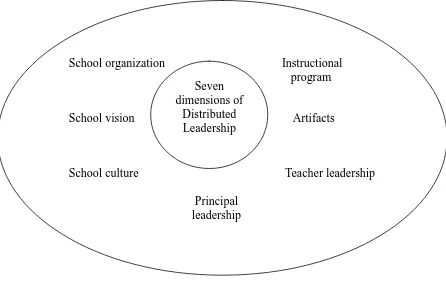
According to Spillane, leadership is the practices between the leaders and followers. The interdependencies between leaders, followers, and the environment had been studied. “Principal leadership, teacher leadership, school organization, school vision, school culture, instructional program, and artifacts were the seven dimensions” (Spillane, 2006) that been discover through the study from those school who practicing distributed leadership.
Sc
Figure 1.1 : Seven Element of Distributed Leadership, (James P. Spillane, 2006)
1.9.2 Student performance
The set of successful achievement for teaching and learning activities and it is occur in the classroom is the student performance. The component for student performance could be studied in terms of students' academic and personal development.(Misnah A. Hamid, 2009)
1.9.2.1Academic
The classroom is the place to undergo the process of learning. In order to improve the academic performance, appropriate programs should be designed. In the
School organization Instructional program program
School vision Artifacts
School culture Teacher leadership
Principal leadership
Seven dimensions of
realization of the nation’s vision to provide human capitals who master the knowledge and skills, the school should focuses on academic quality and curriculum. (Misnah A. Hamid, 2009)
1.9.2.2Character
African proverb “it takes a village to raise a child” is very popular among educator. But the proverb is not suitable for the modern country. In the village of the African, they would ask each others about the how are their children, but the American people would better get off from each other due to the American were no longer have the sense of village anymore. From here, we get to know the importance of the building up of student character because it needs a whole village to mould a children character. So, we as the educators must find a way to be a village builder in order to help building up a good character among the children.
The personality of a student is also being name as behavior. Performance character is the planning in order to improve the performance behavior. The improvement of the performance behavior is through the building up of the positive character. The positive character building process is towards the achievement of the goals set by using the appropriate techniques. The things that will help to build up self-esteem and help student to excel is student practicing culture of mutual respect, learn to be punctual, students discipline themselves in and out of the classroom and how the students meet the attendance at school. (Misnah A. Hamid, 2009)
Student Student
Academic Character
Figure 1.2 : The component of student performance, (Misnah A. Hamid, 2009)
1.9.3 Conceptual Framework
Teacher’s Perceptions
Principal’s Leadership Behavior
Relationship?
Independent Variable Dependent Variable
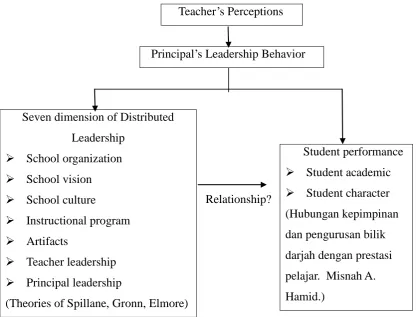
Figure 1.3 : Concetual framework for distributed leadership and student performance.
Dimensions of distributed leadership are: school organization, school vision, school culture, instructional program, artifacts, teacher leadership and principal leadership practice by secondary school teachers. The seven dimensions of distributed leadership are independent variable. The dependent variable is student performance divided into two parts that are student academic and student character.
Seven dimension of Distributed Leadership
School organization
School vision
School culture
Instructional program
Artifacts
Teacher leadership
Principal leadership
(Theories of Spillane, Gronn, Elmore)
Student performance
Student academic
1.10 Definition of Terms
In this section, in term of aiding further study, below definition of concepts or terms are to be given.
1.10.1 Distributed Leadership
One of the most ancient leadership notions that had been recommended for the fulfillment of organizational goals through the people is the distributed leadership. The distributed leadership is associated with the decision making in the organization. It is being prove that two heads are better than one or two sayings. This literally means that problem-solving with the consultation is impossible with a single head.
In this study, there is seven dimension of distributed leadership is being studied that is school organization, school vision, school culture, instructional program, artifacts, teacher leadership and principal leadership.
School’s vision is the mutual beliefs of the team member of the school. Teachers have participation in school vision, mission and instructional practices in the school.
School culture describe about the climate in the school. Teacher should be encouraged to have roles play in the school as well as cooperate with the administrations in solving any problem arises in the school level of organization.
principal. Instructional process is the review for the special need by the students in learning mathematics.
Artifacts are the teacher assessments, lesson plans, as well as the student work in order to value the school instructional program. The teacher could use the artifact to have feedback on any instructional program being carried out and could find a way to improve the instructional program.
Teacher leadership means teacher could have the leadership roles to improve colleagues instructional skills in the classroom and consequently improve the students performance. Teacher leader also means teacher solving any problem arise in the school in collective with the others teacher in the school.
Principal leadership is the participation of principal in the meeting with mathematics teacher and encouraging teacher in the process of developing student achievement.
1.10.2 Student performance
relationship between distributed leadership with the school performance. (Gordon, Z.V., 2005)
In this study, the component for student performance that been studied is the students’ academic and personal development.
The outcome of the education is the academic achievement. The academic achievement or the academic performance is the extent of the institution, teacher or the student that achieving their educational goals. The measurement tools use to measure the academic achievement is by examinations or continuous assessment. It is very common that student effort plus the teachers, parents and guardians are same level of their responsibilities to produce a student with good performance. The combine effort of the above stated person surely will give out the best result ever. The other aspect like the health status, study ambition, self-discipline, punctuality, social life, guardian qualification as well as the food habit play an vital role as well. (Gordon, Z.V., 2005)
1.11 Conclusion
In conclusion, the distributed leadership has its own implication in order to push the school management to a higher level of development. Through the study, it is hope that frames inquiry into the leadership activity could be build up in order to develop more integrative knowledge about the distributed leadership as a practice in the school organization.
Distributed leadership also been studied in detail by the seven dimension build up to have in-depth studies on distributed leadership in the school. The seven dimension of distributed leadership are to study in detail the relationship between the seven dimensions of distributed leadership with the student performance.
The knowledge that had been generated from the study about the distributed leadership is hoped to be able to provide insight into the improvement of the leadership practice in the school organization. This could also provide some thinking about intervening a change to the school that does not perform well in the school organization management through the measure in the student performance. The leaders could also identifies the most suitable dimension to replace the dimension that had been practice by them in their previous leadership roles in the school in order to improve school leadership that could be prove through the improvement in student performance. It is hope that rich knowledge about the distributed leadership practice could be establish as reference for the leaders in aiding them have a effective leadership roles in their organization.
REFERENCES:
James P. Spillane and Amy Franz Coldren (2011). Diagnosis and Design for School Improvement: Using a Distributed Perspective to Lead and Manage
Change.Teachers College, Columbia University: New York and London.
James P. Spillane (2006). Distributed Leadership. John Wiley and Sons: San Francisco.
Monique Whittington Davis (2009). Distributed Leadership and School. Online accessed on 15/10/2012 available on http://gradworks.umi.com/3344534.pdf
Hester Hulpia, Geert Devos and Hilde Van Keer (2011). The Relation Between School Leadership From a Distributed Perspective and Teachers’ Organizational commitment: Examining the Source of the Leadership Function. Online accessed on 18/10/2012 available on
http://eaq.sagepub.com/content/47/5/728
James P. Spillane (2005). Distributed Leadership. Online accessed on 25/10/2012 available on
http://sdexter.net/courses/589/downloads/SpillaneLeadership05.pdf
Dave Hall, Helen M. Gunter and Joanna Bragg (2011). The Discursive Performance of Leadership in School. Online accessed on 2/11/2012 available on
http://mie.sagepub.com/content/25/1/32
James P. Spillane, Richard Halverson and John B. Diamond (Unknown). Distributed Leadership: Toward a Theory of School Leadership Practice. Online accessed on 5/11/2012 available on
http://www.sesp.northwestern.edu/docs/twdsldrpracticeSPIHALDIA.pdf
Kenneth Leithwood, Karen Seashore Louis, Stephen Anderson and Kyla Wahlstrom (2004). Review of Research How Leadership Influences Student Learning. Online accessed on 6/11/2012 available on
http://conservancy.umn.edu/bitstream/2035/1/CAREI%20ReviewofResearch%20 How%20Leadership%20Influences.pdf
Edvantia (2005). Research Brief Shared Leadership and Student Achievement. Online accessed on 9/11/2012 available on
http://www.edvantia.org/pdta/pdf/Shared_Leadership.pdf
Maria EliophotouMenon (unknown). Leadership Theory and Educational Outcomes: The Case of Distributed and Transformational Leadership. Online accessed on 11/11/2012 available on
http://www.icsei.net/icsei2011/Full%20Papers/0125.pdf
Richard Gorton and Judy A. Alston (2010). School Leadership and Administration: Important concepts, case studies & simulations. McGraw-Hill: New York.
Susan Tranter and Adrian Percival (2006). Performance Management in Schools: Unlocking your Team Potential. Pearson Education Limited: Great Britain.
Michelle Renee Engel-Silva (2009). The Role of Distributed Leadership in Quality Educational Organizations. Online accessed on 12/12/2012 avaiable on
Martin Coles and Geoff Southworth (2005). Developing Leadership: Creating the schools of tomorrow. Two Penn Plaza: New York.
Pamela S. Angelle (2010). An Organizational Perspective of Distributed Leadership: A portrait of a Middle School. Online accessed on 7/4/2013 available on http://www.amle.org/portals/0/pdf/publications/RMLE/rmle_vol33_no5.pdf
Anonymous (2003). Distributed leadership and teacher leadership. Online accessed on 7/4/2013 available on
http://www.ukessays.com/essays/education/distributed-leadership-and- teacher-leadership-education-essay.php
Ahmad Fadzli Yusof & Amin Idris (2007). PDA Untuk Pemimpin Berwibawa. Kuala Lumpur: PTS Millenia Sdn. Bhd.
Firestone, W. & Martinez, M. (2007). Districts, Teacher Leaders, and Distributed Leadership : Changing Instructional Practice. Leadership and Policy in Schools.
Yahya Don, Aziah Ismail & Yaakub Daud (2007). Kepimpinan dan Pembangunan Pelajar Sekolah di Malaysia. Kuala Lumpur: PTS Professional Publishing Sdn. Bhd.
Yusof Boon (2011). Asas Pengurusan Sumber Manusia. Skudai: Universiti Teknologi Malaysia
The Pennsylvania State University (2001). How To Determine a Sample Size. Pennsylvania: PennState Extension.
Thomas R. Black (2003). Doing Quantitative Research. London: SAGE Publications Ltd.
Wayne K. Hoy & Michael Di Paola (2009). Studies in School Improvement. USA: Information Age Publishing Inc.