AN
ONLINE
COLLABORATIVE
LEARNING
SYSTEM:
DESIGNING
FOR
EVALUATION
OF
STUDENTS’
LEARNING
Nazli Yahaya; Norazila Mohamad Razali College of Science & Technology
Universiti Teknologi Malaysia International Campus Jalan Semarak
54100 Kuala Lumpur Malaysia
e-mail: [email protected]
Abstract─This paper will discuss work-in-progress in the development and evaluation of an online collaborative learning system. The context is a study of a course in an on-campus weekend part-time program attended by students who share similar professional engineering backgrounds but living far apart from each other with no opportunities to meet for discussions between weekends. The course requires students to tackle problems based on real life scenarios within small online groups after having attended lectures over the weekend. The research will look at ways in which group work can be conducted, and the contribution of the instructor. The approach to be taken will be an interpretive case study using questionnaire survey, text analysis and interviews. The main findings from the study will be reported, with focus on the strengths of, and difficulties in, using the research methods.
I INTRODUCTION
to be documented and analyzed to rationalize its importance in fostering deep learning, as mentioned.
Evaluation of online discussion regarding its acceptance and student learning, rely on similar sources of evidence, namely, questionnaire survey, interviews, and message analysis. Some researchers have adopted experimental, or at least comparative, methods (eg. Hubscher-Younger & Narayanan, 2003; Koory, 2003). Some have tried to engage students in formative evaluation of their online experiences (eg. Collings & Pearce 2002; Hawkey, 2003).
There have also been reports which relied on a single method, for example, a student survey (eg. Yang & Tang, 2003; Biesenbach-Lucas, 2003), or message analysis (Aviv et al, 2003; Cook & Ralston 2003; Martinez et al, 2003; Swan, 2002; Watson & Prestridge 2003). There are also reports in which two methods of data collection have been used; for example, survey and interview (Galanouli & Collins, 2000), message analysis and interview (Light & White 2000), message analysis and survey (Seabrooks, Kenney & LaMontagne, 2000; Thomas, 2002; Tolmie & Boyle, 2000).
The most striking feature of this research are, firstly, the use of message analysis, often cited as a unique method for those researching asynchronous online discussion, and, secondly, over reliance on other qualitative methods to support resulting theories gleaned from the discussion messages archived in the system.
II BACKGROUND
III PURPOSE OF STUDY
This paper will describe the design and development of the online collaborative learning system to enable the evaluation of students’ online experience and learning within the Physics course of an Engineering program.
A couple of questions of research pertaining to this paper is: (i)how should the online system be designed to permit students’ uncomplicated storage of materials, easy access to instructor’s materials and easy movement into public discussion? (ii) does the system help to improve students’ learning?
IV METHOD
Students are placed into three online groups of four to five members, after they register into this web-based system. Each group is given assignments in the form of questions and/or scenarios, posed online by the instructor, to discuss and answer, at three junctures throughout the semester. The assignments will be based on two to three previously lectured topics, and students are required to apply their understanding to solve the assignment problems. Every group is placed in different chat venues for isolated group discussions, facilitated by the instructor.
Learning materials provided during the weekend classes are supplemented by more online materials uploaded by the instructor and made available to every student in each group, to download into their personal folders. Every member student is provided with an online editor to type, edit, re-edit and review their entries and also provided with an upload button to share their work with other members in the chat venue.
As an impetus, the instructor will pose first messages into each group’s chat venue to persuade each member to contribute text ideas to complete each assignment over a stipulated period. These assignments are then submitted to the instructor to be graded.
students’ movement and use. This entails formative evaluation of the online learning system.
The archived messages will be analyzed qualitatively. Themes or common descriptions are identified, to trace out students’ flow of ideas or concepts before arriving to their communal understanding. After every group’s submission of assignment, every student will take an in-class concept test to be held during the weekend classes. These tests comprise of questions or items related to the respective assignments, and are designed to elicit students’ understanding after the online collaborative learning. The archived message analysis and the concept test constitute the summative evaluation of the online learning system.
V THE SYSTEM
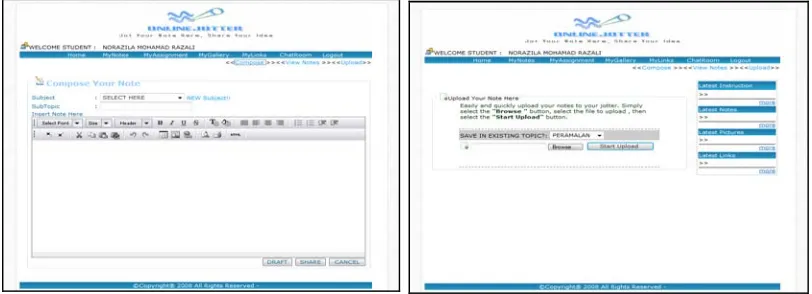
Perkins (2005) suggested that reflection on problem solutions that focuses on understanding abstract concepts indicate improved learning. In advocating this, all of the images in Figure 1 show how the prototype system will allow students to write ideas, edit previous entries, create and organize materials, tag them, and store for future review. Figure 1 (a) shows how students can create and edit their work and store them. Figure 1(b) shows how students can store their edited work, as well as, organize their downloaded materials.
Debate and discussions will take place in the designated chat rooms which will engage students in online discussions. Instructors will be able to post conferences, and students will be able to post questions, ideas, ways and perspectives to solve problems posted earlier. Figure 1(c) and 1(d) show how and where students may do so in the system.
(c) chat venue entry (d) posing of messages
It was also suggested that better learning take place when students articulate thus reviewing their understanding. Reflective articulation will be an important function of this tool, allowing students to write down, review and revise their prior concepts appropriate to responses they receive from the collaborative discussions. Concept transformation may occur and may be discerned upon comparison to prior concepts recorded in earlier personal brainstorming. Figure 1(e) shows the personal folders in which students can keep their work to be retrieved for future review.
Figure 1(e) Students’ personal folders
VI SUMMARY
Since the transformation of students’ concepts in the course of their online learning will be studied, identifying and categorizing students’ responses will be the major task in this research. Selected individual students’ learning responses will be categorized into their prior, shared and constructed knowledge. We will examine for any change or richness in students’ concepts or ideas, their attitudes and/or perceptions during the whole course of collaborative learning. This may also be materialized in the form of students’ reflective articulation, or, compositions written stored in their personal folders. Students will write in their own way about what they have learned from the collaborative discussions and compare with their prior thoughts about the concepts of the learning content. Instructors will prompt in each student’s conference to cast students’ awareness about the changes in their learning.
REFERENCES
Aviv, R. Erlich, Z., Ravid, G. & Geva, A. (2003). Network analysis of knowledge
construction in asynchronous learning networks. Journal of Asynchronous Learning
Networks, 7(3), 1-23. http://www.sloan-c.org/publications/jaln/v7n3/v7n3_aviv.asp
Biesenbach-Lucas, S. (2003). Asynchronous discussion groups in teacher training
classes: Perceptions of native and non-native students. Journal of Asynchronous Learning
Networks, 7(3), 24-46.
Collings, P. & Pearce, J. (2002). Sharing designer and user perspectives of web site
evaluation: A cross-campus collaborative learning experience. British Journal of
Educational Technology, 33(3), 267-278.
Cook, D. and Ralston, J. (2003). Sharpening the focus: Methodological issues in
analsysing on line conferences. Technology, Pedagogy and Education, 12(3), 361-376.
Galanouli, D. & Collins, J. (2000). Using unmediated computer conferencing to promote
reflective practice and confidence-building in initial teacher education. Technology,
Garrison, D.R. (1993). A cognitive constructivist view of distance education: An analysis
of teaching-learning assumptions. Distance Education, 14(2), 199-211.
Harasim, L.M. (Ed.). (1990). Online education: Perspectives on a new environment. New
York: Praeger.
Hawkey, K. (2003). Asynchronous text-based discussion: A case study with trainee
teachers. Education and Information Technologies, 8(2), 165-177.
Hiltz, S.R. (1994). The virtual classroom: Learning without limits via computer networks.
Norwood, NJ: Ablex.
Honebein, P., Duffy, T.M., & Fishman, B. (1993). Constructivism and the design of
learning environments: Context and authentic activities for learning. In T.M. Duffy, J.Lowyck, & D.
Hubscher-Younger, T. & Narayanan, N. (2003). Authority and convergence in
collaborative learning. Computers and Education, 41, 313-334.
Jonassen (Eds.), Designing environments for constructivist learning. Heidelberg: Springer-Verlag.
Jonassen, D.H., & Rohrer-Murphy, L. (1998, February). Activity theory as a framework
for designing task analyses for constructivist learning environments. Paper presented at the annual conference of the Association for Educational Communications and
Technology, St. Louis,MO.
Koory, M. (2003). Differences in learning outcomes for the online and F2F versions of an
introduction to Shakespeare. Journal of Asynchronous Learning Networks, 7(2), 18-34.
Light, P., Nesbitt, E., Light, V. & White, S. (2000). Variety is the spice of life, student
use of CMC in the context of campus based study. Computers and Education, 34,
257-267.
Martinez A, Dimitriades, Y, Rubia, B, Gomez, E. & de la Fuente, P. (2003). Combining qualitative evaluation and social network analysis for the study of classroom interactions.
Oh, S.; Jonassen, D. H. Scaffolding Online Argumentation during Problem-Solving Journal of Computer-Assisted Learning v23 n2 p95-110 Apr 2007 16pp.
Perkins, Simon C. (2005) Towards a socio-constructivist approach to learning and
teaching within OLT environments. In Perkins, Simon C., Eds. Proceedings OLT 2005
Conference, pages pp. 209-214.
Puntambekar, S. (2006) Analyzing Collaborative Interactions: divergence, shared
understanding and construction of knowledge Computers and Education 47 p332-351
Seabrooks, J., Kenney, S. & LaMontagne, M. (2000). Collaboration and virtual
mentoring: Building relationships between pre-service and in-service special education
teachers. Technology, Pedagogy and Education, 9(2), 219-236.
Stacy, E. (1999) Collaborative Learning in an Online Environment. Journal of Distance
Education
Swan, K. (2002). Building learning communities in online courses: The importance of
interaction. Education, Communication and Information, 2(1), 23-49.
Thomas, M. (2002). Implementing a CMC tutor group for an existing distance education
course. Journal of Computer Assisted Learning, 18(3), 351-366.
Tolmie, A. & Boyle, J. (2000). Factors influencing the success of computer mediated communication (CMC) environments in university teaching: A review and a case study.
Computers and Education, 34, 119-140.
Wallace, R. (2003). Online learning in higher education: A review of research on
interactions among teachers and students. Education, Communication and Information,
3(2), 241-280.
Watson, G. & Prestridge, S. (2003). A networked learning community approach to
sustain teacher ICT professional development. Australian Journal of Educational
Technology, 19(2), 227-240.
Yang, H. & Tang, J. (2003). Effects of social network on students' performance: a web