Volume 3, Number 2, December 2008
Predictors of Intention To Continue
Using Internet Banking Services:
An Empirical Study of Current Users
Huam Hon Tat & Khalil Md Nor Faculty of Management and Human Resource Development Universiti Teknologi Malaysia, Malaysia
[email protected] [email protected]
&
Eng Tzu Yang, Khor Jia Hney, Lim Yik Ming
& Tan Li Yong
Faculty of Accountancy and Management, University Tunku Abdul Rahman, Malaysia
ABSTRACT
The Internet presents the banking industry with an electronic and remote distribution channel. Wherease many studies examined the intention to use Internet banking, this study investigates predictors of intention among current users to continue using the services. Questionnaires were distributed to 210 residents in Klang Valley, Malaysia, of whom 204 (97.1%) responded to the survey. The findings demonstrated that, among the predictors tested, trust was found to be the strongest predictor of intention to continue using Internet banking, followed by compatibility and ease of use. Recommendations to Internet banking service providers and discussions for future study are provided.
International Journal of Business and Information
1. INTRODUCTION
There has been a fundamental shift in the use of banking delivery channels toward self-service channels such the Internet [Hernández-Ortega, 2007]. Internet banking, which was introduced in the early 1990s [Srivastava, 2007], makes it possible to replace the manual service functions provided by bank employees, along with the brick and mortar investment required of financial institutions [Dandapani, et al., 2008]. It represents an electronic marketplace where consumers may conduct their financial transactions virtually [Reiser, 1997; Daniel, 1999].
Today, financial service institutions that offer their services over the Internet are keen to accelerate the adoption process, knowing that the cost of delivering the service over the Internet is much less than delivering the same service over-the-counter [Polatoglu and Ekin, 2001]. In addition, Internet banking is an important innovation that presents institutions a vital distribution channel, which could act as a means of attaining competitive advantage through cost reduction and better satisfaction of customer needs [Carrington, et al., 1997; Kassim and Abdulla, 2006; Mols, 1999].
In response to the increased competition, banks in Malaysia are starting to leverage the Internet as a means to provide financial services. An empirical study by Sulaiman, et al. [2005] suggests that the adopters' perceptions of e-banking in developing countries appear to be very favorable. In Malaysia, however, despite the authorities‟ encouragement to the public to adopt Internet banking, traditional branch-based retail banking remains the most common method for conducting banking transactions. For example, Sivanand, et al. [2004] found that, although more than 80% of their respondents were aware of Internet banking, less than 10% were currently using the services.
With regard to information technology adoption, previous studies have suggested that the set of beliefs that influences an individual to adopt the technology may not be the same as the set of beliefs that leads to his or her initial adoption [Venkatesh, et al., 2003]. According to Kruglanski and Klar [1985], each time a particular goal of an individual is achieved by a specific behavior, the cognitive link between the behavior and goal becomes stronger. The result is a cognitive goal-behavior link that creates an automatic response behavior (i.e., habit). This may suggest that factors that are considered by an individual in the initial stage of adoption may be different from the factors that are considered by him or her after using the technology.
Volume 3, Number 2, December 2008
In another aspect, previous literature has highlighted numerous barriers to the adoption of Internet banking. One local finding suggests that the adoption of Internet banking is not so encouraging in Malaysia mainly because of factors such as lack of Internet accessibility, poor awareness, and security concerns [Suganthi, et al., 2001].
Although there is sufficient evidence that the electronic revolution has commenced in Malaysia, Internet banking research, however, is still in its infancy, particularly with regard to the predictors of intention among current users to continue using the services. This study was undertaken, therefore, to better understand the predictors that may influence current Internet banking users to continue using these services.
This paper attempts to determine predictors that may influence the current users of Internet banking to continue using the services. Based on the literature reviewed, we strongly believe that trust, compatibility, and ease of use are key predictors of their intention to continue using Internet banking services. The current users of Internet banking services in Klang Valley, Malaysia, were chosen as the population of this study.
We hope to shed some light on answers to the following question: “Do trust, ease of use, and compatibility significantly contribute to the intention of current users to continue using Internet banking services?” The findings of the present paper can contribute in the following manner. If trust, compatibility, and ease of use are significant in influencing the current users‟ intention to continue using the services, financial institutions that provide Internet banking should then emphasize and focus on these determinants to ensure that current users will continue using the services.
2. CONCEPTUAL BACKGROUND
This section discusses three predictors of the intention to use Internet banking – trust, compatibility, and ease of use.
2.1. Trust
Among the predictors of the intention to use Internet banking, trust has been found to be one of the most important factors that influence an individual to use the technology [Md Nor and Pearson, 2007]. Trust is also a vital factor in determining whether an individual chooses to purchase goods or services via the Web [Quelch and Klein, 1996]. As noted by Spekman [1988], trust is the cornerstone of the strategic partnership between a business and its Internet customer.
International Journal of Business and Information
affected by trust, which in turn is affected by a consumer‟s perception of the size and reputation of the store.
Trust is a prominent influence on an individual‟s willingness to engage in online exchanges of money and personal sensitive information [Wang, et al., 2003]. Trust tends to influence an individual‟s general buying decisions. According to Enders, et al. [2006], non-Internet believers require a substantial effort of persuasion before they start engaging in e-banking and create an e-habit. An empirical study by Poon [2008] indicates that approximately 70% of his Malaysian respondents agree that trust is influencing them to use Internet banking. In another empirical study in Singapore by Fock and Koh [2006], the authors found that higher levels of trust are significantly associated with a greater willingness to try Internet banking. In this perspective, it is reasonable to hypothesize that:
H1: The perception of trust will have a positive relationship to
the intention to continue using Internet banking services.
2.2. Compatibility
Perceived compatibility reflects the degree to which the use of an innovation is considered by the individual as consistent with his/her values, socio-cultural beliefs, and past and present experiences [Rogers, 1995]. Rogers defines perceived compatibility as the degree to which an innovation is seen to be compatible with existing values, beliefs, experiences, and needs of adopters. It also refers to the fact that an innovation is more likely to be adopted when it is compatible with an individual‟s job responsibilities, value, and system [Agarwal and Prasad, 1997].
Compatibility is a measure of the values or beliefs of individuals, the ideas they have adopted in the past, and the ability of an innovation to meet their needs [Gerrard and Cunningham, 2003]. As noted by Ndubisi and Sinti [2006]:
“Given that individuals have already established personal banking norms, lifestyle, finance management system, and account monitoring mechanism prior to the advent of Internet banking, their acceptance or rejection of this new mode will rely greatly on the extent this new mode accommodates or rejects all or some of the past values.” (p. 24).
Based on the above discussions, we postulate that current users‟ intention to continue using Internet banking services is subjected to their perception in term of the compatibility of the service with the previous mode of doing their financial activities.
H2: Perceived compatibility will have a positive relationship with
the intention to continue using Internet banking services.
2.3. Ease of Use
Volume 3, Number 2, December 2008
In the context of a Web site, ease of use may refer to an easy-to-remember URL address, a well-organized format, easy site navigability, and concise and understandable contents, terms, and conditions [Santos, 2003].
According to Davis [1989], perceived ease of use refers to the degree to which a person believes that using a particular system would be free of effort. It is one of the important measures of user satisfaction, system adoption, or information systems (IS) success [Moore and Benbasat, 1991], and has been studied extensively in the context of information technology (IT) adoption and diffusion.
In applying the perceived ease of use construct in the Internet banking context, banks should focus on Web site navigation and applicable functions to cater the needs of their users [Raman, et al., 2008].
From the preceding remarks, it is thus reasonable to state that perceived ease of use may affect a current user‟s intention to continue using Internet banking. Thus, the following hypothesis is proposed:
H3: Perceived ease of use will have a positive relationship with
the intention to continue using Internet banking services.
3. METHODOLOGY
This section contains a discussion of the sampling frame, measures used in this study, and statistical methods employed.
3.1. Sample
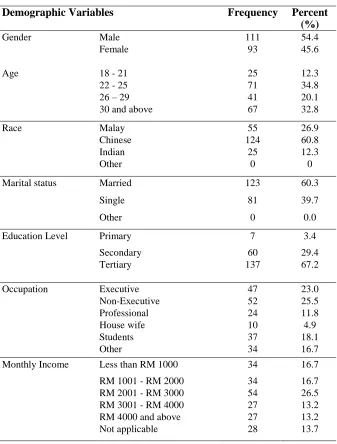
The population of this study was current users of Internet banking services in Klang Valley, Malaysia. The sampling frame chosen was residents who had already been exposed to at least one online banking transaction. Out of 210 questionnaires distributed, 204 (97.1%) of them were usable for data analysis. The profile of the respondents is depicted in Table 1.
The sample shows that the number of male (54.0%) respondents is slightly higher than the number of female (46.0%) respondents. In terms of race, there is a greater representation of Chinese (60.8%) respondents, followed by Malay (27.0%) and Indian (12.2%) respondents. The sample shows that the largest age group that responded was from 22 to 25 years of age (34.8%), followed by age 30 and above (32.8%), age 26 to 29 (20.1%) and age 18 to 21 (12.3%).
International Journal of Business and Information
Table 1 Profile of Respondents
Demographic Variables Frequency Percent
(%)
Gender Male
Female
111 93
54.4 45.6
Age 18 - 21
22 - 25 26 – 29 30 and above
25 71 41 67 12.3 34.8 20.1 32.8
Race Malay
Chinese Indian Other 55 124 25 0 26.9 60.8 12.3 0
Marital status Married 123 60.3
Single 81 39.7
Other 0 0.0
Education Level Primary 7 3.4
Secondary Tertiary 60 137 29.4 67.2
Occupation Executive
Non-Executive Professional House wife Students Other 47 52 24 10 37 34 23.0 25.5 11.8 4.9 18.1 16.7
Monthly Income Less than RM 1000 34 16.7
Volume 3, Number 2, December 2008
3.2. Measurement
In general, the measures used in this study were modified from previous research. The measures used to gauge trust and compatibility were adapted from Slyke, et al. [2004], and comprised five and seven items, respectively. The work of Wang, et al. [2003] was adapted to measure ease of use (7 items) and intention to continue using Internet banking services (3 items).
The respondents were asked to rate on a 5-point Likert scale (1 = “Strongly Disagree” to 5 = “Strongly Agree”). The Cronbach‟s alpha for trust, compatibility, ease of use, and intention to continue using Internet banking services were 0.89, 0.80, 0.79, and 0.91, respectively, thus providing evidence of reliability.
3.3. Statistical Methods
In order to have a summary measure of the strength of the relationships among the research variables, a Pearson correlation analysis was conducted to indicate the direction, strength, and significance of the bivariate relationships. Multiple regression analyses were performed to test the relationship between the current users‟ intention to continue using Internet banking services and its three independent variables; namely, trust, compatibility and ease of use.
Using the recommendation of Hair, et al. [1998], we also conducted the following analyses to test the assumptions of regression analyses: linearity, homoscedasticity, normality, and outliers identification.
4. RESULTS
Table 2 presents the scale means, standard deviation and correlations for the study„s variables. Scrutiny of the pair wise correlations among trust, compatibility, ease of use, and the intention to continue using Internet banking services provides an early support for positive significance direct relationships. Compared with other variables, trust (r = 0.70, p < .01) had the strongest correlation with the intention to continue using Internet banking services, followed by compatibility (r = 0.62, p < .01) and ease of use (r = 0.61, p < .01).
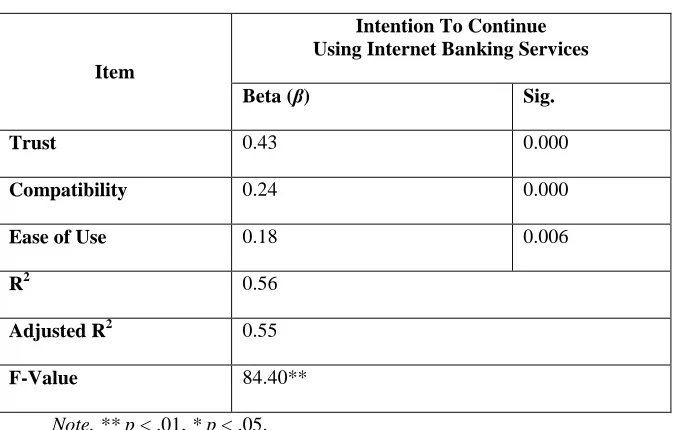
Multiple-regression analysis was used to assess the direct effect of trust, compatibility, and ease of use on intention to continue using Internet banking services. The results are summarized in Table 3, which shows that the trust, compatibility, and ease of use all positively and significantly affected the intention to continue using Internet banking services.
International Journal of Business and Information
Table 2
Descriptive Statistics and Correlations
Item M SD 1 2 3 4
Trust 3.42 0.24 0.62** 0.64** 0.70**
Compatibility 3.84 0.63 0.62** 0.63** 0.62**
Ease of Use 3.45 0.64 0.64** 0.63** 0.61**
Intention to Continue Using Internet Banking Services
3.85 0.64 0.70** 0.62** 0.61**
Note. ** p < .01, * p < .05.
Table 3
Multiple Regression Results for
Trust, Compatibility, and Ease of Use on Dependent Variable (Intention to Continue Using Internet Banking Services)
Item
Intention To Continue Using Internet Banking Services
Beta (β) Sig.
Trust 0.43 0.000
Compatibility 0.24 0.000
Ease of Use 0.18 0.006
R2 0.56
Adjusted R2 0.55
F-Value 84.40**
Volume 3, Number 2, December 2008
5. DISCUSSION
Our findings reveal that, among the three predictors tested – namely, trust, compatibility, and ease of use – trust was found to have the strongest positive influence on the intention to continue using Internet banking services. The fact that trust has the strongest positive significance influence corroborates findings from earlier studies [Kassim and Abdulla, 2006; Md Nor and Pearson, 2007].
These findings provide useful practical implications. In this respect, it is of paramount importance for the providers of Internet banking services to develop Internet banking systems that are trustworthy through high levels of security and privacy protection. This assurance will provide current users of Internet banking services with a high level of trust, which will consequently encourage them to continue using the services.
One of the ways to build high levels of trust and improve communication is to have a “visible” contact. This strategy has usually been overlooked by Internet banking providers. For example, the hotline operator can be equipped with a video Web camera instead of a telephone. Video conferencing through the Internet banking platform can become a great way to communicate directly with the Internet banking user [Raman, et al, 2008]. They noted that video conferencing may lead to higher trust among current users of Internet banking as the result of the “feel of touch” they experience by seeing a visual object of human customer service, leading them to infer reliable support in the case they need help.
The results of this study also show that the effect of perceived compatibility on the intention to continue using Internet banking has a greater influence on intention than does the effect of perceived ease of use. This phenomenon can be explained by the target samples used in this study; i.e., current users of Internet banking.
These users are accustomed to making Internet banking their mode of financial transaction. Their experience in using the services may result in fewer problems in navigating the site and a better understanding of the site content, terms, and conditions. Hence, perceived ease of use might be of less concern to them when using Internet banking services.
On the other hand, compatibility of Internet banking with the lifestyle, beliefs, and experiences of current users has more influence on the intention to continue using the service. This suggests that users are more particular with an innovation that is close to what they already know and use.
International Journal of Business and Information
6. CONCLUDING REMARKS
This study indicates that trust is the most important factor that influences the intention of current users of Internet banking to continue using the service, followed by compatibility and ease of use. In conclusion, building trust with current users should be the primary concern of Internet banking providers. To increase the retention rate of current Internet banking users, it is imperative that banks in Malaysia ensure a secure Internet banking system.
Although this study has generated some interesting findings, it is not without limitations. One of them is related to the design of the questionnaire, which was available only in the English language. Respondents who do not know English had difficulties answering the questionnaire.
In addition, this study considered only three predictors (trust, compatibility, and ease of use) that influence the continued use of Internet banking services. There may be other predictors, such as perceived risk, usefulness, and relative advantage, that can influence the criterion variable.
Future studies should translate the questionnaire into other languages (e.g., Malay and Chinese) to enable some respondents to answer the questions more effectively. In addition, to overcome the limitation of this study, which looked at only three factors, future studies should consider other predictors, such as perceived risk and usefulness, in order to obtain a more in-depth understanding of the elements that influence the intention to continue using Internet banking services.
REFERENCES
Agarwal, R., and Prasad, J. 1998. The role of innovation characteristics and perceived voluntariness in the acceptance of information technologies, Decision Sciences 28(3), 557-584.
Carrington, M.; Languth, P.; and Steiner, T. 1997. The Banking Revolution – Salvation or Slaughter, Pitman: London.
Cooper, R.G. 1997. Examining some myths about new product winners, In Katz, R. (ed.), The Human Side of Managing Technological Innovation, Oxford, pp. 550-560.
Dandapani, K.; Karels, G.V.; Lawrence, E.R. 2008 . Internet banking services and credit union performance, Managerial Finance, 34(6), 437-446.
Daniel, E. 1999. Provision of electronic banking in the UK and Republic of Ireland, International Journal of Bank Marketing, 17(2), 72-83.
Davis, F.D. 1989. Perceived usefulness, perceived ease of use, and user acceptance of information technology, MIS Quarterly, 13(3), 319-340.
Volume 3, Number 2, December 2008
Fock, S.T.; and Koh, H.C. 2006. Conceptualization of trust and commitment, and understanding the relationships between trust, commitment and willingness to try Internet banking services, Journal of Business and Information, 1(2), 1-24.
Gefen, D. 2000. E-commerce: The role of familiarity and trust, Omega, 28(6), 725-737. Gerrard, P.; and Cunningham, J.B. 2003. The diffusion of internet banking among
Singapore consumers, The Journal of Bank Marketing, 21(1), 16-28.
Hair, J.F. Jr.; Anderson, R.E.; Tatham, R.L; and Black, W.C. 1998. Multivariate Data Analysis. Upper Saddle River, NJ: Prentice-Hall.
Hernández-Ortega, B.; Jiménez-Martinez, J.; Hoyos, M.J.M. 2007. An analysis of Web navigability in Spanish Internet banking, Journal of Internet Banking and Commerce 12(3), 1-8.
Jarvenpaa, S.L.; Tractinsky, N.; and Vitale, M. 2000. Consumer trust in an internet store, Information Technology and Management 1, 45-71.
Kassim, N. M., and Abdulla, A.K.M.A. 2006. The influence of attraction on Internet banking: An extension to the trust-relationship commitment model. The International Journal of Bank Marketing 24(6), 424-442.
Kruglanski, A.W., and Klar, Y. 1985.. Knowing what to do: On the epistemology of actions. In Kuhl, J., and Beckmann, J. (eds), Action Control: From Cognition to Behavior, Springer-Verlag, Berlin, The Federal Republic of Germany.
Md Nor, K.M., and Pearson, J.M. 2007. The influence of trust on Internet banking acceptance, Journal of Internet Banking and Commerce 12(2), 1-10.
Mols, N.P. 2002. The Internet and the banks strategic distribution channel decisions, International Journal of Bank Marketing 17(6), 295-300.
Moore, G,C., and Benbasat, I. 1991. Development of an instrument to measure the perception of adopting an information technology innovation, Information Systems Research 2(3), 192-222.
Ndubisi, N.O., and Sinti, Q. 2006. Consumer attitudes, system‟s characteristics and Internet banking adoption in Malaysia, Management Research News 29(1/2), 16-29. Polatoglu, V.N., and Ekin, S. 2001. An empirical investigation of the Turkish consumers‟ acceptance of Internet banking service, International Journal of Bank Marketing 19(4), 156-65.
Poon, W. 2008. Users‟ adoption of e-banking services: The Malaysian perspective, The Journal of Business and Industrial Marketing 23(1), 59-.
Porter, J. 1998. Jeff Bezos on Amazon‟s Personalization Strategy, downloadable from
Web site
http://bokardo.com/archives/jeff-bezos-on-amazons-personalization-strategy/.
Quelch, J.A., and Klein, L.K. 1996. The Internet and international marketing, Sloan Management Review, Spring, 60-75.
Raman, M.; Stephenaus, R.; Alam, N.; and Kuppusamy, M. 2008. Information technology in Malaysia: E-service quality and update of Internet banking, Journal of Internet Banking and Commerce 13(2), 1-18.
Reiser, S.J. 1997. The Information highway and electronic commerce: What does it mean for you? Current Issues, March, 12-15.
Ridings, C.M.; Gefen, D.; and Arinze, B. 2002. Some antecedents and effects of trust in virtual communities, Journal of Strategic Information Systems 11, 271–295.
Rogers, E.M. 1995. Diffusion of Innovations. The Free Press: New York, NY.
International Journal of Business and Information
Sivanand, C.N.; Geeta, M.; and Suleep. 2004. Barrier to mobile Internet banking services adoption: An empirical study in Klang Valley of Malaysia, The Internet Business Review 1, 1-17.
Spekman, R.E. 1988. Strategic supplier selection: Understanding long-term buyer relationships, Business Horizons, July/August, 75-81.
Srivastava, R.K. 2007. Customer‟s perception on usage of Internet banking, Innovative Marketing 3(4), 66-75.
Slyke, C.V.; Belanger, F. ; and Comunale, C.L. 2004. Factors influencing the adoption of Web-based shopping : The impact of trust, Database for Advances in Information Systems 35(2), 32-51.
Soderlund, M., and Ohman, N. 2003. Behavioral intentions in satisfaction research revisited, Journal of Consumer Satisfaction, Dissatisfaction and Complaining Behavior 16, 53-66.
Suganthi, Balachandher, and Balachandran. 2001. Internet banking patronage an empirical investigation of Malaysia, Journal of Internet Banking and Commerce, downloadable from Web site www.arraydev.com/commerce/JIBC/0103_01.htm. Sulaiman, A.; Lim, C.H.; and Wee, A. 2005. Prospects and challenges of E-banking in
Malaysia, The Electronic Journal of Information Systems in Developing Countries,
downloadable from Web site
http://new.ejisdc.org/ojs/include/getdoc.php?id=167&article=184&mode=pdf. Venkatesh, V.; Morris, M.G.; Davis, G.B.; and Davis, F.D. 2003. User acceptance of
information technology: toward a unified view, MIS Quarterly 27(3), 425-478. Wang, C.C., and Lee, H.Y. 2003. E-mail Rumors and Forwarding Behavior. Paper
presented at the International Conference of Pacific Rim Management, Washington: Seattle.
Zeithaml, V.A.; Berry, L.L.; and Parasuraman, A. 1996. The behavioral consequences of service quality, Journal of Marketing 60, 31-46.
ABOUT THE AUTHORS
Huam Hon Tat is a senior lecturer of management, specializing in marketing. He has
presented works at international conferences and has published works in international and regional journals in the areas of personality, life satisfaction, entrepreneurship, organizational behavior, and services marketing. He has supervised students at the undergraduate, master‟s, and doctoral levels.
Khalil Md Nor is a senior lecturer at the Department of Management, Faculty of
Management and Human Resource Development, Universiti Teknologi Malaysia. He has published and presented papers nationally and internationally. His research interests are in the areas of technology adoption, knowledge management, and e-commerce.
Eng Tzu Yang, Khor Jia Hney, Lim Yik Ming, and Tan Li Yong are marketing