Computational Linguistics and Chinese Language Processing
Vol. 10, No. 4, December 2005, pp. 445-458 445 © The Association for Computational Linguistics and Chinese Language Processing
[Received April 12, 2005; Revised June 13, 2005; Accepted August 15, 2005]
Feature Representations and Logical
Compatibility between Temporal Adverbs and Aspects
Shih-Min Li
∗, Su-Chu Lin
∗and Keh-Jiann Chen
∗Abstract
In this paper, we propose clear-cut definitions of distinct temporal adverbs and provide descriptive features for each class of temporal adverbs. By measuring time points in temporal axis, we revise and reclassify the temporal adverbs listed in [Lu and Ma 1999] into four classes of semantic roles, namely, time, frequency, duration, and time manner. The descriptive features enable us to distinguish temporal relations and predict logical compatibility between temporal adverbs and aspects.
Keywords: Temporal Adverbs, Aspects, Temporal Schema, Speaking Time, Reference Time, Event Time
1.
Introduction
There are about 130 temporal adverbs in Mandarin Chinese. Lu and Ma [1999] classified temporal adverbs into two groups, speaking-time related adverbs (abbr: ST-related adverbs, 定時時間副詞) and reference-time related adverbs (abbr: RT-related adverbs, 不定時時間副 詞). The ST-related adverbs consist of 27 temporal adverbs, which are subdivided into three subclasses. In the class of RT-related adverbs, 104 temporal adverbs are listed and subdivided into 18 subclasses. In Lu and Ma’s definition, ST-related adverbs modify events that happen at specific time points; RT-related adverbs modify events that have happened in the past or will happen in the future. However, the subdivisions are vague, and the definition is incomprehensible. For example, cengjing 曾經, ceng 曾, yeyi 業已 and yejing 業經 are grouped into two different subclasses of ST-related adverbs. The former two are grouped into the same subclass, which includes actions or situations that happened or existed before the speaking time. The later two are grouped into the same subclass, which includes actions or situations have been completed or have occurred. In fact, it is difficult to differentiate between actions or situations that have ‘happened’ or have ‘completed’, especially when the situation type is an achievement situation with SHORTLY-PRECEDE(t1,t2) or NEARLY-EQUAL
∗
446 Shih-Min Li et al.
(t1,t2).1
Moreover, temporal adverbs may not have the same syntactic behaviour even though they are classified into the same subclass. For instance, the ST-related adverbs cong 從, conglai 從來, zhijin 至今, xianglai 向來, sulai 素來, lilai 歷來, su 素, and yixiang 一向 are grouped into the same subclass. When they co-occur with the aspect markers le 了, guo 過, and zhe 著, however, cong, conglai, and zhijin are incompatible with le and zhe; in addition, xianglai, sulai, lilai, su, and yixiang are incompatible with le and guo. The reason for the difference in the compatibility of temporal adverbs with aspects will be discussed in the following.
In this paper, based on the application of Smith’s proposal for temporal location, we suggest more clear-cut definitions and provide descriptive features for each subclass of temporal adverbs. The descriptive features help us to define temporal relations and to predict the compatibility between temporal adverbs and aspect markers.
2.
Literature Review and Methodology
To make clear-cut differentiations, time points in the temporal axis and the notion of temporal location proposed by [Smith 1991] will be used here to redefine the temporal relations of the temporal adverbs treated in [Lu and Ma 1999]. We will use the data in the Academia Sinica Balanced Corpus (Sinica Corpus) to analyze Mandarin Chinese temporal adverbs.
Smith [1991] discussed aspectual systems in language. She mentioned that the temporal information in a sentence is located in the time when the situation occurs. Adverbials further specify temporal location. Time is represented as a straight line stretching in both directions from Speech Time. The linear representation is presented in (1):
(1) Time Line [Smith 1991]
--- Speech Time --- Past Present Future
1
The terms SHORTLY-PRECEDE(t1,t2) and NEARLY-EQUAL(t1,t2) were mentioned by Yang and
Bateman [2002]. The predicate SHORTLY-PRECEDE(t1,t2) indicates that time point t1 only shortly
precedes time point t2. The predicated NEARLY-EQUAL(t1,t2) indicates that time point t1 lies close to
time point t2. Applying the terms to the explanation of achievements, we can treat t1 as Yang and
Bateman’s ti, the event initial time, and as Smith’s [1991] I, initial points, and regard t2 as Yang and
Bateman’s tf, the event finishing time, and as Smith’s F, final points. Yang and Bateman’s expression
Feature Representations and Logical Compatibility between 447 Temporal Adverbs and Aspects
Following Reichenbach [1947], to temporally locate all types of sentences, three times are required: Speech Time, Reference Time, and Situation Time. Speech Time (ST) is the center of the temporal system. Reference Time (RT) is the temporal standpoint of a sentence, and, in complex sentences, it is a secondary orientation point. Situation Time (SitT) is the time of the event or state, identified as the interval [I]. To show the temporal location of these three times, Smith [1991] gives example 2a and its time line 2b. In 2b, time 2 is Reference Time, while time 3 is Situation Time:
(2) a. Mary said last Tuesday that she was leaving in 3 days. b. …..time 2………..….time 3….……… time 1 last Tuesday + 3 days Speech Time
Mayr said Mary leave
Mandarin Chinese does not have the grammatical category of tense, so temporal location is expressed directly by adverbials and indirectly through the use of an aspectual viewpoint. Temporal adverbials function as locating adverbials, which are classified as deictic, anaphoric, or referential, according to the type of orientation they take [Smith 1991]. Furthermore, Smith illustrates each situation type and viewpoint type with temporal schemata. Below are the temporal schemata of the Mandarin Chinese aspectual markers le, guo, and zhe, which are represented by symbols I, F, F+1, …. and /:2
(3) Temporal schema for the –le perfective [Smith 1991]3 I F
/ / (RVC)
(4) The Mandarin –guo perfective viewpoint [Smith 1991] I ….F F+1
/ /
2
I and F indicate initial and final points. F+1 indicates a stage distinct from the final stage. The dots indicate internal stages and the slashes indicate the interval process.
3
448 Shih-Min Li et al.
(5) The –zhe viewpoint [Smith 1991] I….….
////State
Klein [1994] points out five temporal features and notes TT, TU and TSit. TT, topic time, is the time span to which the speaker’s claim on the occasion is confined. TU is the time of utterance, which is the time at which the utterance is made. TSit is the time of the situation, which is the time at which the situation occurs.
In addition to Smith’s and Klein’s terminology, we can apply the event modules in the MARVS framework proposed by Huang et al. [2000] to analyze the temporal relations of temporal adverbs. Event modules are the basic building blocks of the event contour. Five event modules stand alone or in combination; they are Boundary, Punctuality, Process, State, and Stage. The event module Boundary is defined as an event module that can be identified with a temporal point and must be regarded as a whole (including a complete Event). It is adopted in this paper to define the Boundary Point.
Yang and Bateman further discussed the semantic temporal relations of an aspect system and proposed principled semantic conditions for aspect combination. In their opinion, the Chinese aspect system is actually composed of both aspect morphemes (-le, -zhe, -guo4, etc.) and aspect adverbials. The Chinese aspect system has, basically, seventeen simple primary aspect forms. These simple primary aspect forms belong to perfective, imperfective, or future-existing subsystem, according to the semantic properties of individual cases. Some simple primary aspect forms can combine to form an aspect of secondary type if their temporal attributes are in harmony. The temporal relation of the combination is represented graphically by time points ti, tf, tr, and ts4
.
In this paper, we adopt the terms proposed in the research described above to clarify the temporal relation of each subclass of temporal adverbs listed in [Lu and Ma 1999]. We use the notations ST, RT, ET, BP, Start, and End to define temporal relations. Each, respectively, denotes the speaking time, reference time, event time, boundary point, start point of the event, and end point of the event. The symbols <, ≦, and =, respectively, indicates priority, inclusion and overlap in temporal location. For instances, the temporal features for le, guo, and zhe are defined as follows in our system and they are compatible with the temporal schemata proposed in [Smith 1991].
4
As the second footnote mentions, ti is the event initial time, and tf is the event finishing time. The
Feature Representations and Logical Compatibility between 449 Temporal Adverbs and Aspects
le: BP≦ST, which means that the prominent boundary point of the referred event precedes the speaking time;
guo: End<ST, which means that the end point of the referred event precedes the speaking time; zhe: ET=RT, which means that the referred event time overlaps with the speaking time.
3.
Temporal Relations and Compatibility between Temporal Adverbs and
Aspects
Temporal adverbs were classified by Lu and Ma into two classes, ST-related adverbs and RT-related adverbs, according to the time point of the situation referred to. ST-related adverbs establish constraints between event time (ET) and speaking time (ST), but RT-related adverbs establish constraints between ET and reference time (RT). For example, the ST-related adverb cengjing only denotes events or situations that happen or exist before ST. To be precise, the end points of events occur prior to ST. or example, the sentence wo shangci cengjing jieshao guo 我上次曾經介紹過 ‘I have introduced it last time’ is grammatical; however, *wo xiaci/mingtien cengjing jieshao guo 我 *下次/明天 曾經介紹過 ‘*I have introduced it next time/tomorrow’ is ungrammatical. The RT-related adverb yijing 已經 is used to refer to events that happen or exist before either a certain specific time, an event, or ST. For instance, the sentences shang libaiwu wo yijing chuguo le 上禮拜五我已經出國了 ‘I had gone abroad last Friday’ and xia libaiwu wo yijing chuguo le 下禮拜五我已經出國了 ‘I have gone abroad next Friday’ are both grammatical even though xia libaiwu is a future specific time.
Lu and Ma divided ST-related adverbs into three subclasses and RT-related adverbs into eighteen subclasses. Three subclasses of ST-related adverbs were subdivided into nine sub-subclasses. Eighteen subclasses of RT-related adverbs were subdivided into thirty sub-subclasses. Checking Sinica Corpus, we find that some of the RT-related adverbs in Lu and Ma’s classification behave like ST-related adverbs. Some temporal adverbs denote the order of events and establish constraints only between two ETs. Some temporal adverbs refer to habitual situations, which are not related to temporal relations. Therefore, our classification of temporal adverbs is somewhat different from Lu and Ma’s. In this paper, temporal adverbs are divided into four classes according to temporal relations. More detailed subclasses will be introduced in the following sections.
3.1
Temporal Relations and Compatibility between ST-related
Adverbs and Aspects
450 Shih-Min Li et al.
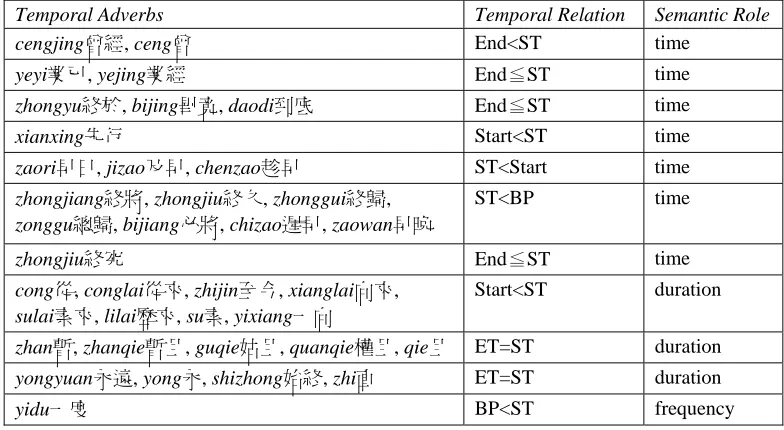
Table 1. Temporal relation and semantic role of each subclass of ST-related adverbs
Temporal Adverbs Temporal Relation Semantic Role
cengjing曾經, ceng曾 End<ST time
yeyi業已, yejing業經 End≦ST time
zhongyu終於, bijing畢竟, daodi到底 End≦ST time
xianxing先行 Start<ST time
zaori早日, jizao及早, chenzao趁早 ST<Start time
zhongjiang終將, zhongjiu終久, zhonggui終歸, zonggu總歸, bijiang必將, chizao遲早, zaowan早晚
ST<BP time
zhongjiu終究 End≦ST time
cong從, conglai從來, zhijin至今, xianglai向來, sulai素來, lilai歷來, su素, yixiang一向
Start<ST duration
zhan暫, zhanqie暫且, guqie姑且, quanqie權且, qie且 ET=ST duration
yongyuan永遠, yong永, shizhong始終, zhi直 ET=ST duration
yidu一度 BP<ST frequency
For instance, cengjing and ceng are grouped into the same subclass of ST-related adverbs. Since they denote actions or situations that happened or existed before ST, the end points of the situations precede ST. Thus, the temporal relation of cengjing and ceng is defined as End<ST.
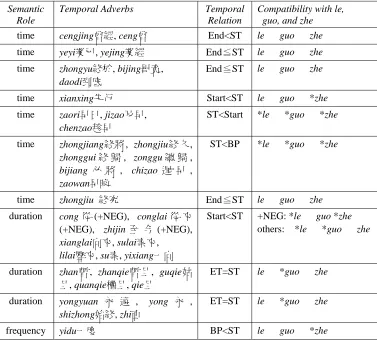
Temporal features not only clearly indicate the relations among these ST-related adverbs but also predict and verify the correctness of the co-occurrences of temporal adverbs and aspectual markers, including le, guo, and zhe, by unifying their temporal features. The temporal features of le, guo, and zhe are BP≦ST, End<ST, and ET=RT, respectively. If the corpus data shows that a given sentence is grammatical after the combination step, its combination of temporal relation will be in harmony; otherwise, there may be something wrong with the temporal relations or some other essential factors may cause incompatibility. On the other hand, we assume that by detecting harmony in the combination of temporal relations between temporal adverbs and aspects, we can predicate whether a given temporal adverb is compatible with le, guo, and zhe. Here, we will use an example with cengjing and ceng. The corpus data in the Sinica Corpus show the following combinations of cengjing with le, guo, and zhe:
(6) ceng jing co-occurs with le, guo, and zhe
a. 我們的通信曾經給了她很大的快樂
women de tongxin cengjing gei ta henda de kuaile
Feature Representations and Logical Compatibility between 451 Temporal Adverbs and Aspects
b. 我們曾經提過
women cengjing ti guo we had mentioned before
c. 曾經提著小包袱
cengjing ti zhe xiao baofu ever carried little backpack
The combination of cengjing with le, guo, and zhe is grammatical, so we conclude that the temporal relation of cengjing is correct and assign the semantic role of time to the subclass of cengjing and ceng. On the other hand, from the observation of the temporal relations of le, guo, zhe, and cengjing, the temporal relation of cengjing is compatible with that of le, guo, and zhe, respectively. Thus, before checking the data in the Sinica Corpus, we can predict the that co-occurrence of cengjing with le, guo, and zhe, respectively is grammatical. The grammatical sentences in (6) prove that our hypothesis and prediction are correct.
Temporal adverbs classified into the same subclass with the same temporal relation may not have the same syntactic behaviours. For instance, cong, conglai, zhijin, xianglai, sulai, lilai, su, and yixiang are grouped into the same subclass and assigned the semantic role of duration. The temporal relation of these temporal adverbs is defined as Start<ST. We find, however, that cong, conglai, and zhijin are incompatible with le and zhe; in addition, xianglai, sulai, lilai, su, and yixiang are incompatible with le and guo. Although this subclass of ST-related adverbs has the above temporal relation, their compatibility with aspectual markers is somewhat different. The Sinica Corpus sentences shown below reveal that cong, conglai, and zhijin are usually found in negative sentences. The feature [+NEG] brings about the different syntactic behaviours:
(7) 好像這件事從沒發生過
hoaxing zhejian shicong mei fasheng guo It seems this thing hasn’t happened before.
(8) 從來不會逃避
454 Shih-Min Li et al.
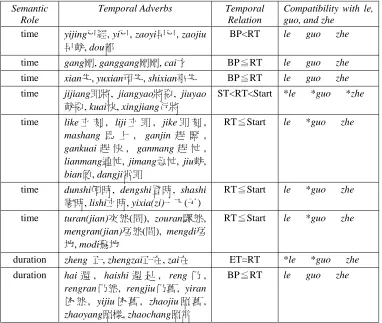
(11) 已經吃過飯
yijing chiguo fan have had a meal
(12) 蛇已經咬著他了
she yijing yao zhe ta le A snake has bitten him.
We find that the combinations of temporal relations of some classes and those of aspect markers contradict the corpus data. The temporal adverbs classified in subclasses with like, dunshi, and turan(jian) indicate situations or events that happen immediately after ST or another situation. Their temporal relation is defined as RT≦Start. The corpus data show that these RT-related adverbs are incompatible with guo; however, their temporal relation RT≦Start is compatible with guo. Sentence (13) shows the temporal relation of like between RT and ST:
(13) 他一聽到消息,立刻回了電話
ta yi tingdao xiaoxi like hui le dianhua
He immediately called back when he got the news.
456 Shih-Min Li et al.
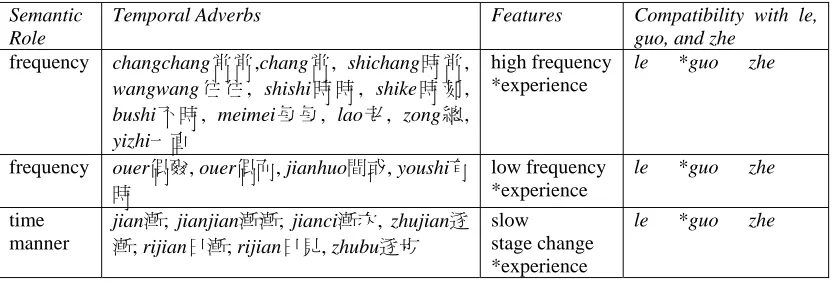
time manner
suishi隨時 preparatory *le *guo zhe
time manner
anshi按時, anqi按期 preparatory
regular
*le *guo *zhe
4.
Conclusion
In sections 3-1 to 3-4, we classified the temporal adverbs listed by Lu and Ma into four main classes. The subclasses in each main class are somewhat different from Lu and Ma’s although the majority are similar. Lu and Ma’s two-class classification of temporal adverbs is vague, so we adopt four more detailed classes. The corpus data in the Sinica Corpus verify the correctness of our temporal relations. In addition, the co-relations of temporal relations between temporal adverbs and the aspect markers le, guo, and zhe help us to predict the co-occurrences of temporal adverbs with aspect markers. The feature representations of temporal relations are also helpful for assigning semantic roles to temporal adverbs in the Sinica Treebank.
In future work, if necessary or for other reasons, the subclasses of temporal adverbs may be subdivided into sub-subclasses. Furthermore, certain classes of temporal adverbs can co-occur grammatically, while certain classes cannot.
(14) 他曾先行離去
ta ceng xianxing liqu He had left in advance.
(15) *他曾早日離去
ta ceng zaori liqu He had left soon.
Feature Representations and Logical Compatibility between 457 Temporal Adverbs and Aspects
References
Allen, J. F., “Towards a General Theory of Action and Time,” Artificial Intelligence, 23, 1984, pp.123-154.
Huang, C.-R., K. Athens, L.-L. Chang, K.-J. Chen, M.-C. Liu, and M.-C. Tsai, “The Module-Attribute Representation of Verbal Semantics: From Semantics to Argument Structure,” International Journal of Computational Linguistics and Chinese Language Processing, 5(1), 2000, pp.19-46.
Klein, W., Time in Language, Routledge , London, 1994.
Lu, J., and Z. Ma (陸儉明&馬真), “關於時間副詞” 現代漢語虛詞散論, 1999, pp.98-127. Reichenbach, H., Elements of Symbolic Logic, Macmillan, London, 1947.
Smith, C. S., The Parameter of Aspect, Kluwer Academic Publishers, Dordrecht. 1991.
Yang, G.-W., and Bateman John A., “The Chinese Aspect System and its Semantic Interpretation,” In Proceedings of 2002 COLING II, 2002, Academia Sinica, Taipei, pp.1128-1134.
Website Resources
Huang, C.-R., MARVS, http://corpus.ling.sinica.edu.tw/course/marvs/index.html,2001.
Academia Sinica, Sinica Corpus, version 4.0, http://www.sinica.edu.tw/SinicaCorpus/index.html, 2001.