A Comparison of Machine Learning Algorithms
for Prepositional Phrase Attachment
Brian Mitchell & Robert Gaizauskas
Department of Computer Science, University of Sheffield, Regent Court, Portobello Road, Sheffield. S1 4DP UK
brianm,robertg @dcs.shef.ac.uk
Abstract
This paper presents work which extends previous corpus-based work on training Machine Learning Algorithms to perform Prepositional Phrase attachment. Besides recreating others’ experiments to see how algorithms’ performance changes with the number of training examples and using n-fold cross-validation to produce more accurate error rates, we implemented our own vanilla Machine Learning Algorithms as a comparison. We also had people perform exactly the same task as the Machine Learning Algorithms to indicate whether the way forward lies in improving Machine Learning Algorithms or in improving the data sets used to train Machine Learning Algorithms. The results from all these experiments feed into our other work transforming the Penn TreeBank into a more useful resource for training Machine Learning Algorithms to do Prepositional Phrase attachment.
1.
Introduction
This paper presents work which takes extra steps be-yond previous attempts to train a learning algorithm for Prepositional Phrase Attachment using the Penn TreeBank (Marcus et al., 1993) as the data source. Besides recreating others’ experiments — Error-Driven Transformation-Based Learning by Brill and Resnik (1994) — we extended these experiments in four ways: first by changing the number of training examples and second by performing 10-fold cross-validation. Moreover, we performed the same two compar-isons with basic implementations of simple Machine Learn-ing Algorithms (MLAs). Finally, a novel Web-based exper-iment to measure human performance at exactly the same task was set up.
Each of these extensions had a purpose: whereas the point of changing the number of training examples seen by a Machine Learning Algorithm was to monitor the attach-ment accuracy as this number increased, the 10-fold cross-validation experiments were designed to yield a more ac-curate picture of mean performance. The motivation for implementing two of the simplest Machine Learning Algo-rithms — a Na¨ıve Bayesian Classifier and two variations of Decision Tree — was two-fold: to provide some real base-lines against which to measure other’s more sophisticated approaches and to check claims, for example (Brill, 1993, p38f.), that these simple algorithms are less suitable for PP attachment than their more sophisticated counterparts. The purpose of the Web-based human test was also two-fold: first to ratify some “average human figures” produced by Ratnaparkhi et al. (1994) but more importantly to suggest whether more mileage might be gained from a training set with more features rather than inching minor accuracy in-creases by developing Machine Learning Algorithms them-selves.
2.
The Task
The task investigated here involves making a binary de-cision about attaching a Prepositional Phrase (PP) to either a noun or verb. These attachment decisions were identified long ago and are commonly known as:
Right Association — where a constituent tends to at-tach to another constituent immediately to its right: this favours attachment to the noun (Kimball, 1973)
Minimal Attachment — where a constituent tends to attach to an existing nonterminal using the fewest ad-ditional syntactic nodes: this favours attachment to the verb (Frazier, 1978)
However work by Whittemore et al. (1990) showed that neither Right Association nor Minimal Attachment account for more than 55% of cases — the actual attachment ratio depends on the corpus — and work by Taraban and McClel-land (1990) showed that these structural models are poor predictors of people’s behaviour when resolving ambiguity. Both these works found lexical preferences to be the key to resolving attachment ambiguity. Based on these premises, Hindle and Rooth (1993) in their landmark research de-cided to use the co-occurrence of verbs and nouns with specific prepositions in 13,000,000 words of the Associ-ated Press Corpus as an indicator of “Lexical Association.” From then on, corpus-based training for automatic PP at-tachment has been dominated by methods that utilise some form of Mutual Information generated by the co-occurrence of vocabulary.
For their research, Brill and Resnik (1994) used the Penn TreeBank (PTB) utility tgrep to extract 12,766 quadtuples from the near 165,000 sentences1of Wall Street Journal (WSJ) text in the PTB corpus, reserving 500 of these examples for testing. Note that these quadtuples are only for sentences matching the pattern(v n1 p n2)
for example:
see/v the boy/n1 on/p the hill/n2
Such sentences account for 775% of the corpus and are
in-herently structurally ambiguous, though not always seman-tically ambiguous.
For the original research by Brill & Resnik, the vocabu-lary in both the training and test sets was reduced to its root
1
form, to maximise the scope of vocabulary. So an actual example reads:
ban, trade, through, computer when the original sentence was:
In Washington, House aides said Mr. Phelan told congressmen that the collar, which banned pro-gram trades through the Big Board’s computer when the Dow Jones Industrial Average moved 50 points, didn’t work well.
Penn TreeBank filewsj 0088
The examples are also presented in this way for the manual experiment, making the human task identical to that of the Machine Learning Algorithm used by Brill & Resnik.
3.
Baselines
The random chance of correct attachment reflects the distribution of attachments in a given data set, which for the PTB is approximately 64:36 for nominal:verbal attach-ment distribution. So attaching all PPs to the noun (Right Attachment) gives 64% attachment accuracy as a baseline — this is reasonably close to the general 55% figure of-fered by Whittemore et al. This 64% figure was confirmed using the ZeroRlearning scheme from Weka.2 ZeroR simply predicts the majority class in the training data, nom-inal attachment in this case, but as part of its execution the scheme outputs various statistics including the distribution of examples between classifications: 634% in this case.
In their experiments, Brill & Resnik achieved 808%
accuracy using the words alone (though they did manage 811% by adding word-class information). Others have
reached similar scores on the same task using the same cor-pus: Stetina and Nagao (1997) also used semantic infor-mation to attain 88% accuracy (the highest score yet and done with a decision tree); Collins and Brooks (1995) used Backed-Off Estimation and scored 841% without
morpho-logical processing and 845% with it; and Ratnaparkhi et al.
(1994), who used Maximum Entropy, scored 777% using
just the words and 816% by adding word-class
informa-tion. That paper also produced two sets of “average human figures” (where “average” applied to the figures, not the humans) by taking the average scores of three treebanking experts (presumably the three authors) tested on three hun-dred sentences selected randomly from the corpus. Two hu-man figures were produced: 882% accuracy using just the
four head words ( ´a la Brill & Resnik) and 932% using the
whole sentence. Interestingly, the human scores from Rat-naparkhi et al. are not borne out by our own experiments, see 5.
4.
Recreating the PTB2 Experiments
As already mentioned, numerous Machine Learning Al-gorithms have been applied to the problem of Prepositional Phrase attachment. However, the algorithms that have been most famously reported are not the simplest Machine2
The Waikato Environment for Knowledge Analysis, aJava
software workbench from the University of Waikato that is freely available fromhttp://www.waikato.ac.nz/˜ml/weka
Learning Algorithms available. Therefore, we elected to implement our own vanilla versions of two of the simplest Machine Learning Algorithms: a Na¨ıve Bayesian Classi-fier and a Decision Tree, all based on the descriptions in Mitchell (1997). Although the mathematics behind EDTBL is simpler than some implementations of Decision Trees that utilise pruning, our implementations were deliberately kept as simple as possible: having no pruning and using a basic version of theID3algorithm to partition the data.
We created two versions of the Decision Tree: one using the standard Information Gain (IG) metric based on entropy to rank the contribution of each attribute per example, the other using Gain Ratio (GR) which is an extension of IG that penalises discriminants chosen from large sets. This means that GR tries to avoid deciding the attachment based on the actual vocabulary of nouns and verbs, preferring to make decisions using the preposition where possible.
The availability of the original data and software used by Brill and Resnik (1994) not only enabled the recreation of their experiment — gratifyingly obtaining exactly the same accuracy — but also enabled a series of other experi-ments using our own software on a data set which, although not exactly a universal standard, had already been tested by experts and which is available to anyone via the Internet.
4.1. Phase 1
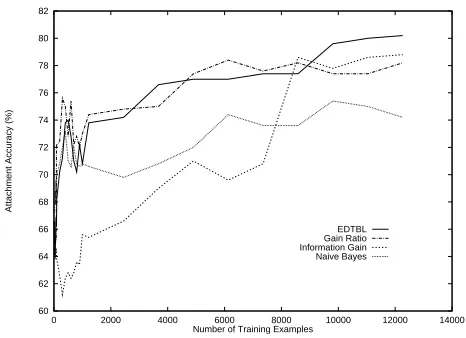
For this phase of the experiments, the original training and test data from Brill and Resnik (1994) were used and kept in their original ordering, although it was necessary to change the structure of the data files to allow the other learning algorithms to read them. A particular Machine Learning Algorithm was selected, trained, and always eval-uated on the same test data of 500 examples. To measure how quickly the Machine Learning Algorithm in question became competent at Prepositional Phrase attachment, the number of training examples was gradually increased from a small number (just 100 examples) until all of the 12,266 examples were seen by the learning phase. The selection of the training examples was always a contiguous sample of the complete training data, always starting from the begin-ning. The results of all the algorithms run in Phase 1 appear in Figure 1.
More results with smaller amounts of training data (fewer than 1,000) were obtained deliberately, partly be-cause we were curious by how much the accuracy would fluctuate with so few training examples, and partly because we wanted to compare these algorithms’ performance with that of a Support Vector Machine (SVM). The SVM3is lim-ited to utilising fewer than 2,000 training examples: this limitation applies to SVMs in general because of they way they manipulate the data. As a check, we also used the SVM supplied with Weka and hit similar limitation and performance figures. Both SVMs consistently produced 73% to 77% accuracy even with as few as 200 training ex-amples. The SVMs’ figures are not shown in Figure 1 be-cause they would be difficult to distinguish in the crowded left-hand side of the graph.
3The software was written by Vincent Wan of the Speech and
60 62 64 66 68 70 72 74 76 78 80 82
0 2000 4000 6000 8000 10000 12000 14000
Attachment Accuracy (%)
Number of Training Examples EDTBL Gain Ratio Information Gain Naive Bayes
Figure 1: Results from Phase 1
4.2. Discussion of Phase 1 Results
The most striking event shown by Figure 1 is the rapid jump up by the Decision Tree using Information Gain as part of itsID3algorithm. One advantage of the Decision Tree method is that its tree of rules is meaningful to a hu-man reader and a hu-manual inspection of the trees at either end of the jump showed that the Decision Tree had sud-denly “realised” that using the preposition itself as the main discriminant rather than the other vocabulary (the nouns and verbs) had more benefit. Further analysis of the re-gion between 7,000 and 8,500 training examples (using the same data in different orders) showed that the switch from nouns and verbs to the preposition as the main discriminant was always quite sudden and always occurring around the 8,000 mark. The conclusion from this is that usingID3
with Information Gain is less beneficial than using it with Gain Ratio if the system has insufficient training data to realise that prepositions have more worth as the primary discriminant. But once the Information Gain Decision Tree has seen sufficient training data, as shown in the results of Phase 2, it produces similar accuracy scores to Gain Ratio. A second interesting feature shown by Figure 1 is that the Na¨ıve Bayesian Classifier is the only algorithm that ends on a downward trend. Of course, were more train-ing data available, the Na¨ıve Bayesian Classifier may well improve again, even if the improvement were merely the next phase of its apparently oscillating accuracy.
A third interesting features of Figure 1 is the relative performance of EDTBL and the Decision Tree using Gain Ratio. Between about 4,200 and 9,000 training examples, Gain Ratio actually performs better, although EDTBL fin-ishes with a 2% absolute advantage and a relative error dif-ference of 917%. The continuation of this contest between
Decision Trees and EDTBL becomes even more interesting in Phase 2.
4.3. Phase 2
Whereas Phase 1 already had pre-prepared sets of train-ing and test data, Phase 2 needed to reorganise those data into n-fold cross-validation data, in this case ten sets. First the training and test data were merged into a single set, then the order randomised. This randomly ordered set was then
used to create ten cross-validation sets, achieved by split-ting the entire data set into ten parts. Each tenth became test data, one for each of the ten sets, with the remaining nine-tenths of the data forming the training data for that set. The order of the data in each training set was then randomised again. Any significant gains or losses in algorithm perfor-mance due to data ordering are rendered unlikely due to this double randomisation and the n-fold cross-validation.
Each of the chosen Machine Learning Algorithms was run in turn over the ten sets of cross-validation data. For each cross-validation set, the number of training exam-ples was increased, as in Phase 1, until it covered all 11,490 training examples (stepped data). Whereas Phase 1 used 500 test cases (408% of the data), the 10-fold
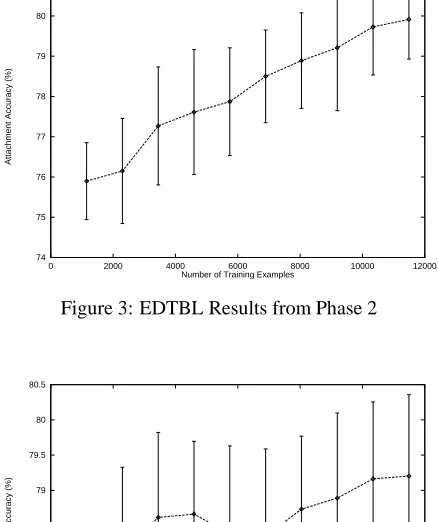
cross-validation uses 10% of the data, or 1,276 test cases. The mean percentage of attachment accuracy and its standard deviation were computed for the same data step over all ten of the cross-validation sets. These figures for each Machine Learning Algorithm were merged into the same graph for comparison purposes (see Figure 2), though the standard deviation only appears in the individual graphs (Figures 3, 4, and 5) for clarity.
62 64 66 68 70 72 74 76 78 80
0 2000 4000 6000 8000 10000 12000
Attachment Accuracy (%)
Number of Training Examples
EDTBL Gain Ratio Information Gain Naive Bayes
Figure 2: Results from Phase 2
4.4. Discussion of Phase 2 Results
As in Figure 1, the most striking event is the rapid jump up (always in approximately the same place in each set of the n-fold cross-validation) by the Decision Tree using In-formation Gain. Once the InIn-formation Gain Decision Tree has made this jump, it performs with a mean accuracy quite consistent with that of the Decision Tree using Gain Ra-tio. Before that point, however, the performance of the two algorithmic variations is staggeringly different, not only in absolute terms with GR massively outperforming IG, but also in behaviour: whereas Information Gain is always im-proving, Gain Ratio wavers around 78%. Should an appli-cation require a fast and simple algorithm that works well having seen only a few thousand training examples, then a Decision Tree using Gain Ratio is worth considering.
rapidly. For the amount of training data currently available, however, it is a poor choice, though it does do somewhat better than a random guess.
It is now clear that it takes about 6,500 training exam-ples for EDTBL to overhaul the Decision Tree using Gain Ratio. But once it starts performing better, it stays perform-ing better: EDTBL is ultimately about 1% more accurate than the Decision Trees in both absolute and relative terms. However, a glance at Figures 3, 4, and 5 shows that by tak-ing standard deviation into account, the Decision Trees can outperform EDTBL when trained on 11,490 examples.
The 10-fold cross-validation experiments demonstrate that Error-Driven Transformation-Based Learning is not outstandingly better thanID3, thus refuting Brill’s impli-cation in his thesis that Decision Trees are less suitable than EDTBL for Prepositional Phrase attachment. Although the experiments also show that EDTBL does not need many examples to perform quite well, the same can be said for Decision Tree usingID3and Gain Ratio.
An extra result, not shown in any of the graphs, came about whilst usingWeka’sZeroRclassifier to validate the baseline in preparation for this paper: we also tried their implementation of a Decision Table. Using the same train-ing and test data as in Phase 1, we obtained an accuracy of 8456%. Unfortunately, it was not possible to produce a
comprehensive set of Phase 1 and Phase 2 results in time.
74 75 76 77 78 79 80 81
0 2000 4000 6000 8000 10000 12000
Attachment Accuracy (%)
Number of Training Examples
Figure 3: EDTBL Results from Phase 2
76.5 77 77.5 78 78.5 79 79.5 80 80.5
0 2000 4000 6000 8000 10000 12000
Attachment Accuracy (%)
Number of Training Examples
Figure 4:ID3Gain Ratio Results from Phase 2
62 64 66 68 70 72 74 76 78 80 82
0 2000 4000 6000 8000 10000 12000
Attachment Accuracy (%)
Number of Training Examples
Figure 5:ID3Information Gain Results from Phase 2
74 74.5 75 75.5 76 76.5 77 77.5 78 78.5
0 2000 4000 6000 8000 10000 12000
Attachment Accuracy (%)
Number of Training Examples
Figure 6: Na¨ıve Bayesian Classifier Results from Phase 2
5.
Manual PP Attachment Experiments
All the techniques mentioned previously generally ob-tain similar scores and all perform less well than we would like. So is the problem with the algorithms themselves or with the representation of the data? One way to decide is to see whether people can outperform the computer on a level playing field. So we created some software to test humans on the task exactly as it was given to the Machine Learning Algorithms. The data shown to the human subjects are the same as those shown to the MLAs; indeed the data are that of the test set used in the experiments described above and by Brill & Resnik. Besides working with the data, human users also have the opportunity to mark any examples that they believe are genuinely ambiguous.
Our software, written inJavaand supported byCGI
scripts, has been implemented to run in a browser over the World Wide Web, thus making the experiment accessible to as large an audience as possible.4 The main part of the software displays ten pages of fifty examples each, where each example contains five words: the verb, the noun, the preposition, the head noun of the PP’s complement, and the wordambiguous. The first two fields andambiguous
are clickable and become highlighted with a tick when se-lected. Checkingambiguousis how users indicate they
4The experiments are still on-line and can be accessed via
believe a particular example to be genuinely ambiguous. The selection of a noun or verb within a particular exam-ple is mutually exclusive: selecting one deselects the other if it had already been selected. Note that even though a user may believe an example to be ambiguous, a decision must still be made between nominal or verbal attachment. Besides presenting the attachment examples, the software also requests some personal details which includes whether or not a user is a native speaker of English and what lan-guage or grammar expertise that person has. These details allow a quaternary breakdown of results: native speakers versus non-native speakers, orthogonal to experts versus non-experts.
5.1. Discussion of Results and Issues from the Online Manual Experiment
Although the experiment is still very much underway, there have already been some interesting results and feed-back.
In terms of results, our “average human figures” are sig-nificantly lower than those of Ratnaparkhi et al. Whereas their three treebanking experts obtained 882% on the same
kind of test as ours (though on 300 rather than 500 exam-ples), the three language experts who have used our soft-ware so far have averaged 757%. Two non-native
speak-ers have so far completed all the examples, one scoring the lowest mark to date, 664%, the other the highest, 788%.
The software only came on-line a few days before the dead-line, so there were only five completed answers available to report here but more than a dozen people have started com-pleting answers. But the fact that no-one has even come close to 88% suggests that the treebankers’ particular ex-pertise gave them a huge advantage. The eventual hope for our “average human figures” is that “average” will apply not only to the figures themselves (mean scores) but also to the humans: the mean score of an average (not particularly expert) user. So far this figure is 734%.
There has been some interesting feedback from partic-ipants. Every one found the exercise difficult. Those with some language expertise said they had no trouble under-standing the task itself, though they still found some of the attachment decisions hard to mark. The non-experts found both the concept of the task and the task itself difficult. They said they would have liked to have seen more exam-ples before embarking on the exercise. Presumably all the experts had already heard of the problem of Prepositional Phrase attachment and so had a better understanding of the task. So far, two people who started the task have decided not to finish because they found it too taxing.
Allowing the user to choose ambiguous seems to have caused some confusion, though not in the way am-biguity in Prepositional Phrase attachment usually does. Some people seem to have selectedambiguousfor those examples that they found more difficult, in particular if they found it hard to imagine a sentence containing the four head words, rather than because the attachment really is ambigu-ous. Others have disputed the worth of theambiguous
field itself, arguing that if an example is ambiguous, then the attachment either cannot be decided or does not matter since it will not change the meaning of the sentence. The
intention behind putting theambiguouschoice in was to obtain a rough frequency count of genuinely ambiguous at-tachments. It was also intended to see whether any prepo-sitions, for example “in” or “on”, or kinds of preposition, such as locative or temporal, cause more ambiguity than others to humans. In the end, the data from this field may instead yield a picture of the kinds of example that people find more difficult, whether or not they are actually am-biguous. Such examples may also vary between native and native speakers and between language experts and non-experts.
Of course by scoring people’s efforts, there is an im-plication that humans can actually achieve 100% accuracy with Prepositional Phrase attachment. But we acknowledge that the answers obtained from the PTB may contain errors, therefore further experimentation may help: for example a similar web-based experiment showing the entire sentence not just the head words. The inter-annotator agreement in such an experiment could help define a more acceptable set of answers, should there be any discrepancies with the an-swers defined in the PTB. Of course, there may be cases of genuine ambiguity where changing the attachment of the PP makes no difference to the meaning of the sentence, in which case the inter-annotator agreement may well be low: an interesting fact in its own right.
6.
Discussion
The comparison between EDTBL and the simpler Ma-chine Learning Algorithms is interesting. Despite Brill dis-missing Decision Trees in his thesis, they actually do re-spectably well, being within 1% of EDTBL and 2% of Maximum Entropy but still a few percent behind Backed-Off Estimation. Initially, using the vocabulary as the main discriminant yields poor results for the Decision Tree using Information Gain but once it has seen about 8,000 exam-ples, it suddenly “realises” that the preposition is the single best classifier to determine attachment and there is a con-sequentially staggering jump in accuracy. Yet unlike Gain Ratio which starts out using the preposition as the primary discriminant and which is permanently penalised for using the nouns and verbs, Information Gain retains the flexibil-ity to discriminate using actual nouns and verbs if need be. There is an as yet unconfirmed possibility from theWeka
experiment, that a Decision Table may be even better than a Decision Tree for the Prepositional Phrase attachment task. In comparison, the experiments have shown that the Na¨ıve Bayesian Classifier performs poorly and seems to be a sub-stantially inferior choice of algorithm for PP attachment.
7.
Further Work
Prior to the experiments described in this paper, we re-worked the Penn TreeBank into a new form to make it eas-ier to extract a richer feature set for Prepositional Phrase attachment. This was triggered by the realisation that the standard binary attachment decision between noun and verb is not the only pattern in which Prepositional Phrases occur ambiguously. This observation has since been borne out by Fang (2000) both independently of our research and on a different corpus, ICE-GB (Greenbaum, 1992; Greenbaum, 1996). Fang finds that the canonical(v n1 p n2)
quad-tuple accounts for less than a quarter of ambiguous cases in the ICE corpus.
Our reworking of the PTB involves several transforma-tions, including relabeling Noun Phrases as Simple Noun Phrases if they contain no embedded phrases, grouping verbs in the manner of a chunking parser to replace the highly nested right-branching structure inherent in the PTB, and adding explicit pointers to the head words of phrases, though this step is not without difficulty since the defini-tion of a head word is disputed in the field. The hope is that by making the more information explicit, a richer set of attributes on which to train MLAs will become more ev-ident. We believe that the basic four head words are simply too impoverished to allow Machine Learning Algorithms to approach human performance with full sentences.
8.
References
Eric Brill and Philip Resnik. 1994. A Rule-Based Ap-proach to Prepostional Phrase Attachment Disambigua-tion. In Proceedings of the 15th International Confer-ence on Computational Linguistics (COLING–94), Ky-oto, Japan.
Eric Brill. 1993. A Corpus-Based Approach To Language Learning. Ph.D. thesis, University of Pennsylvania. Michael Collins and James Brooks. 1995. Prepositional
Phrase Attachment through a Backed-off Model. In David Yarowsky and Kenneth Church, editors, Proceed-ings of the 3rd Workshop on Very Large Corpora, pages 27–38, Cambridge, Massachusetts, June.
Alex Chengyu Fang. 2000. A Lexicalist Approach towards the Automatic Determination for the Syntactic Functions of Prepositional Phrases. Natural Language Engineer-ing, 6(2):183–201, June.
Lyn Frazier. 1978. On Comprehending Sentences: Syntac-tic Parsing Strategies. Ph.D. thesis, University of Con-necticut.
S Greenbaum. 1992. A new Corpus of English: ICE. In J Svartvik, editor, Directions in Corpus Linguistics: Pro-ceedings of the Nobel Symposium 82, pages 171–179, Stockholm, Sweden. Mouton de Gruyter, Berlin. S Greenbaum, editor. 1996. Comparing English
World-wide: The International Corpus of English. Oxford Uni-versity Press.
Donald Hindle and Mats Rooth. 1993. Structural Ambi-guity and Lexical Relations. Computational Linguistics, 19(1):103–120.
J. Kimball. 1973. Seven Principals of Surface Structure Parsing in Natural Language. Cognition, 2:15–47.
Mitchell Marcus, Beatrice Santorini, and Mary Ann Mar-cinkiewicz. 1993. Building a Large Annotated Corpus of English: The Penn Treebank. Computational Linguis-tics, 19(2):313–330.
Tom Mitchell. 1997. Machine Learning. McGraw-Hill, International edition.
Adwait Ratnaparkhi, Jeff Reynar, and Salim Roukos. 1994. A Maximum Entropy Model for Prepositional Phrase Attachment. In Proceedings of the ARPA Workshop on Human Language Technology, Plainsboro, New Jersey, March.
Jiri Stetina and Makoto Nagao. 1997. Corpus Based PP Attachment Ambiguity Resolution with a Semantic Dic-tionary. In Jou Zhou and Kenneth Church, editors, Pro-ceedings of 5th Workshop on Very Large Corpora, pages 66–80, Beijing and Hong Kong, August 18–20.
Roman Taraban and James L. McClelland. 1990. Con-stituent Attachment and Thematic Role Assignment in Sentence Processing: Influences of Content-Based Ex-pectations. Journal of Memory and Language, 27:23– 30.
Greg Whittemore, Kathleen Ferrara, and Hans Brunner. 1990. Empirical Study of Predictive Powers of Sim-ple Attachment Schemes for Post-Modifier Prepositional Phrases. In Proceedings of the 28th Annual Meeting of the Association for Computation Linguistics, pages 23– 30.