Building a Multilingual Named Entity-Annotated Corpus Using
Annotation Projection
Maud Ehrmann, Marco Turchi, Ralf Steinberger
European Commission - Joint Research Centre (JRC), IPSC - GlobeSec Via Fermi 2749, 21020 Ispra (VA) - Italy
Abstract
As developers of a highly multilingual named entity recognition (NER) system, we face an evaluation resource bottleneck problem: we need evaluation data in many languages, the annotation should not be too time-consuming, and the evaluation re-sults across languages should be compa-rable. We solve the problem by automat-ically annotating the English version of a multi-parallel corpus and by projecting the annotations into all the other language versions. For the translation of English entities, we use a phrase-based statistical machine translation system as well as a lookup of known names from a multilin-gual name database. For the projection, we incrementally apply different methods: perfect string matching, perfect consonant signature matching and edit distance simi-larity. The resulting annotated parallel cor-pus will be made available for reuse.
1 Introduction
Named Entity recognition is a well-established task, acknowledged as fundamental to a wide va-riety of natural language processing (NLP) appli-cations (Nadeau and Sekine, 2007). As for other text mining applications, annotated corpora con-stitute a crucial and constant need for named en-tity recognition (NER). Within a development or training framework, annotated corpora are used as models from which machine learning systems, or computational linguists, can infer rules and deci-sion criteria; within an evaluation framework, they are used as a gold standard to assess systems’ per-formances and help to guide their quality improve-ment,e.g.via non-regression tests.
During the last decade, several named entity (NE) annotated corpora were built, thanks to a
large series of evaluation campaigns (Fort et al., 2009). However, most of these gold-standard data are available only for English or for a few lan-guages. Even if unsupervised methods tried to overcome this difficulty, the shortage of annotated data for the large majority of the world’s languages remains a problem. An obvious solution is to man-ually produce annotated corpora, but it is a com-plex and time-consuming task and it may be diffi-cult to find experts in each specific language.
Beyond the scarcity of annotated corpora, an-other issue lies in the fact that annotation schemas or guidelines usually differ from one annotated corpus to another: named entity extents can be dif-ferent (e.g.inclusion or not of the function in a per-son name), as well as entity types and granularity (e.g.some corpora may consider product names, whereas others will differentiate, within this cat-egory, vehicles, awards and documents, and oth-ers will not even consider product names). Such divergences should be expected, as annotated cor-pora are built according to different applications. However, they constitute a real issue, particularly when developing or evaluating multilingual NE recognition systems and the effort to reuse exist-ing annotated data collections is big.
Our goal is to automatically build a set of multi-lingual named entity-annotated corpora, taking ad-vantage of the existence of parallel corpora (bilin-gual or multiparallel). Traditionally used in the field of Machine Translation, parallel corpora have been exploited in recent years in various NLP tasks, including linguistic annotation, with the cre-ation of annotated corpora. The underlining prin-ciple is annotation projection, where annotations available for a text in one language can be pro-jected, thanks to the alignment, to the correspond-ing text in another language, creatcorrespond-ing herewith a newly annotated corpus for a new language.
This paper presents how we applied this method to named entity annotations, projecting
cally annotated English entities to, firstly, French, Spanish, German and Czech multiparallel cor-pora and, secondly, Russian parallel corcor-pora. We experimented with several annotation projection techniques: starting from the baseline of simply searching for the English name string in foreign text, results improve gradually by adding new in-formation and varying projection methods. Our objective is to make freely available named en-tity annotated-corpora in a large set of languages, with a quality similar to that of manually anno-tated data.
This method shows several advantages. Firstly it could be a way of overcoming the NE-annotated data shortage problem. Then, it could solve the non-harmonized annotation issue: if the projected annotations (on the target side) always come from the same automatic recognition system (on the source side), then we obtain annotated corpora in different languages, but with a common annota-tion schema. The use of multiparallel corpora also presents the benefit of ensuring the comparability of NER system results across languages; morever, as named entity recognition systems are domain-sensitive, it could be relevant to evaluate multilin-gual NER systems on equivalent tasks.
The remainder of the paper is organized as fol-lows. We introduce related work (section 2), then present our NE projection method (section 3), re-port the results (section 4) and finally conclude and propose some elements for future work (sec-tion 5).
2 Related Work
Regarding the automatic acquisition of NE an-notated corpora, some work investigates how to constitute monolingual annotated data (An et al., 2003; Nothman et al., 2008).
With respect to parallel corpora, their exploita-tion has been growing in recent years, showing their usefulness in various NLP tasks like word sense disambiguation or cross-lingual tagging (re-fer to the state of art presented by Bentivolgi and Pianta (2005)). With respect to cross-lingual knowledge induction, multiple work addressed the challenge of automatic parallel treebank building (Lavie et al., 2008; Hwa et al., 2005), whereas (Padó and Lapata, 2009; Bentivogli and Pianta, 2005) explored semantic information projection.
Several researchers investigated named en-tity annotation and parallel corpora exploitation.
Yarowsky et al. (2001) carried out some pio-neer experiments, investigating the feasibility of annotation projection over four NLP tasks, in-cluding named entity recognition. The goal was to automatically induce stand-alone text analy-sis tools via robust (and noisy) annotation pro-jection. More recently, Ma (2010) applied a co-training algorithm on unlabelled bilingual data (English-Chinese), showing that NE taggers can complement and improve each other while work-ing together on parallel corpora. Samy et al.
(2005) developed a named entity recognizer for Arabic, leveraging an Arabic-Spanish parallel cor-pus aligned at sentence level and POS tagged. With a slightly different goal, Klementiev and Roth (2008) proposed an algorithm for cross-lingual multiword NE discovery in a bicross-lingual weakly temporally aligned corpus. The work of Volket al.(2010) on combining parallel treebanks and geo-tagging showed similar results to what we offer, with the difference that they focused on the location type only and worked with a bilin-gual French-German corpus. Finally, Shahet al.( 2010) designed a Machine Translation-based ap-proach to NER which includes a NE annotation projection phase based on word alignment.
These approaches aimed at
develop-ing/improving NER systems and parallel
annotated corpora seemed to be a positive side-effect of these experiments. In comparison, our work differs from that mentioned here in that we aim at developing an annotated multilingual parallel corpus for evaluation purposes. Using a multilingual parallel corpus is beneficial over using a bilingual corpus in that we save more annotation time. More importantly, text type, entity type distribution, and entity annotation specifications are the same across all languages, resulting in a more useful evaluation resource. We will make this multi-parallel corpus freely available to other system developers.
3 Named Entity Annotation Projection
We used a multiparallel corpus in English, French, Spanish, German and Czech (news texts coming from the WMT shared tasks (Callison-Burch et al., 2009)), hereafterEn-4, and an English-Russian one (union of two news data sets (Klyueva and Bo-jar, 2008; Rafalovitch and Dale, 2009)), hereafter
En-Ru. For each language,En-4has a training set of roughly 70,000 sentence pairs and a test set of 2,490 sentence pairs, against 160,000 and 2,700 respectively forEn-Ru. We used the test sets for the annotation projection. The next sections detail each step of the NE annotation projection process.
3.1 Automatic annotation of Source Named Entities
The first step is to annotate NEs in one corpus in a given language. We chose to annotate En-glish entities of typePerson(including titles), Lo-cationandOrganisationand tried to project them in the corresponding texts in other languages. As a matter of fact, English is a resource-rich lan-guage with already existing efficient tools, but one may choose another source language, according to his/her goals and constraints. We used an in-house NER system (Steinberger and Pouliquen, 2007; Crawley and Wagner, 2010) to process the En-glish source side text (any NER system or even manual annotation could have been used at this stage). Obviously, the NER system’s quality is a crucial element that determines the projection quality. In the English texts of the En-4and En-Rucorpora, the NER system annotated 826 unique entities (corresponding to 1,395 occurrences) and 674 (1,312 occurrences) respectively.
3.2 Source Named Entity Translation
The second step corresponds to the translation of the previously extracted entities into the tar-get languages. We make use of two different NE translation sources: translations resulting from the application of a Phrase-Based Statistical Ma-chine Translation system (PBSMT), and transla-tions resulting from the exploitation of a multilin-gual Named Entity database.
3.2.1 PBSMT System
One of the most popular classes of statistical ma-chine translation (SMT) systems is the Phrase-Based Model (Koehn, 2010). It is an extension of the noisy channel model, introduced by (Brown et al., 1994), using phrases rather than words. A source sentence f is segmented into a sequence
of I phrases and the same is done for the target sentence e, where the notion of phrase is not re-lated to any grammatical assumption: a phrase is an n-gram. The best translatione of f is ob-tained by maximizing the PBSMT model prob-ability p(e|f), relying on three components: the probability of translating a phraseeiinto a phrase
fi, the distance-based reordering model and the
language model probability.
Phrases and probabilities are estimated process-ing the parallel data. Word to word alignment is firstly extracted running the IBM models (Brown et al., 1994), and then proximity rules are ap-plied to obtain phrases, see (Koehn, 2010). Prob-abilities are estimated counting the frequency of the phrases in the parallel corpus. In this work, we used the open source PBSMT system Moses (Koehn et al., 2007).
Since Named Entities correspond most of the time to small sets of contiguous words (phrases), the phrase-based model appeared to be well-suited to translate this kind of units. Instead of running a whole SMT system, we could have used the word alignment only or done a simple phrase-table lookup. By choosing the first option, we would have been dependent on the NE alignment qual-ity and, by choosing the second one, we would have lost another advantage of the PBSMT sys-tem: its decoder’s capacities, which allows the reconstruction of the good target phrase even if spread over different phrases (a NE could be cut into different phrases during the phrase table ex-traction). These choices were confirmed by pre-liminary experiments.
15 ranked translations according top(e|f).
Correction Phase Entity translations are not al-ways correct because the PBSMT system tries to reproduce the most readable sentence driven by the language model; in this way, the transla-tion system may add articles, prepositransla-tions or in some cases groups of words before or after the entity name. For example, the french translation ofAfghanistanisen Afghanistanand the transla-tion of Germanyisl’ Allemagne. In these cases, only Afghanistan and Allemagne should be pro-jected, as prepositions and articles cannot be part of proper names in French. We could observe sim-ilar phenomena in other languages. To address this problem, we post-processed the translations in a simple way: applying stopword lists. This allowed us to correct a certain number of entities for each language, even if some wrong entities could remain in the translation list. Before pro-jecting these “corrected” translated entities in the aligned corpora, we asked bilingual annotators to check the correctness of the translated entities, ac-cording to a set of evaluation categories that iden-tifies possible translation errors. In all languages, the main problems seem to be the addition and subtraction of word(s) during the translation phase (En: tariq ramadanFr: peut-être tariq ramadan). More details about this evaluation are reported in (Ehrmann and Turchi, 2010).
3.2.2 External Named Entity Resource
In addition to the SMT approach, we benefit from an external multilingual named entity database; it contains, among others, translations and translit-erations of entity names in several languages. By querying this database, we retrieved, for each En-glish entity, a list of translated entities (that may have different spellings) in a given language.1
The information coming from the external re-source is quite reliable, because part of the entity names has been manually checked. However, it is not exhaustive. On the contrary, the SMT sys-tem provides translations almost every time, but they may be incorrect. In other words, informa-tion coming from the external resource and the SMT system can complement each other, the for-mer boosting precision and the latter ensuring re-call. For example,Sakharov Prize for Freedom of Thought is correctly translated by the SMT
sys-1The database contains 134,046 en-fr NE translations, 157,442 en-es, 156,363 en-de, 2,807 en-cs and 65,916 en-ru.
tem for each language while the database does not contain this name.
3.3 Annotation Projection Methods
Once we have a list of possible translations (or candidates) for a given NE in an English sentence, we try to project it into the corresponding sen-tences of the aligned corpora. We incrementally apply different projection strategies.
String matching The first projection method we use is a strict string matching: the candidate is present or not in the translated sentence. With this method, we are able to project the entityeuropean parliament2from the English sentence to the cor-responding Spanish one in the following example:
English: recipients of the 2005 sakharov prize from the <organization>european parliament</organization>. . .
Candidate list: parlamento europeo, presidente del parlamento europeo, parlamento de europa, parla-mento europea
Spanish: las "Damas de Blanco", galardonadas con el premio sajarov 2005 otorgado por el <organization> parlamento europeo </organization>, . . .
This method is rigorous and does not allow to catch named entities showing different spellings or morphological variants that are not present in the candidate list. The following is an example where the entity (tariq ramadan) cannot be projected in the target Czech sentence:
English: with the possible exception of <person> tariq ramadan </person>. . .
Candidate list: tariq ramadan, ramadan tariq
Czech: nevyjímaje tarika ramadana
Consonant Signature matching If the string matching method does not retrieve any result, then we try to match candidates and potential NE over consonant signatures. The consonant signature of a token is obtained by first producing a “nor-malised” form and then by removing the vow-els, as described in (Steinberger and Pouliquen, 2007). The normalised form is produced through the application of a small set of transformation rules based on empirically observed regularities between name variants (double to single conso-nant, ck tok, ou touetc.). We compare the first candidate token to each sentence token and if there
is an exact match between their consonant signa-tures, we continue the comparison with the next tokens until the end of the candidate unit. Con-sidering again thetarik ramadanexample and its consonant signature [trk - rmdn], this method al-lows to project its person tag onto the stringtarika ramadanawhich, even if not present in the candi-date list, has the same consonant signature.
Similarity Distance Finally, for cases where the consonant signature matching method fails, we at-tempt to project the NE by computing a similar-ity measure between the consonant groups. Re-producing the work done by (Pouliquen, 2008), we applied a cost-based Levenshtein edit distance, “where the difference between two letters is not bi-nary but depends on the distance between two let-ters”. This distance is learned from a set of exist-ing named entity variants. By lookexist-ing at several examples, we empirically determined the thresh-old of 0.7, above which the similarity shows good candidates for matching. With this third method, we succeed to project some more candidates, as illustrated by this example: the name samantha geimer can be projected from English to Czech, thanks to the calculation of the string similarity distance between the two groups [smnth - gmr] and [smnth - gmrv]:
English: the lawyer of samantha geimer, the victim. . .
Candidate list: samantha geimer, geimer samantha
Czech: právní zástupkyne obeti, samanthy geimerové
4 Results
4.1 Experimental settings
We ran several experiments according to various set-ups. First of all, we started from the baseline of simply searching for the English named entities in the foreign texts. Then, during the source NE annotation step, we noticed the presence of wrong English entities. We are not interested in evaluat-ing the quality of the NER system that we used but we wondered how it can affect our projection per-formance. Therefore, we manually corrected the English entities of the En-4corpus; performance results are reported according to corrected and non-corrected source entities. Finally, we evalu-ate the performance of the projection combining different translation approaches. English entities are translated using: (1) external information: for each language pair, a list of English-Foreign
en-tity associations is used as a look-up table (DB
in Table 1), (2) machine translation system (SMT) and (3) external information and machine transla-tion system together: a list of all possible trans-lations is associated to each English entity3(ALL). Moreover, with respect to the SMT approach (case 2), we consider two different SMT outputs: (2a) highest-ranking translation (SMT-1) and (2b) top 15 ranked translations (SMT-15). By considering the less probable translations up to 15, we expect to cover as much as possible morphological varia-tions in inflected languages.
4.2 Results
As we do not have a reference corpus, we only compute projection Recall. In the future, we plan to manually annotate a part of the multilingual set to evaluate Precision.
Recall results are presented in Table 1. As said above, we combined several translation ap-proaches and projection methods. First it should be noted that the baseline gives quite good results for target languages of the same alphabet (from 0.3 to 0.5 in theEn-4 corpus). Most of the success-ful English projections are for person names, but performance decreases with inflected languages. Adding external information (DB) brings some improvements but it all depends on the amount of translations available in the database, as shown by the difference in gains between French (+12 pts) and Czech (+5 pts). By taking into account the highest-ranking translation (SMT-1), recall im-proves quite significantly for each target language, although Czech and Russian show lower results. Merging of external and SMT-1 translations (ALL with SMT-1) produces small improvements.
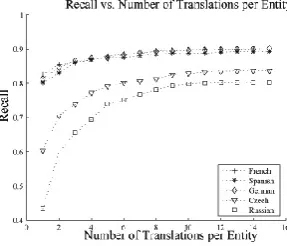
Overall results improve even more consider-ing more SMT translations (SMT-15) and vary-ing projection methods. As evidenced by Fig-ure 1, taking into account less probable transla-tions emitted by the SMT system yields signif-icant improvements, especially for inflected lan-guages (+8pts for French, +24 for Czech and +37 for Russian). Then, applying different projection methods for the remaining non-projected entities increases again the results (+0.4 pts on average for all languages), consonant signature and similarity measure giving more or less the same contribu-tion. Adding external information on top of this
Translation configurations French Spanish German Czech Russian
Baseline 0.493 0.415 0.494 0.312 0.041
Baseline (corrNE) 0.508 0.431 0.516 0.323 0.041
DB 0.628 0.59 0.631 0.375 0.201
SMT-1 0.840 0.846 0.836 0.604 0.433
ALL (with SMT1) 0.869 0.852 0.857 0.594
-SMT-15 0.929 0.917 0.921 0.837 0.803
SMT-15 + csnt 0.940 0.933 0.933 0.879 0.842
SMT-15 + cnst + sim 0.953 0.942 0.947 0.919 0.867
ALL (with SMT-15) 0.93 0.916 0.924 0.831 0.803
ALL (with SMT-15) + cnst + sim 0.954 0.943 0.95 0.918 0.867
Table 1: Projection Recall performance according to various translation configurations and projection methods. Recall is computed relative to the total number of English annotated entities in each corpus.
CorrNE= corrected English Named Entities;csnt= consonant signature andsim= similarity measure. Apart from Baseline, all results are computed with corrected English entities.
Figure 1: Recall projection performance accord-ing to the number of SMT translations (with straccord-ing matching projection method).
configuration (SMT15 + csnt + sim + DB) brings only small improvements. At the end, best results range from 0.86 to 0.95, showing significant im-provements over the baseline. Among the differ-ent approaches we tried out, the most beneficial ones are SMT-15 for the translation and the com-bination of three methods for the projection, par-ticularly in the case of highly inflected languages.
4.3 Error Analysis
Non-projected entities are approximately the same across languages. We identified four main reasons of non-projection. First, as already pointed out, it happens that some English NEs are wrongly anno-tated, even when manually corrected. This can be illustrated with the following case: in the English entity iraqi prime minister nouri al-maliki only
prime minister nouri al-malikiis annotated and, in
consequence, it is not possible to project the Span-ish translationprimer ministro nouri al-malikion the targetprimer ministro iraquí nouri al-maliki. Then, entity translations can be incorrect. We can report this example: the English entity state sec-retary peter wichertis wrongly translated by sec-retario de estado peter wichert habría solicitado, which make the projection impossible. Further-more, human sentence translations across parallel texts are not always equivalent, which sometimes block the projection, even with correctly trans-lated entities: European Court of Justiceappears ascorte europeoin the Spanish sentence, whereas we try to projectcorte europea de justicia. Finally, there are some hopeless cases combining all sorts of mistakes.
5 Conclusion and Future Work
consid-ering NE sub-parts like functions, titles, etc. At last, we are currently working on Italian and Hun-garian and we intend to reproduce this work on other parallel corpora, including for resource-poor languages.
References
An, J., Lee, S. and Lee, G. (2003) Automatic acquisi-tion of named entity tagged corpus from world wide
web. InProceedings of ACL (ACL’03), Sapporo.
Bentivogli, L. and Pianta, E. (2005) Exploiting paral-lel texts in the creation of multilingual semantically annotated resources: the MultiSemCor Corpus. In
Natural Language Engineeringpp. 247–261, Cam-bridge University Press.
Bering, C., Drozdzynski, W., Erbach, G., Guasch, C., Homola and others. (2003) Corpora and evaluation tools for multilingual NE grammar development. In Proceedings of Multilingual Corpora - Linguis-tic Requirements and Technical Perspectives, Lan-caster.
Brown, P.F., Della Pietra, S., Della Pietra, V.J. and Mer-cer R.L.(1994). The Mathematic of Statistical
Ma-chine Translation: Parameter Estimation. In
Com-putational Linguistics, 19(2):263–311.
Callison-Burch, C., Koehn, P., Monz, C. and
Schroeder, J. (2009) Findings of the 2009 Workshop
on Statistical Machine Translation. InProceedings
of the Fourth WMT’09, Athens.
Crawley, J. B. and Wagner, G. (2010). Desktop text
mining for law enforcement. In Proceedings of
ISI’10, Vancouver.
Ehrmann, M. and Turchi, M. (2010). Building Multi-lingual Named Entity Annotated Corpora Exploiting
Parallel Corpora. In Proceedings of AEPC, Tartu,
Estonia.
Fort, K., Ehrmann M. and Nazarenko, A. (2009) To-wards a Methodology for Named Entities Annota-tion. InProceedings of LAWIII, Singapore.
Hwa, R., Resnik, P., Weinberg, A., Cabezas, C. and Kolak, O. (2005). Bootstrapping parsers via syntac-tic projection across parallel texts. InNatural Lan-guage Engineering, 11(3).
Klementiev, A. and Roth, D. NE Transliteration and Discovery from Multilingual Corpora. (2008) In
Learning Machine Translation.MIT Press.
Klyueva N. and Bojar O. UMC 0.1:
Czech-Russian-English Multilingual Corpus. (2008) InProceedings
of International Conference Corpus Linguistics.
Koehn, P., Hoang, H., Birch, A., Callison-Burch, C., Federico, M., Bertoldi, N. and others (2007). Moses: Open source toolkit for statistical machine transla-tion. ACL, 45(2), Columbus, Oh, USA.
Koehn, P. (2010). Statistical Machine Translation. Cambridge Univ. Press.
Lavie, A., Parlikar, A. and Ambati, V. (2008). Syntax-driven learning of sub-sentential translation equiva-lents and translation rules from parsed parallel
cor-pora. In Proceedings of theHLT-SSST-2 workshop,
Columbus, Ohio.
Paroubek, P., Chaudiron, S. and Hirschman, V. (2007). Principles of Evaluation in Natural Language Pro-cessing. InTAL, 48-1
Ma, X. (2010) Toward a Named Entity Aligned
Bilin-gual Corpus. In Proceedings of the Seventh LREC
Conference, Malta.
Nadeau, D., and Sekine, S. (2007) A survey of named entity recognition and classification. InLinguisticae Investigaciones, 30-1, pp. 3-26.
Nothman, J., Curran, J., and Murphy, T. (2008) Trans-forming Wikipedia into named entity training data. InProceedings of the ALTA Workshop, Hobart.
Padó, S. and Lapata, M. (2009) Cross-linguistic pro-jection of role-semantic information. InJournal of Artificial Intelligence Research, 36.
Pouliquen, B. (2008) Similarity of names across
scripts: Edit distance using learned costs of
n-grams InAdvances in Natural Language Processing,
Sringer.
Rafalovitch, A. and Dale, R.(2009) United Nations General Assembly Resolutions: A Six-Language
Parallel Corpus. InProceedings of the MT Summit
Samy, D., Moreno-Sandoval, A. and Guirao, J.M. (2005). A Proposal for an Arabic Named Entity Tag-ger Leveraging a Parallel Corpus (Spanish-Arabic). In Proceedings of RANLP Conference, Borovets, Bulgaria.
Shah R., Lin B., Gershman A. and Frederking R. (2010). SYNERGY: A Named Entity Recognition System for Resource-scarce Languages such as
Swahili using Online Machine Translation. In
Pro-ceedings of (AfLaT), LREC, Valleta, Malta.
Steinberger, R. and Pouliquen B. (2007). Cross-lingual
Named Entity Recognition. In Named Entities
-Recognition, Classification and Use, Benjamins Current Topics, Vol. 19, pp. 137-164.
Turchi, M., DeBie, T. and Cristianini N. (2008). Learn-ing Performance of a Machine Translation System: a Statistical and Computational Analysis. In Proceed-ings of the Third WMT’08, Columbus, Oh, USA.
Volk, M., Goehring, A. and Marek, T. (2010)
Com-bining Parallel Treebanks and Geo-Tagging. In
Pro-ceedings of The Fourth LAW Workshop, Uppsala.
Yarowsky, D., Ngai, G. and Wicentowski, R. (2001) In-ducing Multilingual Text Analysis Tools via Robust
Projection across Aligned Corpora. InProceedings