
A Fast, Memory Efficient, Scalable
and Multilingual Dictionary Retriever
P. Fernandes, L. Lopes, C. A. Prolo, A. Sales, R. Vieira
Pontif´ıcia Universidade Cat´olica do Rio Grande do Sul Avenida Ipiranga, 6681 – 90619-900 – Porto Alegre – RS – Brazil
{paulo.fernandes, lucelene.lopes, carlos.prolo, afonso.sales, renata.vieira}@pucrs.br
Abstract
This paper presents a novel approach to deal with dictionary retrieval. This new approach is based on a very efficient and scalable theo-retical structure called Multi-Terminal Multi-valued Decision Diagrams (MTMDD). Such tool allows the definition of very large, even multilingual, dictionaries without significant increase in memory demands, and also with virtually no additional processing cost. Besides the general idea of the novel approach, this paper presents a description of the technologies involved, and their implementation in a software package called WAGGER. Finally, we also present some examples of usage and possible applications of this dictionary retriever.
Keywords: Dictionary retriever, Decision diagrams, Multi-valued Decision Diagrams
1.
Introduction
Morphological analysis and Parts-Of-Speech tagging (POS-tagging) are practically solved problems in terms of accuracy. Nearly perfect scores (above 96%) can be achieved for many well-resourced languages like En-glish (Schmid, 1994; Gim´enez and M`arquez, 2004). How-ever, for many applications, as search engines and ubiqui-tous real time applications, time and space efficiency are at least as critical as accuracy.
According to a leading author in the natural language pro-cessing area: “This explosion of published information would be moot if the information could not be found, an-notated and analyzed so that each user can quickly find in-formation that is both relevant and comprehensive for their needs.” (Manning et al., 2008). Moreover, the ability to add new words according to the individual form of speech used is also highly desirable in a such a volatile media as the web.
Therefore, we describe in this paper a novel way of stor-ing dictionaries that can be used for morphological analy-sis focusing in efficiency and flexibility gains. Specifically, our proposal is to store a large number of words in a Multi-Terminal Multi-valued Decision Diagram (MTMDD) struc-ture that can be used to classify any known word, discover-ing its word classes. The major benefits of such MTMDD approach are: (i) memory efficiency since, even for a set of several million words, the MTMDD structure can be stored with less than a hundred Mbytes; (ii) flexibility since new words can be efficiently added; and (iii) fast recovery since the time to classify words is negligible.
Such characteristics allow us to consider very large sets of words, as existing dictionaries for many languages alto-gether. This is a highly desirable feature considering mul-tilingual language processing scenarios which are about to become more frequent in information systems. For exam-ple, a very thorough multilingual dictionary with English, French, Italian and Portuguese words would have around three million words, and could be stored in a nearly 70 Mbytes MTMDD structure capable of classifying 2
mil-lion words in less than 3 seconds in a laptop, e.g., a Mac-BookPro with i7 2.2 GHz processor, 4 Gbytes memory. From a practical point of view, the resource made available with this paper is a MTMDD-based word class retriever,
i.e., a software package called WAGGER that is capable of:
• Creating a new MTMDD-based word class retriever from a custom set of classes and an initial set of words with its corresponding classes (e.g., from a dictionary of inflected words or from annotated corpora);
• Adding new words to an existing MTMDD-based word class retriever;
• Annotating raw text, according to an existing MTMDD-based word class retriever.
In this paper we briefly describe the MTMDD structures (Section 2). Section 3 presents general information about the WAGGER software package. Section 4 presents some numerical results in dealing with multi-lingual dictionaries using WAGGER software.
2.
Multi-Terminal Multi-valued Decision
Diagrams (MTMDD)
Multi-valued Decision Diagrams (MDDs)
(Kam et al., 1998) are efficient, compact data-structures used to represent and manipulate extremely large sets of data. MDDs have been applied in the generation and manipulation of the reachable state space of structured models (Sales and Plateau, 2009; Ciardo et al., 2007). Besides low memory consumption, MDDs provide an efficient way of performing operations over large sets of data.
An MDD is a directed acyclic edge-labeled multi-graph with the following properties: (i) nodes are organized into N+1 levels, which are numbered by N to 0; (ii)
non-terminal nodes are arranged at levels N to 1; (iii) level 0
$ ./wagger -cre -dic=<dictionary> -out=<mtmdd>
$ ./wagger -add -mdd=<mtmdd> -dic=<words> -out=<mtmdd>
$ ./wagger -tag -mdd=<mtmdd> -txt=<text> -out=<tagged> [ -unk=<unknown> ]
Figure 2: WAGGER functionalities
the reader may find all examples and files used in this pa-per.
From a practical perspective, WAGGER software has three functionalities available to the user:
• creation of a new dictionary;
• addition of new words to an existing dictionary;
• annotation of a set words according to an existing dic-tionary.
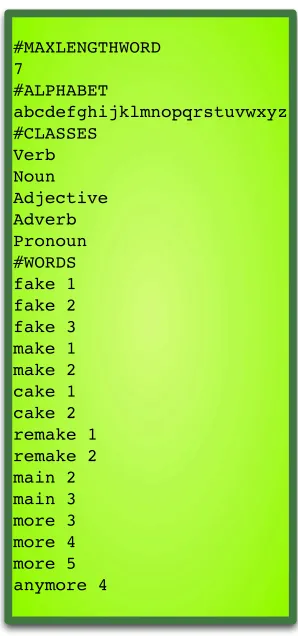
The usage of these functionalities is described in Figure 2. In this figure there are three different types of calls to WAG-GER. The first one creates (-cre) a new MTMDD struc-ture (-out), holding all the words from the input dictio-nary (-dic). The second call adds (-add) to an exist-ing MTMDD structure (-mdd) the words within dictionary (-dic), creating a new MTMDD structure (-out). The third call annotates all words within a text (-txt=text) according to a dictionary stored in a MTMDD structure (-mdd) delivering the possible word classes for each input word in an output file (-out), and optionally, in separate file (-unk), all words that were not found in the dictionary. The dictionary format (see example in Figure 3) is com-posed of four sections:
• The maximum length of a word, an integer (this value is needed to define the maximum depth of the MT-MDD structure);
• The alphabet, i.e., the valid letters for the dictionary (this list is needed to define the maximum out degree of MTMDD structure nodes);
• The word classes for this dictionary (this list is needed to define the number of terminal nodes in the MTMDD structure);
• The list of words of the dictionary with its classes.
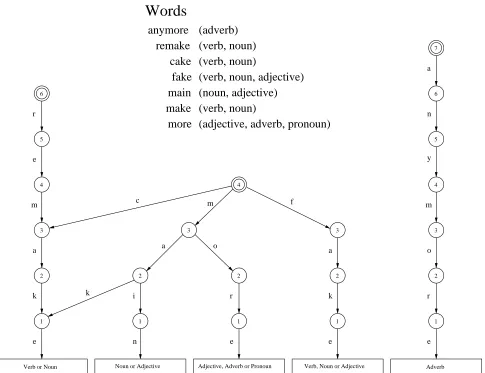
In Figure 3, the dictionary corresponding to the MTMDD structure presented in Figure 1 is written. It has the max-imum word length equal to 7 and the traditional latin al-phabet without diacritics. There are 5 word classes for this example are: Verb, Noun, Adjective, Adverb and Pronoun. The words considered in this dictionary are represented, in-dexing its class according to the order of classes defined. Note, for example, that the word “remake” can be either a Verb (indexed as 1) or a Noun (indexed as 2).
#MAXLENGTHWORD 7
#ALPHABET
abcdefghijklmnopqrstuvwxyz #CLASSES
Verb Noun Adjective Adverb Pronoun #WORDS fake 1 fake 2 fake 3 make 1 make 2 cake 1 cake 2 remake 1 remake 2 main 2 main 3 more 3 more 4 more 5 anymore 4
Figure 3: WAGGER dictionary file example
4.
Numerical Results Evaluation
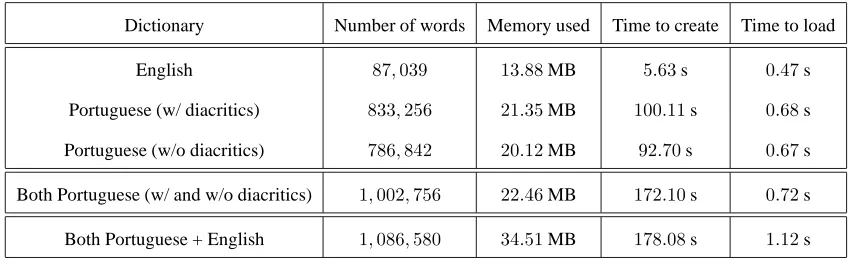
In order to illustrate the advantages of our proposal in terms of memory and time saving we run an experiment which is described below.Using the proposed approach, we initially loaded three dic-tionaries with the following sets of words:
• 87,039 English words;
• 833,256 correctly spelled Portuguese words (using di-acritics, e.g., “c¸”, “˜a”);
• 786,842 Portuguese words without diacritics1(as usu-ally written in informal text exchanges, or in limited keyboards).
1The smaller number of words without diacritics is due to the
for Term Extraction from Portuguese Language Corpora. In Proceedings of the 4th Language & Technology
Con-ference: Human Language Technologies as a Challenge for Computer Science and Linguistics (LTC ’09), pages
427–431, Poznan, Poland, November. Adam Mickiewicz University.
Cl´audio L. Lucchesi and Tomasz Kowaltowski. 1993. Ap-plications of finite automata representing large vocabu-laries. Software: Practice and Experience, 23(1):15–30. Christopher D. Manning, Prabhakar Raghavan, and Hinrich Sch ¨utze. 2008. Introduction to Information Retrieval. Cambridge University Press, Cambridge.
Afonso Sales and Brigitte Plateau. 2009. Reachable state space generation for structured models which use func-tional transitions. In Int. Conf. on the Quantitative
Eval-uation of Systems (QEST’09), pages 269–278, Budapest,
Hungary, September.
Helmut Schmid. 1994. Probabilistic Part-of-Speech Tag-ging Using Decision Trees. In Proceedings of
![Opportunities to Foreign Investment in Kosovo : [presentation given on September 6, 2011]](data:image/gif;base64,R0lGODlhAQABAIAAAP///wAAACH5BAEAAAAALAAAAAABAAEAAAICRAEAOw==)