A Use Case for Controlled Languages as Interfaces to Semantic Web
Applications
Pradeep Dantuluri, Brian Davis, Siegfried Handschuh
Digital Enterprise Research Institute National University of Ireland Galway
pradeep.varma, brian.davis, [email protected]
Abstract
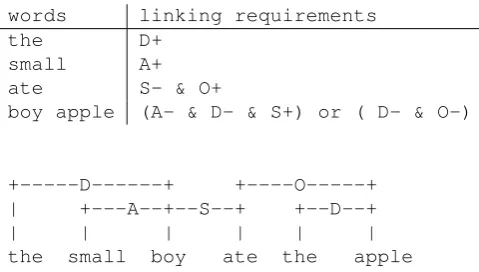
Although the Semantic web is steadily gaining in popularity, it remains a mystery to a large percentage of Internet users. This can be attributed to the complexity of the technologies that form its core. Creating intuitive interfaces which completely abstract the technologies underneath, is one way to solve this problem. A contrasting approach is to ease the user into understanding the technologies. We propose a solution which anchors on using controlled languages as interfaces to semantic web applications. This paper describes one such approach for the domain of meeting minutes, status reports and other project specific documents. A controlled language is developed along with an ontology to handle semi-automatic knowledge extraction. The contributions of this paper include an ontology designed for the domain of meeting minutes and status reports, and a controlled language grammar tailored for the above domain to perform the semi-automatic knowledge acquisition and generate RDF triples. This paper also describes two grammar prototypes, which were developed and evaluated prior to the development of the final grammar, as well as the Link grammar, which was the grammar formalism of choice.
1.
Introduction
The Semantic web1aims to simplify the process of building knowledge-based applications by enabling a web of inter-operable and machine-readable data. This is done by for-malizing the descriptions of the structure and semantics of the data available on the web. The linked data initiative2 is a positive step in that direction, exposing huge amounts of data for further analysis and use by other applications. However creating and exposing linked data is a task that requires thorough knowledge of various technologies. A solution to this is to create technologies which would en-able the average internet user to annotate and embedd data in his/her own textual resources. This paper aims to ex-plore the possibility of using controlled natural languages (hereby referred to as CNL) as an interface to semantic web applications, specifically targeting the domain of project documents like meeting minutes, status reports, etc. The major goal was to enable novice users to author and anno-tate text documents using a controlled language. Further-more, these documents can be parsed to extract the implicit knowledge contained, due to the enforcement of a fixed grammar and vocabulary. The authors have previously used this approach to build an annotation tool along with proto-types of the grammar and ontologies for the meeting min-utes domain (Davis et al., 2009).
CLANN (Controlled Language for ANNotation)3builds on the experiences gained from the previous work, by incorpo-rating redesigned versions of the grammar and the domain ontology. CLANN is designed to be an end-to-end seman-tic web application complete with a domain ontology, a per-sistent layer based on RDF4and a user interface for editing
1
http://www.w3.org/2001/sw/
2http://linkeddata.org/ 3In this document
CLANNrefers to the annotation platform as well as controlled grammar
4
Resource Description Framework - http://www.w3.
and authoring documents. The domain was expanded to include all the documents in a project specific setting (for example, meeting minutes, status reports, etc).
The main contributions of the paper include an designing an ontology for the domain of project documents and the design and implementation of the CLANN grammar and its previous prototypes.
2.
Controlled languages as an interface
Rolf Schwitter5defines a CNL as ,”Controlled Natural Languages are subsets of natural languages whose grammars and dictio-naries have been restricted in order to reduce or eliminate both ambiguity and complexity.”
Traditionally, CNLs fall into two major categories: those that improve the readability for human readers, in particu-larly for non-native speakers, and those that improve the computational processing of a text. CNLs have already been applied to ontology authoring and population (Smart, 2008Unpublished). Previous work by the authors (Davis et al., 2009) focussed on applying CNLs to semantic an-notation. The process of semantic annotation according to (Handschuh, 2005) involves addition or association of se-mantic data or meta-data to the content, according to an agreed-upon ontology.
3.
The CLANN grammar
CLANN is designed to facilitate knowledge capture from every-day, repetitive, domain-specific texts. To better ex-plore the applicability, two independent prototypes of the grammar were developed(Davis et al., 2009) focusing al-ternatively on usability and expressivity. This work has
org/RDF/
5http://sites.google.com/site/
Table 1: Excerpt of CLANN I grammar with examples
Sentence Pattern Example Parsed pattern
<NP><VP><NP>(<PP>+) Ambrosia to submit "her PhD Proposal" during "the next week".
(Ambrosia <NP>) (to submit <VP>)
(her PhD Proposal <NP>) (during (the next week <NP>)<PP>).
Table 2: Excerpt of CLANN II grammar with examples
Sentence Pattern Example
<text>[is a <Class>]. Dirk[is a Person].
Creates an object of the class Person with labelDirk. Note the the label is taken from the document content.
<text>[is a subclass of <Class>].
Proposal[is a subclass of Document] or [Proposal is a subclass of Document].
Creates a new class with labelProposalas a subclass of the classDocument. <text>[<property>
<object>].
Dirk[toComplete "PhD Proposal"]or[Dirk toComplete "PhD Proposal"].
Creates a triple which links the instances ofDirkandPhD Proposalwith the prop-ertytoComplete.
eventually led to the CLANN grammar, which is essentially a merge between the former two grammars, incorporating most of the advantages, albeit a few changes.
CLANN-prototype1 is designed with a major focus on us-ability. Each sentence adhered to one of the syntactic rules and used a lenient vocabulary. This domain vocabulary was derived by corpus analysis using Word Smith tools 6 on the document corpus. This ensured that most of the sen-tences resembled normal English sensen-tences. An example of such a syntactic construct is given in Table 1. CLANN-prototype1 is grammatically lax in comparision to typical CNL approaches to knowledge creation.
A modified shallow parser, built in GATE7 using JAPE8 rules, is then used to parse the text, extract the knowledge and instantiate the ontology.
CLANN-prototype2 was designed with a major focus on expressivity. It differs from the conventional notion of CNL, whereby the entire document is written in CNL, rather it allows the user to add snippets of CNL text, en-closed in"[ ]", to the document or associate them to a particular text in the document. These snippets should ad-here to aSubject-Verb-Objectsyntax, where the subject is either specified in the snippet or taken from the free text. The vocabulary for CLANN-prototype2 also includes the vocabulary of the ontology, thereby allowing the user to represent any kind of relational meta-data. This approach was inspired by the CLOnE9Language (Funk et al., 2007). The syntactic constructs of CLANN-prototype2 along with
6http://www.lexically.net/wordsmith/
version5/index.html
7General Architechture for Text Engineering - http://
www.gate.ac.uk
8
Java Annotation Patterns Engine -http://gate.ac.uk/ sale/tao/splitch8.html#chap:jape
9
CLOnE - Controlled Language for Ontology Editing
examples are shown in Table 2.
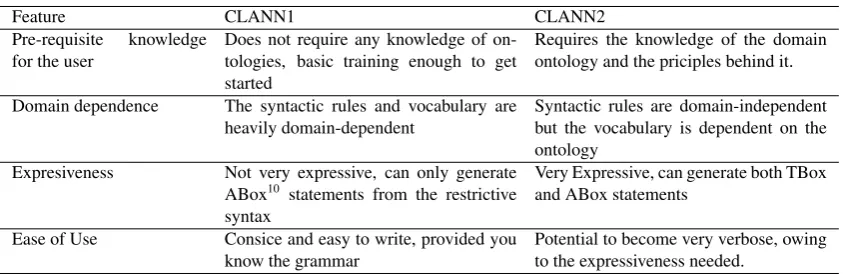
The finer details of design and implementation of these grammars are described in (Davis et al., 2009). Both gram-mars use a common template, described above, which is initially parsed to extract the inherent meta data of the doc-ument (in this case, meeting minutes). A detailed compari-sion of the two approaches is shown in the Table 3. The CLANN grammar is essentially a combination of the previous prototypes, incorporating the snippets of CLANN-prototype2 into controlled text of CLANN-prototype1. This is currently in the development. For other sample doc-uments, demos and information please refer to the project home page11. The CLANN grammar makes use of three diffrent techniques to encode knowledge into the text. They are the templates, the CL snippets (controlled language snippets) andcontrolled english. Each of these are detailed below along with examples.
3.1. Templates
Conventionally, work on semantic annotation focused on two-step approaches where the authoring of a document has to precede the annotation of the same. This problem can be overcome by adopting alatent annotation(Davis et al., 2009) approach by the use of controlled languages, which merges both the authoring and annotation steps into one. The information is encoded in the restricted vocabulary and grammatical structure of the controlled language. However, preliminary evaluations suggest that annotating every piece of information using a CNL makes the task quite verbose, thereby demotivating the users. A simple solution to this is to supplement the CNL by using templates which encode implicit domain information, an example of which is shown below.
Figure 2: Overview of the PDO ontology
utes Ontology). However, the MEMO ontology was only used as a proof-of-concept implementation of the domain. Later, this was completely redesigned and a new ontology PDO (Project Document ontology) was developed in accor-dance with proper ontology design principles, specifically the METHONTOLOGY approach outlined by (Fern´andez-L´opez et al., 1997). The PDO ontology, described using RDFS16and OWL-DL17, models the inherent structure and concepts of various documents in a project-specific setting, like meeting minutes, status reports etc. The scope of this ontology was limited to modelleing the discourse structure of various project documents like meeting minutes, status reports, final reports, deliverables, etc. The content of these documents is not modelled, in order to make the ontology very flexible and interoperable. Care was taken to ensure that other domain ontologies can be easily linked. So, for instance, a meeting minute note might talk about anything from software projects to movie reviews but still be mod-elled by the ontology, while using the respective domain ontolgies of software projects and movies.
A pictorial representation of the ontology is shown in Fig-ure 2. Document is the central class which is subclassed byMinutesandStatusReport. Artefact is the main place-holder class for various arefacts contained in a document, like AgendaItem, Poll, ActionItem, TravelReport, etc. A
16RDFSchemahttp://www.w3.org/TR/rdf-schema 17
OWL (Web Ontology Language) has three flavours, OWL Lite, OWL DL and OWL Full. http://www.w3.org/TR/ owl-features/OWL DL is named so becase of its correspon-dence with Description Logics. This flavour of OWL is neither too strict nor too simple.
partial instantiation of the ontology is described in Turtle18 syntax in the Figure 3. For a complete specification of the PDO ontology please refer to http://ontologies.
smile.deri.ie/pdo#.
6.
Conclusion and Future Work
In conclusion, we have set out to explore the possibility of using controlled languages as interfaces to semantic web applications. We decided to narrow down the domain to meeting minutes and status reports, and designed an on-tology representing the domain. We have developed the CLANN system for knowledge acquisition along with the CLANN grammar and experimented with a few flavours of the grammar. Furthermore, we are currently working on implementing the ideas presented for the CLANN3 gram-mar.
Future work will involve developing a smart CNL text edi-tor for novice users, as well as packaging the CLANN mod-ule as an extension to the Semantic MediaWiki. We also plan to evaluate our work against othe semantic wikis, to judge the feasibility of the approach.
Acknowledgements
The work presented in this paper has been funded in part by Science Foundation Ireland under Grant No. SFI/08/CE/I1380 (L´ıon-2).
18Turtle is an easy, human-readable serialization of RDF.
:x1 a pdo:Minutes;
pdo:hasAttendee :Brian, :Siggi, :Pradeep; pdo:hasAbsentee :Tudor;
... ...
pdo:contains [ a pdo:ActionItem;
pdo:hasComment "Brian to complete the task"; pdo:hasOwner :Brian;
pdo:hasEndDate "2010-03-10"^^xsd:Date]; ...
...
pdo:contains [ a pdo:Poll;
pdo:hasComment "Who is attending the conference?"; pdo:hasOption [ pdo:hasComment "I am";
pdo:hasSupportor :Brian];
pdo:hasOption [ pdo:hasComment "I am not"; pdo:hasSupportor :Pradeep, :Siggi]]. ...
...
Figure 3: Using the PDO Ontology
7.
References
H. Cunningham, D. Maynard, and V. Tablan. 2000. JAPE: a Java Annotation Patterns Engine (Second Edition). Re-search Memorandum CS–00–10, Department of Com-puter Science, University of Sheffield, November. Brian Davis, Pradeep Varma, Siegfried Handschuh, Laura
Dragan, and Hamish Cunningham. 2009. On designing controlled natural languages for semantic annotation. S. Decker. 2006. The social semantic desktop: Next
gener-ation collaborgener-ation infrastructure. Information Services and Use, 26(2):139–144.
Mariano Fern´andez-L´opez, Asunci´on G´omez-P´erez, and Natalia Juristo. 1997. Methontology: from ontological art towards ontological engineering. InProceedings of the AAAI97 Spring Symposium, pages 33–40, Stanford, USA, March.
A. Funk, V. Tablan, K. Bontcheva, H. Cunningham, B. Davis, and S. Handschuh. 2007. Clone: Controlled language for ontology editing. In ISWC/ASWC, pages 142–155.
Siegfried Handschuh. 2005. Creating Ontology-based Metadata by Annotation for the Semantic Web. Ph.D. thesis.
Daniel D. K. Sleator, C Fl Daniel Sleator, and Davy Tem-perley. 1991. Parsing english with a link grammar. InIn Third International Workshop on Parsing Technologies. P. R. Smart. 2008,(Unpublished). Controlled natural