A Question Answering System for German. Experiments with Morphological
Linguistic Resources
Florian K¨ohler
∗, Hinrich Sch ¨utze
∗, Michaela Atterer
∗∗∗Institute for NLP
University of Stuttgart
koehlefn@ims
·
uni-stuttgart·
de, [email protected]∗∗Institute for Linguistics
University of Potsdam atterer@ling
·
uni-potsdam·
deAbstract
Question Answering systems are systems that enable the user to ask questions in natural language and to also receive an answer in natural language. Most existing systems, however, are constructed for the English language, and it is not clear in how far these approaches are also applicable to other languages. A richer morphology, greater syntactic variability, and smaller fraction of webpages available in the language are just some issues that complicate the construction of systems for German. In this paper, we present a modular Question Answering System for German which uses several morphological resources to increase recall. Nouns are converted into verbs, verbs into nouns, and the tenses of verbs are modified. We use a web search engine as a back end to allow for open-domain Question Answering. A POS-tagger is employed to identify answer candidates which are then filtered and tiled. The system is shown to achieve a higher recall than other systems for German.
1.
Introduction
In the recent years, the field of Question Answering (QA) has evolved considerably, bringing forth a number of highly interesting systems and methods such as (Pasca and Harabagiu, 2001), (Dumais et al., 2002), (Hartrumpf, 2006), (Harabagiu and Hickl, 2006), (Moldovan et al., 2007). Question Answering systems enable the user to ask questions in natural language and to also receive an answer in natural language. They can be used for both search-ing the Internet or electronic corpus collections. However, most systems built in the past years are constructed for the English language, and it is not clear in how far these ap-proaches are also applicable to other languages which have a richer morphology and greater variability in their syntac-tic constructions. English morphological variants as well as synonyms are usually found by web search engines com-monly used as system back ends, but this is not necessarily the case for other languages. This fact together with the fact that web pages in other languages comprise a much smaller fraction of the www compared to English web pages1, leads to a smaller recall; fewer potential answer candidates are found. Some systems such as Answerbus (Zheng, 2002) use a machine translation component to evade the prob-lem above, but this raises a number of other probprob-lems, such as low-quality translations and the problem that many lan-guage/area specific questions cannot possibly be answered, because English web pages never contain the answers (such as the names of people well-known exclusively in those countries where the language is spoken). Therefore in this paper we aim at two contributions: 1) constructing an open-domain Question Answering system tailored to the needs of searching German web pages for answers (there is very little work in German QA); 2) experimenting with
morpho-1
(cf. http://www.internetworldstats.com/ stats7.htm)
logical resources to increase the recall of the system.
2.
Related Work
Currently, there are only few unrestricted Question An-swering systems for German. Answerbus (Zheng, 2002) can treat German among other languages but uses the En-glish system in combination with machine translation. Ex-trAns and WebExEx-trAns (Moll´a et al., 2003) are not open-domain, and (Neumann and Xu, 2004) require a semi-structured query formulation. The system by (Hartrumpf, 2006) is perhaps the most similar to the system presented here in terms of unrestrictedness and web-based search on German data, but it differs in that it is an adaptation of an original corpus-based system and uses a sophisticated se-mantic component. The widely known systems of (Dumais et al., 2002) and (Pasca and Harabagiu, 2001) (both built for processing English) provided the basic motivation for the system presented here – (Dumais et al., 2002) in terms of mining data from the web, and (Pasca and Harabagiu, 2001) in terms of using linguistic resources for query ex-pansion/increasing recall. So far our system only uses mor-phological resources for query expansion but the system ar-chitecture is kept modular such that further resources can be tested in the future as in the work of (Pasca and Harabagiu, 2001).
3.
System Architecture
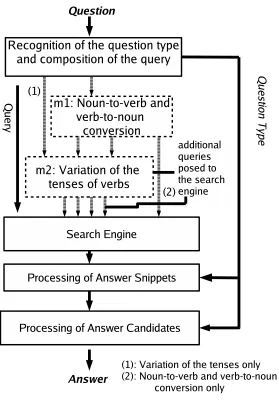
The architecture of the system is schematized in Figure 1 First, the user’s question is analyzed to render 1) the ques-tion type and 2) the relevant parts for query construcques-tion. The query then enters the search engine – in our case we used the Yahoo API2. The answer snippets returned by the search engine are then further processed: they are part-of-speech tagged to help find the relevant answer candidate,
Figure 1: System architecture.
answer-candidates are matched to the question types, and similar answer candidates are merged before the most fre-quent answer-candidate is selected.
3.1. Question Types
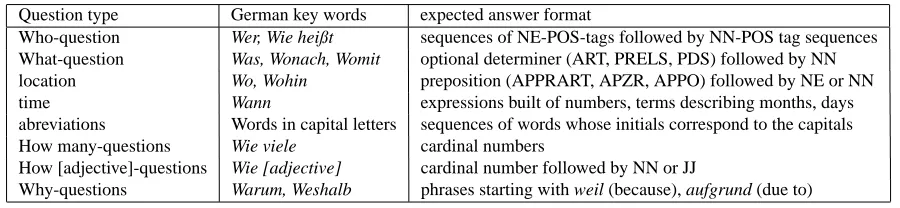
Question types are mainly recognized by identifying the question word. The system so far can deal with the ques-tion types shown in Table 1 The POS-tag sequences that are expected as answer types refer to the STTS-tagset (Schiller et al., 1995).3
3.2. Query Composition and Query Modification
For composing the query the question words and auxiliaries are erased from the user’s question. Two (optional) mod-ules, m1 and m2, are used for query modification. The first module performs noun-to-verb and verb-to-noun con-versions in order to achieve a higher recall. The question Was hat Edison erfunden? (What did Edison invent?) nor-mally results in the query+Edison +erfunden (+Edison
+in-3
To compensate for tagging errors, we sometimes also allow for similar tags as in the case of the determiner.
vented). Using query extension we also obtain the query
weighting of queries etc. As Table 8 shows, the system is however comparable to other German Question Answering systems. Note that a fair comparison is not possible due to the different data that were used. One of the systems also was not evaluated considering unrestricted question types, and that increasing recall was not always tried or evaluated in the manner we do.
5.
Conclusion
We built a highly modular question answering system for German that mines data from the Internet for answer ex-traction. The system is a highly extensible prototype which in its current version is tuned to the fact that German web pages comprise only an small fraction of the Internet com-pared to English web pages. The system uses morphologi-cal data resources such that it achieves a higher remorphologi-call than comparable systems.
6.
References
S. Dumais, M. Banko, E. Brill, J. Lin, and A. Ng. (2002). Web question answering: Is more always better? In Pro-ceedings of the 25th Annual International ACM SIGIR Conference on Research and Development in Informa-tion Retrieval (SIGIR 2002), pp. 291–298, Tempere, Fin-land.
Sanda M. Harabagiu and Andrew Hickl. (2006). Methods for using textual entailment in open-domain question an-swering. In Proceedings of the ACL 2006.
S. Hartrumpf. (2006). Adapting a semantic question an-swering system to the web. In Proceedings of the EACL 2006 Workshop on Multilingual Question Answering (MLQA’06), pp. 61–68, Trento, Italy.
Vladimir I. Levenshtein. (1966). Binary codes capable of correcting deletions, insertions, and reversals. Soviet Physics Doklady, 10(8), pp. 707–710.
Dan I. Moldovan, Christine Clark, Sanda M. Harabagiu, and Daniel Hodges. (2007). Cogex: A semantically and contextually enriched logic prover for question answer-ing. Journal of Applied Logic, 5(1), pp. 49–69.
Diego Moll´a, Rolf Schwitter, Fabio Rinaldi, James Dow-dall, and Michael Hess. (2003). NLP for answer extrac-tion in technical domains. In EACL 03 Workshop: Nat-ural Language Processing for Question Answering, pp. 5–11, Budapest.
G¨unter Neumann and Feiyu Xu. (2004). Mining natural language answers from the web. International Journal of Web Intelligence and Agent Systems, 2(2), pp. 123–135. M. A. Pasca and S. M. Harabagiu. (2001). High perfor-mance question/answering. In Proceedings of the 24th Annual International ACM SIGIR Conference on Re-search and Development in Information Retrieval (SI-GIR’2001), pp. 366–374.
A. Schiller, S. Teufel, and C. Thielen. (1995). Guidelines fr das tagging deutscher textkorpora mit STTS. Tech-nical report, University of Stuttgart and University of T¨ubingen.
H. Schmid, A. Fitschen, and U. Heid. (2004). SMOR: A german computational morphology covering derivation, composition and inflection. In Proceedings of the 4th
International Conference on Language Resources and Evaluation (LREC), pp. 1263–1266, Lisbon, Portugal. Helmut Schmid. (1994). Probabilistic part-of-speech
tag-ging using decision trees. In Proceedings of Interna-tional Conference on New Methods in Languge Process-ing, pp. 44–49, Manchester, UK.