Sentiment analysis based on probabilistic models
using inter-sentence information
Kugatsu Sadamitsu
†, Satoshi Sekine
‡, Mikio Yamamoto
††Graduate School of Systems and Information Engineering, University of Tsukuba 1-1-1 Tenoudai, Tsukuba science city, Ibaraki 305-8573, JAPAN
{[email protected],myama@cs}.tsukuba.ac.jp
‡Computer Science Department, New York University 715 Broadway, 7th floor New York, NY 10003, USA
Abstract
This paper proposes a new method of the sentiment analysis utilizing inter-sentence structures especially for coping with reversal phe-nomenon of word polarity such as quotation of other’s opinions on an opposite side. We model these phephe-nomenon using Hidden Conditional Random Fields(HCRFs) with three kinds of features: transition features, polarity features and reversal (of polarity) features. Polarity features and reversal features are doubly added to each word, and each weight of the features are trained by the common struc-ture of positive and negative corpus in, for example, assuming that reversal phenomenon occured for the same reason (feastruc-tures) in both polarity corpus. Our method achieved better accuracy than the Naive Bayes method and as good as SVMs.
1.
Introduction
Recently, many people express opinions on the WWW, us-ing blogs and online customer reviews. It results in enor-mous amount of texts including subjective opinions or sen-timents. Such information is a valuable for consumers and companies, and there are demands for the efficient analy-sis of the information. One of the popular analyanaly-sis of the information is to find if the opinion is positive or negative regarding the target item or service. It is called “sentiment classification”(Turney, 2002)(Pang and Lee, 2002) which is a subject of growing interest. Many past sentiment classi-fication studies only use word-level information in accor-dance with the polarity of the word. This paper aims to improve the accuracy of sentiment classification by using Hidden Conditional Random Fields (HCRFs) to construct a sentence-by-sentence basis model, thereby capturing the global information that was not captured using the conven-tional word-by-word model. To be more precise, the chain structure of sentences is modeled using HCRFs that regard sentences as direct output symbols. We will describe the new models achieved better accuracy than the Naive Bayes method and as good as SVMs.
2.
Sentiment classification using
inter-sentence information
2.1. Reversal of polarity in the sentence level structures
It is often the case that information in inter-sentence should be included in order to make the accurate analysis. Con-sider the following review from Amazon.com1.
1
http://www.amazon.com
An example of review
I like this razor very much. It gives a close shave with-out damaging the skin. However, the only drawback is that you must constantly be holding in the “On” button. My last razor had a button that when it was switched on, it stayed on.
This is a positive review about the razor, although there are also negative sentences which partially complain about it. In this paper, we hypothesize that this partial reversal of polarity occurs on a sentence-by-sentence basis as the first-order approximate, and such the sentence-level structures are modeled by sequential models such as the HCRFs that regard a sentence as the output unit.
2.2. Modeling of inter-sentence structure using HMMs
When hypothesizing that each sentence has a certain hid-den class (e.g. ”quotation” class or ”evaluation for a differ-ent target” class) and the transition of the class makes up structure of the document, it is natural to use HMMs which regard the sentence itself as an output symbol. Moore type sentence based HMMs are considered here for a sentence
sthat is represented as a set of words. ProbabilityPHM M
of a documentdusing sentence based HMMs is defined as follows.
PHM M(d|a,b) =
X
q1T
T
Y
t=1
aqt−1qtbqt(st)
= X
q1T
T
Y
t=1
aqt−1qt
|st|
Y
n=1
bqt(wtn) (1)
Wherestmeanst-th sentence in the documentd,T means
the number of sentences in the documentd,wtnmeansn-th
word in the sentencest, andqt means the HMMs state of
the sentencest. Furthermore,a,bare model parameters,
Table 1: Average 10-fold cross-validation accuracies of sentiment classification using the HCRFs and basic mod-els.
NB SVMs HCRFs
train init 81.54 82.56 82.74 70.38
Naive Bayes method and as good as SVMs, it can be said that effective training was achieved. In addition, the ex-ample review shown in the section 2.1. is an real review which is improved by using HCRFs. On the other hand, an example which is worsen by using HCRFs is following.
• This is not a scuba diving watch but fun for snorkling and skin diving. The atomic watch updates well in the Washington, DC area. Mine updated the first night and I didn’t even put it in a window as suggested. It has synchronized with NIST Ft. Collins every night since. Everything works as advertised.
The first sentence in this review includes two reversal words “not” and “but”. Unfortunatelly, our model can’t capture multiple reversal phenomenon. The more reversal words appeared in the sentence, the higher probability of the re-versal (negative) hidden state is estimated. This is an im-portant future tasks for our method.
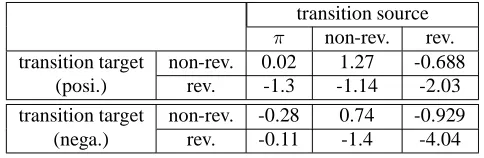
The table 2 shows the training results of the transition pa-rameter (λtrans). π means first sentence transition, “non-rev.” means that the sentence polarity is not reversal of the document polarity and “rev.” means the sentence polarity is reversal of the document polarity. Some interesting re-sults can be observed here. First, a higher weight is seen in the case where the transition target is in a non-reversal state in comparison to where it is in a reversal state. This result shows that more sentences stay in the non-reversal state as a human’s intuition. Regarding initial transitionπ
the negative model has a higher weight in the reversal state (-0.11). This is a characteristic that only appears in this part of the entire table. The reason for this result is presumed that a negative review would have the tendency of first par-tially acknowledging a positive opinion or of consulting the opinions of others.
Finally, we show the table 3 which has the characteristic words for the polarity and reversal features. These ranks are calculated with the difference in feature weight values to each other. The table shows the top 5 polarity words and the top 2 and selected from the top 50 reversal words, as the top reversal words are a little noisy, similar to the top 2 words. The numbers in the brackets on the right side of the reversal words denote the rank of the words.
5.
Conclusion
This paper proposed a new method of the sentiment clas-sification utilizing inter-sentence structures especially for coping with reversal phenomenon of word polarity. Polar-ity features and reversal features are doubly added to each word, and each weight of features are trained by common
Table 2: The transition weights of HCRFs (λtrans) .
transition source
π non-rev. rev. transition target non-rev. 0.02 1.27 -0.688
(posi.) rev. -1.3 -1.14 -2.03
transition target non-rev. -0.28 0.74 -0.929 (nega.) rev. -0.11 -1.4 -4.04
Table 3: The characteristic polarity and reversal words.
polarity words reversal words (top 5) (top 2 and selected from top 50)
posi. nega. non-rev. rev.
excellent unusable unusable(1) replay(1) pleased returned receipt(2) lens(2) pleasantly disappointing specially(20) initially(11) compliments disappointed secondly(34) vs.(34)
easy horrible additionally(50) e.g.(45)
structure of positive and negative corpus, thereby allow-ing effective modelallow-ing. As the future work we will take into consideration multiple reversal phenomenon, as de-scribed in the previous section. Furthermore we are going to apply other parameter training methods, including expo-nential gradient algorithms(Globerson et al., 2007), more appropriate initial values, the other loss functions, and an method with an increased number of HCRFs states.
6.
References
Regina Barzilay and Lillian Lee. 2004. Catching the drift: Probabilistic content models, with applications to gen-eration and summarization. In Proc. of the HLT-NAACL
2004 Conf., pages 113–120.
A. Globerson, T.Y. Koo, X. Carreras, and M. Collins. 2007. Exponentiated gradient algorithms for log-linear struc-tured prediction. In Proc. of the 24th ICML, pages 305– 312.
Asela Gunawardana, Milind Mahajan, Alex Acero, and John C. Platt. 2005. Hidden conditional random fields for phone classification. In Proc. of the INTERSPEECH
Conf.
Daisuke Ikeda, Hiroya Takamura, Lev-Arie Ratinov, and Manabu Okumura. 2008. Learning to shift the polar-ity of words for sentiment classification. In Proc. of the
IJCNLP-08 Conf.
B.-H. Juang and S. Katagiri. 1992. Discriminative learning for minimum error classification. In IEEE Trans. Signal
Processing, volume 40, pages 3043–3054.
J. Lafferty, A. McCallum, and F. Pereira. 2001. Condi-tional random fields: Probabilistic models for segment-ing and labelsegment-ing sequence data. Proc. 18th International
Conf. on Machine Learning, pages 282–289.
ran-dom fields and local sentiment flow. In Neural
Informa-tion Processing Systems, volume 18.
Ryan McDonald, Kerry Hannan, Tyler Neylon, Mike Wells, and Jeff Reynar. 2007. Structured models for fine-to-coarse sentiment analysis. In Proc. of the 45th ACL
Conf., pages 432–439.
Bo Pang and Lillian Lee. 2002. Thumbs up? senti-ment classification using machine learning techniques. In Proc. of the EMNLP Conf., pages 76–86.
Ariadna Quattoni, Michael Collins, and Trevor Darrell. 2004. Conditional random fields for object recognition. In Neural Information Processing Systems, volume 17. Jun Suzuki, Erik McDermott, and Hideki Isozaki. 2006.
Training conditional random fields with multivariate evaluation measures. In Proc. of the 21st COLING and
44th ACL Conf., pages 217–224.