S T U D Y P R O T O C O L
Open Access
Comparison of usual podiatric care and early
physical therapy intervention for plantar heel pain:
study protocol for a parallel-group randomized
clinical trial
Shane M McClinton
1,2*, Timothy W Flynn
3, Bryan C Heiderscheit
4, Thomas G McPoil
5, Daniel Pinto
6,
Pamela A Duffy
7and John D Bennett
8Abstract
Background:A significant number of individuals suffer from plantar heel pain (PHP) and many go on to have chronic symptoms and continued disability. Persistence of symptoms adds to the economic burden of PHP and cost-effective solutions are needed. Currently, there is a wide variation in treatment, cost, and outcomes of care for PHP with limited information on the cost-effectiveness and comparisons of common treatment approaches. Two practice guidelines and recent evidence of effective physical therapy intervention are available to direct treatment but the timing and influence of physical therapy intervention in the multidisciplinary management of PHP is unclear. The purpose of this investigation is to compare the outcomes and costs associated with early physical therapy intervention (ePT) following initial presentation to podiatry versus usual podiatric care (uPOD) in individuals with PHP.
Methods:A parallel-group, block-randomized clinical trial will compare ePT and uPOD. Both groups will be seen initially by a podiatrist before allocation to a group that will receive physical therapy intervention consisting primarily of manual therapy, exercise, and modalities, or podiatric care consisting primarily of a stretching handout, medication, injections, and orthotics. Treatment in each group will be directed by practice guidelines and a procedural manual, yet the specific intervention for each participant will be selected by the treating provider. Between-group differences in the Foot and Ankle Ability Measure 6 months following the initial visit will be the primary outcome collected by an independent investigator. In addition, differences in the European Quality of Life–Five Dimensions, Numeric Pain Rating Scale, Global Rating of Change (GROC), health-related costs, and cost-effectiveness at 6 weeks, 6 months, and 1 year will be compared between groups. The association between successful outcomes based on GROC score and participant expectations of recovery generally, and specific to physical therapy and podiatry treatment, will also be analyzed.
Discussion:This study will be the first pragmatic trial to investigate the clinical outcomes and cost-effectiveness of ePT and uPOD in individuals with PHP. The results will serve to inform clinical practice decisions and management guidelines of multiple disciplines.
Trial registration:ClinicalTrials.gov: NCT01865734
Keywords:Cost, Exercise therapy, Musculoskeletal manipulations, Plantar fasciitis, Podiatry
* Correspondence:[email protected]
1
Rocky Mountain University of Health Professions, 561 East 1860 South, Provo, Utah 84606, USA
2
Department of Physical Therapy, Des Moines University, 3200 Grand Avenue, Des Moines, IA 50312, USA
Full list of author information is available at the end of the article
Background
Plantar heel pain (PHP), or plantar fasciitis, is a common condition that approximately 1–2 million Americans re-ceive treatment for each year [1,2]. Individuals with PHP commonly have prolonged and recurrent symptoms that cost from $192 to $396 million to treat annually [3-7]. Actual healthcare costs for PHP management are likely higher because this estimate reflects only 818,000 of the 1–2 million individuals estimated to have PHP annually and does not include indirect costs, such as loss of work productivity or costs associated with treatment provided by podiatrists and physical therapists [2].
The etiology of PHP is multifactorial including inflam-mation, chronic tendinopathy, foot posture or mobility dysfunction, lower leg inflexibility, mobility impairments of the foot, ankle, knee and hip, and neurodynamic dysfunc-tion [8-17]. Due to the multifactorial nature of PHP, many terms such as plantar fasciitis, plantar fasciopathy, and plantar fasciosis have been used to describe the condition. Furthermore, there are a number of different treatments proposed to be effective in PHP and multiple healthcare providers that offer primary care for PHP [18-20].
Providers within the healthcare system that manage PHP include podiatrists, physical therapists, chiroprac-tors, primary care physicians, and orthopedic surgeons. Prevalence estimates for individuals with PHP that seek care from non-physician providers who manage PHP is not available. However, approximately 1 million visits for PHP were made each year to office or hospital-based physicians between the years 1995 and 2000 [2]; 62% of visits were made to primary care physicians and 31% to orthopedic surgeons, with physical therapy ordered or provided at 19% of these visits [2]. In addition to physi-cians, there is evidence to suggest that individuals with PHP also visit podiatrists and physical therapists fre-quently as primary providers for this problem. It has been estimated that up to 15% of patients seeking care from a podiatrist have a chief complaint of PHP and a survey of podiatrists indicated that PHP was the most prevalent condition in podiatry practice [21,22]. A sur-vey of physical therapists in orthopedic practice indi-cated that PHP was the most common foot condition seen [23]. While physicians, podiatrists, and physical therapists each see a significant number of individuals with PHP, the primary role of several different disci-plines may contribute to the observed variance in PHP management [2].
Clinical guidelines can provide direction in the pres-ence of practice variation and multiple treatment op-tions. Currently there are two clinical guidelines on PHP provided by the American College of Foot and Ankle Surgeons (ACFAS) and the Orthopaedic Section of the American Physical Therapy Association (APTA) [19,20]. Both guidelines are intended for use by podiatry and
physician specialties, although the APTA guidelines are also intended for use by physical therapists [24]. While there are many common recommendations between the two guidelines, including foot and lower leg stretching, taping, orthotics, and night splints, there is an apparent difference in recommendations for the timing of referral to a physical therapist and inclusion of common physical therapy interventions for PHP. ACFAS guidelines rec-ommend 6 weeks of unresponsive treatment and testing to include imaging (e.g., radiographs), corticosteroid in-jections, orthotics, taping, oral anti-inflammatories, and an unsupervised home program before referral to a physical therapist. In contrast, APTA guidelines do not indicate a timeline for certain interventions as described in the ACFAS guidelines. Additionally, recommenda-tions for iontophoresis, manual therapy, and supervised exercise are included in the APTA guidelines without specific mention in the ACFAS guidelines. Since the APTA guidelines were written in 2008, additional evidence has been published supporting the use of manual therapy inter-ventions in the management of PHP [10,25,26]. The conflicting recommendations of the ACFAS and APTA guidelines may result in different healthcare utilization patterns. Following the ACFAS recommendations, there is likely to be greater utilization of corticosteroid injections, oral medication, and radiographs in the first 6 weeks whereas a greater utilization of manual therapy and exer-cise procedures may result from following the APTA guidelines and recent manual therapy evidence. The discrepancies between guidelines and discipline-specific practice patterns for PHP contribute to uncertainty in the best management strategy of primary providers for PHP. An important factor to clarify is the role of physical ther-apy intervention within the first 6 weeks that a patient presents to a provider for PHP.
Early physical therapy intervention versus a delayed referral has demonstrated improved outcomes, de-creased likelihood of surgery and injections, fewer office visits, and reduced advanced imaging and medication in individuals with low back pain [27-29]. No investigations were found on the impact of early physical therapy inter-vention in PHP. If physical therapy interinter-vention provided early after initial presentation to a provider for PHP can reduce utilization of healthcare while improving out-comes, this would be a significant contribution to the eco-nomic and disability-related burden of PHP. Therefore, the purpose of this investigation is to compare the out-comes and costs associated with usual podiatric care (uPOD) versus early physical therapy intervention (ePT) in patients with PHP.
Specific aims
the Foot and Ankle Ability Measure (FAAM) between ePT and uPOD in individuals with PHP at the 6-month follow-up will be tested using a randomized clinical trial. Aim 2: Compare the difference in secondary outcome measures using the 3-item (average, worst, least) nu-meric pain rating scale (NPRS), and global rating of change (GROC) scale. These measures will be taken concurrently with the FAAM in the randomized clinical trial to test the null hypothesis that there is no difference in NPRS and GROC between ePT and uPOD.
Aim 3: Compare the cost-effectiveness of ePT versus uPOD. Costs and quality of life measures will be cap-tured concurrently in the randomized clinical trial to calculate incremental cost-effectiveness ratios and test the null hypothesis that there is no difference in cost-effectiveness between ePT and uPOD.
Aims 1 and 2 will be the focus of this paper although Aim 3 will also be considered in the planning of this project and is included here for clarity of the entire pro-ject’s scope. The procedures to accomplish Aim 3 will be outlined in a subsequent publication.
Methods
Study design
This investigation will be a block randomized clinical trial comparing participant-reported outcomes and cost-effectiveness of ePT and uPOD with follow-up extending to 1 year (Figure 1).
Setting and ethical approval
The location for this study will be the Podiatry and Physical Therapy Departments at the Des Moines Uni-versity Clinic, Des Moines, IA, USA. This study has re-ceived Institutional Review Board (IRB) Approval from Des Moines University (IRB identification, 04-13-02) and Rocky Mountain University of Health Professions (IRB identification 131034–02). Within the Des Moines University IRB approval, agreements regarding review of protected health information in preparation for research, and extraction of data from electronic health records were made between the Des Moines University Clinic and the principle investigator. As a part of this agreement, all enrolled participants will sign a Health Insurance Port-ability and AccountPort-ability Act of 1996 authorization to use and disclose individual health information for research purposes form in addition to the informed consent form.
Participants
Individuals presenting with a primary complaint of PHP to the Podiatry Department of the Des Moines Univer-sity Clinic will be recruited for this study. Participants will be included if they have a primary clinical diagnosis of PHP determined by having tenderness to palpation of the plantar aspect of the heel and pain associated with first step after waking in the morning or with progression of weight-bearing during the day. Eligible participants will be between the ages of 18–60 and demonstrate a score of less than 74/84 on the FAAM activities of daily living (ADL) subscale to allow for improvement of at least the minimum clinically important difference [30]. Participants will be excluded if they had prior surgery of the foot, ankle, or lower leg; clinical signs of radiculopathy; contra-indications to manual therapy interventions (i.e., tumor, fracture, rheumatic inflammatory disease [rheumatoid, re-active and psoriatic arthritis, inflammatory bowel disease, ankylosing spondylitis, and systemic lupus erythematosus], osteoporosis, prolonged history of steroid use, severe vas-cular disease, etc.); clinical indication of plantar fascia rup-ture; are unable to complete questionnaires; unable or unwilling to comply with treatment recommendations of either treatment group; or had prior treatment for PHP in the past 6 weeks. In addition, individuals who have a body mass index (BMI) greater than 30 kg/m2or symptoms for longer than 1 year will be excluded due to the greater risk of chronic symptoms and poor response to conservative management [4,6,13,31].
[image:3.595.57.291.448.665.2]The number of participants for this study is based on the power needed to detect between-group differences in the primary outcome measure, the FAAM, at 6 months. In the absence of research comparing physical therapy and podiatry interventions or podiatry interven-tions using the FAAM as an outcome measure, sample size calculations are based on achieving a clinically Figure 1Diagram of participant flow through the study.BMI:
Body mass index; DMU: Des Moines University; ePT: Early physical therapy intervention; EQ-5DTM: European Quality of Life–Five
meaningful difference between the groups and details from a recent clinical trial by Cleland et al. [10] that used similar methods to this investigation. Sample size estimate was made using G*Power 3.1.5 based on de-tecting a difference between groups greater than the minimal clinically important difference (MCID) (i.e., 9 point change) of the FAAM at 6 months with an alpha level of 0.05, 80% power, and pooled sample variance of 14.5 from Cleland et al. [10,30,32]. This resulted in an effect size of 0.62 and 42 participants needed per group. To account for participants who drop-in or drop-out of treatment, in addition to the possibility of some participants not returning the FAAM question-naire, the sample will be increased by 33% resulting in 56 participants per group. The focus, and consequently the power analysis of this investigation is on functional outcome (based on FAAM scores) and therefore may result in underpowered analysis of secondary variables.
Outcome measures
Outcomes will be collected at 6 weeks, 6 months, and 1 year after initial presentation. An investigator blinded to group allocation will collect all primary and secondary outcome measures. A small financial incentive will be provided to facilitate completion of outcome measures over the study duration.
Primary outcome measure
The FAAM ADL subscale will be used to assess participant-reported functional outcome. The FAAM has demonstrated an intraclass correlation coefficient of 0.89 and a MCID of 8 for the ADL subscale [30].
Secondary outcome measures
A 3-item, 0–10 (0 = no pain, 10 = worst imaginable pain), NPRS will be used to assess average pain in addition the lowest and highest levels of pain in the past week. The average of the three ratings will be used to represent overall pain intensity. The 3-item NPRS has demon-strated test-retest reliability of 0.61, and an MCID of 2 points [33]. The GROC scale will be used to assess participant-reported improvement. The GROC is a sin-gle question item that includes 15 ranks for global im-provement from−7 (a very great deal worse) to 0 (about the same) to +7 (a very great deal better) [34]. Scores of +5 have previously been used as an indicator of clin-ical success [10,35]. Overall health status will be mea-sured by the European Quality of Life-Five Dimensions (EQ-5D™).The EQ-5D™is a general measure of health-related quality of life that includes five items health-related to mobility, self-care, usual activities, pain/discomfort, and anxiety/depression [36]. Index scores from the United States general population will be applied to the
EQ-5D™ to calculate the quality-adjusted life year, where 0.0 = death and 1.0 = perfect health [37].
Intervention
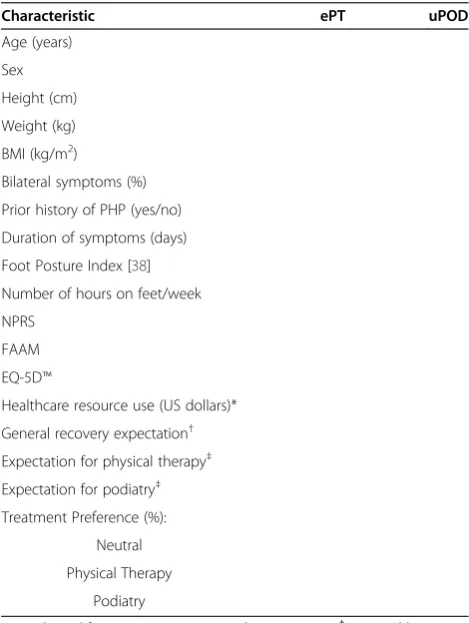
All patients will attend one visit with a podiatrist where the podiatrist will perform an evaluation and provide intervention based upon usual practice patterns. After this visit, the patient will be invited to participate in the study and undergo a baseline examination that will collect data on variables indicated by Table 1. A member of the office staff will randomize group assignment using ran-dom block sizes of 4 and 6, and concealed envelopes con-taining group assignment to ePT or uPOD (Figure 1).
Early physical therapy intervention group (ePT)
[image:4.595.304.539.365.677.2]Individuals in the ePT will be managed by a physical therapist in accordance with the APTA plantar heel pain practice guidelines and recent evidence in support of manual therapy intervention [10,19,25,26]. Treat-ment provided will be based on identified impairTreat-ments and may include manual therapy (joint and soft tissue
Table 1 Baseline measures of participant characteristics
Characteristic ePT uPOD
Age (years)
Sex
Height (cm)
Weight (kg)
BMI (kg/m2)
Bilateral symptoms (%)
Prior history of PHP (yes/no)
Duration of symptoms (days)
Foot Posture Index [38]
Number of hours on feet/week
NPRS
FAAM
EQ-5D™
Healthcare resource use (US dollars)*
General recovery expectation†
Expectation for physical therapy‡
Expectation for podiatry‡
Treatment Preference (%):
Neutral
Physical Therapy
Podiatry
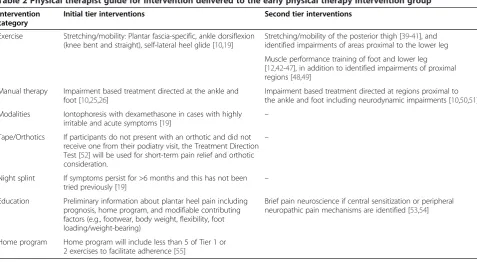
mobilization/thrust manipulation to the lower half of the body), lower leg and plantar foot specific stretching/ self-mobilization, foot and lower leg muscle performance training, night splints, taping, over-the-counter orthotics/ heel cup/heel cushion, and iontophoresis. The specific intervention will be selected at the discretion of the treating physical therapist, yet will be guided by a man-ual of procedures that directs intervention priorities and progression based on current best evidence (Tables 2 and 3). The principle investigator will conduct training sessions with each ePT provider to assure comprehension of the items and interventions included in the manual of procedures. Training sessions are estimated to last 1–4 hours per provider and will be conducted in brief sessions with follow-up until each therapist reports comprehension. Participants in the ePT group will be managed by the physical therapist without additional podiatric intervention until the participant achieves a GROC of “quite a bit better” and demonstrates inde-pendence in condition management strategies or a plateau in progress demonstrated by GROC or FAAM scores. While participants in the ePT group will be managed primarily by the physical therapist, they are free to return to the podiatrist if they choose.
Usual podiatric care group (uPOD)
Individuals in the uPOD group will receive care typical of podiatric management of PHP at the Des Moines University Clinic that is in accordance with the recently updated practice guideline [20]. According to the guide-line [20], the first 6 weeks of treatment includes foot
taping/padding, home stretching exercises, over-the-counter arch support/heel cup, shoe recommendations, oral anti-inflammatories, and corticosteroid injections. If the participant is non-responsive to the first 6 weeks of treatment, the guideline indicates the next 6 months of treatment should include corticosteroid injections, custom orthotics, a night splint, immobilization, and referral to a physical therapist [20]. If the participant is not responsive after 6 months of treatment, extracor-poreal shock wave therapy or a fasciotomy surgery is recommended per the guideline [20]. Extracorporeal shock wave therapy is not available at Des Moines Uni-versity and partial or full fasciotomy is performed in less than 1% of patients. In addition to the treatment indicated above, the podiatrist may order radiographs or ultrasound imaging within their scope of practice. The specific intervention will be selected at the discretion of the treating podiatrist and Figure 2 indicates the preva-lence of intervention and testing procedures from a ran-dom sample of care episodes between February 2008 and August 2011 at the Des Moines University Podiatry Clinic.
Statistical analysis
Baseline group variables will be summarized using the mean and standard deviation for continuous measures and percentages for categorical measures. Independent
[image:5.595.59.537.474.736.2]t-tests (P <0.05, two-tailed) or the appropriate nonpara-metric test will be used to compare between-group dif-ferences in baseline characteristics (Table 1). Parametric test assumptions will be analyzed for all continuous vari-ables by visual inspection of histograms, use of skewness
Table 2 Physical therapist guide for intervention delivered to the early physical therapy intervention group
Intervention category
Initial tier interventions Second tier interventions
Exercise Stretching/mobility: Plantar fascia-specific, ankle dorsiflexion (knee bent and straight), self-lateral heel glide [10,19]
Stretching/mobility of the posterior thigh [39-41], and identified impairments of areas proximal to the lower leg
Muscle performance training of foot and lower leg [12,42-47], in addition to identified impairments of proximal regions [48,49]
Manual therapy Impairment based treatment directed at the ankle and foot [10,25,26]
Impairment based treatment directed at regions proximal to the ankle and foot including neurodynamic impairments [10,50,51]
Modalities Iontophoresis with dexamethasone in cases with highly
irritable and acute symptoms [19] –
Tape/Orthotics If participants do not present with an orthotic and did not receive one from their podiatry visit, the Treatment Direction Test [52] will be used for short-term pain relief and orthotic consideration.
–
Night splint If symptoms persist for >6 months and this has not been tried previously [19]
–
Education Preliminary information about plantar heel pain including prognosis, home program, and modifiable contributing factors (e.g., footwear, body weight, flexibility, foot loading/weight-bearing)
Brief pain neuroscience if central sensitization or peripheral neuropathic pain mechanisms are identified [53,54]
score within double the standard error of skewness cri-teria, and Levene’s test for homogeneity of the variance. A repeated measures analysis of variance will be used to compare group differences in the FAAM, NPRS, EQ-5D™, and number of office visits associated with treat-ment at each time point. Results will be reported as the
group mean, mean difference between groups, 95% confi-dence intervals, f-value,P value, power, and effect size. The χ2
[image:6.595.58.539.99.395.2]test will be used to compare GROC scores between groups at each time point and results will be reported as the χ2 value, P value, and the frequency per category. The types of treatment based on Current Procedural Terminology and Healthcare Common Procedure Coding System codes provided per group will be reported as percentages. Analysis of covariance will be used if any group differences are observed in participant characteris-tics. Intention-to-treat analysis will be performed by com-paring the complete case analysis to multiple imputation analysis. Multiple imputed data sets will be generated using the Multivariate Imputation by Chained Equations algorithm with SPSS 19.0 for Windows (SPSS Inc., Chicago, IL, USA). Multinomial logistic regression will be used to obtain pooled regression estimates from the data sets that will be used for analysis. Post-randomization exclusion of included participants that did not meet eligibility criteria or that did not receive intervention will be considered for exclusion of the analysis by an independent, blinded adjudication committee that will evaluate all randomized participants [57]. Any cross-overs will be analyzed in the original group to which they were assigned. A separate analysis excluding crossovers will be performed.
Table 3 Phases and progression of physical therapy treatment
Phase Goals Criteria for advancement to next phase Interventions
Phase I 1. Decrease irritability 1. Mild to moderate pain 1. Address contributing factors (footwear,
orthotics, taping, neurodynamic impairments)
2. Educate participant on condition and rehabilitation
2. Dorsiflexion≥10 degrees (measured in prone with knee extended) [11], or symmetrical dorsiflexion to uninvolved
side 2. Participant education
3. Improve dorsiflexion 3. Modalities
4. Stretching/self-mobilization
a. Home Program; <5 exercises [55]
b. Night splint (if symptoms persist for >6 months) [19]
5. Manual therapy
Phase II 1. Further reduction in pain 1. Minimal to no pain 1. Exercise*
2. Single leg heel raise≥12 repetitions [56], or symmetrical performance to the uninvolved side
2. Manual therapy*
2. Restore muscle performance 3. Gait training
3. Minimize gait deviations 3. Walking items on FAAM≤“slight difficulty”
4. Enhance basic function(s)
Phase III 1. Enhance higher level function(s) including sport and recreational activities
Discharge when: 1. Progression of exercise
GROC≥“quite a bit better”and participant demonstrates understanding of independent condition management
2. Sport/recreation specific training
2. Education on independent condition management and prevention 2. Prevent recurrence
OR
Plateau evident in GROC or FAAM scores and participant demonstrates understanding of independent condition management
*Manual therapy during Phase II will address residual impairments from Phase I but Phase II treatment will reflect greater volume of exercise interventions than manual therapy compared to Phase I. FAAM: Foot and Ankle Ability Measure; GROC: Global rating of change scale.
[image:6.595.57.292.518.686.2]Participant expectations and preferences for ePT or uPOD will be categorized into three categories; matched, unmatched, and neutral. Participants will be labelled
‘matched’if they are allocated to a group for which they have expressed a higher expectation of benefit. A higher ex-pectation will be denoted by comparison of visual analog rat-ings between the groups (ePT and uPOD; Additional file 1). Unmatched participants will be those who are allocated to the treatment group for which they have a lower expectation of benefit. Neutral participants will be those who indicate the same level of expectation for both treatments. Similar categorizations will be made for participant preference based upon their response to the treatment preference question (Additional file 1). General expectations of improvement will be dichotomized into met or unmet based upon rankings at the 6-week, 6-month, and 1-year follow-up relative to baseline rankings. Participants that demonstrate 6-week, 6-month, and 1-year ranks equal to or higher than base-line will be considered to have met their global expecta-tions of improvement. Participants that demonstrate rankings below baseline expectations will be considered to have unmet global expectations of improvement. Aχ2test of independence will be used to compare the proportions of individuals with matched/unmatched/neutral expecta-tions or preferences to global expectaexpecta-tions (met or un-met). In addition, differences in expectation and preference categories will be analyzed relative to treatment success using aχ2test of independence. Treatment success will be determined by the GROC at each period with success de-fined as a GROC of +5,“a great deal better”, or greater.
Economic evaluation
An economic evaluation will be conducted alongside this randomized clinical trial in accordance with established methods [58,59]. Costs and consequences of ePT and uPOD from the viewpoint of a healthcare payer and so-ciety will be estimated using billing records and a participant-reported questionnaire at all follow-up time points. Incremental cost effectiveness will be reported using quality-adjusted life-years derived from the EQ-5D™and index scores from the United States [37]. A separate protocol paper will describe the methods of the economic evaluation in greater detail and in accordance with recommendations from publication guidelines for economic evaluations [60].
Discussion
This paper describes the methods of a randomized clin-ical trial comparing ePT and uPOD for PHP. The pro-posed work builds on emerging evidence indicating the benefit of early physical therapy intervention [27-29], which has not been established in a population of indi-viduals with PHP. In addition, previous investigations have analyzed the outcome associated with individual or
1–2 combined interventions for PHP. This is the first pragmatic study, as far as we are aware, that investigates the role and cost-effectiveness of impairment-based physical therapy intervention early in the multi-disciplinary management of PHP. The implications of this work ad-dress national concerns about rising healthcare costs in the American healthcare system, will help inform clinical guidelines, and benefit multiple healthcare providers in-volved in PHP management. This trial is registered at clinicaltrials.gov, identifier NCT01865734 to increase transparency of trial. The results of this investigation will be submitted for publication in peer-reviewed journals and presented at local and national meetings regardless of the outcome. The Orthopaedic Section, APTA, Inc. will be credited for monetary support pro-vided for this work in all publications and presentations.
Limitations
This study will be the first to compare uPOD and ePT and this investigation will be conducted at one location, the Des Moines University Clinic. As a result, the find-ings may have limited generalizability to other settfind-ings. In addition, treatments provided by both groups will be done at the discretion of the provider. There will be six Podiatrists and four Physical Therapists providing treat-ment, which may result in variation of treatment within each group. Efforts will be made to reduce variation by providing a guide based upon current best evidence for the physical therapy intervention (Tables 2 and 3), but the intent of this trial is to capture the value and differ-ences of pragmatic clinical approaches used to manage PHP. This may result in difficulty describing specific details about treatment beyond reporting of Current Procedural Terminology codes used when treatment is billed, but general aspects of treatment will be de-scribed in as much detail as possible.
The inclusion and exclusion criteria used in this inves-tigation will help to reduce the likelihood of confound-ing factors but will also limit the generalizability of results. The results of this investigation may not apply to individuals with a BMI greater than 30 kg/m2, PHP symptoms for longer than 1 year in duration, older than 60 years of age, or comorbid conditions that were ex-cluded in this trial (e.g., osteoporosis, rheumatic inflam-matory diseases, severe peripheral artery disease).
PHP. Therefore, the design of this trial is based upon local patterns of patient entry to the healthcare system for PHP. The results of this investigation may be limited in clinical scenarios where the patient may present to another pro-vider first or does not receive an evaluation and treatment from a podiatrist initially.
Additional file
Additional file 1:Participant expectation and preference questionnaire.
Abbreviations
ACFAS:American College of Foot and Ankle Surgeons; ADL: Activities of daily living; APTA: American Physical Therapy Association; BMI: Body mass index; ePT: Early physical therapy; EQ-5D™: European quality of life-five dimensions; FAAM: Foot and ankle ability measure; IRB: Institutional Review Board; MCID: Minimum clinically important difference; NPRS: Numeric pain rating scale; PHP: Plantar heel pain; uPOD: Usual podiatric care.
Competing interests
The authors declare that they have no competing interests.
Authors’contributions
SMM is the principle investigator and will be responsible for the study design, IRB applications, participant recruitment, ePT treatment delivery, training of independent examiner who will collect data and compensate participants, and training of office and professional staff at the study location including analysis of baseline tests/measure reliability. He will also be responsible for data analysis and interpretation, presentation of results, and project write-up. TWF, BCH, and TGM will be responsible for the study design, data analysis and interpretation, presentation of results, and project write-up. DP and PAD will provide consultation of the design and analysis of the economic evaluation aspect of this study including manuscript writing. JDB will provide consultation on the podiatric-specific aspects of the study design including manuscript writing, and assist with implementation of study procedures in the Podiatry department including participating as a provider of uPOD treatment. All authors read and approved the final manuscript.
Acknowledgements
This study has received peer-review and is funded in part by the Orthopaedic Section, APTA, Inc. The Institutional Review Boards (IRB) at Des Moines University (IRB identification 04-12-03) and Rocky Mountain University of Health Professions (IRB identification 131034–02) have approved this study. The study is sponsored by Des Moines University.
Author details 1
Rocky Mountain University of Health Professions, 561 East 1860 South, Provo, Utah 84606, USA.2Department of Physical Therapy, Des Moines
University, 3200 Grand Avenue, Des Moines, IA 50312, USA.3Department of Physical Therapy, Rocky Mountain University of Health Professions, 561 East 1860 South, Provo, Utah 84606, USA.4Department of Orthopedics and Rehabilitation, University of Wisconsin–Madison, 1300 University Avenue, Madison, Wisconsin 53706, USA.5School of Physical Therapy,
Rueckert-Hartman College of Health Professions, Regis University, 3333 Regis Boulevard, Denver, Colorado 80221, USA.6Department of Physical Therapy and Human Movement Sciences/Center for Healthcare Studies, Feinberg School of Medicine, Northwestern University, 645 North Michigan Avenue, Suite 1100, Chicago, Illinois 60611, USA.7Public Health Program, Des Moines
University, 3200 Grand Avenue, Des Moines, Iowa 50312, USA.8Podiatric Medicine Program, Des Moines University, 3200 Grand Avenue, Des Moines, Iowa 50312, USA.
Received: 22 September 2013 Accepted: 18 November 2013 Published: 3 December 2013
References
1. Pfeffer G, Bacchetti P, Deland J, Lewis A, Anderson R, Davis W, Alvarez R, Brodsky J, Cooper P, Frey C, Herrick R, Myerson M, Sammarco J, Janecki C, Ross S, Bowman M, Smith R:Comparison of custom and prefabricated orthoses in the initial treatment of proximal plantar fasciitis.Foot Ankle Int1999,20(4):214–221.
2. Riddle DL, Schappert SM:Volume of ambulatory care visits and patterns of care for patients diagnosed with plantar fasciitis: a national study of medical doctors.Foot Ankle Int2004,25(5):303–310.
3. Digiovanni BF, Nawoczenski DA, Malay DP, Graci PA, Williams TT, Wilding GE, Baumhauer JF:Plantar fascia-specific stretching exercise improves outcomes in patients with chronic plantar fasciitis: a prospective clinical trial with two-year follow-up.J Bone Joint Surg Am2006,88(8):1775–1781. 4. Wolgin M, Cook C, Graham C, Mauldin D:Conservative treatment of
plantar heel pain: long-term follow-up.Foot Ankle Int1994,15(3):97–102. 5. Beyzadeoglu T, Gokce A, Bekler H:The effectiveness of dorsiflexion night splint added to conservative treatment for plantar fasciitis.Acta Orthop Traumatol Turc2007,41(3):220–224.
6. Martin RL, Irrgang JJ, Conti SF:Outcome study of subjects with insertional plantar fasciitis.Foot Ankle Int1998,19(12):803–811.
7. Tong KB, Furia J:Economic burden of plantar fasciitis treatment in the United States.Am J Orthop2010,39(5):227–231.
8. Yi TI, Lee GE, Seo IS, Huh WS, Yoon TH, Kim BR:Clinical characteristics of the causes of plantar heel pain.Ann Rehabil Med2011,35(4):507–513. 9. Wearing SC, Smeathers JE, Urry SR, Hennig EM, Hills AP:The
pathomechanics of plantar fasciitis.Sports Med2006,36(7):585–611. 10. Cleland JA, Abbott JH, Kidd MO, Stockwell S, Cheney S, Gerrard DF, Flynn
TW:Manual physical therapy and exercise versus electrophysical agents and exercise in the management of plantar heel pain: a multicenter randomized clinical trial.J Orthop Sports Phys Ther2009,39(8):573–585. 11. Riddle DL, Pulisic M, Pidcoe P, Johnson RE:Risk factors for plantar fasciitis:
a matched case–control study.J Bone Joint Surg Am2003,85-A(5):872–877. 12. Kibler WB, Goldberg C, Chandler TJ:Functional biomechanical deficits in
running athletes with plantar fasciitis.Am J Sports Med1991,19(1):66–71. 13. Irving DB, Cook JL, Young MA, Menz HB:Obesity and pronated foot
type may increase the risk of chronic plantar heel pain: a matched case–control study.BMC Musculoskelet Disord2007,8:41.
14. Hendrix CL, Jolly GP, Garbalosa JC, Blume P, DosRemedios E:Entrapment neuropathy: the etiology of intractable chronic heel pain syndrome.J Foot Ankle Surg1998,37(4):273–279.
15. Johnston MR:Nerve entrapment causing heel pain.Clin Podiatr Med Surg
1994,11(4):617–624.
16. Schon LC, Glennon TP, Baxter DE:Heel pain syndrome: electrodiagnostic support for nerve entrapment.Foot Ankle1993,14(3):129–135. 17. Diers DJ:Medial calcaneal nerve entrapment as a cause for chronic heel
pain.Physiother Theory Pract2008,24(4):291–298. 18. Orchard J:Plantar fasciitis.BMJ2012,345:e6603.
19. McPoil TG, Martin RL, Cornwall MW, Wukich DK, Irrgang JJ, Godges JJ:Heel pain–plantar fasciitis: clinical practice guildelines linked to the international classification of function, disability, and health from the Orthopaedic Section of the American Physical Therapy Association.
J Orthop Sports Phys Ther2008,38(4):A1–A18.
20. Thomas JL, Christensen JC, Kravitz SR, Mendicino RW, Schuberth JM, Vanore JV, Weil LS Sr, Zlotoff HJ, Bouche R, Baker J, American College of Foot and Ankle Surgeons heel pain committee:The diagnosis and treatment of heel pain: a clinical practice guideline-revision 2010.J Foot Ankle Surg
2010,49(3):S1–19.
21. Martin JE, Hosch JC, Goforth WP, Murff RT, Lynch DM, Odom RD:
Mechanical treatment of plantar fasciitis: a prospective study.J Am Podiatr Med Assoc2001,91(2):55–62.
22. Al Fischer Associates, Inc:2002 Podiatric practice survey: statistical results.
J Am Podiatr Med Assoc2003,93(1):67–86.
23. Reischl S:Physical therapist foot care survey.Orthop Pract2001,13:27. 24. Agency for Healthcare Research and Quality:Guideline Comparison.[http://
www.guideline.gov/compare/index.aspx]
25. Looney B, Srokose T, Fernandez-de-Las-Peñas C, Cleland JA:Graston instrument soft tissue mobilization and home stretching for the management of plantar heel pain: a case series.J Manipulative Physiol Ther2011,34:138–142.
manual therapy combined with a self-stretching protocol for the management of plantar heel pain: a randomized controlled trial.J Orthop Sports Phys Ther2011,41(2):43–50.
27. Wand BM, Bird C, McAuley JH, Doréf CJ, MacDowell M, De Souza LH:Early intervention for the management of acute low back pain: a single-blind randomized controlled trial of biopsychosocial education, manual therapy, and exercise.Spine2004,29:2350–2356.
28. Gellhorn AC, Chan L, Martin B, Friedly J:Management patterns in acute low back pain: the role of physical therapy.Spine2012,37(9):775–782. 29. Fritz JM, Childs JD, Wainner RS, Flynn TW:Primary care referral of patients
with low back pain to physical therapy: impact on future healthcare utilization and costs.Spine2012,37(25):2114–2121.
30. Martin RL, Irrgang JJ, Burdett RG, Conti SF, Van Swearingen JM:Evidence of validity for the foot and ankle ability measure (FAAM).Foot Ankle Int
2005,26(11):968–983.
31. Irving DB, Cook JL, Menz HB:Factors associated with chronic plantar heel pain: a systematic review.J Sci Med Sport2006,9(1–2):11–22.
32. Faul F, Erdfelder E, Lang AG, Buchner A:G*Power 3: a flexible statistical power analysis program for the social, behavioral, and biomedical sciences.Behav Res Methods2007,39(2):175–191.
33. Childs JD, Piva SR, Fritz JM:Responsiveness of the numeric pain rating scale in patients with low back pain.Spine2005,30(11):1331–1334. 34. Jaeschke R, Singer J, Guyatt GH:Measurement of health status:
ascertaining the minimal clinically important difference.Control Clin Trials
1989,10(4):407–415.
35. Cleland JA, Childs JD, Fritz JM, Whitman JM, Eberhart SL:Development of a clinical prediction rule for guiding treatment of a subgroup of patients with neck pain: use of thoracic spine manipulation, exercise, and patient education.Phys Ther2007,87(1):9–23.
36. Brooks R:EuroQol: the current state of play.Health Policy1996,37:53–72. 37. Shaw JW, Johnson JA, Coons SJ:US valuation of the EQ-5D health states: development and testing of the D1 valuation model.Med Care2005,
43(3):203–220.
38. Redmond AC, Crosbie J, Ouvrier RA:Development and validation of a novel rating system for scoring standing foot posture: the foot posture index.Clin Biomech2006,21(1):89–98.
39. Bolívar YA, Munuera PV, Padillo JP:Relationship between tightness of the posterior muscles of the lower limb and plantar fasciitis.Foot Ankle Int
2013,34(1):42–48.
40. Labovitz JM, Yu J, Kim C:The role of hamstring tightness in plantar fasciitis.Foot Ankle Spec2011,4(3):141–144.
41. Harty J, Soffe K, O’Toole G, Stephens MM:The role of hamstring tightness in plantar fasciitis.Foot Ankle Int2005,26(12):1089–1092.
42. Jung DY, Kim MH, Koh EK, Kwon OY, Cynn HS, Lee WH:A comparison in the muscle activity of the abductor hallucis and the medial longitudinal arch angle during toe curl and short foot exercises.Phys Ther Sport2011,
12(1):30–35.
43. Jung DY, Koh EK, Kwon OY:Effect of foot orthoses and short-foot exercise on the cross-sectional area of the abductor hallucis muscle in subjects with pes planus: a randomized controlled trial.J Back Musculoskelet Rehabil2011,24(4):225–231.
44. Fiolkowski P, Brunt D, Bishop M, Woo R, Horodyski M:Intrinsic pedal musculature support of the medial longitudinal arch: an electromyography study.J Foot Ankle Surg2003,42(6):327–333. 45. Lynn SK, Padilla RA, Tsang KK:Differences in static- and dynamic-balance
task performance after 4 weeks of intrinsic-foot-muscle training: the short-foot exercise versus the towel-curl exercise.J Sport Rehabil2012,
21(4):327–333.
46. Chang R, Kent-Braun JA, Hamill J:Use of MRI for volume estimation of tibialis posterior and plantar intrinsic foot muscles in healthy and chronic plantar fasciitis limbs.Clin Biomech2012,27(5):500–505. 47. Allen RH, Gross MT:Toe flexors strength and passive extension range of
motion of the first metatarsophalangeal joint in individuals with plantar fasciitis.J Orthop Sports Phys Ther2003,33(8):468–478.
48. Bullock-Saxton JE, Janda V, Bullock MI:The influence of ankle sprain injury on muscle activation during hip extension.Int J Sports Med
1994,15(6):330–334.
49. Friel K, McLean N, Myers C, Caceres M:Ipsilateral hip abductor weakness after inversion ankle sprain.J Athl Train2006,41(1):74–78.
50. Meyer J, Kulig K, Landel R:Differential diagnosis and treatment of subcalcaneal heel pain: a case report.J Orthop Sports Phys Ther2002,
32(3):114–122.
51. Alshami AM, Souvlis T, Coppieters MW:A review of plantar heel pain of neural origin: differential diagnosis and management.Man Ther2008,
13(2):103–111.
52. Vicenzino B:Foot orthotics in the treatment of lower limb conditions: a musculoskeletal physiotherapy perspective.Man Ther2004,9:185–196. 53. Louw A, Diener I, Butler DS, Puentedura EJ:The effect of neuroscience
education on pain, disability, anxiety, and stress in chronic musculoskeletal pain.Arch Phys Med Rehabil2011,92(12):2041–2056. 54. Louw A, Puentedura EL, Mintken P:Use of an abbreviated neuroscience
education approach in the treatment of chronic low back pain: a case report.Physiother Theory Pract2012,28(1):50–62.
55. Henry KD, Rosemond C, Eckert LB:Effect of number of home exercises on compliance and performance in adults over 65 years of age.Phys Ther
1999,79(3):270–277.
56. Kulig K, Lederhaus ES, Reischl S, Arya S, Bashford G:Effect of eccentric exercise program for early tibialis posterior tendinopathy.Foot Ankle Int
2009,30(9):877–885.
57. Fergusson D, Aaron SD, Guyatt G, Hébert P:Post-randomisation exclusions: the intention to treat principle and excluding patients from analysis.BMJ
2002,325(7365):652–654.
58. Glick HA, Doshi JA, Sonnad SS, Polksy D:Economic Evaluation in Clinical Trials.New York: Oxford University Press Inc.; 2007.
59. Drummond MF, Sculpher MJ, Torrance GW, O’Brien BJ, Stoddart GL:Methods for the Economic Evaluation of Health Care Programmes.3rd edition. New York: Oxford University Press Inc.; 2005.
60. Husereau D, Drummond M, Petrou S, Carswell C, Moher D, Greenberg D, Augustovski F, Briggs AH, Mauskopf J, Loder E:Consolidated health economic evaluation reporting standards (CHEERS)–explanation and elaboration: a report of the ISPOR health economic evaluation publication guidelines good reporting practices task force.Value Health
2013,16(2):231–250. doi:10.1186/1745-6215-14-414
Cite this article as:McClintonet al.:Comparison of usual podiatric care and early physical therapy intervention for plantar heel pain: study protocol for a parallel-group randomized clinical trial.Trials201314:414.
Submit your next manuscript to BioMed Central and take full advantage of:
• Convenient online submission
• Thorough peer review
• No space constraints or color figure charges
• Immediate publication on acceptance
• Inclusion in PubMed, CAS, Scopus and Google Scholar
• Research which is freely available for redistribution