Raspberry pi Home Automation with Arduino
Suma L 1, Rajeshwari R 2, Vivekanand3
U.G. Student, Department of Computer Engineering, SKIT, Chikkabanavara, Karnataka, India1 U.G. Student, Department of Information Engineering, SKIT, Chikkabanavara, Karnataka, India2
U.G. Student, Department of Computer Engineering, SKIT, Chikkabanavara, Karnataka, India3
ABSTRACT: Today we are living in 21stcentury whereautomation is playing important role in human life. Home automation allows us to control household appliances like light, door, fan, AC etc. It also provides home security and emergency system to be activated. The proposed system does not require a dedicated server PC with respect to similar systems and offers a novel communication protocol to monitor and control the home environment with more than just the switching functionality. The objective of our system is to take care of several domestic systems that may normally be difficult for those who are handicap or elderly to take care of. The proposed idea will allow a user with any android enabled device to run a piece of downloadable software on any mobile devices.
KEYWORDS: Home Automation and Security; Arduino; Embedded Systems; Android phone; Tablet. I. INTRODUCTION
Home automation or Smart Homes can be described as introduction of technology within the home environment to provide convenience, comfort, security and energy efficiency to its occupants. The project presents a low cost and flexible home control and monitoring system using an embedded microprocessor and microcontroller, with IP connectivity for accessing and controlling devices and appliances remotely using Smart phone application adding intelligence to home environment can provide increased quality of life. . Home automation not only refers to reduce human efforts but also energy efficiency and time saving. With the introduction of the Internet of Things (IoT), the research and implementation of home automation are getting more popular.
The Internet of Things (IoT) can be described as connecting everyday objects like smart-phones, Internet TVs, sensors and actuators to the Internet ,where the devices are intelligently linked together enabling new forms of communication between things and between things themselves. Building IoT has advanced significantly in the last couple of years since it has added a new dimension to the world
.
II. LITERATURESURVEY
N. Sriskanthan [1] explained the model for home automation using bluetooth via PC. But unfortunately the system lacks to support mobile technology.
Syed Anwaarullah [2] explained RTOS based home automation but failed to work with smartphone.
Muhammad IzharRamli [3] designed a prototype electrical device control system using Web. They also set the server with auto restart if the server condition is currently down.
Pradeep G [4] proposed home automation system by using bluetooth which saves lot of power and time using mechanism to save the preloaded list by not making it to setup connection all the time when required.
Al-Ali and Al-Rousan [5] presented a design and implementation of a Java-based automation system through World Wide Web. It had a standalone embedded system board integrated into a PC-based server at home.
hardware and building external accessories for Android devices. Android powers hundreds of millions of mobile devices in more than 190 countries around the world.[7] It's the largest installed base of any mobile platform and growing.
III.PROPOSEDSYSTEM Pi Enabled Smart Home Devices
Raspberry Pi:A microprocessor will interface with the android module to perform the automation. A simple microprocessor will receive signals from the smartphone and it will be processed.
Fig 1 : Raspberry pi
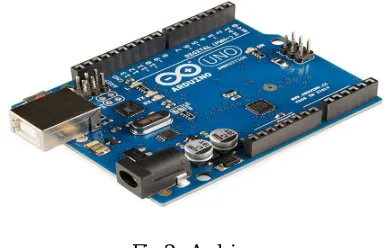
Arduino: It is an open-source computer hardware and software company, project and user community that designs and manufactures microcontroller-based kits for building digital devices and interactive objects that can sense and control objects in the physical world.
Fig 2 : Arduino
These systems provide sets of digital and analog I/O pins that can be interfaced to various expansion boards ("shields") and other circuits. The boards feature serial communications interfaces, including USB on some models, for loading programs from personal computers.
Develop Software Interface Mobile Device: An android application to be developed using the ADT (Android Developer Tools) java platform for programs running on mobile devices that communicates between pi and home devices easily.
Integrate the Sensors to a Device: The Raspberry Pi needs to be integrated with the lighting ,motion detection, water sensor at a low cost with easy installation. After extensive research into the products and solutions currently available, the following were chosen to meet our application specific requirements.
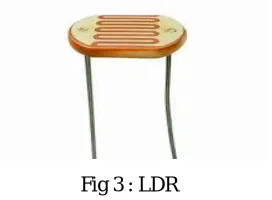
Fig 3 : LDR
Area Intrusion Sensor:A Pir sensor monitors a room and sets off audio alarm notification when it senses a moving body.
Fig 4 : PIR Sensor
Temperature/Humidity Sensor:Temperature and humidity is reported to the mobile app. Optionally, you can enable when temperature dips below/above some preset value. View a historical chart of temperature data
.
Fig 5: Dht11 Sensor
Water Sensor: It gives the details about water level in the containnner and report back with alarm.
Fig 6: Water Sensor IV.DESIGN
System Requirement: The Android platform includes support for the Bluetooth network stack, which allows a device to wirelessly exchange data with other Bluetooth devices. The application framework provides access to the Bluetooth functionality through the Android Bluetooth APIs. These APIs let applications to wirelessly connect to other Bluetooth devices, enabling point-to-point and multipoint wireless features.
Using the Bluetooth APIs, an Android application can perform the following:
Connect to other devices through service discovery
Transfer data to and from devices
Manage multiple connections.
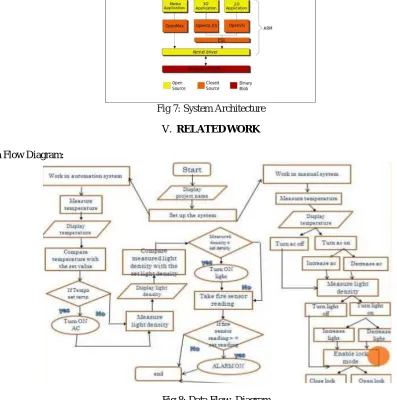
Fig 7: System Architecture
V. RELATEDWORK
Data Flow Diagram:
Fig 8: Data Flow Diagram
add additional security features.An android application to be developed using the ADT (Android Developer Tools) java platform for programs running on mobile devices that communicates between pi and home devices easily.
Use Case Diagram:
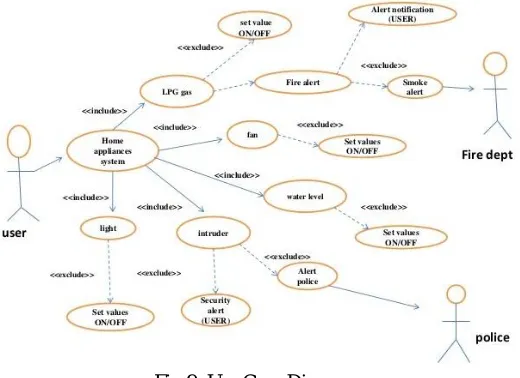
Fig 9: Use Case Diagram
Use case diagrams are intended to model the functional requirements of the system. It shows a set of use cases and actors and their relationships. It is always selected to be the start point of software design.
VI.RESULTS
Module Module Function Sensors Used 1. Fire Alarm It detects fire and alarm with buzzer LM35 2. Motion Detection Detects Motion with alarm PIR Sensor 3. Automatic Street Light Sense the dark and light on LDR Sensor 4. Light Control using App Control light using app and change
red, green, blue color.
Bluetooth Communication 5. Temperature Level Graph Lowest temperature displays yellow
light, Moderate temperature displays green color,Out of range temperature displays Red
LM35
6. Water Alarm It senses the water level if exceeds alarm
Water Sensor
Detailed Pic:
(a) (b) (c) (d)
Fig 10: (a) Light control using app, (b) Temperature Control, (c) Automatic Street Light, (d) Motion Detection VII. APPLICATION
Following are the applications of Home Automation and Security System.
Precise and safe blind control.
Security cameras can be controlled, allowing the user to observe activity around a house or business right from a Monitor or touch panel.
Security systems can include motion sensors that will detect any kind of unauthorized movement and notify the user through the security system or via cell phone.
VIII. FUTUREWORK
Looking at the current situation we can build cross platform system that can be deployed on various platforms like iOS, Windows. Limitation to control only several devices can be removed by extending automation of all other home appliances.The future work is to control home automation based on RTOS based Automation.
IX.CONCLUSSION
This is an ongoing project. Our prime objective is to assist handicapped/old aged people. This paper gives basic idea of how to control various home appliances and provide a security using Android phone/tab.We have discussed a simple prototype in this paper but in future it can be expanded to many other areas.
X. AKNOWLEDGEMENT
We acknowledge the efforts and hard work by the experts who have contributed towards development of the different home automation systems. We also acknowledge the efforts of the reviewers of the journal for the suggestions and modifications to improve the quality of the paper and to help to prepare camera ready copy
REFERENCES
[1]N.Sriskanthan and Tan Karand."Bluetooth Based Home Automation System",Journal of Microprocessor and Microsystem,Vol 26,pp.281-289,2002.
[2] Muhammad IzharRamli,MohdHelmyAbdWahab,Nabihah "TOWARDS SMART HOME:CONTROL ELECTRICAL DEVICES
ONLINE",Nornabiah Ahmad International Conference on Science and Technology:Application in Industry and Education(2006)
[3] Al-Ali,Memeber,IEEE& M.Al-Rouzan,"Java Based Home Automation",IEEE Transaction on Consumer Electronics,Vol 50,No 2 MAY 2004 [4] Pradeep G,B SanthiM.Venkateswarao, “Ad-Hoc LowPowered 802.15.1 Protocol Based Automation System for Residenceusing Mobile Devices”, Dept.of ECE, K L University, Vijayawada,Andhra Pradesh, India IJCST Vo l. 2, SP 1, December 2011
[5] E. Yavuz, B. Hasan, I. Serkan and K. Duygu. “Safe and Secure PIC Based Remote Control Application for Intelligent Home”. International Journal of Computer Science and Network Security, Vol. 7, No. 5, May 2007.
[6]AmulJadhav, S. Anand, NileshDhangare, K.S. Wagh “Universal Mobile Application Development (UMAD) On Home Automation. [7] S.P.Pande, Prof.Pravin Sen, “Review On: Home Automation System For Disabled People Using BCI” in IOSR Journal of Computer Science (IOSR-JCE) eISSN: 2278-0661, p-ISSN: 2278-8727 PP 76-80
[8] BasilHamed, “Design & Implementation of Smart House Control Using LabVIEW” at International Journal of Soft Computing and Engineering (IJSCE) ISSN: 2231-2307, Volume-1, Issue-6, January 2012
[9] Basma M. Mohammad El-Basioni1, Sherine M. Abd El-kader2 and Mahmoud Abdelmonim Fakhreldin3, “Smart Home Design using Wireless Sensor Network and Biometric Technologies” at Volume 2, Issue 3, March 2013
Science and Applications, Vol. 1, No. 6, December 2010
[11] Rosslin John Robles and Tai-hoon Kim, “Review: Context Aware Tools for Smart Home Development”, International Journal of Smart Home, Vol.4, No.1, January, 2010
[12] HitendraRawat, Ashish Kushwah, Khyati Asthana, AkankshaShivhare, “LPG Gas Leakage Detection & Control System”, National Conference on Synergetic Trends in engineering and Technology (STET-2014) International Journal of Engineering and Technical Research ISSN: 2321-0869, Special Issue
[13] Nicholas D., Darrell B., Somsak S., “Home Automation using Cloud Network and Mobile Devices”, IEEE Southeastcon 2012, Proceedings of IEEE.
[14] Chan, M., Campo, E., Esteve, D., Fourniols, J.Y., “Smart homes-current features and future perspectives,” Maturitas, vol. 64, issue 2, pp. 90-97, 2009
http://research.microsoft.com/en-us/projects/homeos/ http://source.android.com/tech/accessories/index.html