Survey on Home Automation System Using
Arduino and Android Bluetooth
Nimisha Rai 1
Assistant Professor, Department of Electronics, Dr. D.Y.Patil ACS College, Pimpri, Pune University, Pune
Maharashtra, India1
ABSTRACT: The main objective of this proposed system is to develop a Home Automation System using Arduino and Android mobile with Bluetooth Module. Due to advanced technology nowadays people want to control the home appliances remotely. Modern Houses are expected with automatic control system instead of conventional switches which are fitted on the wall. To control the home appliances people have to operate the switches, which is an inconvenient method for elderly and physically disabled person. This home automation system brings the comfortness and improves the quality of living. This can be achieved with Smart Phone supported by Android OS, a Bluetooth model and ARDUINO UNO controller.
KEYWORDS: Android OS, Bluetooth, Arduino UNO.
I. INTRODUCTION
Home automation is a process of controlling and monitoring home appliances remotely by using wireless technology. This system can be implemented with various sensors, controller and Blue tooth module. The various sensors are used to detect light, motion, temperature and other sensing element and send data to the main controlling unit. Here Arduino is used as a controlling unit which receives the data from various sensors and based on program it controls the relay or other devices. The Benefits of Home Automation system is to save Energy, more security, makes life easier and added convince.
Home appliances are the different devices which are used in home to perform specific function such as Refridgerator, Air Cooler, Fan, TV, Water Pumps etc. Automation is a technology where things are being controlled automatically, either remotely or in close proximity. Automation lowers the human efforts to the lowest possible degree. In Home Automation Common tasks include turning off lights when no one is in the room, automatic Bell ringing, automatic door opening based on password security, automatic water tank filling, automatic plant watering, automatic fan regulation depending upon temperature etc.
This proposed system not only reduces human efforts but also provide energy efficiency, time saving and security. This system also helps handicapped and old aged people who will unable to control the home appliances. This system is designed to control electrical appliances and devices in house with relatively low cost design, user-friendly interface and ease of control.
II. RELATEDWORK
control the household appliances with a single SMS or by using an android application. It also informs the owner in case of fire, gas leakage and theft even when the owner is not in the house.
III.PROPOSED SYSTEM
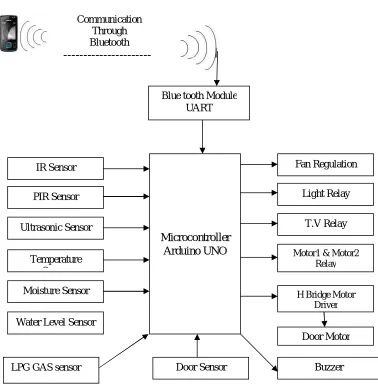
Fig.1: Block Diagram of Home Automation System
Figure shows Block diagram of Proposed Home Automation System. As shown in the figure it consists of various sensors which sense the physical quantity & give the corresponding signal to the microcontroller. According to the programming microcontroller performs various controlling action. As shown in the figure IR sensor is used to detect the presence of a person and after detecting a person it gives the signal to the microcontroller to open the Main gate. A PIR sensor is used to detect motion of the person to switch ON /OFF the light of a room when person enters or leaves a room. Temperature sensor is used to detect the temperature of a room and according to that it automatically adjusts the speed of a FAN. Moisture sensor is used to measure moisture content of a soil to switch ON/OFF the motor for
Microcontroller Arduino UNO IR Sensor
PIR Sensor
Ultrasonic Sensor
Temperature Sensor
Moisture Sensor
Water Level Sensor
Door Sensor
Fan Regulation
Light Relay
T.V Relay
Motor1 & Motor2 Relay
H Bridge Motor Driver
Door Motor Communication
Through Bluetooth
---
Blue tooth Module UART
watering to a plant. Water level Sensor is used to detect water level of a water tank to switch ON/OFF the motor for filling the water tank. LPG GAS sensor is used to detect Gas leakage in home and alert for the same by using buzzer.
A. Description of the Proposed System 1. Arduino UNO
Fig.2: Arduino UNO Microcontroller Board
Arduino Uno is a microcontroller board which uses ATmega328P. It has s 14 digital input/output pins, 6
analog inputs, a 16 MHz quartz cr ystal, a USB con nection, a power jack, an ICSP header and a reset button. It also supports serial communication using Tx and Rx pins. It can be easily connected to the computer with a USB cable or it can also be power ed with AC-to-DC adapter. It is a open source platform which means that both board and software is readily available on Internet. The software used for Arduino devices is called IDE (Integrated Development Environment) which is free to use and it can be programmed using C and C++ language.
2. PIR sensor
Fig.3: Pin diagram of PIR sensor Fig.4: Interfacing of PIR sensor with Arduino UNO
detector. Our bodies generate infrared heat, and this heat is detected by the motion sensor. The sensor outputs a 5V signal for a period of one minute as soon as it detects the presence of a person. It offers a tentative range of detection of about 6–7m and is highly sensitive.
3. LM 35
.
Fig.5: Pin diagram of LM 35 Temperature sensor Fig.6: Interfacing of LM 35 with Arduino UNO
LM35 is a precision IC temperature sensor with its output proportional to the temperature (in oC). The sensor circuitry is sealed and therefore it is not subjected to oxidation and other processes. It also possess low self heating and does not cause more than 0.1 oC temperature rise in still air. The operating temperature range is from -55°C to 150°C. The output voltage varies by 10mV in response to every oC rise/fall in ambient temperature, i.e., its scale factor is 0.01V/ oC.
4. HC -05
Fig.7: Pin diagram of HC-05 Bluetooth Module Fig.8: Interfacing of HC-05 with Arduino UNO
The HC-05 module is a Bluetooth SPP (Serial port protocol) module which means that it communicates with the Arduino through serial communication. The maximum range for wireless communication for this module is 10 meters.
5. LPG GAS Detector
Fig.9: Pin diagram of LPG GAS detector Fig 10: Interfacing of LPG GAS detector with Arduino UNO
An LPG gas sensor is a one kind of device which is used to sense the presence of a hazardous LPG gas leak in service station, cars, storage tanks and homes. LPG Sensor Module comprises of a MQ3 sensor which is used to sense LPG gas. This module contains a MQ3 sensor which actually detects LPG gas, an LM393 comparator for comparing the output voltage of MQ3 sensor with a reference voltage. It gives a HIGH o/p when LPG gas is detected
6. Soil Moisture
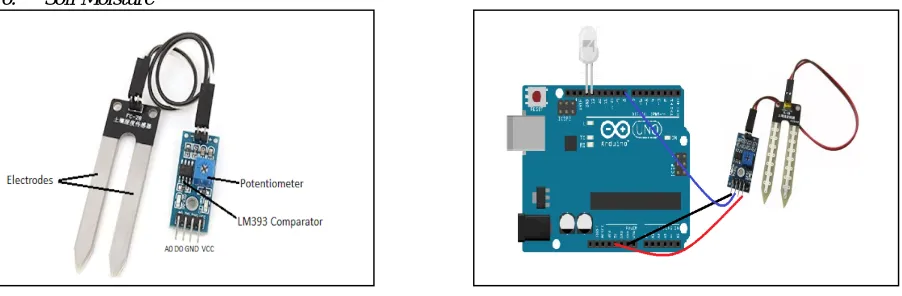
Fig.11: Module of Soil Moisture Fig 12: Interfacing of Soil Moisture with Arduino UNO
7. Servo Motor
Fig.13. Servo Motor Fig 14. Interfacing of servo motor with Arduino UNO
Servo motors are used to control the position of objects, rotate objects, move legs, arms or hands of robots etc. with high precision. All motors have three wires Out of which two will be used for Supply (positive and negative) and one will be used for the signal that is to be sent from the MCU .Servo motor is controlled by PWM (Pulse with Modulation) which is provided by the control wires.This degree of rotation can be controlled by applying the Electrical Pulse of proper width, to its Control pin. Servo checks the pulse in every 20 milliseconds. Pulse of 1 ms (1 millisecond). width can rotate servo to 0 degree, 1.5ms can rotate to 90 degree (neutral position) and 2 ms pulse can rotate it to 180 degree.
The above figures prove the positive impact of context awareness in ICN routing protocols. Particularly, the delivery probability of ICN routing protocols increases as context aware technique is employed. The impact of the context aware technique on the delivery probability differs slightly from one technique to other based on the usefulness of the collected data. However, the three context aware techniques all share being able to improve the delivery probability of ICN routing protocols. Note that although spray and wait protocol was reported to have a high delivery probability compared to epidemic [2], context aware techniques were able to benefit both routing protocol despite their original performance.
IV.CONCLUSION
In this paper, low cost and user friendly home control and monitoring system using Android based Smart phone is proposed. In the proposed architecture arduino uno microcontroller and Bluetooth communication is used for communicating between the remote user and the home devices. Any Android based Smart phone with built in Bluetooth facility can be used to access and control the devices at home. This proposed system is easy to use, save time and energy. It is not only useful for physically disabled and aged people but also reduces the human labour. This system is only suitable for short range communication.
REFERENCES
1. Sheetal Prusty "ARDUINO BASED HOME AUTOMATION USING ANDROID APPLICATION” 2017 International Journal of Intelligent Computing and Applied Science, Vol. 5, issue 1, pp. 23-26, 2017
2. Nathan David , Abafor Chima , Aronu Ugochukwu ,Edoga Obinna “D e s i g n o f a H o m e A u t o m a t i o n S y s t e m U si ng Ard ui no” 2015 International Journal of Scientific & E ngineering Research, , vol.6, issue 6, pp 795-803, 2015
3. Akanksha Singh, Arijit Pal, Bijay Rai “GSM Based Home Automation, Safety and Security System Using Android Mobile Phone” 2015 International Journal of Engineering Research & Technology, vol. 4, issue 4,pp 490-494, 2015
4. M uha mma d Asa d ulla h, Khalil Ull a h, “ S mart home automation system using Bluetooth technology” International Conference on Innovations in Electrical Engineering and Computational Technologies (ICIEECT), DOI: 10.1109,pp 978-981
5. Amruta Patil, Pooja Potnis, Karishma Katkar, “SMS Based Home Automation System using Arduino ATMEG328 with GSM” , International Journal of Engineering Trends and Technology (IJETT) , 2017,vol.7, issue 7, pp 369-374
6. Zatin Gupta, Tanay Sen, Vinayak Gupta, Vaishnavi, Vijay, “Home-Automation using Arduino-UNO Board and Android App”, International Journal of Computer Applications, 2018,vol.182, issue 11,pp 18-20