ISSN(Online): 2320-9801
ISSN (Print): 2320-9798
I
nternational
J
ournal of
I
nnovative
R
esearch in
C
omputer
and
C
ommunication
E
ngineering
(An ISO 3297: 2007 Certified Organization) Vol. 3, Issue 2, February 2015
Real Time Routing Algorithm Based On
NSGA-II in Wireless Mesh Networks
Seidfarbod Seidali Routeh
Bachelor Student, Iran University of Science and Technology, IRAN
ABSTRACT: With the growing demand for real time services in Wireless Networks, quality of service (QoS) based
routing has emerged as an interesting research topic. But offering some QoS guarantee in wireless networks raises significant challenges. This paper presents a real time routing algorithm based on NSGA-II. This algorithm has been widely used in optimization problems. NSGA-II is a non-dominated sorting genetic algorithm which consists of multi objective functions. NSGA-II algorithm starts with a random population. Each individual in population is considered as a chromosome. Two objective functions were considered in this paper: (i) End to end delay, (ii) path reliability. Final solutions were sorted by Pareto front method. The wireless mesh network was modeled as an undirected graph, in which the sets of nodes N and links L represent computer sites and communication cables. Experimental results proved that the proposed NSGA-II routing algorithm can achieve better performance in compare of other well-known methods like Ad Hoc on Demand Distance Vector (AODV).
KEYWORDS: NSGA-II algorithm, routing algorithm, mesh network, objective function
I. INTRODUCTION
As the development of networking technologies and the increasing popularization of network based applications, computer networks are now being widely used in scientific researches, business, education, national defense and other domains [1, 2]. It also used as an important technology in the field of industrial process management [3, 4, 5, 6, 7, 8, 9, 10]. Several industrial organizations such as ISA [11], HART [12] and ZigBee [13] have been actively pushing the application of wireless technologies in industrial automation Routing is a general network design problem, in which an optimal assignment of network link capacity and the best selection of routes are to be determined in a reasonable amount of time.
Nowadays, real-time systems are found in many diverse application areas including; automotive electronics, avionics, computer network, telecommunications, space systems, medical imaging, and consumer electronics. In all of these areas, there is rapid technological progress. A real-time system controls an environment by receiving data, processing them, and returning the results sufficiently quickly to affect the environment at that time. A system is said to be real-time if the total correctness of an operation depends not only upon its logical correctness, but also upon the real-time in which it is performed. Real-time systems, as well as their deadlines, are classified by the consequence of missing a deadline:
Hard: missing a deadline is a total system failure.
Firm: infrequent deadline misses are tolerable, but may degrade the system's quality of service. The usefulness of a result is zero after its deadline.
Soft: the usefulness of a result degrades after its deadline, thereby degrading the system's quality of service. Thus, the goal of ahard real-time system is to ensure that all deadlines are met, but for soft real-timesystems the goal becomes meeting a certain subset of deadlines in order to optimize some application-specific criteria. The particular criteria optimized depend on the application, but some typical examples include maximizing the number of deadlines met, minimizing the lateness of tasks and maximizing the number of high priority tasks meeting their deadlines.
II. RELATED WORK
ISSN(Online): 2320-9801
ISSN (Print): 2320-9798
I
nternational
J
ournal of
I
nnovative
R
esearch in
C
omputer
and
C
ommunication
E
ngineering
(An ISO 3297: 2007 Certified Organization) Vol. 3, Issue 2, February 2015
called SPEED. SPEED is a highly efficient and scalable protocol for the sensor networks. Shen et al. [16] applied a Tabu search algorithm for the routing and capacity assignment problem in computer networks.
Evolutionary algorithms have been widely used in many fields like clustering, image processing and also routing problem as well. Genetic algorithm is an evolutionary algorithm which is inspired from natural process of selection and genetic. Ga has gained considerable attention in recent years for solving various optimization problems. Lin et al. [17] applied a genetic algorithm (GA) based approach to route selection and capacity flow assignment. A number of papers have demonstrated the usefulness of a GA based approach in sensor networks [18, 19, 20, 21]. The work of [20] focused on deriving an energy efficient scheme that satisfy the required detection probability [21] using a distributed GA. The work of [20] focused on finding an optimal traffic distribution to improve the lifetime of multi-sensor networks. A GA based approach for routing in two-tiered sensor networks is proposed in [22] that only used energy optimization to maximize life time of network. QuESt [23] is a routing protocol that uses Multi Objective GA to find paths in a flat (non-clustered) wireless sensor network.
Topology is one of the most important parameter which effects throughput and efficiency of a network. Mesh is one of common topologies which is widely used in computer networks. In a Mesh topology, each of the network nodes (computer and other devices) is interconnected with one another. Every node not only sends its own signals but also relays data from other nodes. In fact a true mesh topology is the one where every node is connected to every other node in the network.Fig.1 shows how nodes are connected through Mesh topology. Advantages of mesh topology can be listed as:
In compare of topologies like Bus if one client fails to proceed, the others can continue their jobs. Data can be transmitted from different devices simultaneously. This topology can withstand high traffic.
Expansion and modification in topology can be done without disrupting other nodesFig.1. Wireless mesh topology
In this paper, we presented a new real time routing algorithm based on NSGA-II in wireless Mesh networks. The Non-dominated Sorting Genetic (NSGA) Algorithm is a Multiple Objective Evolutionary algorithm which is an extension of the Genetic Algorithm for multiple objective function optimizations.
III.NSGA-IIALGORITHM
The objective of the NSGA-II [24] algorithm is to improve the adaptive fit of a population of candidate solutions to a Pareto front constrained by a set of objective functions. The NSGA-II is an improvement of a previous algorithm developed by the same authors called NSGA. NSGA algorithm has features like:
These algorithms do not consider the use of elitism strategies, which prevent the loss of good solutions, and can hence be a key factor in speeding up the search.
Additional parameters must be set for ensuring diversity, mostly with the help of a sharing parameter NSGA is suitable for continuous optimization problems
ISSN(Online): 2320-9801
ISSN (Print): 2320-9798
I
nternational
J
ournal of
I
nnovative
R
esearch in
C
omputer
and
C
ommunication
E
ngineering
(An ISO 3297: 2007 Certified Organization) Vol. 3, Issue 2, February 2015
we are seeking to find it. Chromosomes will be evaluated by objective functions till expected answer is reported or max iteration reaches. For making diversity between solution, crossover and mutation is included in process of algorithm. NSGA-II sorts solutions with Pareto front method. In this method, Population would be sorted based on non-domination into each front. The first front is being completely non-dominant set in the current population and the second front is being dominated by the individuals in the first front. To each individual in each front a rank (fitness) would be assigned. Also another value is given to each chromosome based on which front they belong to. Individuals in first front are given a fitness value of 1 and individuals in second are assigned fitness value as 2.
IV.PROPOSEDALGORITHM
Routing problem is considered as a complex nonlinear programming which has many restrained conditions and it is known to be NP-completeness [25, 26]. The objective of routing problem is finding set of links to deliver packages from sender node to receiver. The routing algorithm is that part of the network layer software responsible for deciding a route of each packet from its source node to its destination based on the network topology. The motivation here is to provide a set of Pareto optimal solutions by the NSGA-II algorithm and give it the flexibility to choose the best possible solution from this set. The design objectives in our routing algorithm are:
1. Keep the average delay per packet or message below a given level 2. Keep desirable reliability in whole network
A computer network can be modelled as an undirected graph G = (N, L), in which the sets of nodes N and links L represent computer sites and communication cables. Following figure shows an example of graph model of a network.
Fig.3. Graph model of a computer network.
A sample chromosome of above network in our proposed algorithm is depicted in figure 4. A path (route) is encoded by listing nodes from its source to its destination based on the topology of the network.
Fig.4. A sample chromosome of
For reliability metric, we used ETX [27] for calculating the path reliability. ETX is defined as the expected number of transmissions (including retransmission) for a successful end-to-end data forwarding and hop-by-hop acknowledgment. The following expression shows how to compute the ETX metric for a path:
ISSN(Online): 2320-9801
ISSN (Print): 2320-9798
I
nternational
J
ournal of
I
nnovative
R
esearch in
C
omputer
and
C
ommunication
E
ngineering
(An ISO 3297: 2007 Certified Organization) Vol. 3, Issue 2, February 2015
(1)
fdv : The forward delivery ratio is the measured probability that a data packet successfully arrives at the recipient
rdv : the reverse delivery ratio is the probability that the ACK packet is successfully received
End to end delay is measured by following equation:
Delayendtoend = (time for sending packet) + (time for receiving acknowledge) (2)
In our method, for the cause of real timing, if Delay time exceeds the maximum time then solution would be considered as failed.
To determine the ability of a chromosome to survive and produce offspring, Eq. (1) and Eq. (2) are used as objective functions. When we apply GAs to a n -objective optimization problem, we have to evaluate the values of n objective functions for each solution. A weighted-sum objective is used to evaluate the chromosome. The way to transform the values of objective functions to the fitness value of each string x in the generation is to combine the 2 objective functions as follows:
Fi = W1*(etxi) + W2/(Delayendtoend) (3)
Fi is fitness value of chromosome with number (i)
The value of W1 and W2 is between zero and one (0<W1,W2<1)
ISSN(Online): 2320-9801
ISSN (Print): 2320-9798
I
nternational
J
ournal of
I
nnovative
R
esearch in
C
omputer
and
C
ommunication
E
ngineering
(An ISO 3297: 2007 Certified Organization) Vol. 3, Issue 2, February 2015
V. SIMULATION RESULTS
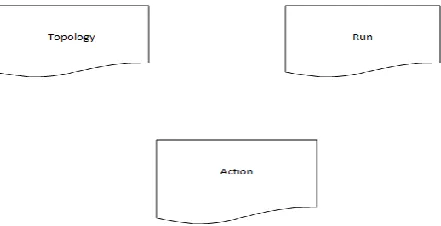
The proposed routing algorithm is based on NSGA-II algorithm and its application is optimizing real time routing through mesh networks. The processing of the proposed approach is explained in the above sections, now, in this section, we present the experimental results of the proposed algorithm which has been implemented in MATLAB. MATLAB is a high-level language and interactive environment for numerical computation, visualization, and programming. Fig.5 shows main classes which were developed for implementing proposed method. Classes are described as below:
Fig.5. Main classes which were developed for implementation of proposed algorithm
Topology class is developed for making a Mesh wireless network. Run class is used for controlling real timing systems
Action class is responsible controlling routing algorithm, state of clients like sending and receivingTable 1 shows result of comparison between NSGA-II algorithm and Ad Hoc On Demand Distance Vector (AODV). The proposed algorithm was evaluated under different scenarios and nodes. Experimental results proved that NSGA-II can proceed in less amount of time in compare to AODV.
Algorithm Number of nodes Execution time
NSGA-II 7 7.51
AODV 7 14.51
NSGA-II 14 45.21
AODV 14 74.18
Table.1. A comparison between NSGA-II real time routing algorithm and AODV
ISSN(Online): 2320-9801
ISSN (Print): 2320-9798
I
nternational
J
ournal of
I
nnovative
R
esearch in
C
omputer
and
C
ommunication
E
ngineering
(An ISO 3297: 2007 Certified Organization) Vol. 3, Issue 2, February 2015
Fig.6. A comparison between AODV and NSGA-II average delay time
Value of NSGA-II parameters were assigned as:
Number of generation = 10 Crossover method = single point Mutation method = Bit string flip Population = 100
VI.CONCLUSION AND FUTURE WORK
In this paper, we study the real time routing problem in wireless mesh networks. Our goal was optimizing reliability and end to end delay. Proposed method is based on NSGA-II algorithm which is a Multiple Objective evolutionary algorithm and the objective of this algorithm is to improve the adaptive fit of a population of candidate solutions to a Pareto front constrained by a set of objective functions. The algorithm uses an evolutionary process with surrogates for evolutionary operators including selection, genetic crossover, and genetic mutation. We implemented proposed algorithm in MATLAB. A comparison was made between NSGA-II real time routing algorithm and Ad Hoc On Demand Distance Vector (AODV). Following results were observed within experimental analysis:
Execution time for finding desirable path in proposed algorithm was less that AODV Decreasing Delay time for sending packets
In compare to AODV, less number of lost and dropt packets was observed
REFERENCES
1. L. Baccouche and H. Eleuch, "Rt-Dbp: a multi-criteria priority assignment scheme for real-time tasks scheduling", Appl.Math. Inf. Sci., Vol.
6, No. 11, pp. 382–388 (2012).
2. A.Jemai, A. Mastouri and H. Eleuch, "A tabu search algorithm for the routing and capacity assignment problem in computer networks", Appl. Math. Inf. Sci. Vol. 5, No. 3, pp. 655–667 (2011).
3. Andreas Willig, “Recent and emerging topics in wireless industrial communications: A selection,” IEEE Trans. on Industrial Informatics, 2007.
4. Dick Caro, Wireless Networks for Industrial Automation, ISA Press, 2004.
5. J. Song, S. Han, A. K. Mok, D. Chen, M. Lucas, M. Nixon, and W. Pratt, “WirelessHART: Applying wireless technology in real-time industrial
pro-cess control,” in RTAS, 2008.
6. Rajeev Alur, Alessandro D’Innocenzo, Karl H. Johansson, George J.Pappas, and Gera Weiss, “Modeling and analysis of multi-hop control
ISSN(Online): 2320-9801
ISSN (Print): 2320-9798
I
nternational
J
ournal of
I
nnovative
R
esearch in
C
omputer
and
C
ommunication
E
ngineering
(An ISO 3297: 2007 Certified Organization) Vol. 3, Issue 2, February 2015
7. Gera Weiss, Rajeev Alur, Alf J. Isaksson, and Karl H. Johansson, “Scalable scheduling algorithms for wireless networked control systems,” in
CASE,2009.
8. Joonas Pesonen, Haibo Zhang, Pablo Soldati, and Mikael Johansson, “Methodology and tools for controller-networking codesign in
Wire-lessHART,” in ETFA, 2009.
9. Shahid Raza, Adriaan Slabbert, Thiemo Voigt, and Krister Landern¨ as,“Security considerations for the wireless hart protocol,” in ETFA, 2009.
10. Gabriella Fiore, Valeria Ercoli, Alf J. Isaksson, Krister Landern¨ as, and Maria Domenica Di Benedetto, “Multihop multi-channel scheduling
for wireless control in WirelessHART networks,” in ETFA, 2009.
11. “ISA,” http://www.isa.org/.
12. “HART communication,” http://www.hartcomm.org.
13. “ZigBee Alliance,” http://www.zigbee.org
14. Jain, M., Choi, J. I., Kim, T., Bharadia, D., Seth, S., Srinivasan, K., ... & Sinha, P. (2011, September). Practical, real-time, full duplex wireless. InProceedings of the 17th annual international conference on Mobile computing and networking (pp. 301-312). ACM.
15. Coello, C.A.C., Lamont, G.B., Van Veldhuisen, D.A.: Evolution-ary Algorithms for Solving Multi-Objective Problems. Springer,Berlin (2007) 16. Jian Shen, Fuyong Xu, and Peng Zheng, "Study of key pre-distribution schemes in wireless sensor networks: case of BROSK (use of WSNet)",
Computers & Operations Research, Vol. 32, No. 11, pp. 2785–2800 (2005).
17. Xiao-Hui Lin, Yu-Kwong Kwok, Vincent K.N. Lau, "A genetic algorithm based approach to route selection and capacity flow assignment", Computer Communications, Vol. 26, pp. 961–974 (2003)
18. Ataul Bari, Shamsul Wazed, Arunita Jaekel, Subir Bandyopadhyay, ”A genetic algorithm based approach for energy efficient routing in two-tiered sensor networks”, Ad Hoc Networks , Vol.7, 2009, 665–676
19. Navrati Saxena, Abhishek Roy, Jitae Shin, “QuESt: a QoS-based energy efficient sensor routing Protocol”, Wireless Communications and
Mobile Computing Journal, 2009, vol.9, no.3, 417–426
20. Y. Pan, X. Liu, “Energy-efficient lifetime maximization and sleeping scheduling supporting data fusion and QoS in Multi-Sensor Net”, Signal
Processing, 2007, Vol.87 (12), 2949–2964
21. Q. Qiu, Q. Wu, D. Burns, D. Holzhauer, “Lifetime aware resource
22. management for sensor network using distributed genetic algorithm”, ISLPED’06, ACM Press, New York, NY, 2006, 191–196
23. EkbataniFard, G. Hossein, et al. "A multi-objective genetic algorithm based approach for energy efficient QoS-routing in two-tiered wireless
sensor networks." Wireless Pervasive Computing (ISWPC), 2010 5th IEEE International Symposium on. IEEE, 2010.
24. Navrati Saxena, Abhishek Roy, Jitae Shin, “QuESt: a QoS-based energy efficient sensor routing Protocol”, Wireless Communications and
Mobile Computing Journal, 2009, vol.9, no.3, 417–426
25. K. Deb, A. Pratap, S. Agarwal, and T. Meyarivan. A fast and elitist multiobjective genetic algorithm: Nsga-ii. Evolutionary Computation, IEEE Transactions on, 6(2):182 -197, apr 2002.
26. Guangming Lin, Chengbo Huang, Shaobin Zhan, Xin Lu and Yunting Lu, "Ranking Based Selection Genetic Algorithm for Capacity Flow
Assignments", Communications in Computer and Information Science, Vol. 107, pp. 97-107 (2010).
27. Emilio C.G. Wille, Marco Mellia, Emilio Leonardi, Marco Ajmone Marsan, "A Lagrangean relaxation approach for QoS networks CFA
problems", International Journal of Electronics and Communications (AEÜ), Vol. 63, pp. 743–753 (2009).
28. Douglas S. J. De Couto, Daniel Aguayo, John Bicket, and Robert Morris, “A high-throughput path metric for multi-hop wireless routing”, Wireless Networks, 2005, Vol.11 (4)
BIOGRAPHY
Seidfarbod Seidali Routeh is a Researcher in the Computer Science department and Also head