ISSN(Online): 2320-9801
ISSN (Print): 2320-9798
I
nternational
J
ournal of
I
nnovative
R
esearch in
C
omputer
and
C
ommunication
E
ngineering
(An ISO 3297: 2007 Certified Organization)
Vol. 3, Issue 6, June 2015
Image/Video Dehazing Using Guided Filter by
Multi-Scale Fusion
Anju Raj. G.R1,Simi.M.S2
M.Tech (Signal Processing), Dept. of Electronics and Communication, Marian Engineering College, Trivandrum,
Kerala, India1
Assistant Professor, Dept. of Electronics and Communication, Marian Engineering College, Trivandrum, Kerala, India2
ABSTRACT: One among the problems faced in image processing is restoration of degraded image. This degradation is caused by various atmospheric phenomena like fog,haze etc . Particles in the atmosphere absorbs and scatter the light as it travels to the observer leads to cause haze,fog etc. Our paper defines a dehazing technique by using the guided filter. This technique is based on deriving two inputs from a single hazy image/video frame by white balancing and contrast enhancing .These two inputs are weighted by some specific weight maps such as luminance, chromaticity and saliency. Artifacts introduced by these weight maps can be reduced by multi-scale fusion, but yet we need to improve the naturalness of image by removing the fine haze, so we propose image/video dehazing by guided filter. Guided filtering the weighted sum of two inputs followed by multi-scale fusion by laplacian of inputs and Gaussian of the guided image avoids halo artifacts. Results shows that this method gives a dehazed image with improved naturalness. This method is applicable for real time application.
KEYWORDS: Outdoor images & videos,Fusion strategy,Guided filtering,Dehazing
I. INTRODUCTION
One of the main aim in image processing is to obtain a enhanced image. Outdoor images are degraded by the
atmospheric phenomena like fog,haze etc many application such as consumer/computational photography and computer vision requires a vision enhanced image. Atmospheric particles absorbs and scatter the light as it travels to the observer leads to cause haze,fog. These degraded image lose contrast and airlight shift the color of the image. Haze removal makes the image visually pleasant and correct the color shift. Here we obtain the haze free image by fusion method. By the process of image fusion the good information from each of the given images is fused together to form a resultant image whose quality is superior to any of the input images. This is achieved by applying laplacian on the input and Gaussian on the weighted inputs. The resultant image is formed by combining such magnified information from the input images into a single image. Aim behind fusion based technique is that we derive two image from the original imageinorder to blend them effectively we go for fusion. For blending we requires only important features of the images so we go for the weight maps. Finally the artifacts introduced by weight map is reduced by the laplacian of input and Gaussian of weighted input weight map is reduced by the laplacian of input and Gaussian of weighted input. Moreover to preserve the naturalness and to remove the fine haze we use guided filter .Weighted inputs are guided and then Gaussian is applied.
II. RELATED WORK
In the literature, a few approaches has been proposed. First approach is based on multiple images [2,9,8]taken under bad atmospheric condition. In this approach different image of same scene under different medium properties and different atmospheric condition is considered. This approach produce attractive results but the process is time consuming. we have to wait for the changes in medium properties that was the drawback of this technique.
ISSN(Online): 2320-9801
ISSN (Print): 2320-9798
I
nternational
J
ournal of
I
nnovative
R
esearch in
C
omputer
and
C
ommunication
E
ngineering
(An ISO 3297: 2007 Certified Organization)
Vol. 3, Issue 6, June 2015
different angle. polarized haze component in the scene can be found out by using the difference between the images. Drawback of this method is that this technique cannot be applied to scene with strong haze because for image with strong haze have quick change then the polarized filter change.
Another category of approach is dark object subtraction technique[16][17]. In this technique the offset value of the dark channel is subtracted from the image in order to remove the haze. this kind of technique is more suitable for homogeneous scenes. Several strategies use recorded six bands of reflected light to obtain the enhanced image. Zhang[18] et al introduced haze optimized transformation using the red and blue bands.
Next class of technique is for the scene which requires the approximated 3D-geometrical model of the input scene[7,5]. This method requires only a single image but the disadvantage is that this method is more complex and problematic. Dehazing based on a single image is more difficult.[1] Ancuti's single image dehazing based on fusion technique produce good result but it doesn't remove fine haze and fails to preserve the naturalness of the image.Our technique also implies fusion based strategy there are many fusion based strategy but our technique doesn't go for any complex state of art. This is the first paper to use fusion with guided filtering. Guided filter preserves the edges and corners of the image and remove fine haze. Our technique is computationally effective and is useful for real time applications.
III. THEORY
(x) =R(x)t(x) + ∞(1-t(x)) (1)
where is the observed image for each pixel x, R(x) is the scene radiance, ∞ is the air light, t is the transmission
coefficient .With an addictive haze layer, the scene get attenuated and color of the haze is determined by the air light image received by the observer is the combination of all. Our aim is to find R. This happens because of the scattering of light by the atmosphere towards the observer. During the day time, the light from sun is scattered in all direction by the molecules and particle present in the atmosphere. some of this scattered light reaches the observer cause increase in brightness of distant object. This is known as airlight. When the distance of the object increase the brightness also increase because more scattering occurs in this case. The first component in the equation forms direct attenuation and it can be represented as
D(x) = R(x)t(x) (2)
Considering the atmosphere as homogenous, we can estimate the transmission coefficient using the Beer-Lambert law;
t(x) = ( ( )) (3)
where is the atmospheric scattering coefficient and d is the scene depth
IV . DEHAZING USING GUIDED FILTER BY FUSION-PROPOSED METHOD
This section gives the detailed presentation of our technique. Main idea behind this method is to combine the inputs, weights and guided sum of the weighted inputs in a proper way to obtain the haze free image. One can select the input and weight on there wish. By selecting proper weights and input we can obtain an effective haze free image.
A .Inputs
Its a difficult task to remove haze from a single image. So we derive two inputs from the single image. we
obtain two inputs by taking the first input (I1)as the haze free image and the second input as the hazy region. we aims
to recover the optimal visibility in one of the image but the entire haze from image cannot be removed by this way. Haze free region is obtained by white balancing the original hazy image and hazy region is obtained by contrast enhancing the original hazy image. white balancing correct the color shift caused by the air light.
ISSN(Online): 2320-9801
ISSN (Print): 2320-9798
I
nternational
J
ournal of
I
nnovative
R
esearch in
C
omputer
and
C
ommunication
E
ngineering
(An ISO 3297: 2007 Certified Organization)
Vol. 3, Issue 6, June 2015
gray_value = (R_avg+ G_avg + B_ avg)/3 (4)
By grey world assumption,
scale value = gray value / average of each color component
R,G,B component of the new white balanced image is found by multiplying the scale value into the R,G,B component of the image
Our second input I2 is obtained by contrast enhancing the hazy image, this is done by subtracting the average
luminance value of the entire image I from the original image I. This step aims at enhance the region having low contrast i.e this technique increase visibility in hazy regions. Mathematical expression for contrast enhancing is given by:
(x) = ( (x) − Ῑ ) (5)
where is the factor which enhance the low contrast region regions and gamma value we choosen is:
= 2∗(0.5 + Ῑ ) (6)
For video, we can divide into frames and each frame forms a single image.
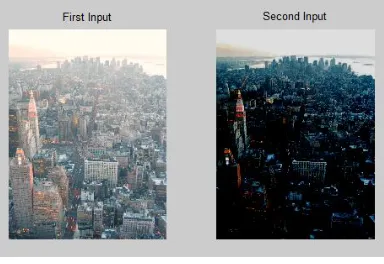
Fig 1.Derived inputs B. Weight maps
In the previous section contrast enhanced by the factor gamma, it do same operation on entire image but the optical density of haze varies in image in order to overcome this limitation weight map is introduced. this is computed in per-pixel fashion which defines the spatial relation of degraded areas As we requires only the important feature of image, we filter the important features by computing the weight maps. Main aim behind weight map is to preserve the region with good visibility. There are three weight used in this section.
1.Luminance Weight Map
This weight map is used to measure the visibility in each pixel. Assigns high value to region with good visibility and low value to region with low visibility .One of the easy way to measure the visibility is to find loss of colorfulness. Since hazy image have low saturation. luminance can be calculated by averaging the R,G,B channel.
ISSN(Online): 2320-9801
ISSN (Print): 2320-9798
I
nternational
J
ournal of
I
nnovative
R
esearch in
C
omputer
and
C
ommunication
E
ngineering
(An ISO 3297: 2007 Certified Organization)
Vol. 3, Issue 6, June 2015
k indexes the derived inputs. Luminance tend to reduce the global contrast and colorfulness to overcome this effect we go for another weight map
2. Chromatic Weight Map
This weight map controls the saturation gain in the outputs. We humans prefer images having high saturation is the idea behind this weight map. This map is calculated by finding the distance between saturation value S and maximum of saturation range for each pixel.
( ) = exp(-( ( ) ) ) (8)
default value is 0.3. Here also the pixel with low saturation is assigned low value and those with high is assigned high
value.
3. Saliency Weight map
This weight map measures the degree of exposure with respect to the neighbourhood region.This measures evaluate a certain object stands out from rest of the image.For this map computation we use saliency algorithm of
Achanta et al. The saliency weight at pixel position (x,y) of input Ik is defined as:
= || I (x) −Iμ|| (9)
where is the average pixel of the input .. By employing a small 5×5 16 [1, 4, 6, 4, 1]separable binomial kernel with
the high frequency cut-off value ωHc = π/2.75, is obtained. Finally we normalize the resultant weight maps using:
Ŵ ( ) = ( )
( ) (10)
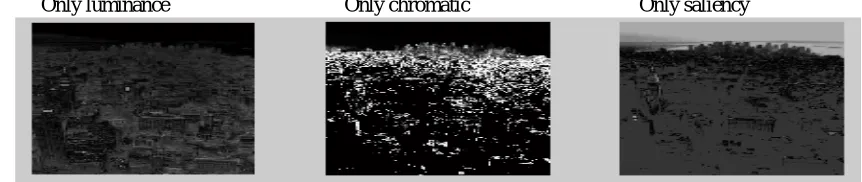
Only luminance Only chromatic Only saliency
Fig 2. Impact of each weight maps on first derived input
Only luminance Only chromatic Only saliency
ISSN(Online): 2320-9801
ISSN (Print): 2320-9798
I
nternational
J
ournal of
I
nnovative
R
esearch in
C
omputer
and
C
ommunication
E
ngineering
(An ISO 3297: 2007 Certified Organization)
Vol. 3, Issue 6, June 2015
Normalized weight map Normalized weight map first input second input
Fig.4 Normalized weight maps of first and second inputs
C. Guided Filtering
Guided filter is the edge preserving smoothening filter behaves like bilateral filter but have better behaviour at edges. Here filtering operation is done with the help of a guidance image. Guidance image can be input im age itself or another different image. It can transfer the guidance image to the filtering output. This is the one of the fast edge preserving filters so can be used for many applications including detail enhancement, HDR compression, dehazing, matting etc. Here we use normalized weight map of first input as guidance image because it depicts the haze free region and the normalized weight map of second input as the input image. Input image is guided with the help of guided image and it makes the input image same as the guided image itself.
D.Multi-Scale Fusion
In order to avoid the artifacts introduced by the weight maps we go for multi-scale fusion. Fusion is carried
out by summing the input weighted by guided normalized weight maps. ŵ is the guided normalized weight map
F(x) = ŵ (x) ( ) (11)
Input image is decomposed by the laplacian pyramidal representation of the input image into a hierarchy of image such that it denote different frequency band .Next is to compute the gaussian of the guided normalized weight map and blending the laplacian and gaussian to form a dehazed image. Blending is performed as:
Fl(x) = Ʃd Gl{ŵ (x)Ll{Id(x)} (12)
where l is the number of pyramidal level. Default(l=5).summing up the gaussian of the guided normalized weight map and the laplacian of the input forms fusing. this has to be carried out for every pyramid layer in a bottom up fashion.
ISSN(Online): 2320-9801
ISSN (Print): 2320-9798
I
nternational
J
ournal of
I
nnovative
R
esearch in
C
omputer
and
C
ommunication
E
ngineering
(An ISO 3297: 2007 Certified Organization)
Vol. 3, Issue 6, June 2015
Input
Frame --- I to P frame generation
Input generation
Weight maps
Filtering
Multi-Scale fusion
Combining Results
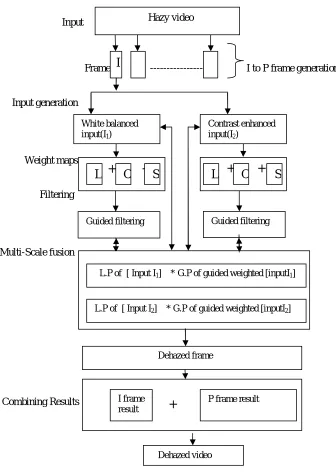
Fig 5 Proposed Architecture
V. RESULT AND DISCUSSION
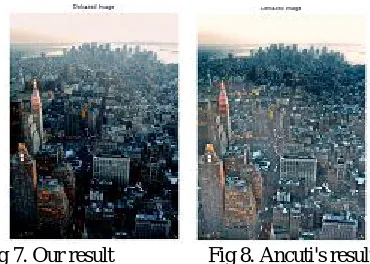
Our method has been tried on large set of database with different atmospheric condition such as fog and smoke it shows our method works well with other atmospheric condition proving that our technique is a robust method. Our method (Figure7) is compared with Ancuti's dehazing (Figure8) method using fusion. Our method produce comparable and even better result. Our technique removes all the fine haze and maintain the naturalness of the image and preserve the edges by using guided filter. Ancuti's method produce over saturation in haze free region using the guided filter we can remove the over saturation to a limit but not to full extend
I
+ +
Contrast enhanced input(I2)
White balanced input(I1)
+ +
L
C
S
L
C
S
Guided filtering Guided filtering
L.P of [ Input I1] * G.P of guided weighted [inputI1]
L.P of [ Input I2] * G.P of guided weighted [inputI2]
Dehazed frame
+
I frame result P frame resultDehazed video
ISSN(Online): 2320-9801
ISSN (Print): 2320-9798
I
nternational
J
ournal of
I
nnovative
R
esearch in
C
omputer
and
C
ommunication
E
ngineering
(An ISO 3297: 2007 Certified Organization)
Vol. 3, Issue 6, June 2015
Fig 6: Dehazing video frames
Fig 7. Our result Fig 8. Ancuti's result
Figure 1 shows the derived images from the original hazy image this is obtained by applying white balancing and contrast enhancing. Figure 2 shows the impact of each weight map on the first derived input and figure 3 shows the impact of each weight map on the second derived input. These weight maps are summed together, the nornalised weight map of both first and second input is shown on figure 4. Flowchart of our algorithm is depicted by figure 5. For processing video , our process requires minimum core i5 CPU, 8Gb RAM. With intel core i7 CPU our process requires only 2-200ms whereas Ancuti's technique requires 2-300ms. Our technique produce visually pleasing result but the limitation is that it produce over saturation in haze free regions. Figure6 shows dehazing video frames.
VI. CONCLUSION
This paper introduce a video and image dehazing technique .Most of the existing papers are concentrated on image dehazing technique but our technique yields both video and image. Moreover existing dehazing technique focus only on haze removal they don't preserve the edges of the input images our technique preserves the edges of the input image by using guided filter .Our technique is faster when comparing with existing fusion based strategy. In future we would to do some techniques that would reduce over saturation in this method.
ACKNOWLEDGMENT
We would like to take this opportunity to express our gratitude to all those who have guided in the successful completion of this endeavor. We express our sincere thanks to [1] for inspiring us to do this work and [14] for giving a new direction in completing the work. We are very thankful to the staffs of Marian Engineering college, trivandrum for their valuable suggestions.
ISSN(Online): 2320-9801
ISSN (Print): 2320-9798
I
nternational
J
ournal of
I
nnovative
R
esearch in
C
omputer
and
C
ommunication
E
ngineering
(An ISO 3297: 2007 Certified Organization)
Vol. 3, Issue 6, June 2015
REFERENCES
[1] Codruta Orniana Ancuti and Cosmin Ancuti single image dehazing by multi scale fusion. IEEE TRANSACTIONS ON IMAGE PROCESSING, VOL. 22, NO. 8, AUGUST 2013
[2] F. Cozman and E. Krotkov. Depth from scattering. In Proceedings of the 1997 Conference on Computer Vision and Pattern Recognition, vol. 31, pp. 801–806., 1997. 1, 2
[3] R. Fattal. Single image dehazing. to appear in SIGGRAPH,2008. 2
[4] A. Gijsejij and T. Gevers. Color constancy using natural image statistics. in proceeding of IEEE CVPR, 2007. 5
[5] N. Hautiere, J. Tarel, and D. Aubert. Toward fog-free invechicle vision systems through contrast restoration. CVPR,2007. 1 [6] E. McCartney. Optics of the atmosphere: Scattering by molecules and particles. John Wiley and Son, 1975. 2
[7] S. Narasimhan and S. Nayar. Interactive deweathering of an image using physical models. IEEE Workshop on Color and Photometric Method in Computer Vision, 2003. 1, 2
[8] S. G. Narasimhan and S. K. Nayar. Contrast restoration of weather degraded images. IEEE PAMI, 25(6), June 2003. 1,2 [9] S. K. Nayar and S. G. Narasimhan. Vision in bad weather. In ICCV (2), pages 820–827, 1999. 1, 2
[10] Y. Schechner and N. Napel. Clear underwater vision. CVPR,2004. 8
[11] Y. Y. Schechner, S. G. Narasimhan, and S. K. Nayar. Instant dehazing of images using polarization. 1:325–332, 2001. 1,2 [12] S. Shwartz, E. Namer, and Y. Schechner. Blind haze separation.CVPR, 2006. 1
[13] R. Szeliski, R. Zabih, D. Scharstein, O. Veksler,V.Kolmogorov, A.Agarwala, M. Tappen, and C. Rother. A comparative study of energy minimization methods for markov random fields. in proceeding of ECCV, 2006. 5
[14] Kaiming He, Jian Sun, and Xiaoou Tang, \Guided Image Filtering" IEEE Transactions On Pattern Analysis And Machine Intelligence, Vol. 35, No. 6, June 2013.
[15] Jiahao Pang, Oscar C. Au and Zheng Guo, \Improved Single Image Dehazing Using Guided Filter" APSIPA ASC 2011 Xian.
[16] P. Chavez, “An improved dark-object subtraction technique for atmospheric scattering correction of multispectral data,” Remote Sens. Environ., vol. 24, no. 3, pp. 459–479, 1988.
[17] G. D. Moro and L. Halounova, “Haze removal and data calibration for high-resolution satellite data,” Int. J. Remote Sens., pp. 2187–2205, 2006. [18] Y. Zhang, B. Guindon, and J. Cihlar, “An image transform to characterize and compensate for spatial variations in thin cloud contamination of Landsat images,” Remote Sens. Environ., vol. 82, nos. 2–3, pp. 173–187, 2002
BIOGRAPHY
Anju Raj.G.R. is a research scholar, pursuading her Masters in Technology(M. Tech), under the university of Kerala, India. She did her Bachelor of Engineering(B.E) in Indian Engineering College, Nagercoil, Tamil Nadu, India. Her research interests include Image and video dehazing