Abstract— This project presents an implementation of three- phase Distribution Static Compensator (DSTATCOM) using ANN (back-propagation (BP) control algorithm) for its functions such as harmonics elimination, load balancing and reactive power compensation under nonlinear loads. A BP based control algorithm is used for extraction of fundamental weighted value of active and reactive power components of load currents which are required for estimation of reference source currents. The proposed system is verified by the results of MATLAB/Simulink.
Index Terms— Artificial neural network (ANN) (BP control algorithm), DSTATCOM, Harmonics, Load balancing, MATLAB/Simulink , Power quality, Reactive power, Weights.
I. INTRODUCTION
The quality of available supply power has a direct economic impact on industrial and domestic sectors which affects the growth of any nation [1]. This issue is more serious in electronic based systems. Level of harmonics and reactive power demand are popular parameters that specify the degree of distortion and reactive power demand at a particular bus of the utility [2]. The harmonic resonance is one of most common problem reported in low and medium level distribution system. It is due to capacitors which are used for power factor correction and source impedance. Power converter based custom power devices (CPDs) are useful for reduction of power quality problems such as
power factor correction, harmonics compensation, voltage sag/swell compensation, resonance due to distortion, voltage flicker reduction within specified international standards[3-4]. These CPDs include Distribution Static Compensator (DSTATCOM), Dynamic Voltage Restorer (DVR) and Unified Power Quality Conditioner (UPQC) in different configurations [5]. Performance of any custom power device depends very much upon control algorithm used for reference current estimation and gating pulse generation scheme. Some of the classical control algorithms are Fryze power theory, Budeanu theory, p-q theory and SRF theory [6], Lyapunov-function-based control and nonlinear control technique [7] etc.
An immune RBF (Radial Basis Function) neural network integrates the immune algorithm with the RBF neural
Manuscript received May, 2015.
Kavali Hemadri, Department Of Electrical And Electronics
Engineering, MJRCET, Piler, JNTU Ananthapur, AP, India.
V.Veera Nagi Reddy, HOD, Department Of Electrical And Electronics Engineering, MJRCET, Piler, JNTU Ananthapur, AP, India
network. This algorithm has the advantages in learning sped and accuracy of the astringent signal. So, it can detect the harmonics of the current timely and precisely in the power network [8]. A multilayer perceptron neural network is useful for identification of nonlinear characteristics of the load. Feed forward back propagation ANN consists of various layers as input layer, hidden layer and output layer. It is based on feed forward back propagation with high ability to deal with complex non linear problems [9]. Back-propagation (BP) control algorithm is also used to design the pattern classification model based on decision support system. Standard BP model has been used with full connection of each node in the layers from input to output layers. Some applications of this algorithm are as to identification of user faces, industrial processes, data analysis, mapping data, control of power quality improvement devices etc [10]. Control of power quality devices by neural network is a latest research area in field of power engineering. Extraction of harmonic components decides the performance of compensating devices. Back-propagation algorithm which is trained the sample can detect the signal of power quality problem in real-time. Its simulation study for harmonic detection is presented in [11]. Many neural network based algorithms are reported with theoretical analysis in single phase system but their implementation to DSTATCOM is hardly reported in the available literature.
In this project, a back-propagation (BP) algorithm is implemented in three phase shunt connected custom power device known as DSTATCOM for extraction of weighted value of load active power and reactive power current components in nonlinear loads. Proposed control algorithm is used for harmonics suppression and load balancing with DC voltage regulation of DSTATCOM. In this BP algorithm, training of weights has three stages. It includes feed forward of the input signal training, calculation and back propagation of the error signals and upgrading of training weights. It may have one or more than one layer. Continuity, differentiability, non-decreasing monotony are the main characteristics of this algorithm. It is based on mathematical formula and does not need special features of function in learning process. It also has smooth variation on weight correction due to batch updating features on weights. In training process, it is slow due to more number of learning step but after training of weights, this algorithm produces very fast trained output response. In this application, proposed control algorithm on a DSTATCOM is implemented for compensation of nonlinear loads.
Power Quality Enhancement in Distribution
System using ANN based DSTATCOM
1
Kavali Hemadri,
2V.Veera Nagi Reddy
1M.Tech Student MJRCET, PILER, JNTU, Ananthapur, AP-India.
2II. DSTATCOM A. Basic principle:
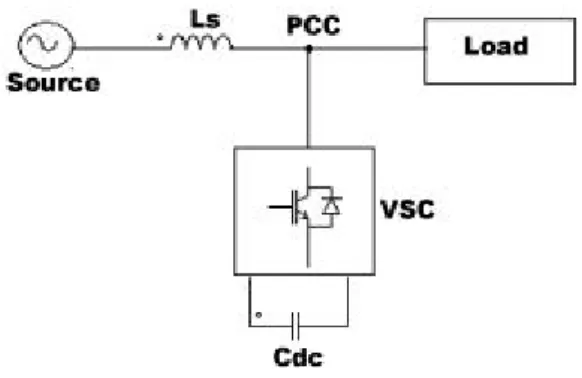
A DSTATCOM is a controlled reactive source, which includes a Voltage Source Converter (VSC) and a DC link capacitor connected in shunt, capable of generating and/or absorbing reactive power. The operating principles of a DSTATCOM are based on the exact equivalence of the conventional rotating synchronous compensator.
Fig.1 Basic structure of DSTATCOM
The AC terminals of the VSC are connected to the Point of Common Coupling (PCC) through an inductance, which could be a filter inductance or the leakage inductance of the coupling transformer, as shown in figure 1. The DC side of the converter is connected to a DC capacitor, which carries the input ripple current of the converter and is the main reactive energy storage element. This capacitor could be charged by a battery source, or could be recharged by the converter itself. If the output voltage of the VSC is equal to the AC terminal voltage, no reactive power is delivered to the system. If the output voltage is greater than the AC terminal voltage, the DSTATCOM is in the capacitive mode of operation and vice versa. The quantity of reactive power flow is proportional to the difference in the two voltages. It is to be noted that voltage regulation at PCC and power factor correction cannot be achieved simultaneously. For a DSTATCOM used for voltage regulation at the PCC, the compensation should be such that the supply currents should lead the supply voltages; whereas, for power factor Correction, the supply current should be in phase with the supply voltages. The control strategies studied in this paper are applied with a view to study-ing the performance of a DSTATCOM for power factor correction and harmonic mitigation.
B. Commonly Used Solutions to Improve Electric Power Quality
i. There are three ways that is commonly applied to improve voltage deviation of electrical power system. The most effective solution is reactive power compensation, as SVC - Static Var Compensator (typically, TCR-Thyristor Controlled Reactors and TSC-Thyristor Switched Capacitors), SVG - Static Var Generator and APFCC-Active Power Factor Correction Circuit. Other solutions include regulation of field current of
synchromotor, application of on-load voltage regulation transformer.
ii. A large number of solutions have been selected to solve the problem of fluctuation and flick of voltage and almost all these solutions simultaneously have the function of harmonic suppression.
iii.To suppress harmonics in electrical power quality. The most effective solution is to apply filters. The commonly applied filters are passive power filter (usually passive LC filter) and active power filter (APF). APF normally has two types according to the ways it connects to the object that is compensated shunt APF and series APF. Among which, shunt APF is common in practical application.
III. PROPOSED SYSTEM CONFIGURATION
A VSC (Voltage Source Converter) based DSTATCOM is connected to a three phase ac mains feeding three phase linear/nonlinear loads with internal grid impedance which is shown in Fig. 2. The performance of DSTATCOM depends upon the accuracy of harmonics currents detection. For reducing ripple in compensating currents, tuned valued of interfacing inductors (Lf) are connected at ac output of the VSC. A three phase series combination of capacitor (Cf) and a resistor (Rf) represents the shunt passive ripple filter which is connected at point of common coupling (PCC) for reducing the high frequency switching noise of the VSC. The DSTATCOM currents (iCabc) are injected as required compensating currents to cancel the reactive power components and harmonics of the load currents so that loading due to reactive power component/harmonics is reduced on the distribution system.
IV. CONTROL ALGORITHM
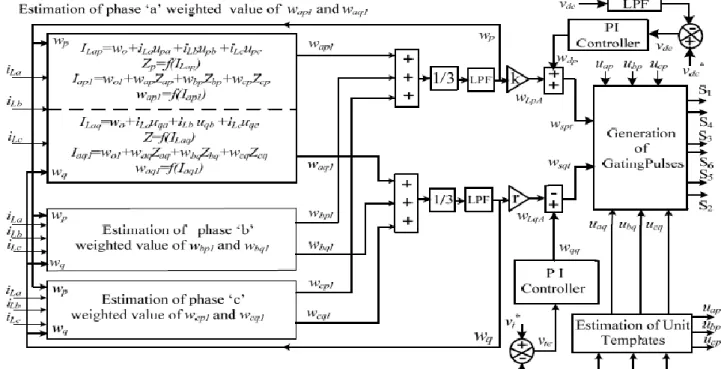
The back propagation training algorithm for estimation of reference source currents through the weighted value of load active power and reactive power current components of block diagram shows in Fig. 3. In this algorithm, phase PCC voltages ( , and ), source currents ( , and ), load currents ( , and ) and dc bus voltage ( ) are required for extraction of reference source currents (
, , ). There are two primary modes for operation of
this algorithm, first one is a feed forward and second is back propagation of error or supervised learning. Detail application of this algorithm for estimation of various control parameters are given below
Fig. 3. Estimation of reference currents using BP control algorithm
A. Estimation of Weighted Value of Average Fundamental Load Active and Reactive Power Components
A back propagation training [10,11] algorithm is used to estimate the three phase weighted value of load active power current components ( , , ) and reactive power current components ( , , )from polluted load currents using feed forward and supervised principle. In this estimation, input layer for three phase (a, b, c) is expressed as,
where is the selected value of initial weight and , ,
are in-phase unit-templates. In-phase unit-templates are estimated using sensed PCC phase voltages ( , , ). It
is the relation of phase voltage and amplitude of PCC voltage ( ). Amplitude of sensed PCC voltages is estimated as,
In-phase unit templates of PCC voltages ( , , ) are estimated as,
Extracted values of , and are passed through sigmoid function as a activation function and output signals
( , and ) of feed forward section are expressed as,
Estimated values of , and are fed to hidden layer as input signals. Three phase outputs of this layer ( ,
, ) before activation function are expressed as,
where and , , are the selected values of initial weight in hidden layer and updated value of three phase B. Amplitude of Active Power Current Components of the Reference Source Currents
An error in dc bus voltage is obtained after comparing reference dc bus voltage and sensed dc bus voltage of a VSC and this error at nth sampling instant is expressed as,
(12) This voltage error is fed to a proportional-integral (PI) controller which output is required for maintaining dc bus voltage of the DSTATCOM. At nth sampling instant, the output of PI controller is as,
(13) where and are the proportional and integral gain constants of the dc bus PI controller.
are the dc bus voltage errors in and instant and
(n) and (n-1) are the amplitude of active power
component of the fundamental reference current at and instant. The amplitude of active power current components of the reference source current ( ) is estimated by addition of output of dc bus PI controller ( ) and average magnitude of load active currents ( ) as,
(14)
C. Amplitude of Reactive Power Components of the Reference Source Currents
An error in ac bus voltage is achieved after comparing amplitude of reference ac bus voltage and sensed ac bus voltage of a VSC. Extracted ac bus voltage error at the
sampling instant is expressed as,
(15) The weighted output of the ac bus PI controller for regulating the ac bus terminal voltage at nth sampling instant is expressed as,
(16)
where (n) is part of reactive power component of source current and it is renamed as . and are the proportional and integral gain constants of the ac bus voltage PI controller. The amplitude of reactive power current components of the reference source current ( ) is calculated by subtracting the output of voltage PI controller ( ) and average load reactive currents ( ) as,
(17) D. Estimation of Reference Source Currents and Generation of IGBTs Gating Pulses
Three phase reference source active and reactive current components are estimated using an amplitude of three phase (a, b and c) load active power current components, PCC
voltage inphase unit templates and reactive power current components, PCC quadrature voltage unit templates as,
(18) (19) Addition of reference active and reactive current components is known as reference source currents and these are given as,
(20) The sensed source currents ( , , ) and the reference
source currents ( , , ) are compared and current error signals are amplified through PI current regulators and their outputs are fed to PWM controller to generate the gating signals for IGBTs (Insulate Gate Bipolar Transistors) S1 to S6 of VSC used as a DSTATCOM.
V. SIMULATION RESULTS
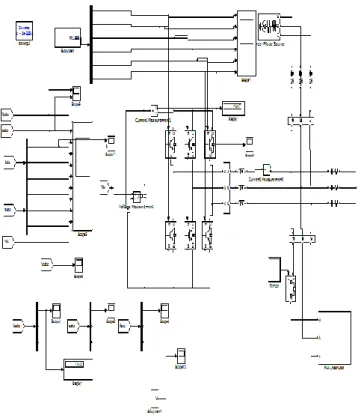
SIMULINK and Sim Power System (SPS) toolboxes is used for the development of simulation model of a DSTATCOM and its control algorithm. The performance of control algorithm is observed under nonlinear loads.
A. Proposed system simulation circuit
Fig. 4 ANN Based DSTATCOM Simulation circuit The performance indicates are as phase voltages at PCC ( ), balanced source current ( ), load currents ( , , ), compensator currents ( , , ), and dc voltage ( ) which are shown in fig .4 under varying loads (at t=3.7 s to 3.8 s) condition.
Fig.5 Performance of DSTATCOM under non linear loads
B. PCC Voltage of phase ‘a’
C. Source current of phase ‘a’
D. Load current of phase ‘a’
E. Performance of DSTATCOM
Performance of parameters Nonlinear loads
PCC Voltage (V),%THD 243.07V, 2.32% Supply Current (A),%THD 31.08A, 1.62%
Load Current (A), %THD 33.13A, 24.16%
VI. CONCLUSION
VSC based DSTATCOM has been accepted as the most preferred solution for power quality improvement and to maintain rated PCC voltage. A three phase DSTATCOM has been implemented for compensation of nonlinear loads using BPT control algorithm to verify its effectiveness. The proposed BPT control algorithm has been used for extraction of reference source currents to generate the switching pulses for IGBTs of VSC of DSTATCOM. Various functions of DSTATCOM such as, harmonic elimination, load balancing and DC voltage regulation of DSTATCOM have been demonstrated. From simulation and implementation results, it is concluded that DSTATCOM and its control algorithm have been found suitable for compensation of nonlinear loads. The DC bus voltage of the DSTATCOM has also been regulated to rated value without any overshoot or undershoot during load variation. Large training time in the application of complex system, selection of number of hidden layer in system are the disadvantage of this algorithm
REFERENCES
[1] R. C. Dugan, M. F. McGranaghan and H. W. Beaty, Electric Power
Systems Quality, 2ed Ed., McGraw Hill, New York, 2006.
[2] Alfredo Ortiz, Cristina Gherasim, Mario Manana, Carlos J. Renedo, L. Ignacio Eguiluz and Ronnie J. M. Belmans,―Total harmonic distortion
decomposition depending on distortion origin,‖IEEE Transactions on
Power Delivery, vol. 20, no. 4, pp. 2651-2656, October 2005.
[3] K. R. Padiyar, FACTS Controllers in Power Transmission and
Distribution, New Age International, New Delhi, 2008.
[4] Tzung-Lin Lee, Shang-Hung Hu and Yu-Hung Chan,―DSTATCOM with positive-sequence admittance and negative-sequence conductance to mitigate voltage fluctuations in high-level penetration of distributed generation systems,‖IEEE Transactions on Industrial
Electronics, vol.60, no. 4, pp. 1417-1428, April 2013.
[5] B. Singh, P. Jayaprakash and D.P. Kothari,―Power factor correction and power quality improvement in the distribution system,‖Journal of
Electrical India, pp. 40-48, April, 2008.
[6] B. Singh and J. Solanki,―A comparison of control algorithms for DSTATCOM,‖IEEE Transactions on Industrial Electronics, vol. 56, no. 7, pp. 2738-2745, July 2009.
[7] S. Rahmani, N. Mendalek and K. Al-Haddad,―Experimental design of a nonlinear control technique for three-phase shunt active power filter,‖IEEE Transactions on Industrial Electronics, vol.57, no.10, pp.3364-3375, Oct. 2010.
[8] Fu Guangjie and Zhao Hailong,―The study of the electric power harmonics detecting method based on the immune RBF Neural Network,‖in Proc. of Second International Conference on Intelligent
Computation Technology and Automation, 2009, vol. 1, pp.121-124.
[9] A. Zouidi, F. Fnaiech, K. Al-Haddad and S. Rahmani,―Artificial neural networks as harmonic detectors,‖in Proc. of 32nd Annual Conference
on IEEE Industrial Electronics,2006, pp.2889-2892.
[10] Insung Jung, and Gi Nam Wang,―Pattern classification of backpropagation algorithm using exclusive connecting network,‖Journal of World Academy of Science, Engineering and
Technology, vol. 36, pp. 189-193, 2007.
[11] Chen Ying and Lin Qingsheng,―New research on harmonic detection based on neural network for power system,‖in Proc. of Third
International Symposium on Intelligent Information Technology Application, 2009, vol. 2, pp.113-116.
Kavali Hemadri, received B.Tech degree from SKIT,
SRIKALAHASTI, JNTU Ananthapur in 2011. Currently he is pursuing his master’s degree from MJRCET, PILER, JNTU Ananthapur in the department of electrical and electronics engineering. His current interests include smart grids, distributed generation systems and renewable energy sources.
Sri V.Veera Nagi Reddy, MJR College of Engineering
and Technology (MJRCET), Piler, Chittoor(dt) A.P, India. He obtained masters degree from JNTU,Anantapur, India. Currently, he is working as HOD in electrical and electronics engineering department at MJRCET, A.P, INDIA. His research interests include Robotics, smart grids, distributed generation systems and renewable energy sources, power system operation and control.