VIDEO WATERMARKING ALGORITHM FOR CONTENT
AUTHORISATION
V.Rajendhiran J.Elavanthan M.Vengadapathiraj R.Vinothkumar Dr.M.Saravanan
Abstract:-In this paper proposed a novel video watermarking technique using Discrete Wavelet Transform and Singular Value Decomposition based on sub band selection formula. To proliferation the level of authentication, the two watermarking methods are used: one is the original watermark and the other is the proprietors’ fingerprint. These two watermarks are entrenched into the cover video based on the sub band assortmentnotches. As of the tentative analysis, found that the proposed watermarking technique is more robust to all possible attacks than existing video watermarking technique. Keywords: Discrete Wavelet Transform (DWT), Singular Value Decomposition (SVD), Authentication, Watermark
1. INTRODUCTION
With the speedy growth of internet technologies as well as digital multimedia processing, a large amount of data is easily accessible to each person these days. In similar to the increasingsort in the multimedia applications, expertise also facilitated illegal copying, tampering, and distribution of digital video. Therefore, various authentication schemes have recently been proposed for verifying the authenticity of the image, video content. The confirmation techniques are basically classified as: digital watermark based and digital signature based systems.
Digital watermarking is a technique which involves two steps: (i) an algorithm to embed slight certification evidence called watermark content on the host content. (ii)An algorithm to recover or extract the embedded watermark with less alteration.Watermarking techniques can be broadly characterized into two groups: spatial domain
Methods and transform fieldapproaches. The spatial domain approaches embed by adjusting directly on the pixels of an image.
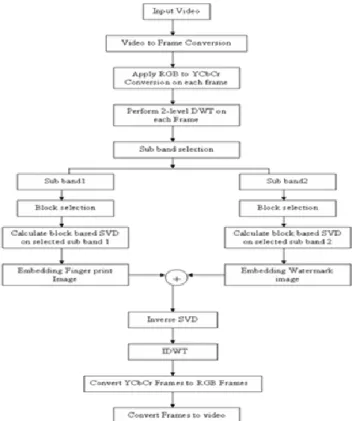
The proposed scheme involves the following steps at the transmitter and the receiver side as follows: At the source side, after put on the DWT on the Y section of each frame, find the region of embedding the watermark and fingerprint using the subband varietynotches. Then split the designatedsubbands into chunk of size equal to the size of the watermark and the fingerprint. Achieve singular value alteration on the selected blocks of the subband. At the receiving end, the same fingerprint image and watermark image is extracted by applying the reverse steps as that of the transfer side, which is then related with the original fingerprint image. The resultant match concludes whether the extracted watermark is authenticated or not.
The rest of the paper is systematized as follows. Section 2 dispensed with the associated works. Sections 3, 4 and 5 talks about Discrete Wavelet Transform (DWT), Singular Value Decomposition (SVD) and colour model alteration respectively. Section 6 explains the proposed watermarking scheme. Section 7 shows experimental results. Decisions and Upcoming Work are given in the Section 8.
2. RELATED WORKS
A numerous video watermarking algorithms have been proposed in either spatial or frequency domain. This unit discussed some of the famous existingwatermarking methods. Mobasseri proposed spatial domain watermarking on compressed videos. Journalistshave exposed that the probability of embedding a watermark in the raw video and also the possibility of recovering it from the MPEG decoder by exploiting the inherent processing gain of DSSS (Direct
Sequence Spread Spectrum). Tsai and Chang proposed a compressed video sequence via VLC decoding and VLC code substitution. Used Watson‟s DCT-based video watermarking to achieve better inaudibility. Novel adaptive approaches to video watermarking have been proposed by Ge et al. In order to guarantee the robustness and perceptual invisibility of the watermarkuses both intra-frame and inter-frame information of video content. The advantage of this proposed method remains that the extraction of watermark can be done without using the novel video, since the embedding was done adaptively based on the signal characteristics and human visual system.
Haney have proposed a multiplicative video watermarking scheme with Semi-Blind maximum likelihood decoding for copyright security. They first split the video signal into non-overlapping pixel cubes. Then, the 2D Wavelet transform is applied on each plane of the selected cubes. For taking out, a semi-blind possibilitydecoder is employed.
This method was robust against linear complicity, frame swapping, dropping, noise insertion, median filtering.
3. 2D-DWT
The mathematical instrument used for categorized decomposition of an image is the Discrete Wavelet transform (DWT). This transform is composed of minor waves, called wavelets with varying frequency and limited period. Wavelet transform deals both spatial and frequency explanation of an image. In this renovation process, the retention of temporal process is possible which is unlike to Fourier transform and Wavelets are usuallyshaped by mother wavelet which is a fixed function of translations and dilations.
The DWT makes the signal to split into low and high frequency portions. The low
Figure1 subband decomposition of 2D DWT
The lifting based implementation of two levels 2D-DWT may be computed using filter banks as shown in Fig.3. The input samples X (n) are passed through two stages of analysis filters. They are first processed by low-pass (h (n)) andhigh-pass (g (n)) horizontal filters and are sub sampled by two. Subsequently, the outputs (L1, H1) are processed
by low-pass and high-pass vertical filter. Note that: L1, H1 are the outputs of 1D-DWT; LL1, LH1, HL1
and HH1 one-level decomposition of 2D-DWT.
4. SINGULAR VALUE DECOMPOSITION
Singular value decomposition (SVD) can be looked at from three mutually compatible factsof view. On the one hand, can see it as a technique for transforming correlated variables into a set of uncorrelated ones that better expose the various relationships among the uniquedata objects. At the same time, SVD is a way for identifying and ordering the dimensions along which data points exhibit the most difference. This ties in to the third approach of inspectingSVD, which is that once identified where the most difference is, it‟s possible to find the best calculation of the original data points using rarer
blue and a reference value differences and the Cr component represents the red and a reference value differences. The expression below shows the RGB to YCbCr color model.
6. PROPOSED ALGORITHM
In this section watermarking embedding and extraction algorithm is discoursed in detail. 6.1. Embedding Algorithm
Step 1: Input Video into frames
Step 2: RGB to YCbCrAlteration on every frame
Step3: Execute 2-level DWT on Y module of each Frame
Step 4: Perform Subband selection algorithm as charts,
(i)Using the below formula, the score Zr is
calculated:
Step5: Choose Subbands with top two scores and named as Subband1 and Subband2. Step 6: Embedding the Binary Watermark image and the Finger print image in the subbands which has highest score and the next highest scores respectively,
Figure 2 block diagram
Figure 3. Embedding Algorithm
7. EXPERIMENTAL RESULTS
The presentation of the projected watermarking system has been measured in terms of its imperceptibility and robustness against the possible attacks like noise addition, filtering, geometric attacks etc. used a sample video sequence „rhinos.avi‟ of length 114 frames as a cover video and two different binary meaningful watermark image „hibiscus. If‟ of size 250 X 250 and fingerprint image „fingerprint. Shows the original and the watermarked video frames respectively. The embedded binary watermark and fingerprint image the mined binary watermark and fingerprint image. INPUT
Table. performance evaluation 8. CONCLUSIONS
In this paper presented a video watermarking algorithm based on Discrete Wavelet Transformand Singular Value Decomposition for content verification. The investigationalscrutinydisplays that approach is vigorous against common image processing attacks such as, Poisson attack, Gaussian Attack, Median Filtering, Salt and Pepper attack, Rotation The contrast in Table 2 shows this method is good when associated to the existing watermarks. As a forthcoming work, can go for embedding different watermarks on the different frames of an image, which may outcome in increasing the embedding capability.
REFERENCES
[1] L. CS, L. Hym and S. Cj, “Structural digital signature for image authentication: an incidental distortion resistant scheme”, Proceedings of the multimedia security workshop 8th ACM
security and watermarking of multimedia contents,(2000),
[4] C-H. Lee and Y-K.Lee, “An Adaptive Digital Watermarking Technique for Copyright Protection”, IEEE Trans. Consumer Electronics, vol. 45, (1999) November, pp. 1005-1015.
[5] I. J.Cox, M. Miller and J. A. Bloom, “Digital Watermarking”, Morgan Kaufmann, (2002).
[6] C. T. Hsu and J. L. Wu, “DCT-based watermarking for video”, IEEE Trans. Consumer Electronics, vol. 44, (1998) February, pp. 206-216. [7] S. Mallat, “A theory for multi-resolution signal decomposition: The wavelet representation”, IEEE Trans. Pattern Anal. And Machine Intel.vol. 11, no. 7, (1989) July, pp. 674- 693.
[8] H. Andrews and C. Patterson, “Singular Value decompositions and Digital Image Processing”, IEEE Trans. on Acoustics, Speech, and Signal Processing, vol. 24, no. 1, (1976) February,pp.26-53. [9] B. G. Mobasseri, “A spatial digital video watermark that survives MPEG”, Proceedings of International Conference on Information Technology: Coding and Computing, Las Vegas, USA, (2000), pp. 68-73.
[10] H. M. Tsai and L. Chang, W. Highly, “Imperceptible video watermarking with the Watson‟s DCT-based visual model”, IEEE International Conference on Multimedia and Expo, Taipei, Taiwan,vol. 3, (2004), pp. 1927-1930. [11] Q. Ge, Z. Lu and X. Niu, “Oblivious video watermarking scheme with adaptive embedding mechanism”, Proc. Int. Conf. Machine Learning and Cybernetics, Xian, China, vol.5,(2003),pp.2876-2881. [12] C. T. Hsu and J. L. Wu, “A DCT-based watermarking for videos”, IEEE Transactions on Consumer Electronics, vol. 44, no. 1, (1998), pp. 206-216.
[13] I. Hong, I. Kim and S. S. Han, “A blind watermarking technique using wavelet transform”, Proceedings of IEEE International Symposium Industrial Electronics, Pusan, Korea, vol. 3, (2001),
pp. 1946-1950.
Existing system Proposed system Types of attacks Avg. PSNR in dB Correlatio n coefficient Avg. PSNR in dB Correlatio n coefficient Gaussian 28.94 4 0.789 29.12 4 0.795 Poisson 24.97 0 0.6987 25.25 4 0.7254 Salt & Pepper 25.18 4 0.789 25.65 1 0.7954 Contrast adjustmen t 28.98 9 0.524 29.12 4 0.5654 Median filtering 34.96 7 0.865 35.24 5 0.8756
Watermark”, IEEE Transactions on Consumer Electronics, vol. 46, no. 2, (2000), pp. 375-384. [17] F. Liu, K. Han and C. Zheng Wang, “A Novel Blind Watermark Algorithm based on SVD and DCT”, IEEE Conference, (2009), pp. 283-286. [18] S. Sinha, P. Bardhan, S. Pramanick, A. Jagatramka, D. K. Kole and A. Chakraborty, “Digital Video Watermarking using Discrete Wavelet Transform and Principal Component Analysis”, International Journal of Wisdom Based Compuitng,vol.1, no. 2, (2011), pp. 7-12.
[19] H. Khalilian and I. V.Bajic, “Multiplicative Video watermarking with Semi-Blind Maximum Likelihood Decoding for Copyright Protection”, IEEE Conference, (2011), vol. 125-130.