
für Angewandte Analysis und Stochastik
Leibniz-Institut im Forschungsverbund Berlin e. V.
Preprint
ISSN 2198-5855
Maximum likelihood drift estimation for a threshold diffusion
Antoine Lejay
1,2, Paolo Pigato
3 submitted: March 22, 2018 1 Université de Lorraine, CNRS IECL UMR 7502 54600 Vandœuvre-lès-Nancy France E-Mail: [email protected] 2 Inria 54600 Villers-lès-Nancy France E-Mail: [email protected] 3 Weierstrass Institute Mohrenstr. 39 10117 Berlin Germany E-Mail: [email protected] No. 2497 Berlin 20182010Mathematics Subject Classification. 62M05, 62F12, 60J60.
Key words and phrases. Threshold diffusion, oscillating Brownian motion, maximum likelihood estimator, null recurrent process, ergodic process, transient process, mixed normal distribution.
Leibniz-Institut im Forschungsverbund Berlin e. V. Mohrenstraße 39 10117 Berlin Germany Fax: +49 30 20372-303 E-Mail:
[email protected]
World Wide Web:http://www.wias-berlin.de/
Antoine Lejay , Paolo Pigato
Abstract
We study the maximum likelihood estimator of the drift parameters of a stochastic differential equation, with both drift and diffusion coefficients constant on the positive and negative axis, yet discontinuous at zero. This threshold diffusion is called the drifted Oscillating Brownian motion. The asymptotic behaviors of the positive and negative occupation times rule the ones of the es-timators. Differently from most known results in the literature, we do not restrict ourselves to the ergodic framework: indeed, depending on the signs of the drift, the process may be ergodic, tran-sient or null recurrent. For each regime, we establish whether or not the estimators are consistent; if they are, we prove the convergence in long time of the properly rescaled difference of the es-timators towards a normal or mixed normal distribution. These theoretical results are backed by numerical simulations.
1
Introduction
We consider the process, called adrifted Oscillating Brownian motion (DOBM), which is the solution to the Stochastic Differential equation (SDE)
ξ
t=
ξ
0+
Z
t 0σ(ξ
s) dW
s+
Z
t 0b(ξ
s) ds,
(1) withσ(x) =
(
σ
+>
0
ifx
≥
0,
σ
−>
0
ifx <
0
andb(x) =
(
b
+∈
R
ifx
≥
0,
b
−∈
R
ifx <
0.
(2) The strong existence to (1) follows for example from the results of [28]. Separately onR
+andR
−, thedynamics of such process is the one of a Brownian motion with drift, with threshold and regime-switch at
0
, consequence of the discontinuity of the coefficients.This model can be seen as an alternative to the model studied in [36], which is a continuous time version of the Self-Exciting Threshold Autoregressive models (SETAR), a subclass of the TAR models [45, 46].
The practical interest of such processes are numerous. In finance, we show in [31] that an exponen-tial form of this process generalizes the Black & Scholes model in a way to model leverage effects. Moreover, the introduction of a piecewise constant drift such as the one in (2) is a straightforward way to produce a mean-reverting process, if
b
+<
0
andb
−>
0
. In [31], we find some evidenceon empirical financial data that this may be the case. This corroborates other studies with different models [35, 38, 44].
Still in finance, the solution to (1) models other quantities than stocks. In [13], Eq. (1) with constant volatility serves as a model for the surplus of a company after the payment of dividends, which are payed only if the profits of the company are higher than a certain threshold. Similar threshold dividend
pay-out strategies are considered in [3]. In these works, the behavior of the process at the discontinuity is referred to as “refraction”. SETAR models have also applications to deal with transaction costs or regulator interventions [49], to interest and exchange rates [6, 9], ...
More general discontinuous drifts and volatilities arise in presence of Atlas models and other ranks based models [17]. SDE with discontinuous coefficients have also numerous applications in physics [39, 42], meteorology [15] and many other domains.
In [43, 44], F. Su and K.-S. Chan study the asymptotic behavior of the quasi-likelihood estimator of a diffusion with piecewise regular diffusivity and piecewise affine drift with an unknown threshold. The quasi-likelihood they use is based on the Girsanov density where the diffusivity is replaced by
1
. In particular, they construct some hypothesis test to decide whether or not the drift is affine or piecewise affine in the ergodic situation.In [26], Y. Kutoyants consider the estimation of a threshold
r
of a diffusion with a known or unknown drift switching atr
. His results are then specialized to Ornstein-Uhlenbeck type processes. Also this framework assumes that the diffusion is ergodic.In the present paper, we derive some maximum likelihood estimators for the drift parameters
b
−andb
+ from continuous observations. We study their asymptotic behavior as the time tends to infinityin order to derive some confidence intervals when available. This article completes [30], where we estimate
(σ
−, σ
+)
for high-frequency data. We use our estimators on financial historical data in [31].Our estimators of
b
±T areβ
T±=
±
(±ξ
T)
∨
0
−
(±ξ
0)
∨
0
−
L
T(ξ)/2
Q
±T,
where
Q
+T (resp.Q
−T) is the occupation time of the positive (resp. negative) side of the real axis, andL
T(ξ)
is the symmetric local time ofξ
at0
. Estimators forQ
± andL
T(ξ)
are quite straightforwardto implement from discrete observations of a trajectory of
ξ
, and so are estimators forb
±. As for theestimators of
(σ
−, σ
+)
in [30], the local time and the occupation times play a central role in the studyof the estimators of
(b
−, b
+)
.The long time asymptotic regime of the process depends on the respective signs of the coefficients
(b
−, b
+)
. Using symmetries, this leads 5 different cases in which the process may be ergodic, nullrecurrent or transient and the estimators have different asymptotic behaviors. In some situations, the estimators are not convergent. In others, we establish consistency as well as Central Limit Theorems, with speed
T
1/2 orT
1/4, depending again on the signs ofb
±. We summarize in Table 1 the
vari-ous asymptotic behaviors. We are in a situation close to the one encountered by M. Ben Alaya and A. Kebaier in [1] for estimating square-root diffusions, where several situations shall be treated. The work [26, 43, 44] mentioned above only consider ergodic situations. Non-parametric estimation of the drift in the recurrent case is considered in [4].
Finally, we develop in Section 7.1 a hypothesis test for the value of the drift which is based on the Wilk’s theorem, which relates asymptotically the log-likelihood to a
χ
2 distribution with 2 degrees of freedom. Besides, we show in Section 7.2 the Local Asymptotic Normality (LAN [27, 29]) and the Local Asymptotic Mixed Normality (LAMN [22]) in the ergodic case and the null recurrent case with non vanishing drift. These LAN/LAMN properties are related to the efficiency of the operators. The Wilk’s as well as the LAN/LAMN properties are proved by combining the quadratic nature of the log-likelihood with our martingale central limit theorems.β
T+−
b
+β
T−−
b
− (E)b
+<
0, b
−>
0
ergodic≈
√1Tq
1
−
b+ b−σ
+N
≈
1 √ Tq
1
−
b− b+σ
−N
(N0)b
+= 0, b
−= 0
null recurrent √1Tβ
1+ √1Tβ
− 1 (N1)b
+= 0, b
−>
0
null recurrent≈
√1Tσ
+N
+≈
T11/4σ
−√
b− √ σ+ N−√
|N | (T0)b
+>
0, b
−≥
0
transient≈
√1Tσ
+N
R
T0asT
→ ∞
(T1)b
+>
0, b
−<
0
transient≈
√1Tσ
+N
R
+T1asT
→ ∞
Table 1: Asymptotic behavior of estimators, where
N
,N
+ andN
− are independent, unit Gaussian variables. The law of(β
1−, β
1+)
in case(N0)is given in (25). The r.v.sR
T0andR
+T1follow the law in(22). Results of both sides in(T1)are wrt to
P
+(cf. Proposition 6), which intuitively can be thought as conditioning to the process diverging towards postive infinity.transform. In Section 3, we characterize the different regimes of the process accordingly to the signs of the drifts. Our main results are presented in Section 4. The limit theorems that we use are presented in Section 5. The proofs for each cases are detailed in Section 6. We present the Wilk theorem and the LAN/LAMN property in Section 7. Finally, in Section 8, we conclude this article with numerical experiments.
2
The maximum likelihood estimator
In this section, we propose and discuss an estimator for the parameters
(b
−, b
+)
of the drift coefficientof
ξ
from continuous time observationsData 1. We observe of a path
(ξ
t)
t∈[0,T]on the time interval[0, T
]
of the solution to(1), together withits negative and positive occupation times
Q
−T=
Z
T 01
ξs<0ds
andQ
+ T=
Z
T 01
ξs>0ds,
as well as its symmetric local time
L
T(ξ) = lim
→01
2
Z
T 01
−≤ξs≤ds.
The coefficients
(σ
−, σ
+)
are known.Remark1. Approximations of
(Q
−T, Q
+T, L
T(ξ))
are easy to construct from(ξ
t)
t∈[0,T]so thatobserv-ing
(ξ
t)
t∈[0,T]is sufficient to build approximations of our estimator. This is detailed in Section 8.1.The Girsanov weight of the distribution of (1), with respect to the one of the solution to
dξ
t=
σ(ξ
t) d
W
f
, for a Brownian motionf
W
, isG(b
−, b
+) = exp
Z
T 0b(ξ
s)
σ(ξ
s)
d
W
f
s−
1
2
Z
T 0b
2(ξ
s)
σ
2(ξ
s)
ds
.
(3)A reasonable way to set up an estimator of
(b
−, b
+)
is to considerG(b
−, b
+)
as a likelihood and toNotation1. To avoid confusion with the
+
and−
used as indices, we writeL
x
M
+:= max{x,
0}
for the positive part ofx
andL
x
M
−:= max{−x,
0} ≥
0
for the negative part.Proposition 1. The likelihood
G(b
−, b
+)
is maximal at(β
T−, β
+ T)
given byβ
T±=
±
L
ξ
TM
±−
L
ξ
0M
±−
L
T(ξ)/2
Q
±T.
(4)Proof. Let us denote by
ξ
the canonical process. Let us consider the measureP
such thatξ
is the unique solution todξ
t=
σ(ξ
t) d
W
f
t,t
∈
[0, T
]
for a Brownian motionW
f
.Under the distribution
Q
, with densityG(b
−, b
+)
given by (3), with respect toP
, the processξ
is solution todξ
t=
σ(ξ
t) dW
t+
b(ξ
t) dt
forW
defined byW
t=
f
W
t−
R
t 0 bσ
(ξ
s) ds
. UnderQ
, the processW
is a Brownian motion.We define
γ(x) =
b(x)/σ
2(x)
andF
(x) =
γ(x)x
forx
∈
R
. The functionF
is piecewise linear withF
0(x) =
γ(x)
forx
6= 0
andβ
=
γ(0+)
−
γ(0−) =
b
+σ
2 +−
b
−σ
2 −.
From the Itô-Tanaka formula1[23, Theorem 7.1, p. 218],
F
(ξ
t)
−
F
(ξ
0) =
Z
t 0F
−0(ξ
s) dξ
s+
β
2
L
t(ξ) =
Z
t 0γ(ξ
s) dξ
s+
β
2
L
t(ξ), t
∈
[0, T
].
Sinceγ(ξ
s) dξ
s=
b(ξ
s)/σ(ξ
s) d
f
W
s,Z
T 0b(ξ
s)
σ(ξ
s)
d
f
W
s=
F
(ξ
T)
−
F
(ξ
0)
−
β
2
L
T(ξ).
Injecting this in the formula (3),
log
G(b
+, b
−) =
F
(ξ
T)
−
F
(ξ
0)
−
β
2
L
T(ξ)
−
1
2
Z
T 0b
2(ξ
s)
σ
2(ξ
s)
ds
=
F
(ξ
T)
−
F
(ξ
0)
−
β
2
L
T(ξ)
−
b
2+2σ
2 +Q
+T−
b
2 −2σ
2 −Q
−T.
(5)Maximizing (5) over
b
+andb
−leads to (4).The proof of the next lemma is a direct consequence of the Itô-Tanaka formula. It is the key to study the asymptotic behavior of
β
±.Lemma 1. For any
T
≥
0
,β
T±=
b
±+
M
T±Q
±T,
whereM
±:=
±
R
·0
σ
±1
±ξs≥0dB
s are continuous time martingales withhM
±
i
=
σ
2±
Q
± andhM
+, M
−i
= 0
.The occupation time is non decreasing. For the sake of simplicity, let us write
Q
±∞= lim
T→∞
Q
±T
∈
R
+∪ {∞}.
1
3
Analytic characterization of the regime of the process
3.1
Scale function and speed measure
A well known fact [19, 23, 41] states that the infinitesimal generator
(L,
Dom(L))
of the processξ
solution to (1) may be written as
Lf
=
1
2
σ
2(x)e
−h(x)d
dx
e
h(x)df
(x)
dx
withh(x) =
Z
x 02b(y)
σ
2(y)
dy
for all
f
∈
Dom(L) =
{f
∈ C
0(
R
)
| Lf
∈ C
0(
R
)}.
The process
X
is fully characterized by itsspeed measureM
with a densitym
and itsscale functionS
withm(x) :=
2
σ(x)
2exp(h(x))
andS(x) :=
Z
x 0exp(−h(y)) dy.
(6)3.2
The regimes of the process
The diffusion
X
is either recurrent or transient. Iflim
x→+∞S(x) = +∞
andlim
x→−∞S(x) =
−∞
, then the process is (positively or null)recurrent. Otherwise, it istransient[19, 23]. Whenb(x) =
b
+forx
≥
0
,S(x) =
x
ifb
+= 0,
σ
2 +2b
+1
−
exp
−
2b
+x
σ
2 + ifb
+>
0,
σ
+22|b
+|
exp
2|b
+|x
σ
2 +−
1
ifb
+<
0.
Similar formulas hold for
b
−. Hence, the processξ
is transient if only ifb
+>
0
orb
−<
0
.A recurrent process is either null recurrent orpositive recurrent. The process is positive recurrent if and only if
M
(
R
) :=
R
R
m(x) dx <
+∞
, in which case it is actuallyergodic. Therefore, the processξ
is ergodic if and only ifb
+<
0
andb
−>
0
. Otherwise, the processξ
is only null recurrent.When the process is ergodic (
b
+<
0
,b
−>
0
), its invariant measure ism(x)
M
(
R
)
dx
=
b
−b
−+
|b
+|
e
−2x|b+| σ2+ ifx
≥
0,
|b
+|
b
−+
|b
+|
e
2xb− σ2− ifx <
0.
Therefore, the regimes of
ξ
depends only on the respective signs ofb
+andb
−. Nine combinations arepossible. As some cases are symmetric, we actually consider five cases exhibiting different asymptotic behaviors of
Q
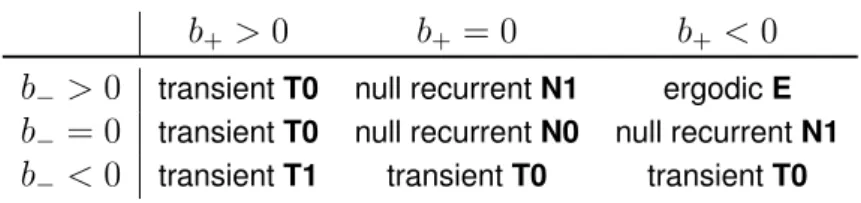
±T, hence of the estimators. This is summarized in Table 2.These cases are:
E) Ergodic case
b
+<
0
,b
−>
0
.N0) Null recurrent case
b
+= 0
,b
−= 0
.b
+>
0
b
+= 0
b
+<
0
b
−>
0
transientT0 null recurrentN1 ergodicEb
−= 0
transientT0 null recurrentN0 null recurrentN1b
−<
0
transientT1 transientT0 transientT0Table 2: Recurrence and transience properties of
ξ
.T0) Transient case
b
+>
0
,b
−≥
0
.T1) Transient case
b
+>
0
,b
−<
0
.CaseT0corresponds to two entries of table 2. The case
b
+<
0
,b
−= 0
is symmetric toN1. Caseb
+≤
0
,b
−<
0
is symmetric toT0.4
Asymptotic behavior of the estimators
In this section, we state our main results on the asymptotic behavior of the occupation times of the process and the corresponding ones of the estimators, for each of the 5 cases.
Proposition 2(Ergodic caseE). If
b
+<
0, b
−>
0
, thenQ
+TT
,
Q
−TT
a.s.−−−→
T→∞|b
−|
|b
−|
+
|b
+|
,
|b
+|
|b
−|
+
|b
+|
.
(7) In addition,(β
T+, β
T−)
−−−→
a.s. T→∞(b
+, b
−)
and√
T
p
|b
−|
+
|b
+|
(β
T+−
b
+, β
T−−
b
−)
law−−−→
T→∞σ
+p
|b
−|
N
+,
p
σ
−|b
+|
N
−!
,
where
N
+andN
−are two independent, unit Gaussian random variables.Proposition 3(Null recurrent case with vanishing driftN0). Assume
b
+=
b
−= 0
. Assumeξ
0= 0
.Then
Q
+TT
,
Q
−TT
law= (Λ,
1
−
Λ)
for allT >
0,
where
Λ
follows a law of arcsine type with densityp
Λ(u) :=
1
π
1
p
u(1
−
u)
σ
+/σ
−1
−
(1
−
(σ
+/σ
−)
2)u
for0
< u <
1.
Besides,√
T
(β
T+, β
T−)
law= (β
1+, β
1−)
(8)where the explicit joint density of
(β
1+, β
1−)
is given by (25)below. In particular,(β
T+, β
T−)
converges almost surely to(b
+, b
−) = (0,
0)
.Proposition 4(Null recurrent case with non-vanishing driftN1). Assume
b
+= 0
,b
−>
0
. ThenQ
+TT
a.s.−−−→
T→∞1
and(β
+ T, β
− T)
a.s.−−−→
T→∞(b
+, b
−).
In addition, there exists three independent unit Gaussian random variables
N
−,N
+andN
such thatQ
−T√
T
,
√
T
(β
T+−
b
+), T
1/4(β
T−−
b
−)
law−−−→
T→∞σ
+b
−|N |, σ
+N
+, σ
−p
b
−p
σ
+·
N
−p
|N |
!
.
(9)Proposition 5(Transient case for upward driftT0). Assume
b
+>
0
,b
−≥
0
so that the processξ
istransient and
lim
T→∞ξ
T= +∞
. ThenQ
+T/T
converges almost surely to1
asT
→ ∞
andβ
T+−−−→
a.s. T→∞b
+and√
T
(β
T+−
b
+)
law−−−→
T→∞σ
+N
+ (10)for a unit Gaussian random variable
N
+. Let`
0be the last passage time to
0
, which is almost surelyfinite. Assume
ξ
0= 0
. We haveβ
T−1
T >`0=
R
T01
T >`0 andlim
T→∞β
− T=
R
T0a.s. withR
T0:=
L
∞(ξ)
2Q
−` 0=
L
∞(ξ)
2Q
− ∞.
(11)The density of
R
T0is given by (22)below. The caseb
+≤
0
,b
−<
0
is treated by symmetry.Proposition 6(Transient case for diverging driftT1). Assume
b
+>
0
,b
−<
0
so that the processξ
is transient. Assume that
ξ
0= 0
. Then there exists a Bernoulli random variableB ∈ {0,
1}
such thatP
(B
= 1) = 1
−
P
(B
= 0) =
σ
−b
+σ
+b
−+
σ
−b
+,
P
+Q
+TT
−−−→
T→∞1
= 1
andP
−Q
−TT
−−−→
T→∞1
= 1
withP
+(·) =
P
(· | B
= 1)
andP
−(·) =
P
(· | B
= 0).
On the event
{B
= 1}
(resp.{B
= 0}
),β
T+(resp.β
T−) converges almost surely tob
+(resp.b
−) whileβ
T−−
b
−(resp.β
T+−
b
+) is the ratio of two a.s. finite random variables.In addition, for unit Gaussian random variables
N
+andN
−,√
T
(β
T+−
b
+)
law−−−→
T→∞σ
+N
+ underP
+,
(12)√
T
(β
T−−
b
−)
law−−−→
T→∞σ
−N
− underP
−.
(13) In addition,lim
T→∞β
− T=
R
−T1a.s. under
P
+withR
− T1
=
L
∞(ξ)
2Q
− ∞,
(14)lim
T→∞β
+ T=
−R
+T1a.s. under
P
−withR
+ T1=
L
∞(ξ)
2Q
+ ∞.
(15)5
Auxiliary tools
In this section, we give first some results on a martingale central limit theorem that will be used con-stantly. To deal with the transient or null recurrent cases, we make use of some analytic properties of one-dimensional diffusions.
5.1
Limit theorems on martingales
The following result follows immediately from [32, Proposition 1, p. 148; Theorem 1, p. 150].
Proposition 7(A criterion for convergence). Under the true probability
P
,(i) as
T
→ ∞
,β
T+ (resp.β
T−) converges a.s. tob
+ (resp.b
−) on the event{Q
+∞= +∞}
(resp.{Q
−∞
= +∞}
).(ii) as
T
→ ∞
,M
T+ (resp.M
T−) converges a.s. to a finite value on the event{Q
+∞
<
+∞}
(resp.{Q
−∞
<
+∞}
). In other words,β
±T is not a consistent estimator on
{Q
±∞
<
+∞}
.We now state an instance of a Central Limit theorem for martingales which follows from [7]. This theorem will be used to deal with the casesE,N1andT1. Let us start by recalling the notion of stable convergence introduced by A. Rényi [21, 40].
Definition 1(Stable convergence). A sequence
(X
n)
n∈Non a probability space(Ω,
F,
P
)
is said toconverge stably with respect to a
σ
-algebraG ⊂ F
if for any bounded, continuous functionf
and any bounded,G
-measurable random variableY
,E
(f(X
n)Y
)
−−−→
n→∞
E
(f(X)Y
).
Proposition 8 (A central limit theorem for martingales). Let
(Ω,
F
,
P
)
be the underlying probability space of the processξ
with a filtration(F
t)
t≥0. If for some constantsc
+, c
−>
0
,Q
+TT
P−−−−→
T→+∞c
+andQ
−TT
P−−−−→
T→+∞c
−,
then for the martingales
M
±defined in Lemma 1,M
T+√
T
,
M
T−√
T
F∞−stably−−−−−−→
T→∞(σ
+√
c
+N
+, σ
−√
c
−N
−),
(16) on a probability space(Ω
0,
F
0,
P
0)
extending(Ω,
F
,
P
)
and containing two independent unit Gaussianrandom variables
N
+,N
−, themselves independent fromξ
. In addition,√
T
M
T+Q
+T,
M
T−Q
−T F∞−stably−−−−−−→
T→∞σ
+√
c
+N
+,
σ
−√
c
−N
−,
(17) Proof. Seta
T:=
1/
√
T
0
0
1/
√
T
andq
T=
hM, M
i
T=
σ
2 +Q
+ T0
0
σ
2 −Q
− T.
Thus,a
Tq
Ta
0T=
"
σ
2 + Q+T T0
0
σ
2 − Q−T T#
P−−−→
T→∞c
+c
−.
(18)Theorem 2.2 in [7] yields (16). Besides,
√
T
M
± TQ
±T=
T
Q
±T×
M
T±√
T
.
(19)If a sequence
(X
n)
n convergesF
∞-stably and a sequence(Y
n)
n ofF
∞-measurable randomvari-ables converges in probability, then
(X
n, Y
n)
nconvergesF
∞-stably. Using the property in (19) and(17) yields (17).
5.2
The fundamental system
Along with the characterization through the scale function and the speed measure, much information on the process can be read from the so-calledfundamental system[11, 19, 41]: For any
λ >
0
, there exists some functionsφ
λ andψ
λsuch that
ψ
λandφ
λare continuous, positive fromR
toR
withφ
λ(0) =
ψ
λ(0) = 1
.ψ
λis increasing withlim
x→−∞ψ
λ(x) = 0
,lim
x→∞ψ
λ(x) = +∞
.φ
λis decreasing withlim
x→−∞φ
λ(x) = +∞
,lim
x→∞φ
λ(x) = 0
.φ
λandψ
λare solutions toLf
=
λf
.In the case of piecewise constant coefficients with one discontinuity at
0
, these solutions may be computed as linear combinations of the minimal functions for constant coefficients. Using the fact thatφ
,φ
0,ψ
andψ
0 are continuous at0
,ψ
λ(x) =
exp
x
−b−+√
b2 −+2σ2−λ σ2 − ifx <
0
κ
+exp
x
−b++√
b2 ++2σ+2λ σ2 ++
δ
+exp
x
−b+−√
b2 ++2σ2+λ σ2 + ifx
≥
0,
(20)φ
λ(x) =
κ
−exp
x
−b−−√
b2 −+2σ2−λ σ2 −+
δ
−exp
x
−b−+√
b2 −+2σ−2λ σ2 − ifx <
0,
exp
x
−b+−√
b2 ++2σ+2λ σ2 + ifx
≥
0
(21) withκ
+:=
−b
−σ
2++
b
+σ
2−+
σ
−2p
b
2 ++ 2λσ
+2+
σ
2+p
b
2 −+ 2λσ
−22σ
2 −p
b
2 ++ 2λσ
+2,
δ
+:=
b
−σ
2+−
b
+σ
−2+
σ
−2p
b
2 ++ 2λσ
2+−
σ
+2p
b
2 −+ 2λσ
2−2σ
2 −p
b
2 ++ 2λσ
2+,
κ
−:=
−b
−σ
2++
b
+σ
2−−
σ
−2p
b
2 ++ 2λσ
2++
σ
+2p
b
2 −+ 2λσ
−22σ
2 +p
b
2 −+ 2λσ
−2,
δ
−:=
b
−σ
2+−
b
+σ
−2+
σ
−2p
b
2 ++ 2λσ
2++
σ
+2p
b
2 −+ 2λσ
−22σ
2 +p
b
2 −+ 2λσ
−2.
We also define the quantities [37]
b
ψ(λ) :=
1
2
ψ
λ0(0)
ψ
λ(0)
=
−b
−+
p
b
2 −+ 2σ
−2λ
2σ
2 −≥
0
andφ(λ) :=
b
−
1
2
φ
0λ(0)
φ
λ(0)
=
b
++
p
b
2 ++ 2σ
+2λ
2σ
2 +≥
0.
In particular,
b
ψ(0) = 0
andφ(0) =
b
b
+σ
2 + whenb
−≥
0
andb
+≥
0.
5.3
Last passage time and occupation time for the transient process
When
ξ
is a transient process, the last passage time`
0= sup{t
≥
0
|
ξ
t= 0}
ofξ
at0
is almostsurely finite. Its Laplace transform is (See (53) in [37]):
E
0[exp(−λ`
0)] =
b
ψ(0) +
φ(0)
b
b
ψ(λ) +
φ(λ)
b
.
Let us now assume that
b
+>
0
andb
−≥
0
. This is the transient caseT0where the process endsup almost surely in the positive semi-axis. Thus,
Q
−`0
=
Q
−
∞and
L
`0(ξ) =
L
∞(ξ)
.Let us write
b
b
±:=
b
±/σ
±2. From Corollary 5 in [37],E
0[exp(−αL
∞(ξ)
−
λQ
−∞)] =
b
ψ(0) +
φ(0)
b
α
+
φ(0) +
b
ψ(λ)
b
=
b
b
+α
+
b
b
+−
bb− 2+
1 2σ2 −p
b
2 −+ 2σ
−2λ
.
Let
p
L∞(ξ)(t)
be the density ofL
∞(ξ)
. Settingλ
= 0
, we see thatL
∞(ξ)
is distributed according toan exponential distribution of rate
b
b
+. Thus,p
L∞(ξ)(t) =
b
b
+exp(−
b
b
+t)
. A conditioning shows thatE
0[exp(−αL
∞(ξ)
−
λQ
−∞)] =
Z
+∞ 0exp(−αt)
E
0exp(−λQ
−∞)
L
∞(ξ) =
t
p
L∞(t) dt.
By inverting the Laplace transform with respect to
α
, sincep
L∞(t) =
b
b
+exp(−
b
b
+t)
,E
0exp(−λQ
−∞)
L
∞(ξ) =
t
= exp
−t
−
b
b
−2
+
1
√
2σ
−s
b
2 −2σ
2 −+
λ
!!
.
Inverting the latter Laplace transform with respect to
λ
, the densityp
Q−∞
(s|t)
ofQ
− ∞given{L
∞(ξ) =
t}
isp
Q− ∞(s|t) =
t
σ
−2
√
2πs
3/2exp
tb
−2σ
2 −−
b
2 −s
2σ
2 −−
t
28σ
2 −s
.
Hence, the distribution
p
(Q−∞,L∞(ξ))
(s, t)
of the pair(Q
− ∞, L
∞(ξ))
isp
(Q− ∞,L∞(ξ))(s, t) =
tb
+σ
2 +σ
−2
√
2πs
3/2exp
b
−2σ
2 −−
b
+σ
2 +t
−
b
2 −s
2σ
2 −−
t
28σ
2 −s
.
The density
p
RT0(r)
of the random variableR
T0:=
L
∞(ξ)/2Q
− ∞is thenp
RT0(r) = 2
Z
+∞ 0s
·
p
(Q− ∞,L∞(ξ))(s,
2rs) ds
=
rb
+σ
2 +σ
−√
2
2rb
+σ
2 ++
(r
−
b
−)
22σ
2 − −3/2, r >
0.
The distribution of
L
∞(ξ)/2Q
+∞whenb
−<
0
,b
+≤
0
is found by symmetric arguments.Let us now assume that
b
+>
0
andb
−<
0
. This is the transient caseT1where the process can endup in both semi-axis. The Laplace transform is
E
0[exp(−αL
∞(ξ)
−
λQ
−∞)] =
b
ψ(0) +
φ(0)
b
α
+
φ(0) +
b
ψ(λ)
b
=
b
b
+−
b
b
−α
+
b
b
+−
bb− 2+
1 2σ2 −p
b
2−+ 2σ
−2λ
.
With analogous computations as before we get that the density
p
R−T1
(r)
ofR
− T1isp
R− T1(r) =
r
σ
−√
2
b
+σ
2 +−
b
−σ
2 −2rb
+σ
2 ++
(r
−
b
−)
22σ
2 − −3/2, r >
0.
Considering also the previous case, we can write the following formula, holding for the density of
R
=
R
T0orR
=
R
−T1in both casesT0andT1:p
R(r) =
r
σ
−√
2
b
+σ
2 ++
L
b
−M
−σ
2 −2rb
+σ
2 ++
(r
−
b
−)
22σ
2 − −3/2, r >
0.
(22)Notice that this is the density of a positive random variable which is not integrable. This gives the limit behavior of the estimator
β
T−ofb
−. The behavior ofβ
T+ in the corresponding cases can be found bysymmetric arguments.
6
Proofs of the asymptotic behavior of the estimators
6.1
Asymptotic behavior for the ergodic case (E)
The ergodic case is the most favorable one. The process
ξ
is ergodic, so that for any bounded, mea-surable functionf
, T1R
0Tf
(ξ
s) ds
converges almost surely toR
f(x)
Mm((x)R)
dx
.With the explicit expression of
M
that follows from (6),M
(
R
+) =
−1
b
+, M
(
R
−) =
1
b
− andM(
R
) =
|b
+b
−|
|b
−|
+
|b
+|
.
From the ergodic theorem, since
Q
±t=
R
0t1
±ξs≥0ds
,Q
±TT
a.s.−−−→
T→∞M
(
R
±)
M
(
R
)
so thatQ
+TT
a.s.−−−→
T→∞|b
−|
|b
−|
+
|b
+|
andQ
− TT
a.s.−−−→
T→∞|b
+|
|b
−|
+
|b
+|
.
(23)6.2
Asymptotic behavior for the null recurrent case with vanishing drift (N0)
Whenb
−=
b
+= 0
, the processξ
is an Oscillating Brownian motion (OBM, introduced first in [24],see also [30]). Supposing
ξ
0= 0
, using the scaling relation [30, Remark 3.7], for anyT >
0
,L
ξ
TM
+√
T
,
L
ξ
TM
−√
T
,
L
T(ξ)
√
T
,
Q
+TT
law= (
L
ξ
1M
+,
L
ξ
1M
−, L
1(ξ), Q
+1).
Therefore,√
T
β
T+β
T−=
L
ξ
TM
+/
√
T
−
1 2L
T(ξ)/
√
T
Q
+T/T
1 2L
T(ξ)/
√
T
−
L
ξ
TM
−/
√
T
Q
−T/T
law=
β
1+β
1−=
L
ξ
1M
+−
1 2L
1(ξ)
Q
+1 1 2L
1(ξ)
−
L
ξ
1M
−Q
−1
.
We recall now that
X
= Φ(ξ) :=
ξ/σ(ξ)
is a Skew Brownian motion [10, 30]. An explicit formula for the density for the position a Skew Brownian motion, its local time and its occupation time is known [2, 12]. Since the transformΦ
is piecewise linear, one easily recover the one of an OBM, its local and occupation times. Hence, the density of(ξ
1, L
1(ξ), Q
+1(ξ))
isp
(ξ 1,L1(ξ),Q+1)(ρ, λ, τ
)
=
(λ/2 +
ρ)λ/2
2πσ
−σ
3+(1
−
τ)
3/2τ
3/2exp
−
(λ/2)
22σ
2−(1
−
τ
)
−
(λ/2 +
ρ)
22σ
2+τ
forρ
≥
0,
(λ/2
−
ρ)λ/2
2πσ
+σ
3−(1
−
τ)
3/2τ
3/2exp
−
(λ/2)
22σ
2 +τ
−
(λ/2
−
ρ)
22σ
2 −(1
−
τ
)
forρ <
0.
(24)The change of variable in the density suggested by
(β
1+, β
1−, Q
+1) =
L
ξ
1M
+−
L
1(ξ)/2
Q
+1,
L
1(ξ)/2
−
L
ξ
1M
−1
−
Q
+1, Q
+ 1 givesp
(β+ 1,β − 1,Q + 1)(a, b, δ)
= 2δ(1
−
δ)p
(ξ1,L1(ξ),Q+1)
(aδ
+
b(1
−
δ),
|aδ
+
b(1
−
δ)| −
aδ
+
b(1
−
δ), δ)
and then, since
Q
+1∈
[0,
1]
,p
(β+ 1,β − 1)(a, b)
=
Z
1 02δ(1
−
δ)p
(ξ1,L1(ξ),Q+1)
(aδ
+
b(1
−
δ),
|aδ
+
b(1
−
δ)| −
aδ
+
b(1
−
δ), δ) dδ.
(25)6.3
Asymptotic behavior for the null recurrent case with non-vanishing drift
(N1)
We consider
b
+= 0
,b
−>
0
. The particle is then pushed upward when its position is negative. Yetthe process is only null recurrent. The measure
M
satisfiesM
(
R
−) =
1
b
−Using 9) in [19, Section 6.8, p. 228] or [34, 47], with (26),
Q
−TT
a.s.−−−→
T→∞M
(
R
−)
M
(
R
)
= 0.
Since
Q
+T+
Q
−T=
T
, it holds thatQ
+T/T
converges almost surely to1
. Using Proposition 8 onM
+only, we obtain thatM
T+√
T
law−−−→
T→∞σ
+N
+ (27)for a Gaussian random variable
N
+∼ N
(0,
1)
and then that√
T
(β
T+−
b
+)
law−−−→
T→∞σ
+N
+.The asymptotic behavior of
Q
−T is more delicate to deal with as the processξ
is only null recurrent. For this, we use the results of [14] which extends the one of D.A. Darling and M. Kac [8] on additive and martingale additive functionals.The Green kernel with respect to the invariant measure
M
ofL
is given by [11, 19, 41]g
λ(x, y) :=
1
W
λ(
ψ
λ(x)φ
λ(y)
ifx < y,
φ
λ(x)ψ
λ(y)
ifx
≥
y
withW
λ=
ψ
λ0(0)φ
λ(0)
−
ψ
λ(0)φ
0λ(0)
S
0(0)
.
The Wronskian
W
λis then equal toW
λ=
√
2λ
σ
++
p
b
2 −+ 2λσ
2−σ
−2−
b
−σ
2−.
In particular,W
λ/
√
λ
converges to√
2/σ
+asλ
converges to0
.On the other hand, it follows from (20) and (21) that
ψ
λ(x)
−−→
λ→0ψ
0(x) := 1
andφ
λ(x)
−−→
λ→0φ
0(x) := 1
whenx >
0
whileψ
λ(x) = exp(x
√
2λ)
−−→
λ→0ψ
0(x) := 1
andφ
λ(x) =
φ
0(x) := 1
whenx
≥
0.
For a measurable function
f
:
R
→
R
+ such thatR
R
f
dM <
+∞
, the above convergence results imply that√
λ
Z
Rg
λ(x, y)f
(x)m(y) dy
−−→
λ→0σ
+√
2
Z
Rf
(y)m(y) dy,
∀x
∈
R
.
We then define
`(λ) :=
√
2/σ
+which is a constant function, andα
:= 1/2
, the exponent ofλ
.Let
(M
t)
t≥0 be a Mittag-Leffler process of index1/2
(it is the inverse of an increasing stable processof index
1/2
). The process2
−1/2M
is equal in distribution to the running maximum of a Brownian motion, or equivalently, to the local time of a Brownian motion [14, Remark 2.9, p. 21].From Theorem 3.1 and Corollary 3.2 in [14, p. 26], since
hM
−i
t=
σ
2 −Q
− t,t
≥
0
andM
is continu-ous,p
`(n)
M
− ntn
1/4, `(n)
Q
−nt√
n
t∈[0,1] law−−−→
n→∞σ
−√
νB
−(M
t), νM
t t∈[0,1] (28)with respect to the uniform topology, where
B
is a Brownian motion independent fromM
andν
=
Z
Rm(y)
E
yZ
1 01
ξs≤0ds
dy
=
M
(
R
−) =
1
b
−.
From the reflection principle, the distribution of
M
1 is the same as the one of a truncated normaldistribution
√
2T
whereT
:=
|G|
withG ∼ N
(0,
1)
. Settingt
= 1
in (28) and using the scaling property of the Brownian motionB
−,M
T−T
1/4,
Q
−TT
1/2 law−−−→
T→∞σ
−√
σ
+p
b
−√
T · N
−,
σ
+b
−T
!
for a Gaussian random variable
N
−∼ N
(0,
1)
independent fromT
. It remains to show the independence ofN
+,N
−andT
.Since
hM
±i
t
=
σ
2 ±
Q
±
t and
hM
+, M
−i
t= 0
for anyt
≥
0
, the Knight theorem [18,Theo-rem 7.3’, p. 92] implies that there exists on an extension of
(Ω,
F
,
P
)
a2
-dimensional Brownian motion(B
+, B
−)
such that
M
t±=
B
±(σ
2 ±Q
±
t
)
for anyt
≥
0
. Let us setB
n+(t) =
n
−1/2
B
+(nt)
and
B
n−(t) =
n
−1/4B
−(
√
nt)
for any integern
and anyt
≥
0
. From the scaling property,(B
+n, B
n−)
is still a
2
-dimensional Brownian motion which converges in distribution to a2
-dimensional Brownian motion(B
+∞
, B
∞−)
in the spaceC
([0,
1],
R
2)
of continuous functions.For any
0
≤
s
≤
t
≤
1
,Q
+nt−
Q
+ns
≤
n(t
−
s)
so that(Q
+nt
/n)
t∈[0,1] is tight in the space ofcontinuous functions. Hence,
(Q
+nt/n)
t∈[0,1]converges in probability to the identity mapt
7→
t
in thespace of continuous function
C([0,
1],
R
)
.Combining this result with (28), it holds that
B
n+(t), B
n−(t), n
−1Q
+nt, n
−1/2Q
−ntt∈[0,1] is tight inC
([0,
1],
R
4)
and then necessarilyB
n+(t), B
n−(t),
Q
+ ntn
,
Q
−nt√
n
t∈[0,1] law−−−→
n→∞(B
+ ∞(t), B
− ∞(t), t, νM
t)
t∈[0,1]in the space of continuous functions
C
([0,
1],
R
4)
. Being the inverse of a1/2
-stable process, hencea pure jump process,
M
is independent from(B
+∞
, B
∞−)
for the arguments presented in [14, p. 38]or [18, Theorem 6.3, p. 77]. For any
t
∈
[0,
1]
, it holds thatM
nt+√
n
=
1
√
n
B
+(σ
2 +Q
+ nt) =
B
+ nσ
2+Q
+ ntn
andM
− ntn
1/4=
1
√
n
B
−(σ
−2Q
−nt) =
B
n+σ
−2Q
+ nt√
n
.
Using(n
−1Q
+nt
)
t∈[0,1] and(n
−1/2Q
−nt)
t∈[0,1] as random time changes, we deduce from the resultsin [5, p. 144] that
M
nt+n
1/2,
M
nt−n
1/4,
Q
+ntn
,
Q
−nt√
n
t∈[0,1] law−−−→
n→∞(B
+(σ
2 +t), B
−(σ
−2νM
t), t, νM
t)
t∈[0,1].
By settingN
+:=
B
+(σ
2 +)/σ
+in (27),T
:=
M
1/
√
2
andN
−:=
B
−(σ
2 −ν)/σ
−√
ν
, this proves (9) usingt
= 1
in the above limit.6.4
Asymptotic behavior for the transient case (T0)
We recall that we consider onlyb
+>
0
andb
−≥
0
.It is known that the last passage time
`
0 to0
is almost surely finite so thatQ
−∞<
∞
almost surely.Since
Q
+T=
T
−
Q
T−, we obtain thatQ
+T/T
converges almost surely to1
. The convergence results regardingβ
T+follows from Proposition 8 applied only to one component.The asymptotic behavior of
β
T+follows from Proposition 7(ii).When
T > `
0 andξ
0= 0
, thenξ
T>
0
and thusβ
T−=
L
T(ξ)/2Q
−T. Yet the local timeL
T(ξ)
and the occupation times
Q
−T are constant whenT > `
0. The result follows by the computations ofSection 5.3.
6.5
Asymptotic behavior for the transient case generated by diverging drift
(T1)
When
b
−<
0
andb
+>
0
, the process is also transient asS(+∞)
<
+∞
andS(−∞)
>
−∞
. The scale functionS
mapR
to(−γ
−, γ
+)
withγ
±=
|σ
±2|2b
±. From the Feller test [23,Theorem 5.29], the process does not explode. Thus, as
ξ
0= 0
, it follows from [48] or [23, Proposition5.5.22, p. 354] that
p
:=
P
lim
T→∞ξ
T= +∞
= 1
−
P
lim
T→∞ξ
T=
−∞
=
γ
−γ
−+
γ
+=
σ
2 −b
+σ
2 +b
−+
σ
−2b
+.
Then event that
{lim
T→∞|ξ
T|
= +∞}
arise when the process starts an excursion with infinitelifetime, thus after the last passage time to
0
. We denote byA
±the event{lim
T→∞Q
±T/T
= 1}
, sothat
A
+∩
A
−=
∅
. Hence,
P
(A
+) = 1
−
P
(A
−) =
p
.Using the same arguments as in the case T0, given
A
±,β
T± converges almost surely tob
± whileβ
T∓=
±L
∞(ξ)/Q
∓`0.For the Central Limit Theorem, we apply Corollary 2.3 in [7] on
M
T+/
√
T
. AsQ
+T>
0
a.s. as soon asT >
0
sinceξ
0= 0
and{B
=
p}
=
A
+,
a.s. forp
= 0,
1,
it follows that for a normal distribution
N
,s
T
σ
2 +Q
+T·
M
√
TT
F∞−stably−−−−−−→
N→∞N
underP
(· | B
= 1).
It follows thatβ
T+−
b
+=
√
T
M
TQ
+T=
σ
+s
T
Q
+Ts
T
σ
2 +Q
+TM
T√
T
F∞−stably−−−−−−→
N→∞σ
+N
underP
(· | B
= 1).
Hence the result.
7
Wilk’s theorem and LAN property
Owing to the quadratic nature of the log-likelihood, we easily deduce both a Wilk theorem, on which a hypothesis test may be developed, as well as the Local Asymptotic Normality (LAN) property, which
proves that our estimators are asymptotically efficient.
7.1
Wilk’s theorem and a hypothesis test
The log-likelihood
log
G(b
+, b
−)
can be computed from the data using (5). Moreover, this function isquadratic in
b
+andb
−. We have thenD(b
+, b
−) :=
∇
log
G(b
+, b
−) =
LξTM + σ2 +−
Lξ0M + σ2 +−
1 2σ2 +L
T(ξ)
−
b+ σ2 +Q
+ T−
LξTM − σ2 −+
Lξ0M − σ2 −+
1 2σ2 −L
T(ξ)
−
b− σ2 −Q
− T
and
H(b
+, b
−) := Hess log
G(b
+, b
−) =
−
Q+T σ2 +0
0
−
Q−T σ2 −
.
Therefore, around any point
(b
+, b
−)
,log
G(b
++ ∆b
+, b
−+ ∆b
−) = log
G(b
+, b
−)
+
D(b
+, b
−)
·
∆b
+∆b
−−
Q
+ T2σ
2 +∆b
2+−
Q
− T2σ
2 −∆b
2−.
(29)In particular, we prove a result in the asymptotic behavior of the log-likelihood for the ergodic caseEor the null recurrent caseN1. A similar result can be given for the null recurrent casesN0with a different limit distribution that can be identified with the density given in Section 6.2.
Proposition 9(Wilk’s theorem; Ergodic caseEor null recurrent caseN1). Denote by
(b
true+
, b
true−)
bethe real parameters. Then
−2 log
G(b
true+, b
true−)
−−−→
lawT→∞
χ
2:= (N
+)
2+ (N
−)
2underP
(btrue+ ,btrue− ) (30)
for two independent, unit Gaussian random variables
N
+ andN
−. Besides, when(b
+
, b
−)
6=
(b
true +, b
true−)
, then−
log
G(b
+, b
−)
a.s.−−−→
T→∞+
∞
underP
(b true + ,btrue− ).
(31)Proof. Considering (29) at
(b
+, b
−) = (β
T+, β
T−)
sinceD(β
T+, β
T−) = (0,
0)
, for any parameter(b
+, b
−)
and anyα
+, α
−>
0
,log
G(b
+, b
−) =
−
Q
+T2T
α+σ
2 +T
α+ 2(b
+−
β
T+)
2−
Q
− T2T
α−σ
2 −T
α− 2(b
−−
β
− T)
2.
When the process is ergodic (CaseE), we set
(α
+, α
−) = (1,
1)
. It follows from Proposition 2 that(30) holds. When
(b
+, b
−)
6= (b
true+, b
true−)
, thenβ
±T
−
b
±does not converge to0
whileQ
+T converges
a.s. to infinity. This proves (31). The result is similar in the caseN1with
(α
+, α
−) = (1,
1/2)
.A hypothesis test can be developed from Proposition 9. The null hypothesis is
(b
+, b
−) = (b
0+, b
0−)
for a given drift
(b
0+
, b
0−)
while the alternative hypothesis is(b
+, b
−)
6= (b
0+, b
0−)
.Using (5), we compute
log
G(b
0+
, b
0−)
. The null hypothesis is rejected with a confidence levelα
if−
log
G(b
0+
, b
0−)
> q
αwhereq
αis theα
-quantileP
[χ
2≤
q
α] =
α
whileχ
2 follows aχ
2distribution7.2
The LAN property
The LAN (local asymptotic normal) property, introduced by L. Le Cam in [29], characterizes the effi-ciency of the estimator (See also [16,27] among many other references). It was extended as the LAMN (local asymptotic mixed normal) to deal with a mixed normal limits by P. Jeganathan in [22].
The quadratic nature of the log-likelihood as well as our limit theorems implies that the LAN (resp. LAMN) property is verified in the ergodic caseE(resp. null recurrent caseN1).
Proposition 10(LAN property; Ergodic case E). In the ergodic caseE, the LAN property holds for the likelihood at
(b
true+
, b
true−)
with rate of convergence(σ
2+/
√
T , σ
2−
/
√
T
)
and asymptotic Fisher informationΓ :=
1
|b
−|
+
|b
+|
σ
2 +|b−|
0
0
σ
2 −|b+|
.
Proof. At
(b
true+, b
true−)
, the gradient may be writtenD(b
true+, b
true−) =
Q+T √ T σ2 +√
T
(β
T+−
b
true +)
Q−T √ T σ2 −√
T
(β
T−−
b
true −)
.
Using (29),R(T
) := log
G
b
true ++
σ
+2 ∆√b+ T, b
true −+
σ
2− ∆√b− TG(b
true +, b
true−)
=
Q
+T(β
T+−
b
true+)
Q
−T(β
T−−
b
true −).
·
∆b
+∆b
−−
σ
2 +Q
+ T2T
∆b
2 +−
σ
2 −Q
− T2T
∆b
2 −=
√
1
T
M
T+M
T−·
∆b
+∆b
−−
1
2T
∆b
+∆b
−· hM
+, M
−i
T∆b
+∆b
− (32)With
c
=
|b
+|
+
|b
−|
, Proposition 2 implies that(T
−1/2M
+,
−1/2M
−)
converges in distribution toG ∼ N
(0,
Γ)
andT
−1hM
+, M
−i
T converges to the diagonal, definite positive matrix
Γ
. This provesthe LAN property.
Proposition 11 (LAMN property; Null recurrent caseN1). In the null recurrent caseN1, the LAMN property holds for the likelihood at
(b
true+
, b
true−)
with rate of convergence(σ
+2/T
1/2, σ
−2/T
1/4)
andasymptotic (random) Fisher information
Γ :=
σ
2 +0
0
σ
2 − σ+ b−|N |
for a normal random variable
N ∼ N
(0,
1)
.8
Simulation study
8.1
From continuous to discrete data
In this section, we apply the estimator (4) to simulated processes. We test whether the results are good or not depending on sign and magnitude of involved quantities (cf. [36, Section 4.1]).
Estimator (4) involves
(ξ
0, ξ
T)
which are observable, as well as(L
T(ξ), Q
−T, Q
+T
)
which are not.Imagine that we observe
ξ
t on a discrete time grid{kT /n;
k
= 0, . . . , n}
. The time step betweentwo observations is
∆t
=
T /n
. In [30] we discuss, in the case of the Oscillating Brownian Motion, the estimator for the occupation timeQ
+T given the Riemann sums:b
Q
+T ,n= ∆t
nX
k=11
ξkT /n≥0.
We proved that the speed of convergence is strictly better than
√
n
, meaning that√
n(
Q
b
+T ,n−
Q
+T)
−−−→
Pn→∞
0
. This result can be extended to the drifted processξ
via the Girsanov theorem.Again in [30], we propose the following approximation of the local time of
ξ
at0
b
L
T ,n=
−3
2
r
π
2∆t
σ
++
σ−
σ
+σ
− nX
k=1L
ξ
kT /nM
+−
L
ξ
(k−1)T /nM
+·
L
ξ
kT /nM
−−
L
ξ
(k−1)T /nM
−.
(33)Up to some constants, this is essentially an approximation of the covariation between
L
ξ
tM
+
and
L
ξ
tM
−
. In [30] we also proved the consistence of such estimator. For the Brownian motion, this estimator converges at speed
n
1/4. The proof has not been adapted to our case because of the technical difficulties due to the discontinuity of the coefficients in0
. Anyway we conjecture a rate of1/4
. An alternative estimator can be constructed counting the number of crossings, as in [20]. We use (33) for empirical reasons, since it performs better on simulated trajectory.At this point, we also notice that estimator (33) involves
σ
±, which are quantities not directly observableon the trajectory; let us mention that the same is true for the classic estimator of local time for SDEs with differentiable coefficients [20]. Therefore, if
σ
±are known a priori, (33) can be implemented usingsuch quantities. Otherwise,
σ
±must be estimated on discrete time observations ofξ
as well, a problemwhich has been thoroughly investigated in [31].
We do not push further in the present paper the theoretical discussion on the quality of these dis-crete time approximations. Some more insights, based on numerical results, are given in the following section.
8.2
Implementation and simulation
The aim of the following section is to show on figures the numerical evidence of the central limit theorems stated in Section 4. We also mean to say something more on the choice of the step of the time grid in relation to the quality of the estimation of the local time. The code used for the following simulations have been implemented using the software
R
. We will consider time grids of the type{0, T /N,
2T /N, . . . , T
} ⊂
N
, so withN
∈
N
, and use as approximation of local and occupation time the following:b
L
T ,N andQ
b
+T:=
Q
b
+T,N.
Summing up, as estimators of
b
±we use the approximationb
b
±T ,N=
±
L
ξ
TM
±−
L
ξ
0M
±−
L
b
T ,N/2
b
Q
±T,N.
(34)These are our discrete times approximations of the continuous time estimators for which the conver-gence results have been proved. In practice, in some cases the estimator does not really depend on the local time, but is essentially determined by the final value of the process and the occupation times. In those cases, the quality of the discrete time approximation of the local time does not really matter, and therefore we can take
N
= 1
. In most cases, anyway, a good approximation of the local time is needed in order to observe on simulations the theoretical central limit behavior expected from Section 4. In these casesN
∈
N
must be taken large enough.In what follows, the choice of the parameters is detailed for every figure. The diffusion parameter is taken constant
σ
+=
σ
−= 0.01
, the same one for all the different simulations, and supposed knowna priori. In such manner the CLTs that we want to test can be better observed. To use estimator (34) on real data, with
σ
± not known, one must first use the estimators forσ
±in [31] and then use suchestimations in the estimator (33) for the local time. We indicate with
[+]
and[−]
estimation on positive and negative semiaxis, e.g.(N1)[+]stands for “estimation ofb
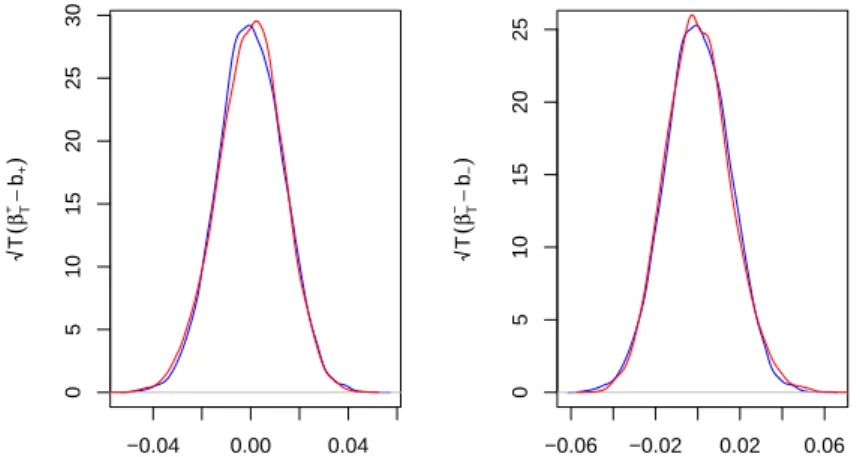
+” in caseN1.−0.04 0.00 0.04 0 5 10 15 20 25 30 (E)[+] T ( βT +− b+ ) −0.06 −0.02 0.02 0.06 0 5 10 15 20 25 (E)[−] T ( βT −− b− )
Figure 1: (E). SDE parameters:
σ
±= 0.01, b
−=
0
.
004
, b
+=
−
0
.
003. Simulation parameters:
T
=
1000
, N
=
100 000. We show both sides (positive and negative) of the estimation, displaying
the density of√
T
(β
T±−
b
±)
. The CLT in Proposition (7) is accurate for largeT
and time stepT /N
small, since the quality of the estimation of the local time is key in this case. The limit behavior is Gaussian.
−0.04 −0.02 0.00 0.02 0.04 0 10 20 30 40 (N1)[+] T ( βT +− b+ ) −0.04 −0.02 0.00 0.02 0.04 0 10 20 30 40 (T0)[+] T ( βT +− b+ ) −0.04 −0.02 0.00 0.02 0.04 0 10 20 30 40 (T1)[+] wrt P+ T ( βT +− b+ ) −0.04 −0.02 0.00 0.02 0.04 0 10 20 30 40 (T1)[−] wrt P− T ( βT −− b− )
Figure 2:(N1)[+],(T0)[+],(T1)[+]w.r.t
P
+,(T1)[−]w.r.tP
−. SDE parameters:σ
±=
0
.
01; in case
N1:
b
−=
0
.
004
, b
+= 0;
in caseT0:b
−=
0
.
004
, b
+=
0
.
006; in case
T1:b
−=
−
0
.
004
, b
+=
0
.
003. Simulation parameters:
T
=
1000
, N
=
1000. We display the density of
√
T
(β
T+−
b
+)
incasesN1andT0. We also show
√
T
(β
T±−
b
±)
in caseT1, but the density is w.r.tP
± (cf. (6)). Thisis approximated computing the estimator on trajectories such that
ξ
T is larger or respectively smallerthan
0
. In all these cases the CLT is Gaussian and we do not need to have a fine discretisation/time grid, since the local time is asymptotically negligible and the quantities which matter in the estimator areξ
T and the occupation times. This accounts of (9)-positive part, (10), (12) and (13).−0.04 −0.02 0.00 0.02 0.04 0 10 20 30 40 50 (N1)[−] T ( 1 4 ) (β T − − b− )
Figure 3: (N1)[−]. SDE parameters:
σ
±= 0.01;
in case N1:b
−=
0
.
004
;
b
+= 0.
Simulationparameters:
T
=
1000
, N
=
100 000. The CLT in (9)-negative part, is accurate for large
T
and time stepT /N
small, since the quality of the estimation of the local time is key in this case. Remark that in this case (null recurrent), the CLT has speed of convergenceT
1/4 and the limit law is not Gaussian. This accounts of (9)-negative part.0.00 0.01 0.02 0.03 0.04 0.05 0 20 40 60 80 (T0)[−] βT − 0.00 0.01 0.02 0.03 0.04 0.05 0 5 10 15 20 25 30 (T1)[+], wrt P− βT + 0.00 0.01 0.02 0.03 0.04 0.05 0 10 20 30 40 50 60 70 (T1)[−], wrt P+ − βT −
Figure 4: (T0)[−], (T1)[+] w.r.t to
P
− and (T1)[−] w.r.t toP
+. SDE parameters:σ
±= 0.01
; incase T0:
b
−=
0
.
004
, b
+=
0
.
003; in case
T1:b
−=
−
0
.
003
, b
+=
0
.
01. In case
T0: simulationparameters:
T
=
20
, N
=
1000. We display the density of
β
T−. In caseT1: simulation parameters:T
=
20
, N
= 3
×10
7. We display the density ofβ
±T w.r.t
P
∓(cf. (6)). This is approximated computingthe estimator on trajectories such that
ξ
T is smaller or respectively larger than0
. In these casesthe estimator is not consistent, so what we show is not actually a CLT but the convergence of the estimators towards the law (22) (cf. results (11), (14), (15)). This convergence is accurate for large
T
but also depends on the time step
T /N
. Moreover, we see that the theoretical distribution ofβ
T− in case T1is almost singular at the origin, and therefore the exact behavior near the origin is hard to catch on simulated trajectories. This can be improved using different kernels (instead of the Gaussian one) in the estimation of the density. This can be easily done with the function “density” inR
. The limit behavior is better approximated whenb
+ andb
− have similar magnitude. We chose here to displaythe case
b
−=
−
0
.
003
;
b
+=
0
.
01
to mention this critical behavior. Anyway, this feature does notreally matter in statistical application, because in this case the estimator not only is not consistent, but does not even guess the correct sign of the parameter. Indeed, we are here in the very critical case of a transient process generated by diverging driftT1.
−0.3 −0.2 −0.1 0.0 0.1 0 5 10 15 20 25 (N0)[+] T βT + −0.1 0.0 0.1 0.2 0.3 0 5 10 15 20 (N0)[−] T βT −

![Figure 2: (N1) [+] , (T0) [+] , (T1) [+] w.r.t P + , (T1) [−] w.r.t P − . SDE parameters: σ ± = 0.01 ; in case N1: b − = 0.004, b + = 0; in case T0: b − = 0.004, b + = 0.006 ; in case T1: b − = −0.004, b + = 0.003](https://thumb-us.123doks.com/thumbv2/123dok_us/431420.2549710/22.892.128.749.134.324/figure-n-t-sde-parameters-case-case-case.webp)
![Figure 4: (T0) [−] , (T1) [+] w.r.t to P − and (T1) [−] w.r.t to P + . SDE parameters: σ ± = 0.01 ; in case T0: b − = 0.004, b + = 0.003 ; in case T1: b − = −0.003, b + = 0.01](https://thumb-us.123doks.com/thumbv2/123dok_us/431420.2549710/23.892.182.721.288.538/figure-t-t-p-sde-parameters-case-case.webp)
