A KNOWLEDGE-BASED FRAMEWORK FOR
INFORMATION EXTRACTION AND
EXPLORATION
ABDULADEM ALJAMEL
School of Science and TechnologyA thesis submitted in partial fulfilment of the requirement of Nottingham Trent University
for the degree of Doctor of Philosophy
I This work is the intellectual property of the author. You may copy up to
5% of this work for private study, or personal, non-commercial research. Any re-use of the information contained within this document should be fully referenced, quoting the author, title, university, degree level and pagination. Queries or requests for any other use, or if a more substantial copy is required, should be directed in the owner of the Intellectual Property Rights.
II I hereby declare that the thesis has been composed by myself and that the work has not be submitted for any other degree or professional qualification. I confirm that the work submitted is my own, except for included work that has formed part of jointly-authored publications. My contribution and those of the other authors to this work have been explicitly indicated below. I confirm that appropriate credit has been given within this thesis where reference has been made to the work of others.
Part of the work in this thesis has been previously published as a full conference research paper. The details are below:
Aljamel, A., Osman, T. and Acampora, G., 2015. Domain-specific Relation Extraction: using distant supervision Machine Learning. In: The 7th International Joint Conference on Knowledge Discovery, Knowledge Engineering and Knowledge Management (IC3K 2015), Lisbon, Portugal, November 12-14, 2015. pp. 92-103. SCITEPRESS.
III
Acknowledgements
First and foremost, I want to thank all of you who made this journey more bearable and even enjoyable sometimes. I never meant to do a PhD, but life is unpredictable and takes you to unexpected places you have never imagined.
I am extremely grateful to my main supervisor and director of study, Dr Taha Osman, for his valuable guidance, scholarly inputs and consistent encouragement I have received throughout the research work. This feat was possible only because of the unconditional support provided by him. He has always made himself available to clarify my doubts despite his busy schedules and I consider it as a great opportunity to do my doctoral programme under his supervision and to learn from his research expertise and understanding. Thank you Taha for all your help and support.
I would also like to extend thanks to my supervisors Dr Giovanni Acampora and Dr Ziqi Zhang and my independent assessor Dr Richard Cant for their advice regarding this research and Dr Autilia Vitiello for her critical review of our journal paper. Also, I would like to express my gratitude to Dr Evtim Peytchev for his generosity of allowing me use his Mac Station for my research experiments.
I believe that intensive courses like PhD are impossible to succeed without the patience and support of a caring family. I owe my loving thanks to my wife, Noha. Without her support, encouragement and understanding, it would have been impossible for me to finish this work. I owe a lot of gratitude to my parents, who encouraged me at every stage of my life, and longed to see this achievement come true. I deeply miss them because they are not with me to share this joy. May God have mercy on their souls. Also, my special gratitude is due to my brothers, sisters and children for their support.
A heartfelt thanks to my fellow doctoral students for their feedback, cooperation and of course friendship; in particular, my friend Hussein Khalil for being part of this long journey. My friend Remi (Ayodeji Remi-Omosowon) deserves special mention for his ideas and informal discussions.
The thesis would not have come to a successful completion without the support I received from NTU staff; specially the staff of Doctoral School, DoctoratePlus Programme, library and in-sessional Academic English Support courses. I take this time to express my gratitude to all of them for their services.
After all, it has been a unique experience and without the people around me, it would not be the same.
IV
List of Acronyms
ANNIE A Nearly-New Information Extraction system3N 3 Notation
API Application Programming Interface
BBB Bundle Branch Block
BNode Blank Node
BORO Business Objects Reference Ontology
CSV Comma-Separated Values
DDM Dividend Discount Model
DL Description Logics
DSS Decision Support System
EA Evolutionary Algorithms
ECG ElectroCardioGram
FIRST large scale inFormation extraction and Integration infRastructure for SupporTing financial decisionmaking
FOAF Friend Of A Friend
FOL First-Order Logic
GA Genetic Algorithm
GATE General Architecture Text Engineering platform
GDP Gross Domestic Product
GUI Graphic User Interface
HC Hill-Climbing algorithm
IDE Integrated Development Environment
IE Information Extraction
IR Information Retrieval
JAPE Java Annotation Patterns Engine JSON JavaScript Object Notation
KB Knowledge Base (or Knowledgebase)
kbfwo Knowledge-based Framework Ontology
KNN K Nearest Neighbour algorithm
LHS Left Hand Side
LOD Linked Open Data
MKNN Mutual K-Nearest Neighbour
ML Machine Learning
N3 Notation3
NASDAQ National Association of Securities Dealers Automated Quotations
NE Named Entity
NER Named Entity Recognition
NLP Natural Language Processing
NYSE New York Stock Exchange
OWA Open World Assumption
OWL Web Ontology Language
PAUM Perceptron Algorithm with Uneven Margins algorithm
POS Part Of Speech
REST Representational State Transfer
V
RDFS Resource Description Framework Schema
RHS Right Hand Side
RMHC Random Mutation Hill-Climbing algorithm ROC Receiving Operator Characteristic
RQ Research Question
RWS Roulette Wheel Selection
S&N Sufficient and Necessary Logic
SA Simulated Annealing algorithm
SBI State Bank of India
SDB SQL triple DataBase
SPARQL SPARQL Protocol And RDF Query Language SQL Structured Query Language
SUS Stochastic Universal Sampling
SVM Support Vector Machines algorithm
SW Semantic Web
SWRL Semantic Web Rule Language
SWT Semantic Web Technology
TDB Triple DataBase
TOVE TOronto Virtual Enterprise ontologies
TSV Tab Separated Values
UI User Interface
URI Uniform Resource Identifier
WB World Bank
W3C World Wide Web Consortium
XBRL eXtensible Business Reporting Language
XML eXtensible Mark-up Language
VI
Abstract
Harnessing insights from the colossal amount of online information requires the computerised processing of unstructured text in order to satisfy the information need of particular applications such as recommender systems and sentiment analysis. The increasing availability of online documents that describe domain-specific information provides an opportunity in employing a knowledge-based approach in extracting information from Web data.
In this thesis, a novel comprehensive knowledge-based framework is proposed to construct and exploit a domain-specific semantic knowledgebase. The proposed framework introduces a methodology for linking several components of different techniques and tools. It focuses on providing reusable and configurable data and application templates, which allow developers to apply it in diversity of domains. The objectives of this framework are: extracting information from unstructured data, constructing a semantic knowledgebase from the extracted information, enriching the resultant semantic knowledgebase by sourcing appropriate semi-structured and structured datasets, and consuming the resultant semantic knowledgebase to facilitate the intelligent exploration and search of information. For the purpose of investigating the challenges of extracting and modelling information in a specific domain, the financial domain was employed as a use-case in the context of a stock investment motivating scenario.
The developed knowledge-based approach exploits the semantic and syntactic characteristics of the problem domain knowledge in implementing a hybrid approach of Rule-based and Machine Learning based relation classification. The rule-based approach is adopted in the Natural Language Processing tasks associated with linguistic and structural features, Named Entity Recognition, instances labelling and feature generation processes. The results of these tasks are used to classify the relations between the named entities by employing the Machine Learning based relation classification. In addition, the domain knowledge is analysed to benefit knowledge modelling by translating the domain key concepts into a formal ontology. This ontology is employed in constructing semantic knowledgebase from unstructured online data of a specific domain, enriching the resulting semantic knowledgebase by sourcing semi-structured and structured online data sources and applying advanced classifications and inference technologies to infer new and interesting facts to improve the decision-making and intelligent exploration activities. However, most relations are non-binary in the problem domain knowledge because of its specific characteristic hence an appropriate N-ary relation patterns technique were adopted and investigated.
VII A serious of a novel experiments were conducted to implement and configure a Machine Learning based relation classification. The experimental evaluation evidenced that the developed knowledge-assisted ML relation classification model, which was further boosted by our implementation of GAs to reduce the feature space, has resulted in significant improvement in the process of relation extraction. The experimental results also indicate that amongst the implemented ML algorithms, SVM exhibited the best relation classification accuracy in the majority of the training datasets, while retaining acceptable levels of accuracy in the rest in the remaining training datasets.
Web Ontology Language (OWL) reasoning and rule-based reasoning on the resultant semantic knowledgebase were applied to derive stock investment specific recommendations. In addition, SPARQL query language was employed to explore the semantic knowledgebase. Moreover, taking into consideration the problem domain’s requirements for modelling non-binary relations, a relation-as-class N-ary relations pattern was implemented, and the reasoning axioms and query language were adjusted to fit the intermediate resources in the N-ary relations requirements.
In this thesis also the experience on addressing the challenges of implementing the proposed knowledge-based framework for constructing and exploiting a semantic knowledgebase were summarised. These challenges can be considered by domain experts and knowledge engineers as a novel methodology for employing the Semantic Web Technologies for the knowledge user to intelligently exploit knowledge in similar problem domains.
The evaluation of knowledge accessibility by utilising Semantic Web Technologies in the developed application includes the ability of data retrieval to obtain either the entire or some portion of the data from the semantic knowledgebase for a particular use-case scenario. Investigating the tasks of reasoning, accessing and querying the semantic knowledgebase evidences that Semantic Web Technologies can perform an accurate and complex knowledge representation to share Knowledge from a diversity of data sources and, improve the decision‑making process and the intelligent exploration of the semantic knowledgebase.
VIII
Table of Contents
Acknowledgements ... III List of Acronyms ... IV Abstract... VI Table of Contents ... VIII List of Figures... XIII List of Tables ... XV
1 Introduction ... 1
1.1 Motivation ... 1
1.2 Domain Knowledge Role in Information Extraction ... 1
1.3 Utilising Semantic Web Technologies in Knowledge Representation and Exploration ... 4
1.3.1 Semantic Web Technologies Languages ... 5
1.3.2 Semantic Web Reasoning ... 11
1.3.3 Knowledge Exploration ... 13 1.4 Problem Statement ... 14 1.5 Proposed Solution ... 14 1.6 Research Questions ... 15 1.7 Research Methodology: ... 17 1.8 Thesis Structure... 18 2 Related Works ... 19 2.1 Introduction ... 19
2.2 Reviewing Literature in Exploiting Semantic Knowledge Bases ... 19
2.3 Reviewing Natural Language pre-processing tools ... 23
2.4 Conclusion ... 26
3 The Proposed Framework for Domain-Specific Information Exploration and Decision-Making ... 27
IX
3.2 The Motivating Scenario ... 28
3.3 Semantic-based Decision Support Systems for Stock Investment ... 29
3.3.1 The Formulation of the Decision-making Problem ... 30
3.3.2 Retrieving the Relevant Data for the Given Problem ... 36
3.3.3 Reasoning on the Semantic Knowledgebase ... 37
3.4 The Framework’s Objectives... 38
3.5 The Framework’s Phases and Tasks ... 39
3.6 Summary ... 41
4 Domain Data Modelling for Bridging the Gap between Data and Knowledge ... 43
4.1 Introduction ... 43
4.2 Identifying the Purpose of the Semantic Model, Ontology Specification Task .... 44
4.2.1 Overview ... 44
4.2.2 The Scope Of Our Ontology ... 45
4.3 Descripting the Concept Map, Ontology Conceptualisation Task ... 48
4.3.1 Overview ... 48
4.3.2 Our Concept Map Implementation ... 49
4.4 Transforming the Conceptual Description into a Formal Model (Ontology), Formalisation Task ... 50
4.4.1 Overview ... 50
4.4.2 Formalising Our Problem Domain Knowledge ... 51
4.5 Non-Binary Relations Problem ... 56
4.5.1 Problem Overview ... 56
4.5.2 Our Approach to Implement an N-ary relation pattern ... 59
4.5.3 Discussion ... 68
4.6 Implementing the Formalised Model, Implementation Task... 69
4.6.1 Overview ... 69
4.6.2 Our Ontology Implementation ... 71
4.6.3 Ontology Maintenance ... 76
4.7 Summary ... 77
5 Linguistic Pre-Processing and Named Entity Recognition for Information Extraction ... 79
X
5.1 Introduction ... 79
5.2 Linguistic Pre-Processing and Recognising Named Entities tools ... 80
5.3 Domain-Specific Information Extraction ... 81
5.4 Retrieving Online Unstructured data and Textual Content Detection ... 82
5.5 Natural Language Pre-Processing Tasks in the Named Entity Recognition Pipeline ... 83
5.5.1 Tokenisation Process Resource ... 85
5.5.2 Gazetteer lists tagging Process Resource ... 86
5.5.3 Sentence Splitter Process Resource ... 88
5.5.4 Part Of Speech (POS) Tagging Process Resource ... 88
5.5.5 Morphological analyser Process Resource... 89
5.5.6 Recognising the Named Entities by using the JAPE transducer ... 89
5.5.7 Co-references resolution Process Resource ... 91
5.5.8 Dependency path tree tagging Process Resource... 92
5.6 Summary ... 94
6 Relation Classification Using a Hybrid of Rule-based and Machine Learning Approaches ... 96
6.1 Introduction ... 96
6.2 Relation Extraction Related Works... 97
6.2.1 Rule-Based Relation Extraction Approach ... 97
6.2.2 Supervised Machine Learning Relation Extraction Based Approach .... 98
6.2.3 Our Relation Extraction Approach ... 101
6.3 Relation Classifiers ... 102
6.3.1 Support Vector Machine (SVM) ... 102
6.3.2 Perceptron Algorithm Uneven Margin (PAUM) ... 102
6.3.3 K-Nearest Neighbour (KNN) ... 103
6.3.4 Classification Implementation methods ... 103
6.4 Relation Detection and Generating the Training Datasets ... 103
6.4.1 Generating training datasets from online structured datasets ... 104
6.4.2 Generating training datasets manually ... 106
6.5 Features Extraction ... 107
XI
6.7 Tuning The Relation Classifiers ... 109
6.7.1 Methods and Techniques to Measure Classifiers’ Evaluation ... 109
6.7.2 Optimising the Relation Classifiers in terms of determined classes imbalance ... 111
6.7.3 Optimising the Relation Classifiers in terms of the probability threshold ... 112
6.8 Relation Classifiers Evaluation Discussion ... 113
7 Feature Selection Optimisation by Using Genetic Algorithms as a Wrapper Approach... 115
7.1 Introduction ... 115
7.2 Feature Selection Background and Related Works ... 115
7.2.1 Features Selection Approaches Evaluation Criteria, Filter and Wrapper Approaches ... 116
7.2.2 Genetic Algorithms as Wrapper approach for optimising feature selection ... 117
7.3 Our Implementation of Genetic Algorithms for Feature Selection ... 118
7.4 The Results of Genetic Algorithms Feature Selection ... 122
7.5 Evaluating the Relation Classification Models by using the Selected Feature subsets ... 124
7.6 Features Category Selection... 126
7.7 Reducing our Genetic Algorithm Search Space ... 128
7.7.1 Grouping Features by their Similarities and Interrelations ... 128
7.7.2 Grouping by Features Frequency ... 129
7.7.3 Evaluation and Discussion ... 130
7.8 A Comparison between Random Mutation Hill-Climbing and Genetic Algorithms ... 132
7.9 Summary ... 136
8 Constructing and Exploiting the Semantic Knowledgebase ... 138
8.1 Introduction ... 138
8.2 Constructing the Semantic Knowledgebase ... 138
8.2.1 Information Extraction Stage ... 140
XII 8.2.3 Enriching the Semantic Knowledgebase by Sourcing Online
Datasets ... 143
8.3 Domain-Specific Data Requirements for the Decision-Making Process... 149
8.4 Exploiting the Semantic Knowledgebase: Decision Support and Information Exploration ... 151
8.4.1 Applying Ontology Reasoning Techniques on the Semantic Knowledgebase ... 152
8.4.2 The User Request Submission Component... 156
8.4.3 The Recommended Decision Production Component ... 157
8.4.4 Exploring the Semantic Knowledgebase Component ... 163
8.5 Summary ... 168
9 Framework Application Requirements ... 170
9.1 Introduction ... 170
9.2 Use-case Scenario’s Questions and the Framework’s Answers ... 171
9.3 The Implementation Phases of the Knowledge-based Framework ... 173
9.4 Semantic Knowledgebase representation: ... 178
9.5 Semantic Knowledgebase Accessibility ... 184
9.6 Semantic Knowledgebase Sources Quality ... 190
9.7 Summary ... 191
10 Conclusions and Future Work ... 193
10.1 Overview of the work ... 193
10.2 Thesis Contributions To Knowledge ... 197
10.3 The PhD Research Limitation and Plans for Further Work ... 201
XIII
List of Figures
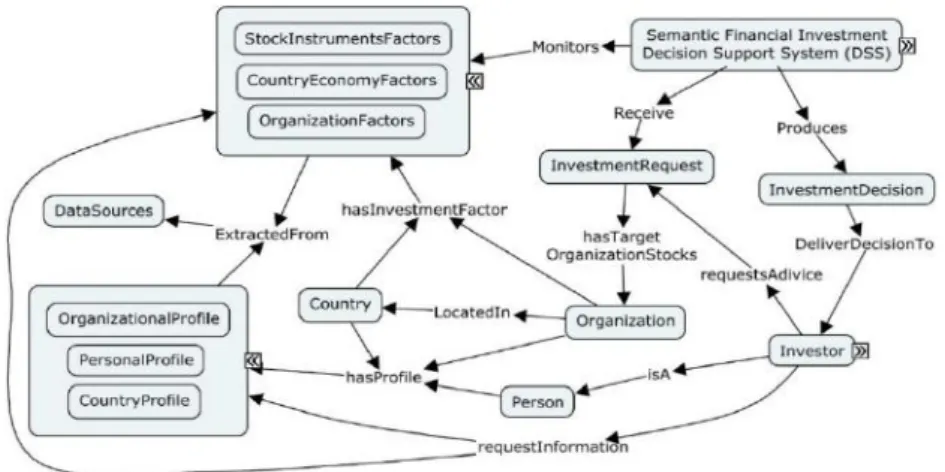
Figure 3.1: The overview of the framework implementation scenario ... 37
Figure 3.2: The Four phases of The General Framework ... 41
Figure 4.1: Ontologies Categorisation ... 45
Figure 4.2: The Concept Map of the Activities of the motivating Scenario... 46
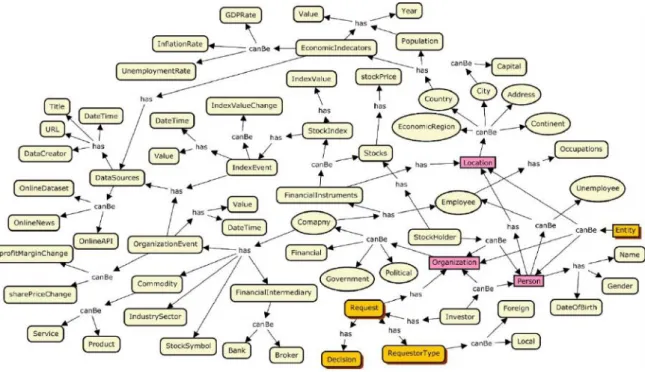
Figure 4.3: The Concept Map of Our targeted Domain-Specific Knowledge ... 50
Figure 4.4: N-ary relation pattern ... 59
Figure 4.5: N-ary Relation Example ... 61
Figure 4.6: Inverse N-ary Relation Example ... 64
Figure 4.7: OWL axioms for N-ary Relations Example ... 66
Figure 4.8: Example of GDP Classes and Relations ... 73
Figure 4.9: Classes and Properties Examples ... 74
Figure 4.10: Ontology Graph ... 75
Figure 4.11: An Example Of Annotation Properties Usage ... 77
Figure 5.1: The content detection of the online news article ... 83
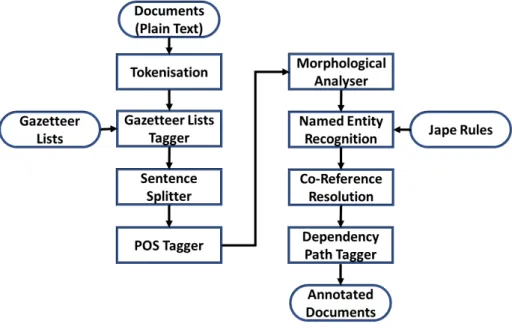
Figure 5.2: Named Entity Recognition and linguistic features generation pipeline ... 85
Figure 5.3: The typed dependency path Example ... 92
Figure 5.4:GATE developer Interface presenting examples of tagged linguistic features and annotated named entities in a document. ... 93
Figure 6.1: SVM model accuracy in terms of the number of non-relevant relation instances(NI) in two entity pairs training datasets, Location-Organization(LO) and StockSymbol-Organization(SO). ... 112
Figure 6.2: Indicates the impact of the probability threshold in the performance of SVM relation classifiers’ models. The threshold peaks are 0.45 for the Person-Organization model and 0.4 for the Person-Organization-Date model. ... 113
Figure 6.3: Examples of the impact of the probability threshold values change on the precision and recall rates by applying SVM, PAUM and KNN classifiers on Person-Organization and Organization-Percent training datasets. ... 114
Figure 7.1: Chromosome features filtering ... 119
XIV Figure 7.3: The Genetic Algorithm Iterations to select the best feature subset for Stock
Index and the percentage increase or decrease training dataset by using
SVM, PAUM and KNN ML algorithms. ... 122
Figure 7.4: Indicates the comparison between SVM relation classifiers’ models when using all features and feature subset selected by GA in Person-Location and StockIndex-Organization training datasets in terms of the best threshold. ... 125
Figure 7.5: Examples of two training datasets to compare the features categories combination to train SVM classifier in terms of F1-measure and the probability threshold. ... 126
Figure 7.6: GA and RMHC Samples Comparison. ... 134
Figure 8.1: The process of Constructing Semantic Knowledgebase Stages ... 140
Figure 8.2: Populated Triples Graph Example ... 143
Figure 8.3: Enriching Triples Example by using Crunchbase dataset ... 145
Figure 8.4:Enriching Triples Example by using Yahoo Finance API... 147
Figure 8.5: Enriching Triples Example by using World Bank Online dataset. ... 149
Figure 8.6: The workflow exploring semantic knowledgebase and the integrated Decision Support System ... 152
Figure 9.1: The tools in each architecture components of the semantic-based Application 177 Figure 9.2: A Company class is a subclass of the Organization class ... 179
Figure 9.3: Classifying the Company’s Events as Positive and Negative Events ... 180
Figure 9.4: The result of checking the consistency of the semantic knowledgebase ... 181
Figure 9.5: The Intermediate Classes and N-ary relation properties in the ontology ... 182
Figure 9.6: An axiom to classify organisations as an employers by using OWL existential restrictions in an ontology (This is a screenshot of Portege) ... 183
Figure 9.7: Example of Fuseki endpoint Interface ... 187
Figure 9.8: Example of SPARQL Query Entering and Executing Intercace ... 188
Figure 9.9: Example of displaying Query results by using Jena API ... 189
Figure 9.10: Example of Query results by using Fuseki endpoint which is presented in JSON presented in JSON format. ... 190
XV
List of Tables
Table 1.1: The Manchester and DL Syntaxes for OWL Class Constructors, Boolean and
Restriction Operators... 10
Table 3.1: Economy Indicators Vlaues Thresholds for Stable Economy ... 31
Table 3.2: The relation between Economy Indicators and Economy Stability ... 32
Table 4.1: Examples of Online news RSS feeds of Unstructured data ... 46
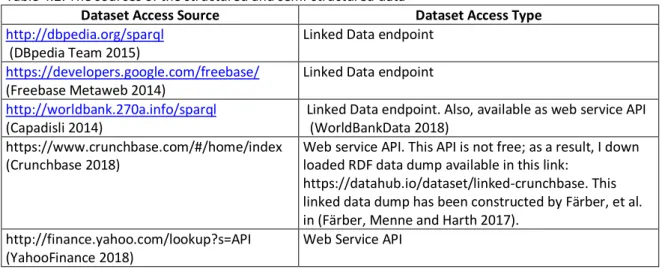
Table 4.2: The sources of the structured and semi-structured data ... 47
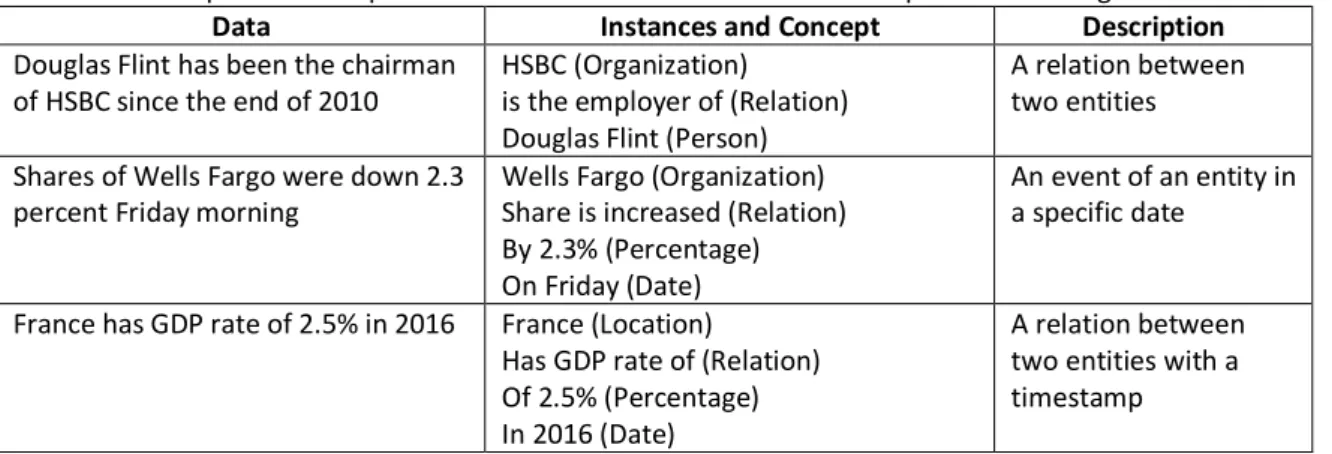
Table 4.3: Examples of concepts and relations that captured from our target domain knowledge ... 47
Table 4.4: Examples of Concepts and Their Interrelations in Our Domain-specific Knowledge ... 48
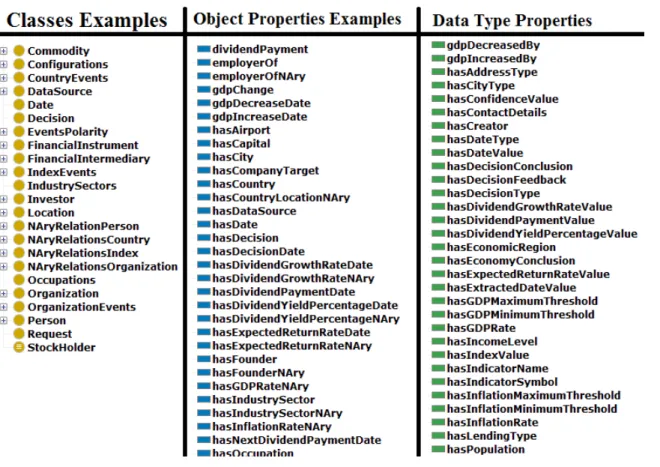
Table 4.5: Categories and Examples of Classes ... 73
Table 4.6: Categories and Examples of Properties ... 73
Table 5.1: Examples of gazetteer lists statistics... 87
Table 5.2: Example of name entry line in the companies' gazetteer list ... 87
Table 5.3: The features associated with the companies' gazetteer list annotation type “Lookup” ... 87
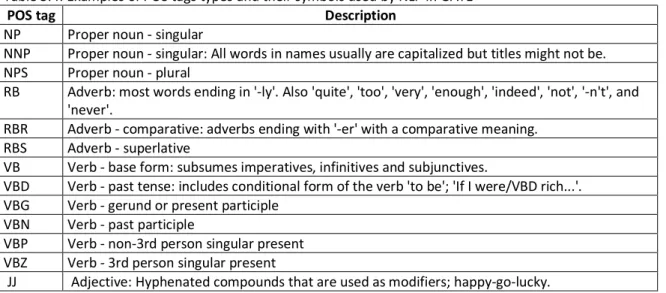
Table 5.4: Examples of POS tags types and their symbols used by NLP in GATE ... 88
Table 5.5: The Precision, Recall and F1-measure results of recognising the targeted named entities by using the adapted ANNIE pipeline ... 91
Table 6.1: The sentences and relation instances number of all pairs ... 104
Table 6.2: The summary of the collected training datasets by using Distant Supervision method (Doc=Documents) ... 106
Table 6.3: The summary of the collected training datasets by using manual method (Doc=Documents) ... 107
Table 6.4: ML Features Vector list ... 107
Table 6.5: The Grid Search Results of optimum ML algorithms Parameters ... 109
Table 6.6: The impact of reducing the number of Negative Relation Instances on ML models accuracy in terms F1-measure for two Automatically Collected Training Datasets ... 111
XVI Table 6.7: The results of 10-fold cross-validation of all training datasets in terms of
Precision, Recall and F1-measure ... 113
Table 7.1: Our implementation of Genetic Algorithms Parameters... 121
Table 7.2: The feature subsets that are selected by using Genetic Algorithms ... 123
Table 7.3: Comparing the Classifiers results in terms of Precision, Recall and F1-measure in all training datasets with the optimised features Vectors by using our implementation of GA (Thr=Probability Threshold) ... 124
Table 7.4: SVM, PAUM and SVM Classifiers with Categorised Features (FC=Features Category, L=Lexical Features, S=Syntactic Features, E=Named Entity Features, Thr=Probability Threshold, P=Precision, R=Recall, F1=F1 score) ... 126
Table 7.5: Comparison between the features categories compilations in SVM, PAUM and KNN classifiers with StockSymbol-Organization and Organization-Date training datasets in terms of F1-measure... 127
Table 7.6: The Gene Representations of Features Groups type 1, 2 and 3 ... 129
Table 7.7: Feature occurrence in the subsets selected by the Genetic Algorithm ... 129
Table 7.8: The Gene Representations of Features Group Type 4... 130
Table 7.9: A comparison between relation classifiers in terms of F1-Measure after applying GA for grouping feature selection (FG=Features Group Number, L=Lexical Features, S=Syntactic Features, E=Named Entity Features, T=Total Features, Thr=Probability Threshold, TDS=Training Datasets) ... 131
Table 7.10: GA and RMHC F1-measure sample runs and their absolute differences ranks 135 Table 8.1: Example of a sentence from RSS Feeds news Article ... 141
Table 8.2: Example of Recognising Named Entities and Extracting Relations Between them ... 141
1
1 Introduction
1.1 Motivation
An increasing amount of data is being made available online. It covers a diversity of specific domains such as entertainment, financial and economy, education, politics, sports and others. I believe that there is an opportunity in extracting specific information from this data to be exploited to inform a variety of applications and services, such as recommender systems to advise financial investors about a potential business risk, sentiment analysis to inform the music industry about an emerging consumer trend or advanced data exploration engines. However, this online data is diverse in terms of volume and complexity, largely unstructured and constructed in natural human languages. This makes the manual exploitation of this data by end users very difficult. Therefore, automated Information Extraction techniques are needed in order to understand the data and extract useful information for the end users. Moreover, automatic Information Extraction can constitute a core component technology in many other Natural Language Processing applications, such as machine translation, question and answering, text summarisation, opinion mining and decision support systems.
I believe that Information Extraction efforts can benefit from the knowledge of problem domain characteristics. Analysing and understanding the domain knowledge to capture its characteristics and features can inform linguistic-based and Machine Learning based Information Extraction techniques to be more accurate in extracting useful knowledge from unstructured data sources.
The extracted information of targeted domain knowledge can be structured and represented in machine understandable semantic model by utilising Semantic-based approaches such as Semantic Web based technologies. The Semantic Web is defined as an extension to the Web where information can be understandable by machines and humans. Semantic Web Technologies present powerful tools to access, use and share information. This presents an opportunity to enrich the semantically structured data by using structured data in public datasets that adopt the same Semantic Web standards. The resultant structured data can be reasoned upon to deliver intelligent query methods against the information and the underlying metadata.
1.2 Domain Knowledge Role in Information Extraction
Applying Information Extraction techniques on unstructured data aims to represent the extracted information in a structured view. Information Extraction could be considered as a
2 pipeline process. In each stage of that pipeline, the tasks of Natural Language Processing are applied in order to obtain valuable information from natural language texts. An Information Extraction process usually starts in recognising the named entities; then, identifying identity relations between named entities, which is known as co-references resolution. Lastly, extracting the relation between the named entities in a certain event (Cunningham 2005, Farmakiotou, et al. 2000).
In Named Entity Recognition task, the sentence’s atomic elements (words or entities) are addressed and classified into predefined types of named entities, such as organisations, place names, persons, dates and numbers. By applying Named Entity Recognition, additional descriptive information can be extracted from the text about the detected entities such as the title and gender of persons. In the entities’ co-reference resolution task, the expressions in a document that refer to the same entity are identified. The co-reference relation will be marked between elements. In the Relation Extraction task, the relationships between the named entities are identified. If more than one relation are extracted and linked together, these relations comprise an event. Event extraction refers to the task of identifying events in unstructured data, which involves extracting several entities and their interrelations; for example, the location and date of opening a branch of a company (Piskorski and Yangarber 2013, Karkaletsis, et al. 2011). Usually, these entities and their interrelations are identified in accordance to the characteristics of the problem domain knowledge. I believe that domain knowledge is important for guiding Information Extraction from unstructured data.
What is domain knowledge?
Domain Knowledge is a knowledge about a specific field/domain of interest or subject that are understood by practitioners in that field/domain of expertise. In fact, domain-specific knowledge is required to identify specific Information Extraction tasks. It requires to be analysed to understand its characteristics. These characteristics could be about the grammar and the meaning of words in the context of a sentence structure or style of the language of the domain. It is crucial to comprehend these characteristics to be engineered in linguistic or structural features. These features should use the relevant knowledge of the problem domain to reflect its characteristics. Once the analysis of the knowledge of the problem domain is performed to understand its characteristics, it can be employed in the implementation of Information Extraction systems by using multiple Information Extraction approaches such as rule-based or Machine Learning based (Gao and Zhang 2003, Song and Roth 2017).
Identifying the relevant domain knowledge is about capturing the key and relevant domain concepts and the relationships between these domain concepts. This includes the common-sense knowledge, which refers to general knowledge of the problem domain. The role of relevant and common-sense knowledge of the domains are important in relating
3 different concepts, arguments, facts, and events to create an inference model and employing semantic relations between concepts to decode information hidden in texts. Furthermore, this relevant knowledge is useful in classifying the entities and their interrelations according to the engineered linguistic and structural features and the captured key concepts of the problem domain. It is also effective for addressing a clear definition of decision-making problems to be modelled and supported by using rule-based reasoning techniques. The captured key concepts, vocabularies and interrelations in the targeted domain knowledge should cover all the data involved in the Information Extraction tasks (Gao and Zhang 2003, Song and Roth 2017, Chen, Yin and Pang 2017).
Knowledge-based approaches originate from understanding the syntactic and semantic characteristics of the domain knowledge to be formalised into semantic model or metadata. Then, discovering and mapping the entities in data onto elements of metadata. For example, the concepts “Organization” and “Person” can be separated from the entities “Apple”, “Tim Cook”, “Satya Nadella” and “Microsoft”. The domain knowledge can be modelled by using the key concepts “Organization” and “Person” including the relation between them. In addition, the entities and their interrelation can be classified according to domain knowledge model and the related features engineering. As a result, “Tim Cook” and “Satya Nadella” will be classified to belong to “Person” concept and “Apple” and ”Microsoft” will be classified to belong to “Organization” concept. In fact, domain-specific knowledge can be modelled and clearly separated from other components of the Information Extraction tasks to be adapted to other domains (Gao and Zhang 2003, Song and Roth 2017). There are several external domain knowledge resources that comprise lexicons and ground facts. Building lexicons includes collecting the most relevant domain terms and entities and their synonyms. They are large dictionaries of person names, location names, temporal expressions and others. These are often referred to as gazetteer lists. These gazetteers are used for different tasks such as recognising the Named Entities. The ground facts represent structured information of the relation between entities which can be used as reference knowledge for other tasks such as slot filling and relation extraction. The opportunity of adopting knowledge-based approach for Information Extraction and Knowledge Representation derived from the common sources of these external domain knowledge resources, which are gazetteers and ground facts. These resources adopt the same Semantic Web standards and available in the Linked Open Datasets (LOD) such as DBPedia and Freebase1 (Mendes, Jakob and Bizer 2012, Weikum and Theobald 2010,
DBpedia Team 2015, Freebase Metaweb 2014, LOD 2018).
Understanding domain knowledge in knowledge-based approaches aides Information Extraction process and knowledge representation activities such as reasoning about objects
1 https://developers.google.com/freebase/. This page provides access to the last available data dump. I downloaded its last
data dump and mainly used Freebase data as a distant source for constructing ML training datasets. The original Freebase API was completely shut-down on 31 August 2016.
4 related to that domain. The next section presents one of the knowledge representation approaches that is based on Semantic Web Technologies.
1.3 Utilising Semantic Web Technologies in Knowledge
Representation and Exploration
Knowledge representation approaches aim to represent knowledge that can be reasoned upon and interpreted and explored by machines. Semantic knowledge-based applications should have a computational model for the targeted domain of interest, to represent part of the real world such as physical objects, relationships or events to be understandable and processable by machines. Semantic knowledge bases store the symbols of the computational model of the domain in statement form for machines to perform reasoning. The reasoning procedures aim to derive implicit statements from a given knowledgebase or check the consistency of a particular entailed statement in the knowledgebase (Grimm, Hitzler and Abecker 2007). Knowledge representation approaches represent knowledge in machine understandable semantic model by utilising approaches of semantic-based technologies such as Semantic Web Technologies.
Semantic Web Technologies are based on different forms of knowledge representation, which are semantic networks, rules and logic. A semantic network is a graph whose nodes represent concepts and whose arcs represent relations between these concepts. They provide a structural representation of statements about a domain of interest. Rules reflect the notion of consequence. They allow the expression of various kinds of complex statements. Logic, on the other hand, has been used by semantic networks and rules to be precisely semantically formalised. Without such precise formalisation, they will be uncertain for computational inferencing purposes (Grimm, Hitzler and Abecker 2007).
First-order predicate logic is an important knowledge representation formalism because all current symbolic knowledge representation formalisms can be understood in their relation to first-order logic. It also provides a notion of universal truth, in the sense that a logical statement can be universally valid truth regardless of any preconditions. Description Logics (DL), on the other hand, is a field of research that has studied a particular decidable fragment of First Order Logic. It is expressive enough such that they have become a major knowledge representation paradigm, in particular; for use within Semantic Web Technologies (Grimm, Hitzler and Abecker 2007).
The Semantic Web offers a powerful logical and standardised technologies to represent, share and process knowledge such as inference and validation. It is based mainly on graph theory and Description Logics. One of the core components of Semantic Web is ontology.
5 Ontology is a formal explicit description of the targeted domain knowledge and it plays a key role in Semantic Web knowledge representation. It is recommended that separating data from metadata or ontology because it provides robustness, scalability, and efficiency for the semantic knowledgebase storage system (Davies, Studer and Warren 2006, Grimm, Hitzler and Abecker 2007, Taye 2010, Hebeler, et al. 2011).
The formalisation of semantic knowledge bases by using ontology could include multiple axioms, definitions, rules, facts, statements, and any other primitives. The main components of the ontology are concepts, relations, instances and axioms and can be characterised in 4-tuple formula below (Davies, Studer and Warren 2006, Grimm, Hitzler and Abecker 2007):
𝑂 = 〈𝐶, 𝑅, 𝐼, 𝐴〉 Where:
O is the ontology.
C is a set of classes representing concepts that are relevant in the domain of interest. They are mapped to the generic nodes in semantic networks, or to unary predicates in logic, or to concepts as in Description Logics.
R is a set of relations that semantically connect concepts and instances to specify their interrelations. They are mapped to arcs in semantic networks, or to binary predicates in logic, or to roles in Description Logics.
I is a set of instances that represent the named and inferred individuals. They can be linked to each other by relations which are classified by concepts or axioms. They are mapped to individual nodes in semantic networks or to constraints in logic.
A is a set of axioms that are used to apply constraints on the properties of the concepts and individuals. Axioms are expressed in logic.
Knowledge representation by using ontology in Semantic Web Technologies should be performed by employing formalised Semantic Web languages. The main requirements of these languages are: well defined syntax, efficient reasoning support, a formal semantics, sufficient expressive power and convenience of expression (Ameen, Khan and Rani 2014a). The next subsections presents an overview for these languages and their reasoning support.
1.3.1 Semantic Web Technologies Languages
In the Semantic Web context, ontology is modelled by utilising Semantic Web Technologies Languages. They are: Resource Description Framework (RDF), RDF Schema (RDFS) and Web Ontology Language (OWL). The specifications of these languages are standardised
6 and recommended by the World Wide Web Consortium (W3C) (W3C 2018). Brief details of these languages are presented below.
1.3.1.1 Resource Description Framework (RDF)
RDF is a graph-based language that allows data within a domain to be linked through named relationships. It is a simple triple structure and a natural method that extends the current data of WEB into a highly structured model to assist machines to describe processed data. In RDF standards, RDF triples are encoded as a set of nodes, subject, predicate and object. These nodes could be resources that are identified by URI references, literals that denote values such as numbers or strings and blank nodes that represent unnamed or anonymous resources that are not assigned URI references. The subject of an RDF triple may be a URI reference or a blank node, the predicate must be a URI reference, and the object may be of all three kinds (URI references, literals, blank nodes). When combined together, RDF triples form a direct, labelled graph. Subjects and objects of RDF triples become nodes in an RDF graph, and predicates become arcs connecting them. URI is stand for Uniform Resource Identifier. By URIs, resources are uniquely identified throughout the web, which allows for a decentralised organisation of knowledge about commonly referenced resources. The resource URI names can be partitioned into URI namespaces and entity names. The semantic statement can be modelled by using RDF triple based on an ontology (Lord 2010, Taye 2010, Cao, et al. 2012, Henson 2013, Grimm, Hitzler and Abecker 2007).
If several triples are linked to each other, they form an RDF graph. The graph’s nodes are URI resources and the arcs are properties. From a knowledge representation view, an RDF graph can be seen as a semantic network. The triples in an RDF graph can originate from different dataset sources with the idea that anybody can state anything about any resource. In this sense, RDF is designed to capture knowledge and meta data that is spread over the web (Lord 2010, Taye 2010, Cao, et al. 2012, Henson 2013, Grimm, Hitzler and Abecker 2007). However, RDF graphs can use blank nodes, which are not assigned URI references. Next subsection will introduce the blank nodes in details.
Blank Nodes
As aforementioned, blank nodes represent unnamed resources in RDF triples that are not assigned URI references. Also, the subject nodes in the RDF triples can be a URI resource or blank node and the object node can be a URI resource, literal or blank node. In the Semantic Web contexts, blank nodes are also known as anonymous resources or bnode. According to RDF standards, blank nodes are utilised to express the existence of a particular thing without using an URI to identify it (Tzitzikas, Lantzaki and Zeginis 2012, Chen, et al. 2012).
7 In fact, blank nodes are one of the core aspect of Semantic Web technology. They are included in several W3C standards and tools. Also, they are heavily used in several Linked datasets across the Web. However, blank nodes are not always utilised with the same meaning or propose. For example, some publishers use them to describe multi-component structures or represent complex attributes without having to name explicitly the auxiliary node or offer protection of the inner sensitive information of the customers from the browsers (Lantzaki, et al. 2014, Hogan, et al. 2014).
Although blank nodes bring some facilities for expressing the information of the resources and the relationships between them in a semantic knowledgebase, they also bring some troubles to manage and process that knowledgebase. There have been several studies in literature reported the negative impact of blank nodes on the representation of Semantic Web data. They have examined the relationship between the usefulness of datasets and the quantity of blank nodes in them. They have found that the datasets are more useful when the quantity of blank nodes in them is at a minimum. The authors Heath, et al. in (Heath and Bizer 2011), Chen, et al. in (Chen, et al. 2012), Tzitzikas, et al. in (Tzitzikas, Lantzaki and Zeginis 2012), Mallea, et al. in (Mallea, et al. 2011), Hogan, et al. in (Hogan, et al. 2014), Lantzaki, et al. in (Lantzaki, et al. 2014) and Booth in (Booth 2013) have revealed that the blank nodes bring some issues to manage and process knowledge bases. These problems can be summarised into the following four aspects:
1- The problem of merging RDF graphs. Because the scope of blank nodes is limited to the dataset, it is impossible to create external links to their triples. This will reduce the potential interlinking between different Linked Data sources. Consequently, merging data from different datasets becomes very difficult as there is no URI reference to identify the blank node.
2- The problem of RDF graph serialisation. There is no guarantee that the syntactic elements or labels which are generated to identify blank node identifiers in one RDF graph representation format, that the same label will be generated for a given blank node each time the graph is serialised. There is no standard, reliable way to reference a blank node across graph serialisations.
3- The problem of SPARQL queries. In RDF semantics, blank nodes are considered as the variables. On the other hand, blank nodes are considered as constant symbols in SPARQL semantics. This causes an inconsistency between the RDF and SPARQL semantics when using blank nodes. Applying a SPARQL query on an RDF data with blank nodes will produce infinitely many redundant solutions for many patterns. As a result, deleting the redundant blank nodes in the original graph and restricting some entailments evaluation about blank nodes will reduce the inconsistency of SPARQL query semantics.
8 4- The problem of publishing Linked Data. The core principle of Semantic Web is that (http://) type URI references should be used for RDF resources. It can be used by Semantic Web agents to link between a diversity of datasets finding more information. The datasets linkages will be broken with the external data at the points of the blank nodes. This will bring many troubles in data query and mining. Eliminatuing the blank nodes in the RDF graph is an important pre-process before it can be published on the Web.
According to Hogan, et al. in (Hogan, et al. 2014), there are huge number of standards and tools and a large volume of published data available and utilise blank nodes. This will make any change to the core semantics of blank nodes incur a huge cost at this stage. Even if the core semantics could be conveniently changed, it is not clear what a better alternative would be. In fact, the RDF 1.1 Working Group (W3C 2018)has decided not to change the core semantics of blank nodes; Instead, they discourage the use of blank nodes and all resources should be named using URI references; for example, the implementers of Friend Of A Friend (FOAF) vocabulary specifications has dropped blank nodes in favour of URI references.
1.3.1.2 Resource Description Framework Schema (RDFS)
RDFS is a general-purpose language for representing simple RDF vocabularies on the Web. It facilitates the specification of application-specific ontological vocabularies in form of class and property hierarchies on top of RDF resources. RDFS Language can be used to express the class membership and subsumption between classes. For this purpose, it defines a set of reserved keywords that can be used in RDF triples to relate resources to classes. RDFS defines a system of typing for RDF resources by introducing the concept of a class. The reserved predicate (rdf:type) is used to indicate class membership or defining a resource to be of a certain type. RDFS classes are organised in a hierarchy of types for RDF resources. The reserved predicate (rdfs:subClassOf) is used to state that there is a subclass relationship between two types of classes. In RDF(S) semantics, any resource used in the predicate position of an RDF triple is a member of the class (rdfs:Property). In addition, properties can be organised in a hierarchy by means of the keyword (rdfs:subPropertyOf) (Lord 2010, Taye 2010, Cao, et al. 2012, Henson 2013, Grimm, Hitzler and Abecker 2007). The RDF(S) vocabularies for typing the resources allow the formulation of subsumption hierarchies and the distinction between instances and concepts in the ontological sense. However, in RDF(S) there is no clear separation between classes and their members. Instead, RDF(S) allows self-reference and classes being members of (meta) classes. Any resource can be tagged as a class by relating it to the predefined meta type (rdfs:Class). The domain and range of the properties can be defined with the predefined predicates (rdfs:domain) and (rdfs:range) (Lord 2010, Taye 2010, Cao, et al. 2012, Henson 2013, Grimm, Hitzler and Abecker 2007).
9
1.3.1.3 Web Ontology Language (OWL)
The OWL provides an expressive language for defining ontologies that capture the semantics of domain knowledge. It is built on top of RDFS and adds a logical formalism to the language. W3C standardisation efforts have produced the OWL family of languages for describing ontologies in the Semantic Web, which comes in different expressiveness capability and each emphasising on different language features: OWL-Full, OWL-DL, and OWL-Lite. OWL-Full is the most expressive language; meanwhile, emphasises on compatibility with RDFS. However, it introduces problems of computational tractability and un-decidability. OWL DL is a subset of OWL-Full and based on Description Logics (DL). To maintain its decidability, it is compatible only with a specific subset of RDFS language. OWL-Lite is subset of OWL-DL and it offers a limited feature set even though it is adequate for many applications. In fact, it is relatively efficient computationally. OWL-DL is currently the most prominent Semantic Web ontology language following the Description Logics paradigm and has desirable computational properties for reasoning systems (Hoekstra 2009, Grimm, Hitzler and Abecker 2007).
OWL facilitates the machine interpretability of Web contents more than that supported by RDF and RDFS. It is designed to be utilised by applications that require processing the content of information rather than solely presenting it to humans. OWL provides additional vocabulary along with a formal semantics. For example, it allows the expressing of individuals equality (owl:sameAs), the expressing of equivalent or disjoint classed and properties (owl:equivalentClass, owl:equivalentProperty, owl:disjointWith, owl:propertyDisjointWith), or the expressing of distinguishing between resource and literal values properties, owl:DatatypeProperty and owl:ObjectProperty (Polleres, et al. 2013, Roussey, et al. 2011, Tomai and Spanaki 2005).
In addition, OWL can describe complex class by using Boolean operators and restriction constructors. Each Boolean operator takes one or more classes as operands. These classes may be named classes, or may be complex classes formed from other constructors’ or operators’ descriptions. The examples of these Boolean operators are owl:unionOf, owl:intersectionOf and owl:complementOf.
Restriction constructors allow describing the individuals of restricted classes in terms of constraints on relationships that those individuals participate in, using specific relation properties with individuals in specific classes. Restrictions consist of three parts:
1- Quantifier. They are value restrictions and cardinality restrictions. OWL provides three kinds of value restrictions, they are existential (owl:someValuesFrom), universal (owl:allValuesFrom) or limited existential (owl:hasValue) value restrictions and provides three kinds of cardinality restrictions, they could be maximum
10 (owl:maxCardinality), minimum (owl:minCardinality), or exact (owl:cardinality) cardinality restrictions.
2- Property. That specifies what property is to be used in the definition of the restriction class. It is defined by the OWL keyword (owl:onProperty).
3- Filler. That specifies the class of individuals which are used to restrict the individuals of the restricted class.
Restrictions can be defined by using the OWL class owl:Restriction. Then, the description is used to define a new anonymous restricted class and it becomes an existing class. This restricted class is a special kind of class that has individual members, which is similar to named class. Each kind of restrictions describes how the restricted class is constrained by the possible asserted values of properties. Membership in a restricted class must satisfy the conditions specified by the kind of restriction and the property specification. In general, Boolean operators and restrictions can be nested or ordered to describe a restricted class (Allemang and Hendler 2011). However, some kinds of restrictions cannot be used to define the restricted class. It is because of the Open World Assumption (OWA). In OWA, universal restrictions cannot be used for identification using equivalence axioms because there is no way to know whether the individual has additional properties of that type or not. In addition, the existential restriction does not constrain the property relationship to members of the restricted class, it just states that every individual must have at least one property relationship with a member of the named class.
The Semantic Web standards syntaxes of writing OWL are RDF/XML and Turtle; however, they are verbose and very hard to read. There is a syntax standard for writing OWL that is used in formal documents and designed to be presented for human reading, it is the Manchester syntax(W3C 2018). It is a text based and more human friendly syntax. For example, Manchester syntax allows strings, integers, decimals, and floats to be written as in most programming languages (Horridge, et al. 2006, Horrocks and Patel-Schneider 2011).
To enhance human readability of the OWL examples in this thesis, Manchester syntax will be used in the remainder of this thesis. However, Description Logics (DL) style or Turtle syntax will be used if they are needed. Table 1.1 below shows the Manchester and Description Logics (DL) syntaxes for OWL Class constructors, Boolean and restriction operators.
Table 1.1: The Manchester and DL Syntaxes for OWL Class Constructors, Boolean and Restriction Operators
OWL Constructor DL Syntax Manchester Syntax Example
intersectionOf C Ç D C and D Employee and StockHolder
unionOf C È D C or D Person or Organization
complementOf ¬C not C not StockHolder
11
someValuesFrom $R.C R some C hasStock some Person
allValuesFrom "R.C R only C hasStock only Organization
minCardinality ³n R R min n EmployerOf min 50
maxCardinality £n R R max n EmployerOf max 300
cardinality =n R R exactly n EmployerOf exactly 3
hasValue $R {a} R value a hasProduct value DeskTop
1.3.2 Semantic Web Reasoning
Not only do OWL ontologies allow extensive knowledge expressivity through facts representation, but they also infer new facts from existing facts by reasoning process through the use of their meta-data. A reasoning process can be applied on a semantic knowledgebase to solve problems and make decisions that would otherwise require considerable expertise effort and time; especially, if this knowledge has to be effectively used for reasoning as a part of Decision Support Systems (DSS). Ontologies in these systems should be designed in a way that allows knowledge inference and reasoning (Corsar and Sleeman 2008, Jovic, Prcela and Gamberger 2007, Isiaq and Osman 2014). Reasoner makes it possible to automatically compute the class hierarchy specifically when constructing very large ontologies. It is very difficult to keep large ontologies in a maintainable and logically correct state without reasoners. It is recommended to construct the class hierarchy as a simple tree when the ontology has classes that have many super-classes. In fact, computing and maintaining multiple inheritance is the reasoner responsibility. Not only does this promote the reuse of the ontology by other ontologies and applications, it also minimises human errors that are inherent in maintaining a multiple inheritance hierarchy (Goncalves, et al. 2015).
There are two categories of reasoning in Semantic Web context, Ontology OWL reasoning and user-defined rule-based reasoning. Below is an explanation for those two categories.
1.3.2.1 OWL reasoning:
In OWL reasoning, there are many tasks the correspond to standard Description Logics reasoning tasks such as checking the semantic knowledge consistency with respect to the ontology or determine whether individuals in knowledgebase do not violate descriptions and axioms described by ontology. However, there are more tasks can be achieved by reasoning process such as (Bock, et al. 2008):
1- Checking the satisfiability of a concept by determining whether a description of the concept is not contradictory or whether an individual can exist that would be an instance of the concept.
2- Checking the concepts’ subsumption by determining whether concept C subsumes concept D or whether the description of a class C is more general than the description of D.
12 3- Checking whether the individual is an instance of a concept without violating the
descriptions of the concept.
4- Individuals classification by retrieving a property fillers according to some constraints on relationships between individuals’ classes.
1.3.2.2 Rule-based reasoning:
Since OWL axioms and class expressions are variable-free and modelling constructs of OWL are not always adequate, there are statements that may not be expressed simply in OWL and OWL may not suffice for all applications. Thus, rules can be an alternative paradigm for a reasoning process (Hitzler, Krotzsch and Rudolph 2009).
Rules in the Semantic Web are typically conditional statements, if-then clauses. By using these clauses, a new knowledge is added only if a particular set of statements is true. These clauses contain logical functions and operations that can be expressed in rule languages or formats. Not only do rule languages allow describing relations that cannot be described using OWL language, but also they allow sharing and reusing existing rules on the Web. Rule-based reasoning can benefit from the rule language, which permits data interoperation between different reasoners. Requirements of rule language for the Semantic Web include expressiveness, rule interchange, rule integration, rule language interoperability, and compatibility with other Semantic Web standards (Buranarach, et al. 2016).
Rule-based reasoners apply rules with data to reason and derive new facts. When the data match the rules’ conditions, the reasoners can modify the knowledgebase; for example, for fact assertion or retraction, or to execute functions. It is good practice to construct rules from concepts included in the ontology. In this way ontology design is the first and necessary step in the actionable knowledge construction process. The rules can be used for reasoning as a part of a Decision Support Systems (DSS) or they may be used together with the concepts presented in the ontology (Wang, et al. 2004, Jovic, Prcela and Gamberger 2007, Hebeler, et al. 2011, Rattanasawad, et al. 2014).
There are three reasoning strategies or algorithms applied by rule-based reasoner to perform reasoning tasks, Forward chaining, Backward chaining, and a hybrid execution model (Hebeler, et al. 2011, Al-Ajlan 2015, Buranarach, et al. 2016):
1- Forward chaining is a bottom-up computational model. It starts with a set of known facts and applies rules to generate new facts whose premises match the known facts. The inference moves forward from the facts toward the goal.
2- Backward-chaining is a top-down computational model. It starts with a goal and looks for rules to support this goal. The inference moves backward from the intended goal to determine facts that would satisfy that goal.
3- A hybrid execution rule reasoning process performs reasoning by combining both forward and backward chaining. Rules present the form that can be effectively used in order to present actionable knowledge.
13 User-defined rule-based reasoning is a flexible reasoning mechanism through the creation of user-defined reasoning rules within the entailment of First Order logic. There are several Rule languages designed for the Semantic Web. Some of them are introduced by W3C such as Semantic Web Rule Language (SWRL) and others are introduced by different inference engines such as the Jena rule format. Each rule language usually differently supports various logic concepts, and functions (Buranarach, et al. 2016).
SWRL was introduced by W3C (W3C 2018). It is based on combination of the sublanguages of OWL, OWL-DL and OWL-Lite, with Unary/Binary Datalog RuleML, the sublanguage of RuleML. SWRL extends the set of OWL axioms to enable rules to be combined with an OWL knowledge base. The syntax of the rule language is relatively like RuleML. They can also interoperate with each other. Logical operators and quantifications supports of SWRL are the same as RuleML's. In addition, RuleML contents can be parts of SWRL content. Axioms may consist of RDF, OWL and rule axioms. A relation can be an URI, a data range, an OWL property or a built-in relation. An object can be a variable, an individual, a literal value or a blank node. Additionally, the rule language provides many sets of built-in functions such as string functions and mathematical functions (Hebeler, et al. 2011, Buranarach, et al. 2016).
The Jena rule format is used only by reasoning engines in the Jena framework (JENA Apache 2015). The rule language syntax is based on RDF(S) and uses the triple representation of RDF descriptions, which is almost like Notation3 (N3) (W3C 2018) except that a rule name can be specified in a rule, no formula notation, and built-in functions are written in function terms. The built-in functions consists of many set of functions including production functions such as instance creation and instance removing, and can also be extended by the user.
The SWRL rules are part of OWL ontology. The OWL ontology with the SWRL rules are bound to the rules reasoner engine together to execute the rules. On the other hand, the Jena rules and OWL ontology are bound to rules reasoner engine separately, then, the rules are executed.
1.3.3 Knowledge Exploration
Knowledge exploration is about how typical or regular end users can access semantic knowledge and how user interfaces hide the complexity of query languages for those end users; meanwhile, those users take advantage of using exploration and visualisation techniques. There are efforts have been made to facilitate user interaction with the semantic knowledge to assist users to learn and make sense of complex and heterogeneous data and to allow them benefit from the expressivity of Semantic Web standards and languages. Semantic Web Technologies could be utilised in exploring semantic knowledgebase by applying different methods such as keyword search, faceted browsing and auto-translation natural language queries to standard query languages. These methods should support
end-14 users in situations where the knowledge has complex elements that require constant user interpretation during the exploration process. For example, how to support the end users’ search task when they are not familiar with the search domain or they do not have sufficient knowledge about domain to make a query. These kinds of tasks are required in the exploration of the semantic knowledgebase where end users need to identify concepts and relations from the semantic model to learn about the domain in order to understand and acquire knowledge. In addition, these methods should fulfil the tasks of exploring the semantic knowledge by end users and visualise the result of the exploration task in a human understandable format (Thakker, Yang-Turner and Despotakis 2016, Fafalios and Tzitzikas 2013).
1.4 Problem Statement
As the online documents are largely unstructured and constructed in natural human languages, they require applying of automatic techniques to extract useful information from them. This data can have more value when it is formalised in a machine understandable format. In addition, it is challenging to align the discrepancies in knowledge presentation by various contributing information sources and deliver intelligent query methods against that information and its semantic model.
However, extracting information from unstructured data and transferring it into a structured format to be processed by machines for different use-case scenarios is an important problem because it requires addressing and overcoming different challenges. These challenges cover a diversity of disciplines, approaches, tools and techniques, which include automatically extracting information from unstructured data, semantically representing domain knowledge, constructing semantic knowledge from different data sources and consuming the resultant semantic knowledgebase by intelligently exploring it and supporting the decision making process. It is challenging, also, to combine these disciplines, approaches, tools and techniques in one framework to allow the application developers emphasising their efforts on domain problems.
1.5 Proposed Solution
Knowledge-based approach is based on understanding the syntactic and semantic characteristics of domain knowledge. These characteristics can play an important role in improving Information Extraction processing tasks. Moreover, knowledge-based approaches refer to the ability to represent and process knowledge within a domain-specific problem. There is opportunity in employing a knowledge-based approach in extracting information from Web data and process it because there are increasingly online documents that describe information concerning a specific domain; for example, in politics or stock exchange news; actually, the data sources of these documents exclusively service a
15 particular domain. The domain specificity of these documents offers an excellent opportunity for analysing their domain knowledge to be formally characterised by capturing its attributes, linguistic features, semantic features, functions, dynamics, terminologies, concepts and relations.
I also hypothesise that utilising Semantic Web Technologies for domain knowledge representation can result in a highly structured knowledge model (ontology) that enables software agents to comprehend domain-related information, and thus assist in automating the extraction of concepts and relations of relevance to the domain-of-interest. The ontology can also facilitate the inference of new facts from the extracted information to support decision-making and knowledge exploration activities.
The financial domain will be employed as a use-case to investigate extracting information from that domain, modelling the patterns in the extracting information into a semantic model, constructing a semantic knowledgebase and exploiting the knowledgebase to support decision-making process and the intelligent exploration.
To conclude, I will approach my proposed solution of this problem through designing and implementing a framework for developing knowledge-based applications. The framework will adopt a knowledge-based approach to aid the Information Extraction process from the problem domain, its knowledge representation activities and intelligent exploration of the resulting knowledgebase. It will be established by modelling the domain knowledge, extracting information from unstructured data, constructing the semantic knowledgebase, enriching the semantic knowledgebase and lastly exploiting the resulting semantic Knowledgebase by intelligently exploring and processing it to support the decision making. The proposed framework will present a methodology for integrating several components of different techniques and approaches such as Information Extraction, Machine Learning, Evolutionary Algorithms and Knowledge representation.
1.6 Research Questions
As aforementioned, knowledge-based approaches are based on understanding the problem domain knowledge; as a result, this thesis is based on the following hypothesis:
“Adopting a knowledge-based approach will aid the Information Extraction process from the problem domain, its knowledge representation activities and intelligent exploration of the resulting knowledgebase.”
It is worth pointing out that this hypothesis is investigated in the context of developing a framework for the realisation of a domain-specific intelligent exploration. Where stock investment decision-making is selected as a use-case scenario. The investigation, which is
16 based on the hypothesis above, provides a set of research questions (RQ) in order to fulfil the implementation of the proposed framework. These questions are:
RQ1) Knowledge-based approach is based on analysing domain knowledge to understand its characteristics (the linguistic features and structural features). How can Information Extraction and knowledge representation benefit from this knowledge-based approach? RQ2) Supervised Machine Learning algorithms is one of the approaches that are applied for Relation classification. The performance of supervised Machine Learning algorithms is affected by the quality of the training datasets, the quality of features vectors and the parameter values. Consequently, how can these elements be configured and optimised in a relation classification problem?
RQ3) As our intention is to exploit knowledge of the problem domain in the Infor