Department of Agriculture Forest Service Rocky Mountain Research Station General Technical Report RMRS-GTR-175 September 2006
The LANDFIRE
Prototype Project:
Nationally Consistent and Locally
Relevant Geospatial Data for
The use of trade or firm names in this publication is for reader information and does not imply endorsement by the U.S. Department of Agriculture of any product or service
Abstract _______________________________________________
The Landscape Fire and Resource Management Planning Tools Prototype Project, or LANDFIRE Prototype Project, began in April of 2002 and ended in April of 2005. The project was funded by the U.S. Department of Agriculture Forest Service and U.S. Department of the Interior. The objectives of the LANDFIRE Prototype Project were to develop the methods, tools, and protocols for producing consistent and comprehensive digital
maps of current vegetation composition and structure, wildland fuel, historical fire regimes, and fire regime
condition class (FRCC) to be applied across the entire United States at a 30-meter spatial resolution. The
LANDFIRE Prototype Project was conducted in two large study areas: the first in the highlands of central Utah
and the second in the northern Rocky Mountains of Idaho and Montana. The LANDFIRE Prototype Project
involved the compilation of a large field-referenced database to serve as training data for developing predic -tive landscape models; the development of Landsat image catalogs and biophysical gradient layers to serve as spatial predictors for mapping vegetation and wildland fuel characteristics; the development of vegetation
and fuel map unit classifications; the development of a suite of vegetation dynamics models for simulating
vegetation development over time; the implementation of a landscape succession model (LANDSUMv4) for
simulating historical fire regimes and vegetation reference conditions; and the development of maps of surface and canopy fuel and fire effects fuel models for application in wildland fire management planning. This report describes the scientific foundations of LANDFIRE and provides details on the methods and results of the
LANDFIRE Prototype Project.
Key words and phrases: Mapping wildland fuel, Mapping fire regimes, Geographic Information Systems, Remote sensing, Fire ecology, Fire behavior, Wildland fire management
You may order additional copies of this publication by sending your mailing information in label form through one of the following media. Please specify the publication title and number.
Telephone (970) 498-1392 FAX (970) 498-1122 E-mail [email protected] Web site http://www.fs.fed.us/rm Mailing Address Publications Distribution
Rocky Mountain Research Station 240 West Prospect Road
Fort Collins, CO 80526
RMRS-GTR-175. Fort Collins: U.S. Department of Agriculture, Forest Service, Rocky Mountain Research Station. 416 p.
Page
Chapter 1 . . . .1
Executive Summary
Chapter 2 . . . .5
An Overview of the LANDFIRE Prototype Project
Matthew G. Rollins, Robert E. Keane, Zhiliang Zhu, and James P. Menakis
Chapter 3 . . . .45
The Scientific Foundation of the LANDFIRE Prototype Project Robert E. Keane and Matthew Rollins
Chapter 4 . . . .69
The LANDFIRE Prototype Project Reference Database John F. Caratti
Chapter 5 . . . .99
Development of Biophysical Gradient Layers for the LANDFIRE Prototype Project
Lisa Holsinger, Robert E. Keane, Russell Parsons, and Eva Karau
Chapter 6 . . . .123
Developing the LANDFIRE Vegetation and Biophysical Settings Map Unit Classifications for the LANDFIRE Prototype Project
Jennifer L. Long, Melanie Miller, James P. Menakis, and Robert E. Keane
Chapter 7 . . . .181
Mapping Potential Vegetation Type for the LANDFIRE Prototype Project Tracey S. Frescino and Matthew G. Rollins
Chapter 8 . . . .197
Mapping Existing Vegetation Composition and Structure for the LANDFIRE Prototype Project
Zhiliang Zhu, James Vogelmann, Donald Ohlen, Jay Kost, Xuexia Chen, and Brian Tolk
Chapter 9 . . . .217
Vegetation Succession Modeling for the LANDFIRE Prototype Project Donald Long, B. John (Jack) Losensky, and Donald Bedunah
Chapter 10 . . . .277
Using Simulation Modeling to Assess Historical Reference Conditions for Vegetation and Fire Regimes for the LANDFIRE Prototype Project
Federal Recycling Program Printed on Recycled Paper
Using Historical Simulations of Vegetation to Assess Departure of Current Vegetation Conditions across Large Landscapes
Lisa Holsinger, Robert E. Keane, Brian Steele, Matthew C. Reeves, and Sarah Pratt
Chapter 12 . . . .367
Mapping Wildland Fuel across Large Regions for the LANDFIRE Prototype Project
Robert E. Keane, Tracey Frescino, Matthew C. Reeves, and Jennifer L. Long
Chapter 13 . . . .397
Perspectives on LANDFIRE Prototype Project Accuracy Assessment James Vogelmann, Zhiliang Zhu, Jay Kost, Brian Tolk, and Donald Ohlen
Chapter 14 . . . .413
Dissemination of LANDFIRE Prototype Project Data Jeff Eidenshink
Chapter
1
Executive Summary
Matthew G. Rollins, Robert E. Keane, and Zhiliang Zhu
In: Rollins, M.G.; Frame, C.K., tech. eds. 2006. The LANDFIRE Prototype Project: nationally consistent and locally relevant
geospatial data for wildland fire management. Gen. Tech. Rep.
RMRS-GTR-175. Fort Collins: U.S. Department of Agriculture, Forest Service, Rocky Mountain Research Station.
Geospatial data describing wildland fuel and current as well as historical vegetation conditions are essential for planning, implementing, and monitoring projects sup-ported by the National Fire Plan and the Healthy Forests
Restoration Act. Scientifically credible, consistent, and standardized spatial data allow fire and land managers
to accurately identify the amount and locations of lands or communities with hazardous fuel build-up or extreme departure from historical conditions. These data also facilitate the prioritization of ecosystem restoration and hazardous fuel reduction treatments to protect ecosys-tems, property, and people. Moreover, these data may be
used during specific wildland fire incidents to maximize firefighter safety, pre-position resources, and evaluate fire behavior under a variety of weather conditions.
The Landscape Fire and Resource Management Plan-ning Tools Prototype Project, or “LANDFIRE Prototype Project,” was a three-year project that began April 1st, 2002 and ended April 1st, 2005. The project was funded by the United States Department of Agriculture Forest Service and United States Department of the Interior, with an annual cost of approximately $2 million. The objectives of the LANDFIRE Prototype Project were to develop the methods, tools, and protocols for pro-ducing consistent and comprehensive digital maps of current vegetation composition and condition, wildland
fuel, historical fire regimes, and fire regime condition
class (FRCC) for the entire U.S. at a 30-meter spatial
resolution. The LANDFIRE Prototype Project was
con-ducted in two large study areas: the first in the central
Utah highlands and the second in the northern Rocky Mountains of Idaho and Montana.
The LANDFIRE Prototype Project involved various government agencies, universities, and private institu-tions. The two principal partners in the effort were the U.S. Department of Agriculture Forest Service, Rocky Mountain Research Station, Missoula Fire Sciences Laboratory (MFSL) in Missoula, Montana and the U.S. Department of the Interior Geological Survey, USGS Center for Earth Resources Observation and Science (EROS) in Sioux Falls, South Dakota. Additional part-ners included the University of Montana (Missoula) Numeric Terradynamic Simulation Group (NTSG) and Systems for Environmental Management (SEM), also in Missoula, Montana. MFSL mapped
biophysi-cal settings, wildland fuel, historibiophysi-cal fire regimes, and
historical vegetation composition and structure. MSFL also conducted most ecosystem and landscape model-ing. EROS mapped existing vegetation composition and structure; developed a quality assurance, quality control, and accuracy assessment system; and developed the LANDFIRE data-dissemination system. NTSG de-veloped the daily weather DAYMET database used as a foundation for mapping biophysical gradient layers, and SEM created the LANDFIRE reference database
and provided valuable expertise on the classification,
mapping, and modeling of vegetation and fuel.
As mentioned above, LANDFIRE methods were tested in the central Utah highlands and revised based on problems and limitations encountered. These re-vised methods were then tested on the second study area in the northern Rocky Mountains of Montana and Idaho. In April 2004, one year prior to completion of
the LANDFIRE Prototype Project, the Wildland Fire Leadership Council chartered the national implementa-tion of the LANDFIRE Project (LANDFIRE Naimplementa-tional). It is important to emphasize here that the information
presented in this report refers specifically to methods,
procedures, and results from the LANDFIRE Proto-type Project. LANDFIRE National is an ongoing effort involving most of the original collaborators and with the addition of The Nature Conservancy, NatureServe, and the Student Conservation Association to assist in
vegetation modeling, vegetation map unit classification development, and field data collection, respectively.
Lessons learned during the prototype process provide the foundation for the current mapping of vegetation,
fuel, and fire regimes across the United States through LANDFIRE National. Visit www.landfire.gov for a de -tailed description of LANDFIRE National and to learn about and access the various LANDFIRE National data products.
The design criteria for the LANDFIRE Prototype Project resulted from several organizational meetings between the LANDFIRE team and USDA and USDOI
fire management staffs. Agency fire management im -posed abbreviated timelines and solid deadlines, required that LANDFIRE methodology be based on a strong
scientific foundation, and required that the products be scalable to local applications with minimal modification.
These conditions contributed to the following design criteria:
The LANDFIRE Prototype Project must be: • based on the best available science,
• able to be implemented consistently across the nation,
• mapped at a 30-meter pixel size, • reliant on no new field data collection,
• repeatable in time and space, • scalable in application,
• developed within a three-year development timeline, and
• tested for accuracy.
Given these design specifications, we then developed
a set of guiding principles that we used to direct the development of all LANDFIRE data layers. These prin-ciples allowed us to set boundaries for the development of every LANDFIRE product. These guidelines were as follows:
• Development should be targeted at mid-level map
classifications.
• All themes must be identifiable, scalable, mappable,
and model-able.
• Mapping applications must incorporate the bio-physical gradients that determine the distribution of vegetation and disturbance regimes across landscapes.
• The primary development tool should be simulation modeling.
• The timespan for historical reference conditions would be 1600 AD to 1900 AD.
Many databases and computer models were developed to create the geospatial data layers describing vegetation and wildland fuel for the LANDFIRE Prototype Project to demonstrate that the methods and protocols could be applied nationwide. These products can be summarized by the following categories:
• Databases: LANDFIRE reference database, wild-land fuel inventory database, vegetation develop-ment database, and map attribute tables
• Computer models: LANDFIRE-BGC, WXFIRE, LANDSUMv4, and HRVStat
• Biophysical gradient maps: 38 variables describing direct and indirect gradients affecting the
distribu-tion of vegetadistribu-tion and historical fire regimes
• Vegetation maps: existing vegetation, potential vegetation, canopy height, and canopy cover • Wildland fuel maps: fire behavior fuel models,
fire effects fuel models, and canopy fuel
• Fire regime maps: simulated historical fire return interval and severity, fire regime condition class, and
indices of departure from historical conditions The 24 core LANDFIRE Prototype Project spatial data layer products comprise a comprehensive set of data that may be implemented in broad- or mid-level prioritization of hazardous fuel mitigation efforts or in project-level
planning of specific land and wildland fire management
projects. See Chapter 2, table 1 for a detailed list of the LANDFIRE Prototype Project products.
The primary goal of the LANDFIRE Prototype Project was to develop a high-resolution map of FRCC for the entire nation. The computation of FRCC requires a com-parison of current conditions with historical conditions to quantify departure. Current conditions are described using maps of vegetation composition (cover types) and structure (structural stages) derived from a supervised
classification of Landsat imagery using continuous maps
of biophysical gradients and an extensive collection of geo-referenced plot data called the LANDFIRE reference database. Historical conditions were described using a
spatially explicit landscape fire succession model called
LANDSUMv4. Vegetation composition and structure were described using a cover type and structural stage
classification developed specifically for LANDFIRE.
The biophysical gradient layers were created from two ecosystem simulation models that compute variables de-scribing the fundamental physical processes that govern vegetation dynamics. These models used the DAYMET national weather database, which has a 1-km2 spatial resolution and daily temporal resolution spanning 18 years. Biophysical gradient layers created from these models were also used to construct a data layer describ-ing biophysical settdescrib-ings (potential vegetation types) that
was then used to facilitate Landsat imagery classification
and as an input layer for simulating historical reference conditions.
Historical reference conditions were simulated over a timespan of thousands of years using a spatially explicit
landscape fire succession model, called LANDSUMv4,
which simulates vegetation development using deter-ministic succession pathways for different biophysical
settings and simulates fire using a pixel-to-pixel cell
percolation or spread approach. The time series of simu-lated historical vegetation conditions was compared with imagery-derived current conditions using the area oc-cupied by biophysical setting/cover type/structural stage combinations within square (0.81 km2) spatial reporting units. Fire regime condition class was mapped using methods consistent with the Interagency Fire Regime Condition Class Guidebook. In addition, we created a statistical program called HRVStat that computes an-other, more statistically robust index of departure with
a corresponding measure of statistical significance. Fire severity and fire return interval information simulated
over time was summarized over the entire simulation
period to create simulated historical fire regime maps.
Several additional data layers were developed as part of the LANDFIRE Prototype Project to provide critical
in-formation to wildland fire management for planning and
implementing hazardous fuel mitigation and ecosystem
restoration projects. We developed a refined set of fire behavior fuel models specifically for LANDFIRE that
was better suited for distinguishing subtle differences in fuel characteristics resulting from fuel treatments, and we mapped the original 13 fuel models in addition to the
refined set based on an expert system and an integrated
vegetation database describing cover type, structural stage, and biophysical settings. Maps of canopy fuel, including canopy height, canopy cover, canopy bulk density, and canopy base height, were mapped based on
statistical landscape modeling (specifically, regression
trees) using Landsat imagery and the biophysical gradi-ent layers. Fire effects fuel models were developed and
mapped using the same approach as that used for fire behavior fuel model mapping. Maps of fire behavior fuel models and canopy fuel can be used in real-time wildfire applications, such as modeling fire growth or quantify
-ing fire and fuel hazard us-ing the suite of available fire
behavior models, which include FARSITE, FlamMap, and NEXUS. Fire effects fuel models represent actual
estimations of loading by fuel category for fire effects
applications, such as estimating fuel consumption and smoke production using CONSUME or FOFEM. The main strengths of the LANDFIRE Prototype Project included:
• a standardized, open source, repeatable method for developing consistent and comprehensive maps for
use in wildland fire management;
• use of existing databases from government and non-government sources;
• the combination of remote sensing, ecosystem simulation, and biophysical gradient modeling to
accurately map vegetation, fuel and fire regimes;
• a robust, straightforward, biophysically-driven statistical approach;
• a quantitative accuracy assessment;
• the automation of individual LANDIFRE tasks and processing steps;
• comprehensive coverage across all administrative boundaries and ownerships; and
• a seamless, Internet-based database dissemination tool.
The comprehensive, consistent, and automated meth-ods developed through the LANDFIRE Prototype Project complement an integrated approach to wildland
fire management and facilitate comparison of potential
treatment areas using equivalent databases across the entire United States. The LANDFIRE system does
not preclude the use of locally developed fire and fuel
information in planning and management activities. Please refer to the individual chapters of this report for a detailed description of each aspect of the
LAND-FIRE Prototype Project, information on the scientific background, and specific details regarding the indi -vidual procedures for creating the LANDFIRE data products.
For further project information, please visit the
The Authors ____________________
Matthew G. Rollins is a Landscape Fire Ecologist at the USDA Forest Service, Rocky Mountain Research Station, Missoula Fire Sciences Laboratory (MFSL). His research emphases have included assessing changesin fire and landscape patterns under different wildland fire management scenarios in large western wilderness areas; relating fire regimes to landscape-scale biophysical
gradients and climate variability; and developing
pre-dictive landscape models of fire frequency, fire effects,
and fuel characteristics. Rollins is currently science lead
for the LANDFIRE Project, a national interagency fire
ecology and fuel assessment being conducted at MFSL and the USGS Center for Earth Resources Observation and Science (EROS) in Sioux Falls, South Dakota. He earned a B.S. in Wildlife Biology in 1993 and an M.S. in Forestry in 1995 from the University of Montana in Missoula, Montana. His Ph.D. was awarded by the University of Arizona in 2000, where he worked at the Laboratory of Tree-Ring Research.
Robert E. Keane is a Research Ecologist with the USDA Forest Service, Rocky Mountain Research Station, Mis-soula Fire Sciences Laboratory. Since 1985, Keane has developed various ecological computer models for the Fire Effects Project for research and management ap-plications. His most recent research includes the
devel-opment of a first-order fire effects model, construction
of mechanistic ecosystem process models that integrate
fire behavior and fire effects into succession simulation,
restoration of whitebark pine in the Northern Rocky Mountains, spatial simulation of successional commu-nities on landscapes using GIS and satellite imagery,
and the mapping of fuel for fire behavior prediction.
He received his B.S. degree in Forest Engineering in 1978 from the University of Maine, Orono, his M.S. degree in Forest Ecology in 1985 from the University of Montana, and his Ph.D. degree in Forest Ecology in 1994 from the University of Idaho.
Zhiliang Zhu is a Research Physical Scientist with the USDOI Geological Survey Center for Earth Resource Observation and Science (EROS). Zhu’s research work focuses on mapping and characterizing large-area land and vegetation cover, studying land cover and land use change, and developing remote sensing methods for the
characterization of fire fuel and burn severity. His role
in the LANDFIRE Prototype Project has been to design and test a methodology for the mapping of existing vegetation cover types and vegetation structure and to direct research and problem-solving for all aspects of the methodology. He received his B.S. degree in Forestry in 1982 from the Nanjing Forestry University in China, his M.S. degree in Remote Sensing in 1985, and his Ph.D. degree in Natural Resources Management in 1989, both from the University of Michigan.
Chapter
2
In: Rollins, M.G.; Frame, C.K., tech. eds. 2006. The LANDFIRE Prototype Project: nationally consistent and locally relevant
geospatial data for wildland fire management. Gen. Tech. Rep.
RMRS-GTR-175. Fort Collins: U.S. Department of Agriculture, Forest Service, Rocky Mountain Research Station.
Introduction ____________________
This chapter describes the background and design of the Landscape Fire and Resource Management Plan-ning Tools Prototype Project, or LANDFIRE Prototype Project, which was a sub-regional, proof-of-concept effort designed to develop methods and applications for providing the high-resolution data (30-m pixel) neededto support wildland fire management and to implement
the National Fire Plan and Healthy Forests Restoration Act. In addition, this chapter provides synopses of the many interrelated procedures necessary for development of the 24 LANDFIRE Prototype products (see table 1 and appendix 2-A). Throughout this chapter, direction is provided for where, in this report and elsewhere, ad-ditional detailed information is available.
It is important to emphasize that the information
presented in this report refers specifically to methods,
procedures, and results from the LANDFIRE Proto-type Project. National implementation of the methods developed during the LANDFIRE Prototype Project
An Overview of the LANDFIRE
Prototype Project
Matthew G. Rollins, Robert E. Keane, Zhiliang Zhu, and James P. Menakis
(LANDFIRE National) was chartered by the Wildland Fire Leadership Council in April of 2004 and continues on schedule. Approaches and methods for the national implementation of LANDFIRE differ slightly from those detailed in this report because the LANDFIRE National team used the wealth of knowledge gained from developing the LANDFIRE products for the two proto-type study areas to improve the processes for national
implementation. With the exception of the first three
chapters, each chapter in this report describes in detail a major procedure required for successful creation of
the LANDFIRE Prototype products. The final section of each chapter (again, with the exception of the first three
chapters) contains the LANDFIRE Prototype technical team’s recommendations for national implementation, which have been incorporated into the procedures and methods for LANDIFRE National.
Background ____________________
Status of Wildland Fire in the United
States
A history of fire suppression and land use practices has altered fire regimes and associated wildland fuel
loading, landscape composition, structure, and function across the United States over the last century (Brown 1995; Covington and others 1994; Frost 1998; Hann and others 2003; Leenhouts 1998; Pyne 1982; Rollins and
Table 1—LANDFIRE Prototype products created for mapping zones 6 and 9.
Relevant chapter
Mapped products Description in this report
Map Attribute Tables Plot locations and associated themes used to develop training sites for mapping vegetation and wildland fuel.
2 Potential Vegetation A map that identifies unique biophysical settings across landscapes. 7
Type Used to link the process of succession to the landscape.
Existing Vegetation Mapped existing vegetation. 8
Structural Stage Percent canopy closure by life form of existing vegetation. 8 Density/Cover
5 Structural Stage Height Height by life form (in meters) of existing vegetation. 8
6 Fire Interval The mean interval between wildland fires (simulated using LANDSUMv4). 10 7 Fire Severity 1 Probability of an area to experience non-lethal wildland fire (simulated using 10
LANDSUMv).
8 Fire Severity 2 Probability of an area to experience mixed-severity wildland fire (simulated 10
using LANDSUMv).
9 Fire Severity 3 Probability of an area to experience stand-replacing wildland fire (simulated 10
using LANDSUMv).
0 FRCC Vegetation-Fuel Mapped combinations of vegetation and structure that represent seral Class stages of vegetation communities.
Fire Regime Condition Discrete index (-) describing departure of existing vegetation Class (FRCC) conditions from those of the simulated historical reference period.
Developed using Interagency FRCC Guidebook methods.
2 FRCC Departure Index Index (-00) describing the difference between existing vegetation and historical vegetation conditions. Developed using Interagency FRCC guidebook methods.
HRVStat Departure Index (0-) describing the difference between existing vegetation and simulated historical vegetation conditions. Developed using the HRVStat multivariate time series analysis program.
14 HRVStat Significance Index (0-1) describing the confidence in the HRVStat departure index. 11
Index Developed using the HRVStat multivariate time series analysis program.
5 Fire Behavior Fuel Wildland fuel models for modeling the rate of spread, intensity, size, and 2
Models shape of wildland fires. Serves as FARSITE/FLAMMAP input.
16 Canopy Base Height Height from the ground to the bottom of the vegetation canopy. Required 12 for predicting the conversion of surface fires to crown fires. Serves as
FARSITE/FLAMMAP input.
17 Canopy Bulk Density Metric that describes the density of crown fuels. Required to model the 12 spread of crown fires. Serves as FARSITE/FLAMMAP input.
8 Canopy Height Height of the dominant existing vegetation. Serves as FARSITE/FLAMMAP input. 8 9 Canopy Cover Density of the dominant existing vegetation. Serves as FARSITE/FLAMMAP input. 8
20 Slope Slope in percent. Serves as FARSITE/FLAMMAP input. 5
2 Aspect Aspect in degrees. Serves as FARSITE/FLAMMAP input. 5
22 Elevation Elevation in meters. Serves as FARSITE/FLAMMAP input. 5
23 Fuel Loading Models Classification based on fuel loading that provides inputs to models that predict 12 the effects of wildland fires (including smoke production).
24 FCCS Fuelbeds Classification based on fuel loading across several fuel strata. Provides inputs 12 to models that predict fire effects (including smoke production).
others 2001). As a result, the number, size, and
sever-ity of wildfires have departed significantly from that
of historical conditions, sometimes with catastrophic consequences (Allen and others 1998; Leenhouts 1998; U.S. GAO 1999; U.S. GAO 2002b). Recent examples
of increasing wildland fire size and uncharacteristic
severity in the United States include the 2000 Cerro
Grande fire near Los Alamos, New Mexico that burned 19,200 hectares and 239 homes; the 2000 fire season
in the northwestern United States during which over 2 million hectares burned; and the 2002 Biscuit (Oregon), Rodeo-Chediski (Arizona), and Hayman (Colorado)
fires that burned over one-half million hectares and
cost nearly $250 million to suppress (U.S. GAO 2002b).
More recently, the 2003 fire season was distinguished by catastrophic wildland fires that began in early sum -mer with the Aspen Fire north of Tucson, Arizona in which 322 homes were burned. This was followed by
large, severe fires in the northern Rocky Mountains of
western Montana and northern Idaho and arson-caused
wildland fires that burned over 304,000 hectares and
3,640 homes in southern California.
The National Fire Plan and Healthy
Forests Restoration Act
In response to increasing severity of wildland fire
effects across the United States over the last decade, the secretaries of Agriculture and Interior developed a
National Fire Plan for responding to severe wildland fires, reducing hazardous fuel buildup, reducing wildland fire
threats to rural communities, and maximizing wildland
firefighting efficiency and safety for the future (USDA
and USDOI 2001; U.S. GAO 2001; U.S. GAO 2002a;
U.S. GAO 2002b; www.fireplan.org). To implement this
plan, the United States Department of Agriculture Forest Service (USFS) and Department of Interior (USDOI) developed both independent as well as interagency management strategies, with the primary objectives focused on hazardous fuel reduction and restoration of
ecosystem integrity in fire-adapted landscapes through
prioritization, adaptive planning, land management, and maintenance (USDA and USDOI 2001). In 2003, President George W. Bush signed the Healthy Forests Restoration Act into law. The main goals of the act are
to reduce the threat of destructive wildfires while up -holding environmental standards and encouraging early public input during review and planning processes for forest management projects (www.healthyforests.gov).
Importance of Nationally Consistent
Spatial Data for Wildland Fire Management
The factors that affect wildland fire behavior andeffects are inherently complex, being dynamic in both space and time. The likelihood that a particular area of a landscape will burn is often unrelated to the
probabil-ity that a wildland fire will ignite in that area because wildland fires most often spread into one area based on
the complex spatial arrangement and condition of fuel across landscapes. Spatial contagion in the process of
wildland fire highlights the critical need for data that
provide a comprehensive spatial context for planning and
monitoring wildland fire management and hazardous
fuel reduction projects. Furthermore, nationwide, com-prehensive, consistent, and accurate geospatial data are critical for implementation of the National Fire Plan and the Healthy Forests Restoration Act (U.S. GAO 2002a; U.S. GAO 2002b; U.S. GAO 2003; U.S. GAO 2005).
Specifically, consistent and comprehensive geospatial
data are necessary for the following:
• planning wildland fire management with a landscape
perspective,
• allocating resources across administrative boundaries,
• strategic planning for hazardous fuel reduction, • tactical planning for specific wildland fire incidents,
and
• monitoring the geographic consequences of
wild-land fire management.
The LANDFIRE process provides standardized,
comprehensive mapped wildland fuel and fire regime
information to address the objectives listed above. LANDFIRE maps were created using consistent methods over all ecosystems and geographic areas, which allows for reliable representation of “wall-to-wall” wildland
fire hazard across entire regions and administrative
areas. The spatial components of LANDFIRE ensure that individual areas within landscapes may be consid-ered with a spatial context and therefore analyses can
incorporate the potential influence of adjacent areas where wildland fires may occur more frequently or with
different ecological or socioeconomic effects.
History of LANDFIRE ____________
In 2000, the United States Department of Agriculture Forest Service Missoula Fire Sciences Laboratory devel-oped coarse-scale (1-km grid cells) nationwide maps ofsimulated historical fire regimes and current departure
from these historical conditions (Hardy and others 2001; Schmidt and others 2002). These data were designed to
assist landscape and wildland fire management at national
levels (for example, 10,000,000s – 100,000,000s km2)
and to facilitate comparison of wildland fire hazard
between regions and states (Schmidt and others 2002). These coarse-scale, nationwide data layers include mapped potential natural vegetation groups, existing
vegetation, historical fire regimes, departure from his
-torical fire regimes, fire regime condition class (FRCC), national fire occurrence histories, and wildland fire risk
to structures (Schmidt and others 2002). These data layers rapidly became the foundation for national-level,
strategic wildland fire planning and for responding to
national- and state-level concerns regarding the risk of
catastrophic fire. Specifically, FRCC became a key metric for assessing fire threats to both people and ecosystems
across the United States (U.S. GAO 2004).
While well-accepted and valuable for comparative analyses at the national level, the coarse-scale FRCC data lacked the necessary spatial resolution and detail for regional planning and for prioritization and guidance
of specific local projects. In addition, the coarse-scale
FRCC maps relied heavily on expert opinion, which led
to inconsistent classification of vegetation across regional
boundaries. Further, the low resolution and scale incom-patibilities in underlying data resulted in overestimates of the number of areas with highly departed conditions (Aplet and Wilmer 2003).
As a result of the coarse-scale FRCC data’s
shortcom-ings, U.S. Government Accountability Office (formerly General Accounting Office) reports stated that federal
land management agencies lacked adequate information for making decisions about and measuring progress in hazardous fuel reduction (U.S. GAO 2002b). The U.S. GAO (2002b) stated, “The infusion of hundreds of millions of dollars of new money for hazardous fuel
reduction activities for fiscal years 2001 and 2002 and
the expectation of sustained similar funding for these
activities in future fiscal years accentuate the need for
accurate, complete, and comparable data.” United States GAO reports (U.S. GAO 1999, U.S. GAO 2002a, U.S. GAO 2002b, U.S. GAO 2003) have pointed to three
main information gaps in wildland fire management
planning:
• Federal land agencies lack information for iden-tifying and prioritizing wildland-urban interface communities within the vicinity of federal lands
that are at high risk of wildland fires.
• Federal land agencies lack adequate field-based
reference data for expediting the project planning process, which requires complying with numerous environmental statutes that address individual re-sources, such as endangered and threatened species, clean water, and clean air.
• Federal agencies require consistent monitoring approaches for measuring the effectiveness of ef-forts to dispose of the large amount of brush, small trees, and other vegetation that must be removed to
reduce the risk of severe wildland fire.
The LANDFIRE Prototype
Project ________________________
The LANDFIRE Prototype Project started in 2001 and was funded by the United States Department of Agriculture Forest Service and Department of the In-terior, with an annual cost of approximately $2 million. The project’s purpose was to develop methods and tools for creating the baseline data needed to implement the National Fire Plan and to address the concerns of theGAO. LANDFIRE was designed specifically to provide
the spatial data required to implement the National Fire
Plan at regional levels and to fill critical knowledge gaps in wildland fire management planning. To achieve these
objectives, LANDFIRE integrates information from
extensive field-referenced databases, remote sensing,
ecosystem simulation, and biophysical modeling to create
maps of wildland fuel and fire regime condition class
across the United States (Rollins and others 2004). The main strengths of the LANDFIRE Prototype Project approach included:
• a standardized, repeatable method for developing
comprehensive fuel and fire regime maps (see ap -pendix 2-A for an outline of the procedures followed in developing the data products of the LANDFIRE Prototype Project);
• a combination of remote sensing, ecosystem simu-lation, and biophysical gradient modeling to map
fuel and fire regimes;
• a robust, straightforward, statistical framework and quantitative accuracy assessment; and
• a seamless, Internet-based data-dissemination system.
In addition to the strengths of the approach, the main strengths of the LANDFIRE Prototype data included:
• a resolution fine enough (30-m pixel) for wildland fire managers to evaluate and prioritize specific
• national coverage, ensuring that the data may be used for regional and national applications; • comprehensive and consistent methods, allowing
for both an integrated approach to wildland fire
management and the ability to compare potential treatment areas across the entire United States through equivalent databases; and
• the ability to monitor the efficacy of hazardous
fuel treatments as LANDFIRE updates become available over time.
Study Areas
The LANDFIRE Prototype Project was implemented within two large areas in the western United States: the central Utah highlands and the northern Rocky
Moun-tains (fig. 1). These prototype landscapes were chosen
because each represents a wide variety of vegetation assemblages that are common in the western U.S. They were chosen also because pre-processing of the Landsat satellite imagery had already been completed as part of the USGS Multi-Resolution Land Characteristics (MRLC) 2001 project (Homer and others 2002; land-cover.usgs.gov/index.asp).
As the LANDFIRE Prototype depended on imagery solely from the MRLC 2001 project, LANDFIRE ad-opted the use of MRLC mapping zones to divide the United States into workable spatial areas. Use of these delineation units ensured that the LANDFIRE time-table requirements would be met by the MRLC image processing schedule.
Central Utah Highlands mapping zone — The 69,907 km2 Central Utah Highlands mapping zone begins at the northern tip of the Wasatch Mountains in southern Idaho and extends through central Utah to the southern
border of the state (fig. 1). Elevations range from 980 m
to 3,750 m. Vegetation communities range from alpine forb communities in the Uinta and Wasatch Mountains in the northern portion of the mapping zone to desert shrub communities in the southern deserts. Extensive areas of pinyon-juniper/mountain big sagebrush and both evergreen and deciduous shrub communities are found at mid-elevations throughout the Central Utah Highlands mapping zone. The climate of the this mapping zone is highly variable. Thirty-year average temperatures range from –4°C in the high Uinta Mountains to 15°C in the southern deserts. Average annual precipitation varies from 10 cm in the southwestern deserts to nearly 2 meters in the northern mountains (Bradley 1992).
Northern Rocky Mountains mapping zone — The 117,976 km2 Northern Rocky Mountains mapping zone
begins at the Canadian border in northern Montana
and extends south into eastern Idaho (fig. 1). Elevations
range from 760 m to 3,400 m. Vegetation communi-ties range from alpine forbs in the highest mountain ranges to prairie grasslands east of the Rocky Mountain
front. Forest communities are prevalent, with spruce-fir
communities found near the timberline and extensive
forests of lodgepole pine, western larch, Douglas-fir,
and ponderosa pine at middle elevations. Thirty-year average annual temperatures range from –5°C in the
Figure 1—The study areas for the LANDFIRE Prototype Proj-ect were located in the central Utah highlands (Mapping Zone 6) and the Northern Rocky Mountains (Mapping Zone 9). LANDFIRE used mapping zones delineated for the Multiple Resolution Land Cover (MRLC) 200 Project (http://landcover. usgs.gov/index.asp). All of the 2 core LANDFIRE Prototype products were produced for each zone. Lessons learned in
the central Utah study area resulted in refinements that were
high mountains of Glacier National Park to 15°C in the valley bottoms. Average precipitation varies from 14 cm in the valley bottoms to approximately 3.5 meters in the northern mountains (Arno 1980).
Methods _______________________
Many interrelated and mutually dependent tasks had to be completed to create the suite of databases, datalayers, and models needed to develop scientifically cred
-ible, comprehensive, and accurate maps of fuel and fire regimes (see fig. 2, table 2, and appendix 2-A). After a
brief introduction, each of these tasks is detailed below. First, the LANDFIRE reference database (LFRDB) was compiled from existing, georeferenced, ground-based databases from both government and non-government sources. Second, mapped biophysical gradients, poten-tial vegetation types (PVTs), cover types (CT) (existing
vegetation composition), and structural stages (SS) (exist-ing vegetation structure) were mapped us(exist-ing the LFRDB, existing geospatial data, ecological simulation, Landsat imagery, and statistical landscape modeling at 30-meter pixel resolution to describe the existing vegetation and biophysical environment of each prototype study area. Third, succession pathway models and disturbance fre-quencies were entered into the LANDSUMv4 landscape
fire succession model (described in the LANDFIRE Fire Regime Modeling section below) to simulate disturbance dynamics and vegetation development over time. These simulations served to quantify both the historical
ref-erence conditions and the range and variation of fire
regime characteristics critical for determining current departure from historical conditions. Fourth, wildland
fuel characteristics were mapped using field-referenced
data, biophysical data, Landsat imagery, and LANDFIRE vegetation products.
Figure 2—An overview of the LANDFIRE Prototype Project procedures. The LANDFIRE mapping processes began with the creation of the LANDFIRE reference database, which is comprised of a set of all available georeferenced plot information from
within each mapping zone. The reference and spatial databases were used in a classification and regression tree-based machine
learning framework for creating maps of biophysical settings (potential vegetation types), existing vegetation composition (cover type), and vegetation structure (canopy height and density). These core vegetation maps formed the foundation for the simulation
of historical fire regimes and the subsequent calculation of current departure from historical vegetation conditions. In addition, the vegetation maps served as the basis for mapping wildland fuel for simulation of fire behavior and effects.
Table 2—Tasks essential for the creation of the LANDFIRE Prototype products. The first column directs the reader to the appropriate chapter sec -tions containing general descrip-tions of the project’s individual tasks. The second column directs the reader to the appropriate chapter in this GTR containing detailed background and procedural information about the project’s individual tasks. Corresponding inputs/dependencies, methods for completion, and outputs/products are also listed for each task.
Chapter
Task / chapter in this
section heading report Inputs/dependencies Methods for completion Outputs/products
Compiling the • Existing georeferenced • Compiled data from existing • Map attribute tables used as LANDFIRE Reference field databases field databases. training data for mapping Database • Automated conversion • Re-projected and reformatted biophysical settings,
utilities data from native format vegetation, and fuel.
into LFRDB format. • Data for accuracy assessment, • Produced attribute tables for all quality control, and product LANDFIRE mapping applications. evaluation.
Developing the 5 • Topographic data from • Derived simulation units. • Thirty-eight biophysical gradient Physiography and USGS • Implemented WXFIRE. layers used for mapping Biophysical Gradient • STATSGO soils data • Evaluated and processed output. biophysical settings, vegetation,
Layers • DAYMET daily weather and fuel.
data • Data for comparing mapped
• WXFIRE ecosystem themes using biophysical simulator information consistently across
mapzones.
Developing the 6 • LFRDB • Synthesized existing • Custom LANDFIRE
LANDFIRE Vegetation • LANDFIRE design classifications describing classifications meeting design Map Unit criteria potential vegetation, existing criteria that vegetation classes Classifications • Existing national vegetation, and structure. are identifiable, scaleable,
classification systems • Compiled hierarchical mappable, and model-able. • Literature review classifications • Rules/keys for implementing . • Developed keys/queries to classifications in LFRDB.
implement classifications in • Lists of vegetation types to be LFRDB to produce map used in vegetation mapping and attribute tables. modeling and fuel mapping. Mapping Potential 7 • Biophysical gradient • Developed training sites based • Maps of PVT.
Vegetation layers on map attribute tables from • Maps of probabilities of CT by • PVT classification LFRDB. PVT.
• LFRDB • Compiled biophysical gradient • Stratification for vegetation layers for use as spatial succession modeling. independent variables. • Simulation units for • Developed classification trees LANDSUMv4.
predicting PVT. • Basis for stratification for • Created final map in mapping wildland fuel.
ERDAS/Imagine.
Mapping Existing 8 • MRLC 200 Landsat • Developed training sites based • Maps of existing vegetation Vegetation Image Catalog on map attribute tables from composition and structure.
• Biophysical gradient LFRDB. • Current baseline for comparison layers • Compiled dates of Landsat with reference conditions to • Existing vegetation imagery and biophysical determine ecological departure.
classifications gradient layers for use as • Description of the current • LFRDB mapped predictor variables. successional status of
• Developed classification and landscapes across mapping regression trees predicting CT zones.
and SS. • Foundation for wildland fuel
• Created final map in ERDAS mapping.
imagine.
Developing 9 • VDDT model • Conducted workshops for • Evaluation and refinement of Succession Pathway • LFRDB developing modeling classification systems. Models • Vegetation frameworks. • Set of vegetation development
classifications • Evaluated disturbance models for each mapped PVT. • PVT and existing probabilities and transition • Parameters used to simulate
vegetation maps times from literature. fire effects and post vegetation • Vegetation • Assigned local ecologists to recovery in LANDSUMv.
development derive and refine models using • Historical reference conditions workshops VDDT. for evaluation of ecological • Compiled models in the departure.
vegetation and disturbance
Simulating Historical 0 • LFRDB • Divided landscape into • Time series of historical Landscape • Succession pathway simulation units and vegetation conditions for Composition models (VADDD) landscape reporting units. simulation period.
• Parameter database • Parameterized LANDSUMv • Maps of simulated historical fire (VADDD) with information from VADDD. intervals.
• PVT and existing • Ran LANDSUMv. • Probability maps of fire severity. vegetation maps • Compiled and summarized • Reference conditions for • LANDSUMv model results. comparison with current
conditions to evaluate ecological
departure.
Estimating Departure • Cover type map • Implemented Interagency • Consistently mapped FRCC using Interagency • PVT Map FRCC Guidebook methods across each map zone. RCC Guidebook • SS map adapted to LANDFIRE map • Consistent baseline information Methods • Reference conditions classification systems. for determining relative levels of
from LANDSUMv • Quantified reference conditions ecological departure across broad based on LANDSUMv output. regions.
• Calculated departure and created discrete FRCC classes.
Estimating Departure • HRVStat statistical • Compiled input analysis • Multivariate, statistically robust Using HRVStat software database for HRVStat measure of ecological departure.
• Cover type map including reference conditions • Measure of the significance of the • PVT Map and current CT and SS. measurement of ecological • SS map • Determined departure from departure (p-value).
• Reference conditions reference conditions. • Ecological departure mapped as • Determined frequency a continuous variable.
distribution of departure • Consistently mapped ecological estimates using time series of departure across each map zone. historical vegetation conditions.
• Compiled final HRVStat departure and confidence
maps.
Mapping Surface Fuel 2 • LFRDB • Compiled fuel mapping • Maps of fire behavior fuel models • Vegetation database as a subset of the for simulating potential fire spread
classifications LFRDB. and intensity.
• PVT map • Created look-up tables and • Maps of fire effects models for • CT and SS maps rule sets to link fuel models simulating the effects of fires on • Look-up tables and rule to biophysical settings and vegetation.
sets for assigning fuel vegetation composition and models structure.
• Compiled final maps in ArcGIS.
Mapping Canopy Fuel 2 • LFRDB • Populated fuel mapping • Maps of canopy fuels for • FUELCALC database with FUELCALC simulating the initiation and
model output. behavior of crown fires.
• biophysical gradient • Developed training sites from layers fuel database.
• MRLC 200 Landsat • Compiled Landsat imagery, Image Catalog biophysical gradients, and • PVT maps LANDFIRE vegetation maps • Existing vegetation for use as mapped predictor
maps variables.
• Developed regression trees predicting CBH and CBD. • Created final maps in ERDAS
imagine.
Table 2—(Continued)
Chapter
Task / chapter in this
Compiling the LANDFIRE Reference
Database
The LFRDB comprised a compilation of all existing
georeferenced field data available for the prototype map
-ping zones (fig. 3). This database of georeferenced plot
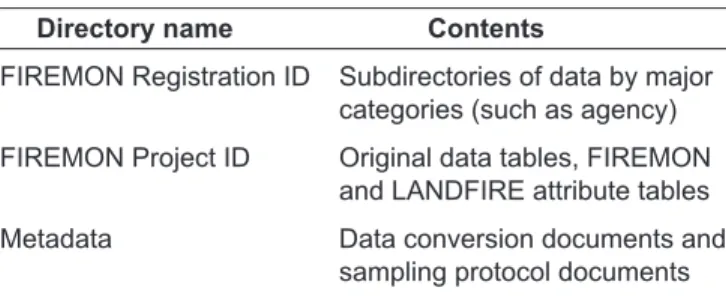
information formed the foundation for most phases of the LANDFIRE Prototype Project. The database was designed in Microsoft ACCESS and had a three-tiered hierarchical structure (Caratti, Ch. 4). Existing data were entered into the database and incorporated into the FIREMON database structure (Lutes and others 2002). The data were then further summarized and reformatted to ensure consistency across the entire database. This involved steps such as converting geographic coordi-nates to the LANDFIRE map projection, converting measurement units to metric, ensuring that all vegetation cover estimates represent absolute cover as opposed to
relative cover, and populating fields that can be used for
quality assurance and quality control (Caratti, Ch. 4).
The final step in developing the LFRDB was classifying
each plot to the appropriate CT, PVT, and SS using the
LANDFIRE map unit classification systems (Long and
others, Ch. 6) and assigning appropriate fuel
character-istics using the LANDFIRE fuel map unit classification
systems (Keane and others, Ch. 12). LANDFIRE map
attribute tables describing georeferenced vegetation and fuel types were then used as training databases for developing most LANDFIRE products.
For inclusion in the LFRDB, all field data needed to
be georeferenced and quantify at least one LANDFIRE
mapping attribute (for example, CT or SS). All field data
were evaluated for suitability and assigned quality control indices based on summary image overlay, logic check-ing, and associated metadata (Caratti, Ch. 4). Sources of data for the LFRDB include but are not limited to the following:
• Forest Inventory and Analysis (Gillespie 1999) • Forest Health Monitoring (USDA Forest Service
2003)
• Landscape Ecosystem Inventory Systems (Keane and others 2002a)
• ECODATA (Jensen and others 1993)
• FIREMON fire monitoring data (Lutes and others
2002)
• Interior Columbia River Ecosystem Management Project (Quigley and others 1996)
• Natural Resources Conservation Service (USDA 2002)
• National Park Service fire monitoring database
(USDI 2001)
Figure 3—The procedure for developing the LANDFIRE reference database. Existing georeferenced plot data were acquired
from numerous sources, including USDA Forest Service Forest Inventory and Analysis data, State GAP programs, and additional
government and non-government sources. These data were processed through automated quality control and re-projection
procedures and compiled in the FIREMON database architecture. The custom LANDFIRE vegetation classes (cover type, PVT,
structural stage, and surface fuel models) were determined for each plot using sets of dichotomous sequence tables. The final
stage of compiling the reference database was the development of map attribute tables that are implemented as training databases in the LANDFIRE mapping processes.
The LFRDB was used to classify, map, and evaluate each of the LANDFIRE products. For example, the LFRDB was used to classify existing vegetation com-munities and biophysical settings (Long and others, Ch. 6), to map PVTs (Frescino and others, Ch. 7), to map cover types (Zhu and others, Ch. 8), to evaluate and quantify succession model parameters (Long and others, Ch. 9 and Pratt and others, Ch. 10), to develop maps of wildland fuel (Keane and others, Ch. 12), and to evaluate the quality of LANDFIRE products (Vogelmann and others, Ch. 13).
Developing the Physiography and
Biophysical Gradient Layers
Several spatial data layers provided baseline informa-tion for the LANDFIRE Prototype Project and served mainly as independent spatial predictor variables in
the LANDFIRE mapping processes (fig. 4). We used
topographic data from the National Elevation Database (NED) to represent or derive gradients of elevation, slope, aspect, topographic curvature, and other topographic characteristics (Holsinger and others, Ch. 5). The Na-tional Elevation Database, developed by the USGS Center for Earth Resources Observation and Science (EROS), was compiled by merging the highest-resolution, best-quality elevation data available across the United States into a seamless raster format. More information about the NED may be found at http://ned.usgs.gov/.
Topographic variables represent indirect biophysical
gradients, which have no direct physiological influence
on vegetation dynamics (Müller 1998); however, the addition of even indirect gradients has been shown to improve the accuracy of maps of vegetation (Franklin 1995). We used an ecosystem simulation approach to create geospatial data layers that describe important
environmental gradients that directly influence the distribution of vegetation, fire, and wildland fuel across
landscapes (Rollins and others 2004). The simulation model WXFIRE was developed for the purpose of employing standardized and repeatable modeling meth-ods to derive landscape-level weather and ecological gradients for predictions of landscape characteristics such as vegetation and fuel (Keane and others 2002a; Keane and Holsinger 2006). WXFIRE was designed to simulate biophysical gradients using spatially interpo-lated daily weather information in addition to mapped
soils and terrain data. The spatial resolution is defined by a user-specified set of spatial simulation units. The
WXFIRE model computes biophysical gradients - up to 50 - for each simulation unit, where the size and shape of simulation units are determined by the user.
The implementation of WXFIRE requires the three following steps: 1) develop simulation units (the smallest unit of resolution in WXFIRE), 2) compile mapped daily weather, and 3) execute the model (Holsinger and oth-ers, Ch. 5). Using the DAYMET daily weather database, WXFIRE was executed over 10 million simulation units
Figure 4—The procedure for developing the LANDFIRE base geospatial data layers. Topo-graphic information from the National Elevation Database, soils information from the NRCS STATSGO database, and data from the DAYMET daily weather database were input into the WX-FIRE weather and ecosystem model. WXWX-FIRE was used to develop 8 gradients describing the
factors that define the distribution of vegetation
across landscapes. These gradients were incor-porated into the LANDFIRE mapping processes to increase the overall accuracy of mapped products. Three dates of Landsat imagery from the MRLC 200 project were used as the basis for mapping existing vegetation composition and structure. All information included in the LANDFIRE spatial database was developed using strict design criteria to ensure that these data could be developed consistently across the entire United States.
for Zone 16 and over 26 million for Zone 19 (Thornton and others 1997). Thirty-eight output variables from WXFIRE describing average annual weather and average annual rates of ecosystem processes (such as potential evapotranspiration) were then compiled as raster grids
and used in developing the final LANDFIRE products (Holsinger and others, Ch. 5). Specifically, these lay -ers were used as a basis for mapping PVT, CT, and SS (Frescino and Rollins, Ch. 7 and Zhu and others, Ch. 8) and for mapping both surface and canopy wildland fuel (Keane and others, Ch. 12). Additionally, biophysi-cal gradient layers facilitated comparison of map units across mapping zones during the map unit development. For example, an equivalent CT in two different mapping zones should have similar biophysical characteristics. Vast differences in biophysical characteristics may indicate that a new CT should be developed.
Developing the LANDFIRE Vegetation Map
Unit Classifications
The LANDFIRE Prototype Project developed vegetation
map unit classifications that, combined with rule sets (keys),
allowed the linkage of LFRDB plot data to geospatial data layers in a systematic, hierarchal, and scaleable framework.
These hierarchal classification systems were directly related
to the predictive landscape modeling of PVT, CT, and SS (Frescino and Rollins, Ch. 7 and Zhu and others, Ch. 8)
for defining the developmental stages within succession models for landscape fire regime modeling (Long and oth -ers, Ch. 9 and Pratt and oth-ers, Ch. 10) and for mapping surface and canopy fuel (Keane and others, Ch. 12). In order for LANDFIRE to be successful, the LANDFIRE vegetation map units need to be:
• identifiable – Map units must be easily identifiable in the field, and the process for assigning map units
based on existing plot data (such as FIA) needs to
be efficient and straightforward.
• scalable – Map unit classifications must have a hierarchy that is flexible for addressing the spatial
scales used in landscape- to national-level assess-ments (for example, 100,000s to 1,000,000s km2).
This flexibility in spatial scale also facilitates links with existing classifications.
• mappable – Only map units that can be delineated using remote sensing and biophysical modeling will be mapped.
• model-able – Map units must fit into the logical
frameworks of the vegetation and landscape simu-lation models that are essential for the creation of many LANDFIRE products.
The LANDFIRE Prototype Project vegetation map unit
classifications were based on combinations of extensive literature review, existing national vegetation classifica -tions and mapping guidelines, development of vegetation succession models, summaries from the LFRDB, and
classifications from other existing fuel and fire regime
mapping projects (Long and others, Ch. 6). Each of the
classifications is composed of two types of units (map and
taxonomic) with several different nested levels possible (Long and others, Ch. 6). Map units are collections of
areas defined in terms of component taxonomic and/or
technical group characteristics. Map units may exist at
any level of a hierarchical map unit classification based
on physiognomic or taxonomic units or technical groups (Brohman and Bryant 2005). Taxonomic units were used
to define and develop map units from the LFRDB and may
also be used by land managers to scale the LANDFIRE
CT map unit classification to floristically finer scales. Hierarchically nested, taxonomically defined map units
allowed the vegetation map units to be aggregated or disaggregated to suit multiple purposes (such as vegeta-tion modeling or fuel mapping). Taxonomic informavegeta-tion
was also used to link the LANDFIRE classifications to other existing vegetation classification systems (Long and others, Ch. 6). The individual classifications are
described below.
Cover type map unit classification — The
LAND-FIRE cover type (CT) map unit classifications described
existing vegetation composition in each mapping zone (Long and others, Ch. 6). Generally, CT map units were distinguished by dominant species or species
as-semblages. Records in the LFRDB were classified to
CT based on indicator types with the highest relative canopy cover. The LANDFIRE Prototype CT map unit
classification was based on the National Vegetation Clas
-sification System (NVCS) and the USDA Forest Service Existing Vegetation Classification and Mapping Guide
(Brohman and Bryant 2005; Grossman and others 1998;
Long and others, Ch. 6) but was modified to meet the LANDFIRE classification criteria listed above. By using
NVCS and the Forest Service Existing Vegetation
Clas-sification and Mapping Technical Guide (Brohman and Bryant 2005), the LANDFIRE CT map unit classification quantitatively combined both physiognomic and floristic
systems and adhered to important Federal Geographic
Data Committee classification standards (FGDC 1997).
The LANDFIRE vegetation map units were used for mapping existing vegetation and vegetation structure (Zhu and others, Ch. 8), modeling succession (Long and others, Ch. 9), parameterizing the LANDSUMv4 model (Pratt and others, Ch. 10), quantifying departure from
historical conditions (Holsinger and others, Ch. 11), and for mapping wildland fuel (Keane and others, Ch. 12).
Structural Stage Map Unit Classification — The
LANDFIRE structural stage (SS) map unit classifica -tion was based on summary analyses of vegeta-tion characteristics contained within the LFRDB. The two main criteria for developing custom SS map units were that these map units had to be useful for describing vegetation developmental stages in succession models and they needed to be relevant for describing vegeta-tion structure for mapping wildland fuel. In addivegeta-tion, LANDFIRE SS map units had to be distinguishable us-ing Landsat imagery. The structural stages of forest CTs were broken into four SS map units based on a matrix of independently mapped canopy cover (CC) and height class (HC) map units (Long and others, Ch. 6). Structure
classification of non-forest CTs was composed of only
two map units describing canopy density. Height status was not included in these SS map units because most growth in non-forest areas occurs relatively swiftly in
the first couple of years after regeneration and then levels
out over time; therefore, height status is less relevant to vegetation succession in non-forest types than in forest types (Long and others, Ch. 6). LANDFIRE structural stages were used to develop models of vegetation de-velopment (Long and others, Ch. 9) and for mapping wildland fuel (Keane and others, Ch. 12).
Potential Vegetation Type Map Unit Classifica
tion — Potential vegetation type (PVT) is a site
clas-sification based on environmental gradients such as temperature, moisture, and soils (Pfister and others
1977). Potential vegetation types are analogous to ag-gregated habitat types or vegetation associations and are usually named for the late successional species presumed
to dominate a specific site in the absence of disturbance
(Cooper and others 1991; Daubenmire 1968; Frescino
and Rollins, Ch. 7; Keane and Rollins, Ch. 3; Pfister
and Arno 1980).
The LANDFIRE PVT map unit classification was cre -ated based on summaries from the LFRDB, extensive
literature reviews, and existing PVT classifications (Long and others, Ch. 6). We began with PVT classifications
that already existed for each of the prototype mapping zones (such as the USDA Forest Service regional
clas-sifications) and then refined these PVT classifications
through expert opinion and data from the LFRDB.
The resultant map unit classification was based on the
presence of indicator types across gradients of shade tolerance, plant water relationships, and ecological amplitude. The LANDFIRE Prototype Project PVT
map units were used to link the ecological process of succession to landscapes (Long and others, Ch. 9), to guide the parameterization and calibration of the
land-scape fire succession model LANDSUMv4 (Pratt and
others, Ch. 10), and to stratify vegetation communities for wildland fuel mapping (Keane and others, Ch. 12).
Mapping Potential Vegetation
We mapped PVT using a predictive landscape modeling
approach (fig. 5). This approach employs spatially explicit
independent or predictor variables and georeferenced training data to create thematic maps (Franklin 1995; Keane and others 2002a; Rollins and others 2004). For the LANDFIRE Prototype, the training data were
cre-ated by implementing the PVT map unit classification
as a set of automated queries that access the LFRDB and classify each plot to a LANDFIRE PVT based on vegetation composition and condition (Long and oth-ers, Ch. 6). Each georeferenced plot and its assigned PVT were overlaid with the 38 biophysical gradients using GIS software. This resulted in a PVT modeling database where PVT was the dependent variable and the biophysical gradient layers were the predictor variables (Frescino and Rollins, Ch, 7).
In the LANDFIRE Prototype, we used classification
trees (also known as decision trees) along with the PVT modeling database to create a spatially explicit model
for mapping PVT within GIS applications. Classifica -tion trees, used as an analog for regression, develop rules for each category of a dependent variable (in this
case, PVT). Classification trees for mapping PVTs were
developed using the See5 machine-learning algorithm (Quinlan 1993; www.rulequest.com) and were applied within an ERDAS Imagine interface (ERDAS 2004;
Frescino and Rollins, Ch. 7). See5 uses a classification
and regression tree (CART) approach for generating a tree with high complexity and pruning it back to a simpler tree by merging classes (Breiman and others 1984; Friedl and Bradley 1997; Quinlan 1993).
Maps of PVT are a principal LANDFIRE Prototype product (table 1). In addition, the LANDFIRE PVT maps were used with the LFRDB to create layers that represent the probability of a particular CT to exist in
a specific area (Frescino and Rollins, Ch, 7), used in
the mapping of CT (Zhu and others, Ch. 8). The PVT map also facilitated linkage of the ecological process of vegetation succession to the simulation landscapes used in modeling historical reference conditions. In the LANDFIRE Prototype, vegetation ecologists created succession pathway models for individual PVTs that