Towards Visualising Security with Arguments
Stefano Bistarelli, Fabio Rossi, Francesco Santini, Carlo Taticchi
Dipartimento di Matematica e Informatica Universit`a di Perugia, Italy E-mail: [email protected]
Abstract
Abstract Argumentation has been proved as a simple yet powerful approach to manage conflicts in rea-soning with the purpose to find subsets of “surviving” arguments. Our intent is to exploit such form of reasoning to visually support the administration of security in complex systems. For instance, in case threat countermeasures are in conflict (also with assets) and only some of them can be selected.
1
Introduction and Motivations
AnAbstract Argumentation Framework (AAF), or System, as introduced in a sem-inal paper by Dung [6], is simply a pair hA, Ri consisting of a set A of arguments and a binary relation R on A, called “attack” relation. An abstract argument is not assumed to have any specific structure but, roughly speaking, an argument is anything that may attack or be attacked by another argument. The sets of argu-ments (or extensions) to be considered are then defined under different semantics, which are related to various degrees of scepticism or credulousness.
In this work, our goal is to start developing a tool to visualise security threats and related countermeasures as arguments, as if security was a continuous dynamic discussion between the administrator and the surveilled system. Existing automated tools to defend a system from such security threats are one potential solution, but a completely automated approach could undervalue the strong analytic capabili-ties of humans, particularly in problematic situations that require vigilant human oversight.
We measure the strength of subsets of arguments and single arguments in ac-cordance with Argumentation Theory. The proposed tool visualises such strength degrees in different colours with the purpose to immediately catch the attention of the Security Administrator on what is going on in his system, and help him to take a decision on the set of countermeasures to be considered.
This paper is electronically published in Electronic Notes in Theoretical Computer Science
a b c d e
Fig. 1. An example of AAF.
2
Preliminaries
In this section we briefly summarise the background information related to classical Abstract Argumentation Frameworks (AAFs) [6].
Definition 2.1 [AAF] An Abstract Argumentation Framework (AAF) is a pair
F = hA, Ri, where A is a set of arguments, and R ⊆ A×A is binary relation, called the attack relation. ∀a, b∈A,aR b (or, a b) means thataattacks b. An AAF may be represented by a directed graph whose nodes are arguments and edges represent the attack relation. A set of arguments S ⊆ A attacks an argument a, i.e., Sa, ifa is attacked by an argument ofS, i.e.,∃b∈S.ba. An argument
a∈A is defended (in F) by a set S ⊆A if for eachb ∈ A, such that b a, also
Sbholds.
Argumentation semantics [6] characterise a collective “acceptability” for argu-ments. Respectively, adm, com, prf, and stb stand for admissible, complete, pre-ferred, and stable semantics.
Definition 2.2 [Semantics [6]] LetF =hA, Ribe an AAF. A setS⊆Ais conflict-free (in F), denoted S ∈ cf(F), iff there are no a, b ∈ S, such that a b or
ba∈R. ForS ∈cf(F), it holds that
• S ∈adm(F), if eacha∈S is defended by S;
• S ∈com(F), ifS ∈adm(F) and for eacha∈A defended byS,a∈S holds; • S ∈prf(F), ifS ∈adm(F) and there is no T ∈adm(F) withS ⊂T;
• S ∈stb(F), if for eacha∈A\S,S a;
We also recall that the requirements in Def. 2.2 define an inclusion hierarchy on the corresponding extensions, from the most to the least stringent: stb(F) ⊆
prf(F)⊆com(F)⊆adm(F). Moreover,σ(F)6=∅always holds for each considered semantics σ (except for the stable one). In the following, we will use the stable semantics because of its sceptical behaviour with respect to the others.
Definition 2.3 [Acceptance-state] Given one of the semanticsσ in Def.2.2and a frameworkF, an argumenta isi) sceptically accepted if∀S ∈σ(F), a∈S,ii) ais credulously accepted if∃S∈σ(F), a∈S andais not sceptically accepted, and iii)
ais rejected if @S∈σ(F), a∈S.
Consider F =hA, Ri in Fig.1, with A= {a, b, c, d, e} and R ={a b, c b, c d, d c, d e, ee}. In F we have adm(F) ={∅,{a},{c},{d},{a, c},{a, d}},com(F) ={{a},{a, c},{a, d}},prf(F) ={{a, d},{a, c}}, andstb(F) ={{a, d}}. Hence, argumenta is sceptically accepted in com(F), prf(F) andstb(F), while it is only credulously accepted inadm(F).
3
A Visualisation Example
Consider a small research and development company. This company cooperates with other (often large) enterprises for the development of complex goods. Such company possesses high-tech knowledge which has to be protected from competitors. The company needs to efficiently use its resources with the purpose to survive in a highly competitive market. In short, the company has the goal (i.e., asset) of ensuring the productivity of operations (a.k.a., Quality of Services, QoS).
In this small example, the security-system administrator has identified the fol-lowing threats and related security controls (in square brackets): hacker penetration (HP) [host IDS (HI), network IDS (NI)] (where IDS stands for Intrusion Detection System), employee abuse (EA) [monitoring functionality (MF), audit procedures (AP)], and compromise of communication channel (CCC) [virtual private network (VPN), encrypted line (EL)].
We would like to emphasise that abstract arguments have no internal structure, and are not “directly linked” to classical logic. For this reason, we can consider multiple sources of information and belief, such as case law, common sense, and expert opinion. We can consider information coming from multiple network-sensors, in the form of logs, warnings, and errors. Facts and beliefs can be also taken from internal policy documents, and standard documents as well. For instance the Standard of Good Practice for Information Security, is a business-focused, practical and comprehensive guide to identifying and managing information security risks in organizations and their supply chains. The 2011 Standard is aligned with the requirements for an Information Security Management System (ISMS) set out in ISO/IEC 27000-series standards, and provides wider and deeper coverage of ISOIEC 270021 control topics, as well as cloud computing, information leakage, consumer devices and security governance.
To work on our example we useSecArg2 (Security with Arguments). SecArg is based on ConArg [4,5] (ARGumentation with CONstraints), which is an Abstract Argumentation reasoning-tool using theGecode library3, an efficient C++ environ-ment where to develop constraint-based applications. The input (text) file passed to SecArg contains the list of arguments partitioned into countermeasures,threats, assets, and attacks between them: for instance, countermeasure(HI), threat(HP), att(HI,HP) (hacker penetration is prevented by a host IDS). SecArg visually rep-resents the different nature of arguments with different colours: green for counter-measures, red for threats, and yellow for assets.
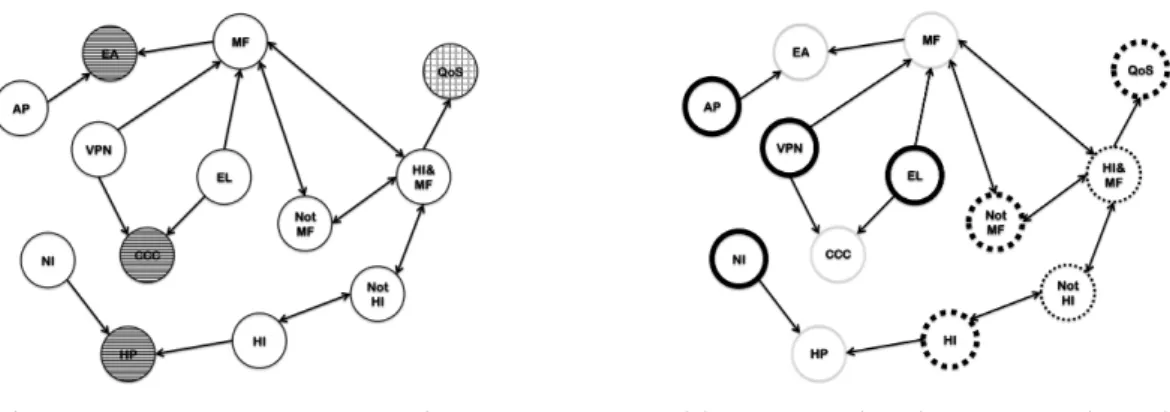
A more extended example is represented in Fig. 2(a). In such AAF we have that executing a host IDS and a monitoring functionality on the same machine (i.e., HI&MF) impacts on its QoS. Hence, we pose an attack between them, and we also consider not having HI (NotHI) or MF (NotMF). Moreover, we have some countermeasures in conflict, i.e., EL or VPN, and MF: it is not possible to monitor all the traffic when some data is encrypted with unknown keys.
1 ISO, ISO, and I. E. C. Std. “ISO 27002: 2005.“ Information Technology-Security Techniques-Code of
Practice for Information Security Management. ISO (2005).
2
http://www.dmi.unipg.it/secarg 3 http://www.gecode.org
(a) The AAF with controls, threats (hori-zontal filling), andQoSasset.
(b) Sceptically (thick), credulously (dotted) accepted, rejected (grey).
Fig. 2. HI = Host IDS, NI = Network IDS, CCC = Compromise of Communication Channel, VPN = Virtual Private Network, MF = Monitoring Functionality, EA = Employee Abuse, EL = Encrypted Line, HP = Hacker Penetration, AP = Audit Procedures, NotMF = not having MF, NotHI = not having HI, HI&MF = having both HI and MF at the same time, QoS = good QoS.
We obtain three stable extensions (we use the stable semantics because it is the most sceptical one, see Sec.2): i) {AP, VPN, EL, HI, NI, NotMF, QoS}, ii) {AP, VPN, EL, HI, NI, HI&MF}, andiii){AP, VPN, EL, NI, NotHI, NotMF, QoS}. In this case, reasoning in terms of stable or preferred semantics is the same, since they both return the same three extensions. Reasoning on the sceptical acceptance of arguments in such three extensions, we obtain that AP, VPN, EL, NI are sceptically accepted (i.e., “always”). This means that, for the attack/countermeasure scenario we have depicted, having audit procedures, a virtual private network, an encrypted line, and a network IDS is always considered a valid argument. Therefore, they cor-respond to a strong suggestion for the security administrator. On the other hand, there are some other arguments that are rejected (see Def.2.3), that is they never appear in such extensions; for instance EA, HP, MF, and CCC. All three threats are successfully “avoided”, in the sense that adopted security countermeasures always prevent all of them. Moreover, also adopting the monitoring functionality counter-measure is not a good idea given this scenario, since it is rejected as well. Finally, the remaining arguments appear sometimes but not always in such three extensions (they are credulously accepted, according to Def. 2.3): NotHI (in 1 extension), HI&MF (1), HI (2), NotMF (2), QoS (2). The number of times they appear is vi-sually highlighted in SecArg by filling arguments with different shades of grey, and also returning the appearance ratio, e.g,. 66.6% for QoS and 33.3% for NotHI. This can be interpreted as a strength-score for these arguments: for instance, having an host IDS beats not having it (2 to 1): hence the administrator is recommended to use it. For the sake of presentation, in Fig.2(b) we use thick continuous circles for sceptically accepted arguments, thin/thick dotted circles for credulously accepted ones (respectively for lower/higher ratio of appearance, e.g., QoS is thicker than NotHI), and light-grey circles for rejected arguments.
4
Related and Future Work
Since the application of Argumentation to Cybersecurity-related issues is relatively a new field (or, at least, not deeply investigated), there is a few related work to be
mentioned. A bunch of works applying Argumentation-based conflict-resolution to the specific case of firewall rules are [1,2,3]. In our approach, however, we would like to provide a general reasoning-tool.
In [8] the authors suggest the use of Argumentation to provide automated sup-port for Cybersecurity decisions. Three different tasks where Argumentation can contribute are surveyed in the paper: first, the establishment of a security policy, drawing from a range of information on best practice and taking into account likely attacks and the vulnerability of the system to those attacks. Secondly, the process diagnosis to determine if an attack is underway after some apparent anomaly in system operation is detected; the final goal is to decide what action, if any, should be taken to ensure system integrity. At last, Argumentation can be used to recon-figure a security policy in the aftermath of a successful attack: this reconfiguration needs to ensure protection against future similar-attacks, without creating new vul-nerabilities.
In [7] the authors propose how arguments can support the decision making process: the aim is to help the system security administrator to react (or not) to possible ongoing attacks. For instance, a decision can be taken either to disable traffic through port 80 or not to disable it.
In this work, we considered cost and productivity requirements in a simplis-tic way. In the future, we would like to consider these and other constraints in a quantitative way, e.g., consider cost of every security control separately and aggre-gating the cost of all controls at the end, keeping it below some threshold. Also the preferences of arguments can be seen in quantitative or qualitative way in order to compare the effects of arguments on the system and prioritise stable extensions. This approach should help the analysis to select the most appropriate configuration.
References
[1] Applebaum, A., K. N. Levitt, J. Rowe and S. Parsons,Arguing about firewall policy, in: B. Verheij, S. Szeider and S. Woltran, editors,COMMA, Frontiers in Artificial Intelligence and Applications245
(2012), pp. 91–102.
[2] Bandara, A. K., A. C. Kakas, E. C. Lupu and A. Russo,Using argumentation logic for firewall policy specification and analysis, in: R. State, S. van der Meer, D. O’Sullivan and T. Pfeifer, editors,DSOM, Lecture Notes in Computer Science4269(2006), pp. 185–196.
[3] Bandara, A. K., A. C. Kakas, E. C. Lupu and A. Russo, Using argumentation logic for firewall configuration management, in:Integrated Network Management(2009), pp. 180–187.
[4] Bistarelli, S., F. Rossi and F. Santini,Benchmarking hard problems in random abstract AFs: The stable semantics, in: Computational Models of Argument - Proceedings of COMMA, Frontiers in Artificial Intelligence and Applications266(2014), pp. 153–160.
[5] Bistarelli, S., F. Rossi and F. Santini,A first comparison of abstract argumentation reasoning-tools, in:
ECAI 2014 - 21st European Conference on Artificial Intelligence, Frontiers in Artificial Intelligence and Applications263(2014), pp. 969–970.
[6] Dung, P. M.,On the acceptability of arguments and its fundamental role in nonmonotonic reasoning, logic programming and n-person games, Artif. Intell.77(1995), pp. 321–357.
[7] Martinelli, F. and F. Santini, Debating cybersecurity or securing a debate? - (position paper), in:
Foundations and Practice of Security - 7th International Symposium, FPS 2014, Lecture Notes in Computer Science8930(2014), pp. 239–246.
[8] Rowe, J., K. Levitt, S. Parsons, E. Sklar, A. Applebaum and S. Jalal,Argumentation logic to assist in security administration, in:Proceedings of the 2012 Workshop on New Security Paradigms, NSPW ’12 (2012), pp. 43–52.