Contract No.: ED-01-CO-0039/0003 MPR Reference No.: 8940-400
Identifying Alternative
Certification Programs
for an Impact Evaluation
of Teacher Preparation
April 30, 2003 Daniel P. Mayer Paul T. Decker Steven Glazerman Timothy W. Silva Submitted to:U.S. Department of Education 555 New Jersey Ave., NW Room Number 308D Washington, DC20208
Project Officer: Elizabeth Warner
Submitted by:
Mathematica Policy Research, Inc. 50 Church Street, 4th Floor
Cambridge, MA 02138 Telephone: (617) 491-7900 Facsimile: (617) 491-8044
Project Director: Daniel Mayer
CONTENTS
Chapter Page
I. ALTERNATIVE CERTIFICATION AS A POLICY ISSUE ... 1
A. OVERVIEW... 1
B. THE POLICY DEBATE... 2
II. WHAT IS ALTERNATIVE CERTIFICATION?... 7
A. HOW DOES ALTERNATIVE CERTIFICATION DIFFER FROM TRADITIONAL CERTIFICATION? ... 7
B. HOW DO ALTERNATIVE CERTIFICATION PROGRAMS DIFFER? ... 11
1. Variation in Entrance Requirements ... 12
2. Variation in Institutions and Training Personnel ... 13
3. Variation in Training Requirements... 14
4. Variation in Mentor Support ... 16
III. WHICH MODELS OF ALTERNATIVE CERTIFICATION WOULD BE DESIRABLE TO INCLUDE IN AN IMPACT STUDY?... 19
A. WHAT RESEARCH QUESTIONS SHOULD GUIDE PROGRAM SELECTION? ... 19
B. SELECTING MAJOR FEATURES FOR STUDY ... 20
1. Major Features... 20
2. Other Features ... 22
C. FOUR ALTERNATIVE CERTIFICATION MODELS... 24
Chapter Page
A. DEVELOPING AN INITIAL POOL OF PROGRAMS
FOR POTENTIAL STUDY... 28
B. NARROWING THE POOL... 29
C. DETAILED DATA COLLECTIONS... 36
D. WHAT WE LEARNED ... 37
1. Training Requirements... 37
2. Entrance Requirements ... 38
3. Categorizing Programs... 39
4. Participant Numbers and Locating Graduates... 43
5. Age and Stability... 44
E. NEXT STEPS... 45
REFERENCES... 47
APPENDIX A: THE EFFECT OF ALTERNATIVE CERTIFICATION ON STUDENT ACHIEVEMENT: A LITERATURE REVIEW
APPENDIX B: EXPERT PANEL MEMBERS AND CONSULTANTS
TABLES
Table Page
III.1 VARIATIONS OF ALTERNATIVE CERTIFICATION MODELS... 25
IV.1 THE TRAINING AND ENTRANCE REQUIREMENTS FOR
11 ALTERNATIVE CERTIFICATION PROGRAMS... 31
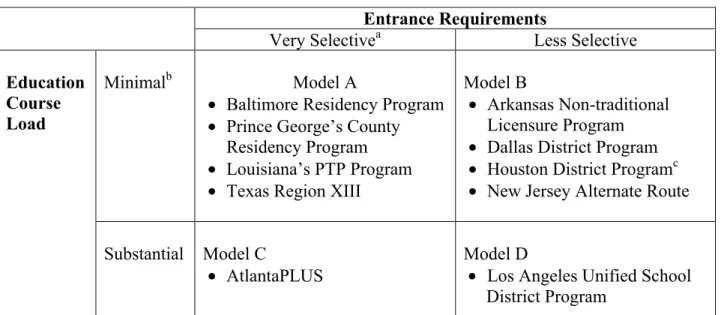
IV.2 ALTERNATIVE CERTIFICATION PROGRAMS AND MODELS
THEY REPRESENT... 40
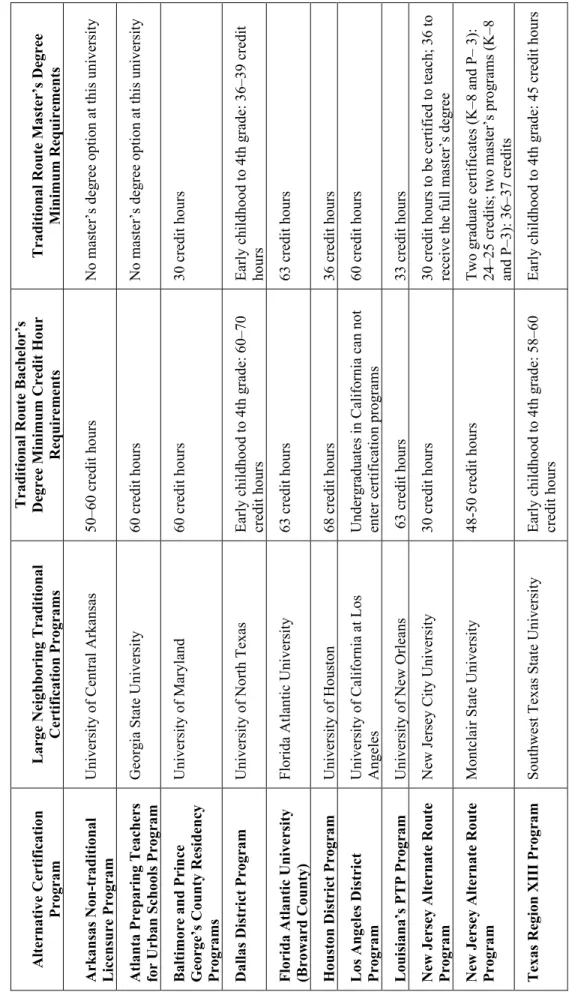
IV.3 TRADITIONAL COURSE WORK REQUIREMENTS FOR
FIGURES
Figure Page
II.1 ALTERNATIVE VERSUS TRADITIONAL ROUTES TO
I. ALTERNATIVE CERTIFICATION AS A POLICY ISSUE
A. OVERVIEW
The past two decades have seen dramatic changes in the number of routes taken by
prospective teachers to earn teaching certification. In the early 1980s, only 8 states offered what
are commonly referred to as “alternative” routes for prospective teachers to obtain teacher
certification, but, as of 2002, 45 states and the District of Columbia offered some type of
alternative certification. By some estimates, about one-third of newly hired teachers come
through alternative certification (Feistritzer and Chester 2002).
Alternative certification provides a means for bachelor’s degree holders to become the
teacher of record with far less previous teacher training than that required by traditional
certification programs.1 The extent and specifics of the training required before and after
becoming the teacher of record vary extensively across alternative certification programs. The
traditional route consists of a degree program (bachelor’s or master’s degree) operated by a
school or department of education that specifies a set of course requirements and other
requirements that comply with the state’s teacher certification regulations.
Presumably, teacher training policy should promote student academic success, but the
existing literature on alternative certification and its effects on student learning is weak. Nor
does the literature provide unambiguous evidence about effective approaches to equip teachers
1Alternative teacher certification programs are distinct from national teacher recruitment
programs such as Teach for America and Troops to Teachers. Certification programs that exist within a particular state offer training that leads to certification within that state. National recruitment programs may offer some training and support, but they funnel candidates into alternative certification programs.
for performing successfully in classrooms. To remedy this weakness, the U.S. Department of
Education's National Center for Education Evaluation (NCEE) plans to launch a random
assignment impact study that would provide rigorous evidence on the effectiveness of teacher
preparation.
The purpose of this report is to help NCEE describe the variety of alternative routes
prospective teachers take to certification and to identify those suitable for a random assignment
impact evaluation. Specifically, the report addresses the following questions:
• What is alternative certification?
• How do alternative certification programs and routes differ from traditional certification
programs and from each other?
• What alterative certification models would be desirable to include in an impact study?
• Which alternative certification programs and routes use these models and should be
considered for inclusion in an impact study?
As we address these questions, we will keep the discussion focused by recognizing that at
least three factors should be considered when launching a study: coherence, feasibility, and scale.
To bring coherence to the project, it is essential to define alternative certification and to identify
the variety of today’s alternative certification routes. Because feasibility will influence design
decisions, we focus the discussion on what is possible. Finally, we refer to resource constraints
when appropriate because they will likely limit the scale of the study, forcing the study designers
to make choices regarding which issues one study can ultimately address.
B. THE POLICY DEBATE
The rapid change in methods of teacher certification has fueled a fierce debate over state
Darling-Hammond and Youngs 2002; Hess 2001; Kanstoroom and Finn 1999; National Commission on
Teaching and America’s Future 2003; U.S. Department of Education 2002; Walsh 2001). The
proponents of traditional certification (TC) view alternative certification (AC) as a threat to the
quality of teachers and education. They view the process of becoming a qualified teacher as
similar to the process of becoming a qualified doctor, lawyer, or architect and thus requiring
several years of preservice professional training before a teacher can take full responsibility for a
classroom (Stoddart and Floden 1995). Darling-Hammond (1994) argues that creating
alternative routes to certification permits unlicensed teachers into the classroom simply as a way
to remedy teacher shortages, thereby reducing the overall quality of teaching. She has noted that
teachers from the Teach for America program “often have difficulty with curriculum
development, pedagogical content knowledge, students’ different learning styles, classroom
management, and student motivation” (p.21). Echoing the argument that substantial training is
required to become a qualified teacher, a commission of 23 leaders in education policy
concluded the following: “A college major or minor, or professional experience in the field,
guarantees neither a command of subject matter nor the ability to teach it successfully. The
knowledge base of teaching is incomplete unless candidates master not just the what of course
content, but also the how of teaching as well” (National Commission on Teaching and America’s
Future 2003).
On the other side of the debate are those whose support for AC is based on either practical
or philosophic reasons. Initially, state legislatures created AC routes to deal with teacher
shortages in the areas of secondary mathematics and science. But because shortages persisted in
other levels and content areas in some of the nation’s rural and urban schools, states established
support AC as a means of redressing teacher shortages do not necessarily view AC routes as
desirable. In fact, many view alternative certification as a “last resort” to be used only when
traditionally certified teachers are in short supply (Hawley 1992b). Indeed, some states make
their alternative routes available to prospective teachers only in shortage areas. For example,
investigations into how AC programs were structured in Nevada, Ohio, Oklahoma, and South
Carolina revealed that these programs were not open to prospective elementary teachers because
state officials in these states perceived no elementary teacher shortages.2
Some supporters of AC believe, however, that alternative certification should be viewed as a
“first resort” rather than as a “last resort” and that removing traditional certification barriers will
expand and improve the labor pool by encouraging academically talented and ethnically diverse
candidates to enter the profession (Hess 2001; Kanstoroom and Finn 1999). According to a
manifesto signed by 54 leaders in education policy, “The regulatory strategy [imposed by
traditional certification requirements] assumes that good teaching rests on a solid foundation of
specialized professional knowledge about pedagogy (and related matters) that is scientifically
buttressed by solid research. In reality, however, much of that knowledge base is shaky and
conflicted.” The manifesto then goes on to state, “Burdensome certification requirements deter
well-educated and eager individuals who might make fine teachers but are put off by the cost, in
time and money, of completing a conventional preparation program” (Kanstoroom and Finn
1999). These AC proponents argue that as long as individuals possess subject matter expertise—
2 This suggests that local labor markets may drive the existence or nonexistence of AC
programs. Further, AC program structures and their impact may vary by labor markets. This issue is not addressed directly in the present report, although, it should be considered in the design of the impact study.
gained either from their undergraduate major or their work experiences—they should be allowed
to teach.
Alternative routes to certification, through their variation from traditional teacher
preparation programs, offer an opportunity to study the effectiveness of preparing teachers using
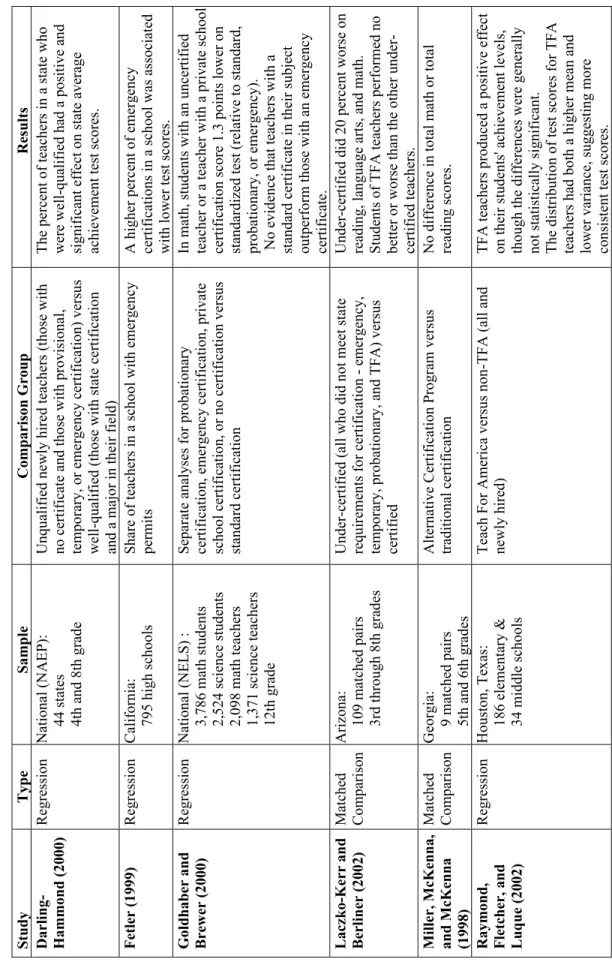
different forms of teacher training and yet the research on this topic is limited (see Appendix A).
The first limitation is that only a handful of studies examines the relationship between teacher
certification and student outcomes, and, among those studies, just two look directly at alternative
certification. The others examine the effects of teachers with traditional certification relative to
teachers without traditional certification, such as those who are uncertified or have emergency
certification. Both the alternative certification studies and the more generic certification studies
use a variety of designs and analytic techniques that yield hard-to-interpret findings regarding the
effect of certification programs on student achievement. The second limitation in current
research, unmeasurable differences in students across different types of teachers, is a potential
problem in almost every study. For example, two studies looking at the impact of the Teach for
America (TFA) program (Laczko-Kerr and Berliner 2002; Raymond et al. 2002) compared TFA
teachers and their students to non–TFA teachers and their students in other schools, though the
characteristics of the schools and the students within them differed considerably. More rigorous
studies focused on alternative certification would offer an important contribution to the policy
II. WHAT IS ALTERNATIVE CERTIFICATION?
In this chapter, we define alternative certification in order to begin to understand what
models of alternative certification might be considered for an impact study. In the first part of the
chapter, we explore how AC programs differ from TC programs. In the second part of the
chapter, we describe how alternative certification programs vary along several dimensions. The
discussion relies on three sources of data: (1) a panel of experts and two consultants convened to
offer guidance on NCEE’s planning of a rigorous study (see Appendix B for a list of panel
members and consultants); (2) a review of the literature describing AC and TC programs; and (3)
informational interviews and document reviews conducted when identifying candidate programs
for the impact study (Chapter IV provides a full description of the interview and review process).
A. HOW DOES ALTERNATIVE CERTIFICATION DIFFER FROM TRADITIONAL CERTIFICATION?
Discussions with a panel of experts and two consultants convened for offering guidance on
NCEE’s planning of a future rigorous study and a review of the literature describing AC and TC
programs (see, for example, Feistritzer and Chester 2002; Hawley 1992a; Stoddart and Floden
1995; Zeichner and Schulte 2001) reveal several critical distinctions between the TC and AC
routes, including, most notably, the type of candidates who take the routes, the timing of their
training, the amount of training received by candidates, the type of institutions delivering the
training, and the nature and amount of support received during teachers’ first year of teaching.
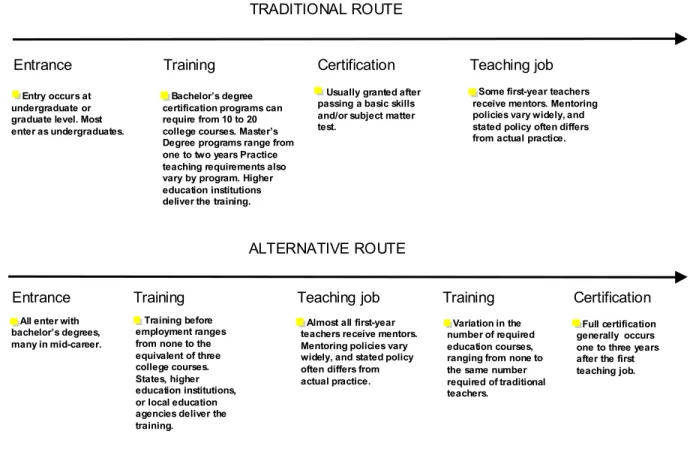
TRADITIONAL ROUTE
ALTERNATIVE ROUTE
Entrance Training Certification Teaching job
Entrance Training ng Teaching job Training Certification
Entry occurs at undergraduate or graduate level. Most enter as undergraduates.
All enter with bachelor’s degrees, many in mid-career.
Bachelor’s degree certification programs can require from 10 to 20 college courses. Master’s Degree programs range from one to two years Practice teaching requirements also vary by program. Higher education institutions deliver the training.
Training before employment ranges from none to the equivalent of three college courses. States, higher education institutions, or local education agencies deliver the training.
Usually granted after passing a basic skills and/or subject matter test.
Almost all first-year teachers receive mentors. Mentoring policies vary widely, and stated policy often differs from actual practice.
Some first-year teachers receive mentors. Mentoring policies vary widely, and stated policy often differs from actual practice.
Variation in the number of required education courses, ranging from none to the same number required of traditional teachers.
Full certification generally occurs one to three years after the first teaching job.
FIGURE II.1
TRADITIONAL VERSUS ALTERNATIVE ROUTES TO CERTIFICATION
On average, the entrants to AC programs differ from TC program entrants in that they are
often older and more ethnically diverse (Zeichner and Schulte 2001). One reason for the
differences is that AC programs are geared toward older candidates. As Figure II.1 notes, the
typical TC candidate receives full certification by completing either an undergraduate or
graduate program. National data reveal that most receive their certification as undergraduates.3
3 Our own analyses of the 1999–2000 School and Staffing Survey (SASS), a nationally
representative data set, reveals that among public school teachers with three or fewer years of experience, 69 percent of elementary, 62 percent of middle, and 58 percent of high school teachers received full certification as part of a bachelor’s degree program.
In contrast, AC programs exclusively target those who already possess a bachelor’s degree and
often target those seeking to make a mid-career transition into teaching.
Figure II.1 also illustrates a controversial aspect of alternative certification; before taking
their first full-time teaching job, alternatively certified teachers undergo virtually no training.
Some argue that a lack of initial training for AC candidates is acceptable because candidates are
screened for subject matter competence before admission (for example, the screen requires
candidates to major or minor in the field in which they will teach, to possess relevant work
experience, or to pass a subject matter test) (Stoddart and Floden 1995).
Specifically, before they take their first job, AC candidates take minimal to no
teaching-related courses (such as courses in pedagogy, child development, and classroom management),
and generally engage in, at most, a few weeks of practice teaching. While the typical AC
program requires AC candidates to attend workshops or take university courses during the first
year of teaching (and sometimes second and third years of teaching), candidates are not fully
certified for one to three years after first entering the classroom.4 In contrast, traditionally
certified teachers complete a full battery of teaching-related courses, participate in an average of
14 weeks of student teaching, and receive their full certification before becoming a full-time
teacher (Feistritzer 1999).
Figure II.1 does indicate that some training does take place after AC teachers start teaching,
although frequently AC candidates receive less cumulative training than TC candidates (Stoddart
and Floden 1995). As discussed more fully in the next section, the amount of training required
4Definitions and certification titles vary from state to state. In this report, “fully certified
teachers” refers to those teachers who completed all of a state’s required course work and passed all state licensing examinations.
by AC programs varies tremendously. Informational interviews and document reviews found that
course work requirements range from none to the equivalent of 12 to 15 postsecondary courses.
The latter is equivalent to the requirements that traditionally certified candidates must satisfy.
In addition to differences in the timing and amount of training, different types of institutions
and instructors often operate AC and TC programs. Traditionally certified candidates usually
receive their training from institutions of higher education and are taught by professors of
education. In contrast, a variety of institutions and professionals offer alternative certification
programs. The institutions include local education agencies, state departments of education,
higher education institutions, and partnerships between or among two or all three of these
institution types. Furthermore, AC training courses are commonly taught by school
administrators, principals, or certified teachers as well as by professors of education.
Some members of the expert panel convened for this project argued that the content of
university-based and -led programs can be too academic and thus removed from the needs of
high-poverty school districts. In turn, teachers prepared in these programs are not always
adequately trained to meet the needs of students in these districts. But the limited literature
exploring differences in TC and AC program content does not identify institutional sponsorship
as a key factor behind variation in program content; instead it points to two alternative
explanations for content variation. First, given that AC candidates come to their programs
possessing subject matter expertise—gained either from their undergraduate major or their work
experiences—AC programs often place less emphasis on content courses than do TC programs
(Stoddart and Floden 1995). Second, while both AC and TC programs often require courses in
pedagogy, child development, and classroom management (Stoddart and Floden 1995; Zeichner
participants, in contrast to their TC counterparts, are engaged in full-time teaching while
participating in training, alternative programs “tend to focus on the programmatic aspects of
teaching—what to do tomorrow and how to survive one’s first year of teaching—more than the
theoretical or philosophic aspects of teaching and learning.”
Finally, Figure II.1 shows that the support structure provided to AC and TC teachers in their
first year of teaching can vary. Given that AC candidates receive little training before becoming
the teacher of record, it is not surprising that almost all AC programs assign mentors (Feistritzer
2002).5 Mentors usually are veteran teachers who are assigned to beginning teachers to help
them learn their trade as well as the philosophy and cultural values of their school. In contrast to
AC programs, not all school districts and states assign mentors to beginning TC teachers (Weiss
and Weiss 1999; National Association of State Directors of Teacher Education and Certification
2002). However, concerns about high attrition rates among all types of beginning teachers has
led to a general expansion of induction and mentoring programs (Weiss and Weiss 1999; Mayer
et al. 2000). As of 2002, 27 states and the District of Columbia operated formal beginning
teacher support systems, although participation was voluntary in nine of the states (National
Association of State Directors of Teacher Education and Certification 2002).
B. HOW DO ALTERNATIVE CERTIFICATION PROGRAMS DIFFER?
The literature (see, for example, Feistritzer and Chester 2002; Hawley 1992a; Humphrey et
al. 2002; Stoddart and Floden 1995; Zeichner and Schulte 2001) also reveals that alternative
certification programs themselves vary along several dimensions. The four most prominent
dimensions of variation are: (1) entrance requirements, (2) the institutions that operate the
programs and conduct the training sessions, (3) the amount of teaching-related course work
candidates must complete, and (4) the level of mentorship support provided to the teachers
during their initial year of teaching.
No nationally representative data on AC programs exist, making it impossible to know
characteristics of AC programs precisely. While Feistritzer and Chester have provided a national
perspective on AC programs in their annual overview of state alternative certification routes (see,
for example, Alternative Teacher Certification: A State-by-State Analysis 2002), their reports
provide data only on AC routes legislated by states and not on the operation of individual
programs that follow particular AC routes. The Texas Alternative Teacher Certification route
provides a useful example. Under this plan, a variety of institutions such as school districts,
higher education institutions, and state-run regional education service centers (ESCs) may design
and run AC programs. Each program has the ability to vary its entry requirements, the duration
of training, and the professional staff; however, Feistritzer and Chester do not attempt to
delineate such variation. Recognizing that the national data are limited, we draw upon a variety
of sources (such as AC program Web pages, articles, books, and interviews with program
administrators and state officials) to compare AC programs along the four dimensions mentioned
above.
1. Variation in Entrance Requirements
Entrance requirements vary from less selective to very selective. Document reviews and
informational interviews reveal that while all programs we reviewed require candidates to hold a
bachelor’s degree, noncompetitive programs look much different from their competitive
counterparts. An example of a noncompetitive program is the Arkansas Non-traditional
one-page essay, participate in a 10- to 15-minute interview, and pass the Praxis I and II
examinations.6 Almost all applicants meeting these requirements are accepted. At the other end
of the spectrum are competitive programs such as the Prince George’s County Residency
Teacher Program. Applicants to this program must demonstrate a 3.0 GPA, pass a teacher skills
test, and fulfill course content prerequisites in mathematics, English, science, and social studies.
In addition, applicants must participate in an extensive interview process that includes a mock
teaching lesson, a group interview in which several candidates come together in one room to
respond to interview questions, and a one-on-one interview between candidates and a program
administrator.
2. Variation in Institutions and Training Personnel
Interviews and document reviews reveal that the type of institutions running AC programs
and the type of personnel conducting the training sessions also vary. Some programs, such as
those in New York State’s Alternative Teacher Certification--Transitional B program, are run by
institutions of higher education, with education school faculty teaching the courses. Other
programs, such as the Texas Region XIII program, are operated by the state. Region XIII staff
deliver approximately 70 percent of the instruction while local university professors or local
school district personnel deliver the remaining 30 percent. Even within a given program,
however, differences in who conducts the courses at various sites can be observed. New Jersey’s
Alternate Route Program is run by the state, for example, but the 10 colleges and 3 consortia of
6The Praxis examinations were developed by the Educational Testing Service and consist of
three assessments for beginning teachers. The assessments are Praxis I: Academic Skills
Assessments; Praxis II: Subject Assessments; and Praxis III: Classroom Performance
Assessments. State education agencies commonly use these examinations in making licensing decisions.
colleges and districts running the training classes have some discretion in how they staff their
classes. While district-level administrators teach all of the classes run by the Essex County
Consortium (a consortium of the Newark and Montclair public schools and Montclair State
University) at Saint Peter’s College, many of the program’s instructors are staff and faculty
associated with the college’s graduate education program.
3. Variation in Training Requirements
The amount of classroom instruction AC candidates must receive before obtaining full
certification varies substantially among AC programs. In addition, as noted above, the literature
and the expert panel point to content differences between AC and TC programs. However, less
has been written about how the curricular content differs among AC programs. In general, our
interviews with AC program administrators revealed that although the amount of course work
varied among programs, the general topics covered in courses varied little and generally included
courses in pedagogy, child development, and classroom management
Informational interviews and document reviews found that AC course work requirements
range from none to the equivalent of 12 to 15 university courses. The latter is equivalent to the
requirements that traditionally certified candidates must satisfy. Given AC advocates’ argument
that teaching methods courses provide little substance and add burdensome requirements that
deter talented prospective teachers, variation in course requirements is of particular policy
relevance.
In view of the three types of courses that AC candidates typically take (university courses,
summer institutes, and weekly workshops), measuring the amount of course work required by an
AC program and translating it into university credit equivalents can be a tricky exercise.
AC summer institutes and AC weekly workshop requirements are generally measured in contact
hours. Despite rules of thumb for converting a course credit into a contact hour (one credit equals
15 hours), equating a four-week, 180-hour summer course with four college courses (assuming
three credits for the typical college course) does not seem appropriate. However, a college
course that meets for a few hours each week over the course of a semester could be equated with
AC workshops that meet weekly over a similar period of time.7
On one end of the teaching-related course requirement spectrum is a program such as the
Georgia Teacher Alternative Preparation Program (TAPP) that requires AC candidates to take 54
credits of education courses (13 courses). Converted into contact hours, the requirement totals
810 contact hours. The substantial course load model appears in other states, including
California, New York, Illinois, and Mississippi. At the other end of the spectrum is Florida’s
new competency-based certification option that requires no education school course work. The
Florida model is rare, although several programs require minimal education course loads. For
example, the New Jersey Alternate Route Program requires no summer training and only 200
contact hours of instruction over one academic year. The requirement is the equivalent of four
three-credit college courses. Similarly, the Arkansas Non-traditional Licensure Program requires
elementary school candidates to take two academic courses at a university, 42 hours of
workshops during the first and second year of teaching, and two summer courses of 70 hours
(one the first summer before the initial teaching experience and the other the following summer).
Excluding the two summer courses, the Arkansas model requires the equivalent of four
university courses.
7However, as noted above, at least one study suggests that the academic rigor of workshops
4. Variation in Mentor Support
The expert panel, informational interviews, and the literature indicate that virtually all AC
programs require their teachers to be mentored by a certified teacher during their initial year of
teaching. These sources also revealed that the mentoring programs can take different forms.
How much the mentors are paid, whether they receive any training, and how often they meet
with their mentees vary from program to program.
Zeichner and Schulte (2001), in their review of 21 studies examining 13 AC programs,
noted that each program included mentoring. The level of mentoring varied from programs that
hired full-time mentors to programs that used teachers or faculty on a part-time basis. We also
found that all 11 AC programs interviewed for this report (a complete list is presented in Section
IV) had mentoring components. In all programs, the mentors worked in the same school as the
AC teachers; however, some programs also relied on additional outside advisors who visited the
schools and provided extra guidance. The level of compensation for the in-school mentors
ranged from $300 in the Texas Region XIII program to $1,200 in the Arkansas state program.
The expert panel, the literature, and our interviews reveal a disjuncture between stated
mentorship policies and actual practice: often the policies call for more interactions between the
mentors and AC candidates than actually occur. Several program administrators pointed to a
challenge in finding mentors for AC candidates. In addition, how often and when mentors and
mentees meet—regardless of stated policy—is often beyond the control of an AC program.
Implementation ultimately appears to depend on the policies set by school principals regarding
release time and the level of enthusiasm and commitment on the part of individual mentors.
In this chapter, we defined alternative certification and identified the four most prominent
the dimensions of variation to construct compelling models of AC so that we may begin the
III. WHICH MODELS OF ALTERNATIVE CERTIFICATION WOULD BE DESIRABLE TO INCLUDE IN AN IMPACT STUDY?
This chapter proposes models of alternative certification to consider for inclusion in the
impact study. It begins by discussing the types of research questions that could guide program
selection. Next, it considers features of AC programs that are central both to the policy debate
and the design of an impact evaluation. The chapter concludes by highlighting four alternative
certification models that embody the selected features of AC programs.
A. WHAT RESEARCH QUESTIONS SHOULD GUIDE PROGRAM SELECTION?
Fundamental to designing an evaluation of alternative certification is the selection of
alternative certification programs for inclusion in the study. Three research questions could
potentially guide program selection:
1. Are AC teachers as effective as TC teachers?
2. Are specific AC programs related to effectiveness?
3. Are specific features of AC programs related to effectiveness?
A study focused on a simple yet broad comparison of AC and TC teachers could address
question one. Although interesting, such a study would have limited usefulness for informing
policy. A major limitation is that both the AC and traditional labels cover a wide range of
program variations, with considerable overlap between the two program categories. For
example, Grover J. (Russ) Whitehurst, director of the Institute of Education Sciences, suggested
at the expert panel meeting that looking at the impact of AC programs in general may not be all
that interesting because of the extent of variation that exists among these programs. In essence,
strategy will be especially unsatisfying to policymakers looking for guidance on how to construct
effective alternative certification routes.
To address question two, the study would focus on measuring the impact of one or two
popular or promising alternative programs as compared with traditional certification routes.
Focusing the study on one or two AC programs would result in an easily interpretable result. For
example, such a study would reveal whether the particular programs generate teachers who are
or are not more effective than teachers entering the profession from traditional routes. However,
the study would be limited in scope because it would generalize only to a few particular
programs and it would not inform the debate about effective program features and thus would
not warrant investment in a rigorous experiment.
To address question three, a study would need to focus primarily on how teacher
effectiveness varies according to the features of the routes that bring teachers into the classroom.
Given the amount of variation in AC routes, policymakers would likely prefer such an approach
as it would inform policymakers and AC programs administrators about the ingredients of
successful AC programs. Given that a study designed around question three would yield insights
into the elements of successful AC programs, we conclude that a study focusing on AC program
features represents the most desirable approach. Therefore, we turn to an assessment of which
major features of AC programs to use to identify AC models.
B. SELECTING MAJOR FEATURES FOR STUDY
1. Major Features
What are the most compelling models of AC to study? In Chapter II we identified four
prominent dimensions of variation (entrance requirements, amount of training, the institutions
characterize AC programs. Although each dimension has policy relevance and merits
examination, two stand out for an evaluation of alternative certification: (1) the amount of
required teaching-related coursework, and (2) entrance requirements.
The amount of training required by AC and TC programs is critical to the debate over
certification and teacher effectiveness. Some consider the required education coursework
associated with traditional routes and some AC routes as unnecessarily burdensome (Finn 2003;
Hess 2001; U.S. Department of Education 2002). These same critics argue that excessive
coursework provides little benefit to those who take the courses and creates a disincentive for
talented individuals to enter the teaching profession. On the other side of the argument,
supporters of such coursework argue that reducing these course requirements will diminish the
quality of the teaching force. In view of the wide variation in AC training requirements,
policymakers have an opportunity to use this variation and select programs for study with
substantially different training requirements. Furthermore, the findings from a study of the
variation in coursework requirements will have direct implications for the ongoing debate
surrounding such requirements.
The other major dimension to be considered in alternative certification programs is the
degree to which programs are selective in their recruitment of teacher candidates. As noted,
entrance requirements vary from less selective to very selective.8 Ignoring this fact increases the
8 Both highly selective and less selective types of programs employ selection strategies
based on the assumption that certain characteristics, independent of the training program, will influence how well teachers learn in certification programs and perform in the classroom. By screening out teachers who do not demonstrate the desired characteristics, programs expect to increase the odds that their candidates will become successful teachers. Programs may screen for different types of characteristics. For example, one program may place more emphasis on verbal skills and another on interpersonal skills. We propose (in Chapter IV) using the proxy measures
odds that the study findings will confound the entrance requirements of a program with the
training requirements of a program. For example, a given alternative certification route that
requires minimal coursework requirements may still produce superior teachers because the route
selects candidates with strong academic talents. By selecting programs with different types of
entrance requirements, the study can reduce the confounding effects and help isolate the impacts
of each program feature. In turn, the selection of programs with different entrance requirements
will make the study more useful to policymakers because they will be able to assess whether the
findings concerning the amount of training generalize to highly selective or less selective
programs.9
2. Other Features
The institutions delivering the training and the amount of support (mentoring) provided
during the first year of teaching are also important features of AC programs, but they are less
(continued)
of GPA and the intensity of the interview process to capture these dimensions. While these measures will not perfectly capture the selection process used by programs, they are preferable to ignoring selectivity altogether.
9 Controlling for program selectivity features of various AC programs is not the same as
controlling for the fact that AC programs in general are intended to expand the labor pool by encouraging more academically talented and ethnically diverse candidates to enter the profession (Hess 2001; Kanstoroom and Finn 1999). In addition, as noted above, AC candidates are, on average, older than TC candidates. Unless teachers are randomly assigned to their certification programs (an impractical design), there is no way of completely eliminating these selection effects. Thus, a study of AC programs will likely produce estimates that confound three effects: (1) the program’s or program model’s ability to select able candidates from an expanded labor pool; (2) its ability to retain able enrollees; and (3) its ability to prepare teachers well for teaching. Because the mode of selecting and retaining candidates for the duration of an AC program is such an integral part of a program’s approach, we see limited value in forcing a study design to disentangle them. Therefore, a study designed to estimate the full impact of a program strikes the best balance between feasibility and policy relevance.
useful program selection criteria than entrance selectivity and amount of training. After
discussing the issue with the expert panel and our consultants, and reviewing the literature, we
decided for two reasons to recommend against using institutional sponsor as a selection criterion.
First, the most visible and intense AC policy debates are not concerned with institutional
sponsorship (see, for example, Kanstoroom and Finn 1999; National Commission on Teaching
and America’s Future 2003; U.S. Department of Education 2002). Second, although some
members of the expert panel and some of the literature note that sponsorship can influence
content emphasis, the literature suggests that differences in content between AC and TC
programs are more pronounced than differences among AC programs. (TC program content
tends to be more academic while AC program content is more applied, and structured to help
candidates understand the issues they confront daily in the classroom.)
Support during the first year of teaching, if provided, usually involves assigning mentors.
The literature devotes ample attention to mentoring, which is frequently featured prominently in
policy discussions (see, for example, Hess 2001; National Commission on Teaching and
America’s Future 2003; U.S. Department of Education 2002). While we considered including
mentoring as a selection criterion, three reasons persuaded us that the case for doing so was less
compelling. First, the importance of mentoring is not a contested issue. Most supporters and
opponents of AC agree on its importance. Second, as mentoring programs expand for TC
teachers, the differences between TC and AC on this dimension shrink and become less
compelling to study. Third, categorizing and selecting programs by their mentorship policies
and support systems is impractical because, as noted above, what AC programs say they do
for example, that monthly meetings take place between mentors and mentees; in fact, the number
of meetings may vary dramatically by school or mentor.10
C. FOUR ALTERNATIVE CERTIFICATION MODELS
The previous discussion argued why entrance requirements and amount of training should
be used to categorize and select programs for study. This section presents four models of
programs based on entrance requirements and training and discusses why including one or more
of the models in an impact study will address important policy issues. Table III.1 identifies four
models that capture a diverse set of potential AC programs that allow us to examine the
effectiveness of teachers coming through the following program types:
1. Very selective programs that require minimal training (Model A) 2. Less selective programs that require minimal training (Model B) 3. Very selective programs that require substantial training (Model C) 4. Less selective programs that require substantial training (Model D)
Models A and B (the top row) represent programs that require only minimal training while
Models C and D (the bottom row) represent programs that require almost as much training as TC
programs. Several AC advocates (Finn 2003; Hess 2001; U.S. Department of Education 2002)
prefer Models A and B to Models C and D because, they claim, the latter group contains
unnecessary course requirements. Models A and C (the left-hand column) differ from Models B
and D (the right-hand column) in that the former set imposes more selective entrance
10 Given the important role that mentor support may play, it is advisable to measure the
amount of support received by teachers in the study and then account for it in the study’s impact analyses.
requirements than the latter set. As noted above, policymakers and others interested in this study
will likely want to know whether the findings generalize to highly or less selective programs.
The four models can be used in at least two ways to address different policy questions. One
approach is to select one model and examine the effectiveness of the teachers trained under that
model as compared to traditionally trained teachers. This approach will allow for a rigorous
experimental study examining the effectiveness of teachers who are alternatively certified in
accordance with a particular type of AC approach and will shed light more generally on effective
teacher training. Given the intensity of the debate over the effectiveness of programs with
minimal training requirements, a strong argument exists for focusing on either Model A or
Model B.
TABLE III.1
VARIATIONS OF ALTERNATIVE CERTIFICATION MODELS
Entrance Requirements
Very Selective Less Selective
Minimal Model A Model B
Amount of
Training Substantial Model C Model D
If sufficient resources are available, a second approach would involve examining the impact
of two or more models with different levels of training or selectivity. This approach would be
similar to conducting a series of rigorous experimental substudies that examine the impact of
each model. The impacts can then be compared to gauge the relative impact of models with
different features. For example, the impact of very selective, minimal training programs (Model
Or the impact of less selective, minimal training programs (Model C) could be compared to the
impact of less selective, substantial training programs (Model D). While these comparisons can
provide further insights into the relative impact of different types of models, the comparisons
will not be experimental and will not provide an estimate of the added value of particular
program features.
A study examining the value added of different features of AC models would require the
random assignment of teacher candidates to different AC models or the random assignment of
students to teachers trained by different AC models. Both of these designs might be impractical
for different reasons. The former would be difficult to implement because it would require
teacher candidates to be randomly assigned to their AC training programs. The later approach
would be difficult to implement because it would require identifying schools that have teachers
IV. CANDIDATE PROGRAMS FOR AN IMPACT STUDY
In this chapter, we present information on 11 programs that could be considered for
inclusion in an impact study. We describe how we selected the programs and what information
we gathered from them. Next, we assign the programs to the four models we identified. We then
conclude by noting some next steps that might be taken during the design phase of the study. We
based our identification of candidate programs for an impact study on four considerations central
to the design of such a study. First, the study design should call for randomly assigning students
to teachers from different certification programs. High school and middle school classrooms are
usually divided by ability levels, thus making random assignment of students to teachers
impractical at these grade levels. In contrast, random assignment of students is more likely to be
acceptable in elementary schools where teachers often teach mixed-ability classes. Therefore, it
seems advisable to narrow the list of possible AC programs to those that accept prospective
elementary school teachers. Based on our contact with a sample of states, it is clear that some
states do not offer elementary teachers an AC route.11
The second consideration was to prioritize, given limited resources, which types of
programs to contact as part of the planning effort. In consultation with NCEE it was decided that
most of the programs we contacted should have minimal education course requirements (Models
11The states excluding elementary teachers from their AC programs include Nevada, Ohio,
Oklahoma, and South Carolina. In Pennsylvania, only the Philadelphia public schools accept elementary AC candidates. According to representatives from these states’ credentialing offices, the lack of an AC elementary route is attributable to the fact that the states are not experiencing shortages of certified elementary teachers.
A and B), although we included two substantial education course requirement programs (Models
C and D) for comparison.
The third consideration was whether there would be a sufficient number of graduates to
yield reliable impact estimates. Fourth, given the cost of recruiting school districts to participate
in the study, it would be desirable to locate teachers from AC programs who are teaching in
either one school district or two or more nearby districts.
A. DEVELOPING AN INITIAL POOL OF PROGRAMS FOR POTENTIAL STUDY We began our work by trying to identify as many AC programs as possible with minimal
education requirements. (At that point, “minimal” was defined as requiring substantially fewer
education courses than the typical TC program.) We took several steps to identify an initially
large pool of programs:
• We consulted with each of the expert panel members with substantive knowledge of
AC programs and with the two consultants who were knowledgeable about variation in AC program design.
• We reviewed the data for each of the 131 AC routes listed in Feistritzer and Chester
(2002).
• We contacted the senior managers of three national recruitment programs whom had
in-depth knowledge of state certification laws: John Gantz of Troops to Teachers (also an expert panel member); Wendy Kopp, president of Teach for America; and Jessica Levin, chief knowledge officer of the New Teacher Project.
• We contacted 18 regional Teach for America project directors representing 16 states
and the District of Columbia as well as selected New Teacher Project and Troops to Teachers regional directors who were recommended to us by our national contacts. We asked the regional contacts to answer the following questions by e-mail: What are the names of the alternative certification programs that elementary candidates rely on in your region or state? How many education courses (or credit hours) does an elementary candidate need to take before receiving full certification from these programs?
To verify whether the initial pool of programs we read or heard about did in fact have lighter
training requirements than typical TC programs, we called state certification offices, examined
requirements posted on state and program Web pages, or made brief calls to program
administrators. Through this process, we winnowed some programs from the original pool. For
example, while we expected that Nevada, Ohio, Oklahoma, and South Carolina had minimal
training requirements, we learned that they lacked AC routes at the elementary level. Other
states, such as Virginia and Kentucky, have minimal training routes that are open to prospective
elementary candidates; however, elementary candidates rarely avail themselves of these routes.
For other states, such as Mississippi and Georgia, our initial information about minimal training
requirements was incorrect.
B. NARROWING THE POOL
We identified six states with legislation that allows AC programs to provide participants
with a level of training (instructional hours) that we defined as relatively “minimal”: Arkansas,
Florida, Louisiana, Maryland, New Jersey, and Texas.12 In Arkansas and Florida we identified
only one type of minimal program, making our choice clear.13 In Louisiana we originally
12Other states might allow minimal AC programs, but we identified none in the written
sources we reviewed or heard of none mentioned by the experts we contacted. Given that Feistritzer and Chester (2002) list 79 non-emergency elementary AC routes, yet we were able to identify only six routes with minimal education course requirements, the suggestion is that substantially more routes have education course requirements in line with traditional certification programs. As noted earlier, we chose two of these to include as an illustration of how they differ from the minimal routes. One of the selected routes is the well-established and large Los Angeles District Intern program; the other is the relatively new Atlanta Preparing Leaders for Urban Schools (PLUS) program.
13 Arkansas’s program is run by the state, which contracts with four different providers to
deliver the training in different regions of the state. The state will be adding more providers next year. The Florida program helps candidates earn certification through the state’s newly created
believed that only one minimal program existed, but after interviewing a representative of that
program we learned that other programs existed in the state that might be worth studying.14 In
California, Maryland, New Jersey, and Texas, each of which operates several programs, we
decided to focus on the largest programs, which typically operate in major cities.15
Within the resources available to us, we were able to gather detailed information on 11 AC
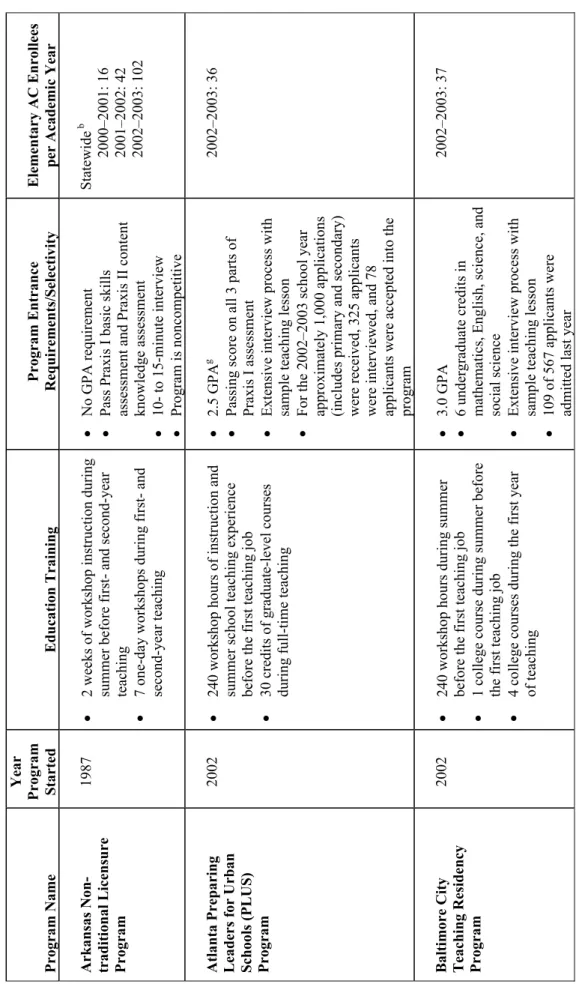
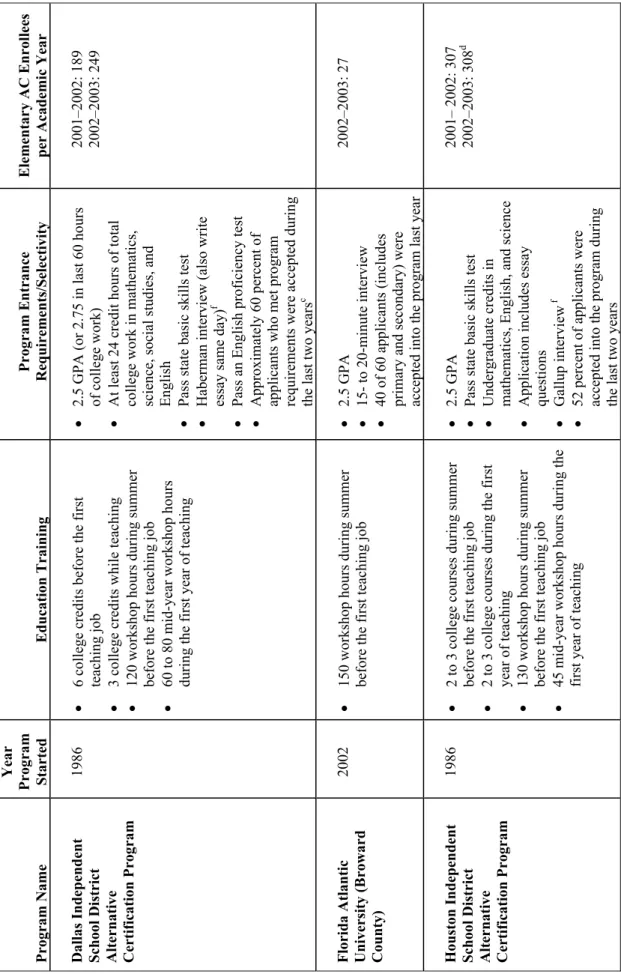
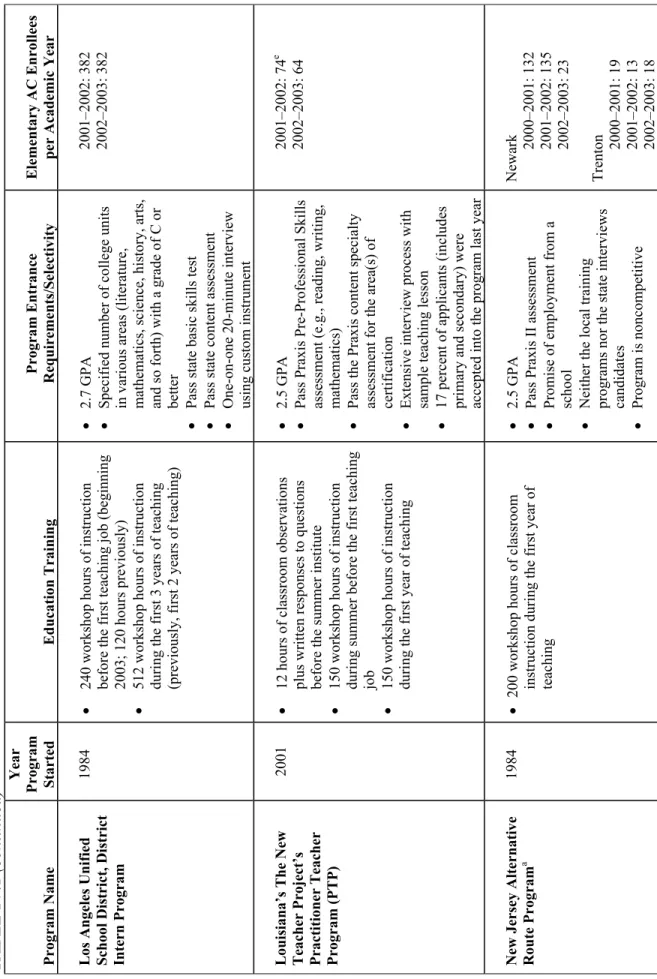
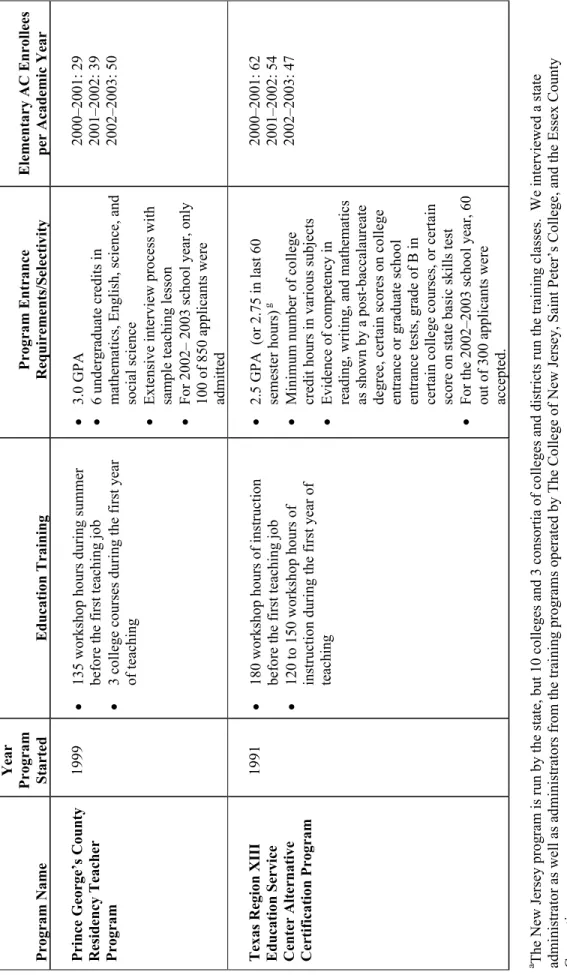
programs.16 Table IV.1 lists the 11 programs we focused on for this exploratory study.
(continued)
competency-based route. In existence for only one year, the Florida program is unique in that teachers can become certified without applying to and receiving training from a program. To become certified, candidates take an examination, are hired to teach, and then have up to three years to pass an assessment system developed by the state.
14 We interviewed an administrator from the privately run The New Teacher Project’s
Practitioner Teacher Program. In 2000, Louisiana’s Practitioner Teacher Program was piloted at 7 institutions of higher education and 1 private provider and is expanding to 12 higher education institutions and 2 private providers next year. The largest postsecondary programs, according to a Louisiana Department of Education official, are the University of New Orleans, Nicholls State University, and Louisiana College.
15For the purpose of this study, we considered New Jersey as operating one AC program.
Indeed, the New Jersey program is state-run and has statewide uniform education course load requirements and program entrance requirements. However, AC participants in New Jersey are assigned to one of 13 regional program providers (10 are run by colleges, 3 by consortia of colleges and districts) that in turn offer training at a total of 85 local training centers. To develop our understanding of this system and to identify areas of the state that may have the largest clusters of AC program graduates, we interviewed program officials and local school district officials in or near three cities: Newark (the Essex County Consortium program operated by Montclair State University and Newark Public Schools), Jersey City (served by the Essex consortium and by a program operated by Saint Peter’s College), and Trenton (program operated by The College of New Jersey).
16We were unable to establish whether one state that might meet our definition of minimal
training had any active elementary AC candidates. Pennsylvania’s Teacher Intern route requires minimal training, but the chief of the state’s Division of Certification noted that only the Philadelphia public schools can accept elementary AC candidates through this route. Whether any AC elementary candidates were using this option was not clear, however. Other researchers may want to consider gathering more information on the Teacher Intern route in the future.
TABLE IV.1
THE TRAINING AND ENTRANCE
REQUIREMENTS FOR 11 ALTERNATIV
E CERTIFICATION PROGRAMS
Program Name
Year
Program Started Education
Training
Program Entrance Requirements/Selectivity
Elementary AC Enrollees
per Academic Year
Arkansas Non- traditional Licensure Program
1987
•
2 weeks of workshop instruction during summer before first- and second-year teaching
•
7 one-day workshops during first- and second-year teaching
•
No GPA requirement
•
Pass Praxis I basic skills assessment and Praxis II content knowledge assessment
• 10- to 15-minute interview • Program is noncompetitive Statewide b 2000–2001: 16 2001–2002: 42 2002–2003: 102
Atlanta Preparing Leaders for Urban Schools (PLUS) Program
2002
•
240 workshop hours of instruction and summer school teaching experience before the first teaching job
•
30 credits of graduate-level courses during full-time teaching
•
2.5 GPA
g
•
Passing score on all 3 parts of Praxis I assessment
•
Extensive interview process with sample teaching lesson
•
For the 2002–2003 school year approximately 1,000 applications (includes primary and secondary) were received,
325 applicants
were interviewed, and 78 applicants were accepted into the program
2002–2003: 36
Baltimore City Teaching Residency Program
2002
•
240 workshop hours during summer before the first teaching job
•
1 college course during summer before the first teaching job
•
4 college courses during the first year of teaching
•
3.0 GPA
•
6 undergraduate credits in mathematics,
English, science, and
social science
•
Extensive interview process with sample teaching lesson
•
109 of 567 applicants were admitted last year
TABLE IV.1
(continued)
Program Name
Year
Program Started Education
Training
Program Entrance Requirements/Selectivity
Elementary AC Enrollees
per Academic Year
Dallas Independent School District Alternative Certification Program
1986
•
6 college credits before the first teaching job
•
3 college credits while teaching
•
120 workshop hours during summer before the first teaching job
•
60 to 80 mid-year workshop hours during the first year of teaching
•
2.5 GPA (or 2.75 in last 60 hours of college work)
•
At least 24 credit hours of total college work in mathematics, science, social studies, and English
•
Pass state basic skills test
•
Haberman interview (also write essay same day)
f
•
Pass an English proficiency test
•
Approximately 60 percent of applicants who met program requirements were accepted during the last two years
c
2001–2002: 189 2002–2003: 249
Florida Atlantic University (Broward County)
2002
•
150 workshop hours during summer before the first teaching job
•
2.5 GPA
•
15- to 20-minute interview
•
40 of 60 applicants (includes primary and secondary) were accepted into the program last year
2002–2003: 27
Houston Independent School District Alternative Certification Program
1986
•
2 to 3 college courses during summer before the first teaching job
•
2 to 3 college courses during the first year of teaching
•
130 workshop hours during summer before the first teaching job
•
45 mid-year workshop hours during the first year of teaching
•
2.5 GPA
•
Pass state basic skills test
•
Undergraduate credits in mathematics,
English, and science
•
Application includes essay questions
•
Gallup interview
f
•
52 percent of applicants were accepted into the program during the last two years 2001– 2002: 307 2002–2003: 308
TABLE IV.1
(continued)
Program Name
Year
Program Started Education
Training
Program Entrance Requirements/Selectivity
Elementary AC Enrollees
per Academic Year
Los Angeles Unified School District, District Intern Program
1984
•
240 workshop hours of instruction before the first teaching job (beginning 2003; 120 hours previously)
•
512 workshop hours of instruction during the first 3 years of teaching (previously, first 2 years of teaching)
•
2.7 GPA
•
Specified number of college units in various areas (literature, mathematics,
science, history, arts,
and so forth) with a grade of C or better
•
Pass state basic skills test
•
Pass state content assessment
•
One-on-one 20-minute interview using custom instrument 2001–2002: 382 2002–2003: 382
Louisiana’s The New Teacher Project’s Practitioner Teacher Program (PTP)
2001
•
12 hours of classroom observations plus written responses to questions before the summer institute
•
150 workshop hours of instruction during summer before the first teaching job
•
150 workshop hours of instruction during the first year of teaching
•
2.5 GPA
•
Pass Praxis Pre-Professional Skills assessment (e.g., reading, writing, mathematics)
•
Pass the Praxis content specialty assessment for the area(s) of certification
•
Extensive interview process with sample teaching lesson
•
17 percent of applicants (includes primary and secondary) were accepted into the program last year
2001–2002: 74
e
2002–2003:
64
New Jersey Alternative Route Program
a
1984
•
200 workshop hours of classroom instruction during the first year of teaching
•
2.5 GPA
•
Pass Praxis II assessment
•
Promise of employment from a school
•
Neither the local training programs nor the state interviews candidates
• Program is noncompetitive Newark 2000–2001: 132 2001–2002: 135 2002–2003: 23 Trenton 2000–2001: 19 2001–2002: 13 2002–2003: 18
TABLE IV.1
(continued)
Program Name
Year
Program Started Education
Training
Program Entrance Requirements/Selectivity
Elementary AC Enrollees
per Academic Year
Prince George’s County Residency Teacher Program
1999
•
135 workshop hours during summer before the first teaching job
•
3 college courses during the first year of teaching
•
3.0 GPA
•
6 undergraduate credits in mathematics,
English, science, and
social science
•
Extensive interview process with sample teaching lesson
•
For 2002– 2003 school year, only 100 of 850 applicants were admitted 2000–2001: 29 2001–2002: 39 2002–2003: 50
Texas Region XIII Education Service Center Alternative Certification Program
1991
•
180 workshop hours of instruction before the first teaching job
•
120 to 150 workshop hours of instruction during the first year of teaching
•
2.5 GPA (or 2.75 in last 60 semester hours)
g
•
Minimum number of college credit hours in various subjects
•
Evidence of competency in reading, writing, and mathematics as shown by a post-baccalaureate degree, certain scores on college entrance or graduate school entrance tests, grade of B in certain college courses, or certain score on state basic skills test
•
For the 2002–2003 school year, 60 out of 300 applicants were accepted. 2000–2001: 62 2001–2002: 54 2002–2003: 47
a The New Jersey program is run by the state, but 10 colleges a
nd 3 consortia of colleges and districts run the training classes.
We interviewed a state
administrator as well as administrators from the training program
s operated by The College of New Jersey, Saint Peter’s College
, and the Essex County
Consortium. b Rough estimates provided by the program director. c The program director provided this estimate but noted that th
e database was not capable of providing the actual number.
d The per year numbers are estimates based on our knowledge that
TABLE IV.1
(continued)
e The program director could not distinguish the elementary and
secondary enrollees, although she indicated that about 50 percent
of these enrollees teach at
the elementary level. f The Haberman Interview for Teachers of Children of Poverty and
the Gallup Organization’s Teacher Perceiver Interview are two co
mmonly used
standardized teacher interviews. g Program administrators claim that in pr
C. DETAILED DATA COLLECTION
We pursued detailed information on the selected set of programs in two primary ways:
telephone calls to senior program administrators (and in some cases to other contacts they
recommended, such as state and school district officials) and reviews of program Web pages.
For each AC program, we sought answers to the following major questions:
• When did the program begin and how stable is the program structure? In other
words, are the course requirements, entry requirements, or other dimensions likely to
change before an impact study is implemented?17
• What are the program’s entrance requirements and how selective is it in choosing
applicants for admission?
• How much education training does each program require both before and after
program participants begin teaching?
• How many elementary AC teachers does each program produce a year?
• How can NCEE find recent program graduates so that they may be included in an
impact study?
• What are the largest nearby traditional certification programs (those whose graduates
would likely comprise a large part of the comparison teachers in an impact study)?18
Whenever possible, we also pursued additional information on the AC programs, for
example, officials’ perceptions about program quality and requirements (their AC program
versus TC programs), demographics of AC elementary teacher trainees, instructional staff
backgrounds, attrition or graduation rates, mentoring and professional development support
provided to new AC teachers before full certification, and program placement services. In some
cases, despite repeated attempts on our part, we were not able to get information within a
17These are the most major questions we addressed, in most cases we were able to pursue
additional information on program operations as reflected in our interview discussion guide presented in Appendix C.