31
The determinant of commertial banks financial performance
in Ethiopia
Ketema Sime1; Kenenisa Lemie2; Endalew Gutu3*
1) Commercial Bank of Ethiopia Jimma District, Ethiopia
2) Management Department, College of Business and Economics Jimma University, Ethiopia 3) Accounting and Finance College of Business and Economics Jimma University, Ethiopia
*To whom correspondence should be addressed. Email: [email protected] DOI: 10.22437/ppd.v8i1.8682 Received: 04.02.2020 Revised: 10.03.2020 Accepted: 22.03.2020 Published: 30.04.2020 Abstract
The study was attempted to investigate determinants of financial performance of commercial banks in Ethiopian by using secondary data. The data were obtained from audited financial statements of five sampled commercial banks for the period of 1997 to 2017 and National Bank of Ethiopia. The study used return on assets (ROA) and return on equity (ROE) as dependent financial performance variable. Moreover, the study used bank specific variables as explanatory variables. Both descriptive statistics and econometrics model specifically fixed effects estimation were used to analyze the relationships of dependent variable with explanatory variables. The major findings of the study shows that bank specific determinants were very important in explaining financial performance of commercial banks. The management efficiency, customer deposit to total asset ratio, capital adequacy ratio, loan to deposit ratio were positively and significantly related to bank’s financial performance. The study recommends that banks put a lot of focus on their own internal processes since bank specific factors have the biggest impact on their profitability. Most importantly, Ethiopian commercial banks should invest in expand in new geographical area and also upscale their innovation leading to products attractive to consumers. Competition, which is the main industry specific factor affecting profitability, should be handled through well designed marketing strategy.
Keywords: Commercial banks, Financial performance, Internal factors JEL Classification: G21, G32
INTRODUCTION
Commercial banks play an important role in the development of a country. A sound, progressive and dynamic banking system is a fundamental requirement for economic development. As an important segment of the tertiary sector of an economy, commercial banks act as the backbone of economic growth and prosperity by acting as a catalyst in the process of development. They inculcate the habit of saving and mobilize funds from numerous small households and business firms spread over a wide geographical area. The
32 funds so mobilized are used for productive purposes in agriculture, industry and trade (Vossen, 2014).
Banking system as one part of financial institution plays an important role in economic growth and development of a country. Efficient banking system reflects a sound intermediation process and enhances the banks’ sustainability. Efficient functioning of commercial banks’ is a best indicator of effective monetary and polices (Aikaeli, 2008; Andries, 2010).
Banking system is very important for the modern economy. As financial intermediaries, banks pool resources from savers and distribute to potential investors, allocate resources, and provide liquidity and payment services. Considering this vital role, it is very important to develop a sound banking system in which banks operate with good performance. To measure performance of banking sector, two kinds of measurement, namely financial ratio measures and efficiency measures are widely used (Suzuki & Sastrosuwito, 2011).
Banks Financial performance is a measure of how well a firm can use assets from its primary mode of business and generate revenues. This term is also used as a general measure of a firm's overall financial health over a given period of time, and can be used to compare similar firms across the same industry or to compare industries or sectors in aggregation. Aburime (2008) observed that the importance of bank profitability can be appraised at the micro and macro levels of the economy. At the micro level, profit is the essential prerequisite of a competitive banking institution and the cheapest source of funds. Hence the basic aim of every bank management is to maximize profit, as an essential requirement for conducting business. At the macro level, a sound and profitable banking sector is better able to withstand negative shocks and contribute to the stability of the financial system. Bank profits provide an important source of equity especially if re-invested into the business. This should lead to safe banks, and as such high profits could promote financial stability (Flamini .2009).
Bank financial performance is important because of its effect on the performance of the whole economy. Good financial performance of banks facilitates economic development by making the saving-investment process more smooth, efficient, and easier to reach. The failure of a single bank, on the other hand, can not only affect its shareholders and depositors but also the rest of other banks and all other business. This in turn causes major distress on the economy as a whole (Rao, 2017).
The banking sector in Ethiopia has become very competitive in the recent past with the players in the industry taking keen interest on the financial performance as it is the prerequisite for the banks survival both in the short term and long term. With the continued entry of new players in the industry and a rise in the number of non-bank financial institutions that also offer financial services, there is need for adoption of prudent management policies and strategies that propels the banks forward in terms of increased performance of which financial performance forms the major integral part. Banks face several risks in their operations which may affect their performance. These risks may be traced to the assets and liabilities of the bank which ultimately threatens the financial position of the bank and hence its long term survival (Joseph, 2015).
Banking sectors play a crucial role in the national economic development by balancing the flow of funds from surplus economic unit of the economy to deficit economic. Measurement of banking financial sector is cannot be neglected, since, it plays an important pillar role in financial sector of economy units (Khan, 2006). Schumpeter & Backhaus (2003) acknowledges and accepted the role of financial institutions and banks in economic development of the country.
33 All commercial banks provide services such as offering basic investment products, making business loans, and accepting deposits. Services like deposit collections and loan disbursement to and/or from large businesses or corporations as opposed to retail banking can be deals with commercial banks. The term commercial bank also helps to distinguish it from investment banks because of their regulation is different in United States. (Belayneh, 2011).
In the 1990s, after the great depression the U.S congress separate the activities of both banks and the commercial banks only engage in banking activities whereas, investment bank where limited to capital market activities only(Samuel,2015).
Credit-related securities, interest rate service, make market in the currency, merchant banking and private equity financing, cash management and treasury, securities under writing commitments and other form of off-balance sheet exposure, performance bonds, providing documentary study guarantees, installment loans, lending money bay overdraft, accepting money on term deposit, issuing banks draft and banks cheque, providing internet, mobile and pos machine service, processing payment via telegraphic and electronic fund transfers are some common activities which provided by commercial banks (Samuel, 2015).
There are two common ways of classifying bank performance determinant factors. For instance, classified banks performance determinant factors are internal (bank specific) and external (macro-economic) factors. The bank specific (internal) factors are the characteristics of individual banks which can affect the performance of the bank. Bank specific or internal factors are operating environment and technology, human capital, management efficiency, business risk, loan performance, earning quality, liquidity, net-worth, asset quality, asset size and capital adequacy are some common internal determinants of banks performance. Macro-economic or external factors includes: bank concentration and regulation, inflation rate, real economic activities (GDP) and tax rate (Aburime, 2005).
The main objective of this study is to analysis the determinants of financial performance of commercial banks in Ethiopia. Depending on the reviewed developed theories by deferent researchers which have a relation with the banks financial performances and the reviewed literatures of different past empirical studies that has the relation with banks financial performances and the objectives of the study, the following eight hypotheses in this study.
H1: There is positive relationship between capital adequacy and financial performance of the banks.
H2: There is negative relationship between asset quality and bank’s financial performance.
H3: There is positive relationship between management efficiency and banks financial performance.
H4: There is negative relationship between loan to deposit ratio and bank’s financial performance.
H5: There is positive relationship between liquidity ratio and bank’s financial performance.
H6: There is negative relationship between numbers of branches and bank’s financial performance.
H7: There is negative relationship between non-performing loan and bank’s financial performance.
H8: There is negative relationship between deposit to total asset ratio and bank’s financial performance.
34 METHODS
Research design
A descriptive design was used in the study. Descriptive research design is a type of research method that is used when a researcher wants to get information on the current status of a person or an object. It is used to describe what is in existence in respect to conditions or variables that are found in a given situation.
Sampling technique.
The population of this study was public and private banks that were operated over the period of 1997/98–2017/18. The sampling techniques was non-probability judgment (purposive) sampling method. The most important criteria used was the Government and private commercial banks which submitted and completed their financial statements of twenty (20) consecutive based on age of commercial banks from year 1997/98 – 2017/18. Data source and collection method
The researcher used secondary source of data. In order to analyze the effect of bank specific variables, computed ratios for five Commercial banks for twenty (20) consecutive years .i.e. from 1997/98-2017/18 GC were collect from the secondary sources of data obtained from published sources such as the National bank of Ethiopia.
Model specification of the study
The scope of the study is limited to examine the effect of internal factors that affect the financial performance of commercial banks, comprising of capital adequacy, asset quality, management efficiency, earning quality, liquidity, and numbers of branches, capital adequacy and operational efficiency.
A multiple linear regression model was used to determine the relative importance of each independent variable to determine banks financial performances. The multiple linear regressions model for return on asset (ROA) and return on equity (ROE) is shown on equations below. The left hand variable Y represents the dependent variable in the model, which in this particular study was the firm’s gross profit to total asset. X Contains the set of explanatory or independent variables in the estimation model. The adopted regression models are:
𝑅𝑂𝐴𝑖𝑡 = 𝐶𝑖 + 𝛼1𝐶𝐴𝑖𝑡 + 𝛼2𝐴𝑆𝑄𝑖𝑡 + 𝛼3𝑀𝐺𝐸𝑖𝑡 + 𝛼4LIQit+ 𝛼5NOBit + 𝛼6LTit + 𝛼7NPLit + 𝛼8CDIT+𝑒𝑖 ... (1)
𝑅𝑂𝐸𝑖𝑡 = 𝐶𝑖 + 𝛼1𝐶𝐴𝑖𝑡 + 𝛼2𝐴𝑆𝑄𝑖𝑡 + 𝛼3𝑀𝐺𝐸𝑖𝑡 + 𝛼4LIQit+ 𝛼5NOBit + 𝛼 6LTit + 𝛼7NPLit
+ 𝛼8CDIT+𝑒𝑖... (2) Whereas;
ROAit = return on asset of bank i at time t
ROEit = return on equity of bank i at time t
CAit = Capital adequacy of bank i at time t
ASQit = Asset quality of bank i at time t
MGEit = Managerial efficiency of bank i at time t
LIQ𝑖𝑡 = liquidity of bank i at time t
NOBit = Number of branches of the bank i at time t
NPLit = nonperforming loan of the bank i at time t
LTDit = Loan to deposit Ratio of the bank i at time t
CDit = customer deposit to total asset ratio of the bank i at time t
Ci = constant for each bank (fixed effects)
a = bank specific factors t = 1997-2017
35 RESULTS AND DISCUSSION
Variable description
The determinants of financial performance banking sectors have been studied by many researchers across the world. However, the literature lacks more evidence regarding Ethiopian context. Thus, this study was conducted to examine the determinant of internal factor of commercial banks in Ethiopian context to contribute its own effort for the evidence.
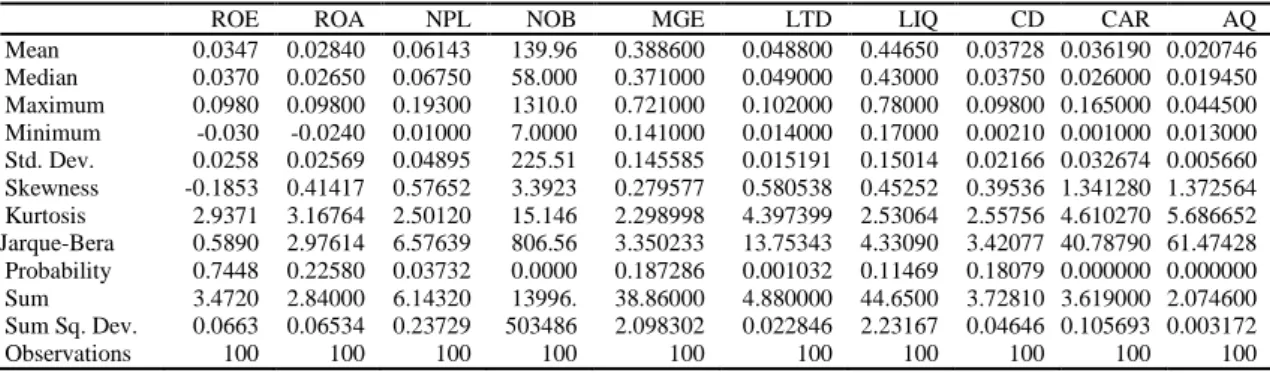
Table 1.Variable description
As indicated from Table 1, ROE measured by the net profit divided by total equity of the bank measures how much the banks are efficiently earning from funds invested by its shareholders. As shown the ROE within the period of the study was 3.4% while the median was 3.7%. The maximum ROE was 9.8% while the minimum was -3.0%. The average of ROA was 2.8%, median was2.6 %, the maximum was 9.8% and minimum was -2.4%. It has a standard deviation of 0.026.
The average value of nonperforming loan (NPL) within the period of the study was 6.1% and the median 6.75%. Non performing loan was maximum and minimum with the values of 0.193 and 0.01 respectively. The average value of number of branch was 139% while median was 58%. The maximum value of number of branch was 1310 while the minimum was 7. Ithas a standard deviation of 225.
The average value of management efficiency (MGE) within the period of the study was 3.9% and the median 3.7%. Management efficiency was maximum and minimum with the values of 0.72 and 0.14 respectively, while the standard deviation was 0.145. The average value of loan to deposit ratio (LTD) was 4.88% while median was 4.9%. The average value of liquidity ratio (LIQ) was 44.6% while median was 43%. The average value of customer deposit to total asset ratio (CDTA) was3.7% while median was 3.7%. The average value capital adequacy ratio (CAR) was 3.6% while median was 2.6%. As revealed by the ten columns, the average value asset quality (AQ) was 2.07% while median was 4.4%. The maximum value of asset quality was 0.044 while the minimum was 0.013. Generally mean shows average of return of commercial banks from its asset and capital and maximum and minimum shows most profit and least profit from single birr prospectively.
The effect of internal factors on the financial performance of commercial banks Under this parts of the study regression analysis for the financial performance of banks measures like ROA and ROE have been discussed to understand the relationship between banks financial performance measures and independent variables. Two regression analyses were done to know the relationship between financial performance measures and those independent variables like, nonperforming loan, liquidity ratio, capital adequacy ratio, loan to deposit ratio, number of branch, asset quality, customer
ROE ROA NPL NOB MGE LTD LIQ CD CAR AQ Mean 0.0347 0.02840 0.06143 139.96 0.388600 0.048800 0.44650 0.03728 0.036190 0.020746 Median 0.0370 0.02650 0.06750 58.000 0.371000 0.049000 0.43000 0.03750 0.026000 0.019450 Maximum 0.0980 0.09800 0.19300 1310.0 0.721000 0.102000 0.78000 0.09800 0.165000 0.044500 Minimum -0.030 -0.0240 0.01000 7.0000 0.141000 0.014000 0.17000 0.00210 0.001000 0.013000 Std. Dev. 0.0258 0.02569 0.04895 225.51 0.145585 0.015191 0.15014 0.02166 0.032674 0.005660 Skewness -0.1853 0.41417 0.57652 3.3923 0.279577 0.580538 0.45252 0.39536 1.341280 1.372564 Kurtosis 2.9371 3.16764 2.50120 15.146 2.298998 4.397399 2.53064 2.55756 4.610270 5.686652 Jarque-Bera 0.5890 2.97614 6.57639 806.56 3.350233 13.75343 4.33090 3.42077 40.78790 61.47428 Probability 0.7448 0.22580 0.03732 0.0000 0.187286 0.001032 0.11469 0.18079 0.000000 0.000000 Sum 3.4720 2.84000 6.14320 13996. 38.86000 4.880000 44.6500 3.72810 3.619000 2.074600 Sum Sq. Dev. 0.0663 0.06534 0.23729 503486 2.098302 0.022846 2.23167 0.04646 0.105693 0.003172 Observations 100 100 100 100 100 100 100 100 100 100
36 deposit to total asset ratio and management efficiency.
The effect of internal factors on ROA
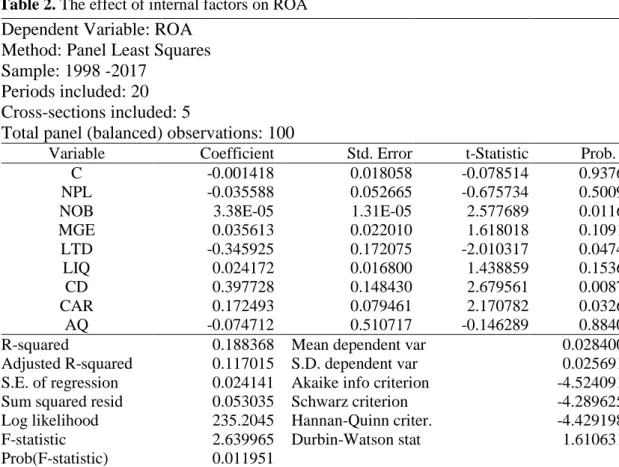
To analysis the relationship between commercial banks financial performance measures and others independent variables two regression analyses were undertaken. The first one was examining the relationship between ROA and explanatory variables. The model of regression was applied as follow:
Table 2. The effect of internal factors on ROA
Dependent Variable: ROA Method: Panel Least Squares Sample: 1998 -2017
Periods included: 20 Cross-sections included: 5
Total panel (balanced) observations: 100
Variable Coefficient Std. Error t-Statistic Prob.
C -0.001418 0.018058 -0.078514 0.9376
NPL -0.035588 0.052665 -0.675734 0.5009
NOB 3.38E-05 1.31E-05 2.577689 0.0116
MGE 0.035613 0.022010 1.618018 0.1091 LTD -0.345925 0.172075 -2.010317 0.0474 LIQ 0.024172 0.016800 1.438859 0.1536 CD 0.397728 0.148430 2.679561 0.0087 CAR 0.172493 0.079461 2.170782 0.0326 AQ -0.074712 0.510717 -0.146289 0.8840
R-squared 0.188368 Mean dependent var 0.028400
Adjusted R-squared 0.117015 S.D. dependent var 0.025691
S.E. of regression 0.024141 Akaike info criterion -4.524091
Sum squared resid 0.053035 Schwarz criterion -4.289625
Log likelihood 235.2045 Hannan-Quinn criter. -4.429198
F-statistic 2.639965 Durbin-Watson stat 1.610631
Prob(F-statistic) 0.011951
As the result indicated in above table loan to deposit ratio, and capital adequacy statically significant at 5% and also number of branch and customers deposit ratio statically significant at 1% management efficiency and liquidity ratio statically significant at 10% level of significances level with ROA. This means loan to deposit, management efficiency, number of branch capital adequacy ratio, customer deposit and liquidity ratio, have a great impact to improve the financial performances of commercial banks. Number of branch, capital adequacy, customer deposit ratio, and liquidity ratio has positive relationship with return on asset which is positive 3.38, 0.17, 0.39 and 0.024 respectively. This means increase in number of branch, management efficiency, capital adequacy, customer deposit ratio, and liquidity ratio directly related with the growth of capital of the bank, as the capital of the bank increase the ability of the bank to provide loan to borrowers also increase this leads the bank to get more return and having strong financial performance. Increase 1% in number of branch, management efficiency, capital adequacy, customer deposit ratio, and liquidity ratio is increase financial performance of bank by 3.38, 0.036, 0.17, 0.39 and 0.024 units respectively.
Loan to deposit ratio have negative relationship with ROA. This means as loan to deposit variables become increased the financial performances of the commercial banks become poor. When the loan to deposit becomes increase the cost of the bank also
37 increase this may directly damage the financial growth of the bank and decrease in financial performance. 1% increase in loan to deposit ratio is decrease financial performance of bank by 0.34 percent.
R-squared is measured the goodness and the fitness of independent variable in explaining the variations in banks financial performance measures of ROA. As the result indicated in the above table R-squared values for the model of regression was 0.188. This result tells us as all variables in this study jointly explain about 18.8 percent of the variation in the bank’s financial performance measure of ROA. The remaining 81.2 percent of the variation in the financial performances of commercial banks of Ethiopia were explained by other variables which is not included in the study. The model is well fitted at 5% percent significant level.
The effect of internal factors on ROE
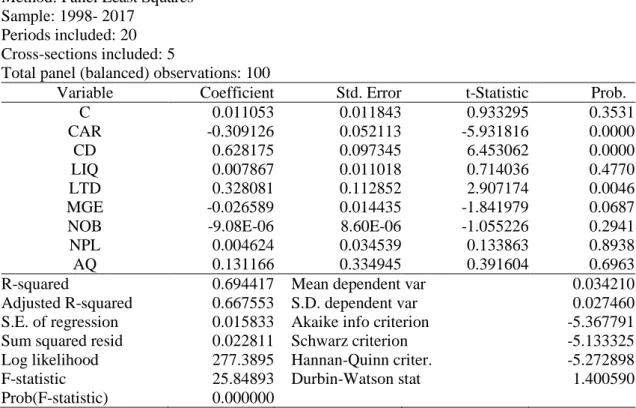
ROE is a ratio derived from net income divided by total equity called return on shareholders ‘equity. It is also an essential profitability ratio that discloses the bank’s profit over shareholders’ investment (Guru, 2010). Under this section the second regression analysis was conducted to know how much ROE which is the bank earning on their equity investment in relation with independent variables included in this study.
Table 3. The effect of internal factors on ROE Dependent Variable: ROE
Method: Panel Least Squares Sample: 1998- 2017
Periods included: 20 Cross-sections included: 5
Total panel (balanced) observations: 100
Variable Coefficient Std. Error t-Statistic Prob.
C 0.011053 0.011843 0.933295 0.3531 CAR -0.309126 0.052113 -5.931816 0.0000 CD 0.628175 0.097345 6.453062 0.0000 LIQ 0.007867 0.011018 0.714036 0.4770 LTD 0.328081 0.112852 2.907174 0.0046 MGE -0.026589 0.014435 -1.841979 0.0687
NOB -9.08E-06 8.60E-06 -1.055226 0.2941
NPL 0.004624 0.034539 0.133863 0.8938
AQ 0.131166 0.334945 0.391604 0.6963
R-squared 0.694417 Mean dependent var 0.034210
Adjusted R-squared 0.667553 S.D. dependent var 0.027460
S.E. of regression 0.015833 Akaike info criterion -5.367791
Sum squared resid 0.022811 Schwarz criterion -5.133325
Log likelihood 277.3895 Hannan-Quinn criter. -5.272898
F-statistic 25.84893 Durbin-Watson stat 1.400590
Prob(F-statistic) 0.000000
Table above depict that the customer deposits, loan to deposit ratio, and capital adequacy ratio statically significant at 5% level of significances level with ROE. This means customer’s deposit, loan to deposit ratio, and capital adequacy ratio, have a great impact to improve the financial performances of commercial banks. Customer deposit ratio and loan to deposit ratio has positive relationship with ROE which is positive 0.628 and 0.328 respectively. This means increase in customer deposit, and loan to deposit ratio directly related with the growth of capital of the bank, as the capital of the bank increase the ability of the bank to provide loan to borrowers also increase this leads the bank to get more return and having strong financial performance.
38 Capital adequacy ratio and management efficiency has negative relationship with ROE. This means as Capital adequacy ratio and management efficiency variables become increased the financial performances of the commercial banks become decrease. OR 1% increase in customer deposit ratio and loan to deposit ratio in -0.309 and -0.0265 unit decrease financial performance of commercial banks.
This result tells us as all variables in this study jointly explain about 69.4 percent of the variation in the bank’s financial performance measure of ROE. The remaining 30.6 percent of the variation in the financial performances of commercial banks of Ethiopia were explained by other variables which is not included in the study. The model is well fitted at 5%percent significant level.
Ben & Goaied (2008) in Yesmine & Bhuiyah (2015) examined the impact of bank characteristics, financial structure, and macroeconomic conditions on Tunisian banks’ net-interest margin and profitability during the period of 1980 to 2000. They suggested that banks that hold a relatively high amount of capital and higher overhead expenses tend to exhibit higher net-interest margin and profitability levels, while size is negatively related to bank profitability. The study also concluded that during the period under study stock market development had positive impact on banks’ profitability and private banks were relatively more profitable than their state owned counterparts. The results suggested that macroeconomic conditions had no significant impact on Tunisian banks’ profitability.
Aworemi, Odeyemi & Oyedokun (2012), Akinwale (2011), Dickson (2012) carried out study in Nigerian Banking industry activities in Nigeria did not meet the desired objectives of liquidity, capital adequacy and corporate governance which have resulted to more troubled banks after the consolidation and studied Risk Management and Project Appraisal in Nigerian Banking industry. It was observed from the findings that Nigerian banks make use of risk analytical techniques in their investment appraisal.
CONCLUSIONS AND RECOMMENDATIONS Conclusions
The management efficiency and ROA have positive relationship. This means management efficiency has positively relationship with financial performances of the banks measures of ROA and have significant influence on the banks performances or an increase in management efficiency leads to increase in financial performances of commercial banks of Ethiopia.
Loan to deposit ratio have negative relationship with ROA. This means as loan to deposit variables become increased the financial performances of the commercial banks become poor. When the loan to deposit becomes increase the cost of the bank also increase this may directly damage the financial growth of the bank and decrease in financial performance..
Recommendations
The management organs of commercial banks of Ethiopia should be initiative to strengthen the internal factors like capital adequacy, management efficiency, and loan to deposit. Because of all commercial banks of Ethiopia have the same future vision which is to become financially strong banks.
Now a day most population of Ethiopians is not aware about the saving habits and how important of saving in bank. So, all financial intermediaries’ in Ethiopia should create the awareness towards the saving habit and the importance of using bank and also they should expand their branch networks in each villages of Ethiopia and support the
39 development of the country by increasing number of branches, number of bank accounts per person, number of bank credit per person.
REFERENCES
Aikaeli, J. (2008). Commercial Banks Efficiency in Tanzania. Paper Presented at a CSAE Conference on Economic Development in Africa. Oxford: St. Catherine’s College.. Ajibola, J. O. (2016). The Effects of Assets and Liability Management on Financial Performance of Some Selected Nigerian Banks. Journal of Accounting and Financial Management, 2(2), 44 - 63
Alper, D. & Anbar, A. (2011). Bank Specific and Macroeconomic Determinants of Commercial Bank Profitability: Empirical Evidence from Turkey. Business and Economics Research Journal, 2(2), 139-152.
Ameur, I., G., Mhiri, S., M., (2013). Explanatory Factors of Bank Performance Evidence from Tunisia. International Journal of Economics, Finance and Management, 2(1), 143 - 152
Andries, M. A. (2010). The determinants of bank efficiency and productivity growth in the central and Eastern European banking systems. Eastern European Economics, 49(6), 38 - 59.
Anjichi, D. A. (2014). Effects of asset and liability management on the financial performance of commercial banks in Kenya. (Unpublished master’s thesis). School of Business, University of Nairobi, Kenya.
Aworemi, J.R., Odeyemi, J.T & Oyedokun, J.A. (2012). Efficacy of Products Marketing Strategy on the Performance of United Bank of Africa, Plc in South-Western Nigeria. International Journal of Business and Social Science, 3(10), 319 - 324. Belayneh, H. (2011). Determinants of Commercial Banks Profitability: An empirical
study on Ethiopian Commercial Banks. (Unpublished master’s thesis). Addis Ababa University, Ethiopia.
Flamini, V., McDonald, C. & Schumacher, L. (2009).The Determinants of Commercial Bank Profitability in Sub-Saharan Africa. IMF Working Paper, WP/09/15.
Gikonya, A. (2011). The effect of asset liability management on profitability of commercial banks in Kenya. (Unpublished master’s thesis). School of Business, University of Nairobi, Kenya.
Joseph, M.T. (2015). The effect of asset liability management on financial performance of micro finance banks in Kenya. Journal of Business Finance and Accounting, 3(4), 573-587.
K.P.Venugopala Rao (2017). Financial Performance Analysis of Banks – A Study of IDBI Bank. International Journal of Research in IT and Management (IJRIM), 7(1), 64 - 72
Sahay, R., Cihak, M., N’Diaye, P., Barajas, A., Bi, R., Ayala, D., Gao, Y., Kyobe, A., Nguyen, L., Saborowski, C., Svirydzenka, K. and Yousefi, S. R. (2015). Rethinking financial deepening: stability and growth in emerging markets. IMF Staff Discussion. Notes 15/08, International Monetary Fund.
Schumpeter J., & Backhaus U. (2003) The Theory of Economic Development. In: Backhaus J. (eds) Joseph Alois Schumpeter. The European Heritage in Economics and the Social Sciences (vol 1). Springer, Boston, MA
Suzuki, Y. & Sastrosuwito, S. (2011). Efficiency and Productivity Changeof the Indonesian Commercial Banks. International Conference on Economics, Trade and Development, 7, 10 – 14
40 University at Albany, State University of New York.
Yesmine, S. & Bhuiyah, M.S.U (2015) Determinants of Banks’ Financial Performance: A Comparative Study between Nationalized and Local Private Commercial Banks of Bangladesh. International Journal of Business and Management Invention, 4(9), 33 - 39
© 2020 by the authors. Licensee JPPD, Indonesia. This article is an open access article distributed under the terms and conditions of the Creative Commons Attribution (CC BY) license (http://creativecommons.org/licenses/by/4.0/).