Intelligence
Report
I
Executive Summary
3II
Global Data Analysis
4Malicious Activities – Source Countries 4
Attack Distribution – Top 03 Foreign Attackers 4
III
Malware Attacks
6Most Probing Countries 6
Most Probing Countries – Unique IP Addresses 7
Most Probing IP Addresses 7
Most Attacking IP Addresses 8
Attacking IP Addresses – 10 Attacks 9
Top Vulnerabilities 11
Most Malwares Detected 12
Detected Malware Hashes 13
Cnc IP Addresses & Domains 13
Attacked Protocols 14
IV
SIP Attacks
15What is SIP? 15
V
Web Attacks
16IP Addresses Conducting Web Based Attacks 16
Web Attack Payloads 16
VI
Brute-Force Attacks
18Most Usernames Used 18
Most Passwords Used 18
Top IP Addresses Conducting SSH Attacks 19
Tools Used For SSH Based Attacks 19
VII
References
20VIII
About TRIAM
21IX
About Contributors
22Executive
Summary
To be able to respond to any threat effectively, one mustfirst identify the threat agents, understand their motives
and study their means of attack comprehensively, i.e. one must achieve situational awareness to be able to defend against, respond to, or counter a threat.
In an effort to provide situational awareness to the in-dustry stakeholders, about the cyber threat landscape of Pakistan, the TRIAM Threat Intelligence Team is extremely proud to present you this monthly Threat Intelligence re-port for the month of April 2015.
In this edition of our monthly Threat Intelligence report we have observed interesting set of activities being per-formed in Pakistan cyberspace. One of the interesting observations has been the increased number of attacks coming IP Addresses of China coinciding with the Chi-nese Prime Minister’s visit to Pakistan in April. The details of these attacks, and all other attacks are documented in this report. The major set of attacks that have been dis-covered recently in Pakistan by global and TISS’ research and IR teams are summarized as follows:
Equation Group – Equation Group is the most advanced APT group found so far and is called the Crown Crea-tor of Cyber Espionage. According to Kaspersky Lab’s researchers the group is unique in almost every aspect of their activities: they use tools, that are very advanced and expensive to develop, in order to infect victims, re-trieve data and hide activity in a professional way, and also utilize classic spying techniques to deliver malicious payloads to the victims. More details for this advanced APT group can be found on:
https://securelist.com/blog/research/68750/equation-the-death-star-of-malware-galaxy/
Ransomware – Ransomware malware is constantly af-fecting Pakistan based organizations with key motive of
financial gains. Ransomware works by encrypting data of
infected machines belonging to organizations and indi-viduals thus completely blocking the access to the data. The decryption key is sent only if a ransom is paid. There has been exponential increase in number of Ransomware attacks in the year 2015 and taking preventive measures from this threat is highly recommended at all layers. If you require more details on these threats or are
ex-posed to these or different malwares, please reach out to us for focused and quick response.
This report has been compiled using our advanced threat intelligence gathering platform consisting of sensors like honeypots, web crawlers and aggregators deployed through-out Pakistan. The information obtained using these sensors are then enriched by correlating informa-tion from different sources. Our aim for releasing these monthly reports is to enable all stakeholders in Pakistan to keep abreast with on-going threats and remain vigi-lant in protecting their networks from potential attacks. Trillium will soon make these threat feeds available to Pakistan based organizations so that their Security Infor-mation and Event Management (SIEM) systems, Firewalls and Intrusion Detection / Prevention Systems can be fed
to provide protection against Pakistan specific attacks.
In month of
April
information gathered from our sensors indicates that:
• Multiple IP addresses particularly from China have been probing Pakistan cyberspace actively and look-ing for vulnerabilities to exploit.
• Attacks of different nature that materialized and had a major impact have been observed coming from Romania, China and Brazil.
• Among the detected malwares that are most active in Pakistan cyberspace, 96% activity has been ob-served for Net-Worm.Win32.Kido.ih – an infamous worm that hogs network resources and is spread by
exploiting Microsoft OS specific vulnerabilities.
The details of information gathered by our sensors are described further in this report.
We hope that you find this month’s report useful and feel
free to contact us with any feedback. DFIR Research team, Threat Intelligence
www.triam.com.pk www.infosecurity.com.pk
Global
Data Analysis
This section presents analysis of attack data from sensors deployed at different places in Pakistan. We process millions of log entries and security alerts that are being captured by our custom and purpose built sensors during the threat analysis. In order to provide real time threat intelligence and security alerts to our customers – we perform advanced analytics on the collected alerts by correlating security events from multiple sensors
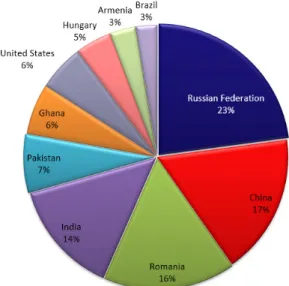
The countries hosting IP addresses that are carrying out malicious activities in Pakistan cyberspace are shown in Figure 1.
Malicious Activities -
Source/Host Countries
Figure 1 - Percentage of events by source/host countries
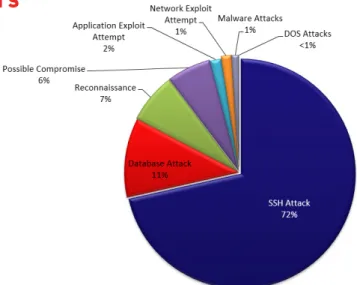
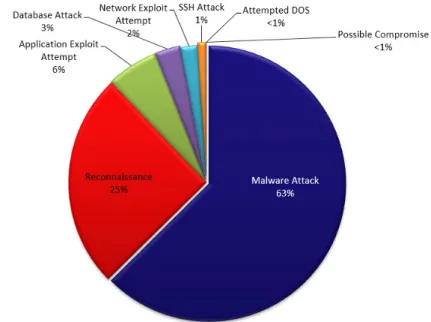
The following figures present
the distribution of attack types originating from top three countries hosting the attacking IP addresses. It is quite evident from the following
figures that attack type distributions
of each originating/hosting country is very different from the other. These
figures reflect the fact that attack
types, motivation of attackers, and sophistication of attacks are different in different regions of the World.
Attack Distribution -
Top 03 Foreign Attackers
Figure 3 - Attacks Originating from IP Addresses Hosted in Romania
Malware
Attacks
Malware attacks are the major threats being faced by Pakistani organizations. Using the Internet, attackers employ unique malware based techniques to infect their target systems for different reasons varying from creating mere
nuisance to stealing credentials to eavesdropping on communication to capturing proprietary and highly confidential
information.
Attackers scan the Internet to look-out for vulnerable services and try to exploit them to gain access to the system and ultimately the network. Often root-kits (type of malware) are used to take over and maintain control of a compromised
system. The following section of the report will present the latest trends of malware based attacks which were identified
based on the information gathered from our sensors during the month of April.
The correlated information from different sensors reveals that there were more than 2,54,000 number of connection attempts to Pakistan cyberspace from different countires of the world. Furthermore, we detected more than 57,000
materialized attacks that were launched in this period. Over 9,000 unique IP addresses tried to establish a connection with our deployed sensors through-out Pakistan at-least once.
After thorough automated analysis and correlation, most of these connection attempts were classified as malicious and were doing intense scanning for figuring out running services (particularly the vulnerable ones) over Pakistan
cyberspace.
One of the top IP address that established most number of connections was found to be 89.40.31.192 with more than 38,400 connections. The origin of this IP address was found to be Romania. There were about 1900 unique IP addresses that succeeded in exploiting a particular vulnerability and uploaded some malware. Total number of attacks launched during this time period was more than 57,000.
One of the top IP addresses that initiated most number of attacks was found to be 89.40.31.192 with about 12,300
successful attacks. The origin of this IP address was found to be Romania. The most number of attacks were launched by exploiting MS08-067, MS08-068, MS09-001 vulnerabilities, which could allow remote code execution.
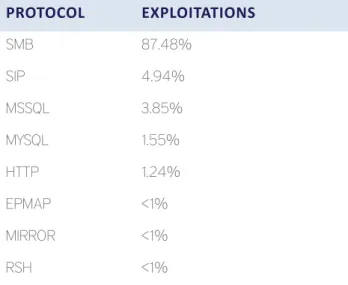
Furthermore, as per our correlated information, port 445 received the highest number of attack traffic with 87.48% of total attacks received. The service hosted on port 445 was SMBD (Server Message Block Daemon).
Further information related to IP addresses trying to make connections and doing attacks, top malware found, top vulnerabilities exploited and top protocol / services exploited is given below.
The IP Addresses from countries doing the most probing and connection attempts are shown in Figure 5.
Probing is done to find services
running on targeted systems and their corresponding vulnerabilities in the target machines which can be exploited.
Most Probing
Countries
The Figure 6 shows the countries hosting the highest number of unique IP addresses that are found to be making connections and doing probing.
Unique IP Addresses
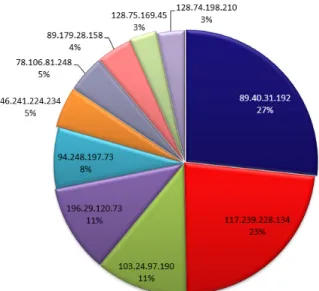
The Figure 7 shows the list of individual IP addresses that are found to be making connections and doing probing.
Most Probing
IP Addresses
IP Addresses Connection Attempts Country
89.40.31.192 38,444 Romania 117.239.228.134 33,135 India 103.24.97.190 16,326 Pakistan 196.29.120.73 15,661 Ghana 94.248.197.73 10,788 Hungary 46.241.224.234 7,181 Armenia 78.106.81.248 6,639 Russian Federation 89.179.28.158 6,271 Russian Federation 128.75.169.45 4,830 Russian Federation 128.74.198.210 4,781 Russian Federation
Table 1 - IP Address Based Connection Distribution
Table 1, shows a list of Top 10 unique IP addresses that established highest number of connection attempts.
Figure 7 - IP Based Conection Distribution Figure 6 - Country Based Unique IP Distribution
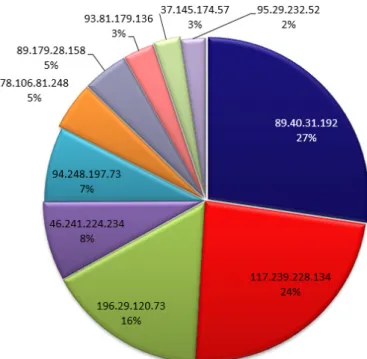
Figure 8 gives the list of individual IP addresses that initiated most number of malware attacks by successfully exploiting vulnerabilities.
Most Attacking
IP Addresses
IP Addresses Successful Attacks Country
89.40.31.192 12357 Romania 117.239.228.134 10680 India 196.29.120.73 7266 Ghana 46.241.224.234 3576 Armenia 94.248.197.73 3402 Hungary 78.106.81.248 2175 Russian Federation 89.179.28.158 2053 Russian Federation 93.81.179.136 1384 Russian Federation 37.145.174.57 1228 Russian Federation 95.29.232.52 1101 Russian Federation
Table 2 below shows the list of Top 10 IP Addresses that launched highest number of attacks.
Table 2 - IP Address Based Distribution
IP Addresses Successful Attacks Country 89.40.31.192 12357 Romania 117.239.228.134 10680 India 196.29.120.73 7266 Ghana 46.241.224.234 3576 Armenia 94.248.197.73 3403 Hungary 78.106.81.248 2175 Russian Federation 89.179.28.158 2053 Russian Federation 93.81.179.136 1384 Russian Federation 37.145.174.57 1228 Russian Federation 95.29.232.52 1101 Russian Federation 37.146.102.200 1000 Russian Federation 78.106.128.120 995 Russian Federation 37.145.177.90 934 Russian Federation 89.179.191.88 641 Russian Federation 95.29.208.177 495 Russian Federation 95.29.218.25 364 Russian Federation 59.103.197.121 362 Pakistan 2.94.120.46 358 Russian Federation 128.75.187.7 300 Russian Federation 93.80.248.154 267 Russian Federation 93.80.189.33 259 Russian Federation 189.4.133.231 243 Brazil 93.80.239.232 229 Russian Federation 128.74.221.216 220 Russian Federation 93.81.184.86 220 Russian Federation 187.21.245.55 206 Brazil 37.145.178.237 188 Russian Federation 189.4.134.2 160 Brazil 187.21.246.10 157 Brazil 46.241.229.78 126 Armenia
Attacking
IP Addresses - 10 Attacks
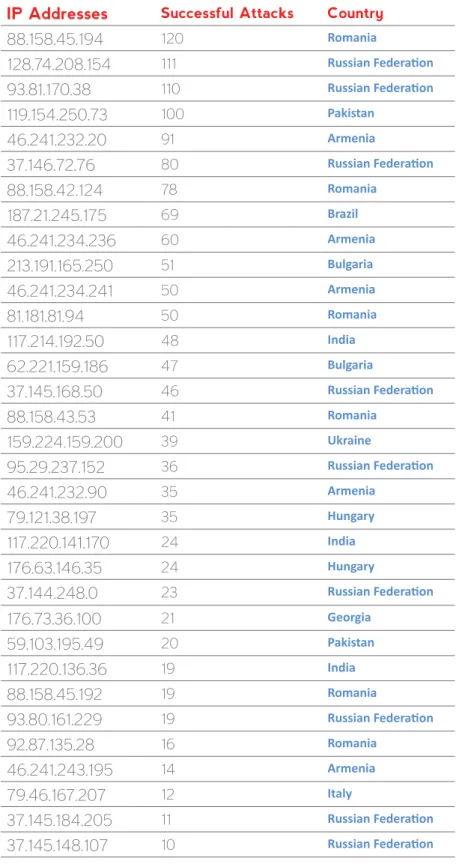
Table 3, provides the list of IP addresses that initiated minimum of 10 malware based attacks on Pakistan cyberspace. It is advised to block these IP addresses on your gateways. Please contact us if you would like to have full list of suspicious IP addresses.
IP Addresses Successful Attacks Country 88.158.45.194 120 Romania 128.74.208.154 111 Russian Federation 93.81.170.38 110 Russian Federation 119.154.250.73 100 Pakistan 46.241.232.20 91 Armenia 37.146.72.76 80 Russian Federation 88.158.42.124 78 Romania 187.21.245.175 69 Brazil 46.241.234.236 60 Armenia 213.191.165.250 51 Bulgaria 46.241.234.241 50 Armenia 81.181.81.94 50 Romania 117.214.192.50 48 India 62.221.159.186 47 Bulgaria 37.145.168.50 46 Russian Federation 88.158.43.53 41 Romania 159.224.159.200 39 Ukraine 95.29.237.152 36 Russian Federation 46.241.232.90 35 Armenia 79.121.38.197 35 Hungary 117.220.141.170 24 India 176.63.146.35 24 Hungary 37.144.248.0 23 Russian Federation 176.73.36.100 21 Georgia 59.103.195.49 20 Pakistan 117.220.136.36 19 India 88.158.45.192 19 Romania 93.80.161.229 19 Russian Federation 92.87.135.28 16 Romania 46.241.243.195 14 Armenia 79.46.167.207 12 Italy 37.145.184.205 11 Russian Federation 37.145.148.107 10 Russian Federation
Top 10 Vulnerabilities
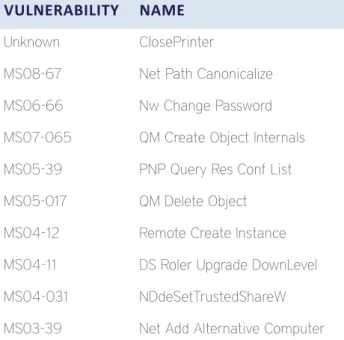
Below is the list and details of vulnerabilities that were exploited the most for malware based injection. It is strongly recommended to fully patch all of the known vulnerabilities related to OS and third-party programs installed in your network. You can contact us to perform security assessment of your IT infrastructure for any potential loopholes and vulnerabilities.VUlneRABIlIty nAme
Unknown ClosePrinter
MS08-67 Net Path Canonicalize
MS06-66 Nw Change Password
MS07-065 QM Create Object Internals
MS05-39 PNP Query Res Conf List
MS05-017 QM Delete Object
MS04-12 Remote Create Instance
MS04-11 DS Roler Upgrade DownLevel
MS04-031 NDdeSetTrustedShareW
MS03-39 Net Add Alternative Computer
MS08-67
Vulnerability in Server service that could allow remote code execution.
http://support.microsoft.com/kb/958644
MS06-66
Vulnerabilities in Client Service for NetWare Could Allow Re-mote Code Execution.
https://technet.microsoft.com/en-us/library/security/ms06-066. aspx
MS05-39
Vulnerability in Plug and Play Could Allow Remote Code Ex-ecution and Elevation of Privilege.
https://technet.microsoft.com/en-us/library/security/ms05-039. aspx
MS05-017
Vulnerability in Message Queuing Could Allow Code Execu-tion.
https://technet.microsoft.com/en-us/library/security/ms05-017. aspx
MS04-12
Cumulative Update for Microsoft RPC/DCOM.
https://technet.microsoft.com/en-us/library/security/ms05-017. aspx
MS04-11
Security Update for Microsoft Windows.
https://technet.microsoft.com/en-us/library/security/ms04-011. aspx
MS08-67
Vulnerability in Server service that could allow remote code execution.
http://support.microsoft.com/kb/958644
MS04-031
Vulnerability in NetDDE Could Allow Remote Code Execution. https://technet.microsoft.com/en-us/library/security/ms04-031. aspx
MS03-39
Buffer Overrun In RPCSS Service Could Allow Code Execution. https://technet.microsoft.com/en-us/library/security/ms04-011. aspx
MS07-065
Vulnerability in Message Queuing Could Allow Remote Code Execution.
https://technet.microsoft.com/en-us/library/security/ms07-065. aspx
Top Few Detected Malwares
Table 5 gives the list of most malwares that have been detected in Pakistan cyberspace. The naming convention used for
these malwares is based on Kaspersky detection. You can find the same malware with different name which are given
to them by other antivirus engines.
Name Percent Net-Worm.Win32.Kido.ih 94.12% Backdoor.Win32.Rbot.bni 2.28% Net-Worm.Win32.Allaple.e 1.20% Net-Worm.Win32.Kido.kj 1.08% Trojan-Downloader.Win32.Kido.bu <1% Trojan-Spy.Win32.Small.pex <1% Trojan.Win32.Genome.tusc <1% Backdoor.Win32.Agent.aknp <1% Trojan.Win32.Genome.ahpxd <1%
Table 5 - Top Malwares Detected
Detected Malwares Hashes
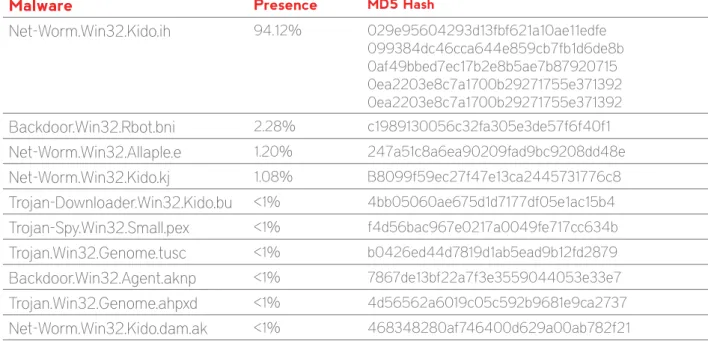
Table 6, provides the list of hashes for the most malwares detected in Pakistan cyberspace. These hashes may be helpful in quickly retrieving the detail of a particular malware from different online sources.
To verify whether your antivirus engine detects the malwares given in Table 6, simply put the hash value in virustotal.com.
Malware Presence MD5 Hash
Net-Worm.Win32.Kido.ih 94.12% 029e95604293d13fbf621a10ae11edfe 099384dc46cca644e859cb7fb1d6de8b 0af49bbed7ec17b2e8b5ae7b87920715 0ea2203e8c7a1700b29271755e371392 0ea2203e8c7a1700b29271755e371392 Backdoor.Win32.Rbot.bni 2.28% c1989130056c32fa305e3de57f6f40f1 Net-Worm.Win32.Allaple.e 1.20% 247a51c8a6ea90209fad9bc9208dd48e Net-Worm.Win32.Kido.kj 1.08% B8099f59ec27f47e13ca2445731776c8 Trojan-Downloader.Win32.Kido.bu <1% 4bb05060ae675d1d7177df05e1ac15b4 Trojan-Spy.Win32.Small.pex <1% f4d56bac967e0217a0049fe717cc634b Trojan.Win32.Genome.tusc <1% b0426ed44d7819d1ab5ead9b12fd2879 Backdoor.Win32.Agent.aknp <1% 7867de13bf22a7f3e3559044053e33e7 Trojan.Win32.Genome.ahpxd <1% 4d56562a6019c05c592b9681e9ca2737 Net-Worm.Win32.Kido.dam.ak <1% 468348280af746400d629a00ab782f21
Following tables show the list of IP addresses and domain names that are found to be malicious and were communicating with infected machines
IP Addresses Country 221.8.69.25 China 204.27.59.22 India 195.22.26.231 Portugal 195.223.0.0 Italy 212.184.0.0 Germany 149.20.56.32 United States 149.20.56.33 United States 149.20.56.34 United States 221.8.69.25 China 54.235.146.190 United States 54.235.146.225 United States 216.146.38.70 United States 216.146.39.70 United States 216.146.43.70 United States 91.198.22.70 United Kingdom 128.30.52.37 United States 204.95.99.86 United States Table 7 - CnC IP Addresses Domains xqpjtkqid.biz yeigidwnrda.ws zwvnfggq.ws smcxq.biz abyoqc.cn ztcabv.cn gwjewwqgig.cn pdcpbbkit.cn xiammogc.cn checkip.dyndns.com xdz.no-ip.org Table 8 - CnC Domains
Table 9, below, shows the list of protocols which were found being exploited for most number of attacks.
PRotoCol exPloItAtIonS SMB 87.48% SIP 4.94% MSSQL 3.85% MYSQL 1.55% HTTP 1.24% EPMAP <1% MIRROR <1% RSH <1%
SMB: The Server Message Block, operates as an appli-cation-layer network protocol mainly used for providing
shared access to files, printers, serial ports, and miscel -laneous communications between nodes on a network.
The Hypertext Transfer Protocol (HTTP) is an applica-tion protocol for distributed, collaborative, hypermedia information systems. HTTP is the foundation of data communication for the World Wide Web. Hypertext is structured text that uses logical links (hyperlinks) be-tween nodes containing text.
RSH: The remote shell (rsh) is a command line comput-er program that executes shell commands as anothcomput-er user, and on another computer across a computer net-work.
Microsoft EPMAP (End Point Mapper), also known as DCE/RPC Locator service, used to remotely manage services including DHCP server, DNS server and WINS. Also used by DCOM.
Table 9 - Attacked Protocols
MSSQL: Tabular Data Stream protocol which is used by Microsoft SQL Server. It listens to tcp/1433 and al-lows clients to login. It can decode queries run on the database.
Mirror: (Managing Isolation in Replicated Real time Ob-ject Repositories), a concurrency control protocol
spe-cifically designed for firm-deadline application operat -ing on replicated real-time databases.
• Connectors (Connector/C, Connector/J, and so forth)
• MySQL Proxy
• Communication between master and slave
replica-SIP: The Session Initiation Protocol is a communications protocol for signaling and controlling multimedia com-munication sessions. The most common applications of SIP are in Internet telephony for voice and video calls.
SIP
Attacks
What is SIP
The Session Initiation Protocol (SIP) is a communication protocol for signaling and controlling
multimedia communication sessions. The most common applications of SIP are in Internet telephony
for voice and video calls, as well as instant messaging using Internet Protocol (IP) networks.
SIP Attacks division
Most SIP attacks can be divided into two groups. First represents various types of a PBX scanning
and probing. Attacker send OPTION message and wait for an answer or simply try to place a call
with immediate cancellation (It means INVITE message followed by CANCEL message). The second
group represents flood attacks using REGISTER message. REGISTER message is used by a user
agent to register to the registrar (SIP Server). An attacker sends continuous REGISTER messages to
the SIP Server in order to downgrade the Server performance and ultimately making it inaccessible
for authorized users.
Register flooding attack
Application layer attack on the Session Initiation Protocol (SIP) is used in VoIP services, targeted
at causing denial of service to SIP servers. A SIP register flood consists of sending a high volume
of SIP register packets to SIP servers, therefore exhausting their bandwidth and resources. 96%
messages type were REGISTER based in our sensors.
SIP Message No. of Distinct Connections Total Messages
Register 3862 73448
Table 10 - SIP REGISTER Message
Malicious IP Total 85.25.160.106 42037 212.129.61.222 9909 188.138.26.190 18088 195.154.39.5 3057 212.83.137.238 211
Web
Attacks
As websites and web based applications are rapidly growing so are the threats. Complex business
applications are now being delivered over the web (HTTP) and paving way for attackers to exploit
any kind of vulnerability.
The following section presents important data relevant to the web attacks faced by Pakistan
cyberspace.
The countries hosting IP Addresses performing the most attacks are shown in Figure 9:
Top Few Countries With
Most Web Attacks
IP Addresses Attacks % Countries
66.74.17.157 21.25% United States 176.99.122.190 17.70% Ukraine 176.10.99.200 13.21% Switzerland 212.83.167.175 10.45% France 118.138.9.49 10.33% Germany 176.10.99.201 9.12% Switzerland 18.239.0.155 7.95% United States 176.126.252.12 5.82% Romania 69.197.148.26 2.18% United States 109.163.234.4 1.99% Romania
Table 12 - IP Addresses Conducting Web Based Attacks Figure 9 - Countries with Web Based Attacks
Following is the list of IP addresses which are found to be launching highest number of Web attacks. It is recommended to block these IP addresses to secure your system from such attacks.
Top Few IP Addresses
-Most Web Attacks
Figure 10 - Web Based Attacks
Among the type of attacks that we observed, SQL injection was seen the most in Pakistan cyberspace.
Top Few
Brute-Force
Attacks
A brute-force attack is the simplest method to gain access to an application or operating system by applying different credentials. In brute-force attack, an attacker tries different but exhaustive combinations of usernames and passwords, over and over again, until he is successfully logged-in. The following section presents the data relevant to brute-force activities performed on SSH protocol in Pakistan cyberspace.
Below table lists the most user attempts seen in Pakistan for SSH. The root username was tried the most number of times. It is strongly recommended to avoid such user names or use complex user names or two factor authentications.
Most Commonly
Used Usernames
Usernameroot Attempts119497ubnt 251 admin 113 guest 28 test 26 support 23 tester 14 testing 14 user 12
Table 13 - Most Usernames Used
Below table lists the most attempted passwords. The admin password was tried the most number of times. It is strongly recommended to avoid these types of passwords.
Most Commonly
Used Passwords
PasswordAttempts admin 88 root 82 123456 70 ubnt 67 password 62 1qaz2wsx 57 passw0rd 29 1q2w3e4r 29 !qaz@wsx 28 qwerty 25 abc123 25
Below table lists the IP addresses with origin that have carried out maximum SSH attacks in Pakistan cyberspace. It is strongly recommended to block these IP address on gateway level.
Top few IP Addresses
Conducting SSH Attacks
IP Address Attempts Country
58.218.199.49 1538 China 61.160.213.190 1302 China 58.218.204.245 1241 China 58.218.213.254 1175 China 221.229.166.28 1157 China 117.21.174.111 1150 China 58.218.204.226 1149 China 221.229.166.27 1138 China 58.218.204.248 1087 China 58.218.199.195 1040 China
Table 15 - IP Addresses Conducting SSH Attacks
Below is the list of tools that were used to gain access on SSH in Pakistan cyberspace.
Mostly Used Tools For
SSH Based Attacks
ToolsSSH-2.0-PUTTY Connections40138SSH-2.0-libssh2_1.4.3 1962 SSH-2.0-libssh2_1.4.1 620 SSH-2.0-JSCH-0.1.51 90 SSH-2.0-libssh2_1.5.0 72 SSH-2.0-PuTTY_Release_0.63 34 SSH-2.0-Granados-1.0 24 SSH-2.0-PuTTY_Local:_ May_14_2009_21:12:18 20 SSH-2.0-libssh2_1.4.2 12
Figure 1 - Percentage of events by source countries
4
Figure 2 - Attacks Originating from IP Addresses Hosted in China4
Figure 3 - Attacks Originating from IP Addresses Hosted in Romania5
Figure 4 - Attacks Originating from IP Addresses Hosted in Brazil5
Figure 5 - Country Based Connection Distribution
6
Figure 6 - Country Unique IP Distribution
7
Figure 7 - IP Based Connection Distribution
7
Figure 8 - IP Address Based Distribution
8
Figure 9 - Countries with Web Based Attacks
16
Figure 10 - Web Based Attacks
17
list of tables
Table 1 - IP Address Based Connection Distribution
6
Table 2 - IP Address Based Distribution
7
Table 3 - IP Based Distribution – 10 Attacks
8
Table 4 - Top 10 Vulnerabilities
10
Table 5 - Top Malwares Detected
12
Table 6 - Detected Malware Hashes
12
Table 7 - CnC IP Addresses
13
Table 8 - CnC Domains
13
Table 9 - Attacked Protocols
14
Table 10 - SIP REGISTER Message
15
Table 11 - SIP – Malicious IP Addresses
15
Table 12 - IP Addresses Conducting Web Based Attacks
16
Table 13 - Most Usernames Used
18
Table 14 - Most Passwords Used
18
Table 15 - IP Addresses Doing SSH Attacks
19
About
TRIAM
With almost a decade of experience, expertise and leadership in the information security
market, Trillium Information Security Systems (Pvt) Ltd. has launched Pakistan’s first
and only focused Managed Security Service Provider brand – TRIAM.
TRIAM’s portfolio of information security services is backed by the industry’s leading minds. Our team has an accumulated experience of more than 150 years of delivering successful information security projects to leading enterprises from all industry verticals of Pakistan, and the region. In addition to our industry experience, TRIAM researchers have published over 45 research papers – thereby enabling TRIAM to explore/study/understand niche areas of the information security domain.
TRIAM is hence launched as the one of the regions most skilled and experienced information security service provider – delivering services to customers that are backed by world leading threat intelligence.
TRIAM Service Portfolio
• Security monitoring
Stored Data Security Analytics Real-Time Data Security Analytics
• Digital Forensics & Incident Response Services
malware Analysis
Digital Forensics & Investigation Incident Handling & Reporting
• Security Assessment Services
Application Security Assessment
Infrastructure Security Assessment
• threat Intelligence Services
threat Feeds Botnet tracking
About
Contributers
This research has been conducted by Trillium Information Security Systems(TISS) in collaboration with Applied Security Engineering Research Group at the COMSATS Institute of Information Technology.
We would like to thank the team members of the TRIAM Threat Intelligence Team and the TISS OPSEC Team for their attention and contribution to the publication of this report.
For more
Information
To learn more about Trillium Information Security Systems and its brand TRIAM, please visit:
infosecurity.com.pk triam.com.pk