1 1
Introduction to
Real-Time Databases
郭大維
郭大維
教授
教授
ktw@cs
ktw@cs
ie
ie
.
.
nt
nt
u.edu.tw
u.edu.tw
嵌入式系統
嵌入式系統
暨無線網路
暨無線網路
實驗室
實驗室
(Embedded Systems and Wireless Networking Laboratory)
(Embedded Systems and Wireless Networking Laboratory)
國立臺灣大學資訊工程學系
國立臺灣大學資訊工程學系
Reading:
Kam-yiu Lam and Tei-Wei Kuo, “Real-Time Database Systems: Architecture and Techniques”, Kluwer Academic Publishers, 2000 Krishna and Kang, “Real-TimeSystems,” McGRAW-HILL, 1997.
2
2
Introduction
An Informal Definition of Real-Time Databases:
A real-time database system is a database
system in which a timely response to a user
request is needed.
Types of Real-Time Database Systems:
•
Hard real-time database systems, e.g., safety-critical
system such as an early warning system, etc.
•
Soft real-time database systems, e.g., banking system,
airline reservation system, digital library, stock market
system, etc.
•
Mixed real-time database systems, e.g., air traffic
3
3 @ all rights preserved for Tei-Wei Kuo, National Taiwan University
Introduction
Introduction
Types of Real
Types of Real
-
-
Time Transactions
Time Transactions
•
•
Hard real
Hard real
-
-
time transactions
time transactions
–
–
No deadline violation
No deadline violation
•
•
Soft real
Soft real
-
-
time transactions
time transactions
–
–
Low miss ratio or
Low miss ratio or
avg
avg
/worst
/worst
-
-
case response time
case response time
•
•
Firm real
Firm real
-
-
time transactions
time transactions
–
–
No value after deadlines expire.
No value after deadlines expire.
value
deadline
deadline
value
deadline
value
4 4Introduction
Introduction
Design Issues
Design Issues
•
•
Real
Real
-
-
Time Concurrency Control
Time Concurrency Control
–
–
Optimistic
Optimistic
vs
vs
Conservative CC
Conservative CC
–
–
Index
Index
•
•
Run
Run
-
-
Time System Management
Time System Management
–
–
Recovery
Recovery
–
–
Buffer Management
Buffer Management
–
–
Disk Scheduling
Disk Scheduling
•
•
Distributed RTDBMS
Distributed RTDBMS
–
–
Data Replication
Data Replication
–
–
Commit Processing
Commit Processing
–
–
Mobile RTDBMS
Mobile RTDBMS
•
5
5 @ all rights preserved for Tei-Wei Kuo, National Taiwan University
Introduction to Real-Time Database
Checklist
⊕
What should we really know about the design issues of
real-time databases?
⊕
What is known about concurrency control of real-time
data access?
⊕
What is known about real-time recovery?
⊕
Why is it so hard to have response-time predictability?
⊕
What is main-memory database? Is it useful to RTDB?
⊗
What is known about real-time query optimization?
⊗
What is known about availability issues, real-time file
systems, and disk management?
6
6
Introduction to Real-Time Database
Time
Model and Design
(Son, Lin, Singhal, Mok, Kuo, Dayal,Ramaritham, Stankovic,since early 1980)
Weak Correctness Criteria
(Mok, Kuo,
Pu,
Ramaritham, Lin, etc, since mid 1980)Concurrency Control (CC)
(Son, Ramaritham, Lin, Bestavos, Wolfe, Garcia-Molina, Mok, Kuo, Lam, Zhao,
Sha, etc, since early 1980) CC Based on Simulation . Complex CC . CC Based on Application Semantics . CC of Mixed RT Transactions . CC + Recovery .
Recovery and Logging
(Ramaritham,Lam, since 1996)Commercial Database &
Realistic Workloads
(??)
Query Optimization
(Wolfe, etc, since early 1990)
Fault Tolerance &
Availability
(Lin, 1988 & ....)File Structure &
Data Caching
(??)
Active + RTDB
(Son, Mok, Lam, since 1996)
7
7
Introduction to Real-Time Database
Real-Time vs. General Purpose Databases
•
Basic Definitions & ACID Properties
•
Correctness Criteria
•
Consistency Constraints
•
Needs for Response-Time Predictability
•
Main Memory Database for RTDB
8
8
Basic Definitions & ACID Properties
A transaction is a sequence of read and write
operations, i.e., r(x) and w(y).
(transaction instance)
A history/schedule over a set of transactions is
an interleaving of the read and write operations
issued by the transactions , e.g.,
w2(x),r1(x),w2(y),r1(y).
A query transaction consists of only read
operations. (vs update)
A serial schedule is a sequence of operations
which are issued by transactions one by one, e.g.,
w2(x), w2(y), r1(x), r1(y).
9
9 @ all rights preserved for Tei-Wei Kuo, National Taiwan University
Data Access versus Semaphore
Data Access versus Semaphore
Locking
Locking
Typical Schedule
Typical Schedule
•
•
T1 (x=x
T1 (x=x
-
-
100, y=y+100)
100, y=y+100)
T2
T2
r(x
r(x
)
)
w(x
w(x
)
)
r(x
r(x
)
)
r(y
r(y
)
)
r(y
r(y
)
)
w(y
w(y
)
)
10 10Basic Definitions & ACID Properties
In conventional databases, transactions
must satisfy the ACID properties:
•
Atomicity: all or nothing.
•
Consistency: consistent transformation of DB
states.
•
Isolation: invisibility for dirty data. (degrees)
•
Durability: permanent committed updates.
In real-time databases, relaxing ACID
depends on application semantics.
11
11 @ all rights preserved for Tei-Wei Kuo, National Taiwan University
Correctness Criteria
Conventional Criteria:
•
Final-State Serializability ~ NP-hard
–
Generate the same final state as a serial schedule does.
•
View Serializability ~ NP-hard
–
Final-State Serializability, and
–
Corresponding transactions have the same view over the
database.
•
Conflict Serializability ~ Polynomial
–
The order of conflicting operations is the same as that of a
serial schedule.
Criteria for Real-Time Databases:
•
Weak criteria are possible, but their definitions depend on
application semantics.
Reading: C. Papadimitriou, “The theory of Database Concurrency Control,” Computer Science Press, 1986.
12
12
Examples: Serializability
S =
R1(X)W1(X) R2(X)R2(Y)W2(Y) W1(Y)
S is final-state equivalent to S1 =
τ
2
τ
1
S is not view equivalent to S1 because of the transaction
view of
τ
2, which is a dead transaction.
S =
R1(Y) R3(W) R2(Y) W1(Y)W1(X) W2(X)W2(Z) W3(X)
S is view equivalent to S1 =
τ
2
τ
1
τ
3.
S is not conflict equivalent to S1
because of the order of the two dead
W(X)’s of
τ
1 and
τ
2.
τ
τ
1
τ
τ
2
τ
τ
3
X
X
X
Y
13
13 @ all rights preserved for Tei-Wei Kuo, National Taiwan University
Correctness Criteria
- Relaxing...
An Airline Reservation Example
1
•
Rules:
–
Reservation:
•
Reserve a seat.
•
If over 100 seats, assign 5 flight attendants to the flight;
otherwise assign 3 attendants.
–
Cancellation
•
Cancel a seat on the flight.
•
If the number of reservations drops below 85, assign only3
flight attendants to the flight.
–
Hysteresis: The assigned number will not oscillate rapidly.
•
Scenarios:
Starting from 3 attendants from TPE to LA, and LA to AUS,
99 servations on each flight.
– ReserveA(TPE,LA), CancelB(TPE,LA,), CancelB(LA,AUS), ReserveA(LA,AUS)
– TPE-LA: 5 attendants, LA-AUS: 3, An acceptable but non-serializable schedule!
1 H. Garcia-Molina and K. Salem, “Main Memory Database Systems: An Overview,” IEEE Trans. Knowledge and Data Engineering, 4(6):509-516, 1992.
14
14
Consistency Constraints
In conventional databases,
•
Internal Consistency
–
Database satisfies consistency and integrity constraints, e.g.,
x=y.
In real-time databases,
timing properties of data are
important, too!
•
Absolute/External Consistency
–
Data reflect the changings of the external environment.
–
For example, stock index.
•
Relative/Temporal Consistency
–
The ages of two data are within a tolerable length of time.
–
For example, the temperature and the pressure of a boiler read
at time t.
15
15 @ all rights preserved for Tei-Wei Kuo, National Taiwan University
Needs for Response-Time Predictability
Why is it so hard to have response-time
predictability for disk-based or other databases?
•
Blocking and transaction abortings caused by the
requirement to meet the ACID properties.
•
Unpredictability of disk access time and page faults
2
.
•
Data dependency of transaction executions.
However, in many cases, we often only
•
use main memory database, or
•
need worst-case predictability, or
•
use real memory addressing, or
•
best effort in scheduling.
2Only bad for disk-based databases, logging purpose, or virtual memory usage.
16
16
Main Memory Database for RTDB
Why main memory databases?
•
Improve response time.
•
Reduce unpredictability of response time.
–
Critical factors of contentions:
•
transaction duration and lock granularity.
•
Hardware technology improvements.
What is the cost or research beside money?
•
Higher frequency in data backup.
•
Vulnerable to system failures - efficient logging
mechanism, recoverability, and recovery time to
transaction and system failures.
17
17
Introduction to Real-Time Database
Concurrency Control
•
Conservative Concurrency Control
•
Optimistic Concurrency Control
•
Semantics-Based Concurrency Control
•
Concurrency Control for
Mixed Transaction Systems
18
18
Introduction to Real-Time Database
Issues for Real-Time Concurrency Control
(RT-CC)
•
Data consistency and integrity.
•
Urgency of transaction executions.
General Approaches for RT-CC:
•
Integrate real-time techniques, e.g., RM, EDF, and PCP,
and traditional concurrency control protocols, e.g., 2PL,
OCC, RWPCP, Multiversion-CC.
•
Utilize application semantics to improve system
performance.
•
Adopt suitable software architectures such as an
19
19 @ all rights preserved for Tei-Wei Kuo, National Taiwan University
Introduction to Real-Time Database
Classification of RT-CC protocols:
•
Syntactic-based concurrency control
–
Conservative Mechanism
•
Prevention of any serializability violation in advance.
– conservative in resource usages.
•
Significant blocking cost
–
Optimistic Mechanism
•
Three phases for each transaction execution:
– read, validation, write
•
Significant aborting cost
– etc•
Semantics-based concurrency control
–
CC with flexibility in reordering read and write events.
•
Concurrency level vs worst-case blocking time.
–
CC with reduced and simplified CC protocols, e.g., single writer.
•
Such systems which totally satisfy requirements rarely exist.
– etc.20
20
Syntactic-Based Concurrency Control
Pessimistic Concurrency Control
•
Ensure that transactions will not violate serializability
consistency during their executions
•
Q: How to favor high priority transactions, e.g., in the
processing of locking requests?
Optimistic Concurrency Control
•
Any violation of serializability consistency from a
transaction will not be checked until its validation time.
•
Q: How to favor high priority transactions if there exist
21
21 @ all rights preserved for Tei-Wei Kuo, National Taiwan University
Lock-Oriented Concurrency Control
Characteristics
A typical way for pessimistic concurrency control
Prevention of serializability violation by lock
management - possibly lengthy blocking time
An Example Protocol
Two-phase locking + A Priority Assignment
Scheme, such as RM or EDF.
Two-phase locking – growing phase and shrinking
phase
priority inheritance.
22
22
Lock-Based Concurrency Control
Read/Write Priority Ceiling Protocol
(RWPCP)
2-Version RWPCP
23
23 @ all rights preserved for Tei-Wei Kuo, National Taiwan University
Lock-Based Concurrency Control
Read/Write Priority Ceiling Protocol
(RWPCP)
2-Version RWPCP
Aborting versus Blocking
24
24
Read/Write Priority Ceiling Protocol
Ceiling definitions of data object O
i
•
Write Priority Ceiling (WPL
i
) of O
i
•
Absolute Priority Ceiling (APL
i
) of O
i
•
Read/Write Priority Ceiling (RWPL
i
) of O
i
–
WPL
i
or APL
i
Ceiling rule
•
A transaction may lock a data object if its
priority is higher than the highest RWPL
i
of
25
25 @ all rights preserved for Tei-Wei Kuo, National Taiwan University
RWPCP
τ
1
τ
3
τ
2
S1 S2 S1&S2 4 6 8 10 12 14 16 18 2 0 20 22 24 26 28 30 RL(S1) UL(S1) 4 6 8 10 12 14 16 18 2 0 20 22 24 26 28 30 RL(S2) UL(S2) WL(S1) 4 6 8 10 12 14 16 18 2 0 20 22 24 26 28 30 UL(S1) WL(S2) UL(S2)APL1 =
τ
1
WPL1=
τ
2
APL2 =
τ
2
WPL2=
τ
3
26 26Properties of RWPCP
Properties in Uniprocessor Environments
•
Lemma1: No transitive blocking (
τ
L
->
τ
M
->
τ
H
)
•
Theorem 1: One priority inversion per
transaction.
•
Theorem 2 : Deadlock-freeness
•
Theorem 4: Serializable schedules if the
27
27 @ all rights preserved for Tei-Wei Kuo, National Taiwan University
RWPCP in a Multiprocessor Environment
τ1 τ3 τ2 τ4 Processor 1 Processor 2 RL(S1) RL(S2) RL(S3) WL(S1) UL(S3) UL(S1) RL(S1) UL(S1) 4 6 8 10 12 14 16 18 2 4 6 8 10 12 14 16 18 2 UL(S2) UL(S1) S1 S2 S3 4 6 8 10 12 14 16 18 2 2 4 6 8 10 12 14 16 18Example 1 RWPCP Schedule
APL1 =
τ
1
WPL1=
τ
1
APL2 =
τ
2
WPL2= null
APL3 =
τ
2
WPL3= null
28 28An Observation
The number of priority inversion may be
more than one when there are more
29
29 @ all rights preserved for Tei-Wei Kuo, National Taiwan University
Why?
The priority gap between the priority of
τ
2
and the read write priority ceiling of the
data objects locked by
τ
2
How to guarantee single priority inversion
time in a multiprocessor environment ?
Priority of
τ
2
WPL(S2)
Reference: Tei-Wei Kuo and Hsin-Chia Hsih, 2000, "Concurrency Control in a Multiprocessor Real-Time Database System,“ the 12th Euromicro Conference on Real-Time Systems, Stockholm, Sweden, June 2000.
30
30
Lock-Based Concurrency Control
Read/Write Priority Ceiling Protocol
(RWPCP)
2-Version RWPCP (2VPCP)
31
31 @ all rights preserved for Tei-Wei Kuo, National Taiwan University
Two-Version Read/Write Priority
Ceiling Protocol
Objectives:
Reduce the blocking time of higher-priority
transactions
Dynamic Adjustment of Serializability Order
Lock Modes
Working/Consistent Versions
Writes on working versions
Reads from consistent versions
Read/Write/Certify Locks
32
32
Two-Version Read/Write Priority
Ceiling Protocol
Ceiling definitions of data object O
i
•
Write Priority Ceiling (WPL
i
) of O
i
•
Absolute Priority Ceiling (APL
i
) of O
i
•
Read/Write Priority Ceiling (RWPL
i
) of O
i
–
WPL
i
for read/write locks or APL
i
for certify locks
Ceiling rule
•
A transaction may lock a data object if its
priority is higher than the highest RWPL
i
of
33
33 @ all rights preserved for Tei-Wei Kuo, National Taiwan University
Two-Version Read/Write Priority
Ceiling Protocol
•
A compatibility table for 2VPCP:
Requested locks
Lock already set
Read
Write
Certify
Read
Granted
Granted
Blocked
Write
Granted
Blocked Blocked
Certify
Blocked
Blocked Blocked
• Remark:
– More versions?
– Aborting allowed?
34 342VPCP
τ
1
τ
3
τ
2
S1 S2 S1&S2 4 6 8 10 12 14 16 18 2 0 20 22 24 26 28 30 RL(S1) UL(S1) 4 6 8 10 12 14 16 18 2 0 20 22 24 26 28 30 RL(S2) UL(S2) WL(S1) 4 6 8 10 12 14 16 18 2 0 20 22 24 26 28 30 UL(S1) WL(S2) UL(S2)APL1 =
τ
1
WPL1=
τ
2
APL2 =
τ
2
WPL2=
τ
3
35
35 @ all rights preserved for Tei-Wei Kuo, National Taiwan University
Properties of 2VPCP
Properties of 2VPCP
Properties
Properties
•
•
Lemma1: No transitive blocking (
Lemma1: No transitive blocking (
τ
τ
L
L
-
-
>
>
τ
τ
M
M
-
-
>
>
τ
τ
H
H
)
)
•
•
Theorem 1: One priority inversion per
Theorem 1: One priority inversion per
transaction.
transaction.
•
•
Theorem 2 : Deadlock
Theorem 2 : Deadlock
-
-
freeness
freeness
•
•
Theorem 4:
Theorem 4:
Serializable
Serializable
schedules if the two
schedules if the two
-
-phase
phase
-
-
locking scheme (2PL) is followed.
locking scheme (2PL) is followed.
36
36
Simulation Results
Simulation Results
Miss Ratios of All Transactions
37
37 @ all rights preserved for Tei-Wei Kuo, National Taiwan University
Simulation Results
Simulation Results
Miss Ratios of the Top ¼ Priority Transactions
38
38
Lock-Based Concurrency Control
Read/Write Priority Ceiling Protocol
(RWPCP)
2-Version RWPCP (2VPCP)
39
39 @ all rights preserved for Tei-Wei Kuo, National Taiwan University
Basic Aborting Protocol (BAP)
Main Idea:
When a lower priority transaction introduces excessive
blocking to a higher priority transaction, then higher
priority transaction will abort the lower priority
transaction.
Compatible Modules:
•
Priority Ceiling Protocol (PCP)
•
2PL
•
A simple aborting mechanism
Reference: Tei-Wei Kuo, Ming-Chung Liang, and LihChyun Shu, “Abort-Oriented Concurrency Control for Real-Time Databases,” IEEE Transactions on Computers (SCI), Vol. 50, No. 7, July 2001, pp. 660-673.
40
40
BAP Protocol Summary
Transactions are classified as abortable or non-abortable in
an off-line fashion.
Each transaction instance
τ
τ
must acquire a semaphore before
access the corresponding data object.
•
•
Lock granted
Lock granted
: when a transaction instance
: when a transaction instance
τ
τ
attempts to lock a
attempts to lock a
semaphore, it checks whether it
semaphore, it checks whether it
‘
‘
s priority is higher than the
s priority is higher than the
priority
priority
ceiling
ceiling
of all semaphores already locked by other transaction instances
of all semaphores already locked by other transaction instances
.
.
•
•
Blocked
Blocked
: if there exists any non
: if there exists any non
-
-
abortable
abortable
lower priority transaction
lower priority transaction
instance
instance
τ
τ
‘
‘
which locked a semaphore with a priority ceiling no less than
which locked a semaphore with a priority ceiling no less than
the priority of
the priority of
τ
τ
, then
, then
τ
τ
is blocked by
is blocked by
τ
τ
‘
‘
, and
, and
τ
τ
‘
‘
inherits
inherits
the priority of
the priority of
τ
τ
.
.
•
41
41 @ all rights preserved for Tei-Wei Kuo, National Taiwan University
BAP Schedule
(
)
T
H5 11
,
T
M(
5 19
,
)
T
L(
7,22
)
42 42PCP+2PL Schedule
(
)
T
H5 11
,
T
M(
5 19
,
)
T
L(
7,22
)
43
43 @ all rights preserved for Tei-Wei Kuo, National Taiwan University
Properties
Lemma 1
.
BAP prevents deadlocks.
Theorem 1
.
Schedules generated by BAP are logically
correct (based on serializability).
Theorem 3
.
No transaction instance
τ
τ
scheduled by BAP
directly or indirectly inherits a priority level from a
transaction instance which is aborted before
τ
τ
commits or is
aborted.
Theorem 4
.
A transaction instance can experience at most
one time of priority inversion under BAP.
Theorem 5
.
A higher priority transaction instance can abort
at most one lower priority transaction instance under BAP.
44
44
Schedulability Analysis
A-cost
i,j:
maximum direct aborting cost of
τ
τ
j
charged by
τ
τ
i
α
-cost
i,j:
max
(A-cost
i,k
),
where i < k <= j
.
Lemma 2.
The worst-case aborting cost for a request of transaction
τ
τ
jbetween time 0 and time t <= p
j
is at most
Lemma 3.
A transaction
τ
τ
i
scheduled by BAP will always meet its
deadline for all process phases if there exists a pair
such
that
where b
i
and ab
i
are the worst case blocking cost and aborting cost of
transaction
τ
τ
i,
,
(
c
mp
)
p
c
b
ab
mp
j k j j HPCi i i i k⎡
⎢
⎢
⎤
⎥
⎥ + + +
≤
∈∑
(
t
,)
p
i i j HPC i j⎡
⎢
⎢
⎤
⎥
⎥ × −
∈∑
τα
cost
( ,
k m
)
∈
R
iR
k m
k
i m
p
p
i i k=
≤ ≤
=
⎢
⎣
⎢
⎥
⎦
⎥
{( , )
1
,
1 2
, , ...,
}
45
45 @ all rights preserved for Tei-Wei Kuo, National Taiwan University
Schedulability Analysis Procedure
Lemma 3 shows that the maximum blocking time
that transaction
τ
τ
i
can tolerate is
MB
MB
i
i
=
=
Initially all transactions are non-abortable.
•
i=1
•
If i > n then stop
•
If transaction
τ
τ
j
has a priority ceiling no less than
τ
τ
i
and the length of the critical section is larger than
MB
i
,
then
τ
τ
j
becomes abortable, where j > i.
•
i=i+1
max
t
c
t
p
c
ab
t SP
j
j
i
i
j HPC
i i ∈−
∈⎡
⎢
⎢
⎤
⎥
⎥
⎛
⎝
⎜⎜
⎞
⎠
⎟⎟ − −
⎡
⎣
⎢
⎢
⎤
⎦
⎥
⎥
∑
46 46Extensions of BAP
Table-Driven Aborting Protocol (TAP)
•
Give a more fine-grained fashion of aborting
relationship
•
An instance of transaction
τ
τ
i
can abort an
instance of transaction
τ
τ
j
only when AB[i, j] =
yes.
•
The rest of the TAP is the same as BAP.
47
47 @ all rights preserved for Tei-Wei Kuo, National Taiwan University
Extensions of BAP
Dynamic Aborting Protocol (DAP)
•
Run-Time Calculation of Tolerable Blocking Time:
–
The blocking time that an instance of a transaction can
tolerate is estimated dynamically and based on the
current workload instead of the worst case situation.
•
Run-Time Determination of Aborting Relationship:
–
An instance of a higher priority transaction
τ
Hcan abort
an instance of a lower priority transaction
τ
Lat time t
only if (1)
τ
L
blocks
τ
H, (2)
τ
Lis abortable, and (3) the
maximum tolerable blocking time of
τ
His less than the
possible blocking time of
τ
Lat time t.
48
48
DAP:
Approximate Schedulability Test
Theorem 8. A transaction
τ
i
i
scheduled by DAP will
always meet its deadline for all process phases if
The maximum blocking time that transaction
τ
i
i
can
tolerate at time t is approximated as:
where
The rest of the DAP is the same as BAP.
The properties of BAP remain.
(
d
)
p
c
c
b
ab
d
i j j HPC j i i i i i⎡
⎢
⎢
⎢
⎤
⎥
⎥
⎥
×
+
+ +
≤
∈∑
AMB
d
t
d
t
p
c
c
ab t
i i i j j HPC j i i i=
− −
⎡
−
⎢
⎢
⎢
⎤
⎥
⎥
⎥
×
−
−
∈∑
(
)
(
)
( )
ab t
d
t
p
i i i i j HPC i j( )
=
(
⎡
−
,)
⎢
⎢
⎤
⎥
⎥ × −
∈∑
τα
cost
49
49 @ all rights preserved for Tei-Wei Kuo, National Taiwan University
Performance Evaluation
Case Study
•
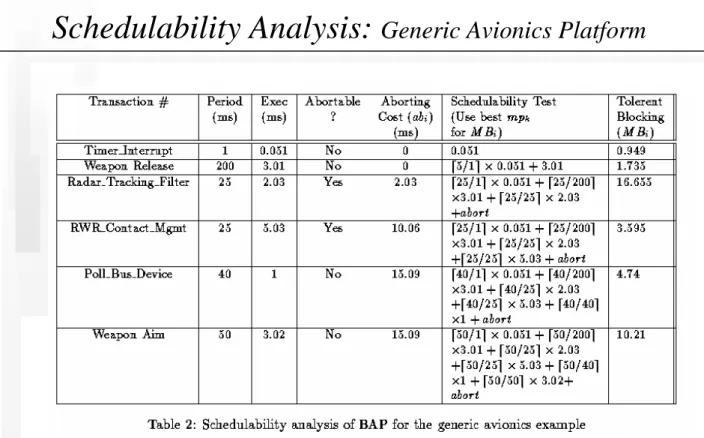
Generic Avionics Platform
–
18 periodic transactions.
–
9 data objects.
•
Olympus AOCS
–
10 periodic transactions.
–
4 sporadic transactions.
–
17 data objects.
Simulation Experiment
•
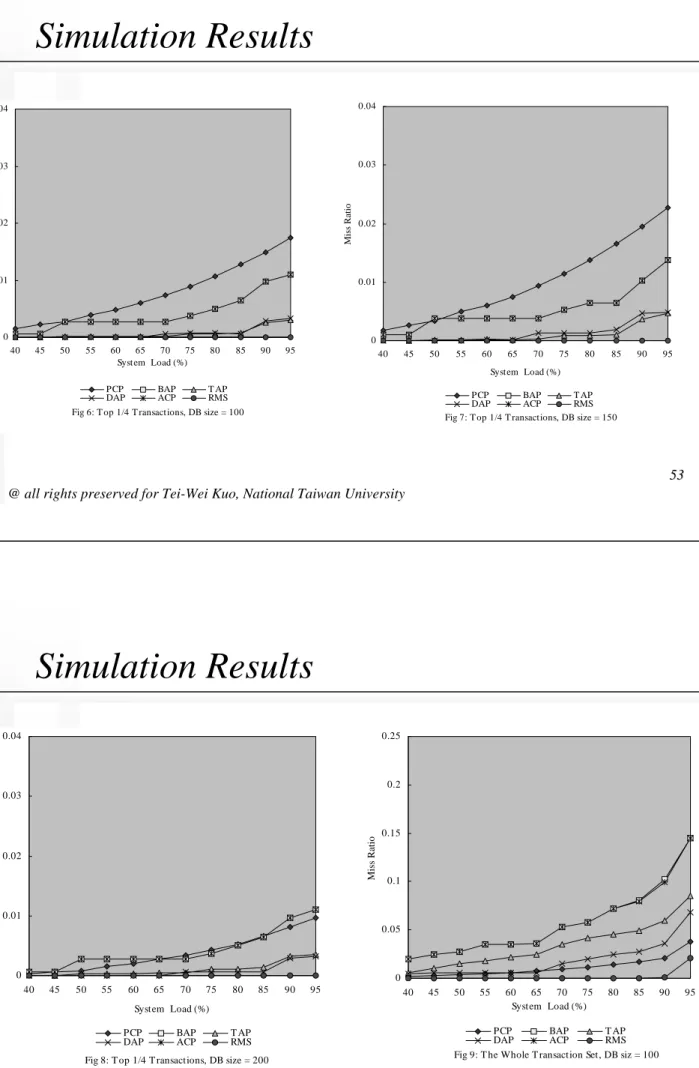
Compare BAP, TAP, and DAP with the well known Priority
Ceiling Protocol (PCP), Rate Monotonic Scheduling
algorithm (RMS), and Abort Ceiling Protocol (ACP).
50
50
51
51 @ all rights preserved for Tei-Wei Kuo, National Taiwan University
Schedulability Analysis:
Generic Avionics Platform
* PCP + 2PL: Only the first two transactions are schedulable.
52
52
Fig 4: T op 1/4 T ransactions, DB size = 25 0 0.01 0.02 0.03 0.04 40 45 50 55 60 65 70 75 80 85 90 95 System Load (%) Miss Ratio PCP BAP T AP DAP ACP RMS
Fig 5: T op 1/4 T ransact ions, DB size = 50 0 0.01 0.02 0.03 0.04 40 45 50 55 60 65 70 75 80 85 90 95 System Load (%) Miss Ratio PCP BAP T AP DAP ACP RMS
Simulation Results
53
53 @ all rights preserved for Tei-Wei Kuo, National Taiwan University
Simulation Results
Fig 6: T op 1/4 T ransact ions, DB size = 100 0 0.01 0.02 0.03 0.04 40 45 50 55 60 65 70 75 80 85 90 95 Syst em Load (%) Miss Ratio PCP BAP T AP DAP ACP RMS
Fig 7: T op 1/4 T ransactions, DB size = 150 0 0.01 0.02 0.03 0.04 40 45 50 55 60 65 70 75 80 85 90 95 System Load (%) Miss Ratio PCP BAP T AP DAP ACP RMS 54 54
Simulation Results
Fig 8: T op 1/4 T ransactions, DB size = 200 0 0.01 0.02 0.03 0.04 40 45 50 55 60 65 70 75 80 85 90 95 System Load (%) Miss Ratio PCP BAP T AP DAP ACP RMS
Fig 9: T he Whole T ransaction Set, DB siz = 100 0 0.05 0.1 0.15 0.2 0.25 40 45 50 55 60 65 70 75 80 85 90 95 System Load (%) Miss Ratio PCP BAP T AP DAP ACP RMS
55
55 @ all rights preserved for Tei-Wei Kuo, National Taiwan University
Optimistic Concurrency Control
Broadcast Commit
Alternation of Serializability
56
56
Real-Time Optimistic Concurrency Control
Example A - A simple optimistic CC
•
Three execution phases: read, validation, write.
•
Use timestamp to validate the serializability of trans.
•
Let the timestamp of A be before that of T.
Serializability consistency is not violated due to T
if
–
A completed its write phase before T starts its read phase,or
–
The read set of A is distinct from the write set of T, and A
finished its write phase before T starts its write phase, or
–
The write set of A is distinct from both the read and write sets
of T.
•
Long transactions are been against because they tend
57
57 @ all rights preserved for Tei-Wei Kuo, National Taiwan University
Real-Time Optimistic Concurrency Control
•
Variations:
–
Broadcast commit protocol:
•
When a transaction commits, it tells all the transactions that
it conflicts with so that they abort.
–
When priority is involved...
•
When T commits at its validation phase, all lower-priority
transactions abort.
•
Any higher priority transactions H in conflict with T...
–
Sacrifice policy - abort T.
–
Wait policy - Wait until H commits. If H commits, abort
T; otherwise, commit T.
–
Wait-X policy - T commits unless more than X% of the
transactions that conflict with it are of a higher priority;
otherwise, T waits… (X=50 seems very good.)
58
58
Real-Time Optimistic Concurrency Control
Example B - Alternation of Serializability
•
Motivation: Reduce abortings by flexibly adjusting serializability order.
•
For example,
R
A(x), R
A(y), R
A(z), R
B(x), R
A(u), W
A(x), W
B(v)
An acceptable order is B, A instead of A, B!!
•
An timestamp-based algorithm:
– The system maintains a valid interval (x,y) for each transaction to assign the transaction a timestamp at its commit time.
– A read timestamp and a write timestamp for each data item which are the latest timestamps of committed transactions that have read and updated it (updates done at commit times).
– Updating of a data item at the commit time of a transaction is effective if the timestamp of the transaction is larger than the write timestamp of the data item; otherwise, the write timestamp is not changed and the update is simply ignored.
•
Example B.1:
– x1(r=40,w=3), x2(r=2,w=60), timestamp(T1)=25, ReadSet(T1)= {x1}, WriteSet(T1)={x1,x2,x3}
– After T1 commits, x1(r=40,w=25), x2(r=2,w=60), x1 is updated, x2 remains the same.
59
59 @ all rights preserved for Tei-Wei Kuo, National Taiwan University
Real-Time Optimistic Concurrency Control
•
Example B.2: modifications of timestamp intervals
Timestamp(T) must be in (33, 49)!
Timestamp(T) must be larger than 90!
•
Rules for assigning timestamps to a transaction T:
–
Determine the validity intervals of data read by T
–
Take the intersection of all these validity intervals. Let it be I
T=(l
T, u
T). If the
interval is empty, then abort T.
–
Let max
Tbe the maximum read timestamp of all of the data items updated by T. If
max
T>= u
Tthen abort T. Otherwise choose a timestamp for T in the interval
(max
T, u
T).
Time
25 33 49 56
T reads X
The write timestamp
of each update.
Time
63 85
potential commit point for T
The read timestamp
of each read.
90Y. Lin and S.H. Son, “Concurrency control in Real-Time Databases by Dynamically Adjustment of Serializability Order,” IEEE Real-Time Systems Symposium, 1990, pp. 104-112.
60
60
Real-Time Optimistic Concurrency Control
The protocol shown in Example B only considers the
transaction that is being validated in the context of the
transactions that have already been committed.
Validation Schemes
1
:
(not exclusively classified)
•
Backward validation:
The validation procedure is performed against recently
committed transactions.
–
Ti: validating transaction, Tj: transactions commit between the time Ti starts
execution and the time at which Ti comes to the validation phase.
–
Cond. 1: The writes of Tj should not affect the read phase of Ti.
–
Abort Ti if necessary.
•
Forward validation:
The validation of a transaction is performed against
concurrently executing transactions.
–
Ti: validating transaction, Tj: transactions which currently executes in their
read phase.
–
Cond. 1: The writes of Ti should not affect the read phase of Tj.
61
61 @ all rights preserved for Tei-Wei Kuo, National Taiwan University
Real-Time Concurrency Control
Other papers for discussion
•
R. Abbott, H. Garcia-Molina, “Scheduling Real-Time
Transactions: A Performance Evaluation,”
Proceedings of the 14th VLDB Conference, 1988.
•
M.-C. Liang, T.-W. Kuo, and L.C. Shu,”BAP: A Class
of Abort-Oriented Protocols Based on the Notion of
Compatibility,” The Third International Workshop on
Real-Time Computing Systems and Applications, 1996.
•
T.-W. Kuo and A.K. Mok, “SSP: a Semantics-Based
Protocol for time Data access,” IEEE 14th
Real-Time Systems Symposium, 1993.
62
62